Larry Has a Nightmare

It is common practice amongst members of the Ho family to take a long siesta after a heavy weekend lunch. Though to be specific, this applies only to those of us in Taiwan. I have, over the years, lost the ability to truly fall asleep at any other time except the night time. For me, napping is really just lying down and closing my eyes, wondering if there is something else I should or could be doing. There always is.

My aunt, uncle, and cousins have no such problem. Among the lucky few equipped with nervous systems immune to stimulants, they can guzzle cups of coffee and tea after any meal and then slide effortlessly into the world’s most delicious and enviable slumber. If, like me, you find yourself tired after a heavy meal but, like me, you find it hard to fall asleep, watching your relatives snore in blissful disregard for the living can be maddening. It is usually around this time – the sixth floor afternoon hush – that I find myself haunting the cool dark hallway, gliding from door to door like an embittered Sandman incapable of infiltrating dreams. Instead I sullenly stalk the halls, a glowering shadow.  
Behind door number one, I see my aunt’s pale white legs wrapped around a body pillow, chubby feet and round toes point towards my uncle’s straight-as-a-board figure. His expression is an enigma – I can’t decide if he is enjoying the nap or does it out of necessity, but in sleep he is all business, hands placed conservatively over his chest with a slight furrow over his brow. Important decisions being made. Next is Karen’s room, where when napping she refuses to stay on her side of the bed. Blankets are twisted around her limbs, hair wrapped around her neck, but she doesn’t seem to mind, so numb is she with sleep. And lastly, there is Larry.

Larry, the crown jewel, kept behind his invariably closed door, encased in the cool darkness required by a man for whom sleeping is sport. Other people sleep. Larry sleeps. Larry slips into a coma, just a few steps away from death. If sleeping were sprinting, Larry would be Usain Bolt. But even Bolt has his preferred racing conditions.  

There is a particular pillow (not too soft. Preferably, and I find this odd, Karen’s pillow); a certain kind of blanket (nothing too scratchy. It irritates his legs), and, contrary to what protective qualities his thick and constantly swollen eyelids might provide, a negligible amount of light (shades completely drawn, just the glowing sliver beneath the door, thanks). There is also room temperature, which he prefers to keep around 25 degrees Celcius, rendering anyone who shares a room with him to long bouts of shivering. But meet all these conditions and he is the world’s most peaceful sleeper. Open that door, second on the right, and be greeted by pitch blackness and instant calm. Hear only the faint, rhythmic purring of a man who has not only entered REM but surpassed it and found a womblike dreamscape you and I will know only twice: before birth and at death…which is also to say, we will never know it.  
When I first arrived in Taipei the AC unit in Larry’s room was broken, which meant he slept for three days on the floor of Karen’s bedroom atop a stack of two thin mattresses and a thick comforter. These conditions were wildly below Larry’s standards, and as a result he tossed and turned each night like a humpback whale who’d just learned that there was no more plankton left in the sea. Princess Larry, we called him during those nights, could not find a comfortable position upon the unforgiving ground, and rather than grin and bear it, he took us down with him, commencing a one-man cacophony of snores. He snored with such ferocity I woke many times during the night, thinking someone had driven a Harley right into the bedroom. 
Except it was just Larry. 
A few days later however, the unit was fixed and the Princess returned to his tower where all his conditions were met. Peace reigned and he slept once again like a lady. 
This afternoon however, it must have been something he ate. We had lunched at an old family haunt, a buffet my grandfather used to like taking us to so he could eat like a ninety-year old bird and tell the rest of us to gorge ourselves. Larry was the first to start and last to stop, and while I’m no doctor, I’m certain that much…content in one’s gastrointestinal tract does not make for restful slumber. 
I walked home in the rain to offset some of chocolate ice cream and by the time I came back, the house was, as expected, silent. They’d all gone to sleep and I thought I might try too, though it was fruitless as always. I began to read instead. An hour later, my aunt, uncle and Karen all rose from the dead and commenced their afternoon activities. Larry’s door stayed closed. The rain continued throughout the afternoon until the sun, despite never having made an official appearance, disappeared altogether and it was night. Finally, from Karen’s room where I sat reading a magazine, I heard Larry’s door open and his wide, hairy feet padding my way. The door swung open. I looked up from a model’s face to see Larry’s, which looked quite haggard. Puffy and splotchy. Despite his heavy slumbering, Larry never looks well-rested, but this afternoon his exhaustion was extreme, as though instead of sleeping he’d been, very quietly, wrestling with an ogre the whole time. 
“You’re finally up,” I said.
“I slept badly,” he said, stomping petulantly to the window and looking out. Did the ogre escape? 
“I’m very sorry,” I said, though I wasn’t. 
“I had a nightmare,” Larry said, then considered, “Nightmares.” 
“Nightmares?” 
“I had a nightmare about having a nightmare. And I couldn’t wake up.” 
I sat up, tossing my magazine aside. What could Larry, who aside from the world-sleeping championship also holds the title for most boring man alive, possibly have a nightmare about? And a nightmare within a nightmare. I was fascinated. 
“Let me get this straight,” I said, “In your nightmare, you were having a nightmare, and you couldn’t wake up.” 
He nodded sullenly, his lips in a princess pout. 
“In your dream you couldn’t wake up.” 
He nodded again. 
“A dream within a dream,” I mused, “That’s some “Inception” stuff right there.” 
Larry cracked a smile, “Yes, and the scariest thing was, once I woke up in my dream, I still couldn’t wake up. I was stuck. It was terrible.” 
“What did you dream about? In the nightmare you had within the nightmare.” 
Larry walked over to the window and looked out, then down, searching for something. He turned to me, his face grave, “Have you ever seen that movie, ‘Silent Hill?'” 
I wanted to shake my head; even his nightmares were lame, but I stopped myself. I empathized. I’d seen the preview for “Silent Hill” which is based on a terrifying videogame I’d played just once at my friend’s house and had decided not to put myself through that kind of stress. The movie wouldn’t be enjoyable for me. Looked too scary. But I never dream about scary movies. Yet for Larry it made sense. When he wasn’t sleeping, he was watching TV or playing video games or doing something else on his phone and laptop. His waking hours were spent in a different kind of coma; it followed that his dreams and nightmares take on the same digital tinge. 
I flipped my computer open and began to write.

“You’ve given me some great content,” I said. 

“Just like that?” Larry asked. 
“Just like that.”
He nodded thoughtfully, though his eyes were getting heavy again. 
“You’re really very good at that,” he said.  
I smiled and began to type, knowing I was nowhere near as good at writing as Larry was at sleeping, but Rome wasn’t built in a day. With that, he opened the door and left for my aunt’s now vacant bed. 

Two Weddings

As I write this, my sister-in-law sits across from me, rubbing her eyes. She’s spent the past three hours staring at the screen of her pink Sony laptop, working on a rather complicated Excel spreadsheet with which she is reviewing the guest list, seating arrangements and task lists.

“This is what she got from her MBA,” my brother jokes.

My brother sits to her left, staring intently at his Mac. He’s using iMovie to create two slide-shows featuring photographs from the past four years of their courtship as well as live footage of their actual wedding last November at the old courthouse in Santa Ana, Orange County. He’s got his headphones on and is replaying the Vietnamese officiant’s speech, which she strangled with heavily accented English. The idea is to add English and Chinese subtitles to the video so people at the reception, to be held this Sunday at noon, can see the actual ceremony.

They are a good team, but both look as though they’d rather be doing something else.

My brother looks up and gives me a pensive stare. I feel he is about to ask me something important, like how to spell “eternity” or solicit my opinion on the slideshow. Instead he says, “I want sashimi.”

My sister in law closes her eyes and lays down across two dining room chairs. I stop typing to stand up and stare at her over the table.

“Cathy? Are you okay?”

She cracks open her left eye, then sighs, “I’m so tired. There’s still so much to do.”

Back in November, my brother and Cathy rushed back to California from Shanghai to see my ailing grandmother before she passed away. They made it in time, meaning Grandma saw them and even got to impart some grandmotherly wisdom regarding love and matrimony. Advice given at the end of one’s life is succinct but also straight to the point. I’m not sure what she said to the engaged couple, but it couldn’t have been more complicated than: “Do you love her? You him? Great. You guys will make it work.”

Her oxygen levels crept up for a few days, plateaued, then plummeted. There is some Chinese superstition regarding weddings and deaths in a family – weddings are happy events, not to be muddled by dark, dirty spirits of death. None of that “Four Weddings and a Funeral” balderdash for the Chinese. If life were a plate of food, we’d be the anal eaters who dislike our mashed potatoes touching the orange chicken.

If someone in the family passes away, then people in the same family who intend to get married must do so in the next thirty days or wait three years. We didn’t understand it, but we often find ourselves respecting and abiding by things we don’t understand, especially death, around which we tread reverentially. My father, the most unreligious man I know, suggested that my brother and Cathy get registered a few days before my grandmother’s funeral. It was along the lines of, “Just get it out of the way now. Planning the reception, all that can come later.”

So they did. We woke early-ish on a Monday morning and got ready as though for a fancy brunch. Cathy had brought a knee length powdery pink lace dress and my brother donned the suit he would wear to my grandmother’s funeral a few days later. I put on a sleeveless grey linen dress, not the brightest of numbers, but it seemed to fit the occasion. It was celebratory without being celebratory. I walked by the bathroom and saw Cathy start her makeup. She had spent the past year growing out her already long hair, which now hung limply down her back. Not wedding hair, but she didn’t know what else to do with it. I surprised myself by offering to curl it, doubting my own hairdressing skills as I said it. But it seemed the sisterly thing to do. We pulled my desk chair into the bathroom and she sat patiently, completely open to the result as I worked around her small frame.

As I wound her hair around the golden barrel and let it fall down into soft ringlets, I felt oddly maternal. I wondered, would I do this for my daughter someday? My sister in law is petite almost to a fault (I look like a mastiff standing next to her prim poodle stature) and there was something childlike about her that morning, sitting sleepily in the witch’s giant chair with her ankles crossed and hands folded in her lap, waiting for her hair to set. Her hair was long but there wasn’t very much of it and I was done in less than fifteen minutes. I finished up with a sample bottle of hairspray still unopened (my signature look being the matronly low bun), and told her to look. She was happy with the result and for a few minutes, turned her hair to and fro to feel the locks bounce. I was surprised neither of us sported burn marks.

Her hair done, all that was left was her makeup, which she applied swiftly, and a few minutes later we were ready to go. My brother was getting married. My father grabbed his camera, I mine, and we split into two separate cars. My brother, Cathy and mom drove ahead to the courthouse. My father, my cousin and I stopped at Ralph’s to pick up a bouquet. A bride must have flowers and there was, perfectly, just one dozen baby pink roses left. We hoped the florist would cut off a few inches of the stem, but she was too busy and absentmindedly gave us an interminable length of ribbon instead to wrap it with. Kathryn and I wrapped it in the car – it was a far cry from the pristine professional bouquets I see in bridal magazines, but there was a simple, happy elegance to it.

The old Santa Ana Courthouse was also simple and happily elegant. A sprawling “romanesque revival” building erected in 1901, it seemed to glow that morning under the warm California sun. The hallways, paved in small blue and white tiles and lined along the sides with shiny subway tiles and heavy oak benches, seemed to echo faintly with the hundreds of thousands of pairs of feet that had clicked down these halls together. They came in merely engaged and left married, tied together by an invisible bond administered by whomever happened to be on Marriage Duty that day.

On that Monday, November 5th, it was a wiry Vietnamese woman whom operated by the rule that smiles (from her at least) must be earned. My brother and his fiance were just another happy young couple who knew nothing of marriage’s hardships and trials. No smile for them. Not yet. She stood imperiously behind the counter as my brother filled out the forms, asking my cousin and I to stand as witness, then robotically stamped and filed whatever needed to be stamped and filed.

“Okay,” she said brusquely when the paperwork was done, “Please wait outside in the hall and the officiator will be with you shortly.”

We milled around in the hall, wondering who the officiator would be and how long the ceremony would last when the door we had just come through swung open and the Asian woman walked out, putting on a long black judge’s robe. It was the weirdest thing.

“Follow me,” she said, then opened the door across the way and motioned us inside. It was a small room, half the size of our living room at home, but warmed by the sun streaming in from the windows at the other end. Meant for intimate ceremonies, it could at most hold a party of twenty-five. There was a podium behind which the woman now stood and before her and above the bride and groom, a latticed arch around which was wrapped fake flowers. Some romantic words I’ve since forgotten were painted on the walls, and there was a row of wooden benches along the back wall for any guests you happened to invite. There were so few of us no one sat, but instead crowded as close as we could to the couple without stepping on their toes.

The officiant, suddenly all smiles, read them their vows with strangled but extremely audible English. This part of the job she apparently relished. My brother repeated his in his perfect english and Cathy repeated hers in English that was a little bit worse than the officiant’s. My father moved nonstop snapping photos, blocking my mother’s view at critical moments, and running in and out of the video I was recording like a slow phantom. In less than ten minutes they were married and we posed before the fake flowers for a family photo and it was so short but in the history of all the weddings that I’d ever been to, it was, in its simplicity, one of the finest.

And that’s how it was: the six of us plus the officiant, though if the simplest of weddings were boiled down further to its essence, it could have been simply, very simply, just my brother, Cathy and the officiant. We were glad to be there, just as we will be glad to be at the Chinese ceremony and reception this Sunday, with nearly two-hundred and fifty other guests (a medium-small wedding by Taiwanese standards). But even on Sunday we will be, just as we were that sunny November morning, no more essential to their union than the romantic words painted on the walls.

Mosquito Bites

IMG_0408

I have – and this may not be the medical term for it but it’s a direct translation from what doctors say in Chinese – an allergy-prone composition. Which means my eyes itch and run quite easily, and I’m prone to bouts of rapid-fire sneezing. When it comes to skin, mine reacts badly to the saliva of jerk-off Taiwanese mosquitoes who apparently prefer American-raised blood as my Taiwanese cousin never gets bitten if she walks with me. Continue reading “Mosquito Bites”

A Note on My Father

My father does not fit into a nutshell, and this is not a remark on his physiognomy, (though if that were the case, it would have to be a very large nut, a type not found on this planet).

This morning I woke up later than usual, having stayed out past midnight last night with friends. My father greeted me in the kitchen, where upon the countertops were lying various half-fruits, freshly cut. I smelled pineapple and a hint of peach. A small huddle of kiwis balanced near the counter’s edge. In the middle of it all were two gorgeous glasses of freshly blended fruit smoothies, one of which he handed to me.

“I put apples and peaches in it today,” he said. I noticed a spray of grey hair fanning out from the back of his head, styled from last night’s sleep. I took the smoothie, silently acknowledging that it was Father’s Day and that the smoothie hand-off should have happened the other way around. 
“Happy Father’s Day,” I said. 
“Oh,” he replied, and shrugged, pointing to the other glass, “That’s for Amy.” He said. My friend was still sleeping, having stayed over to avoid driving home buzzed. 
“Great,” I said, and mentioned that my friends had come over last night before we headed out, “I gave them some of your Johnny Walker Blue Label to drink. They like whiskey. I hope that’s okay.” 
He nodded, slurping from his own smoothie, “Of course it’s okay,” he said, “Did you guys finish the bottle? I have a few more I can bring out.” 
Of course we didn’t finish the bottle, there was still plenty left but it settled me to know that even if we had and left the house in a drunken mess, my dad wouldn’t judge us, or me. 
My mother likes to lament that my father is not so romantic. She likes to travel, he likes to watch travel documentaries. She doesn’t mind trying new foods. My father rotates his meals out between Sam Woo, Lucille’s Smokehouse BBQ, and Ma’s Islamic Chinese Cuisine. She can get pretty emotional, over sentimental YouTube Videos. My father says things like, “I understand you’re sad, but why are you crying?” On top of all that, he can be quite callous at times, possessing a strange sense of humor comprised of bad English puns I wish I could relegate to some black hole of language and lofty Chinese ones I don’t understand. He likes bad slapstick too – there’s a terrible show on TV that features really bad accidents in which people are mortally injured. I think it’s called “The 20 Worst Freak Accidents Of the Week,” and from my room, I often hear him roaring with laughter at some poor slob’s demise unfortunately caught on tape.  
“You gotta see this!” he’ll say, if I happen to be walking by, and he’ll excitedly rewind some guy getting run over by a rogue cattle truck or stabbed in the groin by an angry bull at a bullfight. 
“I don’t want to see that stuff, Dad.” 
“But it’s funny!” 
Usually I walk away. 
Despite of these, uh, shortcomings, my mother sums up my father’s essence: he makes her feel safe. My father is a problem solver – he doesn’t believe in complaining or dark moods or other types of unproductive behaviors. (Though if he sits too long in my Prius he’ll complain about the poor ergonomics of its seats because there is usually nothing better to do when he’s riding shotgun in the Prius). 
When I was sixteen and just started driving on freeways, I volunteered to take three friends to the movies. My father’s friend warned me to avoid freeways if I felt uncomfortable and I’d scoffed, saying, “I can handle it.” I got on the wrong freeway, then like the road warrior I am, jumped over the dividing curb to get on the right freeway, and heard a loud crack. Everything seemed fine until the car, a massive Toyota Land Cruiser, started leaning right, and soon there was another crack, a loud clang clang clang followed by louder, faster clangs as I foolishly sped up and it wasn’t until I saw sparks in my right rear-view mirror that I realized something was terribly wrong with my right front wheel and that if I didn’t pull off the freeway soon, the car might become engulfed in flames and I’d be responsible for three deaths on top of my own. 
I made it off the freeway and saw in horror that the right front wheel was no longer there; what remained was a single stubborn scrap of rubber and the badly banged up rim that had ground so viciously upon the asphalt. 
“I think your wheel’s missing,” some smart ass teenager said, skateboarding by. 
Jesus, I thought, my father will be pissed. Not only was I reckless with the car, but I’d endangered my friends. But I was stranded at a Del Taco and I still needed to find a way to get us home. I called my father, who was having dinner at (surprise, surprise), Sam Woo with a rowdy group of friends. I had an accident, I said, and in one breath continued to tell him what happened. I could sense him nodding over the din, perhaps gravely, but someone burst out laughing right next to him and I realized he hadn’t even left the table to take my call. 
“Is everyone alright?” he asked. 
Yes, I said. None of us were hurt. 
“Where were you going?” 
To a movie, I said, but I think we’re going to miss it now. 
“Get your brother to take you guys,” he said, “As long as no one’s hurt, then everything’s fine. Just leave the car there. Your brother and I will deal with it tomorrow.” 
My brother came, equally calm as my father, and raised his eyebrows when he saw where the wheel had been. 
“Damn Betty.” 
“You think dad’ll be mad?” 
My brother gave me a surprised look. Five years older with ten thousand times more patience, he spent more time than I did talking with our father, “Dad doesn’t get mad about stuff like this.” 
Calmly, my brother drove us to the theater and after the movie, picked us up. The next morning, he and my father went to get the car towed and fixed. 
My father came back incredulous, “How did you drive for so long with no wheel?”
“I didn’t know if I could stop on the freeway,” I looked at him. My father is not one to be attached to material things, but I knew he loved the car, which he refused to get rid of despite my constant pointing out its awful gas mileage. 
“You’re not mad?” 
He grew more incredulous, “Why would I get mad? What would that accomplish? Did you still have a good time last night?” 
I nodded, “It was nice of Guh to come pick us up. We still got to see the movie.” 
My father nodded, “Yes, that was nice of your brother. And I had a good time too, because he was able to do that, and because you guys weren’t hurt. It was just the car. If the car breaks, fix the car -” 
But he paused, a horrible thought unfolding, “If it’d been a smaller, lower car, like the mini-Cooper (which was the car I’d wanted at the time) you guys could have gotten seriously hurt.” 
I nodded, “I’m surprised there was no other damage. It’s a good car.” 
My father smiled, “Aren’t you glad I kept the Land Cruiser?”

At the Bank

Grandpa asked me for a favor today. He has a hard time asking for anything, never mind help, and he probably deliberated for the whole time I was there at his house, from 11:30AM until I was getting ready to leave, at 2:50PM in the afternoon.

I’m sitting at the table and reading Joshua Ferris’s And Then We Came to the End, a tragicomedy about work that I wish I’d written, when grandpa turns the TV volume down.

“When are you leaving?” he asks.

I look up, keeping my finger on a funny passage. He’s asked me that before, but only when I told him ahead of time that I had to leave early for an appointment. But he’s already taken his afternoon nap and as far as I know, he doesn’t really have anything else on his agenda aside from my aunt coming over for dinner.

I glance at the clock, “At 3PM?” I say, implying with my upward intonation that departure time is flexible.

He nods, then turns back to the TV. He doesn’t turn the volume back up and I can tell something is on his mind.

“…Do you want me to stay longer?”

He looks at me and speaks slowly, “I was thinking… maybe you could take me to the bank.”

I close the book and give him one of my “Don’t be ridiculous I can’t believe you didn’t tell me sooner of course it’s not a problem,” looks and said, “Sure!”

“It’s not too late?”

“Grandpa, I don’t have anything else to do.”

He gets up and turns the TV off, “Great,” he said, “But will you wait a moment, I have to fill some things out before we go.”

Grandpa is eighty-seven and he walks pretty slowly, even slower since grandma passed away. He used to complain about her being slow, but I think if he now raced with her memory, they’d tie. But he disappears into his room and emerges less than five minutes later, changed into a crisp light pink button down and a different belt. In his hand he holds a yellow slip of paper, a deposit/withdrawal slip. He feels bad, I can tell, about waiting so long to ask me and thus changed with lightning speed.

“You have everything you need?” I ask, gathering my things.

“Just this,” he says, holding up the paper, “I just need to take out some money.”

Grandpa gets less than $800 per month from Social Security, which is about what I spend at Trader Joe’s and various fine dining establishments, movies and on Amazon each month (if my father is reading this, he is crying), but for grandpa, who basically just pays for gas, water and electricity because various family members bring groceries and necessities over or take him out to eat pretty much every day, it’s a king’s ransom. I bought him a bottle of Head and Shoulders about five years ago and last I checked, he’s still using it, along with the razors, soap and detergent my aunts and uncles supply him with, also around five or six years ago. It’s not that he doesn’t shower or shave or launder his clothes regularly, he just doesn’t buy into the amounts the labels advise you to use. And grandpa doesn’t smell bad, so no one really thinks anything of it.

He’s not a hoarder, though grandma was, something she unfortunately passed onto my mother – and if there is such thing as an upside to your partner of sixty-eight years passing away, it’s that you can finally have the empty fridge and cabinets you’ve always wanted. He hates clutter and really dislikes when we buy him anything he doesn’t need, which is anything, and he more or less eats like a bird so that goes for foodstuffs too. When grandma was alive, it exasperated him to no end that the fridge was always stocked to the point of exploding – she hoarded things that she made, vegetables that we brought her, meats, fish and frozen buns. Whatever she feared would go bad would be crammed into the freezer and it was a common occurrence to open grandma’s fridge and have something fall on your toes. If she had one of those heavy duty restaurant fridges she probably could have filled it up too, in less than a week.

But now grandpa has an old bachelor’s fridge, filled just with a few bottles of prune juice, a plastic tupperware of pickled radish, a jar of peanut butter (which I recently bought basically for myself, when I visit), eggs, and two jars of homemade hot sauce, which are also slowly but surely being consumed by me, because grandpa doesn’t do spicy. It’s weird, opening up that fridge and being able to see the clear plastic shelving when before, it was a puzzle only grandma could decipher. Before, it was unquestionably “Grandma’s fridge” and now, the stark, barren brightness and unappetizing innards are undeniably, “Grandpa’s.” Though if you ask him, he doesn’t need any of it. He just wants his frozen buns and a good, sweet coffee.

And the occasional trip to the bank, apparently, to get cash that he has very little opportunity to spend except on us, in the form of generous red envelopes for birthdays, babies, weddings, new houses, new jobs, etc., which in our family have all been happening quite often.

“I go to the bank about once a month,” he says as we get into the car. I’ve taken him before, but I guess it occurred to him that he’d like to go today.

It’s a large Chinese bank where basically our entire family has opened accounts, so the tellers, whose kids we grew up with, know grandpa and call him, endearingly, “Leu Bo Bo,” Bo Bo meaning someone who’s older than your dad and more familiar than just some random old dude on the street. I drive up to the bank and he clucks at the number of cars in the parking lot.

“So many people today,” he says, but I find a spot pretty close and park.

“Why don’t you stay in the car,” he says, almost apologetically.

“Grandpa, it’s 80 degrees. I’ll just go inside with you.”

“Are you sure? I’ll only be a minute.”

“It’s 80 degrees.”

I hold the door open for him and he waves and smiles at me like I’m a security guard who works the door, then I look behind me and realize he was waving and smiling to the security guard who works the door. There’s a long line, something grandpa didn’t expect and I know he’s feeling worse about “dragging” me to the bank, but honestly, I don’t care and don’t know how to tell him that “Dude, it’s totally fine. I seriously have nothing better to do.

He sighs and we get in line.

The bank is brightly lit, with dark wooden counters for the tellers lining one side and glass offices for the loan officers on the other. There are desks outside the glass offices too, with computer monitors positioned so that the people sitting outside the offices (mostly younger women) could never surf Facebook or read the New York Times because the people in the offices could see pretty much everything going on in the screens.

That sucks, I think. But then there was a steady stream of friendly customers along with a substantial but not overwhelming number of phone calls that come in during the time we are there, and I think, this is a nice work environment. The tellers smile and chat amongst each other, and three out of every four clients seem to know the tellers well.

The tellers work pretty quickly and the line moves forward, but not enough for grandpa.

“Next time, I know not to come on a Monday,” he says, “Everyone does their banking on Mondays.”

“It’s really not bad,” I say, thinking about the Bank of America I use back home that for some reason only has one teller ever. The patrons of this bank is mostly Chinese, who I think are much better at waiting in line than white people. Except Grandpa.

“So many people,” he says again.

I notice that the bank slip he’s holding is a different color from the white ones at the bank.

“Why is yours yellow?”

He laughs and cups his hand over his mouth, a gesture he employs when he’s about to divulge an “embarrassing” secret.

“I took a bunch home with me a long time ago and I still haven’t gone through my stack. They’ve changed the paper to white but I still have to use these yellow ones!”

We share a good chuckle and suddenly, it’s his turn.

“Sorry for the long wait, Mr. Leu,” says the teller, a middle aged man with wire rimmed glasses and a shiny bald head.

“It’s Monday,” Grandpa says, as though he knows how these things are.

“Yes,” the man says, “Mondays.”

I’m not sure if he’s trying to humor grandpa or if Mondays are busy days for banks, or if it’s not a question worth asking, but grandpa is just happy to be helped and less than two minutes later he’s got some bills in hand and is ready to leave, all smiles.

He shuffles towards the door and waves to a teller in the back. I recognize her too, she has a tall son named Andy whom I used to attend Chinese school with. A few months ago Facebook told me he was married and now seeing his mom at the bank, where my parents met her some twenty years ago, makes me think both how much and how little has changed.

“Leu Bo Bo!” she says, “I’m so sorry for the wait. I would have helped you personally but I was stuck with a client.”

Grandpa laughs and waves away her concerns, “You have your work, you have your work,” he says, though I can tell he’s pleased by the treatment he’s getting.

She sees me and smiles, “Good to see you too, Betty. Are you your grandfather’s driver today?”

I smile and nod, “Yes I am. Yes I am.” I hold the door open for grandpa, and motion for him to go through first. Chauffeur, doorman, the whole nine yards.

Grandpa grins sheepishly as he waves goodbye to Andy’s mom. But he’s proud. Everyone else at the bank drove themselves.
Letter from Kaua’i

Hey Guh,

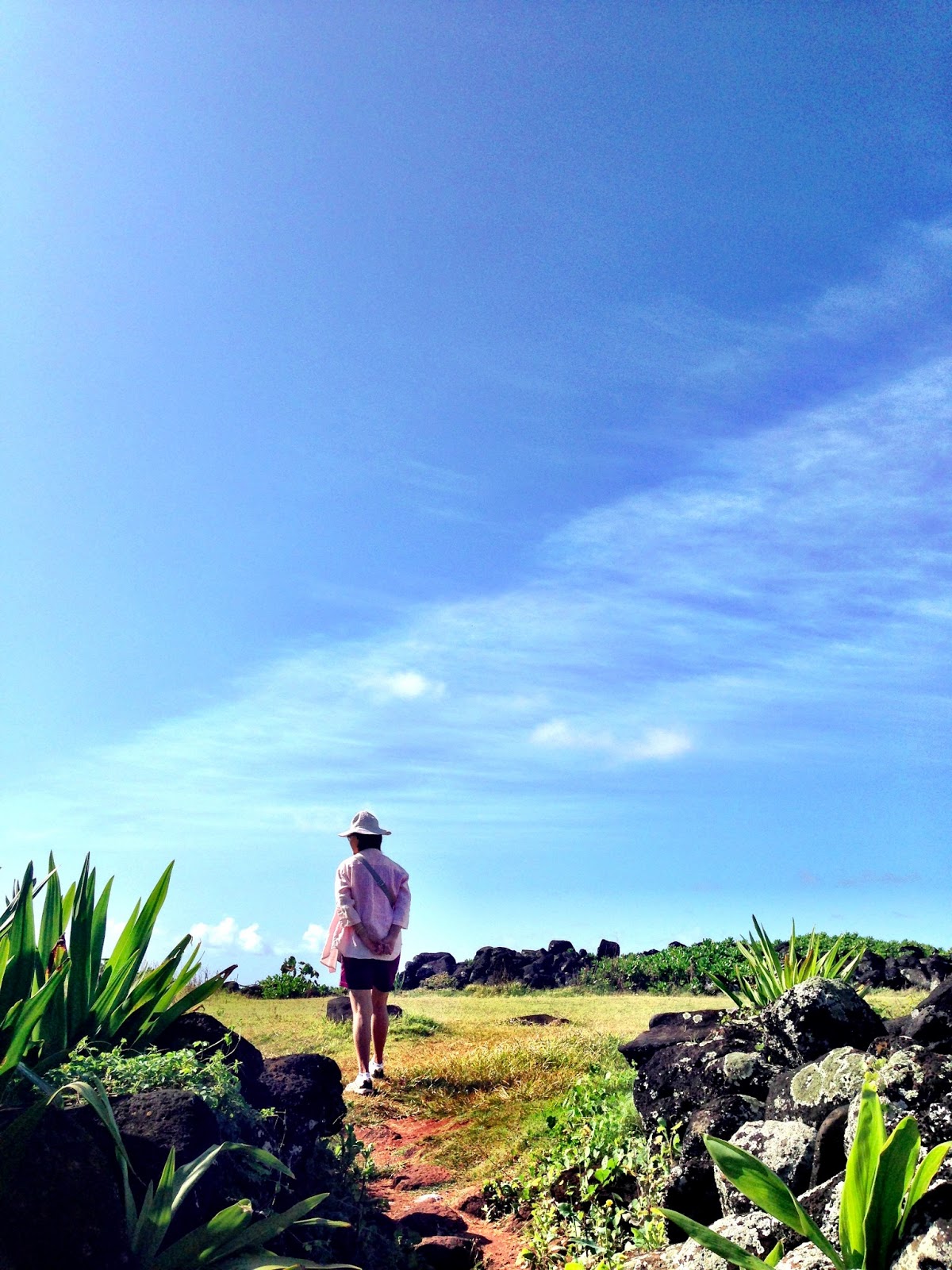
It’s 4:30PM here in Kaua’i and I’ve just come from swimming in the ocean, barely two shades darker than when I arrived. Mom on the other hand, due to some crazy tanning skills, is dark as a panther, even though she’s been wearing a long-sleeved linen shirt, long shorts, a hat, and holding my umbrella as a parasol since we got here.


“I’m just dark,” is her response. She hates it, but then looks down at her brown ashy legs and shrugs, “Oh well. What can I do.” 

She’s napping on the florid Hawaiian print couch in our hotel and I’m writing to you on the balcony, which is supposed to have a “garden view” but really just faces the neighboring resort which is undergoing construction. It’s hard work for these guys, but they get the ocean breeze, an awesome view, and they blast some KIIS FM stuff (so my jam) from a fuzzy radio, but they can only hear it when their drills and hammers aren’t going on. 

If I tilt my chair to the left, I can see the ocean, which is right behind our hotel. It’s a cute place, definitely on the older side, but has separate living room and a full kitchen, which mom likes, a heated pool (though I think that’s unnecessary here) and hammocks hanging from the palm trees. Just a few steps away (God I sound like a brochure) is a nice stretch of beach, too rocky for some people but perfect for me and the other folks who swim with their head above water, that is, half-heartedly, because we’re not into snorkeling or scuba-diving, and who wants all that salt in their eyes? 


Traveling with mom is interesting. I’ve taken trips with just the two of us before, mostly destinations that were driving distance; we went to San Diego before I went to Berkeley and then to Napa while I was up there, but I forgot how much of each trip is just… driving and looking. Mom can walk for days, but she also walks very slowly (you know this) and needs good shoes or else she gets this glum look on her face, as though nothing in the world could make it right. 

The first hike I proposed was just after a rain and the path was too soggy for her. She’d brought these shoes with holes on the bottom, which I told her were perfect for Hawaii and that she shouldn’t wear socks with them but she blamed me, saying that I had told her it wasn’t going to rain much. I told her it was hard to predict the weather, especially in Hawaii. She thought about this and decided to be unreasonable anyway. 

“You said it wouldn’t rain,” she said.  


She was kind of a brat that day, but I got over it.  

So basically we’re in scuba, snorkel, kayak, zip-lining and hiking capital of the USA but we didn’t do any of that, mostly because well, I’m not really into any of that either, but I’m kind of afraid of mom getting really tired or hurting herself. 

This morning we went for a walk along the beach. I told mom to be careful because some of the rocks were slippery. I wanted to walk down near the water and she said she would too but she wouldn’t take off her shoes. I saw some interesting barnacles on a rock closer to the water and wanted her to take a look, thinking, I don’t know what, that maybe mom knew a ton about barnacles – God, barnacles! Of all things to risk your mother’s life for! – and she started towards me so I turned back towards the barnacles and suddenly I heard her cry out. I turned and there she was lying awkwardly between two jagged black rocks and I thought for a millisecond that I’d made her fall to her death because I wanted her to look at some goddamned barnacles.


Her face was twisted up in a grimace and I was frozen there on the beach, not even moved by the waves hitting me in the back of the knees, my mind completely blank when she started laughing. I let out the hugest sigh of relief and rushed over. She nodded towards my camera and said, over the water which seemed to be moving again, “Did you get a picture of that?”

I didn’t (but I definitely thought about it when she started laughing) and asked if she felt anything amiss, bone-wise. She said, “Nope, thank God I have a fat ass.”

So mom is funny (though you knew that too). Funny in that she intends to be funny and also unintentionally. On the plane, she proved to be the most interesting seat mate I’ve had in a while – and I’ve sorted started this thing, writing about these seat mates because I’ve been traveling so much and have sat next to the some interesting people: e.g. Orthodox Jews who own their own printing company (they wanted to hire me onto their sales team), a girl named Leslie who was thinking about following her boyfriend out to California, and most recently, before Hawaii, a middle-aged authoress and HER elderly mother, both of whom were my worst nightmare. I still need to writer an essay about her, but let’s just say she wrote what seems like a terrible book and was telling me how successful she was until Border’s went out of business… I was like, “How come your book wasn’t anywhere else?” and she gave me this really irritated look like I didn’t understand anything about publishing and said, “Well, it’s on Amazon in digital format for $1.99.”

When the sandwich cart came she pulled out her credit card and asked her eighty-year old mother what she wanted and when the old woman told her, she said, “Well, Ma, get out your credit card because you have to pay for it.” I was incredulous, but then remembered that her book was selling for $1.99 and I probably didn’t need to ask her how the sales were if she couldn’t afford to buy her mother a sandwich. Oh man. Knock on wood so that my own writing career will blossom and blossom for decades.

Anyway, Mom though – she couldn’t sleep on the flight over and ended up just counting fat people on the plane, chuckling a bit to herself whenever a fat guy or woman got up and walked around or asked for another beer and soda.

“Look, look, this fatty is getting up to exercise.”

or

“Look, he’s getting another beer. See, Betty, every fatty is fat for a reason.”


I laughed out loud so many times during the flight people trying to sleep around me were probably getting irritated. And it was so funny, to see how childlike mom could be: when the beverage cart came around she asked first for a glass a milk. Milk! And then for a glass of orange juice, two things she never drinks when she’s at home but 40,000 feet in the air it’s totally okay. 

“Milk, please.” “Orange juice, please.” It was bizarre.

And the fruit. Dude, woman eats two to three whole papayas a day, plus bananas and lychees. She was a bit miffed at the entire island of Kaua’i because pineapples aren’t as cheap as she thought. I think she imagined these bounties of fruit falling out of the sky, or just cartloads of fruit outside the hotel for 50 cents a pound, but yeah, the local stuff here is kind of expensive, but mom was like, “Okay, I’ll shell out for papaya.”

But with pineapple she was more reluctant because dad’s not around to cut it into bite-sized triangles.

I get the feeling that she’s just not paying attention. I’ve heard her take a few calls from prospective students and I realize how hard mom and xiao jiu work to keep the Chinese school going, and how much of a headache it all must be, but because she believes in it, she keeps at it. Anyway, these calls tell me that mom is actually really on top of her shit in regards to the things that matter to her, and not that coming to Kaua’i with me doesn’t matter, but she doesn’t have to do anything in terms of planning, because she assumes I’ll be the tour guide and arrange everything, including drive her ass around to all these points which she sometimes doesn’t even get out of the car for, and…well, I do it because it’s in my nature, and it’s fine.


The most hilarious thing: is she is dyslexic for sure, and I think I might have inherited some of that. I get all mixed up about Chinese phrases and it’s the same for her, but in English. You know how she used to always say “May Robinsons” and “California Chicken Pizza” for CPK? Well, there’s a dish here called poke, which is basically sashimi marinated in sea salt, soy sauce, sesame oil and seaweed. Mom really likes it so I ordered it a couple times at various fish markets. She always goes, “Get the Polka Dot?” with a question mark because she knows she’s saying it wrong but can’t be bothered to knock off a few extra letters. I always want to tear my hair out. “Mom, it’s POKE!” pronounced “poh-kay”, I’ll say, and she just laughs, closes her eyes, shakes her head in that way.

“Oh, what are you going to do about me?”

Nothing, really, but buy the poke. But it’s been a good time. We’re going to get some Barbecue now for our last meal in Kaua’i and I gotta run out and pick it up.

Anyway, that’s my little update: telling you things you already know about mom.


love,

Betty 

Laughing Hysterically at Dinner

My birthday dinner with friends was held at The Orange Hill Restaurant, located way up on a hill that over looks Orange County. Stepping inside, my cousin Michelle said, “The last time I came here was ten years ago, for prom.”

My brother and his wife were supposed to have their wedding reception there. My dad and I had rushed around last fall trying to secure the Evening Star Room and adjacent patio and when we’d done so, placed a non-refundable deposit for Sunday, July 7th, a grand time to have a wedding because the ceremony would be held outdoors against the setting sun and afterwards we’d all be ushered into the dining room with panoramic windows of the view. 

Then some things changed. My brother and his wife are now having their reception in Taiwan which left us with a massive question: how do you finagle back the non-refundable deposit? Well, you can’t. But you can host “up to four events,” the restaurant manager told us firmly.

“Have a good time,” my dad said, when I suggested I have a birthday dinner there, “tell your friends to order whatever they want.”

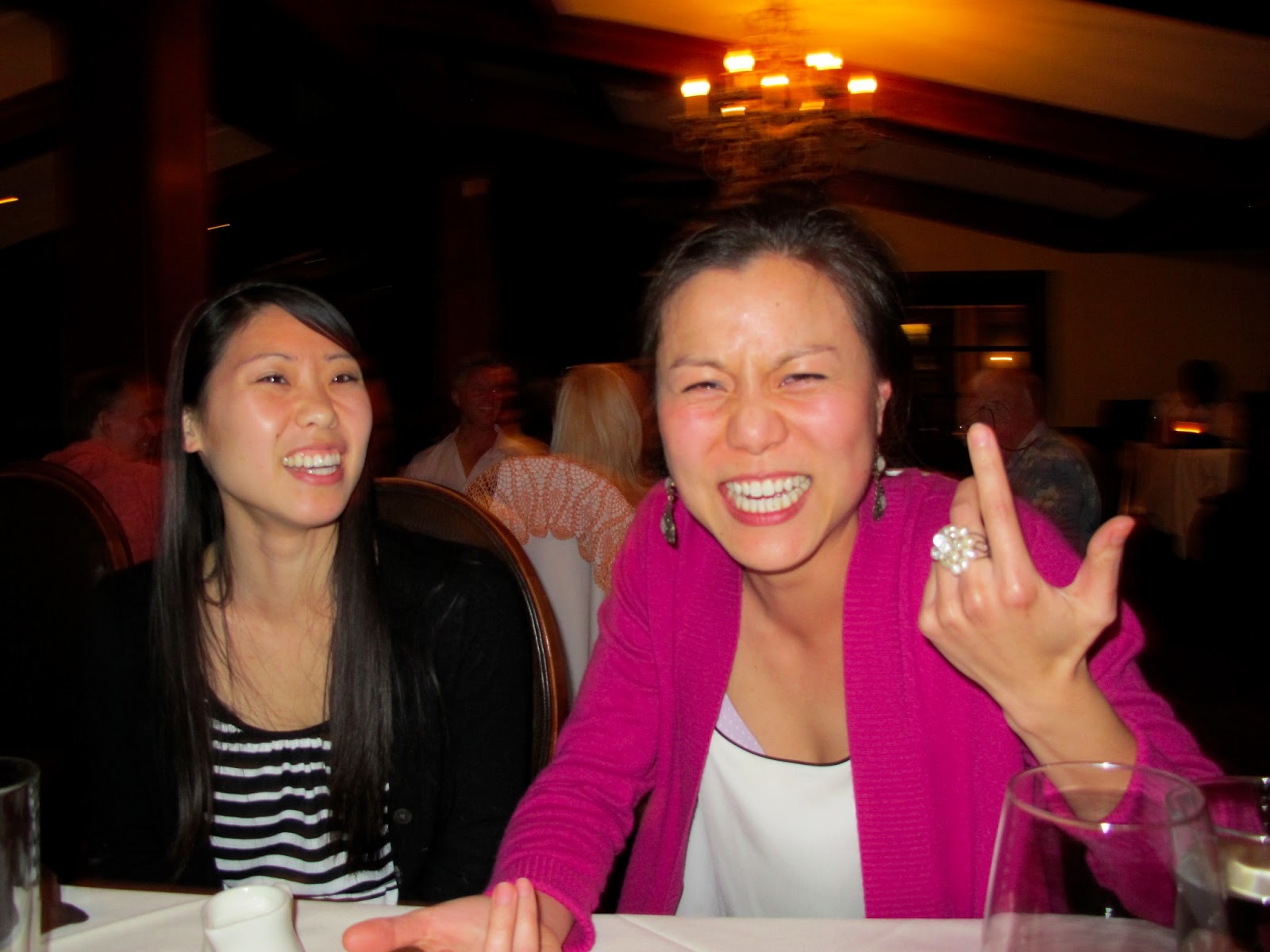
So we did, and I spent most of the night looking like this:

Thanks for this, Charlene. 

Amy was kind enough to put my hair up in a sock bun ten minutes before we left, but from some angles I like I looked a little too kung fu master. It didn’t matter; I always look better in person anyway. I had a good time scaring people at other tables, gentle families who wanted to take their mother somewhere nice with fish on the menu and dim lighting. Except the guy behind me couldn’t tell a story without peppering it with the F word. My poor friends, I hope they had a good time too, though most of the time they were probably thinking, “What is she laughing at?”

Amy: “Betty, you’re scaring me.” Notice the empty plates of dessert. 
Jaime: “I didn’t even say anything.” 

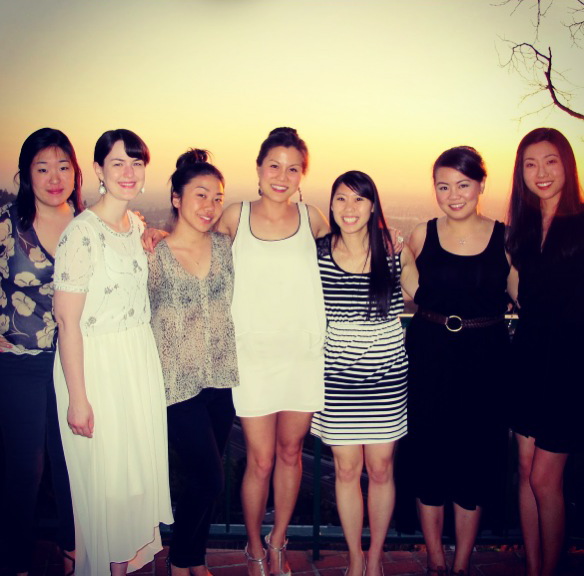
In calmer times, we managed to catch the sunset and pester a kind, patient waiter to take multiple versions of this photo for us.

Twenty-seven with some friends, some cousins, all family. 

Mostly I was laughing because that’s what I do when I’m happy.

Free Bitches

A few days ago I started writing a longish essay about babies which inevitably turned into a meandering musing about age twenty-seven, which I will be in a less than two days’ time. The post had an unintended whiff of complaint, even though as I wrote, my heart was light and I was happily looking forward to my 27th year. I did not post it (which is not to say I won’t post it) not because it wasn’t true – babies DO make me think about growing older – but the thesis of the post, which can be summed up in my cousin Michelle’s turning to me last Saturday night, at the tail end of my nephew’s 100th day dinner when all the young parents with babies had gone home, to say, “Well Betty, we are some free bitches” wasn’t coming across at all. Like a knot in a poorly trained muscle, the mindset of birthday posts I’d written at 25 and 26 was hard to knead away.   
Michelle’s quip made me burst out laughing because it rang true; I just don’t think understood until now, on the brink of 27. Many of my relatives who had not yet left and my mother, sitting across from me, gave me a curious look. No doubt my mother was inwardly thinking, “When will she learn not to laugh so loudly with her molars all on display?” What I should have done was chuckled and said, hiply, “Word, Michelle. Word,” but what’s done was done, like many things. It was a freeing laugh – the kind, if you had been a spy crouched amidst my brain’s debris from the past twenty-seven years or so, that would have shaken up you and the debris. Cleared away some things. I felt lighter for it. 
I looked at Michelle with a thankful smile, though I’m not sure she sensed it, so smug was she in the “freedom” she’d probably always known. We are “free” in the way my married and with child counterparts are not, regardless of gender. My cousin Andrew spent the better part of the evening shaking his head and crossing his arms in a petulant gesture every time someone asked him, “So, when are you going to have your next kid?” while cousins Carol and Daniel, with two babies in tow, raced around the table trying to subdue their eldest, Ethan. 
I want babies, I do! I would be lucky to have children as cute and bubbly and devilish and smart as my nephews and incubating niece. And preferably have them with a smart, handsome man who doesn’t have to love reading or writing but accepts why I do. But I want children even more than I want to be married (“Gasp!” some people say, “A broken family even before it was ever whole!” Oh shush. I’m just saying, if spinsterhood becomes a reality I’d have no problem adopting neglected Chinese babies). 
But, for the first time in my life I feel a strange slowing of life’s refreshing current. A family of my own feels far away not because it seems impossible but because it always has, because of where I am in life. Except now something has switched on inside and the distance between me and said family finally feels comfortable rather than alienating. Those sparky-eyed children standing on the horizon, that sweet gangly boy named Ben and the spitfire girl named Isabel? They’re mine. But I’m a ways yet from greeting them. It’s a good thing they can’t see me, because I haven’t quite perfected a mother’s game face.  
Maybe it’s to do with the upcoming fall, when I’ll retrace my steps with sturdier shoes and sounder mind to the Big Apple and commence a not-so-fancy course of study at a decidedly fancy school, or perhaps the events and sights from this past winter, when I spent two and a half months in Asia, the sprawling continent and womb to places, cities, smells and people I’ve always been in love with and can never be away from for too long. All these things have gotten me thinking and plotting a future that is hazy, but deliciously so. Experience however, all twenty-seven years of it, tells me thinking and plotting are less important than happily living; and for once I’m content to do just that. 

Solitaire

On Wednesday, grandpa turned on the computer.

“I haven’t looked at this machine in a long time,” he said, “This was something your grandma liked to play.”

He was referring to solitaire, a game I used to associate solely with grandma until I started looking down on my way through airports and airplanes and noticed many people playing on their tablets and iPads with trancelike stares. It is an addictive game. In elementary school I thought it complicated; for some reason the numbers on playing cards signalled to me that the game involved math, but one afternoon my brother patiently explained:

“It’s easy,” he said, not really verbally explaining but showing me on the monitor. He moved cards with a simple click and drag of the mouse, “You put things in order. At the end it just sorts itself out.”

I liked the neatness of the game: it fed benign obsessive compulsive tendencies of mine. There was something deliciously militaristic about dragging the cards to their proper place, where they were prettily displayed in alternating colors. It frustrated me when I reached the limit to the number of cards I could pull from the master deck, but that was part of the challenge. What’s next? Could I work with it? Would I be stuck? I especially loved, when everything was squared away, the exhilarating explosion of the conclusion: a seemingly infinite number of cards bouncing insanely out of their decks, the ultimate joke: all that labor to sort things out and then what? Bonkers! Bananas! Now deal again. Now start over.

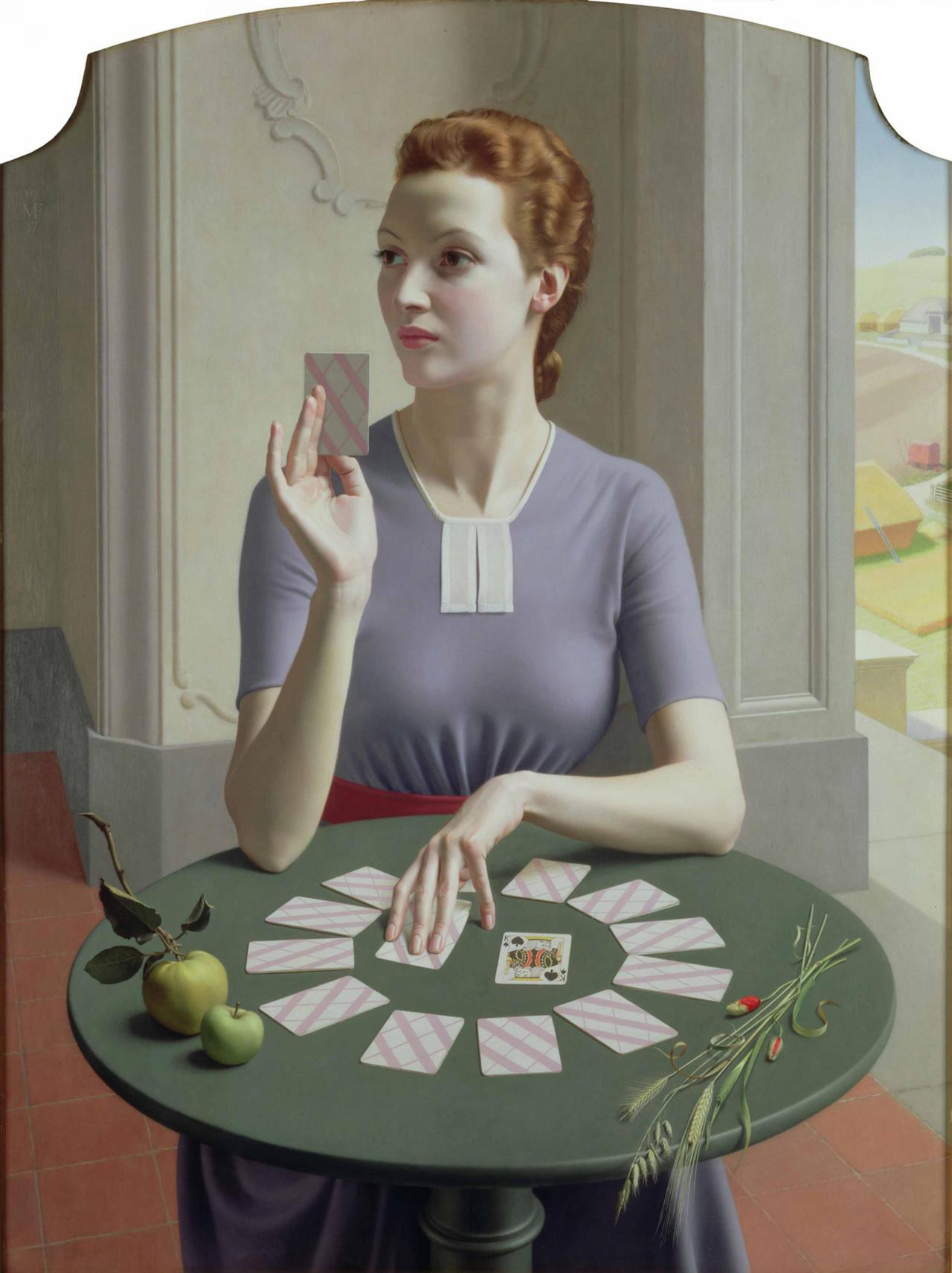
Meredith Frampton A Game of Patience, 1937    Ferens Art Gallery, UK

It may have been over a decade ago now, judging by the looks of the desktop, but someone, perhaps my brother or a cousin, or my uncle who runs a Chinese school and has a hoard of janky computers, set the PC up at my grandparent’s house. The idea was not to “connect” them – my grandparents never had internet – but to install some of their favorite games to help pass the time. Or keep them sharp. I’m not sure which, but both were achieved.

Grandma was an active woman, not that she exercised, but she kept herself busy around the house, in the garden, and in her kitchen. But sometimes when the weather was bad or when she didn’t feel like making buns (most likely her freezer was already full, waiting for hungry grandkids to come and empty it out), she’d set herself down in front of the computer and open solitaire. She played with an admirable concentration that seemed unlikely for someone who played purely out of boredom (I don’t think I ever saw a bored expression play across grandma’s face), and for some reason the image of her, playing solitaire by the sunny window that faced the neighbor’s wall is somehow, in hindsight, a paradoxical picture of elegance. Elegant precisely because it is not. The technical term for this, I cannot recall.

Objectively speaking, there was nothing elegant about my grandmother’s bearing. She was confident, but neither stylish nor poised. She had not exactly aged well. Some of the deepest wrinkles I ever saw were the ones that stretched in all directions across grandmother’s cheek. I can honestly say those wrinkles worry me because I know my skin-type is identical to hers. She gained weight in her old age, due largely to her voracious appetite rather than a slow metabolism (though this did not stop her from pointing out other fat people and shaking her head at them), and her hair, thick, curly and wiry, a Shandong Afro, was kept short in a low-maintenance haircut. On anyone else I would have said, “Butch cut, if there ever was one,” but on Grandma it was the only way her hair could be acceptably styled. A non-style, and in that, utterly her style. The hair stood up stoutly all on its own and grandma, if she was going out somewhere, would simply use an Afro pick to tease it up a bit before stepping out the door.

At home though, she was the epitome of low maintenance. Which is not to say she didn’t have her vanities: she liked having her nails painted and never turned down a bag or blouse or piece of jewelry her kids and grandkids bought her, but compared to the average female, whether Asian or Caucasian, she was, in her dressing and grooming habits, decidedly unfeminine. At least in her old age. She was most comfortable in loose elastic pajama-type pants and roomy collared shirts, which gave her upper body more definition than the soft roundness that was actually underneath. For additional adornment and truly special occasions, she alternated between an old diamond or ruby ring, a black pearl pendant, gifts from my mother, and preferred simple pearl studs in her ears. Around her thick, strong wrist she would wear a thin silver watch with a minuscule band of diamonds around the face. But at home, which is mostly where I saw her, she left those things on her dresser.

So solitaire. I just now recall an old deck of cards sitting on the kitchen table. The smiling cherubic faces of the odd looking angels and mermaids on the backs slowly being rubbed away, white edges stained yellow over the years with a thousand flips and shuffles on tables where countless dumplings were made by grandma’s hands and then consumed by our young mouths. She used to play with these tangible cards and it was only until after the computer was installed that the deck was put away. I never saw it again. It’s still in the house somewhere I’m sure, tucked away behind my grandfather’s knickknacks or old bottles of nail polish, the pigment long separated from the oil. Spare belongings for spare people.

On quiet afternoons, after lunch or perhaps an hour or so before dinner, when the dumplings were made and the vegetables washed and all that was left to do was boil water and drop them in, grandma would pull out the chair before the computer and play. Grandpa would be reading the paper just behind her or sit in front of the TV. Aside from the TV there would be very little noise. They were together but apart, in their own little worlds – she in solitaire and he as well, though a different kind. But they were together, living.

Edward Hopper Four-Lane Road,  1956 Oil on Canvas     Private Collection

Most Wednesdays, my uncle takes grandpa to Rose Hills cemetery. Grandpa brings flowers, if he can find a nice bloom, and they either sit for a while in the car or stand on the grass, near the grave, depending on the weather. I’m assuming. I don’t know. I don’t go with them, nor do I want to. Right now I think in terms of a single year, or when I’m being only slightly more realistic about how life tends to work out, two or three years.

“I hope I get into grad school next year.”

“I hope I find a job before I graduate.”

“I hope I meet someone before I turn thirty.”

It’s limiting, but digestible. My grandparents were nearing their 70th wedding anniversary when grandma passed away and this number I find both awe-inducing and bone-chilling. A few days before grandpa turned the computer on I drove him home from lunch. He was in a good mood and brought it up first. The next five years.

“I think I will still be around,” he said.

“Of course you will,” I said, sneaking a glance at him, “You said you wanted to see me get a master’s and maybe…well, if you’re up for it, maybe I am too, a PhD.”

He looked out the window and when he spoke again his voice had became thick.

“I say I can live for five more years, but one never knows. Your grandma was fine the week before she went into the hospital, and even on certain days in the hospital. She never knew what was coming next or that she had so little time left.”

“It’s true,” I said, “You never know. But still, it’s nice to look ahead.”

But that was the 27-year old speaking, not the 86 year old widower who was born pessimistic to begin with.

So on Wednesday after lunch, he stood up, turned around and saw the computer. He reached behind it and switched it on. I don’t think he planned to, he just did. I was still at the table, not yet ready to clear the dishes, and I watched him double click on the Solitaire icon. The cards were beach themed, absurdly sunny on the outdated monitor. I thought about the upcoming summer and laying out by the pool, going back to Taiwan for my brother’s wedding and my eventual move to New York City. The simple image of the sun shining over a colorful beach umbrella brought all these thoughts and more. My year ahead.

Grandpa clicked and clicked, dragged and dropped. He said nothing and played for five minutes or so. I did not see his face, but I sensed he was not concentrating; his expression, if I walked over to look, would be blank. There was something about his posture – his back was slightly stooped – and the placement of his hands, right hand resting only lightly on the mouse. As though it were moving it than the other way around. His chin rested on his left hand. The pose of a daydreamer, except he was not daydreaming. He was passing the time, playing patience.

Macau Photo Diary: The Trading Gates

I didn’t know much about Macau. Admittedly, I still don’t. It just seemed like one of those places you try and make time for if you’re already in Hong Kong because, well, it’s there. My father, not a gambling man unlike most of his friends, likes it for the food. 

“The egg tart place,” he said excitedly, when I asked him where I ought to take E and C when we visited from Hong Kong, “Let me get you the business card. It’s one of the best egg tarts you’ll ever have.” 
I waited in the living room while he went to his study to retrieve the business card, and then to the garage, where he keeps outdated travel maps. My father is the epitome of homebody – he travels via television – but if he does travel he does so whole-heartedly if a bit blindly in the way men his age do, when they go to look but not to see. He becomes Uber-Tourist, hoarding free maps, business cards and trivia, and snapping photos all along the way with a camera that is usually much too complicated for his photos to reap full benefits. On a recent trip to Hainan island with my mother, my father clicked away furiously while my mother walked slowly behind him, pausing occasionally to sniff a flower or examine a leaf. 
“Your husband,” the other tourists observed, “Is very busy.” 
“Yes,” she said blandly, rolling her eyes at Uber-Tourist, “let him busy himself.” 
Among friends, he is almost laughably, the “learned traveler,” because even though you can’t have a two minute conversation with him without him interrupting you ten times, he’s remarkably sharp and he pays attention. Uber-Tourist for sure, but in his defense a curious travler as well. We both like to pepper the locals – street vendors and cab drivers and the like – with questions about society. My father tucks the information away and recounts them verbally to anyone who will listen. I take mental notes and later, if I remember enough, blog about it.  
He came back from the garage clutching a half dozen maps to his chest which he excitedly spread out across the table:
“Here’s where you want to go,” he said, pulling up a chair and motioning me to sit down, “I know you don’t have any interest in the casinos, but you can take the free shuttle buses into the Old Town…” 
Thus began an hour long verbal tour of Macau via outdated map, interspersed with jaunts down my father’s lanes of memory in which he and his buddies were younger men who worked and played hard, drank like fish and ate like kings without worrying about cholesterol and heart attacks. Each trip to Macau, he laughed, meant they would lose money and gain weight, not the world’s worst trade off, he said, jabbing me with his elbow, unless you’re a young, single woman. 
Times were different now: his friends all sported various diet-related illnesses and begged out of such trips or stopped planning them altogether. They ate light dinners, hardly drank, and went home early, as soon as dinner finished. They developed other interests and took different types of trips – in my father’s case, amateur photography and Hainan island with my mother, who can count the number of drinks she’s had in this lifetime on one hand. 
The map my father now so fondly gazed upon was of Macau, but also a place of rowdy, raucous memories, and now his daughter was planning to go. 
At the end of the hour, I concluded that my father and I were not so different, though he was perhaps more enthusiastic about egg tarts than I could ever be. He rather enjoyed, I was surprised to learn, walking around Macau’s old town and listed more restaurants than I could finish eating in a week.
“It’s not like Vegas,” he said, “The shows are not worth watching and the atmosphere is still kind of seedy,” 
He looked quietly down at the map with a soft smile, “But it’s quite different from anything you’ve ever seen and a good place to go with friends. I think you will enjoy it.”  
What follows are photos from the day trip I took to Macau with E and C. We did not gamble and set foot in a fantastically shaped casino only to use the restroom, among the gaudiest I had ever seen, with crystals hanging from bright chandeliers that cast a disco-club like glow over each toilet. 
My father was right, it was very different. Not in a good or bad way. Just different.     
Scene taken from the turbo-jet. Not recommended for those who get seasick easily.
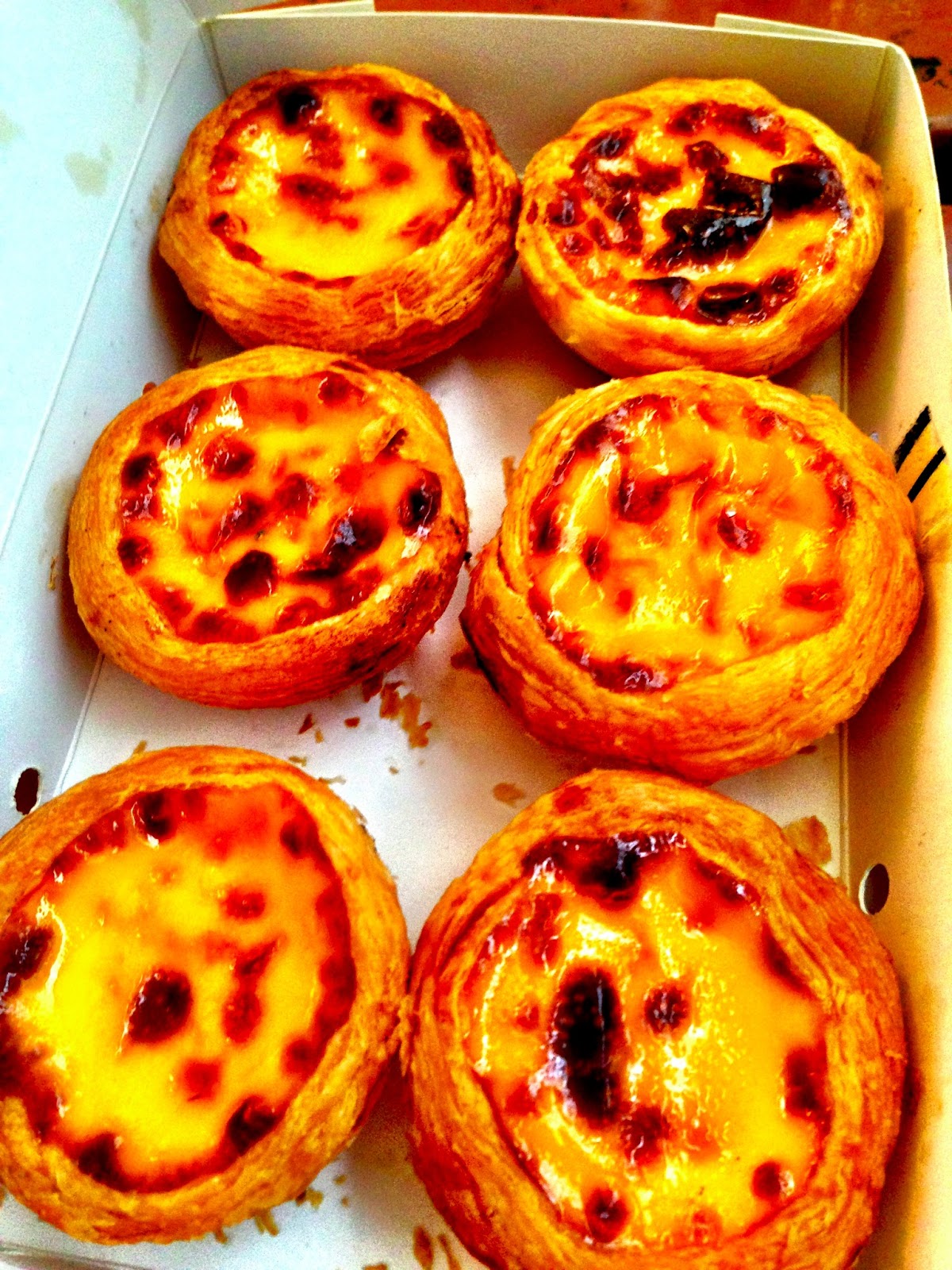
My father’s recommendation. We were greedy and each ate two, then immediately regretted it.
A man neither Chinese nor Portuguese enjoying a gelato by a fountain in old town. A scene from Europe a stone’s throw away from China. That is the crazy thing about Macau. 

An elderly Chinese man waiting outside the church. For what or whom, I’m not certain. 
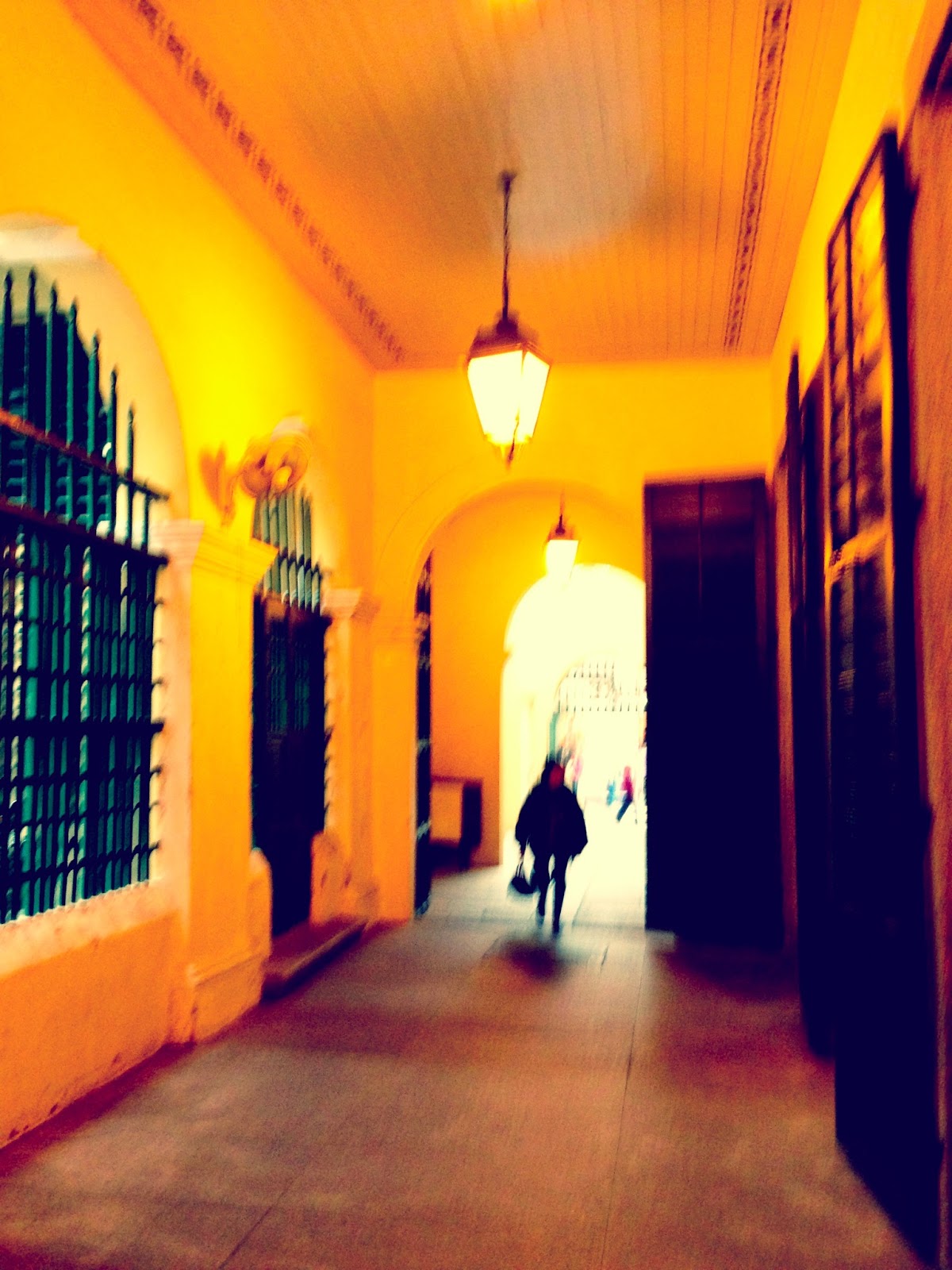
A woman rushing to mass. 
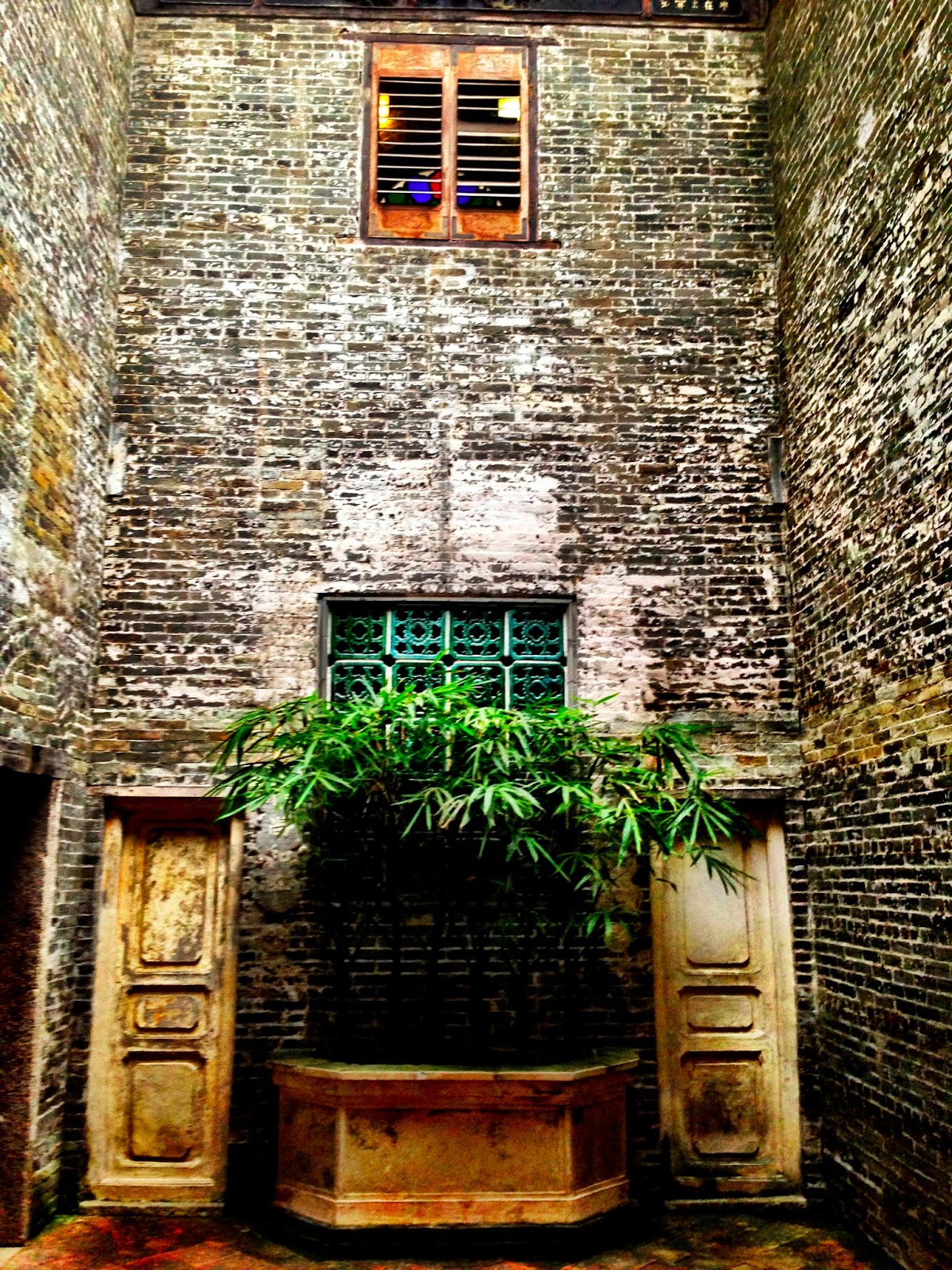
Gorgeous brick atrium of the excellently preserved Casa de Lou Kau, home of a Chinese Merchant and gambling tycoon. 
Another atrium. I wouldn’t mind if the rain fell into my house through a place like this. 
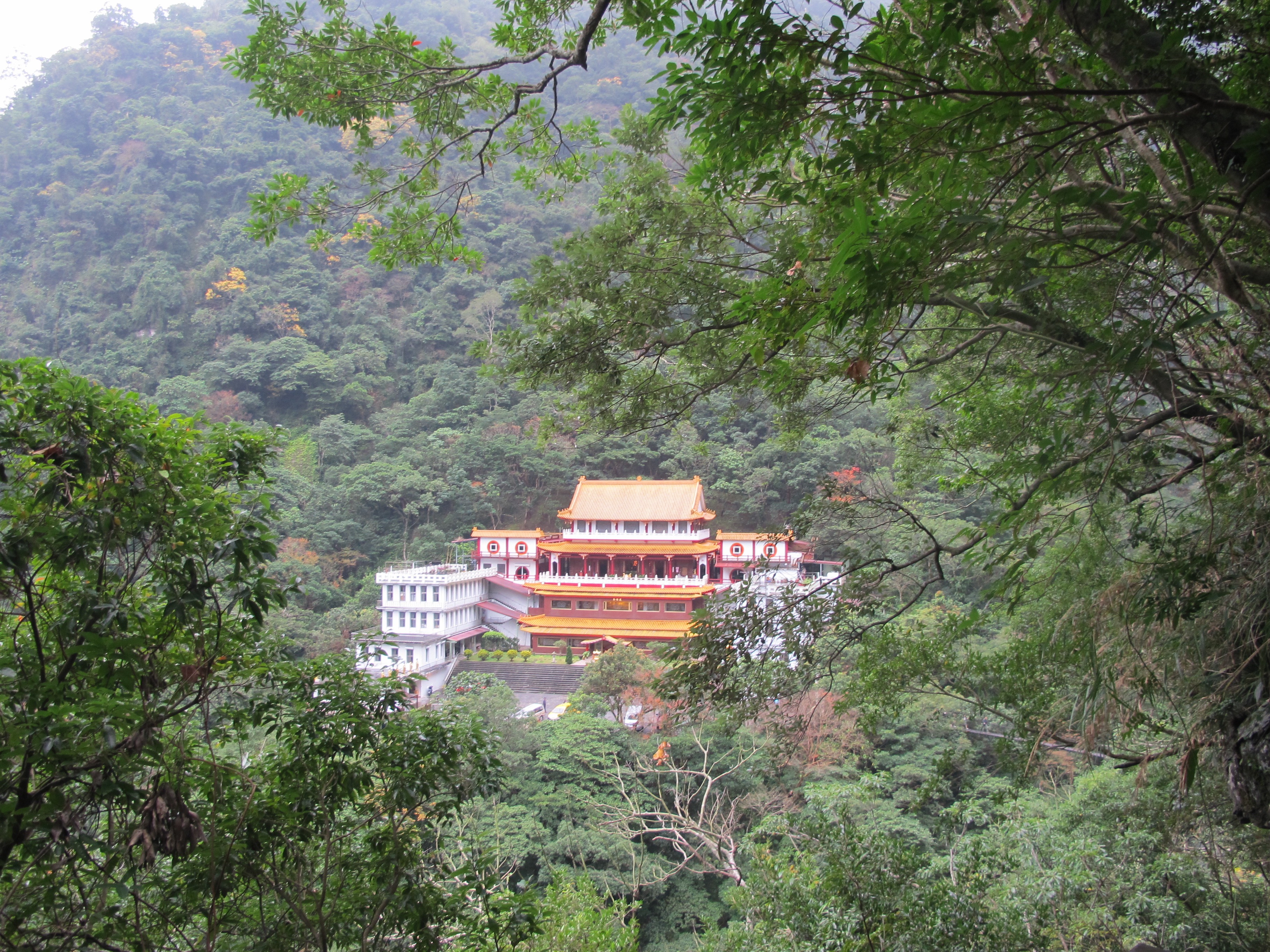
A photo also taken on the way there, because it was nighttime when we left, but I like this shot.