One Year

A year ago today, my grandmother passed away. The day would have gone by without my having given her or my grandfather a second thought had my mother not called me.

It was only 7:30AM back in California and I thought it strange to see my mother’s name flashing on the screen. She’s not one to wake too early, especially not on a Sunday, but I guess this isn’t like most Sundays. When the phone rang, I was standing in the kitchen, mid-sentence with a friend who had spent the night. We were talking about men and blogging. Things important to we the living. I picked up the phone and greeted my mother with the slightest impatience but became quiet when I could hardly hear her speak. She wasn’t crying and did not sound sad, but she seemed reluctant to let her voice rise above a certain octave. She was hesitant to remind me of something. She, along with everyone else, knows that in New York I’m having what is known as “a good time.”

I told my mother that my friend was visiting, hoping she would say, “Oh okay, I’ll call back later,” but instead she said a hollow, “Oh that’s nice,” and finally, after a soft “hmmm,” said, “You know, today marks one year since grandma’s passed away.”

“Oh my God,” I said, “It’s been a year.”

“Yes, so fast,” my mother said softly, “We’re going to her grave later, the family.”

I thought to my grandfather and asked after him, knowing that I would not under any circumstances call or speak to him today. Or tomorrow. Or the day after tomorrow.

“He’s…” my mother hesitated, “he didn’t feel well last night.”

“How so.”

“He felt last night he couldn’t breath and complained of a stomachache. Your aunt Joannie went to visit him and she found him lying huddled on the couch. It made her sad, your aunt said. Just an old man in a cold house, lying huddled on the couch. He told her he felt very cold and very ill.”

“It’s stress,” I said, not sure if I was using the right word in Chinese, “Today is a terrible day for him and it stressed him out last night. I would probably feel sick too.” But I knew exactly which couch and how cold. The house had been warm in theory when my grandmother was alive and well and it was filled with the smells of her cooking and lots of bodies coming in and out to eat with them. But in the winter, when the stove was off and it was just the two of them, when they were napping or quietly playing solitaire, the house could get incredibly cold. It was two stories, the second of which they never ventured to, and possessed an old heating system that struggled against the high ceilings and thin, drafty windows. I often walked in on winter evenings to find grandpa wearing a cap, hands stuffed into the deep, fleece-lined pockets of a black puffy down jacket my cousin Andrew had passed down to him. I would sit and chat, fully aware that my fingers and toes were turning purple.

“The heater…” I would say, and most of the time, grandpa would respond, “Such a waste. Just two people in a big house. We don’t need it.”

I didn’t know how to say ‘heartache’ in Chinese, or not the way I wanted to say it. I knew to say, “Heart hurt,” which was accurate, but for some reason, when applied to Grandpa, seemed just the opposite. It didn’t go with his tough-guy mien. But in any language it is apt, there is no better word for it. Still, I didn’t use it.

I could sense my mother nodding on the other end, looking off somewhere.

“He said he did not feel very good at all.”

“Are you guys going to take him to see the doctor?”

“I don’t know,” my mother said, “We’ll see.”

I looked over to my friend, who knew my family well and knew that my grandmother had passed away. She looked concerned, but I didn’t want her to be. There wasn’t much to be done from here, by either of us. I wanted to hang up and continue talking about men, about blogging, about the future.

“Well,” my mother said after a short silence, “Tell Angie we said hello.”

I said goodbye, almost adding, “I hope Grandpa feels better,” but stopped myself. It wasn’t a cold he had.

—————

Certain days in New York, when I’m walking down the street and see an elderly man or woman sitting alone on a park bench or shuffling slowly somewhere, I remind myself to call my grandfather to see how he’s doing. Mostly, I know. Or I think I know, in the general way you think you understand the feeling that comes with losing someone you’ve been married to for nearly seventy years. So I don’t know. I just know what he’ll say when I call to ask, “How are you doing?”

Ma ma hu hu,” he’ll say, the Chinese equivalent of “same old, same old,” or more accurately, “Whatever.”

Most days, he means this to be funny. My grandfather likes to play Negative Ned to my Positive Polly. It’s our special thing – he thinks I’m a ridiculous smart-ass ray of sunshine, mostly because he doesn’t read my blog and also because with him, I steer clear of certain topics that once broached would make me cry until I had no tears. I don’t always want to cry when I see him. Most of the afternoons we spent together were mild, happy affairs. I cooked a simple meal we would eat together, then I would ask him to split a dessert with me. He would say no. I would shrug and say, “Your loss.” He would chuckle, arms crossed over his chest and shake his head.

“You complain about gaining fat and you always always eat dessert.”

In between bites of chocolate ice cream or cookies or cake I would nod, “Very astute, Grandpa.”

And it went like that. I’d clear the dishes. He’d watch the Chinese news, read another article or two from the Chinese World Journal, and between 1 to 1:30PM, would stand up slowly, wincing as his bones creaked and say, “Nap time, nap time.”

I’d nod and say “Good night,” and he would roll his eyes because it wasn’t nighttime.

“It’s good afternoon,” he’d correct me.

“Good afternoon,” I would stand corrected.

He would nap for an hour. Sometimes, I slept too, lying on the couch in front of the TV with a book on my belly. Grandma used to nap here, and when she was here and I was here, she’d nap in the bedroom and let me have the couch. Now, Grandpa would wake before me and come back quietly to take his seat at the dining table. He would read like a literary phantom behind me until I woke and realized the time and turned to find him there, still and scholarly. An ancient man in a modern Chinese-American painting.

“I’ve been awake for a while,” he would say, and I would rub my eyes and yawn dramatically, kicking my legs out and stretching my arms past the edge of the sofa towards the garden my grandmother used to tend to but is now under grandpa’s care. I’d feeling comfortably childish like a granddaughter just risen from a warm delicious nap and who together with her grandpa, was waiting for grandma to wake too.

But it remained just the two of us for a good part of the afternoon. Grandpa would move to his favorite chair in front of the TV, turn it on in time for a travel-through-China show he liked to watch, and I’d read some more back at the kitchen table. Sometimes I would go to the garden and collect some snow peas, yam leaves or tomatoes and grandpa would be pleased, because he chose to keep watering the plants his wife had loved so much rather than let them wither. Sometimes I would vacuum and grandpa would lift the chairs even though it strained his back. Sometimes we’d talk, though hardly about grandma. And around two or three, I would get ready to go.

I’d stand up and start packing away my books and magazines. He would look up and say, “Going?”

“Going,” I said, “I’ll see you __,” whatever day I was scheduled to come next, though it was a self-imposed thing. I was unemployed and needed structure. Even more, I think, than Grandpa. I’d take my bag, wait a bit while grandpa rose from his chair to let me out, and I’d walk down the driveway towards my car, which was always parked across the street along the neighbor’s curb, beneath a shady tree.

He’d stand in front of the drafty old house, with its red brick and wrought iron front gate. The small, two door garage filled with old Chinese school textbooks and odds and ends from various points of their grown children’s and their children’s lives. Old Christmas gifts and filing cabinets. Large stock pots and steamers my grandmother had used during Chinese New Years’ past. There was a single rose bush near the living room window. There he would be, standing slightly stooped with his arms behind his back, a ballast of sorts, holding down this fort that was and was not his.

“See you later, Grandpa,” I always called out from my window. He’d smile and wave and, seeing my car wend around Sunshine Park and out of sight, he’d slowly turn and go back inside.

In those summer months before I left for school, I didn’t worry about whether he would feel cold. Alone, of course, but not cold.

Forwarded Humor

My mother told me two jokes yesterday. I was eating breakfast in the kitchen and she was using the computer in the dining room, which she has rechristened as her office. She sits at one corner of our long table where she uses her computer, corrects homework assignments, and Skypes with my brother. For anyone else it would seem a massive, lonely work space, but my mother manages to cover most of it with papers, Chinese workbooks, random notes and the occasional bowl of half-eaten oatmeal with an egg cracked over it (not very appetizing, if you ask me). This is also where she gets most of her information from the outside world, in the form of long-winded mass emails forwarded from friends and my father.

She knows better than to pass this cyber trash onto me. I have long since exiled emails from my father to a separate folder titled “Dad” but which could also aptly be called “Horrendously Time-Consuming Bi-lingual Junk Mail,” because for Dad, that’s the purpose of email. He still uses AOL, which is the digital equivalent of the Pony Express. He takes each email very seriously, as though it were a hand-written letter from a relative in China. Before, when he asked me, “Did you see that slideshow/essay/lengthy health report/etc. I sent you yesterday?” I would shake my head and say, “No Dad, stop sending that crap to me,” to which he would respond with an expression of hurt and indignation.

“I only send you the very best emails,” he would say, “They’re always informative or thought-provoking. You should take the time to read them if I’m taking the time to send them.”

I would tell him that I had better things to do. My father would become angry and petulant.

“Well I have better things to do too, than come home and make dinner for you” (if he came home to make dinner that day). And I would give him an odd look, because really. Really?

But I became tired of these arguments and sought to eliminate them from my days. I set up a separate folder: a small, Gmail Siberia reserved expressly for my father, and began to lie to his face. Now I always nod and say, “Yes yes, it was very interesting,” when in fact I haven’t the faintest idea what he’s referring to. It’s okay though, my father invariably provides clues. If it was a slideshow, he will say, “Those were some great photos right?” and I will nod, “So great.” If it was a report of some sort (usually warnings regarding the latest gang tactics – Asian parents love passing these around, even though they and most of their friends live in Newport Beach, Irvine, Cerritos or some other sterile, virtually crime-free city where their Benzes and Bimmers are more likely to be crashed by their Asian wives than vandalized by gangs) he will say, “Did you know that the gangs do this?” To which I will widen my eyes and say, “No! But now I do. Thank you.”

My dad never wants to discuss any of the emails at length. He just wants to make sure I see them. Hearing my response he will smile and nod, satisfied that he contributed somewhat to my daily intellectual digest. And saftey.

“See? I only send you the very best emails.”

At the end of the week I open the folder, give it a quick scan to see if dad sent messages specifically to me (there almost never are; if he has something really important to ask or tell me, he will call) and click “Delete All.” It gives my de-cluttering tendencies the slightest satisfaction.

My mother however, operates differently. She also takes those emails very seriously but rather than bombard my inbox, will call me into the dining room, disguising her intent with the same tone she uses when there is something wrong with the computer.

“Betty! Come quick!”

I usually put down whatever I’m doing and rush to the corner of the dining table. My mother is quite impatient when things don’t work (“Everything is doomed,” she likes to say, when really Gmail just needs refreshing).

But more often than not, the urgency of her call doesn’t match the urgency of what she wants me to see.

“Look at this adorable monkey!” (it was a slideshow of cute baby animals dressed up like human babies).

or:

“Look at this woman in China with no arms and four children! Look at her wash her face! Look at her gather vegetables from her field and wash and cook them!”

She will lean back, click to the next slide and sigh in wonderment, “Isn’t the human spirit amazing.” And there, the next slide will say in Chinese. “The Human Spirit is Amazing.”

As I am already there, at the corner, I can only nod and say, “Yes…” and wonder what it is that prevents me from taking the time to sit through these slideshows while my parents can raptly digest dozens a day. Is it a generational thing?

Sometimes though – and I’m learning to do this more often than to simply rush over like the idiot who believed the boy who cried wolf more than twice – I’ll simply pause what I’m doing, tilt my head and call back, “What is it?”

And my mother, knowing that what she wants to show me is not very urgent but if she doesn’t show me now, she’ll forget it and her daughter will somehow be at a unforgivable disadvantage, will say nothing.

I’ll say, “Mom? Mom?” And start to rise from my chair when voila, there she will be, in the doorway.

It won’t matter if she broke my train of thought – it’s more important that she keep hers. She’ll walk toward me and say, “I just now read a wonderful email…” and I’ll know that it’s story time. Forwarded email story time.

That Betty

Archie Betty and Veronica
A blonde Betty. 

The Post Office in my home town was, up until she retired just a year ago, most often (wo)manned by a lady named Betty, aged sixty-some years. She is a proper Betty, meaning she was born in the forties, a time when the name “Betty” was quite popular for baby girls for whom their parents had grand dreams. These Bettys would go to college, marry well, start families and most likely not name their children Betty. By the time the later decades rolled around, there were other names were more in vogue. Continue reading “That Betty”

Letter from Kaua’i

Hey Guh,

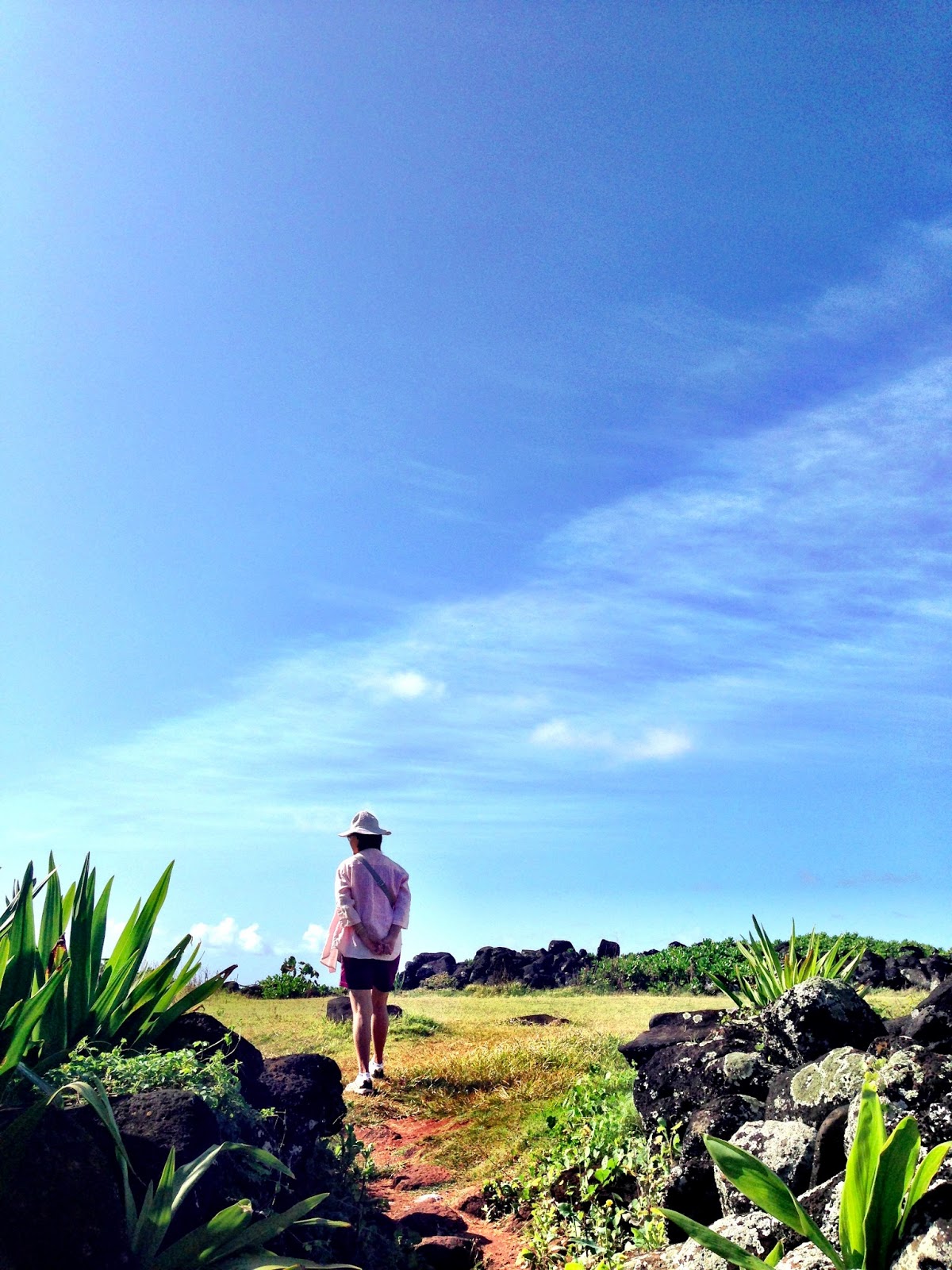
It’s 4:30PM here in Kaua’i and I’ve just come from swimming in the ocean, barely two shades darker than when I arrived. Mom on the other hand, due to some crazy tanning skills, is dark as a panther, even though she’s been wearing a long-sleeved linen shirt, long shorts, a hat, and holding my umbrella as a parasol since we got here.


“I’m just dark,” is her response. She hates it, but then looks down at her brown ashy legs and shrugs, “Oh well. What can I do.” 

She’s napping on the florid Hawaiian print couch in our hotel and I’m writing to you on the balcony, which is supposed to have a “garden view” but really just faces the neighboring resort which is undergoing construction. It’s hard work for these guys, but they get the ocean breeze, an awesome view, and they blast some KIIS FM stuff (so my jam) from a fuzzy radio, but they can only hear it when their drills and hammers aren’t going on. 

If I tilt my chair to the left, I can see the ocean, which is right behind our hotel. It’s a cute place, definitely on the older side, but has separate living room and a full kitchen, which mom likes, a heated pool (though I think that’s unnecessary here) and hammocks hanging from the palm trees. Just a few steps away (God I sound like a brochure) is a nice stretch of beach, too rocky for some people but perfect for me and the other folks who swim with their head above water, that is, half-heartedly, because we’re not into snorkeling or scuba-diving, and who wants all that salt in their eyes? 


Traveling with mom is interesting. I’ve taken trips with just the two of us before, mostly destinations that were driving distance; we went to San Diego before I went to Berkeley and then to Napa while I was up there, but I forgot how much of each trip is just… driving and looking. Mom can walk for days, but she also walks very slowly (you know this) and needs good shoes or else she gets this glum look on her face, as though nothing in the world could make it right. 

The first hike I proposed was just after a rain and the path was too soggy for her. She’d brought these shoes with holes on the bottom, which I told her were perfect for Hawaii and that she shouldn’t wear socks with them but she blamed me, saying that I had told her it wasn’t going to rain much. I told her it was hard to predict the weather, especially in Hawaii. She thought about this and decided to be unreasonable anyway. 

“You said it wouldn’t rain,” she said.  


She was kind of a brat that day, but I got over it.  

So basically we’re in scuba, snorkel, kayak, zip-lining and hiking capital of the USA but we didn’t do any of that, mostly because well, I’m not really into any of that either, but I’m kind of afraid of mom getting really tired or hurting herself. 

This morning we went for a walk along the beach. I told mom to be careful because some of the rocks were slippery. I wanted to walk down near the water and she said she would too but she wouldn’t take off her shoes. I saw some interesting barnacles on a rock closer to the water and wanted her to take a look, thinking, I don’t know what, that maybe mom knew a ton about barnacles – God, barnacles! Of all things to risk your mother’s life for! – and she started towards me so I turned back towards the barnacles and suddenly I heard her cry out. I turned and there she was lying awkwardly between two jagged black rocks and I thought for a millisecond that I’d made her fall to her death because I wanted her to look at some goddamned barnacles.


Her face was twisted up in a grimace and I was frozen there on the beach, not even moved by the waves hitting me in the back of the knees, my mind completely blank when she started laughing. I let out the hugest sigh of relief and rushed over. She nodded towards my camera and said, over the water which seemed to be moving again, “Did you get a picture of that?”

I didn’t (but I definitely thought about it when she started laughing) and asked if she felt anything amiss, bone-wise. She said, “Nope, thank God I have a fat ass.”

So mom is funny (though you knew that too). Funny in that she intends to be funny and also unintentionally. On the plane, she proved to be the most interesting seat mate I’ve had in a while – and I’ve sorted started this thing, writing about these seat mates because I’ve been traveling so much and have sat next to the some interesting people: e.g. Orthodox Jews who own their own printing company (they wanted to hire me onto their sales team), a girl named Leslie who was thinking about following her boyfriend out to California, and most recently, before Hawaii, a middle-aged authoress and HER elderly mother, both of whom were my worst nightmare. I still need to writer an essay about her, but let’s just say she wrote what seems like a terrible book and was telling me how successful she was until Border’s went out of business… I was like, “How come your book wasn’t anywhere else?” and she gave me this really irritated look like I didn’t understand anything about publishing and said, “Well, it’s on Amazon in digital format for $1.99.”

When the sandwich cart came she pulled out her credit card and asked her eighty-year old mother what she wanted and when the old woman told her, she said, “Well, Ma, get out your credit card because you have to pay for it.” I was incredulous, but then remembered that her book was selling for $1.99 and I probably didn’t need to ask her how the sales were if she couldn’t afford to buy her mother a sandwich. Oh man. Knock on wood so that my own writing career will blossom and blossom for decades.

Anyway, Mom though – she couldn’t sleep on the flight over and ended up just counting fat people on the plane, chuckling a bit to herself whenever a fat guy or woman got up and walked around or asked for another beer and soda.

“Look, look, this fatty is getting up to exercise.”

or

“Look, he’s getting another beer. See, Betty, every fatty is fat for a reason.”


I laughed out loud so many times during the flight people trying to sleep around me were probably getting irritated. And it was so funny, to see how childlike mom could be: when the beverage cart came around she asked first for a glass a milk. Milk! And then for a glass of orange juice, two things she never drinks when she’s at home but 40,000 feet in the air it’s totally okay. 

“Milk, please.” “Orange juice, please.” It was bizarre.

And the fruit. Dude, woman eats two to three whole papayas a day, plus bananas and lychees. She was a bit miffed at the entire island of Kaua’i because pineapples aren’t as cheap as she thought. I think she imagined these bounties of fruit falling out of the sky, or just cartloads of fruit outside the hotel for 50 cents a pound, but yeah, the local stuff here is kind of expensive, but mom was like, “Okay, I’ll shell out for papaya.”

But with pineapple she was more reluctant because dad’s not around to cut it into bite-sized triangles.

I get the feeling that she’s just not paying attention. I’ve heard her take a few calls from prospective students and I realize how hard mom and xiao jiu work to keep the Chinese school going, and how much of a headache it all must be, but because she believes in it, she keeps at it. Anyway, these calls tell me that mom is actually really on top of her shit in regards to the things that matter to her, and not that coming to Kaua’i with me doesn’t matter, but she doesn’t have to do anything in terms of planning, because she assumes I’ll be the tour guide and arrange everything, including drive her ass around to all these points which she sometimes doesn’t even get out of the car for, and…well, I do it because it’s in my nature, and it’s fine.


The most hilarious thing: is she is dyslexic for sure, and I think I might have inherited some of that. I get all mixed up about Chinese phrases and it’s the same for her, but in English. You know how she used to always say “May Robinsons” and “California Chicken Pizza” for CPK? Well, there’s a dish here called poke, which is basically sashimi marinated in sea salt, soy sauce, sesame oil and seaweed. Mom really likes it so I ordered it a couple times at various fish markets. She always goes, “Get the Polka Dot?” with a question mark because she knows she’s saying it wrong but can’t be bothered to knock off a few extra letters. I always want to tear my hair out. “Mom, it’s POKE!” pronounced “poh-kay”, I’ll say, and she just laughs, closes her eyes, shakes her head in that way.

“Oh, what are you going to do about me?”

Nothing, really, but buy the poke. But it’s been a good time. We’re going to get some Barbecue now for our last meal in Kaua’i and I gotta run out and pick it up.

Anyway, that’s my little update: telling you things you already know about mom.


love,

Betty 

Kaua’i: Fish and Ice Cream

For starters, there were a lot of fat people on our flight to Kaua’i. I wrinkled my nose at them while my mother chuckled to herself every time a 胖子 (“fatso” in Chinese) got up to get himself another soda.

“Everyone’s fat for a reason, Betty,” mom said, and I nodded, glad that the two of us fit comfortably in our economy seats. We had brought fruit, beef jerky, and granola bars to munch on the plane and watched smugly in our relatively slender frames as the others stuffed their faces with day-old overpriced airline sandwiches. 
Then we arrived in Kaua’i and forgot about the fatties on the plane. I drove my mother to a farmer’s market where she made a beeline for papayas, buying six. She would devour two that night. 
“Papaya doesn’t make you fat,” she would say as I stared, “It’s good for digestion.” 
Holding my mother’s six papayas, I bought a coconut and ask the nice but extremely wrinkled man to hack it in half and scoop out the flesh. I ate half a coconut standing in the parking lot in front of Kmart, refusing to acknowledge that it was akin to eating half a stick of butter. 
“It’s good for my skin. And antibacterial,” I thought. 
Then we raided the Kmart. The wrinkled man still fresh in my mind, I bought a man’s visor emblazoned with “Kaua’i” just in case I lost my mind and forgot where I was, and a tube of Ocean Potion sunblock which smelled like an orange creamsicle.  
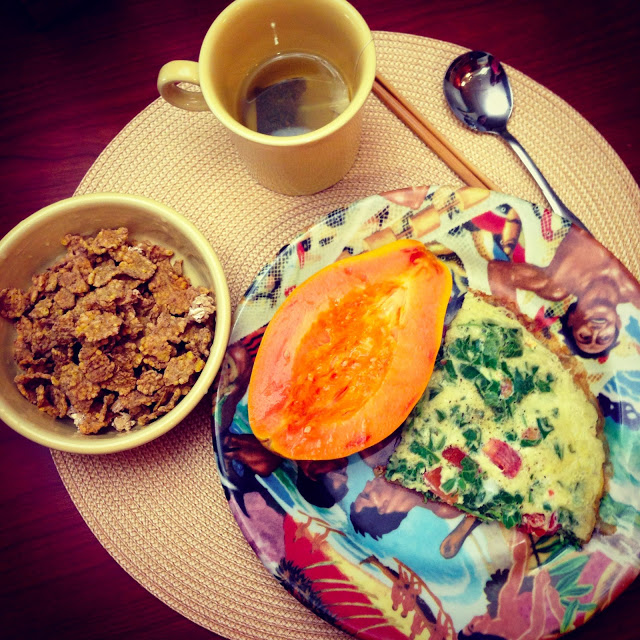
My mother said, “Let’s get eggs, milk and cereal for breakfast. We can each eat two or three eggs a day. And if we have leftovers, we can boil them and take them on the flight home.” 
I nodded in agreement, thinking that we’d be hiking and/or kayaking so much that a big carb and protein and…everything-else-packed breakfast made sense. 
Breakfast of tourist champions. 
But conclude what you will from the following conversation: 
Me: Mom, what activities do you want to do? We can kayak the Wailua River, hike down Waimea Canyon, or go swimming at the beach right behind our resort

Mom: No… I’d rather not. 
We ended up walking, very slowly, a lot. Which normally isn’t enough exercise for me to say, “I’m gonna eat whatever the hell I want,” but when you’re in Kaua’i with your mother who thinks that eating two whole (sometimes three) papayas a day is the very thing one should do when vacationing in tropical fruit heaven, you follow your mother’s lead. Except with ice cream. Despite my sweet tooth being sharper than hers and relishing the occasional heaping plate of red meat, I have a similar palate to my mother’s; we like vegetables and fish. Lots of fish. And we like a good deal. 
Turns out, mom and I flew with the fatties to the right island. Below are the greatest culinary hits from our trip and the dishes behind our combined eight pound (four each) weight gain. 
Kapaa, HI 96746

This place was just down the street from our hotel and the most expensive fish market we visited, but huge portions and excellent seared ahi poke. Below are the seared ahi poke salad and mahi mahi plate lunch (sans rice).
5-5075 Kuhio Hwy. Ste. A
Hanalei, HI 96714
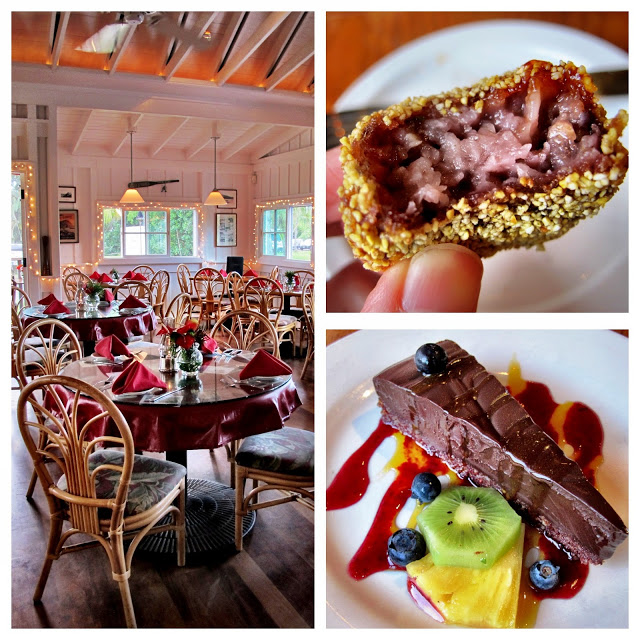
We came here on a recommendation while visiting the north shore and the famed Hanalei Bay. It’s a popular spot with tourists and locals alike and considered a “romantic treat” for people celebrating anniversaries, honeymoons, and engagements. There was a line outside the restaurant before it opened at 6PM, which gave the hostess a power trip. I let her take the trip because she was a stunning middle aged woman with arms like Linda Hamilton. I’m pretty sure she taught yoga during the day and never eats what’s pictured below. That said, the restaurant’s ambience and quality of food doesn’t equal their prices (our most expensive meal in Kaua’i) and afterward we decided to stick with fish markets. I do recommend their Hanalei Taro Fritters (don’t order the rest of the appetizers), Vegan Chocolate Silk Pie, and Deep Fried Macadamia Coconut Crusted Ice Cream (photo later). 
5482 Koloa Rd.
Koloa, HI 96756 
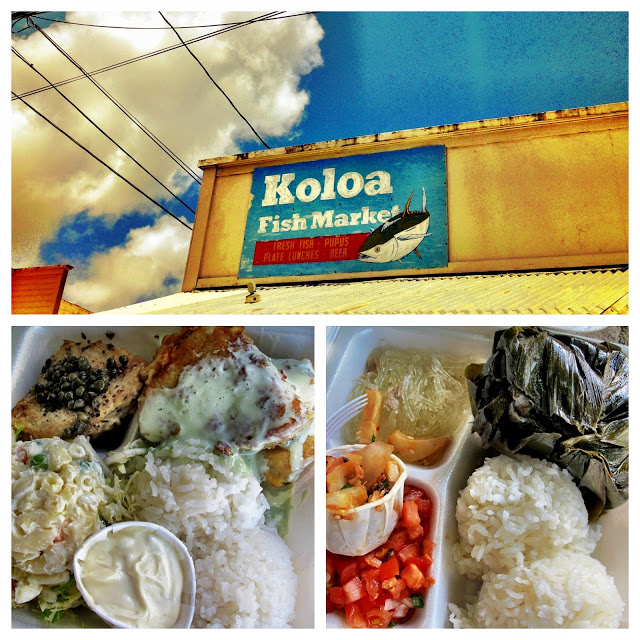
One of my favorite stops, in Old Koloa Town. It was sweltering that day and fish markets don’t exactly have seating, but we found a shady tree nearby and chowed down on their Hawaiian Plate with Lau Lau (pork wrapped in Taro leaves, which was very reminiscent of a similar Chinese dish) and fish cooked two ways (ahi and mahi mahi). Both were great and my mother, not a big meat eater, enjoyed the Lau Lau, which was like baby back ribs except without the ribs and the barbecue sauce… yeah. 

FISH EXPRESS
3343 Kuhio Hwy. Ste. 10
Lihue, HI, 96766

This place is number one. We bought fresh miso marinated butterfish to cook back at the hotel on our first night, and then came back for the grill, which is only open from 10-2PM each day.
“People get mad when they miss the grill,” said the young man behind the counter when we first went, and I immediately made a note to come back. The fish below was hands down the best grilled fish we had in Kaua’i – left is blackened ahi with a fragrant butter sauce and macadamia crusted cream dill sauce mahi mahi. Not pictured is the crab and ahi poke, which my mother ate like salsa, though without chips. She called it “polka dot” and insisted I buy the “polka dot” at all the subsequent fish markets.

“Mom. It’s POKE. Poke-ay.”

“Ah yes, polka dot is the dog.”

“….” (she was thinking of dalmatians).

We brought these to picnic near the beach and it was one of my most memorable meals. My mother complained a bit about the wind, then ate the fish and stopped complaining about anything.

CHICKEN IN A BARREL BBQ
4-1586 Kuhio Hwy
KapaaHI 96746


Our last dinner in Kaua’i, which we paired with a little bottle of wine I’d gotten from the plane. We shared a sampler which offered enough meat for three people, though if I ever go back I’d get the ribs, which were everything good ribs should be. Funny story: I called in my order and when I arrived, the girl said, “You’re the phone order?” 

“Yeah,” I said. 

“Here you go,” she pushed the box towards me and I said, “Wait, this is John’s.” 

Lastly, it wouldn’t be a proper food post without the literal cream of the crop:
ICE CREAM (clockwise from top left):
POSTCARDS CAFE – deep fried macadamia ice cream in coconut shell
ONO ONO SHAVE ICE – not shaved ice, (if rainbow sugar water is your thing, then definitely get it here) but their rather unnaturally hued taro and coconut ice creams.
PAPALANI GELATO – Pineapple (my mother) and chocolate.
LAPPERT’S ICE CREAM AND COFFEE – Kona coffee, my mother’s Achille’s heel and robber of sleep. She ate it at 7PM one evening and was doomed to toss and turn for the rest of the night.

And I had to give this guy his own headshot, because I miss him: Lappert’s Coconut Macadamia Nut Fudge. I went back twice and considered a third but my pants were feeling suspiciously tight and I didn’t want my mother to laugh at me on the plane too.

The End. 

Monday Night Blather: Large Chinese Family Edition

Lately, I don’t feel like writing much. I also don’t feel like reading much, and this may or may not have something to do with the fact that this trip to Taipei, I’m living on the 7th floor instead of the 6th, where my aunt, uncle, and cousins live. My aunt has a key so she comes in whenever, often when I’m in the middle of doing yoga (in the morning) or on the computer (in the evening), and I go down to the 6th floor for my meals when I don’t eat out.

Anyway. I was afraid of this (but I doubt it can be remedied now), the brain drain I lamented in the States shortly before coming here. Two years ago I stayed in Taipei and stood at some sort of existential crossroads. I was waiting for a Fulbright and rationalized that I could dick around for a while before the die was cast. I mean, I wasn’t going to go through the hassle of finding a job and then have to quit just in case I got the Fulbright, right?

Well, it’s kind of similar this time, except I harbor a (not so secret anymore) fear that God’s like, “Dude, you’re having way too much fun because you think you’ll get into grad school.”

“Well God,” I say back, “Won’t I?”

He shrugs, “Perhaps.”

I try to write every day, to be productive by my productivity standards, which are already low by any means. Please don’t compare your life with mine because you can bet your butt I don’t compare my anything with yours – yeah, you there, with the job, the doting boyfriend/fiance, the master’s or imminent doctorate. I’m keeping my eyes and ears open and trying to remember everything I’m seeing and hearing and thinking, but there’s a lot going on – almost too much, in fact, in and around my family and my internal organs (mostly my brain). That kind of means I should be writing all of it down, but instead I sit in front of the computer or my diary and am frozen.

I don’t want to do anything but look at pretty pictures on other people’s consistently updated blogs, or read fluffy articles in the NYTimes (yes, they have fluffy articles). Oddly, I love reading about longevity and how to achieve it, even though my life is looking pretty murky right now. What’s the point of living as long as my grandfather did if sometimes all I want to do is watch “Transformers 3” again? It is without a doubt that Shia LaBeouf and his shiny robot friends will save earth yet again, though I’m not too sure what I’ll feel like at the end of the week. I’m not talking about the doubt that comes with thirteen grad school applications in a field that is more subjective than your take on Damien Hirst’s latest piece, but the doubt that seems to plague my generation (and probably future generations as well – but not my kids, hell no) in general.

Like… what….am….I…..doing? Not just today, but tomorrow and the day after and the day after that?

Well.

I’ll tell you a little story that may have colored my worldview today. Who knows – tomorrow I may write something entirely different and say, “Wow! Look at the colors of the sky! Look at the rain! How fresh and fragrant! The banyan trees lining DunHua South Road – so romantic, those aging silvan soldiers!”

My aunt caught up with me today as I was heading home from a long walk in the XinYi district. She had rushed to the organic produce store around the corner to get two little plastic trays of basil and cilantro – she was going to stir fry some clams for dinner, and the herbs complete the dish.

“Do you remember your San Gu Gu’s husband?”

I nodded. San Gu Gu is Third Aunt, my dad’s half-sister from my grandfather’s second marriage. She is about seventy-seven or so. We saw her and her family about every three or four years as she lived in Shanghai. I do not like San Gu Gu – she seems fake and has a reputation for asking my dad and uncles for money one too many times, even though she’s done quite well for herself as a doctor in Shanghai. I do however, like her husband very much. He’s a simple guy with simple tastes. He and his highly educated wife had three rather spoiled, lackluster children, one of who is slow and has stayed home all his life, and two others who went to expensive colleges in Japan (it was apparently the “vogue” thing to do for upper class Shanghai folks back in the 80’s) before moving to the States, where the daughter quickly married a lackluster guy and their son, Cheng, had his own spoiled, lackluster son named Jimmy with his wife, whom he met and married in Japan. They usually come over for Christmas and everyone shakes their head at Jimmy’s stunted emotional development and limited palate and widening girth – apparently Jimmy is a picky eater who really, according to his mother, “can only eat MacDonald’s so what can I do?” Well, don’t bring it to his room on a silver platter so that he can stuff his face without interrupting his video games, for one… but then again, he’s not my kid.

They didn’t come to Christmas this year because Jimmy’s mom, my cousin-in-law, I guess, if we’re going to get technical with family terms, was diagnosed with stage four pancreatic cancer and is now dying in a hospital in Downtown LA. Cheng put his job as a LA Area Chinese tour guide on hold to take care of his wife and Jimmy dropped out of school. I can’t imagine what Jimmy’s going through right now, but my impression of that kid is so poor I think he’s relieved to be able to sleep in this semester. It’s a terrible way to think because god knows I’d drop out of school ten times over if anything happened to my parents, so I shouldn’t judge a thirteen year old kid, but god he was spoiled. I can’t even begin to fathom how Cheng is doing.

“San Gu Zhang, your cousin Cheng’s dad, passed away last night at midnight,” my aunt said, “He had a stroke a few months ago and then I guess he just didn’t make it.”

My aunt opened the fridge to take out the clams. I noticed in the sink that she had broccoli stalks soaking in a large plastic bowl. My aunt was pretty paranoid about pesticides (as most people who cook for their families should be, I suppose), and always insisted on soaking and resoaking and rinsing the vegetables thoroughly.

“Was anyone there with him?” I asked.

I asked because Cheng, his wife and kid were all in the States, and San Gu Gu had fallen last month on her way home from the hospital. A particularly harsh cold front hit Shanghai just as her husband was hospitalized, and she had slipped on the ice that’d formed on the hospital steps. She broke her hip and was herself hospitalized and then confined to bedrest, far too incapacitated to visit her husband everyday as she’d hoped.

“No,” my aunt replied, “he died alone. The hospital called San Gu Gu who had to arrange a nurse friend of hers to take their youngest son, the slow one, to the hospital to see his dad one last time. Your San Gu Gu arranged to have her husband’s body donated to science.”

I thought about how sad it is to die alone in a cold hospital room, especially during a Shanghai winter. I hoped his room at a window at least.

“The strange thing is, your San Gu Gu knew she would never see him again after she fell.”

A few weeks earlier, when she’d first fallen, she had called my aunt, “My blasted hip,” she said, “I don’t think my husband and I have the karma to be together when either of us departs this earth. Of course, he will probably leave first – I don’t think I will ever see him again.”

This she said in a bed less than a few miles from her husband’s.

“It was such a cold cold thing to say,” my aunt said, slicing the broccoli. A small pot of water was boiling and I could smell the ginger and wine my aunt had tossed in with the clams, “But in the end, she was right. She knew it, somehow.”

I watched my aunt assemble the night’s dinner in silence. The clams simmered and slowly opened. The ginger puffed up with water and the small chili pepper my aunt sliced in cut through fragrant steam emanating from the wok. The broccoli bubbled and turned over and over – my aunt fished each stalk out with chopsticks. The rice steamer clicked. I set the table – just three spots tonight: me, my aunt and my uncle – all in relative good health. My cousins stayed late at work.

My aunt sighed as she carried out the last dish, a spicy minced pork. A Thai dish that she’d bought ready made at a gourmet grocery store in the basement of our favorite department store. My aunt is all about trying new things.

“Your cousin Cheng is probably having the worst year of his life. And it’s only February. First his dad, and now his wife…”

I nodded, but wondered if Cheng had the strength to tell himself that things could only get better from this point, well, some future point, not too far off. His wife is still here, not exactly fighting the cancer but not exactly giving up. I did not know her that well, but she wide-eyed and kind. The kind of person you describe blandly as, “wouldn’t hurt a fly,” and “simple-minded” who ended up being a bad mother because she was only trying to be the best mother possible, never saying no to her kid.

When my parents went to visit her at the hospital, I did not go. I didn’t want to.

The last bit I heard about her: her lungs too, like my grandmother’s, are filling with water. She was so skeletal my mother had a hard time staying in the room, because all she wanted to do was cry with pity.

“Pity is useless,” my father says, but even he was oddly quiet after he returned from the hospital.

At the dinner table my aunt and uncle shook their heads, thinking about all the older relatives we’ve lost these past few years. They rattled off their names like lottery numbers, and I was startled to realize that there had been so many deaths. I knew them all, varying degrees of vagueness. They touched my face at some point, told me I looked like my mother or my father, held my soft young hands in their old papery ones and said, each of them I’m sure, “How good it is to be young!”

“Tell your mother not to work so hard anymore,” my aunt said suddenly, chopsticks pointing at me.

“Why?”

“Life is so short, you see? She needs to enjoy it now, while she can. Go to the places she wants to go. Spend time with the people she wants to spend time with.”

I nodded, but inside, was shaking my head. When you’re a twenty-six year old kid like me, your parents are still the same parents who used to spank you and make you practice piano for an hour each day. They age, sure, but it’s like a flash. You go away somewhere for a little bit, and come back a few months later and notice that while your room is exactly the same and the sun still lands in the same spots on the carpet, your father has a lot of grey hair and your mom moves at a glacial pace. She’s always moved at a glacial pace, but Jesus now she’s really slow. Her back used to be so straight and now she’s slightly hunched. You wonder about your dad’s blood pressure.

“Mom enjoys teaching,” I say, “But I know what you mean.”

My uncle, ever the optimist, pushes back his plate – filled with empty clam shells – and smiles at me. Life is short, the eyes say, handle what you can handle.

“Me?” he asks, as though I’ve asked him, though I guess my look is searching. He gets up to get fruit from the fridge and brings it back with a flourish, “I’d like to live forever.”

“Don’t we all.” My aunt rolls her eyes, motioning with her chopsticks for me and her to finish off the last four clams.

I oblige then take a chunk of honeydew with slightly salty chopsticks. The cold juice floods my mouth and I wince. It’s too sweet for me.

Museums

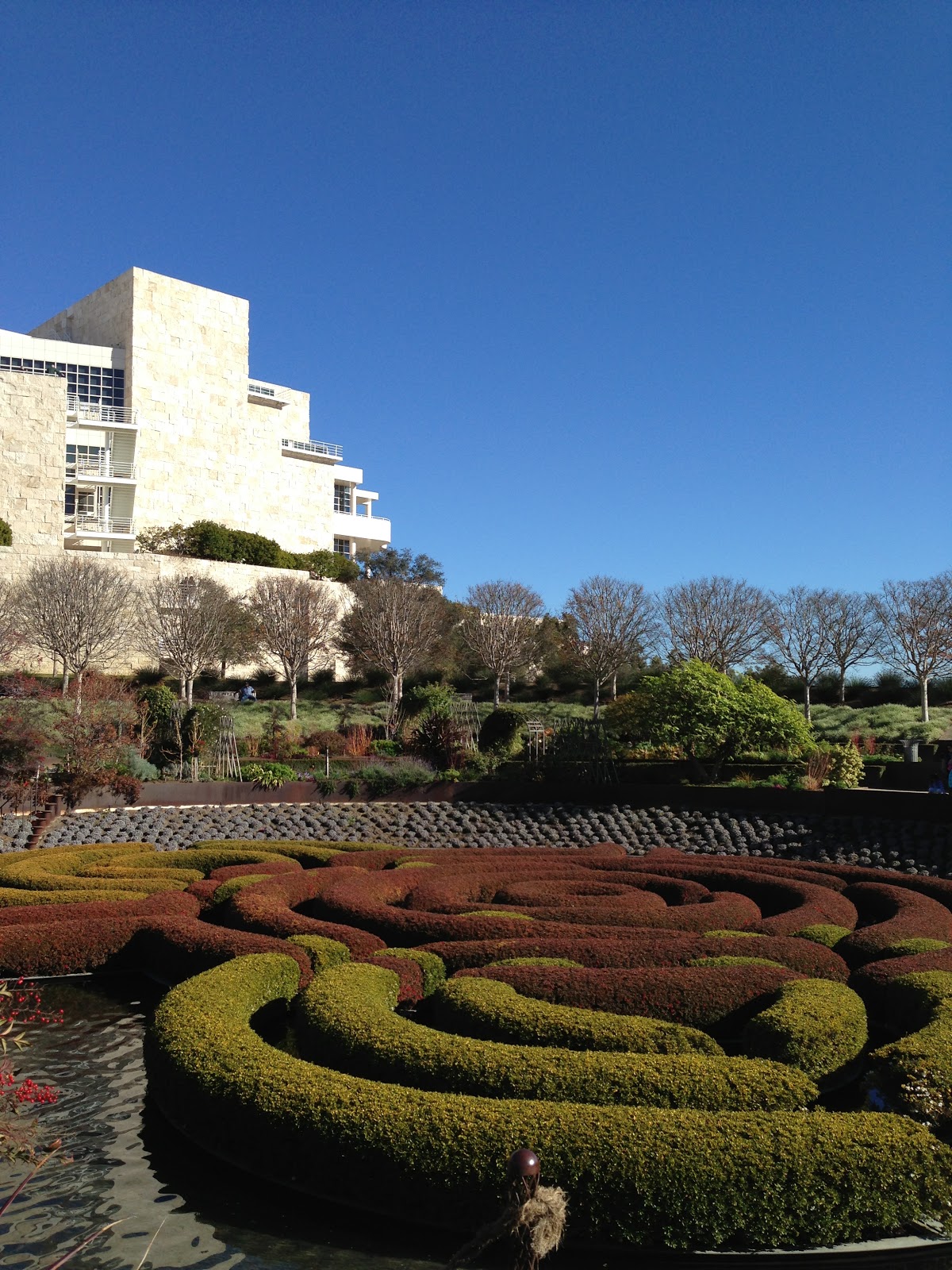
Mothers, aunts and grandmothers are simple people. I took them to the Getty Center in Los Angeles today, an attempt to play tour guide and to get my poor grandmother, a visitor from Taiwan, out of the confines of our small town. So far, she’s taken multiple trips to Costco, Target, and the Desert Hills Premium Outlets where she and even more aggressive women from China (with deeper wallets) nearly cleared out the Coach factory story. We failed miserably two years ago to show her any culture and decided this time to take her to some museums and whatnot.

A few days ago they had such a marvelous time at the Huntington Gardens that I suggested they might like to see the Getty as well. My aunt was overjoyed and reshuffled her appointments before I could retract my suggestion and before I knew it it had turned into a day trip of sorts, the kind where grandmother feels compelled to move all her Tai-Chi videos from her camera to her computer to make room for the thousands of photos she might take at the Getty and Aunt Yang comes prepared with thermos full of hot water and a nylon sack filled with nuts and oranges. 
I suppose I encouraged this. At the Huntington Gardens I had come alive when I came across Hopper’s “The Long Leg,” a part of the Huntington Art Gallery’s permanent exhibit, and told them everything I knew about Hopper (which I’m proud to say isn’t little), and then got in the habit of talking about the rest of the art in general (I did take half a European Art History Survey course at Berkeley, don’t you know, which makes me nearly an expert) and ended up playing docent. My aunt and grandmother thought it marvelous and thought it the best museum tour they had ever taken because well, it was given by me. 
“You know you are the most marvelous young person I have ever met,” my aunt said to me over and over again, “You must know how special you are to be willing to spend so much time with us old people, and to drive us here and there and to explain the art to us! This Hopper fellow! The Long Leg! I will try very hard to remember it. You have educated me today, made me less of a savage.” 
My mother, not so easily impressed, pointed at a sculture of Pandora and said, “So she must be holding a box of soap and is about to bathe.” 
It was quite a busy day at the Getty. We arrived around 11:30AM and at 12:30PM joined a forty-five minute garden tour led by an enthusiastic woman named Debbie who spoke much more and more loudly than the average docent, but who was quite good, and kept her whole group of about twenty people whose ages ranged from 12 – 77 enrapt at what she had to say. I have now forgotten the names of most of the plants and trees she pointed out, but will forever remember the sight and smell of a low, long leaved shrub called “society garlic.” 
The day was sparkling clear with just the faintest layer of smog hanging over Downtown, and everywhere we looked it was just miles and miles of Los Angeles in all its spread out splendor. There! West Hollywood and UCLA; there! that tall cluster, Downtown LA, and over there, Santa Monica, sitting before the deep crystal blue of the Pacific and of course the long undulating hump of Catalina Island. And before all that there were the Getty’s own beautiful gardens. The older women walked, more often in silence than chattering, as I thought they would, with their heads either bent low or looking up, hands held lightly behind their backs. They wondered about the various plants and the stones and the logistics of construction. 
“How did they get all these heavy stones up here?” my mother asked over and over again. 
“Machines,” I said. 
Photo by Very Highbrow on Instagram. 
An hour or so later she asked again and I wondered if she had forgotten that the center was built in the early 90’s and that it was not one of those eerie mysteries such as Stonehenge or Easter Island, but I had to admit the building itself had an ageless quality about it. My grandmother busied herself photographing everything that caught her eye, from the buildings to the tiniest succulents that looked up at all who walked by, to indolent, confused poodles who sat sunning themselves on the pale pink tile stones. Young children squealed about, running up the wide flat steps, swinging from the handrails, and then rolling down the wide expanse of lawns. We saw young couples on well-intentioned “let’s do something cultural” dates, young people dragged there by their parents and young college students back for winter break trying to place what they’d learned in their very first art history survey courses. We saw elderly couples wearing comfortable shoes, sweater vests and blazers who in their retirement rediscovered the leisure necessary to truly enjoy art and who made up the bulk of the guided tours. From them I made a mental note to enjoy my old age. We heard German, French, Italian, Korean, and of course Chinese being spoken around every bend, and marveled at various sculptures and the shape of Robert Irwin’s Zen. 
According to the docent this is a puzzle to tickle the garden goer’s 6th sense: spirituality. 
After the garden we went to see the art, though we skipped the current exhibition of Renaissance art. Not my favorite. I took them straight past the most crowded room where Van Gogh’s Irises were being photographed into oblivion and into a darker room in the corner, where light seemed almost unwelcome. There, we saw Degas’ “The Star,” and Lautrec’s “The Model Resting.” 
The Star or Dancer Taking a Bow, Edgar Degas 1877
                
The Model Resting Henri de Toulouse-Lautrec 1889
Both paintings gave me something to think about. I love the first but was drawn like a magnet to the latter, for reasons I can’t quite place. 
We left at an hour or so before sundown. Emerging from the West Pavilion we were met with the following view. 
Photo by Very Highbrow on Instagram. 
 Taking the tram back down to the parking structure my mother, aunt and grandmother looked tired from walking and squinting at both the sun and the tiny details of a hundred paintings, but they were happy. 
“What a wonderful day you’ve given us,” my aunt cooed, and I could only nod in assent. Not because I gave them anything, but because there were places like this, filled with beautiful art and surrounded by glorious sun-kissed vistas to which I could bring them. 

Peeping Toms

My mother is like a child, though not in a bad way. I marvel at her ability to marvel at the things I take for granted or give little to no thought at all – and push away thoughts of Alzheimer’s to the nether regions of my brain, hoping never to have to retrieve them – and wonder what the switches in her mind look like and who is running them. Happy, mischievous little elves, those switch operators. 

“Look here!” they say, “Look there! Bet you never noticed that before.” 

And obediently my mother will turn and look. Her eyes will grow wide and she will look at me with the kind of earnest surprise that only earnest surprise can generate. Her long index finger will point, and she will ask me something or other, the most obvious question. A restating of the facts themselves, but with a question mark at the end. 

My reaction is always a slackening of the lower jaw and the wrinkling of the top left corner of my nose – a physical embodiment of incredulity

“Mother,” I will inevitably say, “nothing has changed. It has always been like this.   

Last night  she walked into my room and noticed that the louvers on my shuttered windows were open. Let me provide some history. Those windows have been on the south side of my room since the beginning of the house itself. The owners before us outfitted them with shutters that open towards the inside. On a sunny day, the idea was, the girl in the room could open the shutters and enjoy the flowers blooming in the side yard and smell the clean scent of freshly washed laundry sunning on the clotheslines. Such was the function of the side yard: a drying place for clean clothes, a sunning place for pretty white rose bushes or other flowers the lady of the house preferred. 

That elderly couple moved away some twenty years ago and sold their beloved one story house to a young Chinese couple with two young children. The Chinese man was quite fastidious – he was partly by nature and partly by upbringing and training punctual and organized, kept documents in files labeled by date and kept his clothes neatly hung or folded in the closet. He was not obsessive compulsive by any means, but he liked things neat and believed that everything had its place. He was raised in an orderly, tasteful house that blended spare Chinese elegance (his mother) with spots overflowing with shiny English knickknacks (his father). Despite this difference in aesthetic tastes, both parents were punctual and neat. It is odd then, that he married a woman who arrived an hour late to their first blind date and would, for the rest of their married lives, cause him to arrive at least ten minutes late and with high blood pressure to any functions they attended together. This woman was not organized by nature or by training, though to sustain the marriage she tried. She was also by nature a hoarder and this tendency extended to her love of flora. 

When husband and wife moved to their new home formerly occupied by the tasteful elderly couple of Anglo-Saxon descent, the woman immediately set about filling the back and side yards with her hodgepodge of greenery. What had once been a nice, orderly aisle reserved for clean laundry and a few carefully pruned rose bushes was now overrun with pots large and small filled with odd plants of eastern origin, none of which the daughter, whose windows faced this side yard, found aesthetically pleasing. Her mother liked weird spiky plants whose arms looked like crab legs or were wide and flat like ugly green belts. She was loathe to part with any plant and her female relatives took advantage of this, and over the years, added to her mother’s unsightly collection by bringing over their own ugly houseplants that were on the verge of death. 

“Here,” they said to the girl’s mother, “I no longer know what to do with this plant. Perhaps you can nurse it back to health and make it bloom again.” 

Potted Plants,  Paul Cezanne 1890 

It may come as a surprise to some, but a dying ugly plant does not look too much different from a thriving ugly plant. But when one is a plant hoarder, a plant is a plant. The girl’s mother also liked orchids, but these she kept hidden in a green house that sat on the hill, at the back. Instead of complain to her mother, the girl decided at a young age to keep the shutters closed but the louvers open to let in sunlight. She found the light itself pleasing, and did not think about the mess her mother had made of the side yard. At night, it did not matter. Everything was dark, and as the side windows faced the side yard, through which no one ever walked but her mother, the girl did not bother to close the louvers. Ever.

For some twenty years, it can be said, the girl’s mother would come into her bedroom at the end of the night and chat with the girl, telling her stories and doling out the advice only a mother is able to provide. The girl’s bed is positioned directly underneath the shutters, the louvers cast downward at whomever should sit or lie in the bed. They have always been positioned so, and even when the house cleaners come and wipe at the dust and alter the angle of the tilt, the girl will always, always re-position the louvers just so. See, unlike her father, the girl is more than fastidious, she is particular. Especially in regards to the position of the louvers.

They are never closed. The girl believes this takes away from the room’s dimensions. Makes it seem more narrow than it is. So there you have it, the essential point of that history: the louvers are never closed.

Back to last night. I looked up from the book I was reading and stared at her, wondering what in the world she was talking about.

“Your windows are open!” she said again, “You must close them at night!”

“Whatever for?” there was audible alarm in my voice, though my mother failed to notice and instead turned to me with alarm written over her face, as though she couldn’t believe I didn’t know what dangers lurked outside the windows of our small, quiet town.

“It’s not safe! Someone could peek inside and see you!”

“Mother, these windows face the side yard, which is not even connected to the road.”

She waved her hand at me, “You don’t understand. It’s not safe. There could be a bad man out there.”

“No mother, there are only hideous plants.”

She smiled and sat down in her usual spot on the edge of my bed, then proceeded to tell me about the peeping tom that had plagued her and her sister when they were young ladies in their teens.

“Your aunt Joannie and I shared a room and one night I felt someone looking at us, and when I looked to the window, there was a peeping tom! Leering at us right from the window! I screamed and then of course he ran off, but see, there are so many strange people out there.”

I nodded slowly, amused by both the story and my mother’s imitation of her younger self, a personality which emerges constantly and uncannily in her person’s current version. She is, despite her poor memory, someone I would deem ‘ageless.’ And yet in spite of her poor memory something about my south windows prompted a scene of her younger self. We all have those moments, I suppose.

“If I lived in a bad neighborhood in a big city, I’d keep the windows shuttered,” I assured her, “but here…” -I looked up between the louvers and scanned the darkened windows, half expecting to see a pair of bright, leery eyes, but was met with only the faint reflection of my bedside lamp – “I don’t think we need to worry about it.”

“Even so,” my mother said, “even so. You can never be too careful.” But she made no movements to close the louvers.

We chatted some more and she rose to leave, though not before taking one last look outside the windows. She saw nothing, I’m sure – it was a darker night than usual, the moon was off somewhere being bashful – but instead smiled to herself, thinking not of the peeping tom that had frightened her so many years ago but of all her darling odd plants, spiky leaves and waxy arms reaching out or hanging from the old clothesline. They stand in the dark in messy, uneven clusters like poorly conditioned soldiers of a decrepit army. Perhaps they protect me when I sleep.

Odd Philosophy

A few days before Thanksgiving my mother and I began taking walks together in the morning. At first it was a way for us to start talking again, not that we were angry with each other, but because Grandma’s passing on top of our already disparate schedules had made our once nightly talks impossible. She often came home from class or badminton or dinner with my grandfather with little time left to get her classroom affairs in order never mind an hour to talk with me. There were students to Skype with and new teaching techniques to learn, also via Skype. And of course, there was the obligatory time spent with her husband, who has long groused about (but is still secretly quite proud of) his wife’s teaching career.

My mother is a busy woman, and I like walking. So we walk.

Claude Monet Woman with Parasol, 1875

On our last few walks however, it seems whatever I had wanted to say to my mother and whatever she wanted to impart to me during these rare quiet mother-daughter moments has been said, which means there are longer silences as we meander through our quiet, leafy neighborhood. Having discussed our entire family at length (our favorite subject being her husband, my father) we now gaze admiringly at our neighbor’s well-manicured lawns and window treatments, their Christmas decorations and their choice of flora, of which my mother, with her proud green thumb, is the ultimate critic.

I have always seen my mother as an emotionally intelligent person. She possesses an uncanny ability to place herself in others’ shoes, which makes her a talented imitator and performer. A fortuneteller once told her that she would have made a great actress, the kind the spotlight couldn’t get enough of, but that she was blessed to not have to work so hard. Instead, my mother teaches Chinese to students young and old and she teaches about life to me and whomever else can recognize a good life teacher when they see one.

My mother is wise when it comes to relationships – it takes an emotional quotient near genius to stay married to my father for so long – and possesses an interesting and enviable blend of blithe disregard for what others think. I would not say necessarily, that she is a complex woman, especially not after what I am about to write, but the fact that what follows comes from the woman who has also written the handbook of the heart which I carry to and through all my relationships, makes her a most complex figure.

This morning, after we’d been walking for ten minutes  in complete silence, my mother asked, “Grace (referring to my friend Grace, who currently resides in Miami), did she leave already?”

“Yes,” I said, “She left yesterday.” 

“I have been thinking,” my mother said, nodding to herself “That every day, many people fly here and there. So many flights take off every day.”

I stopped and looked back at her, wondering if she would say anything more, but that was it. She had arrived at a conclusion and she shared it with me.

Whether my mother notices my strange stares is questionable, but she has a habit of walking with her eyes up in the air, a soft, relaxed expression on her face. Perhaps these walks is when she lets her mind, as her feet do, wander.

Much of what she says is a result of mental autopilot – the stuff we are compelled to say when the weather is particularly nice and the road seems more peaceful than usual. She has been saying much of it for years, if not to me, then silently to herself when she used to walk alone:

“The weather is perfect today!” (As ninety-nine percent of the time the weather is, in Southern California).

“We are so lucky to live here. It is just like a big park.” (It is, hence our city’s name).

“Look at those trees just beginning to change. Those colors are gorgeous!” (Despite not liking the fall, my mother has endless compliments for it).

But my mother does not just gush. She is not without her knives – razor sharp (often racist, always obvious) observations and judgements that slash through any canvas.

If a fat person is walking our way: “Oh ho, a fat person.”

If an Asian  person walks our way (and in a slightly subdued voice): “Asian,” then a rapid succession of guesses at what kind of Asian until they walk close enough to clarify: “Oh, so they were Korean/Chinese/Japanese.” 

And a rare but occasional sight, a fat Asian person, “How could an Asian person be so fat?” 

If we walk by a particularly beautiful front yard: “This yard is beautiful.”

If the yard has been neglected: “This yard is hard to look at.”

Her expression will be the same one she dons when I emerge from my room wearing heels that are too high or with my hair down, which she won’t shy away from saying makes me look “wild.” If the owner of said yard were to peer out from their kitchen window at precisely the same moment two Asian women are walking by, they would see the younger woman walking a few steps ahead, bemusedly waiting for her mother to catch up with her, and the older woman standing with arms behind her back, neck slightly outstretched and eyes furrowed, lips pursed into a frown – judging, judging. My mother, should their eyes meet, would smile and nod politely though be thinking, “Fix your yard. It is an embarrassment.”

Then she will continue walking slowly towards me and thank goodness the houses are all set quite a ways back from the road, because my mother does not (or does not care to) know how to whisper. She will administer the clincher: “I’ll bet they are Asian.”

And here I will give her my own disapproving look, but she will smile at me and keep on walking.

Also, this morning, a blonde woman leading a blonde horse and an aged German Shepherd walked our way. The horse’s hooves clopped as my mother began her narrative. This is probably what the Caucasians dislike about us: Asians who speak Asian in front of them, but at a time like this I would prefer the Caucasians not understand my mother.

“A horse,” she said.

“Yep,” I said.

“It’s blonde.”

“Yep.”

“Just like the woman.”

When the woman came closer, we both smiled and said good morning, noticing that the woman was in fact quite pretty, with bright blue eyes and a clear complexion. She wore no makeup and had her hair in a loose ponytail. She carried herself with the easy elegance that comes with having the kind of money that allows you not only to own a horse but also know how to ride it correctly, and despite being in her mid forties (though in truth with Caucasian women it is not uncommon for Asians to over guess their age), kept a trim figure. As soon as she was out of earshot (or at least to our backs), my mother and I turned to each other to voice the obvious things we were both thinking.

“She was really pretty,” I said, “Very elegant.”

“Yes,” my mother agreed.

A few moments later, I had stopped to pick up some pine cones, planning to paint them gold and silver for holiday decorations. My mother, seeing the trouble I was having trying to hold them all, offered to help.

From my bunch of about ten, she took exactly one.

I waited for her to take a few more, but she seemed lost in thought. Processing. 

“If I were white,” she finally said, “I would only marry a white person.” 

Clutching the pine cones to my chest, I was reminded of my grandmother’s stay in the ICU and her reaction to seeing a black nurse and black respiratory therapist working at the same time. She assumed that they, both being African American, must be married. Surely this sort of prejudice wasn’t genetic? Surely my mother had a more… sophisticated reason for saying something like this?

“Why?” I asked, though it may have been more appropriate to say, “What the -” followed by an expletive. I was aware that my fingers were beginning to cramp.

Perhaps my mother was thinking of all the Asians we had walked by in the last few days, probably all on their way back to houses set behind neglected yards. Whatever the thought, she merely responded, almost wistfully, “There are so few white people left.”

I looked at her, the pine cones poking my hands and wrists, and marveled at her strange opinions. In the Park, statistically speaking, we Asians were still very much a minority. But despite her role as an educator, my mother has never been one to cite statistics (and god help you if you choose to believe any statistics she does cite. They all fall, invariably, under one kind: unreliable). Rather, she views the world at a driveway’s length and calls it as she sees it, not necessarily (or ever, really) as it is. Political correctness and tact figure not at all. At first I worried about this. But then I thought about her world, parts of which are also my world: the Chinese school, the large Chinese family, the mostly Chinese badminton club with a handful of white people, and the yearly two or three week long trips to China and Taiwan.

I thought too, of other worlds and of the times my mother visited them – how when going through her photos of her first ten country tour to Europe I had asked where several of the photographs were taken and she answered earnestly, “Oh it’s written on the back.” I flipped each photograph over to find “Europe” written in my mother’s educated hand.

I don’t think it is worth my worry. More often than not, our bubbles protect us by keeping us away from others, and on top of that, my mother has that magical quality where even the most cutting remark can seem painless and in the recipient’s best interest. She is like a surgeon, sometimes. 

And of course, there is her garden, the less tended to aspects of which are behind and to the sides of our house. Though, and I would never tell my mother, our front yard, I think, screams to any passersby who care to note: “Chinese people live here.”