I had made it a point to post somewhat regularly and then New York City came and punched me in the face. I’m still here, but only barely. I’m not sure what to write except that I’m realizing my physical stamina cannot live up to the anxiety I feel about moving away, going up and down five flights of stairs daily for the next two or potentially three years, and “starting over” (which I put in quotes because I don’t really think I’m starting over, rather, picking up from the little bits and pieces I’ve left there over the years) in a city that is all the time, from anywhere I am in the world, both strange and familiar.
Forwarded Humor
My mother told me two jokes yesterday. I was eating breakfast in the kitchen and she was using the computer in the dining room, which she has rechristened as her office. She sits at one corner of our long table where she uses her computer, corrects homework assignments, and Skypes with my brother. For anyone else it would seem a massive, lonely work space, but my mother manages to cover most of it with papers, Chinese workbooks, random notes and the occasional bowl of half-eaten oatmeal with an egg cracked over it (not very appetizing, if you ask me). This is also where she gets most of her information from the outside world, in the form of long-winded mass emails forwarded from friends and my father.
She knows better than to pass this cyber trash onto me. I have long since exiled emails from my father to a separate folder titled “Dad” but which could also aptly be called “Horrendously Time-Consuming Bi-lingual Junk Mail,” because for Dad, that’s the purpose of email. He still uses AOL, which is the digital equivalent of the Pony Express. He takes each email very seriously, as though it were a hand-written letter from a relative in China. Before, when he asked me, “Did you see that slideshow/essay/lengthy health report/etc. I sent you yesterday?” I would shake my head and say, “No Dad, stop sending that crap to me,” to which he would respond with an expression of hurt and indignation.
“I only send you the very best emails,” he would say, “They’re always informative or thought-provoking. You should take the time to read them if I’m taking the time to send them.”
I would tell him that I had better things to do. My father would become angry and petulant.
“Well I have better things to do too, than come home and make dinner for you” (if he came home to make dinner that day). And I would give him an odd look, because really. Really?
But I became tired of these arguments and sought to eliminate them from my days. I set up a separate folder: a small, Gmail Siberia reserved expressly for my father, and began to lie to his face. Now I always nod and say, “Yes yes, it was very interesting,” when in fact I haven’t the faintest idea what he’s referring to. It’s okay though, my father invariably provides clues. If it was a slideshow, he will say, “Those were some great photos right?” and I will nod, “So great.” If it was a report of some sort (usually warnings regarding the latest gang tactics – Asian parents love passing these around, even though they and most of their friends live in Newport Beach, Irvine, Cerritos or some other sterile, virtually crime-free city where their Benzes and Bimmers are more likely to be crashed by their Asian wives than vandalized by gangs) he will say, “Did you know that the gangs do this?” To which I will widen my eyes and say, “No! But now I do. Thank you.”
My dad never wants to discuss any of the emails at length. He just wants to make sure I see them. Hearing my response he will smile and nod, satisfied that he contributed somewhat to my daily intellectual digest. And saftey.
“See? I only send you the very best emails.”
At the end of the week I open the folder, give it a quick scan to see if dad sent messages specifically to me (there almost never are; if he has something really important to ask or tell me, he will call) and click “Delete All.” It gives my de-cluttering tendencies the slightest satisfaction.
My mother however, operates differently. She also takes those emails very seriously but rather than bombard my inbox, will call me into the dining room, disguising her intent with the same tone she uses when there is something wrong with the computer.
“Betty! Come quick!”
I usually put down whatever I’m doing and rush to the corner of the dining table. My mother is quite impatient when things don’t work (“Everything is doomed,” she likes to say, when really Gmail just needs refreshing).
But more often than not, the urgency of her call doesn’t match the urgency of what she wants me to see.
“Look at this adorable monkey!” (it was a slideshow of cute baby animals dressed up like human babies).
or:
“Look at this woman in China with no arms and four children! Look at her wash her face! Look at her gather vegetables from her field and wash and cook them!”
She will lean back, click to the next slide and sigh in wonderment, “Isn’t the human spirit amazing.” And there, the next slide will say in Chinese. “The Human Spirit is Amazing.”
As I am already there, at the corner, I can only nod and say, “Yes…” and wonder what it is that prevents me from taking the time to sit through these slideshows while my parents can raptly digest dozens a day. Is it a generational thing?
Sometimes though – and I’m learning to do this more often than to simply rush over like the idiot who believed the boy who cried wolf more than twice – I’ll simply pause what I’m doing, tilt my head and call back, “What is it?”
And my mother, knowing that what she wants to show me is not very urgent but if she doesn’t show me now, she’ll forget it and her daughter will somehow be at a unforgivable disadvantage, will say nothing.
I’ll say, “Mom? Mom?” And start to rise from my chair when voila, there she will be, in the doorway.
It won’t matter if she broke my train of thought – it’s more important that she keep hers. She’ll walk toward me and say, “I just now read a wonderful email…” and I’ll know that it’s story time. Forwarded email story time.
On Packing and Moving East
I spent the better part of the morning getting quotes on hypothetical cardboard boxes filled with clothes purchased over the years from Forever 21, Zara and H&M. By the United States Postal Service and FedEx, shipping would cost more than my entire wardrobe. By UPS, it is slightly less expensive, but only slightly.
“What would the value of the items be, per box?” asked the Indian man over the phone. He owned the UPS down the street from my house.
I did a quick calculation, estimating that the average cost of each item to be around $15. Subtract things like the changing of the seasons and the fact that no one ever buys “Vintage” fast fashion, I realized my clothes were probably worth less than a UPS cardboard box, which costs $8.50. I could basically put one hundred cheap polyester tops in each box and…
“About $200 dollars,” I said with as much resolution as I could muster. I felt then rather tender and generous towards my belongings.
I saw, via landline, the Indian man raise his eyebrows.
“That…is….” he wondered how to say it nicely, “Well UPS declared value can reimburse you up to $100 if anything happens to your packages.”
“That’s fine,” I said quickly. I wondered how severe the pangs of loss I’d feel if anything were to happen to my boxes. I imagined a small gang of bandits, each holding a medium sized U-Haul box, howling with glee and racing towards their appointed meeting place. Some misty bank underneath the Brooklyn Bridge. They would tear open the boxes, see bundles of brightly colored fabric and hoot – because you know, sometimes polyester looks like silk. They could make a killing on E-bay. One of them would beam a flashlight on the tags and they would all be crestfallen.
“Who the hell spends over $300 shipping Forever 21 crap across the country?”
After I’d bought the boxes (from U-Haul, because UPS is certainly a rip-off) I slid open my closet doors and was myself crestfallen. My studio in New York is sunny and bright. It has four windows, which is three more than in the other units I saw. It has a full kitchen with space for a small dining table and a standard refrigerator for the giant tubs of greek yogurt I will stockpile. It has a bathroom with a triangular tub, checkered black and white tile and a sparkling white sink. There is not much room to dance around in (something I like to do in my home bathroom), but it has a window through which lots of light can stream along with the gazes of other tenants, for whom, one Halloween, I shall prepare some “Rear Window” action. It has hardwood floors, high ceilings, soft, cream-colored walls and it sits atop five flights of long, narrow stairs. There is no elevator in the building, but exceedingly sturdy legs is a small price to pay for sunlight, quiet, and other things that keep you alive in the big city.
My studio also has the smallest closet known to man.
It is smaller than Harry Potter’s broom cupboard, smaller than the closets found on Lilliput. Smaller probably, than the island of Lilliput itself. It is, to quote a million people before me, a crying shame. My closet at home is already not enormous, but my father, when he remodeled the house, had shelves and drawers built in to maximize the space, which I maximized to the point of it being maxed out. I also have an enormous dresser and ample space under my bed. I don’t think I qualify as a shopaholic, but I have a lot of stuff. Some of it, my friends chide, for a life I don’t live. I don’t have plans to reinvent myself in New York, but I would like to wear my leopard coat and sequined jacket and borderline bordello-esque heels without someone staring, then hissing, “What is it, Halloween?”
I have a feeling that sort of thing doesn’t happen in New York and if it does, the speaker is probably homeless and insane, instead of a man dining out with his wife and kids.
But for now, my father is reminding me the definition of “essential.”
“Are these heels essential right now? Is this leopard coat essential?”
Nothing is essential, unless you make it so.
My father reminds me that I’m going there to study, not to strut around in stilettos and sequins doing God knows what.
“Yes yes,” I say, waving him away, “I didn’t buy all these clothes just to leave them in California.”
“Yes, but NewYork is a walking city. You must wear sensible shoes. And when it gets cold,” he looks dubiously at the leopard coat. It’s not real leopard (you’re welcome, leopards), nor is it North Face, “You’ll need to wear something warmer than this too.”
Mentally, I start to allocate shoes to one box. Loud coats to another. Sensible things I can roll up and pack into suitcases. Sensible things are to be worn when moving in, when going to class. When riding the subway. And after one is moved in, the not-so-sensible things can be taken out, pressed and worn on the town with friends after the sun has set. Senses are both heightened and on the wane. But this is exactly right; one does not move to New York to be sensible.
A Note on My Brother
My mother used to beat us. Not with anything laughable like a house slipper or the fleshy palm of her hand, but with a thick belt made of genuine cowhide. If we were very terrible (lying, talking back, getting C pluses on math tests), she would use the buckle side. Before you call the cops to make a retroactive arrest, just know my mother will shrug and say, “Did I? I don’t think so. I remember Betty and Howard being quite good kids. They didn’t need much discipline.”
My mother had a simple rule when it came to physical punishment: she would only hit us if a.) we talked back or, b.) we lied. I was terrible at lying but very good at talking back. My brother never talked back but was terrible at lying. And yet he found odd occasions to lie, especially when the lie would most certainly be discovered. His biggest lie as a child (as far as I can remember) was not so skillfully changing a D to a B on his report card. In his room with the door open. He did this around the same time my mother walked in to see if he was doing his homework.
That was a crazy night.
But on average, the likelihood of my getting beaten during any given week was much greater than that of my brother’s. I was snarky, opinionated, stupidly self-righteous – that is, attuned to rights every child should have, which I foolishly thought included that our parents should love us unconditionally, regardless of our grades or opinions.
“Why do I have to go to Chinese school? I’m American.”
“You’re Chinese-American,” my mother would reply.
“I have an American passport. I’m American and it’s a free country and I don’t want to go to Chinese school. You can’t make me.”
“Wait here. I’m going to get the belt.”
“My American friends’ parents would never hit their kids over a C+.”
“Well, we’re Chinese and we don’t get C’s. Especially not in math,” my mother would say.
“You’re supposed to love me regardless of my grades. Love me for me.”
“This has nothing to do with love. You’re terrible at math and it’s embarrassing. For me. Wait here. I’m going to get the belt.”
![]() |
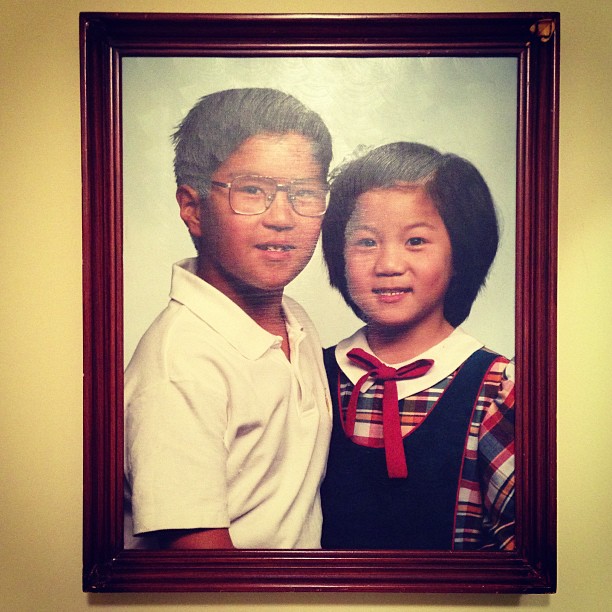
| It’s obvious who was better at math (hint: glasses). |
And this is where my brother the hero would come sweeping in, shielding me from both my mother’s eyes piercing with rage and the belt.
“Get out of the way,” she would say, “This has nothing to do with you.”
My brother would speak calmly. It is the only way he knows how to speak. “Mom, you shouldn’t hit her. You should explain to her what she’s done wrong.”
“I’ve already explained too many times and she doesn’t get it.”
“Hitting her won’t make her get it more.”
If my mother recognized my brother’s brave heroism, she didn’t show it. Instead, she’d snarl for him to get out of the way lest he wanted a beating as well.
And my brother, probably just eleven or twelve, would quake, but he would hold his ground.
“No,” he would say, “No, mom. This isn’t the right way.”
How many of your siblings would have done the same? How many of your siblings would have stood their ground and calmly convinced my mother to back off on your behalf? More than a half dozen times, in the history of my brushes with corporeal punishment, my brother came to my rescue and literally saved my ass from my mother’s belt (one, incidentally, I never saw her wear). He encouraged my mother to use reason, something my father, Mr. Reasonable (but also, Mr. Chinese Man who culturally doesn’t often have a hand in disciplining the children), wasn’t around to do. As we grew older I began to see just how different my brother and I were, and just how essential his beloved “reason” was to my personal development.
My brother could see, from his lofty perch five years ahead, exactly where I stood, but he had long mastered the art of, “It’s not worth getting into,” and “Just let it go. Just let it be.” He’s never bossed me around – I cannot recall a single moment in which he has said, “You should do this or be more like this or stop being like this,” unless of course, I solicited his opinion and then ignored it. While the number of times I’ve forced my opinions upon him, pointed my finger at him to instruct him to do something, is somewhere in the trillions.
At the core of my brother’s worldview is that people will do whatever the hell they want. For them, their way, regardless of how you see it, is the right way…even if it turns out to be a disaster. They chose their path. They dig their own grave or…build their own stairway to Heaven. Save your breath, your energy and the throbbing red you see when someone does something contrary to what you want. Save the blood for something else; you can only control yourself.
My mother tried to beat me into a better math student. Guess what? Sixteen years later, I still scored in the bottom 25% of the nation.
A hundred people tried to talk me out of dropping out of college, but my brother, acknowledging that I needed the time, merely shrugged when I told him. He flew to New York to take me home.
In Manhattan, I greeted him at what was probably my heaviest weight and instead of saying, “Oh Jesus you got fat,” which is essentially what I say each time I see him, he said, “I think you look fine.”
Our flight back was the same time as my last final. I proudly carry an ‘F’ in astronomy from NYU, knowing that while other people were scratching their heads over Orion and Uranus I was in that very sky, sitting at my brother’s side, feeling safe and loved.
When I turned twenty-five, my brother called me from Shanghai from a number that showed up “Unknown.” I didn’t pick up. He left a message in his trademark monotone. Later, when we finally did speak, I told him the “Unknown” had scared me. It was weird to see it on my phone and I was already on the cusp of so many unknowns. I didn’t need my brother’s birthday phone call to wear the same mask. My brother took note. When I turned twenty-six, he called from his US number, which shows up “Guh” and costs ten million times more. It was the tiniest gift, but he remembered, and I smiled for a long time after we hung up.
He laughs at my jokes. Generously gets my humor more than I get his, and saves me face, neither confirming nor denying and simply chuckles when I say, “You’re my number one fan, Guh! You like watching “the Betty Show!”
When people meet my brother then meet me or meet me then meet my brother, they have a hard time believing we’re related. I’m loud and have close to ten million different expressions (all ten million of which I think only my brother has seen) and mask my apparent lack of femininity by moving like a robotic Jackie Chan.
“Howard,” some people have said, even if I’m standing right in front of them, “What’s up with her.”
My brother shrugs because he knows some people are hard to explain.
“That’s my sister,” he says, “Yeah, she can be kinda manly, but she’s cool.”
I not so secretly consider myself more emotionally astute, wittier, and wiser about things like what constitutes a healthful diet (he once asked me, “Does a potato have carbs?”), but he’s perfected his temperament and patience to levels I could only wish for. I’ve tried to change him – “eat less! Be more open about your emotions!” But he won’t budge. And why should he. He’s my brother.
He’s never tried to change me. I am who I am today in part because of this. He’s zen without really knowing what Zen means; a big brother without being Big Brother.
He’s also just turned 32, married, and living in Shanghai, China, where Blogger is blocked and where I think his birthday is coming to an end. He probably won’t see this until the next time he signs into Facebook via some complicated illegal network; hell, I’m not sure he even reads my blog. But it’s his birthday, so I thought I’d paint you guys a picture.
A Monkey Named Hey-Hey
I’m sitting at grandpa’s dining table, just finishing lunch. I brought leftovers and a vegan coconut pecan tart from FreeSoul Caffe. He actually likes it.
Chewing thoughtfully on a pecan, he nods, “Walnuts,” he says.
I tell him it’s actually the walnut’s cousin, but I don’t know its Chinese name.
He takes another bite, “No, no,” he says, “This is walnut.”
His next forkful brings more coconut than pecan.
“This is good, this coconut,” he says. He’s never had it toasted, sprinkled with sugar.
The spoon poised in midair, he poses a question to me:
“Do you know how people get coconuts from the coconut tree?”
“They send someone up there,” I say. I think about the limber young men I saw in Thailand so many years ago, when I visited with my other grandpa. They scrambled up the tree with nothing more than a thick strap and a machete hanging from their waistbands. They were skinny, but were fast and strong, barely breaking a sweat shimmying up the slender trunks when us bystanders were sweating profusely just watching them. They hacked the coconuts off and tossed them to a guy below who hacked off the tops and sold the coconuts for a few cents each. Pity him if he was a poor catcher. More recently in Kauai, I saw less athletic guys being lifted up in cranes. They had chainsaws to prune the trees and let the fronds and coconuts fall to the ground.
Grandpa shakes his head. Apparently we are not talking about the same people.
“Monkeys,” grandpa says, “They send monkeys up there.”
I laugh, “And where do the people use monkeys to get coconuts?”
“Hainan Island,” he says with the slightest whiff of disdain in his voice, as though it was something I ought to have learned in elementary school along with addition and subtraction, “People trained monkeys to harvest coconuts for them.”
He puts the spoon down and brushes his hand over his mouth, checking for crumbs, “But we didn’t use monkeys.”
“No?”
“No. We didn’t have monkeys. So we used our guns.”
“Guns?” A loud scene from “Predator” dances in my head, “Machine guns?”
“Something a little smaller than machine guns,” grandpa says, “but still, we went ‘pa-pa-pa-pa-pa!‘” Grandpa mimics shooting at coconuts in the sky, pointing his right index finger upwards towards the asbestos ceiling. “And they’d come falling out of the tree. But of course sometimes we would ruin the coconuts.” Grandpa makes an exploding motion with his hands.
My heart aches for all the destroyed coconuts. After greek yogurt, whipped cream, sour cream and ice cream, coconut flesh is probably my favorite food.
“Couldn’t you just borrow somebody’s monkey?”
“Borrow somebody’s monkey! Puh!” he scoffs, “You couldn’t just borrow somebody’s monkey. Those monkeys only listened to one master. You’d be lucky if you could get a monkey to eat a banana out of your hand.”
A few minutes later, he looks up. His expression has softened and his eyes have an odd faraway look.
“I had a monkey once.”
What?
| George Stubbs A Monkey, (duh), 1799 Oil on Panel, Walker Art Gallery |
“Well not just me. With the other seven men in my troop. We bought a monkey for a dollar in the mountains of Hainan island, where our troop was based. Monkeys were everywhere, and the mountain people were much better than we were at catching them. They sell them in the mountains – well, they’re so cheap, you just give them a dollar for catching the monkey for you. It’s like a tip.”
“No,” says grandpa, “We didn’t give him a name.”
I’m disappointed. The first thing I would do, after buying a monkey for one dollar in the Hainan mountains, would be to name him.
“How long was he with you guys?”
Grandpa thinks for a minute, “Less than a year, but several months. He traveled with us from Hainan to Guangzhou. Took the boat with us. Marched with us.”
“Marched with you?” I imagine a monkey wearing a miniature forest green soldier’s suit, carrying a miniature machine gun, scurrying in and out amongst shiny soldier’s boots.
Grandpa laughs, “Of course he didn’t march, he sat on our shoulders while we marched. But he was good company.”
“He was such good company and you didn’t give him a name?”
Grandpa considers this, furrowing his brow. “It was so long ago,” he says, and I wonder if it was still as vivid in his mind as it is in mine. “Another troop had a monkey too, it was much bigger than our monkey.” Grandpa raises his hand a foot off the table, “Our monkey was this tall,” then raises his hand six inches higher, “Theirs was this tall. But we liked our monkey just fine. I guess…I guess we called him… ‘Hey-hey.'”
“Hey-hey?”
“Yes,” grandpa make a beckoning motion with his hand, “As in ‘Hey-Hey, come over here.’ And the monkey would come over.”
He leans back, smiling, “He became our ninth man.”
“Hey-hey! Over here!”
“Psst! Over here, Hey-hey!”
For men away from home, away from wives and children, away from their very futures, Hey-hey was a small, lively relief. Sometimes Grandpa remembers a lot from the war, sometimes he can’t remember anything. Sometimes he doesn’t want to talk about it.
“What happened to Hey-hey?” I asked.
Grandpa searches a bit before responding, “We lost him, I guess, after the Communists came and destroyed our troops. He disappeared after that. It’s hard to say what happened. I don’t remember exactly. One day he was gone. Maybe he ran away into the forest or maybe he was killed…”
“You don’t remember?”
He gives me an incredulous look, “We were fighting the Communists in hand to hand combat! We lost a lot of things. My fellow soldiers were dying. I didn’t have time to consider what happened to the monkey, I was lucky to be alive.”
I consider this. It is a good point. I really don’t understand anything sometimes.
Still, I can tell Hey-hey is dancing around in his head, his furry face slightly blurred, like the faces of those he marched with. No one ever says war is a good thing, but there’s a reason men get nostalgic about their army days. Grandpa sighs, then yawns, glancing at the clock. It’s not yet 1PM, though he wants it to be; his eyes are getting heavy. In the army there was no time for naps, and now, some days, it’s all he wants to do. He shakes his head as though to shake away the sleepiness, but like his age, it clings to him more stubbornly than his memories. He rubs his mottled face and shakes his head. His favorite thing to do now: shake his head and think, or not think, about the past.
Dad Comes Back

In about an hour I’ll change out of my pajamas (uniform of the unemployed) and drive some fifty minutes to LAX, where my father’s plane will have just landed. He’ll be itching to stand up and stretch his legs, perhaps help an elderly woman retrieve her bags from the overhead bin just as I’m switching freeways. Continue reading “Dad Comes Back”
Nail Polish
This afternoon I brought over a bottle of nail polish to grandpa’s house.
“What is that for?” He asked, seeing me place it on the table.
“I’m doing my nails before we leave for Las Vegas.”
He grunted at this admission of superficiality then turned on the television.
A while later, he turned to watch me put the finishing touches on my toes.
“You’d better wash your hands after touching your feet like that,” he said.
I smiled punkishly and screwed the bottle closed. “I’ll just wash them okay,” I said, “Just before I serve you lunch.”
![]() |
| Suzanne Valdon (1865-1938) Jeune Femme Assise Oil on Canvas |
After lunch, the polish was dried and I lifted my feet to show him. They shone a bright glossy red called “hip-anema” (by Essie, in case you’re wondering), and I was quite pleased with the result.
“What do you think?” I asked him, wiggling my toes in the air in a fashion rather unbecoming of a twenty-seven year old lady, at the lunch table with her grandfather, no less.
He barely glanced at my feet and shook his head, continuing instead to work his teeth with a toothpick.
“You don’t like it?”
“No,” he said simply, but I could tell he was trying not to smile.
I shrugged and rose to clear the table for dessert, a vegan coconut pecan cream tart. I didn’t tell him it was vegan. Surprisingly he liked it. I refilled his tea and peppered him with some questions about his time in the army. There were, during the lighter times, coconuts and a monkey named Hey Hey.
Finally he looked at the clock. One PM – nap time. He made his way towards the living room while I flopped down on the couch in front of the TV. I put my feet up on the opposite armrest and gazed at them. Kind of like navel gazing, but further away. The early afternoon sun glinted off my freshly painted toenails and beyond them, grandpa’s hunched, sleepy figure was about to turn the corner.
I wasn’t satisfied.
“Grandpa!” I called.
He paused but didn’t turn around. A mottled hand rested on the wall for support.
“You really don’t like my nails?”
He turned his head just slightly, one foot on the single step that led to the living room, “No, I do not. Not even a little bit.”
“Oh.”
“But it doesn’t matter what other people think,” he said, a yawn creeping into his gravelly voice, “As long as you like them.”
“But I really want you to like them,” I whined.
He lifted the other leg to turn the corner and chuckled with the confidence of a man who knew when his opinion mattered. In this case, it did not. What mattered was that he played along. And splendidly, as Grandpa does, he played along.
“Well,” he said, disappearing behind the wall, “You are asking too much.”
That Betty

The Post Office in my home town was, up until she retired just a year ago, most often (wo)manned by a lady named Betty, aged sixty-some years. She is a proper Betty, meaning she was born in the forties, a time when the name “Betty” was quite popular for baby girls for whom their parents had grand dreams. These Bettys would go to college, marry well, start families and most likely not name their children Betty. By the time the later decades rolled around, there were other names were more in vogue. Continue reading “That Betty”
Le Flaneur Mal

A few years ago while visiting me at Berkeley, a friend chided me for not being the thing that a writer most needs to be. Continue reading “Le Flaneur Mal”
How Not To Fight Jet Lag

I woke up at 5AM, considered blogging about something relating to that strange feeling I get when I wake up at 5AM. I sat at the edge of my bed, marveling at the fact that less than twenty-four hours before waking, I was at a club in Taiwan called- and I’m almost embarrassed to say it -Myst. Continue reading “How Not To Fight Jet Lag”