Greetings from Hualien (花蓮), Taiwan.

I’m sitting at a small desk in our hotel in Hualien, blogging for the first time in 2015. Continue reading “On Writing: How to Write (?)”
I’m sitting at a small desk in our hotel in Hualien, blogging for the first time in 2015. Continue reading “On Writing: How to Write (?)”
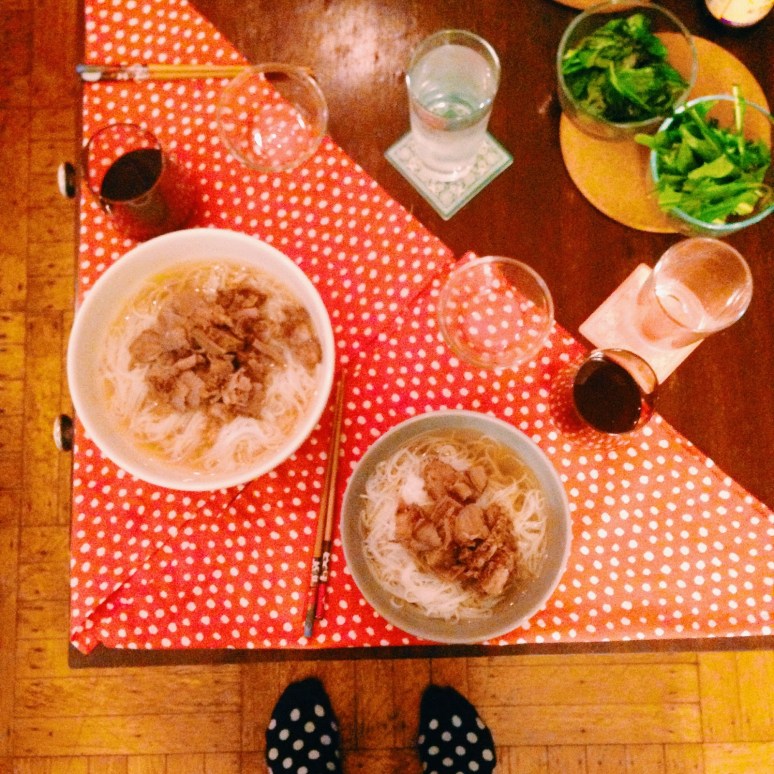
It was our anniversary yesterday and I had given Tom the actual day to plan something and taken the Wednesday after for myself (we are going to Briciola, a wine bar, and watching “A Gentleman’s Guide to Love and Murder” at the Walter Kerr Theater).
Then, on Sunday night he said, “Minh and Paul invited us over for Pho on Tuesday.”

“You have it too easy,” my aunt said, said stroking my hair, “You’re not depressed. You just have difficulty.” Continue reading “Taipei Jeans: A Flashback”
Lately, I have not been feeling like myself. But then I wonder, what is “myself?”
This last month, perhaps longer, has been trying. I have cried more than anyone in my situation (a good relationship, making slow but certain progress in school, surrounded by friends, most of whom I met through Tom, and with kind, patient parents who came to visit and found my boyfriend charming if not the city) ought to, for reasons both big and small and sometimes, for no (apparent) reason at all. I have started fights at midnight and made both of us bleary eyed with exhaustion.
I over think things. I know this. But by now, at the age of twenty-eight and having gone through what I think, what I hope, are similar times, I should know now how to tell the difference between my mood in a time of change and uncertainty versus my general temperament. I wonder if it’s something physiological. Some chemistry I don’t quite understand but which I try to temper by taking fish oils and Vitamin C and making sure I get enough sun on my face and skin and eyes… But nothing. In short, I should know the answer to, “Is this how I am?” or “Is this how I am right now?”
On a whim, my professor changed the final assignment.

A few summers ago in Taiwan, when my aunt had gently shook me awake. It was 9AM and she was about to leave for the office.
“When you and Karen go out today, if you turn left, cross the street.” Continue reading “New York Diary: Neighbors”
 |
| You are here. |
This semester, I’m taking a seminar called “Writing the City.” Before class started the professor gave us an assignment: to take the C or A trains to Nostrand Avenue in Brooklyn and walk “with maximum openness and attention, building a narrative out of what you see, overhear, actual encounters, your insights, responses… The chronicle of a writer’s walk, however you choose to craft it.” Continue reading “Photographs of Brooklyn’s Nostrand Avenue”
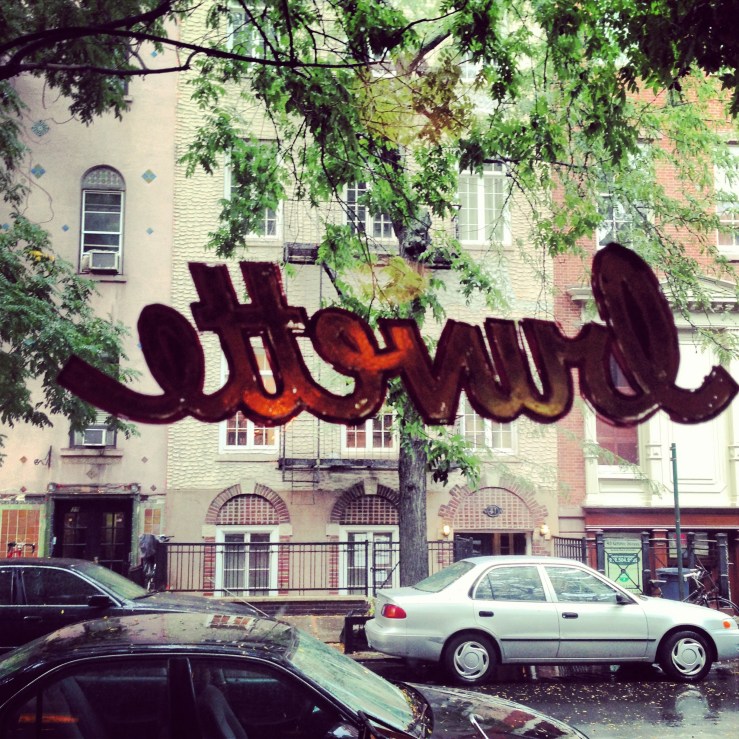
The day I left for California, POI took me to lunch at Buvette, one of my favorite cafes in New York. Continue reading “Bon Mots at Buvette: The Best Lunch Date in New York City”
POI, reticent about his family, did tell me this:
“Don’t say anything racist when you meet my mom.”
As I write this, POI, in London for work, is reading a long email I wrote him late last night.
“I’m assuming you’ll read this in the morning, hence the subject line – and indeed the sun should be showing her face in your part of the world soon.”
“You call everything ‘her’,” he texts, “I don’t think the sun is so equipped.”
I type a single question mark and wait patiently for the wiseacre remark, sure to come.
“No sungina,” he responds.
My mother would call this, “Playing piano to a cow.”
“Meet some peeps,” he had said, when really he meant nearly twenty of his closest friends in New York City.
“Will they let me in if I only have my bachelor’s?” I joked.
We were texting, but he had slapped his head, groaned. A few months later he would bring it up again and I smiled, knowing I had crafted a really good terrible joke.
We said goodbye a few days later, the fifth date. What is this obsession with numbering the dates, you wonder. Not an obsession – just a statement of what to me, seemed at the time to be crucial facts. Prior to POI I had never gone on more than three dates with anyone.
So that night, to be walking by the giant post office on 8th Ave., a massive reminder of a dying art – seemed a marvel in itself. We strolled alongside the steps and I recall thinking how odd and quiet that street was. I felt too, a light feeling – it’s called “hope,” I think. I thought about his rooftop from where the bright red sign of the New Yorker hotel could be seen.
I could, I said to him, not would – could – write to him when he was in London. But of course I would.
“I haven’t written a letter in…probably twenty years,” he said.
This was the expected answer. I was already doing that thing where I lowered expectations because I was beginning to like someone.
“I’ll write,” I offered, “You email.”
“No no,” he said, “I can pop out a few letters,” (or something to that effect).
It’s in his possession now, perched precariously at the edge of his dresser along with the rest of my notecards and letters, sent steadily over the four months he lived in London. There are letter-pressed New York greeting cards with a few lines – “I miss you! See you soon!” – and stuck in between, multi-pagers on lined notebook paper, some written in cafes, others in spurts during tedious lectures and seminars- “I am sitting in my Spy Novel class and some girl is droning on and on about feminism. The professor is trying very hard to look engaged….” etc. etc. Even when I write, I like to hear myself talk. But that’s beside the point.
He never wrote me back – not longhand – but there were phone calls, text messages and short, practical emails, mostly logistics regarding my trips to London. Though once, when I had not heard from him via text or email for two days and despaired that his affections were waning, I found in my inbox later that night a sonnet written to near perfect iambic pentameter.
It was one of those things; you’re supposed to read it quietly and go to bed with a wan, wide smile while keeping certain cards close to your chest – but I told him immediately that I was speechless. Which, if you think of it, is an outright lie.
 |
| Edward Hopper, “Hotel Room” 1931 Oil on Canvas |
Despite his never writing back, despite his never responding outright to anything I wrote in my letters (this is fine because I don’t ask questions in my letters. I show and tell), not once did I suspect him of casting my lengthy epistles aside (as some of my best friends have admitted to doing so). This is the modern letter writer’s entitled presumption. Like psychopaths and greasers, we are an uncommon breed (says the blogger too). A handwritten note is not only rare, it’s more thoughtful; to write by hand is to use a different part of the brain, a part closer to the heart. Thus to receive a handwritten letter, when the writer in question could very well be writing other things to other people… that’s equivalent to saying, You’re welcome. I made you feel special.
But that’s not why I did it. For the most part – and accomplished letter writers adhere to this rule lest we waste precious time and costly, fancy stationery: know your audience. I knew POI to be a reader. And I knew him to be “into me,” as the lingo goes.
When I visited London, I saw that he had propped the greeting cards up on a shelf. I asked where he kept the letters.
“The ten pagers?”
I laughed.
He pulled open his bedside drawer. I saw them there, scattered like old friends at a slumber party.
“What did you think,” I said, “‘Whoa this Betty blathers on and on?'”
“No,” he said. We were not there yet – the stage of being honest. “I mean, you can get really serious sometimes (POI code for ‘sappy’) but some parts of certain letters were pretty funny.”
He sat down at the edge of the bed to look for the excerpts and I left the room – not because I wasn’t interested but because the “replies” I was looking for I found. He had kept my letters.
 VERY HIGHBROW