Travelogue: London Memories

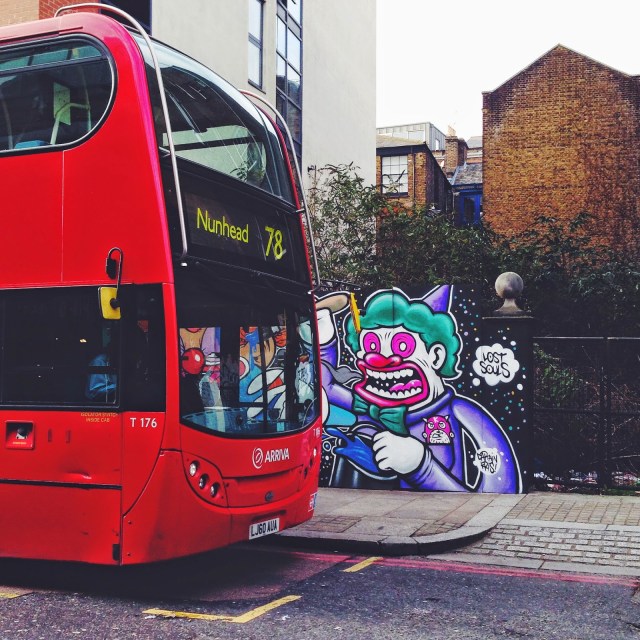
Lost souls please go to Nunhead

This time last year, I was readying to visit Tom in London a second time. The plan was to spend a weekend in Cambridge, return to London and rendezvous with some friends who were also visiting the city, attend Tom’s raucous company holiday party and then, the morning after and presumably hungover, board the Eurostar to spend two gluttonous days in Paris before heading back to London to pack and move Tom back to New York.  


I packed, among other necessities, a white party dress dress, a pair of velvet heels, and a leopard coat. I thought Tom liked the leopard coat because I had sent him a photo of it and he had replied, “Hot.” Over text message, I could see neither a look of disgust nor hear a groan. 

So I thought, “Yeah, super hot.”

I landed at 7AM on the morning of Friday, December 6th and met, at the customs border, a surly, sleep-deprived woman who could be classified as “matronly” in the worst way possible, and “bitchy” in its usual way. Her hair was thinning and her skin, sallow and splotchy, sagged like the elbow patches of her dumpy blue sweater uniform. I wondered how many cigarettes she smoked during her infrequent breaks and how often she thought of shooting herself. Or cheery young foreigners like myself, who came with the expectation to have as much fun as possible. I smiled at her as I always smile to such personnel. I read in a magazine that sometimes smiles are infectious and she looked like she needed one. However, my smile bounced off her soulless eyes and she remained dour. She dully asked how many days I was staying.

“Ten,” I said. 

“What are you here for?” 

“Visiting a friend.” 

“Male, female?” 
“Male.” 

She nodded as she paged languidly through my passport, yawned. Perhaps she found it boring – I had renewed my passport prior to starting school in New York and had just one stamp in it, from my first visit to London back in October. 

“How did you meet him?” 

“We met in New York.” 

She stopped turning the pages and looked up at me. Her expression grew annoyed, then weary, like a haggard schoolteacher having caught her student in a lie.

“So he’s a boyfriend, then?” 

“Um…” I thought back to a half a month before, when Tom and I had defined the relationship but had also not said expressly, the terms “boyfriend” and “girlfriend.” 

“…I guess?” I started to explain that we were dating and we hadn’t really ever said those words, and I cringed as I spoke, part of my consciousness stepping out from my body and watching me explain a rather simple but in the same way complicated situation to a woman who honestly had no business but who seemed at once to care too much and too little. She didn’t have time for incoherent explanations, thank god. 

“Look, he’s your boyfriend,” she snapped, “So just say ‘boyfriend’ and not ‘friend.'” She manhandled my passport, stamping it with a withering look and then waved me off.

A few feet past her cell there was a massive, brightly lit banner that said, “Welcome to London!” and showcased many a smiling Brit. Not surprisingly, my customs officer was not among them.
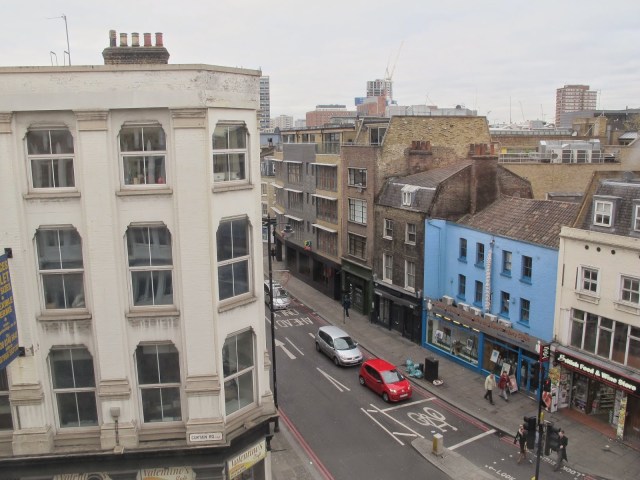
The view from Tom’s window. 

Two hours later I was at the corner of Curtain Road and Old St., where Tom’s corporate apartment was located. We stood across the street from each other for a few moments, waiting black London cabs and red double-deckers roll by. I smiled between each vehicle. Tom waved to me from across the street. I waved back, the hem of my leopard coat billowing in the brisk London air. The light changed and he walked over. I thought he was smiling but as he came closer, saw it was a pained expression with a smile plastered on.  

“What are you wearing,” he said.  

I was confused. Hadn’t he said it was “hot?” 

“You don’t like it?”

“You look like you escaped from the jungle.” 

I was thankful to have brought along another coat in a much more subdued black. But still, I liked the leopard and felt that he should know. 

“Okay so what? If I wear it you won’t walk with me?”

“Oh I’ll walk with you,” Tom said, taking my suitcase, “Right into a coat store.”
Sure that’s all they took? 

You and I: A Story about Defining the Relationship

dc82c-img_9857

“Oh, no, I’m not saying she isn’t a nut — she is — but I’ve noticed before that sometimes someone like that behaves quite ordinarily with everybody, manages everything, you’d never think she was a nut, but there’s just one person, with that person, she’s out of control. It makes you wonder.”
― Doris Lessing, The Good Terrorist

Continue reading “You and I: A Story about Defining the Relationship”

New York Encounters: At Bergdorf Goodman

Over the weekend, a friend with expensive taste visited from Philadelphia.

“Take me shopping,” she said.

Bergdorf Goodman,” I suggested, not because I’d ever purchased anything there, but because once, I had afternoon tea there with my cousin and, over a tier of rather bland cakes and scones, observed such a medley of people: from the rich to the superrich to the not-so-rich pretending to be rich – all rather idle – that I thought my friend ought to see the same. For purely anthropological reasons if nothing else.

We went on a Saturday afternoon and as per the average price tag of most items hovering around $3,000 (perhaps a Bergdorf merchandiser will stumble upon this blog and laugh at how off the number is), it was decidedly less crowded than say, Macy’s or Forever 21. I picked up crocodile clutches and put them back down. My friend, her mother having raised her with different material standards than mine (who proudly shops at T.J. Maxx and boasts how everything, regardless of what or when she bought it, costs “around seven dollars”) pointed at a few two to three thousand dollar handbags.

“I have that. I love it. Oh I have that one too. It’s great. Very functional.”

There was a Balenciaga I really liked. I tried it on and then looked at the price tag. $1,670.

“Ah.” I smiled the “just looking” smile at the sales woman who was coming closer and closer and put the bag down. “Perhaps another time.”

“That’s actually a really good price for a bag that quality,” my friend said with kind earnesty.

I marveled at how two young woman could be shopping in the same very real place, each operating in their own fiscal realities.

“I want to see Moncler,” she said, citing an expensive maker of down jackets and winter wear. We had already seen a small selection of Moncler at the Barney’s in the Upper West Side, but the styles were not “outrageous” enough, as my friend put it. She is a small, thin girl with big, fat style, and a budget to match the latter. I shrugged, “Sure,” and asked a rather bored young man wearing a Barney’s lanyard around his neck what floor.

“Six,” he said, nodding towards the escalators.

The day was getting late and I wanted to head home after Moncler. I had to do some reading for class and thought it better to let my friend shop in her natural state, that is, without a less budget-sensitive friend hovering around. I suspected my friend was holding back many a credit card swipe.

“Let’s take the elevator,” I said.

We waited but two minutes at the elevator bank before the door furthest to the right dinged. A moneyed young couple stepped out, like walking mannequins from a Brooks Brothers window. Seeing no one else, we started towards the open door.

As I stepped in, an elderly lady wearing an enormous, blonde fur coat emerged, as suddenly as a woman her age could.

“Oh,” I said.

“Oh,” she said. She looked dazed, and had one foot out the elevator and a tentative look about her creased face, which was poorly made up. Her lips and cheeks were too pink and the complexion around it nearly grey, as though the foundation had expired some decades ago. There was, above the deeply creased lips a thick mustache which she decided to leave three, four shades darker than her hair, which was too blonde. I wondered if it was a wig. It had a plasticky sheen to it. Her recently manicured nails, the only fresh thing about her, were painted a ghastly shade of teal.

She looked at me without really looking at me.

“Is this going down?”

I looked up and saw that the down arrow was lit.

“It is,” I said, and took a step back, expecting her to do the same.

“Can you get in?”

I cocked my head, wondering if she’d heard me wrong.

“We’re going up,” I said.

“It doesn’t matter,” she said, putting one wrinkled hand up on the doors to keep them open and waving the other at me towards her, “Just get in will you. I hate riding alone in these things.”

My friend looked up from her phone, “What’s going on?”

I did what I felt was the obvious thing and motioned for her to get in.

“It’s going down,” she said.

“Just get in,” I said, switching to Chinese – my friend is from Taiwan – “This lady is a bit senile and she doesn’t want to ride in the elevator alone.”

My friend raised an eyebrow, said nothing else, and followed me into the elevator.

In the short ride down, I snuck glances at this strange, old creature, though I doubt she would have noticed even if I had ogled her, so rapt was her attention to the lights indicating which floor the elevator was on. She tapped her fingers against the fur coat, which my limited experience with such luxe materials prevents me from describing accurately, except I can say with confidence that it was real – perhaps an heirloom piece from another time. Her perfume was very strong, (equally inadequate is my sense of smell. I cannot describe perfume any other way but to say, “It was strong,” or “What? She was wearing perfume?”) and I saw now that the lipstick was not just on her lips, but all around them too.

For the ten seconds we rode in the lift together I wondered about her life and her fears and, as I usually do with women her age who are out and about alone, if her husband was still alive. I also wondered whether in God’s name her house had any mirrors. I imagined her living in a dark, unaired, unkempt, formerly glorious Park Avenue penthouse like a New York cousin of Miss Havisham, and was beginning to mentally squint my way through its musty dark halls when the elevator dinged and the doors slid open to reveal, almost incongruously, the glossy white floor of the spotless beauty department.

In keeping with her fear of elevators, the old woman practically jumped out with surprising lightness of foot as I stood slightly slack-jawed in the middle of the elevator.

“Thanks,” she warbled, lifting her hand and tossing a breezy wave in my general direction, “Bye.”

The doors began to close and I, amused the second time that day by a discrepancy in realities, watched the blonde head on the blonde coat make a beeline for La Mer.
The Perks of Keeping a Diary and Blogging

Lately, I have not been feeling like myself. But then I wonder, what is “myself?”

A few nights ago at dinner, Tom said to me, “You are cheerier than usual.”

I looked at him over the flame of a small votive candle. 
“Am I normally not?” though this was a dangerous question and one I did not want him to answer honestly.

This last month, perhaps longer, has been trying. I have cried more than anyone in my situation (a good relationship, making slow but certain progress in school, surrounded by friends, most of whom I met through Tom, and with kind, patient parents who came to visit and found my boyfriend charming if not the city) ought to, for reasons both big and small and sometimes, for no (apparent) reason at all. I have started fights at midnight and made both of us bleary eyed with exhaustion. 

Tom shook his head, “No, you’re usually pretty cheery -” he paused – “You’re always cheery. But tonight you’re super cheery.” 
I was indeed cheery that night – we were having a pizza date in the East Village – and the night before. For two days a certain peace had washed over me – I had, I thought, accepted things that I was either to accept or reject.
I was cheery too, yesterday, when we, along with two friends, drove an hour to the New Jersey countryside to do east coast fall things: a brisk hike through a crisp, golden forest, a small lunch of cider hotdogs and doughnuts, and a corn maze through which we entered and hours later – chilled, exhausted but triumphant – emerged. 
Some days, when outings are planned and the weather is fine and there is nothing to do really, but move your legs and breathe the air and listen and add to the chatter, it is easy to be cheery. But by the day’s end, you are tired and one misinterpreted word from your lover’s mouth can push your fatigue into a darker mood.

I over think things. I know this. But by now, at the age of twenty-eight and having gone through what I think, what I hope, are similar times, I should know now how to tell the difference between my mood in a time of change and uncertainty versus my general temperament. I wonder if it’s something physiological. Some chemistry I don’t quite understand but which I try to temper by taking fish oils and Vitamin C and making sure I get enough sun on my face and skin and eyes… But nothing. In short, I should know the answer to, “Is this how I am?” or “Is this how I am right now?” 

——-
This morning I struggled for the answer while zoning out in lecture. I thought about the diaries I’d written when I was younger and when, I assume, I was “happier.” Happier in that I didn’t think so much, didn’t plague myself with thoughts about the future, which won’t reveal itself anyway, not it’s full face and shape, until it arrives. I looked forward to things most children looked forward to: the weekends, or more specifically, the hours after Chinese school. I relished warm Thursday afternoons in early summer, when I’d finished my homework and there was nothing left to do but climb the tree outside my window, then swim, and eat dinner. Maybe, if my mother allowed, I would watch some television. I counted down the days to winter break ski holidays with my cousins, and Christmas and Thanksgiving and Halloween! I’d anticipate the end of the year at the start of fall, and allow my excitement to build backwards. 
When I was sixteen a particularly nasty mood hit me – a petulant, tyrannical dark cloud that screamed, “out with the old Betty and in with the new!” – because back then, I used diaries as an attempt to reinvent myself, to just myself – and I threw those diaries away. 
I have no written record of what life was like before that age. It makes me sad to think that I might be writing over words I’d written before, on some ream of recycled paper I bought from Staples. 
Shortly thereafter, I started my first blog. A Xanga. I wrote in it for a few years before another mood struck and I began a new Xanga. Another mood, another time. A few years after that, something changed again, and I was on Blogger, as Very Highbrow, to which I am still faithful and intend to keep. 
Some things don’t change, as much as I would like them to – not because they can’t, but because they shouldn’t. But from time to time I want to reread my old stuff, revisit the old me, because the old me is always, still me. 
I remembered the password to my old archives for my second Xanga, but could not for the life of me remember the first. Xanga, now defunct, had archived all my old entries, but I could not access them with neither the password nor the email I had used over ten years ago. I have tried at least twice a year for the past three years to remember or retrieve that password, but the archives remained infuriatingly out of reach: just a small password box in the way. 
And then in class today, zoning out, I heard my professor say a few familiar words, among them, my old password sans the numbers I attach to the end of most password. I sat up, startled.  
I opened my computer and a few minutes later, voilà: Betty at sixteen, seventeen, eighteen. Betty from a decade ago downloaded onto present Betty’s computer in five seconds flat. 
Just a few pages of code but several hundred thousand words explaining, exploring. A person growing. 

Writing the City: A New York Diary

On a whim, my professor changed the final assignment.

We were reading “What I saw” by Joseph Roth and thumbing the pages during our class discussion, he revisited something valuable. 
“Why not let’s do this,” he said, waving his hands as though to stir up the proposal still taking shape in his head, “Yes, yes, this is much better than the original assignment I have planned.” 
It’s simple: keep a journal. An urban diary of life – your life – in the city. Write it longhand if you wish, and for God’s sake don’t agonize over it. That’s what workshop is for. Try to write every day and at the end of the semester, turn in your best, your favorite 1500 words. 
A few of us groaned. More writing on top of the twenty to thirty pages we were already expected to churn out each week for our thesis workshops. Also, we haven’t been asked to keep a journal since elementary school… 

“Dear Diary, 

Today at recess I kicked a girl in the stomach...” 
A girl from Egypt raised her hand. She is a journalism student with a concentration on arts reporting. What was the original assignment? 
The professor looked at her with a curious expression that said, “Does it matter?” 
He is a curious man with wild salt and pepper hair and a chin that protrudes slightly more than the rest of his face. He is well-dressed in a New York not-quite-young but not-quite-old professorial way: fitted, faded jeans, blazer, worn but probably expensive polo shirt in dark blues and greys. Sometimes he wears a narrow, striped scarf, the kind that makes me wonder: “Yes but…does it keep the neck warm?” It certainly does nothing to tamper the scratchiness of his voice. 
On his narrow nose rests narrow black framed glasses and always at his ankles sits a single, slim briefcase, probably hand-stitched, the leather on the handles worn as well as the bottom, from being placed then picked up on classroom and subway floors. He wears no wedding ring, though he is reasonably handsome and reasonably successful, and it is only after our third or fourth class that I go home and Google him – he’s written two memoirs, one about his daughter’s mental illness and another about his struggles as a writer. 
I once saw him reading on the subway, sitting between a fat black woman and a student not unlike myself, a young Asian woman with hair pulled back into a pony tail, wearing a light sweater and jeans, flats. She was reading a printout, dense with text. My professor, the briefcase now between his ankles, read a slim volume I couldn’t see the title of but was certain it wasn’t something he’d assigned for our class. 
I stood half a car away and wondered if I should walk over to say hello – there was space in front of him – but decided to stay put because I felt it would be awkward to tower over him, my belly in his face trying to make small talk. I guessed he would get off the train at 96th and transfer to an express train – the 2 or 3 to Brooklyn where I swore he lived. I wanted to know where he lived so I could pat myself on the back and say my assumptions were right. 
But he remained seated and I, disappointed, got off. I remembered what he’d said in class. 
“When you write this diary, see if you can put your assumptions away.” 
I pushed through the turnstile, momentarily jostled by a group of young musicians and their sleek instruments made unwieldy by nylon cases and hard shells, and wondered if for me, that was possible.  

Meeting the Parents, Part 1

By this time next week, my parents will have been in New York for one day. They are coming to visit me en route to Canada, where they’ll rendezvous with their retired friends to take in Canada’s fall foliage.

“It’s a good time of year,” I said, when they first proposed the dates, “It won’t be too cold, and there might be a hint of fall colors. And it’s about time you guys met Tom.”

My father grunted, “I don’t need to meet him. I’ve seen his picture.”

“Betty’s right,” my mother said. I could picture her smiling into the receiver. “It’s about time we visited her in New York and met Mr. Tom.”

—-

The last time my mom came to New York was ten years ago, to help me move into NYU. I was eighteen and in New York for the second time ever. My brother and cousin Karen came with and the week before school started, we rented an old but clean two bedroom apartment near Greenwich Village. We bought breakfast foods from the nearby Morton Williams, made toast and fried eggs in the mornings and walked around the city, doing the requisite touristy things – we went to the top of the Empire State Building, saw the Statue of Liberty, took a photo or two in Times Square.

They accompanied me on multiple trips to the first two (or was it three) story Bed Bath and Beyond I’d ever been to, and made sure I had all the necessary dorm room items – scratchy sheets, a too-warm duvet, laundry basket, plastic storage bins, a desk lamp. There was also a shitty, three-cup rice cooker that always produced something closer to congee regardless of how much water I put in. For dinners, because there was no such thing as Yelp! and as I was coming from suburbia and emerging from an age where The Cheesecake Factory was a good restaurant, we ate at restaurants that have surely since been shuttered. There was however one Chinese restaurant we wandered into one evening, and which I continued to frequent after my mom, brother and Karen left. It was called Wok n’ Roll. A quick Yelp! search tells me there are many Chinese restaurants in and around New York with the same name, but the one I, and my roommate too, after I’d taken her there one evening, returned to time and again in Greenwich Village no longer exists. It helped me through some hard times, but the abundance of grease, sugar and MSG in the delicious orange chicken – no doubt it made the hard times harder.

That first week in New York, I ignored the lineup of orientation and welcome activities NYU held for incoming freshman, telling myself my family was in town and my time would be better spent hanging with them. I could, and would make new friends later. This is only partially true.

What happened when they, my familiar cocoon left, is that I cried on the corner of Washington Square Park for a good ten minutes as their taxi drove off. I could see my cousin Karen turning around to look at me from the rearview mirror until my tears blurred her face. They turned left and out of sight. I was alone in New York City.

A few months later, after a tear-ridden telephone conversation with my parents about feeling depressed and directionless, my mother bought a plane ticket and booked a hotel room. She would come to New York, she said, and take me home. Unbeknownst to me, my brother told my mother to calm down. He’d come to New York alone and bring me home. He called me one chilly December evening, as I was trudging home from another mind-numbing astronomy class, and asked what I wanted for dinner. He was at JFK, and would be in Manhattan within an hour.

I screamed, then said I could eat whatever. I was very fat then.

“Steak,” he said, because he always wants steak, “Let’s get a good steak.”

I forget where we ate that night, but I remember smiling across the table from my brother, feeling less anxious and happier than I’d been in a long while. I called my mother that night and told her I was coming home, that I was done with New York. For a while.

“Good,” she said, so was she. For a while.

——
A few days ago my mother called to ask if I needed anything from home.

I was sitting with Tom in his room, deliberating what to read before bed.

“Nope,” I said, thinking about all the unread books I had at home, “I’ve got everything I need right here.”

“Good,” she said.

“I’ve been thinking about your visit though,” I said, “Is there anything in particular you and dad want to see?”

“No, not really.”

“No like…scenic spot you guys really want to see?”

“No museums. And I doubt your dad will want to sit through any shows.”

I smiled. My father’s last trip to New York was some fifteen, twenty years ago, when he’d come with a friend cum business partner, Uncle Xia, and Uncle Xia’s sister. They had had a few steak dinners and attended a concert at Lincoln Center, where both my father and Uncle Xia fell asleep, snoring. Some minutes later an usher tapped my father on the shoulder, politely asking them to leave.

My father was sitting next to my mother, who had me on speakerphone. “I want to see Columbia,” he called out, “And that one park in the middle.”

“Bah. Central Park. It’s called Central Park.”

“I just want to see you and your little apartment,” my mother said, “And I want to meet Mr. Tom!”

“I know,” I cast a sideways glance at Tom, knowing he was anxious about meeting them.

“I’m going to get my hair cut tomorrow,” my mother said brightly, “I don’t want Tom to think, ‘My goodness Betty’s mom is a slob!'”

I laughed, “He wouldn’t think that. And besides, at least you have hair to cut.”

Tom heard my mother’s loud laugh and gave me a look. He hears his name enough amidst flurries of Mandarin to know he is often the topic of conversation.

“Don’t poke fun at him,” my mother said.

“He can handle it.”

We discussed the weather (“I don’t know. It might be cold. It might be really cold. It might not be cold at all. It might rain every day. It might be sunny.”) then said good night and hung up. I turned to Tom.

“Did you hear my mom laugh?”

“I did,” he said, putting down his Kindle.

“She said she was going to get her hair cut for you, because she didn’t want you to think she was a slob.”

He chuckled.

“I told her at least she has hair to cut.”

He rolled his eyes, “Har har.”

“They’re very excited to meet you.”

He groaned, suddenly looking very tired. “It’s going to be awful.”

I shook my head, patted his arm. There, there. I knew my parents and I knew Tom. I knew it would be anything but.