Macau Photo Diary: The Trading Gates

I didn’t know much about Macau. Admittedly, I still don’t. It just seemed like one of those places you try and make time for if you’re already in Hong Kong because, well, it’s there. My father, not a gambling man unlike most of his friends, likes it for the food. 

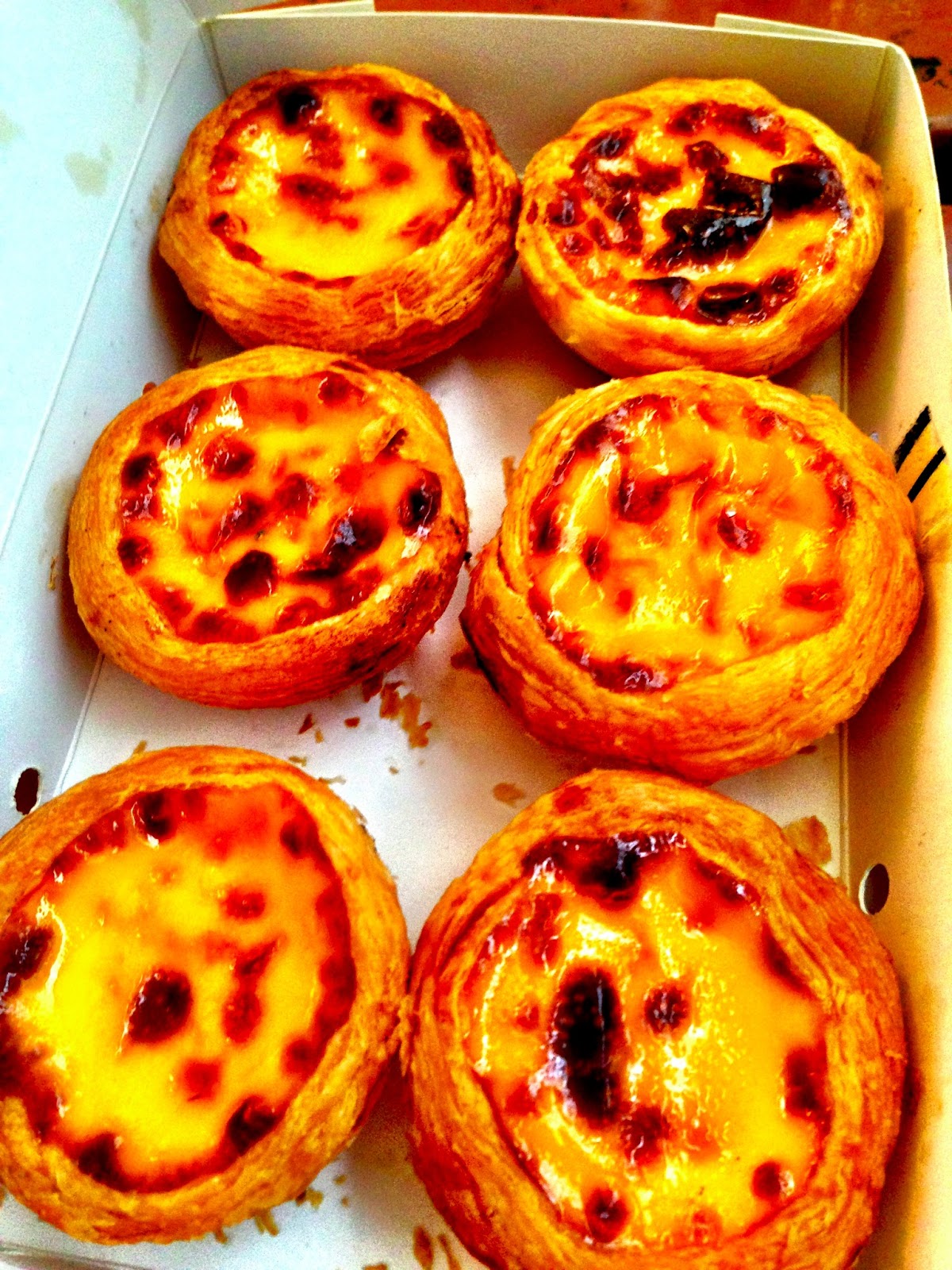
“The egg tart place,” he said excitedly, when I asked him where I ought to take E and C when we visited from Hong Kong, “Let me get you the business card. It’s one of the best egg tarts you’ll ever have.” 
I waited in the living room while he went to his study to retrieve the business card, and then to the garage, where he keeps outdated travel maps. My father is the epitome of homebody – he travels via television – but if he does travel he does so whole-heartedly if a bit blindly in the way men his age do, when they go to look but not to see. He becomes Uber-Tourist, hoarding free maps, business cards and trivia, and snapping photos all along the way with a camera that is usually much too complicated for his photos to reap full benefits. On a recent trip to Hainan island with my mother, my father clicked away furiously while my mother walked slowly behind him, pausing occasionally to sniff a flower or examine a leaf. 
“Your husband,” the other tourists observed, “Is very busy.” 
“Yes,” she said blandly, rolling her eyes at Uber-Tourist, “let him busy himself.” 
Among friends, he is almost laughably, the “learned traveler,” because even though you can’t have a two minute conversation with him without him interrupting you ten times, he’s remarkably sharp and he pays attention. Uber-Tourist for sure, but in his defense a curious travler as well. We both like to pepper the locals – street vendors and cab drivers and the like – with questions about society. My father tucks the information away and recounts them verbally to anyone who will listen. I take mental notes and later, if I remember enough, blog about it.  
He came back from the garage clutching a half dozen maps to his chest which he excitedly spread out across the table:
“Here’s where you want to go,” he said, pulling up a chair and motioning me to sit down, “I know you don’t have any interest in the casinos, but you can take the free shuttle buses into the Old Town…” 
Thus began an hour long verbal tour of Macau via outdated map, interspersed with jaunts down my father’s lanes of memory in which he and his buddies were younger men who worked and played hard, drank like fish and ate like kings without worrying about cholesterol and heart attacks. Each trip to Macau, he laughed, meant they would lose money and gain weight, not the world’s worst trade off, he said, jabbing me with his elbow, unless you’re a young, single woman. 
Times were different now: his friends all sported various diet-related illnesses and begged out of such trips or stopped planning them altogether. They ate light dinners, hardly drank, and went home early, as soon as dinner finished. They developed other interests and took different types of trips – in my father’s case, amateur photography and Hainan island with my mother, who can count the number of drinks she’s had in this lifetime on one hand. 
The map my father now so fondly gazed upon was of Macau, but also a place of rowdy, raucous memories, and now his daughter was planning to go. 
At the end of the hour, I concluded that my father and I were not so different, though he was perhaps more enthusiastic about egg tarts than I could ever be. He rather enjoyed, I was surprised to learn, walking around Macau’s old town and listed more restaurants than I could finish eating in a week.
“It’s not like Vegas,” he said, “The shows are not worth watching and the atmosphere is still kind of seedy,” 
He looked quietly down at the map with a soft smile, “But it’s quite different from anything you’ve ever seen and a good place to go with friends. I think you will enjoy it.”  
What follows are photos from the day trip I took to Macau with E and C. We did not gamble and set foot in a fantastically shaped casino only to use the restroom, among the gaudiest I had ever seen, with crystals hanging from bright chandeliers that cast a disco-club like glow over each toilet. 
My father was right, it was very different. Not in a good or bad way. Just different.     
Scene taken from the turbo-jet. Not recommended for those who get seasick easily.
My father’s recommendation. We were greedy and each ate two, then immediately regretted it.
A man neither Chinese nor Portuguese enjoying a gelato by a fountain in old town. A scene from Europe a stone’s throw away from China. That is the crazy thing about Macau. 

An elderly Chinese man waiting outside the church. For what or whom, I’m not certain. 
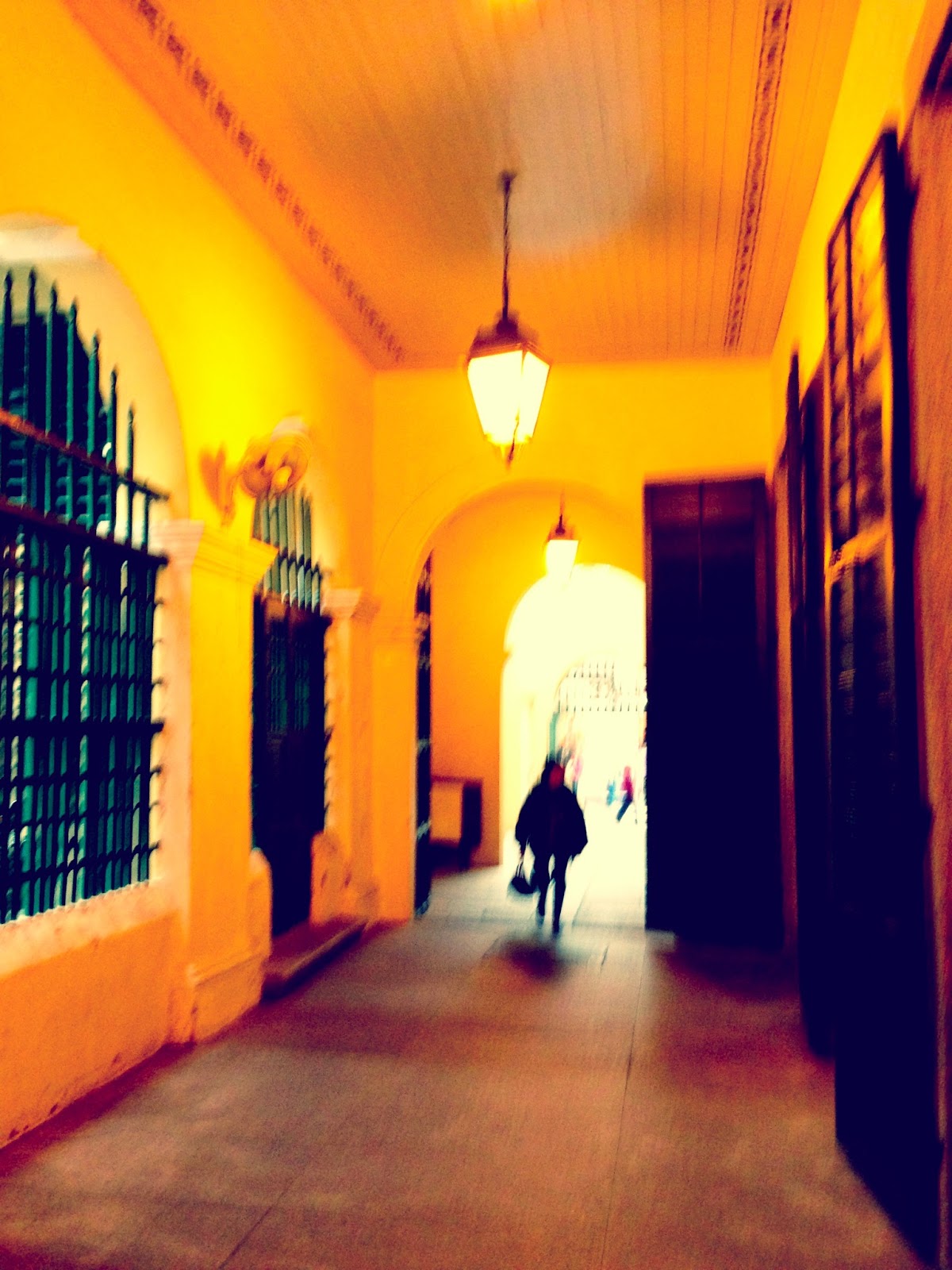
A woman rushing to mass. 
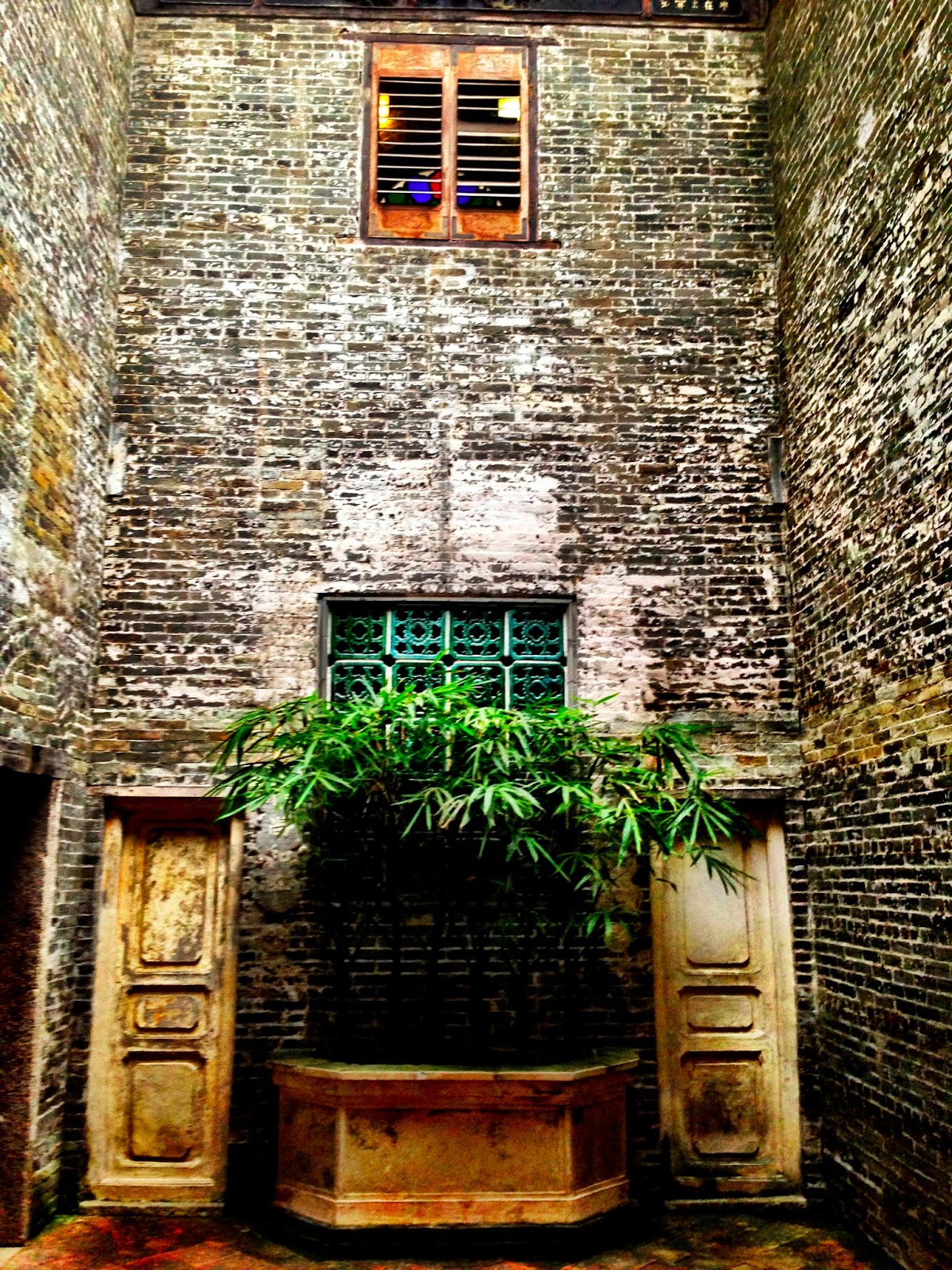
Gorgeous brick atrium of the excellently preserved Casa de Lou Kau, home of a Chinese Merchant and gambling tycoon. 
Another atrium. I wouldn’t mind if the rain fell into my house through a place like this. 
A photo also taken on the way there, because it was nighttime when we left, but I like this shot. 

Immunity

The plan was to fly from Seoul to Shanghai, spend a few quiet days with my brother and his wife before my cousin Karen came into town, at which point we would change out of tennis shoes and into heels and go out into the booming, boozing haze of Shanghai’s nightlife. Then, on Sunday morning we’d beat ourselves awake at 6AM, eyes painfully sensitive to air and light, hair still smelling like last night’s smoke and board a six-hour bus ride southwest to the Yellow Mountains in Anhui Province. We joked about the photos we’d take: done up, mascara’d young women in nightclubs and lounges, tired hags in the clouds high atop the Yellow Mountains.

“You guys have very diverse interests,” my sister in law mused.

That was the plan. What happened instead was I arrived in Shanghai from Seoul at 2:30PM, was greeted with icy cold rain, a half-hour wait for a taxi cab and then an hour long ride from the airport (the closer one, no less) to my brother’s place. I was underdressed and a bit tired from all the waiting, but still, I was in Shanghai and even though my body said, “Heeey, maybe you outta take a nap,” I shrugged off the fatigue, threw on an extra sweater and took a long walk with my sister-in-law before heading to dinner with my brother and his coworker in what seemed like the outskirts of town.

The coworker, a Korean named Daniel, had asked my brother a few months earlier if it would be alright to send some vitamins via his sister. They were much cheaper in the States where their safety and purity was assured. My brother said sure why not and a few weeks later a shoebox-sized packaged arrived from GNC at our house in Orange County, filled with fish oil and men’s daily vitamins, the latter of which made my mother wonder what the hell I was doing to my body. I explained that they were not for me and packed them into a largish suitcase with my scarves and shoes and brought them back to Taipei. My brother then came to Taipei from Shanghai for Chinese New Year and I handed him with the vitamins for his Korean coworker. Upon receiving the vitamins the Korean was pleased.

“When your sister visits Shanghai, I will treat her to dinner for her troubles.”

It really was no trouble (I marveled at the Korean man’s patience, waiting nearly three months for vitamins!) but this is why, after leaving Seoul, my first meal in Shanghai was a Korean feast in Shanghai’s Korea Town, adjacent to a Korean shopping center called Seoul Plaza.

My medical expertise tells me it was the sudden change in weather and not the food that made me sick. The dinner was delicious – a spicy mix of seafood and vegetables paired with endless Korean pickled side dishes and the most excellent bowl of white rice I’ve ever had the pleasure of chewing through – though I still get a bit nauseous thinking about that night’s dinner. I ate more than I normally would have, an unfortunate side effect of fatigue, but was otherwise in good spirits and looking forward to the night’s slumber. Walking out of restaurant into the freezing Shanghai air, I imagined that the Korean food had warmed me. Back at the apartment I changed into pajamas and clearly remember thinking as my head hit the pillow, “I will sleep very well tonight.”

And I did, until 6AM when I woke feeling ill in a vague, indescribable way. It was as though an insidious night terror had crawled down my mouth in the middle of the night and lodged itself in the core of my body, a limbo neither esophageal nor gastric. There was the faintest nausea with an indeterminate discomfort in my belly and a feeling of occupancy at the base of my throat – symptoms which on their own would cause me no worry but experienced altogether made me feel unsure about my existence. What was it? Like a word on the tip of one’s tongue, I could only say over and over again, when my brother woke and asked what was the matter with me, that I “did not feel well.” It was the understatement of the year. I was no stranger to stomach flu or cold and fever, but now the symptoms came from all directions and muddled my mind. Later my aunt would guess that I’d become victim to Taiwan’s latest flu virus, something that sounded like Nola, but without going to the doctor, we couldn’t be sure. I lay in bed ailing, the more coherent parts of my brain deciding whether to stay in Shanghai and calculating what the loss would be if I went home early: 500 RMB fine for canceling the Yellow Mountain tour package and a 700RMB fine for changing the flight and most painful of all, my cousin’s utter disappointment.

Going to the mountains was her idea and I was surprised that she had suggested it. I don’t know anyone else in my generation who would say, “Yes, let’s go clubbing in Shanghai and have a fancy dinner and all that, but please, let’s also see the Yellow Mountains.” That’s my cousin Karen for you. But I suppose when one is an overused and under-appreciated cog in a giant accounting machine, anywhere outside the office building would seem a respite. It makes sense then that the Yellow Mountains in Anhui, the backdrop to such films as Ang Lee’s “Crouching Tiger, Hidden Dragon,” and inspiration for James Cameron’s Pandora in “Avatar” were, at least two weeks ago, Karen’s much anticipated escape.

It would be better to see the mountains with her than not at all and she gamely researched and booked the trip, finding two of the mountain’s best-rated “resorts” (dismal two star motels at best, by most traveller’s standards) and looking up the area’s most popular trails for us to traverse. She had, a few days before her departure to Shanghai, assembled a respectable collection of borrowed hiking gear: a friend lent her his backpack and a coworker a pair of walking sticks, the kind that folded up into a tiny cane when not in use.  To everyone she talked excitedly about our plans. Some of her coworkers looked on enviously before turning back to their computer screens.

My aunt, not wanting her daughter to freeze to death in one of the world’s most famous mountain ranges, took Karen to the department store to buy a full set of Gore-tex outerwear to guard against the chilly mountain air. Karen had perused various online travelogues that advised travelers to prepare sustenance as food up in the mountains was expensive, so she’d gone to 7-11, stocked up on instant noodles and stolen a few packets of instant oatmeal from her office, where on Thursday evening she was only half-heartedly discussing convertible bonds with her manager. Her heart was already climbing the vertical steps leading up the Yellow Mountains and she could very nearly smell the crisp mountain air when she received the string of woeful text messages I sent her from the chilly guest room of our Shanghai condo.

“Hey Karen, I’m really sorry, but I got really sick all of a sudden. I don’t think I can go out never mind go to the Yellow Mountains. I think you should cancel your flight….”

She didn’t respond until a few hours later, but what happened, I learned after returning to Taipei, was that at 5PM on Thursday evening, she’d gleefully told her director that the convertible bonds would have to wait until after her trip to Shanghai. With a skip in her step, she went to check her phone to see if my aunt had called about her coming home for dinner, and instead saw the texts. She read them with the cliched sinking feeling all humans experience at one point or other and with her heart no longer light and her feet suddenly slow and lethargic, heavy, went back to her manager. She asked him to continue about convertible bonds with a muted expression.

“It can wait,” the manager said, waving her away. He knew when the underlings were checked out.

“I’m not going to Shanghai anymore,” she said and glumly explained what had happened.

Her manager laughed, not meanly, but patted her arm and said, “Well, since you’re not going anywhere, we’re not exactly pressed for time. Go tie up your loose ends and we’ll talk about it tomorrow. “

She cancelled her flight, the tour package, and on Friday, arranged to return all the things she’d borrowed. She’d unfortunately cut the tags off the Gore-tex stuff which made it hers forever, and the noodles, well, the noodles would stay uneaten in the kitchen cupboard.

The next morning, her friends and coworkers either jeered or looked at her strangely, “Aren’t you supposed to be partying in Shanghai?” they asked.

She hunched her shoulders and muttered something about her cousin’s weak constitution. The computer screen blinked with the likeness of convertible bonds, whatever the hell they look like. Karen blinked too. She shook her head. Expectations, she decided, were a dangerous thing. About 700 kilometers away in a much bigger and colder city, her cousin dragged herself out of bed, rushed to the toilet and threw up the remnants of a Korean feast.

Please Define: Non-Fiction

My father doesn’t understand non-fiction.

“What does it mean, exactly,” he asks, “This ‘non-fiction.'”

“I write stories that are true.”

“About what?”

“You, me, our family. People I meet. Things I see and think about.”

He looks at me, confused. Something is terribly wrong. “Why,” he says, “Why would anyone want to read about that? Who cares about you or me or our family?”

My father is not being rude, at least I don’t see it this way – he is genuinely curious as to what in the world makes me think this is a good career option.

“I don’t know dad,” I shrug, because I honestly do not, “This is a risk you take when you write. You write what you know and hopefully people want to read it.”

“And if they don’t?”

“Then…I get a day job and do something else in addition to write.”

My father is not satisfied. He’s about to pay a lot of tuition money. He’s a businessman, born to a woman who counted every penny and invested heavily in two things: land and her three sons’ educations. The former so that her sons could pursue careers in real estate development and the latter just in case they bungled it all away.

“Money must be spent on the knife’s sharpest edge,” she liked to say, and even though she passed away long before I was born, her words are from time to time echoed to my cousins and I via our fathers. The sharpest edge would be studying something like Electrical Engineering or becoming a doctor or, as my father had hoped for me early on, plunging into the world of accounting and economics (his eyes were always pretty open to my other faults, but for some reason my ineptitude at math eluded his gaze). Most of my cousins have landed right on the blade. I seem to hover somewhere near the hilt.

“I don’t understand why you won’t write fiction,” my father continues, “What about something like Harry Potter? That woman made a lot of money.”

Ah. The old Harry Potter comparison. As if I could ever in a million years do what Rowling did.

“Dad,” I say, irritation seeping into my voice, “I can’t just sit down and write some seven volume fantasy series. That takes…”

“What does it take? You know I saw a TV special about her – she was homeless! She didn’t even have pens and papers! You have everything! You don’t even have to work and you can’t do what she did?”

I look at him, eyebrows raised and mouth slightly open to say something that would emphasize my exasperation, but nothing comes out. I close my mouth, lower my eyebrows. Dim my eyes.

“Dad, I don’t want to write about things I don’t know or don’t have interest in.”

“Didn’t you like Harry Potter? You have all her books.”

“Yes! But reading something you like is totally different from wanting to write. I like reading about a lot of things, but I don’t necessarily want to write about those same things.”

“Why not?”

“Because it wouldn’t be the same or as good as the other people who write it. Everyone writes what they know, and if they don’t know, they do a lot of research, but normally when they are willing to do the research they’re interested in the subject. I like writing about our family and whatever else I’m interested in.”

My father leans back, “I don’t understand,” then looking up, he sees the look on my face. Not a sad look, just tired. The one I get right before I tell him that it’s better that we live far away from each other so I don’t murder him in his sleep. Time to change the approach.

“Okay,” he says, “just explain to me what non-fiction is. You say you write about family but I don’t understand why people would want to read about that. Show me some examples of people who write the kind of non-fiction you want to write and maybe I can understand.”

I think about David Sedaris, Adam Gopnik, and Anthony Bourdain, and how my father would not understand their appeal, even though all their books are bestsellers. Better to use a Chinese example, but I can’t think of any.

“Gun Germs and Steel!” my father says before I come up with anything, “That’s non-fiction, right? That’s a very good book.”

“Yes, it was,” I say, “I liked it too -“

“You could write something like that!”

“I could, but again, not my thing. That’s like history and social science…not really creative non-fiction.”

“Ohhh,” my father leans back, nods slowly. Is he starting to get it? “So you write more creatively.”

I nod, “I tell true stories from my perspective,” I pause. That sounds like a euphemism for lying, but then again, that’s a whole other bag of worms I don’t want to open. “It’s not research,” I say, “Well, there could be research involved, but that’s to add to the story rather than the story itself.”

My father is silent for a while. I’m not sure what he is thinking, just as he is not sure what I am thinking.    I’m thinking that I need to find a better way to explain this to my father, whose friends nod fervently when he tells them, when they ask, “How are your kids doing?”

But he knows that look. “Your daughter wants to be a writer! That’s fantastic!” they say, clapping him on the back, but inwardly they breath a sigh of relief, “Better your daughter than mine.”

“True stories,” he says, leaning forward now.

“Yes. True stories.”

“But what’s so creative about telling the truth?”

He has me there. I’m not sure, actually, and I tell him so. I don’t make things up – at least not now. I tell it like it is, but hopefully there’s something beyond that. Maybe in the future, I may have to start making things up, to protect people I love or fill in the blanks or satisfy some deep-rooted craving for fantasy or whatever other reasons some writers become novelists and others essayists or biographers.

I turn to go and my father doesn’t ask me any more questions.

“Hm,” he says simply.

It bothers me that I can’t explain it better. But then again, that’s not the kind of writing I do.

——– 

“Good writers define reality; bad ones merely restate it. A good writer turns fact into truth; a bad writer will, more often than not, accomplish the opposite.”  – Edward Albee

“Exploit the things you’re good at.”  – Jason Lee

Practical Advice: Father Knows Best

Two years ago around this same time, I found myself back in California looking for a job. I had just returned from a long weekend trip in Carmel, celebrating my Uncle Louis’s second, for-real retirement (at the eyebrow-raising age of 70) from an aerospace company. Before Carmel I’d been in Asia for a two month-long “waiting” period in much the same vein as I now await graduate school admissions decisions (more on that later) though back then it was for a Fulbright. The Fulbright didn’t come through and I went home to celebrate my uncle’s retirement and mourn my own entry into corporate America, hoping companies wouldn’t ask what I did immediately out of college.


“Well, I was banking on getting this scholarship thingy that would allow me to continue dicking around Asia.” 

“Please leave.” 
I clawed at my face, “What does this mean?” I asked my friends, most of whom were well into graduate studies or about to be or had been working full time for a while. 
“Get a job,” my friends said, “Get real.” 
I didn’t panic, but rather listlessly sent my resume out to random, underpaid Craigslist listings with job titles all containing the word and or variations of ‘assistant’ which I have now come to recognize as a synonym for ‘underpaid, sometimes severely.’ For a few weeks, nobody called. My parents knew the hunt was hard – it was hard for their friends’ children, most of whom were more accomplished and goal-oriented than their daughter – so it was perhaps wisest to inquire politely from time to time and give me no further pressure unless I started looking at plane tickets again. 
One evening, having sent out two dozen or so resumes and cover letters (do people even read those things) to companies that I knew vaguely about, I shut my computer down and went to the living room where my father sat with his feet up on the round glass coffee table, watching the Taiwanese news. He did this every night and mostly did not like it when I tried to speak to him over the pretty news anchor with the light but forceful, staccato voice. I needed an ego boost, something my father, he of the “you could stand to lose about ten pounds,” or “don’t stand like such a man,” or “girls who roll their eyes at their fathers usually stay single forever,” was unlikely to provide, but he was a working man and more importantly he supported me with his work. As of late, having sent more than a hundred resumes out into cold black cyberspace and hearing only radio silence, I realized the possibility that he’d need to do so for a few years more. I needed to know that my father would be okay if I were to be unemployed forever. 
“What,” he said, not bothering to look up from the TV screen.
“The job hunt.” 
He looked up, and kudos to him, read my face, “Not going well?”
“Not at all.” 
He sighed, “I’ve been telling you and telling you. Nothing in this world is easy. You’re the only idiot your age who didn’t rush into the job hunt out of college. You should have started looking in school.” 
“I was applying for a Fulbright!” I sputtered, incredulous though not deservedly so, (applying for a Fulbright is quite different from completing a Fulbright or discovering a cure for Lupus), “I didn’t want to get the job and then get the Fulbright and have to be like, ‘Oh sorry, psych! I have to go and be a Fulbright Scholar now, ha ha.'” 
My father shook his head, “Who cares? It’s always easier to say ‘no’ to a job offer than say ‘yes’ to nothing. You should have started looking a long time ago.” 
This was not the ego boost I was looking for. I did not want the conversation to continue down this particular path, nor did I want to go back to my room to continue the job hunt, but to do anything else would have seemed frivolous. Apparently I should have been making up for lost time and been trolling job postings 24/7, but at that moment, I wanted my dad to make me feel better. Mostly because my mother wasn’t home. She was playing badminton. If anything, I could have used a pep talk and decided to prompt one. 
“Sometimes,” I said grandly and with as serious a look as I could muster – so serious that it was borderline comical, “Sometimes I just want to marry a rich man.” 
My father looked up at me with a sudden, grave interest. He leaned forward and turned off the TV, something he almost never did unless we were arguing and I yelled at him to turn it off. I was mildly surprised and I thought, “Here we go, here’s where Dad goes, ‘Hell no my daughter won’t think like that. I raised her to be a smart, independent woman who will work hard and not have to rely on anyone else to take care of her.” I braced myself, it was a fatherly monologue I needed to hear. 
Instead, over the barely audible buzz of the darkened TV cathodes, my father nodded and say, “That’s okay too.” 
Excuse me. 
My father nodded at me, “I said, that’s okay too.” 
“Dad!” I looked at him with a confused grimace and he at me with eyebrows raised and eyes wide, a strange, hopeful smile on his face as though I had just presented him the solution to the world’s oldest riddle. 
“No, I’m not joking,” he said, “some girls don’t aspire to much, at least career wise.”
“I have aspirations!” I said. 
“You say you want to write! You’ve said that forever! But I don’t see you writing!” 
“I do!” though in fact at that point, I hadn’t, not very much, and not very seriously. I was saving my creative juices for the Fulbright, though in fact I just needed an excuse to not do anything at all for a while. 
My father shook his head, “Look, that’s beside the point. I know you don’t have huge career aspirations. But Jesus, look at you, you don’t even have huge feminine aspirations! You want to marry a rich man but where are you going to find him? And how are you going to find him looking like that?”
He waved at my person, tsk-tsking at my limp hair and pajamas (uniform of the unemployed), sallow, uncared for skin, and just general lack of feminine mystique. I didn’t know whether to laugh or cry, but then again, I am my father’s daughter and it seemed more appropriate to laugh.
“What are you talking about?” I said. 
“Invest in yourself if you don’t see yourself investing too much in a career,” my father said, “Go buy some makeup! Lose some weight and get some new clothes!”
“Dad,” I said, “You’d have to pay for the makeup and clothes.” 
“Okay!” he said, getting more worked up as he spoke, “It’ll be an investment! Make yourself pretty and for God’s sake go out more with your friends to where young people go. All you do is sit around at home and eat and tell me not to eat. You think you’ll meet a rich man loafing at home all day in your pajamas nagging your dad?”
I did not, but I was also still stunned by the conversation in general. What had happened to all that talk before about hard work and self-reliance? Did something change in me or in him? Did my father see (or not see, perhaps) something in me that made him think “investing” in my physical appearance would somehow lead to a more secure future? 
“Do you think I’m incapable of supporting myself?” I wasn’t angry, just curious to know. If my father was anything he was honest. 
He leaned back into the couch and turned the TV on, though kept the volume low. 
“I don’t think you’re incapable,” he said, already beginning to tune out, “My daughter was born capable. But I’m saying you need to set some goals and work towards them. Don’t waffle. Don’t wait. Act. Act now, act fast. You want a job, you prepare for it, right? You want a rich husband? Well, there are preparations for that too.” 
I lay on the couch and watched the news but didn’t listen or register any of it. I was thinking. Slowly, the volume crept back up and five minutes later looked at my father’s face; his eyes were back at their usual after-dinner diameter. 
I pushed myself up, and looked back down at my father and smiled. He smiled back. 
“Thanks Dad,” I said, “I’ll go invest in myself now.” 
“Good. You made a decision.” 
I did, but not fully the one that was implied. As my father began to nod off, I walked away smiling to myself with the memory of the time in the sixth grade, when all the cool girls were wearing Lucky Brand jeans that cost $60, an obscene amount of money to spend on jeans, especially when most of my clothes were hand-me-downs. 
“I’d really really really like a pair of these jeans that everyone at school has,” I had said to my dad, whose clothes are almost exclusively from Costco (polo shirts) or JC Penney (trousers and Hush Puppies), “But they’re kind of expensive.” 
“That’s okay,” my father said, taking out his wallet, “Go buy yourself a pair. How expensive can they be?”
Before I could respond, he took out a twenty dollar bill and pushed it into my hand with the self-satisfaction won from being a father who knows he can always provide for his daughter, “That should do it, no?” 
Back in my room the computer stayed off. The job hunt would continue, that was for sure – better to invest with my own funds than shock my father with the brutal truth of what beauty and its upkeep cost – but for now, I needed my beauty rest. That was free. 

The Fragrant Harbor: Hong Kong Photo Diary

Not supposed to take photos inside Bloomberg Hong Kong, but I did anyway.

In 2011 I spent a day in Hong Kong, walking around Lantau Island and then Central to kill time while waiting for my Chinese Visa to be processed. It definitely wasn’t enough time and I left wondering when I’d get the chance to go back. This year, I jumped at the chance to visit again with E and C, two friends from college whose first stop was Taipei, Taiwan.

Continue reading “The Fragrant Harbor: Hong Kong Photo Diary”

The Eyes Have It

When my grandfather was eighty-six, the spots in his left eye began to impede his vision.

Cataracts, the doctor said, treatable with surgery.

“I’d like to have the surgery,” my grandfather said.

The doctor appraised the octogenarian who appeared much younger than his age. He had bright shining skin, a full head of hair and had walked into the exam room with a sureness of foot that he, the doctor, himself a relatively young fifty-five, rarely saw in men this age. Still, the doctor had over the years seen countless seemingly healthy geriatric patients who were suddenly diagnosed with this or that or who, though healthy this year, experienced a rapid decline into senile decrepitness the next.

Age was a volatile thing. He was also a reasonable doctor, not in it for the money. He operated only when he deemed necessary and in my grandfather’s case, the doctor felt it was not. The patient said that he could see and read through the dingy yellow tint of the cataracts, but that sometimes the left eye was a bit cloudy. This was bothersome.

“Your eyes will serve you well for another ten years,” the doctor said assuringly, though to himself he said, “Though you will likely only need them another five at most.” “If the cataracts are worse by then,” he said to my grandfather, “come back and see me. Then we will remove them.”

My grandfather, not one to take a doctor’s words lightly, nodded and went on his way.

Ten years flew by during which my grandfather read the newspaper each day with yellow tinted eyeballs. The eye doctor continued his practice, advising elderly patients to forgo cataract surgery. He turned sixty-five and some nights, when he was particularly exhausted or not feeling well, he wondered how much longer he had. Twenty years, he hoped, twenty years at least.

The doctor forgot about the eighty-six year old man he saw ten years ago until one day, the man, now ninety-six appeared in his exam room.

“It’s been ten years,” the elderly gentleman said.

The doctor blinked. The man seemed to have aged little. His back was slightly more curved, his skin a few degrees more papery and his eyelids a smidge droopier, but the skin still shone and the walk, though slower, was still steady.

“It has been ten years,” the doctor said, “And the cataracts…”

“I want them out,” said the patient.

The doctor felt a sudden roil of regret in his gut – he had denied this man ten years of better vision. But surely now the gentleman did not have much longer. However, it would be rude too, to say, “Wait ten years more.”

The doctor nodded and, because he was a man of his word said, “We will remove them.” He excused himself to arrange his calendar with the nurse and thought, as he closed the door, you just never know.

A few days later my grandfather opened his eyes.

Grandpa at ninety-nine, three years after his cataract surgery. Wearing a tie that is too long.

His wife and sons and their wives crowded around him.

“How do you feel? What do you see?”

My grandfather blinked and smiled a newborn’s smile, gazing beyond their concerned faces.

“The walls,” he said, pointing at the walls that had always been there, a small, wondering smile on his lips, “The walls are white.”