
It’s 9:06 PM and I’m reading Thoreau for the first time. Continue reading “What is Good Writing? First, Strengthening Ones Literary DNA”
It’s 9:06 PM and I’m reading Thoreau for the first time. Continue reading “What is Good Writing? First, Strengthening Ones Literary DNA”
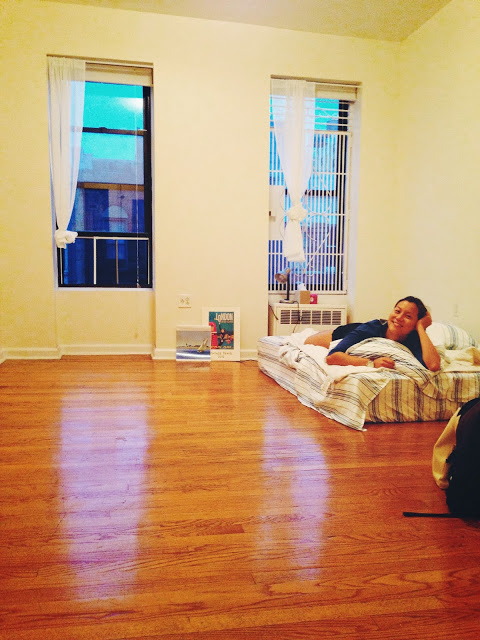
“You did it again, didn’t you,” my father said.
He called me this morning asking about the package they received from Amazon, with my name on it.
I slapped my forehead.
“Oh my god,” I groaned, “I did it again.” Continue reading “The Long Game”
This semester, I signed up for a class called “Thickening the Plot,” taught by a petite funny lady with short, grey-blonde hair and round glasses. When she smiles, her eyes get small and you can see her gums, which my mother tells me is a sign of a person not to be trusted. But I think for this professor, I’ll make an exception.
She has an iphone, an unexpected gadget for a woman who put her phone number down on the syllabus.
 |
| Edward Hopper Summer Evening 1947 Oil on Canvas, Private Collection |
…
How easy it is to get side-tracked in this city. A year ago, I visited New York with my cousin from Taiwan. We stayed at the upper west side apartment of her friend (and now my friend too), a Columbia architecture student named Albert who was, like my cousin, is also from Taiwan. One evening after dinner, we were walking back to Albert’s place and someone – it may have been Albert, it may have been my cousin – suggested something obvious which had already, from the moment my plane touched down onto the tarmac, been taking shadowy shape in my subconscious:
“Why don’t you apply to Columbia’s writing program?”
At that point, I had applied to zero programs, but was shuffling six or so schools in the back of my mind, mostly because those six schools were the only ones I knew who offered non-fiction programs. They were also in unfamiliar states with more farm and/or wild animals than people. I had never considered Columbia. NYU, yes, because of my “familiarity” with it, but not Columbia. It didn’t seem out of reach as just hugely expensive and ivy-league and serious. I didn’t exactly associate it with the arts so much as business, law and medicine. But then I considered Albert, who was studying architecture, considered the fabulous if not liver-ruining time he was having in the city, and our trip thus far, which was filled with shopping, good food, and leisurely strolls through pretty parks and neighborhoods. It was, aside from the money spent doing the aforementioned things, a great city for a writer. The city teemed with “subjects” because it teemed with life. Though it seemed entirely possible that not a thing would be written. I nodded thoughtfully and said to both of them, “Yes, I should consider it.”
I didn’t actually look into Columbia until I went home to California, though New York was certainly still fresh on my mind. I was uneasy, however. In the city, we spent days strolling through the High Line, Central Park, and the West Village. Everywhere I looked, I saw young people like myself (though dressed in way more plaid and corduroy) sitting, writing and thinking. And writing. In Moleskins. It was apparent New York was already filled with writers and/or writing students (some people make the distinction. I am undecided). I remembered a conversation with a friend about his burgeoning family Christmas parties and how inevitably, in the near future because cousins were having kids left and right and the walls of his parent’s house remained inflexible, they would have to disassemble and branch off into smaller families parties.
“We’re reaching critical mass,” he had said drily, and I nodded to myself now thinking about the writer situation in New York. That was exactly it, minus the critical. Just writers en masse.
As was precisely my feeling, when I was walking through these famed New York areas, where tourists and unemployed artists/writers/creative thinkers like to congregate. The former to take photos every few feet and the latter to sit and write a line or two, every few feet.
I remember stopping on the High Line to buy a sour cup of coffee (Blue Bottle, if you’re wondering), and feeling slightly chilled by the brisk fall breeze. The feeling and the smell were familiar to me from my first fall in New York, back in 2004, but this time I felt far from alone. I looked around me on either side of the coffee bar and saw two bearded young men sitting opposite each other on two small tables, both with notebooks open before them, both touching their beards in thoughtful ways and staring out across the High Line. Their journals, diaries, whatever name they gave to their paper darlings, looked loved. The lines were filled with small, scratchy words in inky black pen: genius works in progress.
Were they writing about their respective lovers? Men or women? I couldn’t quite tell, so wonky is my gaydar – but from the way their legs were crossed and their brows furrowed, I discerned that they were very serious about their “craft.” And really it wasn’t just those two men, but also all the writers they knew and the writers those writers knew and all the writers thinking about moving to the city and all the writing students thinking about applying and all the writers already living and writing and kind of working but not really and the writers already filling up the classrooms at Columbia, NYU, the New School, and really, the list goes on.
I rolled my eyes, paid for the coffee, and wondered if I wanted to add myself to such a saturated pool.
I returned home some days later and turned the computer on. Into the box, I typed, “Columbia MFA Creative Non-fiction.” My search was fruitful – so Columbia did have a creative nonfiction writing program. It was simple then – I would apply, but I wouldn’t hold my breath. They don’t give very much aid, if any at all, and I wasn’t sure if I wanted to go back there anyway. As most people applying to MFA programs are wont to do, I had my sights set on Iowa – not the Writer’s Workshop, but the Nonfiction Writer’s Program, which I told myself was no less distinctive. I imagined wearing chunky sweaters and thick brown boots, woolen socks, and eating lots of…gruel. I imagined looking out the window and seeing nothing but rows and rows of tree trunks (I have no idea still, what Iowa’s topography looks like) and brilliant pink and yellows of a sky at dusk, because that’s normally when I look out the window. I imagined small classrooms with other serious writers like myself, talking and laughing and constructively criticizing each other’s latest pieces.
“You could use more dialogue here,” I would say, and they’d nod thoughtfully and appreciatively, and everyone would emerge a better, more well-rounded writer.
On the weekends, I would sit at one of two cafes on the main boulevard and maybe attend a reading given by one of my classmates. Maybe I would go hiking. Learn to hunt. Start making my own fur-lined caps with knitted chin straps.
I did not imagine crowding the subways with bums and businessmen, or being haunted by unaffordable goods in the city’s million windows, or being pulled, socially, left, right, up, down because there is just too much goddamn stuff to do in this city. I had imagined a quieter life, at a quieter school in a quieter city where no one would ever want to come and visit and I had imagined to be writing a lot more, because what else is there to do in a town where everything shuts down at 5PM?
Instead Iowa turned their noses down and Columbia and by extension, New York, welcomed me with open arms. (So did North Carolina and West Virginia, but common writerly sense told me better to grind it out in a thriving city to whom sleep is a stranger with tens of millions of other writers who want the same thing than in the woods with a mere handful of writers and grizzly bears). Which is how I ended up in a, if not the city that never sleeps, or more specifically, a city whose denizens prefer to start putting on their makeup at midnight for what is actually a very early morning on the town. Physically, I am not cut out for this city. I think few writers are. I’m not sure how my classmates get anything done. Between the school-sponsored social events and the hundreds of literary events happening elsewhere in the city (I have never seen SUCH a packed Barnes and Noble when Junot Diaz showed up… I ended up not being able to even see him because there was no room! Writers are true celebrities here, at least in certain bookstores) and the people who are open and kind and inclusive of me in their established New York lives and my own guests who have been coming non-stop (keep coming! This is not a un-invitation. The best cities are meant to be shared!) and the general housekeeping that comes with living on my own and moving into a place that had nothing and the time it takes to do simple things like buy yogurt at a three-story Trader Joe’s (you have not seen a line until you go to Trader Joe’s in Manhattan) and get places (I will, some day, figure out the subway system. Simple as it is), I’m finding it a bit hard to find time to read and most disconcertingly, to write.
But I manage. I try to read during those myriad pockets of time, mostly waiting for the subway, but of course it’s much more fascinating (and productive, I feel) to people watch. So naturally I don’t get much reading done on the subway, though I’ve intently watched other people read books whose subjects range from scientology to brain-imaging to my favorite novels, which always makes me wonder if the reader and I will get along. And I try to write on quiet afternoons like this, before the start of the weekend, which for me, begins on Thursday and ends Sunday morning when it dawns on me that I have two novels to finish before Tuesday.
Of my classmates, there are a few who’ve admitted to being slow readers and even slower writers and I sort of just want to pat them on the back in an sympathetic way and say, “Good luck with that.” But then I think better of it, look at my own schedule and the dark circles under my eyes and the hair that’s been falling out all over my apartment, and I decide to pat my own back and say, “Keep it together, Betty. Remember what Dad said: don’t forget your goddamn degree.”
Your readership means plenty if not everything because I don’t have other writing to show my dedication or seriousness. What you see here is what I write. On top of that, I’m a bit of a philosophical ham, which means if I write but no one reads it, it’s like that proverbial tree felled in the proverbial forest: is it really written if it’s not read? Didn’t think so. In short: thank you. A million thanks for taking the time.
And, lastly, for the nuts and bolts required to build the actual application, most painful of which is the Personal Statement, I’d like to thank Adam Gopnik.
It is not a stretch to say that Adam Gopnik helped me get into Columbia’s MFA program. I thought briefly about lifting entire passages from his book, Through the Children’s Gate and pawning them off as my own in my personal statement, but disgraced plagiarists told me that wouldn’t be a wise course of action. Instead, I used his book as a jumping off point, allowing his insightful paragraphs to act as muse:
What New York represents, perfectly and consistently, in literature and life alike, is the idea of Hope. Hope for a new life, for something big to happen, hope for a better life or a bigger apartment. When I leave Paris, I think, I was there. When I leave New York, I think: Where was I? I was there of course, and I still couldn’t grasp it all. I love Paris, but I believe in New York and in its trinity of values: plurality, verticality, possibility.
In the end, Gopnik gave me more than a leg up. This is what I submitted:
When I quit my job a little less than a year ago, I planned among a variety of plans, to write a book. Continue reading “What I’m Reading: Then We Came to the End by Joshua Ferris”
Recently, loved ones have taken to congratulating me prematurely.
“You’re almost done! You must be so excited!”
“Just three weeks away!”
“I’m so proud of you! Do you want anything for graduation?”
“A graduate! You’ll be just like Dustin Hoffman in that one movie with the ambiguous ending!”
No one’s actually said the last one to me, but it’s the statement to which I can provide the most accurate response.
Lately I’ve been stalling. I haven’t been writing except for lame one pagers in my diary (pining about ‘Ben,’ mostly) and I certainly have not been reading for or participating in class discussions. True, “graduation” is only three weeks away (two, if I subtract the week of Thanksgiving, as I will be home for its entirety) and true, time, in its inevitable way, will fly, but right now, this Tuesday evening, the unwritten pages of final papers are piling up and I haven’t a clue as how to tackle them. It’s no longer a question of motivation – I haven’t been motivated to do well in school since senior year of high school – but rather, an issue with…”What now?”
I didn’t expect this stupid, common question to hit me too like the proverbial ton of bricks, but it has and my face hurts and so I’m asking: What now? I can see into the immediate future. I will graduate. With above average grades, below average affection for my alma mater. (At the department store the other day, I overheard a teenage boy discussing Berkeley and Brown – “I like both,” he said. I looked up from black boots that didn’t exactly fit, my face red, “Choose Brown,” I said.)
I know myself – writing papers assigned by youthful and elderly professors alike is, regardless of my attraction to them, like pulling teeth – and I will write them. I will turn them in and if they are graded by professors, will garner generous grades. If not the professors, then bitter, stingy GSI’s (graduate student instructors), who, if the holiday spirit vacates their hearts at the wrong moment, will damn my papers and final grades to scholarly hell (any grade below an A minus). I don’t want to be cast into that hell, especially not in my last semester, but while it’d be great to leave Cal with an academic bang (3.9 decibels loud!), I am wearied by all this relentless reading and writing and listening. I have waited six years to tune out higher education and on the 17th of this December, 2010, I will finally plug my ears and walk away.
My dear aunt called from Taipei two evenings ago. It’s been my spoken plan now, to leave the States for one or two years and fashion a little expat life for myself on the seventh floor (the most modest penthouse there ever was) in our family’s building on Dong Fend St.
“There’s a fine English cram school near my work,” my cousin told me happily. Both she and my aunt anticipate my return, as though my presence would somehow breathe fresh life into their self-perceived dull ones.
“There’s no one here to make waves,” my aunt sighed into the phone, “And Karen wants to live with you on the seventh floor. Perhaps things will be more exciting this way.”
And I’ve no doubt things will be exciting – I’ll teach English, make a killing (especially now, with my degree!) and shop, dine, watch movies whenever I please – it will be a more mature, more fabulous version of my life in Taipei nearly five years ago, when I tutored privately and taught at the National Taipei College of Nursing. Karen and I grew up together and the plan is to continue growing (or perhaps halt the aging process) while living out our single girl life in Taipei. Is this viable? Is it possible? Am I merely planning some elaborate escape? Taipei, despite its cloying humidity and bustling streets, is my mental cryogenic freeze. I go there to pause. To put “real” life, whatever that is, on hold. Ought I do that for more than six months not to mention a year? Or two?
I have my concerns, not least of which is Taipei’s dating scene- a veritable pond sans fish for a big-boned, deep-voiced, giant shark like me. (I believe I did, yes.) The year and twenty-three summers I’ve spent in Taipei have revealed that my “type” of man does not exist in Taipei. And if he does, he is there only briefly, on a stopover perhaps to bigger and more important cities such as Shanghai, Beijing, Hong Kong or Tokyo. No, Taipei gets the stringy foreigners from Europe and middle America – the guys who are misinformed about but endlessly by idiot Taiwanese girls. They come with pale, blotchy skin, holey t-shirts, and those disgusting sandals with the velcro straps and in the heat, break out in the worst cases of yellow fever known to man. Speak perfect English and their eyes glaze over – they don’t want communication, they want dumplings spooned into their mouths with submissive coos.
Equally repulsive are the wealthy ABC’s (American Born Chinese) and TEABRGHTWFD (Taiwanese Educated Abroad But Returning Home To Work For Daddy). When we were younger, my cousin and I studied my aunt’s wealthy friends, dreaming that marrying into one of these families was certainly the fast track to wealth, power and consequently, happiness. Thank god we developed brains along the way. Despite our meager (future) jobs and pitiful paychecks, we still have, in our fathers and other men we admire, standards to adhere to. And I confess there’s a bit of self-loathing going on here – I’m terrified of being my parents’ charity case (hence the plan to teach English in Taipei) but I would hate to date or marry another charity case, regardless of how lucrative the source of the charity may be.
Thus one setback Taipei might pose is the potential throwing away of two perfectly good years of my twenties. I’m not getting any younger. The crows feet that have stepped into the corners of my eyes are only getting deeper (and funny, I’m not laughing all that much). I’m not thinking too much. I’m thinking critically about my situation as a woman in the world.
Another crux: professional progress. Of course I can pledge to write everyday about the sights and sounds of Taipei and of my family – and most likely, I will, but how diligently will I revise? And how ardently will I complete the applications for the MFA programs I’ve also been crowing about? That was the whole plan, after all – graduate, move, teach, write, apply, enroll (Brown, UCI, Iowa – in that order), learn, write, publish, teach at Harvard. The master plan.
And now that’s it’s written and will soon be posted, I feel better. Now that it’s written, I can see how far this plan is, how strange my fears sound and how very achievable it all is. My imagination is quite vivid. My age still young.
My essays all due in less than three weeks, still unwritten. As long as they remain unwritten, the master plan will seem hazy and far. I can’t have that now, can I?
To Nabokov, Milton, Hitchcock and Wagner (the last not a famous writer but an adorable professor with an unfortunately dull class) – may you all see me to the end.
 VERY HIGHBROW