Security Blanket

A few days ago my mother came in to say goodnight and saw me hunched over my work phone, typing something out to my boss. I looked up, aware my eyes projected fatigue if anything.

She kept her hand on the door handle, as though deciding whether or not she should come in – it was late. She was constantly reminding me to sleep earlier but at the same time saw so little of me during the day that the evenings, right before bed, were the only time we really got to talk

I look forward to talking to my mother at night. Now, she is busier than my father (though he will never agree to this); after teaching a few hours she comes home to make dinner (unless my father, having left work early as he often does now, comes home to make it first) and then prepares to leave again to play two hours or so of badminton at the local club.

When I was younger and she didn’t play badminton, I often watched her sneak in a short naps here and there. I would come home from school and shout something to my brother who would say, “Shh. Mom’s sleeping.” And she’d be in the living room, stretched out primly on the flowered couch, her knees propped up or feet crossed at the ankles, a slight frown on her face. A light sleeper who stirred at the slightest sound, she was never fully asleep. I pitied her for it because my father’s snores are murderous – meaning you will either die from exhaustion, or kill him in the middle of the night.

Whatever my mother thought of her sleeping situation, she and my father worked it out long ago. She took to retiring earlier than he – to get a head start, I suppose. Her tactic was to enter REM before my father came to bed, and would thus be immune to the noise. But I doubt this. It is one of those sacrifices women make when they marry. My father gives her love, warmth, a family, the financial stability to pursue her non-profit Chinese school dreams – all that and more – in exchange for the restful slumber she had before she met him.

And yet to my surprise I observed that my mother slept poorly when my father was not there. As they grew old together, she came to rely on the rhythm of his breath to put her heart at ease. At the end of the day everything was fine – he was there, alive and well, and together they were whole. Her children may grow and fly the coop (though this has yet to happen with the youngest bird), but at the eleventh hour through the first, her husband was there, sleeping peacefully albeit noisily by her side. 

So perhaps it was not the sleep. Whatever it was, she seemed to be always tired, in the same way I feel now. For a long time we thought it was her liver. My mother is also very gullible – fatigue and gullibility do not mix. Fatigue makes one desperate, even more gullible than usual, and she bounced from one doctor to the next, collecting a docket filled with lies about her physical condition.

She was never known for being fair, yet one doctor said her skin appeared jaundiced, which indicated her liver was failing her. Another doctor pointed to the white hairs along her hairline, saying it was something to do with her blood. Lupus. Cancer. Hypothyroidism. We never really did figure it out, but thank goodness my mother, despite her gullibility, hates western medicine with a passion and refused to take any of the medication. “Why damage my liver further, if my liver is already weak?” she reasoned.

Chinese medicine, with its strange herbs and animals parts were another story – my mother believed in eastern medicine with the same principles with which she adhered to Buddhism. Not strictly, but willingly, out of familiarity. Eastern medicine could be explained in Chinese terms more readily than western medicine and procedures, and was, in general, a more holistic approach, which appealed to my mother’s nature-loving bent. She spent a small fortune on carefully measured packets of horsetail, cordyceps, starfish, feverfew and fenugreek which she dutifully boiled every night with dates and ginger root so that our house smelled not unlike the strange, dim doctor’s offices she visited on Taipei’s outskirts.

As a family we tried to persuade her to take on less. Cut her private tutoring classes. Forget doing the Chinese school – not only was it a non-profit, it bled money. Don’t serve on the advisory board of this Chinese committee and that. Stop editing Chinese textbooks for free. And for Chrissakes stop traveling to China and Taiwan for exhausting two-week long conferences while staying in shitty hotels with bad food.

But my mother is stubborn when she sets her mind to something and she had learned long ago that married or not, a woman must have her work. So she persisted in building her Chinese school, and despite our protests, took on more private tutoring students. For a while I feared she would die of exhaustion. And somewhere in the middle of all this, she began to play badminton, hours at a time, three or four times a week.

I thought, “Oh goodness. She will collapse one day.”

Instead, the opposite began to happen. She became more energetic, more lively, more ambitious. It wasn’t just the exercise but also the growing profile of her tiny Chinese school. The two together: a woman’s work and the care she devotes to her body – is a powerful combination for happiness. Yes, she still comes home exhausted some days, but for the most part I have never seen her look so vibrant. My father noticed too, and rather than continue to persuade her to quit, he now accepts his growing role as Mr. Mom – he cooks more, takes care of more things around the house – not that he didn’t before, but he is home more often than my mother is, and the role of half-house husband suits him well.

From my mother I learn that for a woman – or any person, really, to stick to their work, stick doggedly to it even though no one pushes them to do so, they must really love the work. She has the energy to do it because that is how the mind functions – it provides phantom energy, the most potent and secret kind, to help you accomplish what you most love and need in order to feel whole.

And now my mother, armed with phantom energy, comes into my room each night to ask me about my work.

“Does it make you happy?”

“Is your boss a nice man?”

“Do your coworkers like you?”

Yes, yes and yes, I say, but still, there is a feeling that everything about the job is fleeting, much like every other job I’ve held in the past.

I tried to go in with an open mind, thinking, “Who knows how long I’ll stay?” Maybe I will love it and end up staying three, four, five years. A decade?

I heard a hollow laugh when I posed the possibility to myself. 

I’m too young to think that any position I hold now will be my “career,” but I can’t shake the feeling – both paralyzing and liberating – that I may never have a “career,” not in the conventional sense of the word. What is industry? What industry? How should I categorize myself and where, in the vast career planes and skyscraping corporate verticals, do I belong?

“It was a great comfort to turn from that chap to . . . the battered, twisted, ruined, tin-pot steamboat. . . . I had expended enough hard work on her to make me love her. No influential friend would have served me better. She had given me a chance to come out a bit—to find out what I could do. No, I don’t like work. I had rather laze about and think of all the fine things that can be done. I don’t like work—no man does—but I like what is in the work,—the chance to find yourself. Your own reality—for yourself, not for others—what no other man can ever know.”

Joseph Conrad, Heart of Darkness 
Love, a Facet

When my mother goes abroad, which is often, her greatest fear is that we will let her garden die. And by “we,” I mean “I.” My track record for watering mom’s plants lags far behind even my brother’s, whose record would be deemed abysmal by any green thumb’s standards. If asked, he will water every other day for about a fraction of the required time, standing in one place like a statue in a fountain so that a very lucky spot in my mother’s garden will continue to flourish while all the plants around it wilt and wither to the ground like an empire fallen around a tyrant king. Occasionally, if he feels generous, my brother will flick his wrist to and fro, like tossing crumbs to serfs and peasants so that by the time my mother comes home those plants are clinging on for dear life, their stomata (a dusty word, pulled out of 9th grade biology fog) puckered beyond recognition.

But being male and being her son, my brother would only be mildly chastised by my mother’s furrowed brow. She would say, sadly, “Thank you for watering my plants,” before inevitably turn on me because really, watering the garden is a woman’s job, “Why didn’t you water the plants?” she’d say, implying, “Where were you when this massacre happened? Why did you not stop it?”

And really, if my only shortcoming as a daughter was a reluctance to water my mother’s plants, then I’d say, “Oh boo hoo, deal with it,” but this is far from my only shortcoming. For one, I love my mother’s garden in the same way I love Target. I love shopping there and would be terribly, terribly distressed if one day it were to implode and Wal-Mart became my only option for “cheap mega-stores in which to spend too much time and money,” but I would never in a million years enjoy working there. I will take from it (hell, if Target had a “blind employees only day”, I would don soft slippers and leave with an ungodly amount of stolen Hawaiian Tropic Sunscreen, cheap t-shirts, and NYTimes Bestsellers), get what I need to live my good life. But give back? Never!

And so too with my mother’s garden. She plants and tends to a variety of my favorite fruits, vegetables, and herbs: tomatoes, yam leaves, leeks, green onion, mint, basil, cilantro, doughnut peaches, apricots, and those are just what I can name off the top of my head. She does the harvesting as well as most of the cooking (though my father will beg to differ); I merely nod gleefully when she brings in basket after basket of my favorite produce.

With such a plentiful garden that makes so many people so happy (we often swap with my other green-thumbed aunts and grandma), it is only natural for my mother to worry about it in her absence. I worried too, briefly, wondering how many minutes of my day I’d have to devote to watering plants during her recent trip, as my brother would not be here to split the responsibility with me. Watering always turned out to be a rather enjoyable experience – I found I enjoyed the cool breeze at dusk and the grass between my toes, the soothing white noise of the water, but like many things enjoyable or not, I prefer selfish acts of indolence to productive acts of generosity that ultimately benefit myself as well. As it turned out, I needn’t have worried about touching the hose at all – not even once. My father, the jack-of-all trades that he is, saw to that.

If my mother is not traveling with my father, she knows in her heart that my father will take care of not only the plants but also of everything else. It is not in his nature to sit still for longer than an hour long news segment (unless it is very late at night), or to let things fall apart or stay in disarray. I inherited this from him, a desire to purge and clean and organize – though I do it almost exclusively in my own space. My father has a larger conscience than I – and even though rather annoyingly, he likes to be recognized for his “achievements, (“Do you see what I did with the bamboo grove today? Doesn’t it look so neat like a Japanese garden?” Or “Look at these lunches I packed you!”) I would be very narrow-hearted to say that he does not deserve it. Thus my mother knows that her husband – he who masquerades as a sloth on weekday evenings in front of the TV but in actuality, is the king of efficiency and productivity – will take care of the garden, take care of the house, take care of the lazy, easily fatigued, adult, live-at-home daughter in her absence because it is in his nature to do so.

But a smart woman, my mother knows better than to ask him directly. My father no doubt grew up thinking that old joke, “Today is opposite day” was endlessly amusing. In Chinese, we say people like that take great joy in “singing the opposite or minor chord” and for the most part, these people are huge pains, as my father is. But my father is also reliable in the way a man ought to be, especially if he is to talk so loudly and be, in general, a huge pain. He assumed the role of housewife upon my mother’s departure, donning yet another hat in addition to the ones he already wears: bread-winner (and maker, as lately he’s been tinkering with various banana-bread recipes), voice-of-reason, advice dispenser, organizer, laundry man (though this is one chore I do prefer), and a long list of other roles.

Long ago the divisions were made: my mother’s domain was the garden and the messy vanity area in their bathroom. Rather than makeup and perfume – the accoutrements of most women’s vanities – my mother had stacks of Chinese homework and textbooks, pens and pencils she scavenged from wasteful students, and special offers from nearly every Las Vegas casino resort, a testament that even otherwise frugal educators can have foolish and extravagant vices. My father lay claim to the family room, taking the central spot on our curved black leather couch and the small, wooden round table in the corner where he reads his emails, browses the paper, and clips Costco coupons. He is also in charge of cleaning and organizing the garage. The kitchen was like the middle part of a Venn Diagram, where husband and wife converged to cook grand dinners together when they entertained or simply, when they each had ideas about dinner that just so complimented each other.

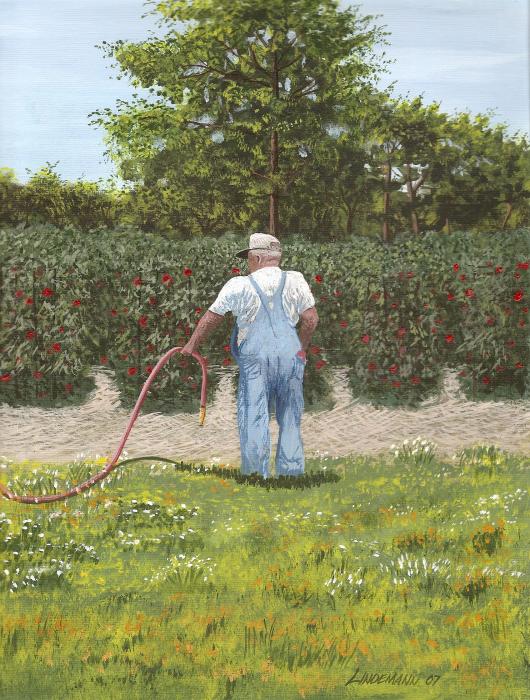
Old Man in Garden by Don Lindemann

Here’s the thing: when my father is gone, my mother stays in her domains and never ventures into my father’s. Why should she? She doesn’t read the newspapers, nor does she watch TV. The garage is just where she parks her car. But when my mother is gone, my father, though you could not tell from his face, almost gleefully assumes the role of gardener as well, and disappears into the yard for hours on end. The garden, because of what is produces, is closely tied to the kitchen and when my mother is home, the clanking pots, running water and tinkling glasses are usually an aural sign of her presence. However, sometimes the kitchen falls unexpectedly quiet and I come out of my room to find the kitchen empty and the back door slightly ajar, a pair of black house slippers awaiting my mother’s feet to re-inhabit them, sounds replaced by this simple image. Recently however, I still hear the clanking and the rushing and the tinkling, and sometimes, when the sounds stop, I enter the kitchen to see that there are pots bubbling on the stove, vegetables diced on the chopping block, and the back door slightly ajar with my father’s beige house slippers standing by. The television is invariably on, the sounds wafting into the kitchen – and the overall effect is calming, as is the knowledge that even without my mother, my father can keep things running smoothly for all of us. 

Like clockwork he removes his socks after dinner each day and steps out and into the backyard to water his wife’s plants until the sun goes down. He does this after a full day’s work, after spending a half hour making dinner for himself and his adult, live-at-home daughter, who during the summers, comes home from work to swim and then sleep for an hour. She eats with relish because her father cooks what she loves, and after dinner, does the dishes, memories of her father being a huge pain briefly suspended in her gratitude for the meal, lovingly prepared. She soaps the dishes and thanks her father for dinner, reminding herself that nothing and no one, no matter how steady or reliable or invariable, ought to be taken for granted. The father nods, pleased that his daughter is both fed and happy and without further ado, steps out into the warm evening air to water the plants his wife adores.

Home

Once, walking by my mother’s room and seeing her settling down for bed, it occurred to me that this had not always been her bed, this room, her room. She lay down on the right side – had she always slept on the right side? – and turned her face towards the lamp, preparing to read herself to sleep.
“When did you start to see this as your home?” I asked, standing in the doorway.
She looked up, the pillowcase hiding half her cheek, “What do you mean? I have never not seen it as my home.”
“No, I mean, when did you…” I faltered, wondering how to phrase the question. I used myself as an example.
“I’m home right now, right? This is my home.”
My mother nodded.
“But you once had a childhood home like this too. When did you feel like your childhood home was no longer your home?”
Edward Hopper, Cape Cod Morning, 1950 

My mother paused for a minute, fingers lightly holding the thin book she had been reading, “I guess when I got married. I lived with your grandparents until then.”

“Was it a strange transition?”
“No, not really.”
“You marry someone and move out, move in, and it’s home? Automatically?”
“It ought to be, but it’s different for everyone. Why?”
I shrugged, not knowing why I was asking except that I had, in that instance, caught a glimpse of my mother as someone younger, without husband and children, living in another house, sleeping in another bed.
  <!– /* Style Definitions */ p.MsoNormal, li.MsoNormal, div.MsoNormal {mso-style-parent:""; margin:0in; margin-bottom:.0001pt; mso-pagination:widow-orphan; font-size:12.0pt; font-family:"Times New Roman"; mso-fareast-font-family:"Times New Roman"; mso-bidi-font-family:"Times New Roman";} @page Section1 {size:8.5in 11.0in; margin:1.0in 1.25in 1.0in 1.25in; mso-header-margin:.5in; mso-footer-margin:.5in; mso-paper-source:0;} div.Section1 {page:Section1;}

–>

Five years ago, my father caved in to the leaky faucets, peeling wallpaper and yellowing fluorescent light covers of our house and announced that he would renovate. Among the things that I pushed for (including a ten-foot kitchen expansion and an entire second story with a game room) was my own bathroom, preferably en suite, and a walk-in closet, every girl’s dream. My father was receptive at first, nodding and taking notes to pass onto a Japanese architect with a fancy pedigree who came back with thousand dollar drawings of my dream house. But on the third or fourth floor plan, my father came to his senses. Among the things that my father actually implemented in the renovation: none of the above. I argued with him for a whole day, though knowing in the back of my head that he was right.
   “Why would I turn it into a two-story house,” he protested, “when you and your brother are about to move out?” 
    He painted a picture of life a few years down the road when the house would be home to just him and my mother, an aging couple with separate but faintly overlapping spheres: my mother’s being the backyard where her orchids and African violets threatened to overtake the lawn, and the dining room, where her Chinese school textbooks and papers had already smothered the smooth wood of our long table. My father’s territories included the living room couch where he often fell asleep in front of Jim Cramer and other Wall Street types and the small round wooden table to the right, where his computer sat and from where he generously doled out more spam than necessary. The kitchen was shared between the two of them, though more and more becoming my father’s territory as he neared retirement and discovered a passion for cooking and entertaining.
In my father’s vision, I saw my brother’s and my bedrooms, shuttered and empty, void of life except for a past life, embalmed in our childhood knickknacks, items that never made it to our new homes, shared with new people. The most recent thing among these relics would be the odd piece of mail that my father would inevitably bring in. Like a lonely mailman on the edge of retirement, he would come down our hallway every so often to set these envelopes upon our dusty desks, wondering when we’d swing by for dinner and pick up the mail. It was a cold, almost cruel image, one that would be realized, soon enough, and vividly so that I did not need to remind my father.
In a sort of compromise, it was decided that my brother and I would move out to a relatively new apartment complex in Irvine while the house was stripped down. My parents would hold down the fort until the renovations crept up to their side of the house, upon which they would then relocate to an Extended Stay on the outskirts of town. My brother and I rented a beige two bedroom in a beige complex behind a beige and purple shopping area. I took the master bedroom, which had an en suite bathroom and a walk-in closet that was sadly, larger than my parents’ at home. We would bring the old furniture from our rooms for our apartment and when the year was up and our house was done, we’d sell it and buy new pieces for our refurbished rooms.
On moving day my brother recruited several of his strongest friends to help us move into the apartment – we worked swiftly and within a few hours our childhood rooms stood empty with compressed patches of carpet lining the ground, where the furniture had been. Here had been my bed. Here had been my desk. Here had been my bookshelf. Only flat circles and rectangles remained from that former life. In the corners, corpses of unfortunate bugs had gathered, my ex roommates. As my brother and his friends drove off to our new apartment, I stayed behind for a while, tying up loose odds and ends, squeezing my belongings into the car. Our apartment was only fifteen minutes away, but it seemed much further than that, now that our rooms were empty. I returned to my room one last time, wondering if I’d miss the flowery wallpaper and matching drapes, adornments chosen by the elderly white couple who had lived there before us.
It was late afternoon as I walked back towards my room. I heard the familiar whirr of our old Kenmore vacuum cleaner, but aside from that, the house was strangely quiet. My mother was teaching Chinese school. I followed the whirr to my room, where I saw my father my father standing in the middle, vacuuming up the dead bugs on the compressed carpet. It clenched my heart, that sight. We were leaving only temporarily, but it was a preliminary stage to something absolutely necessary – my father knew it too. I stopped in the doorway, observing my father move as the afternoon sun danced around him. He did not see me and was framed by the squares of my old window, the view from which he often used to remark upon: “It’s quite nice, isn’t it?” Now he was no longer looking out the window for I was not there to enjoy it with him, not there to receive the old remark. Rather, he moved his arm back and forth with a mute, methodical sadness, stared intently down at the carpet, the fibers of which hinted faintly, only faintly, at his daughter’s footsteps.  

Family Vacation in Carmel, California

Part 1: The Acorn 

In Carmel, I learned how to play Balderdash. 
On Sunday morning we stood at a lookout point on 17-mile drive, a famous stretch of highway that contours the ocean – or does the ocean contour the land? –  and discussed what to do after dinner on our last evening together. 
“Balderdash,” said Caroline, squinting over the water’s rolling glint, “I think you’ll be good at it.”
I nodded in anticipation; who wouldn’t love to play a game they’d be good at? 
The night before we had watched a terrible Taiwanese movie about young gangsters – they crossed and double-crossed each other mostly in Taiwanese, which most of us didn’t understand. And on Friday, the night we arrived, we played Charades, parents included, girls vs. guys. The girls lost, but it wasn’t a terrible loss. Some things take practice. 
And so our weekend passed in a sprawling, ocean side paradise. My cousins rented a rustic house – some family’s home, filled with their history, their lore – to celebrate their father’s retirement. It was called “The Acorn,” though more fittingly it might have been called “The Hive.” Single story with four bedrooms and a separate cottage, the Acorn was designed decades ago in a labyrinthine style for a large family with many children and a constant stream of guests. Built of dark, paradoxical wood that seemed both sturdy and slight, the house creaked ceaselessly, yet was quiet. At night it required dozens of lamps to light yet in the mornings, was flooded with pale, seaside sunlight, the kind that hesitates to emerge from behind the clouds, like a shy but beautiful child hiding behind his mother’s back.
The house was, as my cousin Andrew noted, like a “little museum,” filled with old books with fascinating titles (Principles and Practice of Butter Making by McKay and Larsen, and The Science and Practice of Cheese Making by Van Slyke and Publow – apparently it takes two to write about such subjects). The oldest volume was a Rutgers yearbook from 1928, strangely titled The Scarlet Letter. It left a dusty red mark on my pajamas when I set it in my lap to scan the pages for one Mr. Whisler, the grandfather or perhaps great grandfather of the family who owned the house. But he was nowhere to be found. Yet around me, the Whislers and their friends were everywhere. They hung from the walls in faded photographs and pencil portraits, stern-faced gentlemen with white hair and stiff moustaches, somber-faced children sitting cross-legged before their clapboard schoolhouse, and soft-looking women with high collared dresses and tight braids. They stood atop mantles and bookshelves in trophies of contests past, the most amusing of which was a stout bronzed cow set atop a gleaming onyx column, awarded to T.F. Riley in 1950 for Highest Butter Fat Increase Per Cow: 59.5 lbs. In the front cover of the oldest books were inscribed the names of people – some visitors, some relatives – and, on the underside of a wooden duck, a gift to the Whislers “From George, 1970.” 
My uncle Louis, nearing his mid-seventies, lumbered around The Acorn like a happy child with too-big shoes. Though a former aerospace engineer whose daily work involved pages and pages of algorithms, an hour long commute into the heart of Los Angeles and top-secret trips to top-secret destinations (to this day he is still unable to discuss the nature of some of his projects) he was immediately at home in the Acorn. He found a favorite chair in the living room and developed a routine that included consuming a large brunch, followed by a walk along the ocean if the weather permitted and if the wind was not too strong. 
My aunt Joannie wore a red parka and new, old tennis shoes for much of the trip, smiling softly at her children all around her and her husband, for whom retirement was long overdue. It was a special occasion, she said, when I complimented her shoes. The shoes were nearly a decade old, a gift from her youngest son, but she had saved them for such a trip. They contrasted nicely with the house’s dark floors and against the vivid green grass of the garden, through which she traipsed with my mother.
My parents loved the house too, but for different reasons: my mother gathered parsley from the small herb planter next to the kitchen to sprinkle on our eggs and disappeared for what seemed like hours at a time to stroll around the gardens, which were green and lush and smelled of the nearby sea. She sniffed each blossom and gingerly stroked the wisteria hanging from the trellis, trying to remember the English names of other small, pretty faces.
“Rho…” she would say on her way in, wiping her feet on the mat outside, face flushed from the chilly air, “Rhodo…” And I would finish for her, “…dodendron, Mom. Rhododendron.”  
Like me, my father found the house a perfect place to read, though not because it was filled with books. He brought his own – a thin but dense Chinese paperback with a severe-looking emperor on the cover – and read in one of two padded wicker chairs with their backs against a large window overlooking the garden. In the mornings, my cousins still sleeping, I would wake and walk into the kitchen to see my father fully dressed with hair combed, breakfast eaten long ago, reading in the chair, George’s duck sitting quietly next to his right shoulder. Occasionally my mother’s slow figure would appear in the window, her upper body curved towards a bush or tree, and for a brief moment their bodies would align, my mother standing behind my seated father, the only division between them being a large pane of glass, translucent yet impenetrable. 
Compared to the walls and shelves of all the other rooms, the bedrooms were the sparest; closets emptied and dresser tops cleared for strange guests and their strange, anachronistic things: smart phones, laptops, iPads. Faded paintings and old sports equipment hung from the walls, though like a lingering smell or an intangible albeit vivid memory, one could still feel the aura of visitors past. Being one of two single people on the trip, I volunteered to share a small room with my cousin Darwin (together we made a two-spoke third wheel) thinking it would spare him sharing a room with my father, whose snores I often compare to a jackhammer. Even two rooms away however, my father’s snores impinged upon our late night conversations. We wondered how my mother slept at all. Though in the morning Darwin would accuse me of snoring softly, like a “little bear,” at night, tucked into our narrow twin beds, the ceiling slanting close above our heads, we talked about relationships – his, mostly. What makes a relationship work, we wondered, certainly not snoring like a jackhammer. Yet all around us, married couples old and young slept and slept.