Reflections By the Pool

My aunt invited my grandparents, parents and me over for dinner today. It wasn’t a special occasion or anything, she just bought a ton of groceries and decided to cook, and asked my dad to pick my grandparents up from their home in Cerritos on his way home from work. Dinners like these are a combination of things: an effort to eat healthier (my aunt cooks mostly vegetarian), to spend more time with her parents in addition to the countless hours they spend on the road and at various hospitals, and to spend more time with me. At least I like to think so.

A few years ago I would have shook my head no thanks, opting to stay at home or go out with friends, but in the past year and a half that I’ve been living at home I find myself looking forward to them. I like my aunt’s cooking, despite her dishes being bland and often, unsightly (lord help her presentation if she uses soy sauce or eggs). What’s more, there is the odd family practice of not really paying any attention to the younger generation. Growing up our family celebrations at restaurants and even at home were firmly divided into two tables: adults and kids. There are ten cousins and about as many adults, and my father was usually in charge of ordering for both tables. Thinking himself “hip” to what young people wanted, he would throw a fried noodle, rice or orange chicken dish in at the end of the meal at the kids table, assuming we’d go bananas over that stuff. (Most of the time, we were too stuffed to make a dent and he’d come over and help himself to a bowl, having wanted it for himself all along.) I think even now, with some of my cousins approaching forty and with kids of their own, we sort of still expect to be sat at a table together, separate from our parents.

These days at my aunt’s house I’m just one “kid,” and therefore expected to sit at the table with the “adults,” but their attention turns to me only when they’re concerned that I’m not eating enough or can’t reach a particular dish. It’s not strange until I think about how old I am and, according to society’s life map, where I’m supposed to be. I should be working late or perhaps out with my long-term boyfriend or, if I were married, home readying dinner for my husband and my own kids.

Instead I sit, eat, and listen. They talk about the dishes and how they can be improved (my father and grandma are most voluble when it comes to these matters). They talk about their mutual friends – who has cancer, whose children are getting married, whose parents are aging and on their way out, and who is a little miffed with whom but just too polite to say so. They talk about grandma and grandpa (if grandma and grandpa aren’t present) and their progress and about new and unborn babies, and how different child-rearing is nowadays. They love their children, but sometimes, in the lifestyles and within the marriages themselves, have a hard time recognizing that these children, now adults with houses and children of their own, came from their bodies.

It’s not a bad thing. None of it is bad – and they speak of these things in a matter-of-fact way, between bites of bitter melon, egg and tomato stir fry, pickled cucumbers, pan-fried rock cod, chicken curry, and yam leaves. They are both aware and unaware of time and how fast things change. When my grandparents are present you see on their faces everything that’s being said, those very changes that took place over all the long decades of their lives: the wars and revolutions, the migrations from there to there to here, the marriage and miscarriages and finally the births of these children who branched off into their own full lives with their own migrations and marriages and careers that enabled them to buy large houses in leafy suburbs and eggs in cartons of eighteen. They’ve done their share of fretting over their children. I guess, when you’re eighty-six and your back hurts no matter what position you’re in and you’ve tried every drug in the world, you sort of just realize, “Hey, life is short, don’t try to control what you can’t.”

And my parents and my aunt, they don’t try to control what they can’t. At least not anymore. All the variables have grown up and moved away. I’m not supposed to be around listening to these conversations, where they basically review everything they did right or wrong over the course of our young lives, but I am. What I’m listening to are the memories and realizations of retired tiger moms and formerly stern fathers (not my own, but my grandpa, certainly) who have pretty much stepped back and said, “They, my children, are no longer my responsibility. They have their own lives and I have mine.”

I’m learning a lot – but mostly that life, depending on how you look at it and how you spend it, can be quite short. Or I guess to be more optimistic: it’s long, but it goes by damn quickly.

Case in point:

After dinner my grandma wanted to poke around my aunt’s yard. My grandma loves gardens and plants and she loves to comment on other people’s plants. We encourage this behavior because it means my grandma is doing something somewhat active, even though my grandpa is always in a rush to go back home where he does nothing but sit and stare at the TV or listen to a wailing Beijing opera. We don’t understand his rush to do nothing, but at the same time this sort of pointless impatience seems to afflict most elderly Asian men I know. I think they were programmed to return home to their couches and beds. Anyway, this evening my grandma got up from her chair and walked to the back door.

“It’s so cool here by the door,” she said and without further ado, stepped out without her cane.

“Your cane!” my aunt said. I was done eating by then and rose to bring grandma her cane. I didn’t have to go very far, and since I was already there at her arm, I decided to walk out with her.

It was ten degrees cooler outside now that the sun was lower in the sky and I was instantly glad I had stepped out of my aunt’s warm kitchen. There was a soft breeze, coupled with the smell of grass and whatever plants my aunt kept on my left, that made the air so fragrant. Slowly, we walked around the kitchen window and came to my aunt’s garden patch. I smiled as my grandma poo-pahed my aunt’s plants, laughing at the scrawny tomatoes and tiny apples, but I could tell she was pleased that her eldest daughter, formerly a super successful real-estate agent who couldn’t keep a houseplant alive, now kept a garden at all. (Amusingly, my grandma kept on saying, “Your little garden,” even though my aunt’s yard is roughly, the size of my grandma’s entire house.) Aside from the fact that if my grandma had taken a fall I would have been the one responsible, I felt, standing there by her side, quite young and child-like. I had gone out barefoot and left my phone inside. My parents, aunt and grandpa were still inside chatting and finishing their meal, and for a few minutes it was just me and grandma in the garden.

We didn’t say much, I just stood by and watched her examine a leave here and there. Despite having no strength in her legs my grandma was quite strong in the arms and leaned heavily on her aluminum cane as she reached for a young fruit or browned, dead leaf, which she would pluck off with surprising vigor and thrust to the dirt. Eventually she decided my aunt’s garden was not hopeless and kept on walking beyond it to the pool, where two old lawn chairs sat side by side. She poked at one with her cane and, deciding that she didn’t care about the crusty bird shirt that covered the edges, sat down after bending her legs for what seemed like five whole minutes until her bottom touched the beige mesh of the chair.

She sighed and looked up at me, then twisted her neck around as though realizing for the first time that she was in her daughter’s backyard, “It’s quite nice here, isn’t it?”

It is, I said. Seeing that Grandma was safely seated, I stepped into the pool, wanting to cool my legs. I kicked a bit, stirring to the middle fallen leaves that had collected around the water’s edge.

“Oh my goodness!” my grandma exclaimed, “You kicked out all the dirty things.”

“They’re just leaves, Grandma,” but it was still light and I spotted my aunt’s pool net. I got out of the water and grabbed it, then tried as expertly as I could to gather up all the leaves I’d caused to float to the center of the pool.

“You missed a spot.”

I turned around. My grandfather had come out too and was standing at the opposite end of the pool, near the spa with one arm behind his back and another stretched out and pointing at the water.

“Got it,” I said, and moved to clean the area.

“Maybe you could work for your aunt and clean her pool,” my grandpa said, and chuckled to himself. What a jokester.

“I could, but I’d like to be paid in cash and not in vegetarian dishes,” I said.

He laughed, then walked around to where his wife sat. He bent down to brush the seat off, then sat down gingerly, wincing slightly as the crick in his back acted up.

I put the net down and walked over.

“Are you comfortable?” I asked, already knowing what his answer would be.

“At my age, there is no comfortable. There is only bad and not too bad.”

“Well, hopefully you’re not too bad.”

“Not too bad,” my grandpa nodded.

We sat, the three of us – they in the lawn chairs and me on the floor with my legs in the pool for the better part of an hour, talking about my cousins and their children, and guessing at who would marry next.

“You need to find someone,” my grandma said, then she thought about it and said, “Well, don’t rush it. It takes time to find someone really good.”

My father came out to take a phone call and we could hear his voice breaking in and out over the white noise of a garden in the evening.

My grandma turned to look, “Who’s he talking to?”

“He’s on the phone,” grandpa said.

My grandma looked at me, “Not sure what you, your mother, brother or what your grandpa and I did in our past lives to get a father, husband and son-in-law like him, but we are very blessed.”

I laughed. So I’ve heard from them many times.

My grandpa nodded in agreement, and for the next few minutes we didn’t say anything. Suddenly the pool lights came on along with the waterfall. My aunt had turned them on via remote control from her study. I waved at the window and saw a slim white arm wave back. The pool light, chosen by the previous owners who had no doubt predicted wild booze-filled pool parties, glowed in a myriad of garish colors: red, blue, white, then green. Silently we watched the water change colors, pausing just a few seconds on each hue before slowly changing to the next.

The three of us watched the colors change as though in a trance until my father finished his phone call and came to join us.

“I saw you clean your aunt’s pool.”

“Yup.”

“I told her she could clean her aunt’s pool for a living,” my grandpa said again, and my father laughed.

“Oh no,” he said, “She’s going back to school. At least, that’s what she tells me.”

“That’s the plan,” I said.

“Good, good,” grandpa said, “School is always good.”

My father scoffed, “Yes, but this one doesn’t study. I’m worried I’ll be throwing my money away. She majored in English and all she ever did was read a few novels.”

I shrugged.

“Saying you study is like watching ghosts fight.”

I thought my father was saying something poetic, about how a writer’s struggle is invisible, and for a minute I thought he was coming around. That he understood that my “studying” or “working” wasn’t always something you could chart. But just to make sure, I asked.

“What does that mean?”

“Have you ever seen ghosts fight?”

“No.”

“There you go.”

I rolled my eyes. What was there to explain? Nothing really. It was a nice evening. We had just eaten a healthy, home-cooked meal. I had just cleaned my aunt’s pool and was now sitting with my feet in the water. It felt good, and looking at my grandparent’s faces, they felt good too. My father, with his arms crossed and his phone back in his pocket, was smiling.

My grandpa must have noticed something then. The sun was nearly completely gone, but there was still enough light to see barely, the outline of their faces and mine too.

“You’re at your best right now,” he said suddenly, “this is your best time.”

I wasn’t sure what he meant: was he referring to my youth or intellectual potential or fertility? Maybe all three. Was it warning? Or perhaps in the dimming twilight my grandfather had briefly forgotten that I was twenty-six and spoke to me as though I were still a child, having just left the children’s table to accompany them to the edge of the pool.

I didn’t know and there was something about the moment that told me not to ask. His statement had been issued and I could do with it what I wanted. I kicked my feet up a bit and caused the water to ripple. The lights changed again, then again, and again, casting a glow on all our faces, sometimes warm and red, sometimes a cool blue and white. I wondered if the pool light had a sensor. If I jumped in, would the lights stop changing? Probably not.


Snails

For the past few weekends, I was away. I was on “vacation” on those weekends, short trips to Palm Springs, Las Vegas and San Jose, but there is nothing more relaxing than waking up in your own bed on a warm weekend morning, no alcohol in your bloodstream, no loud music from the night before, no sore soles from high heeled dancing shoes. Self-inflicted torment, I know. On Sunday evenings I would arrive home, exhausted from the drive and the combination of sleeplessness compounded from both the preceding workweek and the resulting weekend. YOLO, my friend Drake likes to say.

YOLO indeed, but there are many ways to YOLO.

This weekend I was at home for the first time in a long time. A delicious, nostalgia inducing state. I was reminded of those lazy summer days of my youth (and in truth there are about to be a lot more with my impending unemployment) where my sole responsibility was to make sure I swam after 4PM, when the sun was not so scorching. And even though this weekend was similar in its simplicity, it is never the same as when you were young. But I tried. I tried.

I ate popcorn and watched a string of Tom Cruise movies (“A Few Good Men” and “Jerry Maguire” – I know he is a crazy Scientologist but man can he deliver some lines!), read magazines from June and July, and went swimming to assuage my growing likeness to a beached whale.

Socially, I spent much needed time with family; lunching with them at a hot, crowded noodle house in Rowland Heights with slow service but enormous dumplings and then cooling off in my cousin’s airy new mansion with green carpeting and onyx vanities. We cooed over their new baby boy. In the afternoon my cousin came over to swim and we paddled and talked while my father dozed in the living room. When we came dripping inside, he gave us fresh cut watermelon. We showered and lounged on my brother’s bed, watching Jerry Maguire propose to Dorothy Boyd.

In the evening, I cut yam leaves from my mother’s garden and blanched them for dinner. It was an eyebrow raising dinner: an odd combination of tomato sauce on yam leaves, with some Parmesan sprinkled on top. My carb-free version of spaghetti. I ate before my mother came home from her line-dance class and when she returned and sat down to eat with my father, I for some reason wanted to stay and talk to them instead of retreat to my room as I normally. I ate a bowl of shaved ice while my father gnawed on leftover pork knuckles. My mother finished the fish she made two days ago.

We were very happy.

After dinner I started to write this, then stopped. I had spend enough time in front of a screen, probably enough for my entire life, though certainly there are several thousand hours ahead. I looked up across the street and saw my neighbor’s car pulling in. I imagined him giving his wife a peck on the cheek as he set his keys down on the kitchen counter. I had been in their house once as a child, and knew the layout. It was the same as ours, except with a second floor. I saw a couple walking their dog after their evening meal, most likely discussing their grown children who lived in other cities. My parents were less than a hundred feet away – we were at the same address and yet I often wondered what they were doing.

I stood up and walked to the living room. My father was asleep in the massage chair. There was a travel show playing, showcasing the gorgeous scenery of some place in Sichuan China. The back door was ajar and my mother’s house slippers at the threshold. It was getting dark and I wondered what my mother could do in the garden.

I called her name and I think she heard me better than I heard her. She was on the hill, crouched in the vegetable patch my father had built for her. The sun was gone and by what light was left I could make out a small plastic bucket in her left hand and the swift plucking motion of her right.

Dunk, dunk.

Whatever she was plucking made a small, satisfying percussion as they hit the inside of the bucket.

“Mom?”

“Hmm?” Her voice was almost singsongy, and though I couldn’t see her face I knew her expression – the slightly wan, but contented look she gets when she’s spent a few satisfying hours in the garden. Hours well spent.

“What are you plucking?”

Dunk, dunk. 

“Snails,” she said, “They come out after dark to eat my precious leaves.”

Dunk, dunk, dunk. 

“Sounds like there are a lot.”

There are. It’s terrible.”

“What do you do with them?”

“I dump them somewhere else.”

“Don’t you think it’s disgusting to touch them?”

Dunk, dunk, dunk.

“I did,” she said, then paused to examine a particularly large one, “I used to use chopsticks. But not anymore. It’s much faster this way.”

I could hardly see my mother then, and left her to her work. Walking back into the house my father stirred.

Where’s your mother?”

Plucking snails in the back,” I said, “They come out at night and snack on yam leaves.”

My father shifted in the massage chair, nodding as though he knew all about snails and yam leaves, “Yam leaves are very good for everyone.” Then he noticed how dark it had become.

Go help your mother,” he said.

I wrinkled my nose, “I don’t want to touch snails or step in the dirt. I’ve already showered.”

“It’s dark,” he said, “You could hold a flashlight for her, couldn’t you? Bring her a light.”

I guess so. I didn’t feel like writing. Not yet. I went to my father’s cabinet, where he kept random things like flashlights and radios and took out the most powerful flashlight he had. The kind that cops use when they are suspicious of someone. The kind that doubles as a weapon. It cast a cold beam, but was sufficiently bright and would illuminate a slimy snail on a clean yam leaf like a helicopter following a car on a high speed chase. Fox News with snails.

Wordlessly, I went back to my mother and clicked it on right where her hand was reaching next. She showed no surprise, as though she’d known all along I would come back with the light.

Point it here,” she said simply. I did as I was told. I held the light for her as she seized the frozen snails. I don’t think she got them all.

“I could never get them all,” she said, “but I did get many of them.”

She told me about a friend of hers who made a funny sort of escargot with the snails she found in her garden.

But I wouldn’t do that,” she said. The little bucket appeared to be about full and I stayed away, purposely not shining the light into the bucket. I think it would have made me squeamish. But my mother took the bucket to a withered avocado tree several feet away from the garden patch and turned the bucket over. She whacked the bucket against a branch. The snails tumbled onto the ground, a confused bunch writhing in the dark.

My mother smiled at me as she came up the cement steps.

“Don’t touch me,” I said.

She laughed. “Of course not. Thanks for your help.”

We stood for a moment and looked down into the garden. A shadowy patch of yam leaves freed from the at least one night’s onslaught of snails.

My father dozed in the light of the living room. My mother was very happy. Poor snails. All they wanted was a twilight snack.

Density (3)

I didn’t tell my father I had been hit by a car until my arm began to hurt. I wasn’t trying to be strong; I just didn’t want to hear him nag. 

The car came from behind. Erica and I walked on the right side of the road, the side we always walk on, I on the outside and she inside. We were talking about something – boys, jobs, my frustration with both – familiar conversation on a familiar road, when suddenly a tremendous force struck my left arm and sent me tumbling violently to the ground. I groaned and was dazed – it didn’t occur to me that I had been hit by a car until a split second later when I turned to see the car speeding down the road. I heard Erica saying, “Oh my god, oh my god,” then when she registered what had happened, screaming, “Hey! HEY! GET BACK HERE!” 
In my dazed state I remember looking up at her from the ground thinking, “I wish she would lower her voice,” as it was late and the neighborhood, being filled with elderly folk, was mostly half asleep.
 Erica bent down, her voice now quieter and more hurried, more worried, “Oh my God, Betty. Betty. Are you okay? Where does it hurt? Don’t move.”
I didn’t know. I groaned because I was confused. Everything hurt and nothing hurt. Even though it was dark, I closed my eyes because it helped me concentrate – I had read something about trauma and how adrenaline or shock can trick you into feeling fine and moving what you shouldn’t be moving. One bone at a time, the article had said. I wiggled my toes. I moved my knees. I tapped the fingers of my right hand, bent my arm at the elbow, rolled my shoulder, my neck and with my right hand, felt my head. I saved my left arm for last because I was terrified that it was shattered but that I just hadn’t registered it. I didn’t look at it. It felt numb. But slowly, very slowly, the sensation came back and I could feel the tips of my fingers – though the left tips felt noticeably duller than the right. But the fact that I could move them – it meant my bones were fine. Nothing was broken.
I got up slowly, then turned my neck left and right. All good. My legs worked fine. And finally the arm. The left arm I let stay at my side – I didn’t want to shock the liquefied muscle. Erica stood by and watched silently, shocked that I was standing.
“Betty,” she said, “maybe you should sit down.”
“I’m fine,” I said.
“No. I think you hit your head.”
“I most certainly did not hit my head.”
“I think you did. You can’t always tell when you have a concussion…and then sometimes people just go to sleep and never wake up. Like Natasha Richardson.” Even in the dark, I could sense her worry, “Please sit down. I’ll get your parents.”
“Erica. I’m fine.”
We finished the walk and at the door, I assured Erica I wouldn’t die in my sleep. There were too many things I had to do. Like check my email.
An hour later, I sat at my brother’s desk, wondering how odd it was that I’d just been hit by a car. My parents had greeted me at the door and asked me how the walk went.
“Fine,” I said, “Great.”
And I went to the computer. I sat and typed something, deleted it, then as my thumb pressed the space bar a sharp pain shot up my left arm. I ignored it and continued writing, but the pain came back stronger and stronger until suddenly, I was fearful of moving any part of my left arm.
I looked at my watch. It had been exactly an hour since I’d been hit – wasn’t my response to the pain a tad too delayed? I imagined a hairline fracture splitting and splitting and the bone finally cracking in two an hour later. Is that what was happening now?
I suddenly had to know. I thought about my grandmother enduring severe constipation and stomach pains, not wanting to “bother” her children with her petty digestive issues until one day there was so much blood in her stool she was frightened. The diagnosis was a minute away from colon cancer and she ended up having a giant segment of her intestine removed.
I wasn’t going to be so stupid. A little nagging was a fair trade for having my father drive me to the hospital, as my left arm was in no condition now to turn a steering wheel.
I walked slowly into the dining room, where my mother sat typing away at her laptop. My father was in the kitchen, within view and earshot.
“Mom, dad,” I said slowly.
“Hm?”
“I have to tell you something, but please don’t freak out.”
My father stopped chopping the scarlet watermelon. My mother looked up from the laptop. Their worry thickened the air.
“I got hit by a car when I was walking.”
My mother gasped. My father put down the butcher’s knife with more force than was necessary. He walked slowly into the dining room, as though walking in too quickly would shatter me. He looked me up and down.
“What? Where? Where does it hurt? Are you bleeding? Who? Who? Did you get the license plate?”
I told them what happened, emphasizing that only my arm hurt – and on the arm, only my tricep…but the pain was increasing and I feared I had a fracture.
“We’ll go to the hospital right away,” my father said, and in the car and in the emergency room, I had to hear it: the long, drawn out “I told you so” about walking with a flashlight or a reflector vest. It was an old warning, often heard, never heeded.
“I’d rather walk in asphalt camouflage,” I’d say.
He’d shake his head, “Once is all it takes.”
And it’s true. Once is all it takes.
On the drive to the hospital I studied my father’s headlights and the area they covered – there was no way the driver did not see me. Perhaps he was inebriated and had slow reflexes. I imagined how – or how I hoped – he felt: filled with remorse. Hitting a pedestrian and driving away. Did he think I was a garbage can? I had bounced loudly off the side of his passenger side car door – a discovery I made later in the bathroom when I discovered a chunk of skin missing from my left hip. I wonder if the thud rang in his head as he tried to sleep that night, not knowing if it was a garbage can or a human. Either way, he had left something toppled over on the side of the road.  
We drove quietly with the Chinese radio playing softly in the background – my father driving jerkily, as though he couldn’t decide between speeding up or slowing down. I held my arm gingerly – trying not to think about the pain and worrying if I would have energy to go into work the next morning. My father finally spoke.
“He didn’t stop at all?”
“No.” I thought about the noise I heard, “I think he sped up.”
My father grunted. I turned to see his face glowing in the dim light of the dashboard and brightened intermittently by the pale yellow street lights we drove past. There were bags under his eyes. He seemed even more tired than I, but here he was, driving me to the ER at midnight. His expression was more disturbed than I had seen it in a while – in fact, he seemed angry.
“Look Bah,” I said, “I know I’m stupid. I should have been holding a flashlight or wearing a reflector vest. I will start walking with both.”
He snorted, “I’m going to buy you a neon reflector body suit. But you didn’t get a license plate? Nothing? Did you see him at all?”
I wondered why he was asking me – I had told him already. I didn’t see anything that could help me identify the driver – just the car from a distance as he sped down the hill and then nothing.
“No, Bah. I didn’t see anything.”
“He just drove away?”
“Yes!” exasperation crept into my voice, “He just drove away! What do you want me to do? I wasn’t exactly in a position to go and chase him down.”
My father shook his head.
“Dad, are you okay?”
 “Okay?” The car swerved slightly, “Of course I’m okay! I didn’t get hit by a car! But I didn’t just raise a perfectly good daughter for 26 years so that some….some… (and here my father said something quite shocking – a Chinese expletive I have no idea how to translate)… could run her over!”
I wonder if I had gotten a license plate or even a vague description, what my father would do. I don’t know. He is not vengeful, but I had never had occasion to see my father act protective. So charmed is my life. He is nearing his mid-sixties, which nowadays is not so old, but at that moment I sensed a strange desperate helplessness. True, HE was driving me to the hospital, not the other way around, but I felt sorry, suddenly, that I had brought this unnecessary stress upon him. How could I take care of them if I didn’t even have the sense to walk at night with a flashlight? But it was the light- the sallow, dingy yellow of the streetlamp that cast more shadows on my father’s face than necessary. It was the light and the time of night and the fact that he was driving me to the ER, something he had never done, and something he hoped he would never have to do again. 

I was still conscious and in one piece, still healthy, but we both knew it had been a close call. An inch closer to the left and I’d have been paralyzed, my spine the central point of impact. Now behind the wheel, he was in control. But there were times during which his daughter, under her own simple volition, would climb too high and out of his reach or step into a darkness into which he (and a others) could not see. 

Density (2)

In the ER waiting room I sat opposite a four year old Mexican girl with down syndrome and a bad haircut. She looked at me lazily from her mother’s lap, a piece of white gauze taped hastily to her forehead. Her father wore a dingy white t-shirt and worn baggy jeans that draped over workman’s boots. He seemed exhausted and furious, alternating between sitting down, tapping his foot impatiently and jumping up to pace about the room, causing the sliding doors to open whenever he got too close to the sensor. His wife was young. Probably younger than I. She seemed tired too, despite having on full makeup. They talked lowly, hurriedly in Spanish as their daughter drooled and wondered why her head hurt, if she could remember at all. Perhaps she just wanted to go back to bed. I watched as she tried to find a comfortable position on her mother’s lap.

I stared at her and she stared back. The father talked impatiently to the nurse.

“We’ve been waiting for over forty minutes. My daughter fell out of bed and hit her head. She was bleeding so badly.”

The nurse didn’t even bother to look past her window to the daughter, who was no longer bleeding. The little girl appeared fine to me too, except for her genetic disability. Her pajamas were stained. There was something sticky in her hair. I wanted to give her a bath. I wanted to give myself a bath, but I had gone to the bathroom and winced, noticing the skin missing from my left thigh and the brilliant red gash on my arm. Those parts wouldn’t be so fun to wash.

We were both injured, the little girl and I, but not seriously so. We would go home eventually, wake up very close to our parents, she perhaps in the same room as her mother, who was likely two or three years younger than I, and I just a hallway away from my parents, who were nearing their mid sixties. Well, my father at least. The father returned to his seat and resumed tapping his foot impatiently. I yawned and stared at my watch, then looked at my father. I had not noticed until now: how white his hair had become! How much looser his jowls seemed! It was late and no doubt I looked haggard as well – the car had knocked my ponytail loose and I couldn’t raise my arm to retie my hair.

The little girl stiffened her body and slid awkwardly out of her mother’s arms and her mother bent down with some difficulty to gather her again. For a minute my father’s and my reflection stared back at us from the sliding glass doors – I saw a gentleman on the cusp of being elderly – not quite there, but just a few years away, and a young woman who could, age wise at least, very easily have been hugging an injured child of her own and tapping her foot impatiently as the doctors and nurses tended to more serious injuries in the back. Instead I was twenty-six and my father sixty-three. I did not have much in common with the little girl’s mother who was fretting like a good mother should, despite the fact that the little girl would be fine. Perfectly. I did not have much in common with her at all.

The little girl and I, however, we weren’t so different.

Density

When I was nine or so, I fell out of a tree. It wasn’t the highest branch, but it was quite high. Halfway up the tree, my father had appeared at the window with his arms cross over his chest. He rarely monitored my outdoor activities and it was a rarity. Emboldened by an audience of one, I went higher than I normally did, to a branch more tender (or given that it snapped so suddenly, just dead) than the rest and plummeted several feet to the ground below. In the millisecond that I glimpsed my father’s face as I fell, I saw him lurch towards the glass. Even in a millisecond, I could sense his panic.

Gustave Caillebotte A Young Man at the Window 1875  

I hit the ground with a thud, muted by the soft dirt and fertilizer my mother kept beneath the tree for her flowers. Had my mother a penchant for small picket fences or cacti, I would have been a nine-year old human kebab. But I suppose that is what mothers think about, when they plant things underneath their daughter’s favorite climbing trees. Feeling slightly dazed but fine, I sat myself up and slowly turned to my father, still at the window. I waved and immediately his posture softened. Fear can freeze you – my father is a man of action, but for the seconds I traveled from branch to ground, he had become a statue.

For years that was the story he and I both told when discussing our bones. Genes are a source of pride in our family, not because any of us are particularly beautiful or talented, but because we are built, for lack of a better word, like fortresses. My father will invariably begin with slapping me on the back as though I were a football player, and say proudly, “She’s so thick! Look at this meat on her back! Look at these arms!” Then he will bend down and measure his knees with his forefinger and thumb, then move the fingers to my knees, adjusting them slightly so that they appear to be the same size.

“Her knees!” He will crow, “Look at her knees! The same width as mine!”

I have a strange relationship with this comparison. On one hand, I am glad to be healthy and athletic (looking) – on the other, it is hard to act or want to act like a lady when your father is constantly comparing you, physically, to himself, a man.

Beyond this, my father is not the type to spoil or coddle. Growing up neither he nor my mother were very generous with praise. I became very good at praising myself and my brother quite adept at changing his report card D’s and F’s to B’s and A’s. Athletically we were never pushed, but I had a hunch that if someone beat us up at school, we’d be shamed if we didn’t fight back. Luckily, no one ever challenged us on that front, though I did once kick a helpless classmate in the stomach when she had already been on the ground. Wisely, I kept this behavior from my parents.

Basically, my father is a straightforward man who only in his older age, is beginning to show his softer side. And even it is not so soft. My father is a critic of the most annoying kind: he zeroes in on your weaknesses and oversights and will loudly point them out at family parties, much to the embarrassment of both his immediate family and those being critiqued. He is very much, the kind of person to say, “I told you so!” And say it again and again and again until your knuckles have turned white from clenching your fists too hard and your teeth on the verge of being ground to dust. You are welcome to jab right back at him, but just know his skin is as thick as his ego is grand. Perhaps it should follow that empathy and emotional intelligence should also be lost on him, and while I’d like to think he is not nearly as attuned to these as I am, he has startling moments of insight into characters and situations, perhaps the product of the only fictions he has ever deemed worthy of reading: the breathtaking sagas of Classical Chinese Literature.

Smart, detail-oriented, excellent at cutting through bullshit and zooming in on mistakes that most people would overlook, my father would make a very good assistant, but for some reason, those that would make very good assistants are usually not assistants. Most curiously, despite being a man’s man, my father can also be a vicious gossip. I see very much of myself in him – but that just makes me a bitch.

But he is aging. As I’d written before about my mother, old age either hardens or softens. In a select few, it does both and in such a way that the person becomes more balanced. More well-rounded.

I don’t know yet what age has done to my father. I am under the impression it is a slow and ongoing process. But on Tuesday night, I saw my father up close for the first time in a long time, only because someone failed to see me at all.

On Tuesday night, I was struck by a car.

(…to be continued, obviously).

Kharma

We’re not a religious family. Once, when my Christian friends in elementary school asked why it was that I slept in on Sundays rather than attend church, I shrugged and said, “I go to Chinese school on Saturdays.” 
They stared at me blankly and said, “Yes, but that’s not the same thing.” And hearing them talk about their church activities and romances and holiday festivities, it didn’t sound like the same thing. They seemed to enjoy church and I, at least on Saturday mornings before I arrived, did not enjoy Chinese school. It was not my religion. It was the linguistic and utterly necessary (now when I look back) facet of my culture. That wasn’t a distinction I was wise enough to make as a child. 
So my friends went to church on Sundays while I slept in. One Sunday (or perhaps it was another day, but for narrative’s sake, let’s pretend it was Sunday), I asked my father, “Why don’t we go to church?” 
Without looking up from the TV he said, “You can go if you like.” 
“I know,” I said. My parents were very open that way. They encouraged me to try this and that, at least my father did, because it meant I would have less time to pester him during the Taiwanese news.
“But why don’t you go to church?” 
“I don’t need it,” my father said shortly. I didn’t see him move, but I detected a slight increase in the volume of the television. A young, pretty Taiwanese news anchor rapidly announced the evening’s headlines. It never seemed strange to me that my father was always watching the news in Taiwan. Because we had a fancy satellite dish, we got it in real time. I grew up with the sharp voices of young female anchors in the background. 
I asked my father what was then, for a 9 year old, a very thoughtful question, “You don’t need church or you don’t need religion?” 
“Neither,” he said, “But if you want to go to church, go.” He raised the volume one notch more before I could ask another question. I’m sure my father would have asked me to go to Church at that moment juts to stop bothering him. 
Later, I posed the same question to my mother, who answered more thoughtfully: “I’m not religious, but if I had to align myself with a particular faith, it would be Buddhism.” 
This made perfect sense. We celebrated Christmas, but not because of Jesus or anything, and I think the only times my mother stepped inside churches were weddings or the time she visited Europe. “That’s all they have in Europe,” she said, “Giant churches that all look the same. And pigeons.” A few years later, when I was going through a shoebox of photos from that trip, on which she’d gone to 8 or 9 different countries, I asked her where a few of them were taken. “It’s written on the back,” she said. I turned the photographs over and saw that she’d written “Europe” on all of them.

Aside from Christmas and the odd Easter dinner at so and so’s house, we really didn’t do anything else remotely religious. At least not in America.

Rene Magritte Golconde ,1953 Oil on Canvas. Houston, Texas, The Menil Collection

In Taiwan, we are religiously, a different family. This came to head when my grandfather passed away and suddenly all of us Ho’s became almost monkish in our devotion to the temple where our name plate was displayed. “Name plate” is a rough translation – a more direct one would be “ancestral name placeholder.” Basically it’s a small, standing plaque with our family name on it. You pay “rent” (actually I don’t know why I put that in quotes. It is actual rent) to the nuns at a temple to have it displayed (either prominently, which means more rent, or less so) and it represents the souls of your ancestors. I think it’s a convenience thing, as going to a local temple to worship the plaque is a lot more convenient than driving to the actual grave site, normally located in the countryside.

Apparently you have more than one plaque, because families, as you know, can be quite complicated. We had one for my grandma and her aunt, an old woman with no teeth who came to Taipei from Shanghai and helped raise my dad and uncles. They called her, in Shanghainese, “Nn’na.” I think their plaque is under “Hu,” my grandmother’s maiden name (some day my parents will read this and tell me, ashamedly, that I got everything wrong).  For many years their plaque was displayed at a temple that wasn’t very good about the upkeep. As happens with limited storage space, more nameplates kept on crowding in because other people in other families kept dying and pretty soon the “Hu” plaque was pushed back to a dark, dusty corner of the display case. Also, people weren’t too good about paying their rent – either that or the nuns at that temple were just lazy jerks and just let things fall to the wayside. Whatever it was, my grandma’s spirit was getting really sick of it. My grandma wasn’t a flashy woman, but she had been the proud matriarch – mother to three well-to-do sons and the third wife of a well-to-do customs’ agent who, even if he didn’t bring home too much bacon, made enough so that she could invest it in property. The property passed down to her sons, who built things on it and sold the things to people who needed such things (namely, housing and office space) and yeah, she was kind of proud of all that.

It made perfect sense that a woman who had built a small fortune around property should be in want of good real estate, even long after she’d left earth. She was disappointed with the set up her sons had left her in and decided to do something about it.

This is where things get weird. In Chinese numerology people born on certain days at certain times are said to be “lighter” in spirit than others. Their spiritual “weight” is lighter than average, meaning they can, if they’re not careful, drift to and fro between realms. I’m not explaining it too well, but I’ll quantify it with two stark examples. If 1 were extremely light and 10 was extremely heavy, my father, the man who doesn’t need religion but isn’t quite an atheist, would weigh in, spiritually, at around 7 or 8. Oddly enough, he studied numerology on a whim in his late twenties and, when my brother was born, predicted his son’s future physical attributes and certain personality traits quite accurately. By the time I came around he’d lost the instruction booklet.

Rene Magritte The Beyond, 1938 L’au-dela Oil on Canvas Private collection

But with children and the responsibility that comes with, my father more or less planted his already firm feet more firmly into the present, earthly life. When his father passed away, he worshiped at his grave out of respect to the rest of the family, still living, not because he actually felt my grandfather could hear what he was saying. (Indeed during a particularly long chanting session – I’ll more into detail about that later – my father fell asleep while kneeling and almost keeled over until a nun came to nudge him awake. My family was embarrassed. My father said, “What? What?”). My mother on the other hand, despite her relative poopooing of western churches, is extremely open minded to religious practices and other matters of the heart and spirit. She is not only receptive to Buddhist teachings, but also, on the whole, a spiritual person. She is the one that first brought to my attention the idea of Kharma – that what you do in this life could very well affect your next life – and while I know some people who resign themselves to this idea that their life now sucks because they’re paying for something bad in their past life, I don’t buy it – or at least try very hard not to. But on the spiritual weight scale, my mother is probably a 2 or 3.

If a spirit floated into the room where my mother and father sat watching television, the spirit would have a better chance getting my mother’s attention because a.) my mother doesn’t really watch too much television and b.) my father would, should the spirit successfully make faint contact, just turn up the volume. Even if the spirit happened to be his own mother.  

My Father’s Stories

Somewhere in between high school and my second year at college, I stopped reading fiction. Not altogether – a small number of brilliant novels made its way into my hands via persistent recommendations from friends and family – but very, very rarely now, compared to my youth when fiction was all I would read. As a young girl visiting the library, I would make a beeline for the new fiction section. If it seemed I’d already gone through the choicest ones, I’d make my way to the back shelves. But I never wandered beyond the shelves marked “Fiction and Literature.” My memory is poor, but perhaps I have done that walk so many times this impression could not help but be ingrained: I remember one evening, hurrying past the biographies and wrinkling my nose in distaste at the thick tomes about real people. “Why would anyone want to read about real people when there is so much great fiction?”

My father was a hypocritical detractor of this mindset. He would shake his head whenever I walked in with a bag full of novels and say, “That stuff doesn’t grow your brain. It makes you dream,” and I’d roll my eyes and say that he had no heart. Fiction builds character, I said. Why do you think I’m so amazing?
I say hypocritical because my father grew up on a steady diet of classical Chinese literature – all of it fiction. You may know the most famous: The Dream of the Red Chamber, The Romance ofthe Three Kingdoms, and Journey tothe West – impossibly long and complicated stories written back then by people with plenty of time and imagination, for people with plenty of time and growing imaginations.

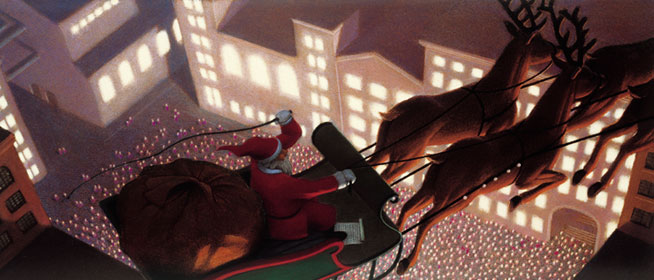
My favorite scene from “The Polar Express.” 

As a grown man with thoughts of career and family, he stopped reading fiction, but he never stopped thinking about it. I have often said that I remember little of my father from my childhood, though if I were to excavate the loose grey matter I hardly use, I would find him exactly where I needed him most.

He often picked me up from daycare and, if he came home later (though always in time for dinner), he would come bearing a large stack of children’s books from the palatial Cerritos Library. When we lived in the city, he took me there on weeknights or Sunday afternoons so that I could make my own choices and I will never forget that magical wing, designed to mimic a medieval castle with turrets filled with thin, colorful spines, each bearing a tale, not necessarily a lesson. But after we moved to a city some thirty minutes away, he often stopped by on his way home from work and picked out books with what he hoped was a discerning eye. To be honest, I don’t remember many of the books – The Polar Express, The Velveteen Rabbit and The Vanishing Pumpkin stand out (going online to see the covers of these books now, for some reason makes me cry) – but collectively, they comprised a lovely childhood.

What’s more, my father told us stories – at least, he tried to. It is a running joke in our family that my brother and I ought to know those stories by heart, at least the Journey to the West, because my father boasts of having played raconteur to us each night around bedtime. And he did, we do, but only parts. He always fell asleep after three or four lines so we never heard the ending. How did the sly monkey and pious monk get to the West? More than anything my brother and I know the sound of his snores, which now blend seamlessly with our perception of that tale. I know now, from Chinese school and later studies that the monk, the pig and the monkey eventually reached their destination, but it is vague to me, unlike my father’s introduction to the story, which still rings loud and clear. Indeed, you must be able to recall the fables and other bedtime stories your parents told you as a child – perhaps you never even set eyes on the words but you remember them and the images they evoke. It becomes innate – the stories as much a part of your genetic makeup as your hair and bones, your heart.

For years I rolled my eyes at my father, thinking he would never understand me because I loved novels and he seemed only to ever read business books and magazines, but looking back, I realize I had forgotten the source of this love. 

100 Years of Vanity, Part V

She was a terrible cook, but nobody could peel shrimp, crack open a crab or a lobster, a mussel or a clam, or disassemble a German pork knuckle as adroitly as my grandmother could and to her liking. No one else could make friends with servers and maitre’ds and managers alike despite being with the most difficult customer many of them had ever known. She knew his appetites better almost, than she knew her own, and it was at the table that we learned how little we knew how to communicate with him – the least we could do was follow her lead. But it was too obvious, to both ourselves as well as to the rest of the world, that the family was at a loss on how to appease my grandfather should grandma step out for a moment.
But these moments were rare – for twenty years she was unfailingly by his side, always there to cater to his vanity, and on the morning of his one-hundredth birthday, she was there as well.
God knows what he dreamed during the night, but at four am his eyes shot open with an all-consuming hate for his aged complexion. Perhaps it was the thought of appearing before four hundred guests under bright ballroom lights, but being an innately vain man, he decided to take extra precautions. He shuffled resolutely into the bathroom and turned on the lights. A few feet away, my grandmother stirred in bed. Having spent the last twenty-years sharing his biological clock (one that wakes often at odd hours of the night to use the bathroom or read the paper-or both), she simply turned the other way and pulled the blanket up to her chin. My grandfather ran his fingers along the shelves, silently reading the minute labels until he found what he was looking for. He began his work.
The balcony, where my grandpa usually stood doing his morning exercises was empty. The bathroom door was closed, a strange phenomenon, for in his old age, the fear of an unheard fall led him to bathe with an open door. She was worried – aside from the hundred ticking clocks of my grandfather’s collection, it was oddly silent. No running water, no brushing of teeth or wringing of frayed undershirts. She went to the door and knocked. Nothing. She knocked again but not before hearing the distinctive click of a compact being closed.
“Can I open the door?” She asked.
“Hmm.”
“What are you doing in there?”
When my grandfather failed to respond she held her breath and turned the knob, bracing herself for what she was not sure, but certainly not to find her husband, a distinguished gentleman to all who knew him, with his face done up like a retired geisha who had failed to remove the makeup from her last night at the teahouse. He turned slowly, a crazy, hunched wax man, and had he the humor to give her a devilish grin she might have died of fright. Instead he said nothing, nodding subtly as though using up an entire bottle of foundation on one’s one-hundredth birthday was de rigueur, and went back to work.
My grandmother rubbed her eyes, not sure if she was dreaming. Why the mask? Why the rosy cheeks? Did he intend to celebrate his one-hundredth year as a lunatic? A transvestite? But the man had laid out his suit and shoes the night before, pairing a red-silk vest with a red-silk handkerchief and now, he apparently wanted his cheeks to match. Between gnarled fingers he held, gingerly, the blush compact in one hand and the brush in the other. Round and round he went on his left cheek, seeing only the perfection of perfection- he was merely enhancing what he always had. He was a handsome actor preparing for his greatest role ever.
Grandma, now fully awake, stepped in.
“You look…” she considered his one hundred year old ego, then thinking about the four hundred guests and her seat next to him, she considered her own, “You look ridiculous.”
I was getting my own beauty rest two floors above, but I imagine a small tussle took place in the master bath that morning as wife tried to wrestle away blush compact from husband.
But he said nothing. Chuckling softly at his handiwork, he handed the compact to her.
An hour later grandma had exhausted an entire box of Kleenex and half a bottle of makeup remover. Her husband’s skin glistened once again in its natural beauty and his cheeks glowed with the faintest pink, from having been rubbed with tissues.
“See,” my grandmother told him, tossing the final Kleenex into the wastebasket with its makeup-laden siblings, “You don’t need any of that makeup – you are handsome enough as is.”
He looked in the mirror and agreed, touching his face and enjoying the softness. Then he looked at her, his patient, adoring wife who had always known best. He looked at her tired face, the dark circles under her eyes, her fuzzy hair – she looked that way because of him, because of all the energy and love she spent on him. He loved her for that.
Still, it was his birthday and she would be sitting next to him.
“We haven’t much time,” he said, handing her the compact, “you’d better get started.”

The End