How to Pass Time in the Hospital

For most of the time now, grandmother sleeps, in a body that she hardly seems to recognize. Her mouth is filled with canker sores. The scab on her upper lip, a result of her fall nearly three weeks ago, still has not healed – a paradoxical side effect of the oxygen mask she needs to keep her alive. She has lost weight and I was startled last night to feel how thin her calves had become, how loose the skin. But still, I repeated loudly what the nurses had said to me two weeks ago, “Grandma, all the nurses say you have excellent firm skin for someone your age.” We think she is sleeping, but we know too, that when you sleep all day, it is always a half sleep, never deep.

Before, when she still had energy to speak she lifted the oxygen mask just long enough to look at my mother and say, “How did it come to this?” 

It seems like half a year ago that the doctor deemed her well enough to commence physical therapy, but in truth it was just last week, when she showed signs of improvement and when her body was still hers. When we visited that week, we found two towels stuffed into the sides of her bed. We pondered these towels until evening after dinner she grabbed one between both hands, held it shoulder width apart, and began to twist and twirl them through the air in a choppy figure eight. It was an oddly elegant motion, and my grandmother performed it with a similar albeit shaky elegance, eyes closed and lips pursed. At times it appeared as though she were chanting. Even this tiny movement caused her to wheeze and I wondered about its effectiveness. My grandmother’s arms are strong, much more so than her legs which have undoubtedly been weakened further after two weeks of bed rest, but I suppose at this point you strengthen what you have and pray the rest will follow.

At the very least, the exercise helped pass the time. If you are a bed-ridden patient in the hospital, there is plenty of time. Twenty-four hours a day for fifteen days and counting, every hour blends seamlessly with the rest because in the hospital room with its darkened windows, one really cannot rely on the sun. My aunt, uncles and mother, my grandmother’s four children, take turns spending the night with her, given a break only occasionally by me, the unemployed grandchild with nothing but time and a stack of unread magazines. When the lights go out and my grandmother tries to sleep (though it is rare that she sleeps for an hour straight), I take out my CD player (a relic, nowadays) and listen to an audiobook. My aunt often asks me not to go – I am too young, I need my rest, etc. etc. but I stare at her sixty-year old face and say, “Yi-Mah, I’m twenty-six, it’s nothing to me.” And of course a few all nighters here and there are nothing, but she and I both know that if my grandma’s status were to suddenly take a turn for the worst, it had better be one of her own children than me, a grandchild with hardly any history. In the grand scheme of things, my life is but a tender, green branch, near the top of a towering oak tree.

Morning arrives and my grandmother stirs in her monstrous mechanical bed, not because she is well rested but because she is exhausted and tossing and turning is the only thing she can do to pass the night. I look at the clock; it is 6AM and neither of us has had any sleep. Between the beeping of her oxygen monitor and other patients’ IV drips and nurses who, so accustomed to their nocturnal lifestyles, forget to lower their voices in the hallway and the hourly visits of the Respiratory Therapist and the Nurse’s Assistant and the Nurse to administer one or two of my grandmother’s dozen steroid-based medications via the painful IV in the thin skin of her hand (re-positioned every two days to prevent infection) or the respirator or through the mouth, rest is clearly the only thing not administered to a patient in a hospital bed.

But still, the sun is just beginning to show itself and despite my brain crying for sleep and the danger of driving home in this exhausted state, I find myself striding out of the hospital’s sliding glass doors, slamming my car door and weaving in and out of traffic, racing home to my own bedroom which is free of other patients, free of fluorescent lights and free of commodes and bedpans and IVs. Anything but the confines of that small, dim space, to which my grandma is chained both by the oxygen tube that keeps her alive and by the weakness of her legs. Anything but that dim space in which she will remain until God or Zithromax and her seemingly impotent cocktail of corticosteroids are finally able to oust the stubborn phlegm in her lungs, though today it is clear that God is waiting because the drugs have failed.

To call myself a prisoner when I am free to leave at any time is to rub my grandmother’s present eternity in her face. But in truth I am trying to contrast a portrait of youth, myself, who knows nothing of patience and the most patient of patients, the etymology of which I am only beginning to grasp.

Movement

Firstly, thank you to those who have sent kind words and thoughts to my family. They are greatly appreciated.

As I write this, my grandmother’s lungs slowly fill with water. She has now been in the hospital for fifteen days, mostly lying down in a bed that is more flexible than she. To move her up or down for meals, we move the bed with the push of buttons conveniently labeled with enormous arrows. And while her arms are still quite strong, it is getting harder for her to push herself up. Occasionally she will sit up with a sudden, startling swing of her legs to the left side of the bed and point at the bedside commode*.

“Move it here,” she will say, “I’d like to sit for a while.”

At first I wondered why she would prefer the hard plastic seat of the commode to the soft mattress, but I thought to my own preferences when dining out, how I prefer chairs to banquets, tables to booths. Squashy seats take away any strength you might employ in your core, the muscles of which enable you to sit up straight and feel dignified, part of regular society. Sometimes she just wants to sit up in bed, but most of the time, if she has made it this far, she wants to sit on the commode. Not use it, just sit on it.

So whomever is at her side will stand behind the commode with arms outstretched in case she falls backwards and wait as she lifts herself up and off the bed, stands for several shaky seconds on her soft legs and turns around inch by inch, the bulk of her weight supported by her strong arms pressing down on the mattress until finally, her bottom is aligned with the top of the commode. With a heroic exhalation, she sits herself down. Panting. This has been for the past two weeks, my grandmother’s main source of exercise and movement, as well as the maximum distance traveled: less than a foot, from bedside to commode.

For all of us with clean, clear lungs and strong, straight legs that can take us from here to there, and even for those of us in physical states similar to hers, my grandmother is a paragon of patience and endurance. A single night in the hospital has me crawling for fresh air, release, sunlight, and did I mention fresh air? The room is like a vault of stale, overused air, far from sterile and filled with the smells of a million different medications, over-boiled hospital food, and of course, other patients plus all that they emit. It is perpetually dim, even near the window, which hospital administration thought necessary to coat with a darkening agent, as though sunlight was the last thing recovering patients needed. As such the interior is brightened only by the  light of two fluorescent bulbs, one deemed “room light” and the other “reading.”

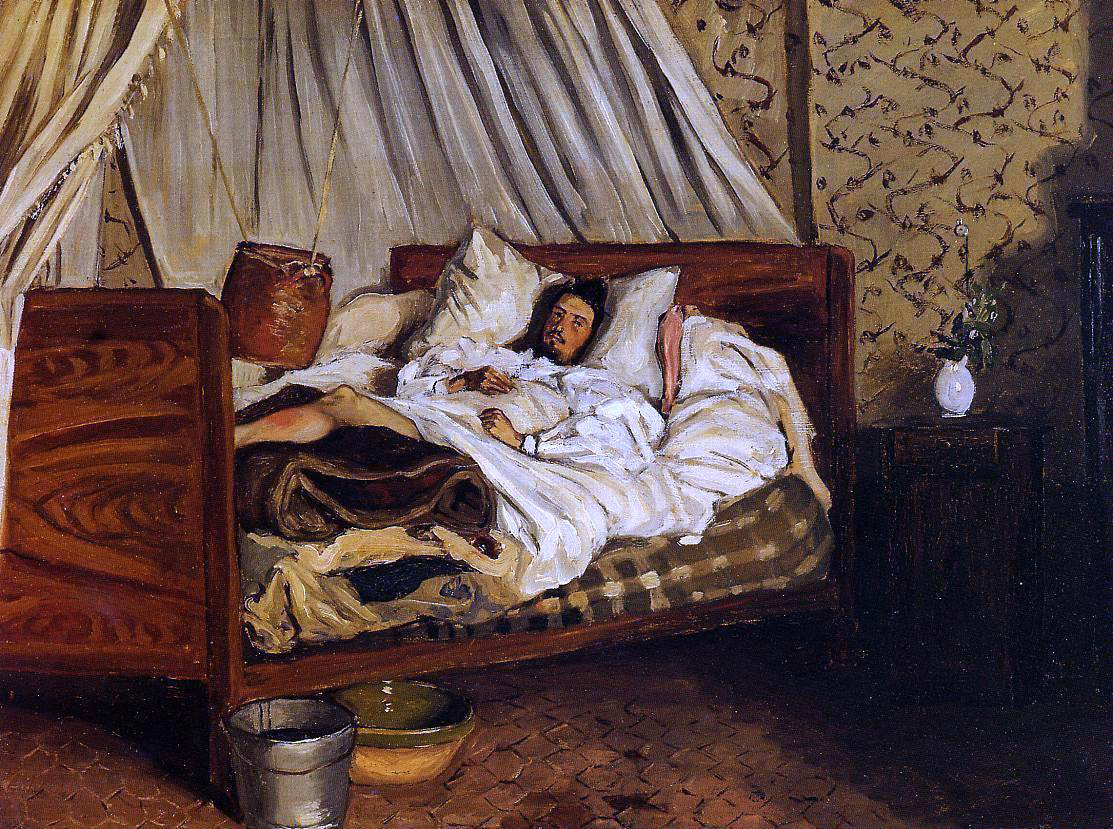
The Improvised Field Hospital     Jean Frederic Bazille, 1865 Oil on Canvas

There is a cheap grey cabinet where patients and family members can store their things, upon the doors of which hang plastic dry erase boards where at every change of shift an energetic nurse comes in with a marker and rigorously erases the last nurses name and writes her own. The board is a bare bones overview of every patient’s “needs,”: the name of the doctor, an elusive man named Hsu; the patient’s diet preferences which in my grandmother’s case is an unappetizing category called “mechanical soft,” and laughably, the “activity for the day,” which is more or less nothing, though hospitals prefer the term “bed rest.” Beneath it all is a row of yellow smiley faces, though not all smiling: they represent a range of emotions: a smile, a grimace, a frown, and a cartoonish scowl meant to signify extreme pain. This is the pain scale – and every patient has a “pain goal,” ranging from 0 to 10, though understandably, a 0 is written on every patient’s board.

To the side, there is a height-adjustable table with difficult wheels, for meals, and a single, vomit-colored chair for visitors. These cramped quarters are meant to accommodate two patients. In the past, before enormous hospital beds and giant breathing machines were invented, this might have been a semi-comfortable set up, but now the machines take up more than seventy percent of the space, forcing nurses and family members to do an awkward dance each time the patient needs something. A dingy yellow curtain divides the room in half, though only by sight, leaving everything else that ought to be blocked (light, sounds, smells) from the other side and the outside, utterly available to torment you and your neighbor. Due to the lack of space, the curtain almost always drapes over something: the vomit colored chair or the commode or the table where your food is placed. You wonder if the hospital ever launders that yellow curtain which is probably as old as the hospital itself and when you arrive at the conclusion, “Probably not,” shake the thought away because it is the wise thing to do.

Most awkward of all, as though privacy and the rest that might result from such privacy were, along with sunlight, unnecessary for full or at least partial recovery, is the fact that even if the room next door is empty, they will always fill the spare bed in your room first before using the empty room next door.

Thus for the past two weeks my grandmother has had a half dozen roommates whose faces she has never seen and some whose voices she has never heard but whose presence and sicknesses can be felt because they are less than three feet away. In years past my grandmother was always the first to leave. She was the one whose health rebounded quickly, astounding doctors and nurses alike. When she left, usually in a wheel chair, they would pat her on the back and say, “Don’t come back,” and she would nod happily, “Of course not.” But now the other patients have come and gone, come and gone, and my grandmother remains.

*For days I called it the “bedpan,” until a frustrated nurse corrected me. “This is the bedpan,” she said, holding up a plastic bedpan, “And this,” she pointed at the aluminum frame that held a plastic toilet seat which sat over a plastic tub for waste, “Is the bedside commode.” I stood there with my GRE textbook and said dumbly, “Thank you.” 

My Mother’s Nightmares

c22f3-15_thumb3

My father left the other day for a two week trip to Asia, not for business, but for fun with retired friends. He is the leader/tour guide, meticulously planning their itinerary from departure to return, in charge of booking all plane tickets and hotels and even drafting a list of must-eat restaurants in each destination: Taipei, Macau, Shanghai, and some province I’m not sure of.   Continue reading “My Mother’s Nightmares”

Let Her Talk

Last Wednesday I volunteered along with my uncle to stay overnight in the ICU, where my grandmother lay under yellow fluorescent lights with a monstrous BiPAP breathing machine strapped to her face like a giant muzzle. A giant muzzle with a blow dryer attached to it. The machine’s function was to push as much oxygen into the patient’s lungs as possible, since the patient’s lungs were most likely resisting their intended purpose, but the machine did not so much help its patients breathe it seemed, as make their last remaining breaths on earth extremely uncomfortable.

For twenty-four hours a day the BiPAP Vision (I have no idea what the “vision” part means) forced air into my grandma’s failing lungs with a horrible, constant whooshing sound, not unlike an industrial strength vacuum cleaner that made the deep, intimidating breaths of Darth Vader’s mask seem like a kitten’s purrs. It cracked her lips and parched her throat, but worse, the pressure of the air forbade her to take any food or water as there was the danger of the air blowing the food down the wrong pipe and causing an infection all over again.

The BiPAP machine should have prevented her from talking, but my grandma has not, for the past ten years (or for the past sixty-eight years that they’ve been married, if you ask grandpa) been one to shut up. The only time she was silent at the hospital was when she had to choose between speaking or breathing, and when that time passed, she was talking again as best she could through the racket of the BiPAP machine.

“Tell her not to talk so much,” my grandpa said over and over again when we visited her in the ICU, “She needs to rest.”

At the time, I had been crying for what seemed like two days straight and was overjoyed to see my grandma well enough to be talking, and I chastised her ornery, often sullen and always stoic husband, “Oh Grandpa, if she wants to talk, let her talk. Someday soon you might not be able to hear her voice at all.”

He looked at me. “What’s that supposed to mean?”

I thought it was obvious, but didn’t respond.

“Oh you mean if she’s dead?”

“Well, yeah,” I said, and my grandpa snorted angrily and walked away.

It was an insensitive thing to say to a man whose wife was hanging on for dear life, but still, I stood my ground. Grandma’s status was far from stabilized and I wanted her to have her say, lest she leave us with wise words unspoken. She never went to college and had little need for books or newspapers, preferring to spend an evening cooking for her progeny, but she’s been around for eight-seven years and it’s not lost on any of us that she raised four filial children, ten adoring grandchildren and maintained a bittersweet marriage to a very difficult man. On top of that she could, as my aunt put it, be the darned community leader of Sunshine Park, where she and my grandpa took their daily morning walks when her lungs still allowed it. I’m sure that for the past twelve days the denizens of their little cul-de-sac have been scratching their heads, wondering where darling talkative Mama Leu is. But word spreads quickly and my grandma’s hospital room has had from the very beginning a nonstop flow of visitors both related and not. People love her. The nurses love her. We love her. There is definitely something to be learned from so much love.

Grandma post ICU and BiPAP, reading about Warfarin.The hair is really something special.

During the first two evenings, when grandma’s vitals were all over the place and when her only hope of leaving the physical world in peace was upon morphine’s calming current, we leaned in close to the mouth cover of the BiPAP machine each time she wanted to speak. If she was at the end of her life, we reasoned, whatever words she spoke would take great effort and we wanted to make sure they were heard.

At first, she cried and we cried and when she spoke her speech waffled back and forth between acceptance of her fate: I’m ready to go, I’m not afraid, don’t be afraid, (I’m rattling them off now but in the moment those are very sad words); and flat out rejection: I’m not ready to go, I don’t want to go, I don’t want to go, I don’t want to go (these are ten thousand time more heart-wrenching and, it turned out, a reflection of her true heart). A few days later when the antibiotics and steroids had taken effect and the infection reduced, she was well enough to inform my grandpa thus: “Don’t listen when someone tells you they’re not afraid of death. Liars, all of them.”

As her condition improved however, thoughts of death and dying floated away and her mind busied itself with other things, namely, hubris and prejudice. That Wednesday night, two days after I’d admonished my grandpa for telling her to shut up, I found awake in the ICU at 2AM, wishing my grandmother would do just that.

Her nurse that evening was a pretty middle-aged black woman with long, curly hair and a perky butt, which according to her, was one reason she was constantly being hit on by reckless young fools in the ER. (“They don’t know I’m old enough to be their mother,” the nurse said smiling to herself). We chatted a bit here and there as she changed my grandmother’s iv, wrote down her vitals, and, occasionally, changed the bedpan – the most unassuming yet menacing reminder of our mortality, if there ever was one. Whenever she clicked her pen to go, I leaned down towards grandma, who even in the deadest hours of the night could not sleep due to the incessant pressure of the Bipap, and asked if she needed anything.

Grandma struggled to unclip her mask and I hurried to help her out of it, worried that she needed more pain medication, “What is it? What do you want me to tell the nurse?”

“Does she know you’re my granddaughter?”

I stared at my darling grandmother. It was two in the morning, she had just come back, it seemed, from death’s door. This was the most pressing question she had?

“What does she need?” the nurse asked kindly.

I chuckled,  aware that my face was, because of the time of night, a sickly yellow pallor, made worse by the unflattering ICU lights, “Oh nothing, my grandma just wants to know if you know that I’m her granddaughter.”

The nurse smiled, “Of course! Your grandma is really proud of her whole family. Earlier I think she was trying to tell me that she had what, twenty grand kids?”

“Ten,” I said. “Ten.”

The nurse nodded towards my uncle who was not quite nodded off, but headed there. He smiled at her.

“And is that your dad?”

“No, that’s my uncle.” 

Grandma tugged at the mask again, this time more hurriedly and I rushed to un-clip it.

“Tell her I’ve got two great-grand kids,” my grandma said, “And two on the way.”

I bit my lip, but the nurse looked at me expectantly. I told her. 

“Wow, that’s such a nice big family you guys have,” she said, “I saw a lot of people gathered around here earlier. She’s lucky to have you all be so close.”

“Yeah,” I said, and looking affectionately towards grandma, I nodded, “She’s pretty special.”

I reached down to clip the mask back on and right before her voice was muffled my grandma asked, “Ask her to guess how old I am.”

I told her to shush and get some sleep. The nurse had other patients in more critical states to attend to.

At four AM, I had all but given up on sleep and instead watched my grandma toss and turn and poke and prod at the plastic mask, one moment scratching the top near the bridge of her nose, at where the mask had dug a fresh red groove, and another scratching the back of her neck, where the Velcro straps no doubt caused a horrendous itch. It was a modern medical torture device and I wanted to rip it off as much as my grandmother did, but if it was removed for more than ten seconds, the blasted machine it was hooked up to would start an incessant beeping and the nurse would come rushing in to admonish us all.

The black nurse came in again to read the machines and a few minutes later a black respiratory therapist entered as well to administer a breathing treatment. They chatted quietly, keeping their voices low so my uncle, who had finally dozed off, could sleep and worked their way around the cramped perimeter of the bed. My grandmother watched them attentively.

The man left, pleased with my grandmother’s oxygen levels and the nurse turned to go to. I glanced at my grandmother to see if she needed anything, and true to form her arm shot out with an alarming urgency for someone supposedly old and tired, though all too lucid.

I unclipped the mask and whispered a little too loudly for the nurse to wait. She turned and said, “Is everything okay? Does Mama need anything?”

Grandma swallowed a couple of times and her eyes fluttered upward. I wondered if the morphine was wearing off. Her mouth opened and closed a couple of times, adjusting to the cooler air and finally, she spoke, “They’re married, aren’t they?”

I was confused for a minute, then realized she was referring to the black nurse and the black respiratory therapist. In her simple deductions of the world at large, the two black people who had by the chance scheduling of their occupations ended up behind the same curtain of the same ICU at the same time, must be married.

I gave my grandma an incredulous look that she ignored and said, “No grandma, they are not.”

“They’re not?” now it was her turn to be incredulous.

“No.” I thought to explain that the nurse was not even from California, that she was a traveling nurse here for 13 weeks, and hailed from Connecticut, but these details, invisible to my grandmother, would mean nothing to her. I could tell she didn’t buy my dissent and rolled her eyes. “They seem married,” she murmured.

“What does mama need?” the nurse said, and I turned to give her an apologetic look. The nurse had been nothing but kind and understanding, and if I’d read her correctly, would merely laugh at my grandmother’s harmless prejudices, but it was four in the morning and I wasn’t about to take any chances.

“She’s fine,” I said, “Doesn’t need anything. She says you guys are great.”

And as if right on cue, grandma waved her IV free hand in both the direction of the Respiratory Therapist that had just gone and then at the nurse. She gave a thumbs up and closed her eyes, attempting to sleep perchance to dream in a world where all black nurses were married to black respiratory therapists, at least those who were in the same room at the same time.

The nurse smiled, “Oh she is just the sweetest thing.” 

Do Not Resuscitate

When you lose your breath, it can go alarmingly fast.

On Friday, my grandmother fried a fish and made fresh green onion pancakes from scratch for dinner at her house. She kneaded the dough with the same strong strokes she’d always used, a little stronger than usual perhaps, as the pancakes came out tougher than usual. As they fried, she wiped away beads of sweat with a powdery white hand. After dinner she told me not to wash the dishes and slowly cleaned the kitchen in her own methodical way. I had my back to her, eating a Nestle Caramel Sundae and when I turned around to throw the wrapper away saw that the kitchen was sparkling clean. If my grandmother was hampered at all by severe shortness of breath or weak legs, you could not tell by the food she put on the table or by the spotless kitchen she kept. She joined us at the table and shared a Nestle Caramel Sundae with my grandpa. She laughed gleefully when I said her fish was unrivaled.

“As long as I can cook for my grandchildren, I will cook for them. Who else can make their favorite dishes the way I can?”

“They are our favorites because you made them so,” I said.

On Sunday, her steroids stopped working and the oxygen tank, with its efficient little whirring and long clear plastic tubing could not deliver enough air to her lungs, the function of which has deteriorated exponentially, as though racing with her frail legs. Which will fail first? It is a race we hope the lungs will lose.

She breathed deeply, desperately into the oxygen machine, hoping the relief would come, but instead her face grew redder and redder and her mouth gaped and gagged. My grandfather could no longer distinguish between a recent red scar she’d gotten from falling on her face and the rest of her skin. He called my uncles, who drove their suffocating mother to the hospital. They were worried, but the drive, her falling, her troubled breathing, these were all more or less routine for the past two years.

They stayed with her at the hospital through the afternoon and in the evening, bid her goodnight. Not because they wanted to leave, but sometimes, she does want them to leave but won’t say it.

On Monday, my uncles returned to the hospital in the morning and later in the afternoon, my mother joined them. The nurse pulled my uncle and mother aside.

“It doesn’t look good,” she said, “The oxygen we are giving her is not enough, and the steroids don’t seem to be taking effect. You and your family need to discuss the DNR.”

I called my mother shortly after this conversation and she cried into the phone. It was around six in the evening.

“Will you guys sign it?” I asked.

“I don’t know,” she said, I could see her face crumpling, “It’s terrible when they try to resuscitate someone. They cut into the throat…it’s just so violent and terrible and you’re never sure what happens after that. Sometimes they don’t come back and they’re just hooked up to the oxygen machine for years.”

It wasn’t my place or my decision, but a hundred images of other old people hooked onto said machines flashed in my head. I saw a lot of sad, fearful faces looking down at blank staring eyes perched atop freshly fluffed pillows. It’s a touchy subject, I know, but sometimes, sometimes you think about this thing called quality of life and dignity and even though I’m only twenty-six and years away from making a decision like that (knock on wood), I said what I felt: “Sign it.”

“We will wait until we’re all here,” my mom said, “But I think we will sign it.” I heard her face crumple again. We hung up.

At 11PM they reached a consensus. My grandmother was moved to the ICU as her DNR was signed.

It is Monday night and my grandma lies sleeping fitfully in the ICU, unfit to do anything, not even breathe. Last Friday, she was frying a fish and making fresh green onion pancakes.

The Dead Don’t Care

A shy anonymous member of D’s team passed around decorated sheets of paper (the kind you buy for formal letters and invitations) to the employees and asked them to “write something to D.” I say anonymous because I still do not know her name and only saw her rarely, as her desk was tucked away somewhere I seldom ventured. She passed the sheets of paper around in long manila envelopes with”instructions” pasted on the inside covers, a sort of starter message to get people’s eulogistic juices running. At first I misunderstood.
“Do you want me to copy the words?”

“Write something to D,” she said softly in poor English.

“To him or to his family?”

“To him.”

“Oh.” I took the folder and stared at her blankly, “Okay.”

She asked me to write carefully and to use the same pen. Heaven forbid the messages be in various colors and that the sheets look like a birthday card. The point, I think, was to make a scrapbook for his family. I don’t know. Maybe at the memorial service tomorrow we will throw it into the ground, atop his coffin. Someone set about gathering photographs. I heard that someone had posted on his facebook a photo of D, sandwiched between me and the receptionist, all of us smiling, D more because he was drunk.

I never added him, so I won’t see it.

I did not avoid his desk this morning – there was no reason for me to other than the fear that I would start crying, but I need not have feared so much. I said hello to the receptionist, who had been at Disneyland when she heard the news. I took the front stairs and did not whistle as I do sometimes, but said good morning to the accountants once I got to the top. It smelled and sounded just like any other day, though slightly subdued. I found to my surprise the executives assembled in the boardroom, though it wasn’t Monday. Were they perhaps convening on D’s behalf? The room was dark and I looked to the projector screen on the wall – bar graphs. Line graphs. Dollar signs. Something about revenues and margins and units – things the living occupy themselves with in dark enclosed spaces. I could not blame them. We were running a show of sorts, and the show must go on.

Around noon HR issued a statement about an employee’s passing, advising the time and place of D’s memorial service. It was a Frankenstein email, copy and pasted from various sources. I wrinkled my brow, thinking the mismatched fonts in poor taste, though I would have done the same thing, only taken more care to hide the hurry with which these things are actually done. Then people began to ask around, not unlike the way people check to see who’s going to a party.

“You going to the service?”

“You carpooling?”

“What time are you leaving?”

I asked these same questions. Stopped in front a friend’s cubicle to do s, and then laughed loudly about something or other right after we established that we were carpooling.

In the afternoon I went downstairs to talk to someone who sat opposite D’s desk. I wondered who’s idea it was to set up the desks like a damn labyrinth. Briefly, I thought, “Here it comes. His desk. Don’t lose it.”

And I didn’t. I walked right by, and on my way back, even stopped for a millisecond to see that someone had left a candle, a vase of white flowers and atop his laptop monitor, a note that said, “Please respect D’s desk. Do not touch or remove anything.” Among other things, that’s one difference between being fired and dying: only the latter warrants turning your desk into a shrine. We are not, it seems, in a hurry to find anyone to replace him – and if we are, the person definitely won’t sit there. And if they do sit there, the rest of us will keep our mouths shut.

Later in the afternoon the head of HR called to ask if anyone had ordered flowers for D’s memorial service. I rolled me eyes. Of course not. I was the person who did that sort of thing because I had the corporate card.

“Could you do that?”

“Sure.”

“Great. Thanks.”

I called the memorial park. They didn’t have a floral service and recommended a local florist who asked me, of all colors, “Do you want blue flowers on white?” I talked at length with the woman on the phone about using white lilies in a standing spray. I was an old hand at this now, having ordered flowers for other employees, both alive and deceased. I thought about adding red roses in the spray, because D seemed to like the color red. Or did he? I don’t know. I saw a few red items on his desk. I shook my head, “No, no. All white.”

“And for the message?”

“From your family here, at the company,” I said, without thinking.

“Okay, great.”

They didn’t take American Express. The clock was ticking. I wanted to go home. I did not want to spend my last few minutes at work searching for florists that took American Express. Not when the show must go on.

I took out my personal Visa and rattled off the numbers. Gave the woman the office fax number so she could send me the receipt. I hung up and finished answering some emails. In a month, I will file an expense report for a standing spray, all white.

 “…there is nothing, once you are dead, that can be done to you or for you or with you or about you that will do you any good or any harm; that any damage or decency we do accrues to the living, to whom your death happens, if it really happens to anyone.” 

– Thomas Lynch,  The Undertaking

One for the New Year: Memento Mori

It is not my usual thing, to write about death on New Year’s Day, but a series of unfortunate events has made it almost necessary.

Yesterday afternoon a coworker called me with a worried note in her voice. I was driving my grandfather and cousin home from lunch and tensed at the sound of my work phone’s ring – it is not unlike the theme song to “Jaws” and while I wonder why I have not changed it, I think subconsciously I prefer not to. If the work phone rings on the weekend, it is 99% of the time my boss or my boss’s wife, neither of whom would call unless something were wrong. I risked both a ticket and my grandfather’s peace of mind regarding my driving and reached for it. On the screen shone the pretty Greek name of a pretty coworker.

“Have you heard anything about D?” she asked.

D was our company’s IT guy -at least that is how I knew him in the beginning. We had an IT team, but D was the the go-to guy if your computer, phone or anything electronic broke down or malfunctioned. We called him first and if he sent someone else in his place, you couldn’t help but be slightly disappointed. I knew vaguely that he handled more serious issues like our connectivity and server security, but in my first few days I work I learned D was, to me at least, indispensable.

“No,” I said, “Why?”

“I heard he was in a bad accident and that he didn’t make it.”

I was driving. I had stayed up late the night before, and had just consumed an enormous lunch. It was information I could not readily process.

I stopped at a red light and my grandfather looked at me, not understanding but sensing that something was wrong. Was it my boss? Had I messed up again? Grandpa was always chiding me to take my job more seriously. At that moment, I had a very serious expression on my face.

“Is it true?”

“I don’t know,” my coworker said, “That’s why I’m calling you. I got some cryptic text messages from the receptionist and was wondering if you heard anything.”

“I haven’t,” I said. I wanted to add that I liked D a lot, but we weren’t close. He had asked, indirectly, to hang out after work a few times, but I always declined. I said instead, “I don’t know anything about anything.”

We exchanged a few more pointless affirmations then hung up, though I was certain of two things: that if D was dead, I wouldn’t be surprised and that I was feeling quite tired.

————–

I met D on my first day of work and while normally not attracted to men of his ethnic origin, found him quite handsome. He was lean then and had a strong, regal profile with thick brows, bright, wide eyes and jet black hair which he styled into a subtle rising tide atop his forehead, giving him the appearance of always leaning forward. I was standing in front of the receptionist’s desk, waiting for the head of HR to come and receive me when he walked in the door, holding a motorcycle helmet and wearing a fitted rider’s jacket. He didn’t smile at me and instead nodded hello to the receptionist and started toward his desk.

“D!” the receptionist said, “Meet Betty! She’s new.” Almost reluctantly, he paused to acknowledge me. We shook hands and I smiled his solemn face, thinking (assuming) that he was just a shy Pakistani man with a wife and kids. I painted. He comes to do his job, socializes little, if at all, then quietly goes home. I didn’t put the clues together, that normally men with young families did not ride motorbikes.

The Spirit of Adventure, 1962. Renee Magritte Oil on Canvas

 It was strange in the beginning, our relationship, which mirrored the way I interacted with the rest of the company. As a newcomer, my policy was to be open and friendly to all. Friends and enemies alike would show themselves in time. But D was, for the first month, an enigma. I sensed that he was avoiding me for mysterious reasons, among them my work mobile, for which D was responsible and which I made do without for the first two weeks because he would not give it to me. Each morning I called his desk and asked, as sweetly as I could, “D, is my phone ready?” And he would say, “Oh soon, soon. There is just one more issue,” then promptly hang up.

I grew impatient (so keen was I to become the best assistant ever), but wasn’t ready to joke with him in my usual manner. If he saw me walking towards him, he would go the other way. If he had no other way to go, he would turn and talk to someone else. I wondered if he had been close with the previous assistant and if he resented that I replaced her. Or perhaps he thought I was fake? I worried about this at first: I had unwittingly taken on a “ray-of-sunshine” role at the office and perhaps the solemn Pakistani with a dark past could see right through it. Let him think what he wants, I thought. I just want my damn work phone.

Thus I sat patiently at my desk and hoped that one day, my phone would be ready. And finally it was. He came by my desk one day and dropped it off, explaining to me how it worked and why it had taken him so long (it was some IT issue I don’t remember). I was overjoyed to finally have a work phone (now the bane of my existence) and told him so.

“You’re very welcome,” he said, his slight Pakistani accent coming out, “Let me know if you have any trouble.”

That was perhaps the kindest thing he had said to me in the beginning.

A few weeks later Jane from marketing called to invite me to an informal interview. I thanked her for the invitation, but was it okay that I wasn’t on their team?

“D is coming,” she said, “He’s one of the cool kids,  and we like you, so just come.”

My niceness had paid off, it seemed, but I warned Jane, “I don’t think D likes me. He’s always avoiding me.”

Jane was surprised, “What! D is The. Nicest. Guy. You just have to get to know him.”

I said okay and that evening went out to dinner. Marketing was interviewing a young woman from up north – the formal interviews with the managers and VPs would take place the next morning. The evening out with the younger folks was a way of loosening her up.

The point of the evening then, was for them to get to know the candidate, but I went in with the selfish mindset. I would finally get a chance to know some of my new coworkers and they, me. We drowned her out, certainly, and who knows, might even have scared her away. We exchanged stories about certain VPs and executives, and they corrected or affirmed my many assumptions. We warned the girl, who grew increasingly silent and nervous, not sure if such a rowdy “interview” was a joke, that if she came to work, there were certain people she’d need to avoid. I was learning too, slowly absorbing information about my new colleagues, especially D.

I learned that he had lost both his parents some years ago in an accident, and a week after they passed, his brother died too. This had come up during dinner in a joking manner and I had brushed it off as a joke, until D kindly corrected me, “Yes, it’s true,” with a soft smile on his face as though he too, couldn’t believe his misfortune. What understatement. I marveled at him then, that he was able to come out and socialize and live a relatively productive life. I thought of my parents and brother and the support they provided me, whenever I needed it. I complained often about living at home, at my father’s annoying habit of having the television on too early in the morning and my brother’s definition of “clean,” but they were alive and well. I could reach out and talk to them whenever I pleased.

I learned that D was ten years older, and that we had gone to the same high school. We had taken P.E. a decade apart under the tutelage of the same teacher, one Mrs. Smith whom ten years after D graduated, would still astound my class with effortless pushups. 

I learned from Jane, when he left for the restroom, that he had an ill-defined romance with the girl in legal whom I found annoying. She was a drama queen disguised as a legal counsel who had also gone to Berkeley and had, perhaps for this reason alone, pegged me as someone worthy of being her new bosom buddy. I begged to differ in various ways, begging out of offers to carpool (we live, unfortunately, in the same town) and invitations to dinner. This did not stop her from dropping hints about her love life. She wanted to lure me with “girl talk” as she called it and, when she had a moment’s free time at the office, would stand by my desk and update me on her romantic liaisons. Apparently she was torn between two men, one who was local and treated her like a queen, and the other, an asshole in another state who had treated her like shit until local man started to pay her more attention.

It didn’t take a detective to figure out that local man was a colleague, considering legal girl worked long hours, leaving little time for outside-the-company romances. When I asked her, she grew huffy and said, “I’m not going to answer that question.” This essentially, answered my question, though I still didn’t know exactly who. Thanks to Jane, I now knew. I questioned D’s taste in women, but thought, whatever floats your boat

And then I caught a glimpse of what Jane meant when she said that D was The. Nicest. Guy. Somethings actions/words you will never forget because they come so out of the blue, yet when they do, you realize you had misread someone, or really, it is a culmination of all the subtleties you had sensed but were too busy worrying about things like work phones to evaluate correctly.

At one point over the din, D noticed I had not yet ordered a drink (I was not planning to drink), and with a concerned look, waved for the server.

“Please sir, could we get the lady a drink?”

It was a line from another era and it melted the ice I had frozen around him.

We drank, ate, laughed. The evening ended and we stood in the parking lot saying goodbye.

“This was fun,” I said to D, and he nodded, a cigarette in his hands.

“We used to do this all the time,” he told me, “back then when some other people were here… but the company went through some changes and those people aren’t here anymore. But yeah, we should do this more often.”

I never saw the interviewee again, but was confident then that I would see D et al. the very next morning.

And I did. The next day my boss had an issue with his cellphone, and I brought it down to D. His desk was as a busy IT person’s should be: stacked with old laptops and cellphones and bundles of wires. His many monitors blinked with interfaces I would never understand  – I did not bother to look too closely. On the walls of his cubicle were pinned a small company banner and a photo of a motorcyclist on a race track, leaning dangerously close to the road.

“And how can I help you?”

I turned and there he was, the kind sir who had made sure I got my drink the night before. I handed him my boss’s phone.

“I’ll take care of it,” he said.

Later that afternoon it was ready and to save him a trip upstairs, I said, “I’ll come down and get it.”

“Okay,” he said, “You could use the exercise.”

Ah. The solemn Pakistani jokes. I wrote back, “Great. I’ll start by punching you in the face.”  

He really enjoyed that. We became friends in the tentative way you become friends with someone at work. He was not whom I thought he was and I was certainly not the “sweet and lady-like” whatever he thought I was. His comment opened the doors for me to joke in return and for a few weeks after he would, whenever I appeared, pretend to duck or say, “Oh no, do I need to grab my helmet?”

Around this time legal girl began to pester me more and more about her love life. She was torn. The asshole was coming back and wasn’t so much of an asshole anymore. He wanted her back. Wanted to move in. Did this imply marriage? He told her he loved her, and even though he had treated her like shit, she wanted to be with him. This left local man out of the equation.

“I feel terrible,” legal girl said, “I’m going to tell local man soon that I’m going back to the asshole. He’s going to be so pissed. He’s going to say I led him on.”

I’ll never know what series of events or what train of thought led D from storming around legal girl’s desk, embittered by her rejection of him to his sudden attention to me, but it would not be far-fetched to say the two were related. Legal Girl had said that D was looking to settle down and get married – that he had not proposed to her, but had proposed, in one conversation or other, a future together. He could envision it…could she?

She had shaken her head vehemently. She was Christian! Her parents were missionaries, for Christ’s sake, literally. He was a Pakistani man with a foggy yet intact Muslim background. She had laughed at the thought of them being together and needless to say, he was enraged, then despondent. All this from legal girl’s lips and never from D’s. I’ll never know the whole story – but regardless of whom pursued who, D was pissed at Legal Girl because according to him, she had pursued him. I surmise he had grown to like her, and then she had turned around and chosen an asshole when from the very beginning, even when D wasn’t interested, he had been The. Nicest. Guy. Ever.

Shortly after legal girl chose, D and I bitched about her on a long drive from our office to LA, where there was a company event. We rode with the receptionist and an IT contractor from Australia who had instantly become one of D’s best friends, and they laughed at our vindictive comments. That evening in LA however, I learned that D could drink far too much and still, frighteningly, feel confident enough to drive us all home.

“You aren’t driving,” I said, “Give me the keys.” And holding a drink, his millionth one that night, he put his hands up and smiled in what he thought must have been a charming manner, but to me, looked purely foolish.

“I can drive, Betty,” he said, “No problem. You seem so fun but now you’re just uptight! Just dance!”

It was nearing two in the morning and I had to work the next day. We all did, but I need more sleep than the average employee and wanted to get home. Alive.

“You’re not driving, D.”

“I can drive.”

“You can’t. You won’t.”

“I can drive.”

It went on like this for several more minutes until it became clear to him that for me and the receptionist, who had already taken off her painfully high heels, the evening was over. I drove them back to the office, a shadow having crossed my overall impression of D. I am judgmental. Undeniable and unapologetic. It irritated me to see a thirty-four year man drink so recklessly. Offer to drive four people home so recklessly.

As the weeks went on, I gathered that that reckless might as well have been D’s middle name. From other coworkers I learned that he liked to drink. A lot. What happened in LA had happened many times in the past: at the company Christmas party, on dozens of happy hours with “the old crowd,” and most likely every night in his apartment. He lived alone with his dog, an aging chihuahua with a bevy of joint and organ problems. He loved the dog dearly and would often go home to walk and feed it in the afternoons. Often he would respond to my emails with a house phone. “What are you doing at home,” I’d ask. “I’m feeding my dog,” he said. “I don’t like to leave him alone for too long.”

From D himself I learned his passion for fast cars, motorbikes and racing.

“Isn’t that dangerous,” I said.

“Nah.” he said, then thought for a moment, “Well, yeah, but I’m not scared or anything.” Later he forwarded me photographs of a car he had totaled – I had driven the same car in high school and knew it was something of a tank, more likely to crush other cars than be crushed. But the photographs showed a vehicle so mangled it seemed impossible that the driver was alive and sending me the photos.

“That’s awful,” I said without humor.

“But I’m fine. It happened. It’s done,” he said lightly. He shrugged as though it were no big deal and I thought about his dead parents and brother. Would I shrug too, if I had lost so many loved ones in a week?

It had not been my intention to create some sort of alliance with D regarding legal girl, nor did I intend to send him an invitation to woo me. Though slowly, uncomfortably, I sensed a redirection of his attention from legal girl to me. I was neither flattered nor mortified, just bemused – what a quick turn of interest! 

Little treats began to appear on my desk. The Australian, an eager wing man, began to make more and more trips upstairs to ask me about my weekend plans on D’s behalf.

“D and I are going to do this or that,” he would say, offering me a chocolate covered cherry or some other sweet treat, “It’s going to be wicked.”

“Sounds fun,” I’d say, chewing.

“Are you interested? D’s gonna drive and he says he can pick you up.”

Thanks but no thanks, I said, and, “The chocolates are great! Thanks for bringing them up.”

“Don’t thank me,” the Australian would say, “Thank D. He told me to bring them up here.”

I was not being coy, but straightforward. Or at least I hoped. And I always did thank D for whatever he did for me, but I invited nothing further. What was the point? I had painted him once, been wrong, and he had repainted himself – the nicest guy, true true, but not my guy. Not in a million years.

——–
In the middle of this, D discovered my blog. In truth, I don’t remember if I shared the link with him or if he found out via his mysterious IT ways. But he began to read. 
I warned him to keep his mouth shut, because I was writing about people we both knew – legal girl included – and he said in that light, no-big-deal way of his, “Of course. Your secret is safe with me.” 
Except it wasn’t. He had seen a post about my boss playing golf in Australia and mentioned it to his boss, an avid golf player, who then wrote me and said, “Your blog is beautiful.” I was angry and warned D again. Don’t tell ANYONE, I said. And he said again, “Of course, of course.” 
A few days later my boss called me into his office. 
“Don’t tell anyone what’s on my calendar. I told you this before,” he said. 
“I don’t tell anyone anything.” 
He stared at me, “You told D that I went golfing in Australia and he told Greg, and Greg, he gets jealous whenever I golf with a celebrity and I have to hear about it.” 
I apologized and made a mental note to really punch D in the face. 
Though I never got the chance. 
Last week. 
His last week. 
On Tuesday after Christmas, I walked in the office and found on my desk a small shopping bag. Atop it lay a small red square of cardstock, cut, it seemed, from a poster. I knew it was from D – I recognized the handwriting. But it was going to be a busy week – my boss had been away on vacation and due back the next day. I had to clean house. I read it swiftly: 
“To a talented writer…” 
I don’t remember the rest because someone called me away and it was many hours later that I finally found the time to open the gift. There were two: the first an angry birds beanie that he perhaps bought on a whim because he thought it was cute, though it almost embarrassed me to hold it up. I quickly stuffed it back to the bottom of the bag, along with the red card. I thought, “Does he know me at all?” The other was carefully selected, which showed me that on some level, he did.
It was a Cross pen, masculine and sleek, not unlike the motorbike D was riding when he lost control at a bend in the road and was hurled into a tree stump.
———–
He “lived” for less than twelve more hours before the game of telephone began, which is how my pretty coworker came to call me on New Year’s Eve with a worried note in her voice. A few hours later my boss called to see if I had heard. 
“I’m not sure of anything,” I said, which was half true, “What have you heard?”
“I heard that D is dead.” 
It was strange to hear the word, “dead” for which “He didn’t make it” is a euphemism. My boss is not one for euphemisms. 
“Let me call HR,” I said. Both our voices were without emotion. I called HR, who sounded as though she’d been crying. 
“I heard that D died,” I said, “Is that true?” 
“Yeah,” she said, “He was in an accident.” 
We exchanged a few more pointless affirmations and I called my boss back. 
“Oh,” he said, his voice then sounded younger, almost childish, and I pictured a seven year old boy watching as his tower of legos came crumbling down, “Ask if there’s anything we can do.” 
“Okay,” I said, though I knew of course there was nothing.
———

On Tuesday, as per my rule of not leading him on, I said nothing until he messaged me.

“Did an angry bird drop by your desk or something?”

I feigned ignorance until then, “So it was you!” I wrote, “Thanks D! That’s so thoughtful of you!”

The rest of the week passed in a blur. The Cross pen sat unopened and unused on my desk at home. I cried in front of my boss on Wednesday. Wondered how long I could stay at my job on Thursday and spoke briefly to D on the phone Friday afternoon because he wanted to know if one of the VPs was upstairs. I answered him absentmindedly, annoyed that he was calling me about this when I was already so busy, and when ten minutes later he appeared he seemed irritated as well.

“Betty, the whole point of my calling you to ask was so you could save me a trip upstairs.”

I wanted to murder him. I was dying, couldn’t he see that? But I remembered the pen and the card – where did I put that small red card? – and apologized. “I’m sorry D. I’m just…not paying attention today.”

“You okay?” he asked.

“I’m fine. I’m just tired. I’m sorry.”

“It’s okay, no big deal.” He shrugged in that easy way of his and walked towards the door that led to the back stairs.

I turned away from my computer and watched him go, thinking about the note he had written on the small red card.Where was it? Had I thrown it away? He opened the door, and before it closed, turned to smile. I waved then turned back to my monitor. Emails. So many emails. All urgent.

Or were they? I started to type again, then heard one of the accountants say to another, “See you next year!”

I winced. To D, I had forgotten to say, “Happy New Year.”
July

IMG_0404

My grandfather was interred on a hillside in the outskirts of Taipei city on a muggy July afternoon. As tradition dictated, we turned our backs on his coffin as the gravediggers dropped him into the ground. There is nothing sinister about a man dying from old age, but there is too much mystery about death to take chances, so by turning away, we were protecting our spirits from following his into the grave. Continue reading “July”

Spring Cleaning

A few days ago was Qing Ming Festival, when Chinese families visit their ancestor’s grave and give them a good scrub.

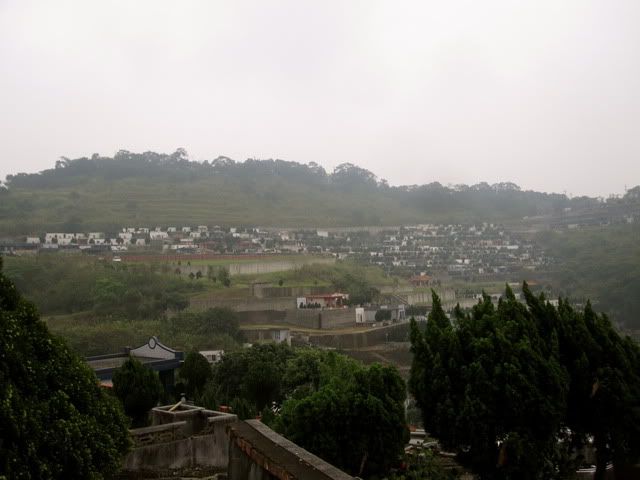
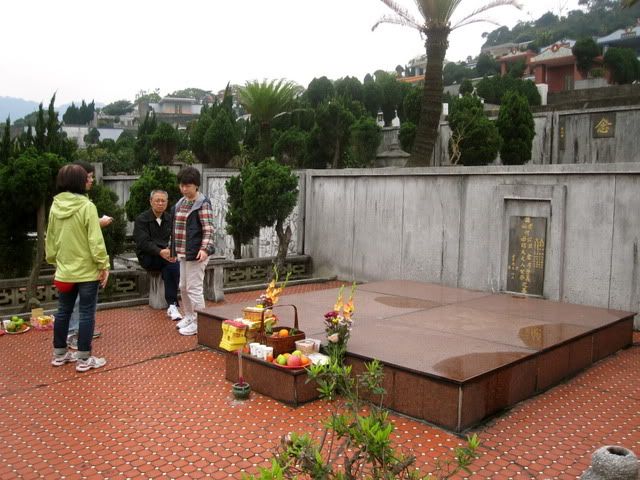
A Taiwanese cemetery.

A few years ago, this was actually necessary. Families would load up their cars with brooms, dustpans, pruning shears, etc. to tackle the natural growth that would eventually creep up over the tombs, which are much larger than standard American grave plots.

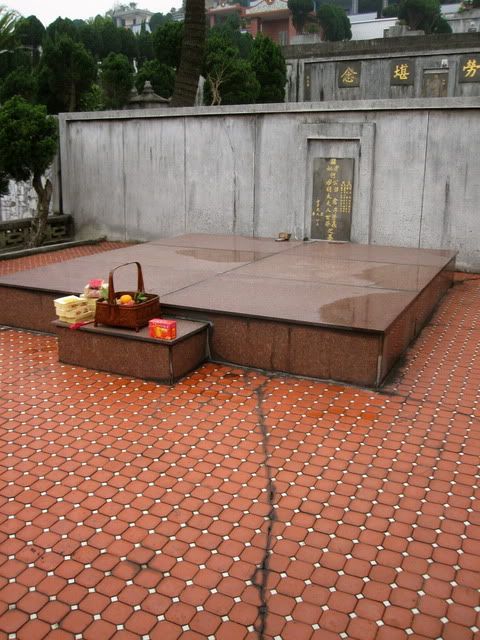
Where Grandma and Grandpa Ho are buried.

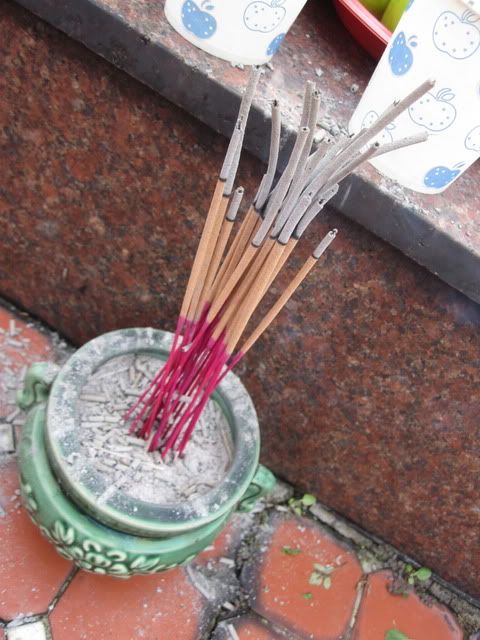
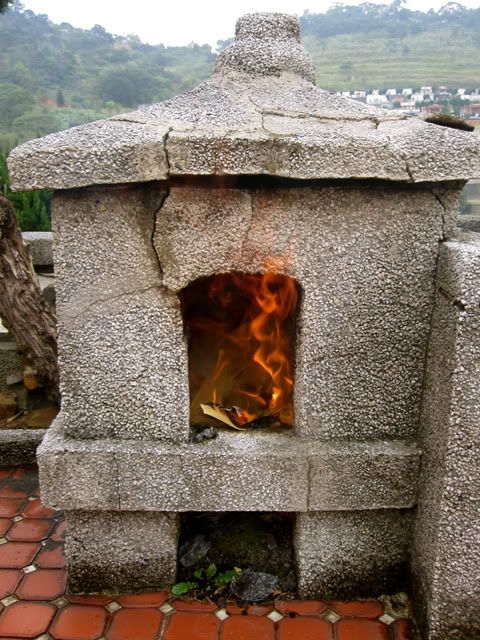
When the weeds had been pulled out, the bushes and grasses trimmed back, and fresh flowers, fruit, wine, and whatever other edible offerings set before, burning incense would be placed in a small pot before the tomb. Incense signifies a spiritual vigil. The living light incense for the dead, or for the Gods, to show that we still respect them. Incense also marks a sort of connection between the two worlds; once the incense is lit, we are in conversation with the dead and it is while the incense burns that we believe our ancestors are consuming our offerings. After the ancestors have eaten and drunk their fill, we burn paper money for them to use in the afterlife. At the markets, one must be sure to buy the right currency: Ghost or God money cannot be burned for Ancestors and vice versa.

Nowadays, at least in Taipei, grave cleaning is unnecessary. We were lucky to find a quiet cemetery with spacious plots and tiled floors. Once a month, we pay a maintenance fee, like you would in a high-end apartment complex and the caretakers come and do the cleaning for us. Some people forget to pay the fee, and their ancestors’ graves are noticeably neglected.

Whoever lies here is writhing in shame.

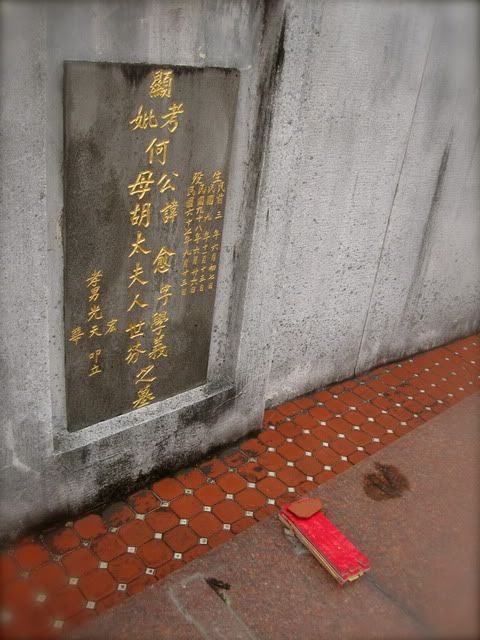
But in Taipei county, land is scarce and plot burials are now rare – reserved for those who had the foresight to buy a plot early on. If you didn’t make such an investment, its cremation for you. My grandfather was the last person in our family to have a traditional, whole-body burial – the plot was bought many years before, when his third wife (and my biological grandmother) passed away. When he lived, we came once a year to worship our grandmother and our father’s great grandmother, who is buried in the neighboring plot, but my grandfather never came along. And why would he? In the second photo, the characters on the tombstone are painted gold, but they’re only gold when the person has been buried. For many years, my grandfather’s name was still in red, signifying his status as a living man.

Also for many years, Grandpa would wait patiently for us to finish eating lunch so he could go home and take an afternoon nap. Now, we wait for him.

The adults talk about where to go for lunch. My uncle (seated) was eating vegetarian that day.
My uncle takes a work-related call.
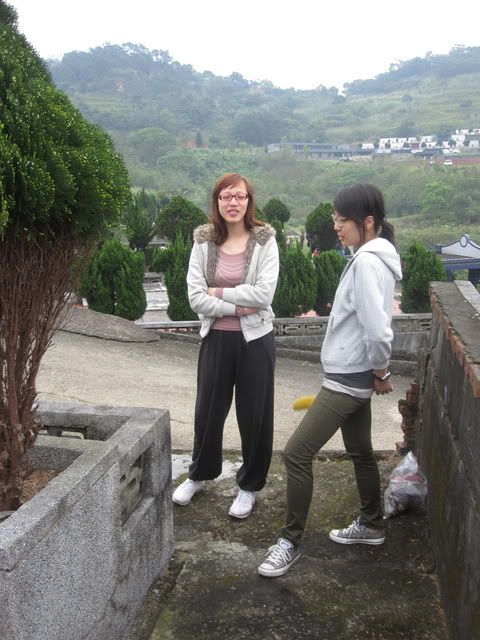
My cousins complain about work. Melody (left) works at a bank. Karen works at PWC.

Almost there…not.
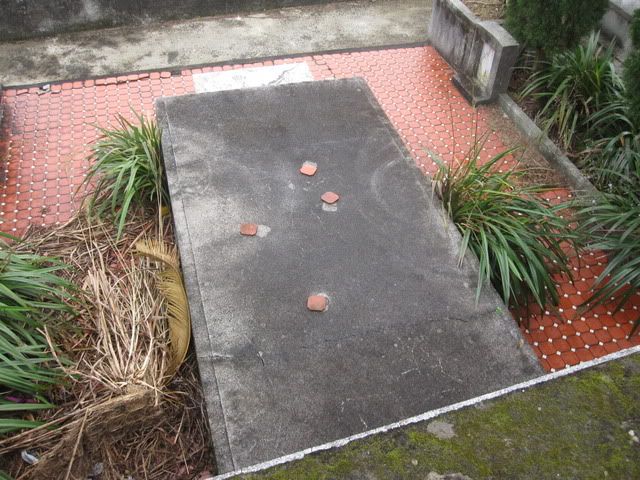
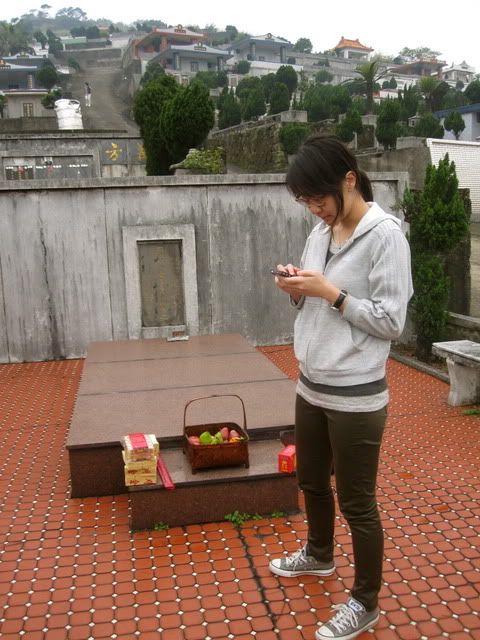
To kill more time, Karen resorts to playing Angry Birds (and then checking Facebook) on our great great Aunt’s grave.

Finally, our grandparents and the Gods alike have feasted and it is time to burn paper money.

May they shop in peace.

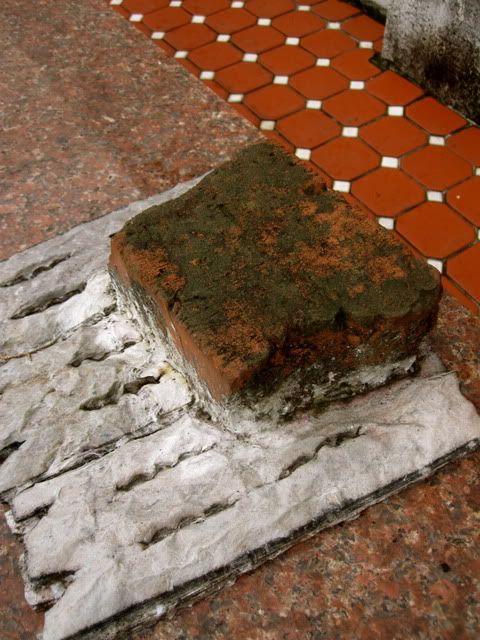
Last year’s grave cleaning marker is removed – a stack of red paper left on the tombs to signify that the relatives have come and paid their respects:

And replaced by a new marker.

Cleaned.

Until next year, Grandpa.