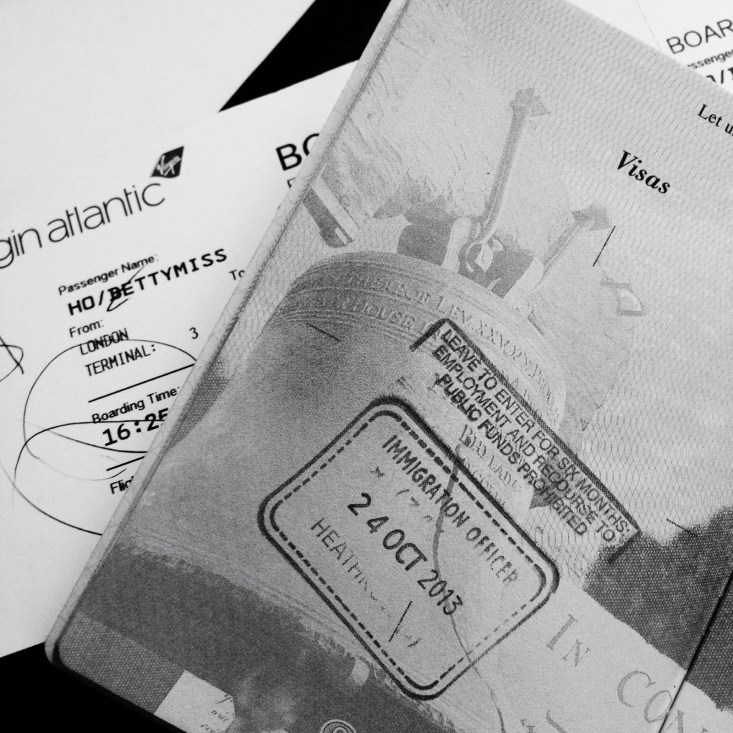
Two weeks before I moved to New York, my new passport arrived in the mail. Continue reading “The First Stamp”
Two weeks before I moved to New York, my new passport arrived in the mail. Continue reading “The First Stamp”
My cousin Melody is not dating a guy named Jim.
She’s not dating Jim, so he pretty much follows her around everywhere they, or mostly Melody, wants to go.
She’s not dating Jim, so he drives her to these places in his BMW.
She’s not dating Jim, so when she found an unpaid internship about a 15-minute drive away, she decided that rather than spend money she wasn’t earning on cab fare, Jim would work around his class schedule and find the time to drop her off and pick her up. Sometimes, on the way home, she’ll ask him to get her something to eat. He always does. He complains about this “abuse” she inflicts upon him but really (and everyone knows this) he does it to himself. He’s in love with her. Otherwise, he wouldn’t do it.
They take trips together, to New York, Montreal and Mexico. They eat at nice restaurants, go sightseeing, probably hold hands and kiss.
If there was a drug that made him feel the way Melody does, he would take it. I should tell Jim about Xanax.
But she’s not dating him. According to Melody, they’re just friends.
“Jim knows too,” she tells me, “I told him.”
And I nod, though as the words leave her mouth I am certain I can hear the sound of Jim’s heart tearing.
A few weeks ago Melody called to say she was coming to New York for a career fair. She’s a student in Boston, studying business something-or-other and sometimes the school suggests they go to career fairs in New York, where they’re supposed to network with potential future employers. But the networking events are dull, awkward and futile affairs and most of the students go with the fair as an afterthought. They mostly just end up meeting up with friends or, in Melody’s case, a cousin in the city.
I suggested afternoon tea at Bergdorf Goodman. It’s a girly thing to do. We’re both girls, Melody a considerably more accomplished one than I.
“Sure!” she said, “And I’ll be bringing my friend. You know, the boy.”
I did know, remembering a conversation we had during the summer, when we were both back in Taipei for my brother’s wedding. Melody had just finished her first year of graduate school and had not, as she put it, “met Mr. Right.”
I was doubtful. From her Facebook photos it seemed like she was constantly being swarmed by guys, most of whom I was sure harbored not-so-secret crushes on her. And then there were the photos she posted of her many excursions outside Boston in which she was the only one photographed, smiling sweetly into the camera from across the table at a fancy restaurant or in front of some tourist attraction. In my experience, girls traveling together usually take photos together. Couples traveling together even more so. It’s weird not to. But when you’re traveling with a guy you’re not exactly dating or even considering dating, taking a photo together is weird. So Melody’s photos were snapped by some adoring fanboy who didn’t mind taking multiple shots from multiple angles and who, at least in theory, didn’t mind not being in the photos.
Click. And the heart tears a little more.
“Really?” I pressed, “You’re not dating anyone?”
“Not really,” she said, shrugging.
“Melody. C’mon.”
“Well, there’s a boy,” she said, using the Chinese term for “younger boy” or “little brother.”
“A boy?”
“Yeah, he drives me around. Nice guy, but just a boy. Seriously, it’s not serious. We’re not dating.”
I laughed, unsurprised and already getting the gist of things. The photographer was the boy was Jim. But still, I wanted specifics. Melody is sometimes a treasure trove of feminine mystique.
“He drives you around?”
“Yeah. He has a car. He’s nice, comes from a good family who does real estate like ours, but I’m almost two years older than he is…” she shrugged and twisted her hair, jutting her chin out in the half-pout she has when she’s mildly dissatisfied with some person or situation, “…I just don’t date boys.”
“So you’re not dating.”
“No no. Not at all.”
“So you’re just friends with this ‘boy.'”
“Yeah.”
“Is this the guy you went to Canada with?”
“And a few other places, yeah.”
“Just you two?”
“Yeah.”
“He’s in love with you.”
She shrugged again, “I told him we’re just friends.”
“And still he just drives you around.”
She nodded blandly, “He doesn’t seem to mind.”
“Amazing.”
.jpg) |
| René Magritte, La Trahison des Images, 1929 Oil on Canvas Los Angeles County Museum of Art |
Melody, despite her euphonic name and sweet nature, is a hammer head attached to a scalpel. She hits these poor fellows with her long limbs, pretty face, and care-free nature then slices their hearts open with the deft hands of a gifted neurosurgeon. But imagine a neurosurgeon who doesn’t know she’s a neurosurgeon. She’s a particular breed of female who always, wherever they go, leaves behind them a river of tears, like that Justin Timberlake song, except less spiteful. The tears are not Melody’s but rather those of young, ideal-driven men who’ve been dumped and told to stop calling but who still follow her around like crack addicts with empty pipes.
Girls like Melody don’t merely break hearts. Love is never simple, and neither is lust. Melody’s MO, blithe as she is to it, is thus: she fills these hearts with promises she never makes but subconsciously hints at by merely glancing, smiling, chatting benignly with these guys – all these little, meaningless interactions point, in the lust-struck brain, towards more substantial promise: the promise of Melody’s undivided attention, of requited love and adoration and somewhere down the line, of a relationship.
It feels like love, it feels like attention, it feels like affection, but the hitch of course – and isn’t there always a hitch? – is that the feeling is always one sided. It’s a dense, heady mist upon which the love story the guy wants to see is projected. But at some point the film stops rolling, the mist dissipates, and he’s standing alone in the cemetery holding a can of soda she wanted but didn’t drink, amidst the remains of other deflated hearts that crackle like empty Doritos bags.
But being objective, I see, as I’m sure you do, that the guys do it to themselves (as does everyone else who’s dumb in love). Melody is loved and in return, she mildly likes, with no particular ill-intent. It’s always, if you ask these girls, kind of an accident.
It’s like taking a walk after a spring rain and coming across a snail or worm on the sidewalk. They don’t really noticing and step down lightly though not lightly enough. Melody always hears the crunch beneath the soles of her Havianas sandals (her footwear of choice as she’s nearly 5’10) and she’ll look down and say, “Oh shoot.” But like the rain, the moment passes and she shrugs. “Nothing to do about it now.” She wipes her feet in the grass a bit and walks on.
So Jim, whom she is not dating.
They’re not dating, so Jim drove Melody all the way from Boston to New York for a career fair only she signed up for. He told himself he could visit friends while Melody (and the two other people whom Jim also drove from Boston at Melody’s behest) went to the career fair.
They’re not dating, so when Melody told him he was going to afternoon tea with her and her cousin, he nodded sure even though he hates tea, hates sandwiches, and hates sweets. He hates those things doubly when he’s hungover, as Jim is when I meet him.
They’ve arrived at Bergdorf’s a few minutes before me, and are sitting across from each other. Melody has her back to the window that faces Central Park and a full view of the dining room. Jim faces Melody, so that she’s the only thing he sees, her pretty face glowing by the light of the window. Seeing me, Melody calls out, “Hi!” and Jim turns around. He looks as though he’s just woken up.
“I’m Betty,” I say.
“Jim,” he says.
“The boy,” I think, and take a seat next to Melody, but not before raising my eyebrows at her in a knowing way. She smiles at me. She knows what I’m thinking, but mostly I’m feeling sorry for Jim and marveling, as I do, at Melody. Another girl would have thought the situation awkward and avoided inviting Jim altogether – why bother with the explaining? – but Melody, and this is part of her charm, tells it like it is. We are not dating, her eyes tell me, this is just afternoon tea with my friend and my cousin.
So this is Jim. The boy. Dressed like a boy. He’s wearing a striped Abercrombie polo, the polo shirt of choice of guys from Taiwan his age and of a certain mindset, which is, “what everyone else is wearing/doing/dating.” He’s more tan than most Taiwanese boys, though this could have more to do with his heritage than actually spending time out in the sun. His head and all the features on it are round. Round eyes, nose, mouth. I can’t decide if he’s cute in a homely way or homely in a cute way. He’s certainly no Adonis, but there’s something comfortable and non-judgmental about his open face. Still, he’s obviously scored a trophy in not dating Melody. And, a few additional points for Jim: he’s more sturdily built (though far from built) than most Taiwanese guys, who all seem, at least when I visit the island, to be on some culturally induced famine.
Despite being only twenty-four and still a graduate student however, Jim seems to have already sunk one foot into middle age. It’s an affliction of young, wealthy Asian men who have too much money and as a result, too little motivation to do anything but get away from overbearing, nagging mothers and find respite in girls like Melody, who don’t nag, not really, unless you’re late picking her up. In which case, you’re in for it. But for the most part, Jim is never late. Jim’s going soft around the middle and probably, in the brain. I guess his main ambition in life at present is to keep Melody happy.
I look at Melody, who despite her easy, languid smile, seems merely content in the specifics of the moment, still a few steps away from happiness.
We look at the menu, though really there’s nothing to think about since we’re here for the afternoon tea, which comes in a set. We just have to choose the tea.
“I’m not big on sweets,” says Jim, thrusting the menu towards Melody, “My secretary can choose for me.”
A comedic attempt to assert his dominance, which Melody quickly shuts down.
“It’s tea you’re choosing, my dear chauffeur,” the hammer says, “The sweets are set.”
Jim is hungover from karaokeing with friends the night before. Melody and their other friends stopped drinking early on and Jim felt it was his duty to block for Melody the alcohol that seemed to keep on coming. But apparently Jim wasn’t as drunk as one of his friends, who was smoking a cigarette and then when he turned to exchange some slurred words with Jim, stuck the cigarette in Jim’s face. Which explains the odd-looking birthmark right under Jim’s left eye.
“It’ll scar,” I said, showing him a cigar burn on my right forearm which I got from my freshman roommate at NYU. She wasn’t drunk. We were walking and she was smoking a cigar and she put it down rather carelessly right where my hand was swinging. I forgave her.
“I did it for her,” he said, pointing indignantly at Melody.
She shook her head, “You did it to yourself.”
He looks at me in mock-protest, “See how she abuses me?”
I laugh, shrug, then launch into the barrage of questions I ask everyone when I first meet them, especially when they’re not dating my cousin: Childhood, schooling, parents, siblings, professional aspirations, general philosophies.
Jim’s father passed away when he was in the fifth grade and his mother raised him and his older brother, though they have a huge family on either parent’s side, so his mom had a lot of help. She sounds like the typical over-bearing Taiwanese mother-in-law, every other word out of her mouth attached to a nag. The last time Jim went back to Taiwan, he changed his flight and returned to the States earlier than he’d planned. In the States, he’d gotten used to not having to hear his mother’s voice all the time.
Jim has an older brother also in the States. According to Jim, they have very different personalities. His brother is an introvert. Doesn’t like partying or drinking or, I’m guessing, chasing after pretty girls.
“My brother loves to say, ‘Please, not now. Please just do not bother me.'” Jim says puts his hands up and grimaces in an imitation of his brother, “We are very different.”
After high school, he moved to the US for college in Hartford, Connecticut. His English is pretty good, but could be better considering how long he’s been here, but then he’s made friends with pretty much every Asian person in Hartford and now Boston, and through a few key acquaintances, many more friends in Flushing, NY.
“He knows a lot of people,” Melody says almost proudly, then pauses, “Well, actually, he knows like this one really fat guy who knows all the Chinese people.”
Jim nods as a matter of factly, “Yeah. I do. That one fat guy.” Jim points to the cigarette burn, “He gave me this. But he’s a good guy. Good times.”
And grad school? He shrugs, assuming I already know the answer. I do. Kids like Jim (like Melody too and to some extent, myself) go to grad school because it’s a.) what everyone else is doing – like wearing Abercrombie polos, b.) supposed to bolster your job prospects c.) a safe haven or one last hurrah before you’re actually ready to start working in the real world. Jim has never worked before, and this is something Melody has an issue with. Even she has spent two years toiling away at a Taiwanese bank after graduating from college.
“I’m into real estate,” he says, “That’s my family business background, and I’d like to learn more, but honestly, trying to find a job or an internship here is so damn hard, and it’s really easy to lose motivation. That’s when I admit to myself that yeah, I’m just another spoiled kid without too much drive.” He chuckles as he says this, and I find myself nodding along to his honesty.
“But,” he continues, “I do want to learn more. It’s the one thing I’m pretty much consistently interested in.” (Besides Melody, I want to add).
“Why are you so good to her?” I say jokingly, when he’s listed all the things he does for her on a daily basis, most of them involving driving and waiting and driving some more.
“I’m good to him too!” Melody protests, “I do his homework for him!”
I look at Jim, so this guy’s getting something out of it too – if not a girlfriend, then perhaps better grades.
Jim nods like he can’t argue with that.
“I’m no good with numbers,” he says, “She definitely has a better grasp of all the projects and stuff we do.”
I stare at Melody, unable to hide my surprise. She’s not exactly known as the brainy one, but then again, when your older sister placed first in the nation for the grueling college entrance examination and then graduated as the top electrical engineering scholar at the nation’s best university (things like this are a huge deal in Taiwan where test scores pretty much predicate your success as a human being), it’s easy for the rest of the world (and to some extent, the family) to remember that you have a brain at all.
“So you do all his homework?”
“No,” Melody says, “But if we have a project, which is all the time, we divide up the assignments and I’ll just take on more of the work load because – (she waves dismissively at Jim, who shrugs like “What can I do?”) – he just takes forever and the quality of his work is not as good.”
Interesting. I look at Jim and think, “Well, you drive her around and she makes sure you don’t fail out of the program. Sounds like a fair-ish trade.”
He shrugs and rolls his eyes, but smiles, “Haha, I guess.”
Then I ask the cruelest question of all, but I feel like we’ve reached that point where it’s okay. It’s probably not okay, but something tells me Jim can take it.
“So,” I look at Jim, “You drive her around. And you,” I look at Melody, “Do his homework for him. You guys take a bunch of trips together, and spend most of your time together, studying, hanging out, whatever.”
They nod. Yes, yes, yes.
“But you’re not ‘together.'”
They shake their heads, Melody slowly, and Jim more jerkily.
“So you guys have some kind of agreement.”
“That’s right,” Melody says.
Jim is about to say something, then stops. He breaks out into a sheepish grin, having decided, I think, that he can be honest here. He’s in a safe place: the sunlight dining room of the Bergdorf Goodman restaurant, seven floors above the swarm of tourists, half of whom are congregating outside the Apple store, lining up for the new iPhone.
“She doesn’t love me, ah,” he says, “She doesn’t love me so that’s the agreement. What can I do about it?”
I am surprised and not surprised by this honest declaration, and my fondness for the boy grows. I look at Melody, who rolls her eyes but in an endeared way, if that’s possible.
“Oh shut up,” she says.
“She always complains that I’m ruining her game,” he says.
“You are! How am I supposed to meet Mr. Right if I’m sitting in your car all the time.”
“I’m driving you places!”
She laughs, “True, true.”
“Besides,” Jim says, “You’re ruining my game too.”
“But Jim,” I point out, “Melody is your game.”
He thinks about it for a millisecond then concedes, “She is, she is.”
He looks fondly at Melody, who can’t help but smile back.
Jim smiles a lot, a weird confident thing. He’s not afraid of losing her, I realized, at least not outwardly so. There’s nothing careful or uneasy about him. He doesn’t tiptoe around her nor does he shy away from my questions which can come off as prying because they are. But thus far, despite their ambiguous (unstated) relationship status, Jim takes them all in stride. None of them seem too personal for him to answer, and he does as a matter-of-factly, with a wry smile. His father’s death, his mother’s reaction to his father’s death, his odd brother, his vague career plans, the cigarette burn mark on his left cheek, and the fact that Melody doesn’t love him back. These are all facts of life.
But Jim is smarter than he looks and more self-assured than how I first imagined him. He’s playing solitaire for now, hoping she’ll one day see him in the light he wants her to see him in. And Melody too, is far from brainless. She likes Jim, I can tell. Despite her reservations about his age and the fact that they’re roughly the same height, she likes that he’s not a pushover, and that he’s open. She hasn’t met his family but from the sound of it, they’re not too different from ours. This sort of thing matters in the long run. And lodged somewhere in the chords her fine-tuned feminine intuition, she knows he’s a good guy with potential. She’s waiting for Mr. Right, but if she’s lucky and if Jim is smart, he’ll become Mr. Right. They’re both playing the long game, just using different investment techniques.
A server in a white coat comes by to replenish our tea, but they need to be heading back to their hotel soon, to pick up Jim’s car and the two other people they came with. Jim is feeling less hungover – he barely ate any of the sandwiches but already he’s wondering what he wants to eat for dinner. Something more substantial than tea and small sandwiches.
The check comes and Melody pays for Jim’s portion.
“I’ll figure it out with you later,” she says quickly, motioning for Jim to put his card away, though I know she won’t.
As we step out of the restaurant and wait for the elevator, I turn and realize Melody is also wearing a shirt from Abercrombie. And white cutoff shorts. And her Havianas sandals. Jim is wearing shorts and sandals. She’s tall and he’s not-so-tall, so they’re roughly the same height, and there’s something about their expressions, the two of them standing easily side by side that seems picturesque in the most stereotypical, young Taiwanese couple sort of way. But they’re not a couple. They’re not dating. The elevator comes. We step in, go down, step out. I hug Melody and, just for the hell of it, hug Jim. I may never see him again because Melody might decide to pull out of the game. She might meet Mr. Right at a gas station on her way home, or in her next class or at her next real job – a lot can happen. Jim could get tired of driving, though I think the former scenarios are more likely. But we hug and make vague plans for me to visit Boston.
“I’ll see you then,” Jim says, “We’ll go out with my friends.”
“Thanks,” I say and find myself wanting to add, “Hang in there, Jim. Because you never know.”
I wave them out and watch as they walk past racks of expensive handbags towards the revolving door. Watch a boy and a girl wearing Abercrombie shirts and sandals, holding hands and stepping out into the city. You never know. You never know.

This is Part 2. Read Part 1 here.
I woke an hour and a half later. Leslie was still sleeping, her chin dipping so low I feared her neck would snap, but her expression remained soft. She had very long eyelashes and freckles. I wonder if she dreamt of anything. Continue reading “In Flight: Leslie (Part 2)”

I flew to Charleston in the smallest plane I’d ever been on, an Embraer ERJ-140. A private jet for some people but for American Airlines, a vessel capable of packing in forty-four passengers, one peroxide blonde flight attendant of German descent and exactly one lavatory, the existence of which seemed so implausible that I did not visit it once during the three-hour flight from Dallas. My seat was 9B, an aisle seat and as I approached found 9A occupied by a pretty brunette. She was covered from the neck down by a red fleece blanket from the airline. She wore glasses and had her hair back in a low ponytail. Continue reading “In Flight: Leslie”
“The sexual warmth is definitely there — but the rest of it has sharp edges, and I’m finding it all unsettling and finding myself wanting to withdraw from it all. I have to admit that I am feeling anger at him for some reason, multi-stranded reasons. His warmth can be deceptive. Tho he speaks sweet words and can be open and trusting, there is also that coolness — and I begin to have an inkling of some things about him that could get to me.”
– From the 1984 diaries of Genevieve Cook, one of Barack Obama’s ex-girlfriends
I don’t know who she is, but I respect and admire her tremendously. And I will buy this book in hardback and read it from cover to cover the day it comes out. If I could, I would buy Genevieve Cook’s diary.
This morning, I read this post in the NY Times, which led me to this article in Vanity Fair, a magazine I stopped subscribing to but will now pick up again.
I thought about a lot of things: first, that I should be more serious about journaling, not because I am dating anyone on the verge of greatness (though, who knows… perhaps I am) but because, as Genevieve Cook’s diaries indicate, a lover writing of her beloved produces some of the sharpest, most lucid and beautiful prose. The kind that blurs the divide between poetry and prose. There is no audience – let me correct myself – the audience is the writer herself.
“How is he so old already, at the age of 22? I have to recognize (despite play of wry and mocking smile on lips) that I find his thereness very threatening. Distance, distance, distance, and wariness.”
Lucid does not mean accurate. Barack’s demeanor to her could have been and probably was completely different from what he showed others, but I doubt any biographer, reporter, or profiler could get as full an account of anyone – especially someone as reserved as the President is portrayed to be – than a lover who writes. Barack was a lover too, and he wrote, but I doubt his pen was as focused on their love as hers was. And even if the focus was tantamount, Genevieve, I think, saw more. She had foresight:
 |
| Self Portrait, 1930 Edward Hopper Oil on Canvas |
This limited his view of her. The irony is that this period in our President’s life is seen as one of growth and development, of shape-shifting. He was contemplating the road less-taken (and truly, is there a road less taken? Only 43 had traveled that road before he did), yet without knowing it, was molding himself into someone strangely predictable despite his perceived mystery, someone whose future partner could be found and fitted in snugly, like the missing piece of a moderately difficult jigsaw puzzle.
And here is Michelle, succinctly drawn up even before Barack meets her
“Hard to say, as obviously I was not the person that brought infatuation. (That lithe, bubbly, strong black lady is waiting somewhere!)”
The young serious lover has a special perch, which, if I were asked to place it on the human body, would be roughly, where we as elementary school children pressed our right hands over our hearts during the Pledge of Allegiance. That is essentially where you stand as a hopeful young-but-serious lover: closer to his heart than his head, but not so far away from the latter that you can’t sense something stirring, some thought or ambition that could take him away from you. Sometimes it is a role so distinctly defined that once he assumes it, there is no looking back. The suit is buttoned, the tie tied tight, the papers signed and delivered that life stepped into, like a hot, steaming shower with a heavy glass door. Sometimes another hand turns on the faucet before you can say, “Life.” You are either with him or not.
If not, you no longer stand on his breastbone. You, outside, can only put your hands on the glass and wonder at the figure shrouded in mist.
“Barack — still intrigues me, but so much going on beneath the surface, out of reach. Guarded, controlled.”
I have been a young lover, but never a young, serious lover. I have written seriously my
share of studies of real men I have come to know and then not know, my writer’s conscious crouched near my heart, in the hollow of my collarbone, at the base of my throat. I have turned real men into fictions and watched, with a calm acceptance that surprises even me, as the real men walked away or I away from them.
This has nothing to do with being male or female but with a very different kind of role. Am I more like Barack or am I Genevieve? At what point will I say, I am who I am meant to become and find the missing piece? Perhaps never.
So for those who are loved by writers, be wary. Don’t be afraid to love her back, but be wary. Know this: a writer will consume you with every sense at her disposal. From the moment you meet, onto paper, blogs, stories both true and not, and into her memory. You are being written.
 |
| Jo Painting 1936, Edward Hopper Oil on Canvas |
Last night I went on a date on second street in Long Beach. S and I met at a club last Saturday night where he’d gone with his younger sister and her boyfriend, all three of them needing a drink after they’d narrowly escaped with their lives. On their way home from dinner, a drunk driver ran a red light and nearly hit their car in an intersection – S saw his life flash before his eyes as the cars headlights flooded his peripheral vision, but at the same time, his foot never left the gas, only pressed harder and a millisecond later they had cleared the intersection, were still breathing and still alive.
I had gone out with my cousin Kathryn on a whim. It was Saturday night, which I had planned to stay in for, but when she suggested we go out, I thought, “I’m twenty-six. I ought to go out and do young people things.” We chose Busby’s, a convenient combination club/sports/dive bar that had good music (for us this means top 40’s), cheap parking and no cover charge, the same things that attracted other young people (who I think are mostly younger) wanting to go out but not spend a ton of money or worry about what to wear. I had stood in front of my closet wondering how “jazzed up” I wanted to be when I decided it was not one of those Saturday nights. I wore what the editors of People Magazine would have labeled “steasy” – (Stylish and Easy, if you’re dumb), a silk shirt and hoodie, a tight skirt and boat shoes. No jewelry, no makeup, freshly washed hair.
S came up to us dressed like a college kid – a purple hoodie, v-neck shirt and dark almost skinny jeans that tapered off into a pair of beat-up Vans. He was a good dancer and social too, though not knowing the story of how he’d just escaped with his life, I thought it was strange that he’d go to a club with his sister and her boyfriend. The young couple stood off to the side making out by the door while S danced with me and my cousin.
I gave him the look I normally reserve for extraterrestrials, “What are you, the world’s happiest third wheel?”
He shook his head, “I knew you were gonna ask me that,” then said enigmatically, “Look, we just came out to celebrate life right now.”
I thought he had a gay touch (I’m not a fan of v-neck t-shirts on guys) and that he might still be in college, but nodded kindly and didn’t ask any more questions. We danced, the three of us, though not even awkwardly as S was a good and lively dancer and seemed to be making friends all over the dance floor. A couple of Africans were celebrating a 21st birthday (I think they were lying), and at one point, asked S if they could take a photo with his “girls,” meaning my cousin and I. They were so drunk they wanted photos with the only two girls not wearing any makeup. I said sure, and while S gamely took the photo for us, I made sure to smile like a maniac. Let the birthday boy go through his photos tomorrow and think, “Jesus what was I thinking.”
My cousin and I didn’t plan on staying too late, so around 12:30AM we gave each other the “It’s time to bounce” look and turned to go.
S glanced at his sister then at me, “You’re leaving? We’re about to leave too, I think.”
“Yeah, it was nice meeting you, S.” I stuck out my hand, which he shook and then pulled me in for a hug.
“Give me your number,” he said.
 |
| Rene Magritte The Treason of the Pictures (This is Not a Pipe) 1928-9. |
I pulled back and gave him the ET look again. Wasn’t he gay? The word “beard” flashed in my head. Oh whatever. He was nice. Kinda skinny, kinda pasty, but nice. I gave him my number.
“I guess he wasn’t gay,” I said to Kathryn as we got into the car.
He asked me out to dinner the next day. I was then, more or less as I am now, in the business of being open minded. I wonder if with every bad or “eh” date, something narrows, but I think not – it’s a learning process. I said, “Sure.” He suggested Long Beach, a midpoint between Pasadena, where he lived and Orange, where I live. I thought, “Snoop Dogg’s hood. I’m down.”
We texted a bit before the actual date, and he called a few times. He had a nice voice but always sounded sleepy – he was an analyst at a small bank in Pasadena, but clarified saying that it was just a job title and what he really did was pull a lot of data for a lot of people, because they had recently laid off an entire department and expected him and his coworker to pick up all the slack.
“I hate it,” he said, “But honestly, I don’t know what I’d do otherwise.”
I said he’d figure it out and asked him what he majored in in college.
He paused for a minute then said, “I didn’t go to school.”
“Oh, then how’d you get a job at a bank?”
“I started out as a temp, doing like admin paper pushing stuff, then they fired all the other temps and I was the only one, and I was sort of eager in the beginning. I wanted to learn as much as I could. Then they realized that I’d been temping for a year, so they gave me a full-time position.”
I nodded, imagining the disapproval on my parent’s faces. We weren’t a super judgmental family, having a handful of pretty successful individuals who had never gone to college – and indeed I myself had come pretty close to being a permanent college dropout, but still, we are nothing if not hypocrites. My parent’s judgmental expressions were pretty vivid during this conversation.
Later, the night before my date with S I saw the expressions form live.
“Oh honey,” my mother said sadly, “Don’t waste your time with this one.”
“It won’t go anywhere,” my dad said gruffly, “Raise the bar for yourself a little bit, will you?”
“He’s nice,” I said. Had I still been a rebellious teenager I would have lied and said we were close to becoming engaged, but I knew from the few conversations S and I had had that it really wouldn’t go anywhere. It wasn’t one of those, “Oh you never know,” things – I had outgrown those a few dates back. What I hadn’t outgrown or gotten rid of was the tendency to, once the conversation had started, to go on dates out of courtesy. But I’m a writer. Everything is copy. So I went for the copy.
I turned a thirty minute drive into forty minutes because I got lost and got on the wrong freeway. He was running late too. I was listening to rap music, hoping it would put me in a long beach state of mind. We had decided to meet at a Mediterranean restaurant called Open Sesame and I got there before he did, scoring a prime parking spot right in front of the restaurant, which was bursting at the seams with people. When he walked up the certainty of my knowing it wouldn’t go anywhere was only compounded. He was too skinny. Skinnier than I’d remembered and his jaw tapered down almost to a sharp point. He had bad skin. His teeth were crooked. He wore a checkered shirt and white v-neck t-shirt underneath. There was something gaunt about his eyes, which weren’t hungry but tired and defeated. Without the loud music and the energy of having just escaped with his life, S was much more subdued. Shy, even. He apologized profusely for being late. I shrugged, saying I had been late too. Calm down.
The wait at Open Sesame would be thirty-five minutes. It was already 9PM and I wasn’t in the business of eating too much, too late. He didn’t know what to do and put his name down and was about to reach for the buzzer when I said, “I don’t want to wait thirty-five minutes, let’s go somewhere else.”
He nodded and then proceeded to point to every restaurant on the street, “How does that one look? Or that one?” I said nothing until we walked in front of a sushi restaurant. It was mildly packed. “Here,” I said. He opened the door.
I answered some work emails while he debated between halibut and cod.
“Get both,” I said, then, glancing down at my phone, “I’m sorry, my boss is mad at me about something and I really just want to get it done right now.”
A perky waitress with a thick Japanese accent came to take our order. At the last minute I ordered freshwater eel and a seaweed salad. Might as well. I smiled at her and said thank you when she brought our tea.
“You’re so nice,” he said.
I thought, “No, you are.”
When the waitress brought the seaweed salad I pulled apart my disposable chopsticks and felt a splinter. The restaurant was dark though, so I couldn’t see it, only feel it and was then consumed by it. I nodded absent-minded as he told me about his day and asked me about my job. I wanted nothing more than to have a pair of tweezers and a brighter light.
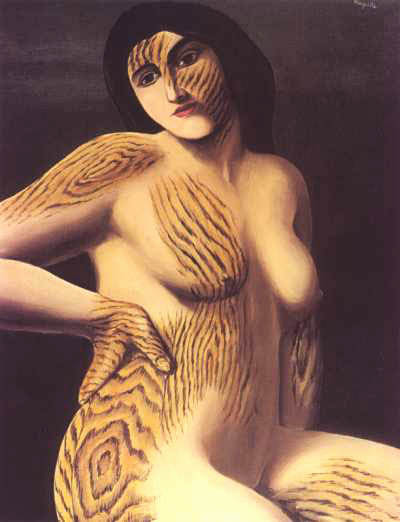 |
| Rene Magritte Discovery, 1927 Oil on Canvas. Brussels, Private Collection. |
We ate and I, intermittently rubbing where the splinter was, asked probing questions about his family, which he answered willingly and honestly. He was half Chinese and half Mexican and came from a broken home. His parents had divorced when he was one, his mom remarried a man he disliked and gave birth to two daughters, his half sisters with whom he had alright relationships with. He disliked his stepfather who disliked him back. His biological father was a seventy-year old Chinese man with a predilection for marriage. He had married four times. They were never close, but recently, his dad was diagnosed with colon cancer which made S realize he should reach out a bit more. Pity the man.
He told me all this and I nodded, admiring the fact that he was trying to patch things up with his father and that he made an effort to spend more time with his sisters, especially the younger one, whom he’d gone to Busby’s with.
“What about you?” he asked, “Are you close with your family?”
“Yes,” I said shortly. The splinter was really irritating me.
“That’s so great.”
“It is.”
He ate slowly for a minute, searching for something to say while I studied my hand. My phone pinged and I reached for it. It was my boss again, nothing urgent, but I didn’t like to leave his messages unanswered for too long. I responded, then went back to hunting for the splinter.
Finally, I spied it – the tiniest sliver of balsa wood, or whatever those cheap disposable chopsticks are made of, sticking up across the smooth inside curve of my hand. I pinched it out and felt ready to smile again.
“I got it,” I said.
“What?”
“The splinter. The chopsticks, they gave me a splinter.”
He looked relieved, “Oh, why didn’t you say something earlier? I could have helped you get it out.”
I looked at him, thinking back to a random factoid my cousin had once told me. If you leave a splinter in and it works its way into your veins and bloodstream, it could pierce your heart and instantly kill you. But I would live another night. I saw in his earnest expression the image of his head bent over my hand, the glistening sushi sitting patiently near our elbows, waiting to be consumed with cheap disposable chopsticks. I was certain he would never touch my hands. I would never see him again, like so many others, after this night, and maybe he felt the same way about me. But we were still sitting across from each other at a sushi restaurant in Long Beach.
“It’s okay,” I said, “I got it out.”
“That’s good. Those things can be pretty painful.”
I laughed, “Yeah.”
“So it’s all good. Everything’s good. No more splinters.”
“Everything’s good for now, ” I said.
He asked for the bill and when it came, paid it swiftly.
“You can get next time,” he said.
I smiled and stood up. “Thank you, I’ll get dessert.”

In 2011, I had my first kiss. I traded it for a tattoo, or more accurately, a glimpse of a tattoo, on the back of a boy I met in Las Vegas. I had just turned twenty-five, so it was about time. The tattoo was nothing original – a koi jumping out of a pond – something he’d found on the internet.
“Koi are supposed to be good luck,” he said, leaning against the bar. He was a twenty-something financial analyst from Chicago, in Vegas for a bachelor party with huge group of Asian frat brothers. He had just ordered me a vodka cranberry (with Ketel) and was waving a hundred dollar bill at the bartender, who had too many hundred dollar bills waved in his face to react in a timely manner.
“Good luck?” I smirked, my eyebrows raised in judgment. “So you think you’re a lucky guy?”
He shrugged, the hundred dollar bill poised in mid-air, “Well, you’re here aren’t you?”
Looking back, it was very well rehearsed.
The bartender finally took the bill, gave the Tattooed man his change, and presented me with the strongest vodka cranberry I’d ever tasted. I choked a little bit, wondering if the bartender and the Tattooed man were friends. It was still early and he had not impressed me so much yet, but I wanted to be flirtatious.
“Show me the fish,” I said, batting my eyelashes.
“Maybe I will, later.”
We danced for a bit, talked about nothing, and when later came, I reminded him about the tattoo. My drink was still full and I handed it to a friend, fueling a later incident in which she would almost throw up in my car.
“Ah,” he said, as though he’d forgotten all about it, “That’s right. Okay, I’ll show you. Follow me.” He led me to some tree-lined walkway near the side of the club. It was actually the walkway that led to the bathroom, but it was quieter there. Or maybe things just get quiet when you’re focused on someone. The image of someone. An image on someone. He sat me down on the edge of a planter.
“You want to see my tattoo?”
I nodded. How exciting.
He started to unbutton his shirt, then paused to deliver a line. Looking back, it was very well-rehearsed.
“I’m not just going to show you for free,” he said.
Oh shit.
“You gotta kiss me.”
Oh shit.
Let me be straightforward about things.
Prior to that night, I could count the number of guys I’d kissed with the number zero. I didn’t want to tell him because pop culture and empirical evidence tells me men (and women, to some degree) are uncomfortable with information like this. It reeks of liability. You open yourself up and voila, I am somehow responsible for your organs. And could I blame him for wanting a kiss?
I reviewed my actions leading up to that moment: I had batted my eyelashes furiously. Danced suggestively. Was wearing a short dress from Forever 21 when in fact, I had just turned 25, and which I had spent the better part of the night pulling downwards, hopefully suggesting the opposite of what the dress suggested. This was not part of my feminine mystique but a common feminine mistake. You want the attention and sure, you can dress the part, but can you remember and deliver the lines? More often than not the attention comes in a tidal wave and suddenly you are drowning because you spent too much time playing badminton and reading during the years when most other people were exploring relationships with the opposite sex.
I blanched for a minute. Maybe longer, but not long enough for the tattooed man to think, “Hey, this girl just zoned out on me…” I thought of how thin my lips were and how dry my mouth was and how horribly tired I must look up close. Was my mascara running? Probably. My hair was flat. I smelled like smoke.
But then one giant question: how do I do this? Where was a Judy Blume novel -open with key passages highlighted – when you needed one?
It was a nice evening though, and I was having a good time. I smiled at him, Oh, what the hell.
Okay, I said, hoping the awkwardness I felt was only a feeling and not a look. I leaned in.
We kissed. I felt his five o’clock shadow scrape against my upper lip and on the corner of my mouth. I thought of a Saint Ives Apricot scrub I used to use but stopped because it was too abrasive. This felt slightly different. He pulled back, looking thoughtful.
The moment had passed and I was amused again. Was he judging my kiss? It must have sucked, but I wasn’t going to admit anything. I remembered my lines. I smiled expectantly. Kiss for tat.
“Alright,” he said, “I’ll show you.”
His skin was paler than I expected, and I laughed at him for it. “We don’t get much sun in Chi-town,” he said. The shirt came off and there it was, the image of a wan-looking fish I had paid a kiss to see. A first kiss. A fish out of water. A night club in Vegas. Called XS, but could now be rechristened Club Cliche. I looked at the fish, nodded and said all the requisite things, “Wow. Did it hurt. How long did it take. Was it expensive.”
It didn’t hurt so much and yeah, it was expensive, but he wanted to get another one. I hoped he wouldn’t.
Later, we kissed again and then again. At three AM he put his skinny black tie around my neck and told me to keep it.
“Maybe I’ll visit LA sometime and get my tie back.”
At four AM he and his friends walked me and my friends to our hotel room. We kissed one last time and I thought, “Hey, am I good at this or what,” though I knew that my lips were probably chapped beyond recognition.
Forty-six years ago, my grandfather retired from his position as a customs officer and with fortune’s second wind, established a small company, the workings of which to this day, remain somewhat of a mystery to me. I once asked my second uncle what it was the company did. Looking up briefly from his computer screen which, as usual, was covered with blinking red and green numbers, he shrugged and said, “I know what I do for the company, but other people, I’m not quite sure. A smattering of things, I guess.”
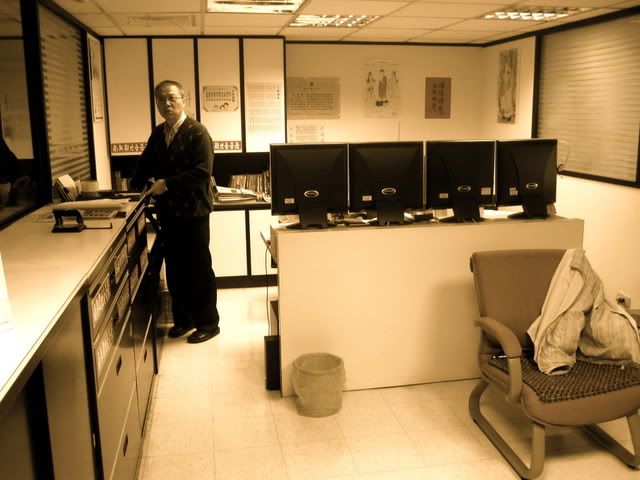 |
| First Uncle Kwang-Hong, the middle brother, in his office. |
At its inception it was a medical supply trading company and only later, with my grandmother’s death, began its foray into real estate development. She had wisely bought random parcels of land throughout Taipei, leaving it to her sons who in turned built office buildings and tall condominiums upon it when they were grown and joined the company’s ranks.

 |
| Project drawings from the company’s heyday. |
Why, people ask the children in our family, don’t we just “take over” the family business? It was and remains modestly successful and, were we to infuse it with youthful innovations, surely it could rise to become even greater?
 |
| Where important meetings once took place, old files and boxes of supplies pile up. |
Fat chance, we reply, not least because the office exudes a musty smell and a blanketed quiet – all signs of a company in decline. The boys are off hunting bigger fish (i.e. companies that occupy more than just a single floor) and the girls, well, we can’t help but think of all the office ladies who in the company’s heyday, were still pretty young blossoms waiting to be plucked from white collar obscurity. Now however, they are old maids. Family lore has it thus: if you are a single woman entering the company’ work force then you will leave a single woman. It’s the company curse, and a notably sexist one at that. Men who work at the company will eventually find themselves happily married to wonderful wives who bear even more wonderful children (case in point: me). This is precisely what happened to my grandpa, uncles and father and a smattering of other men who have come and gone. Women however, risk an eternity of spinsterhood.
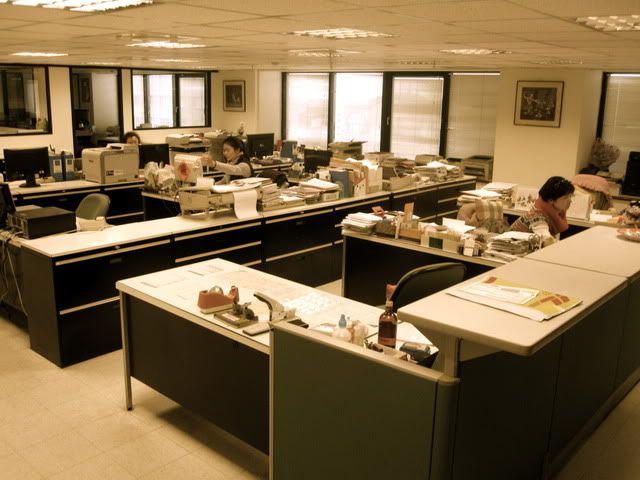 |
| Doomed. |
Of the six women who have begun their careers with us, only one is married, and this occurred prior to her employment. The other five have given up looking for love, it seems, though I can’t say for sure. I doubt women ever stop looking. They dress up to come to work, though there are no men to impress but my two married uncles, one of whom is almost hermit-like. The company’s one man financial analyst, he closes the office door each morning, hiding behind four giant computer screens until lunchtime, when he steams his home-packed lunch, inhales it, then settles in for a nap. He rarely speaks to anyone, bidding only good morning and good night to the office ladies.
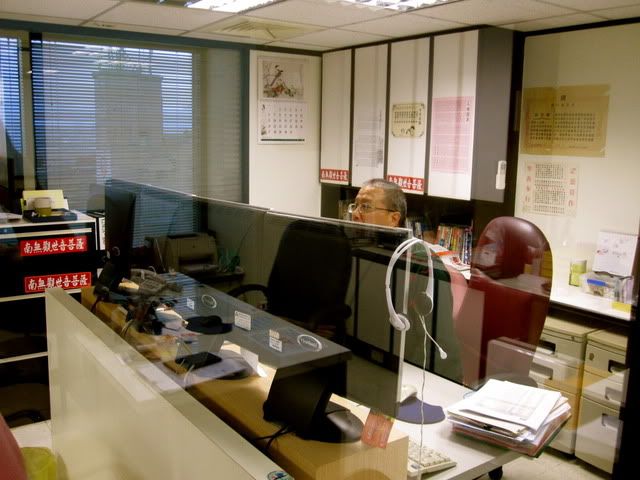 |
| An artist at work. |
My other uncle, my father’s youngest brother, is a bit of a workaholic. When he is kind he is very kind, but when he is angry, the entire office cowers beneath his oppressive anger. The women fear him, but they also cannot leave him. It is a strange dynamic, one that puzzles me to no end.
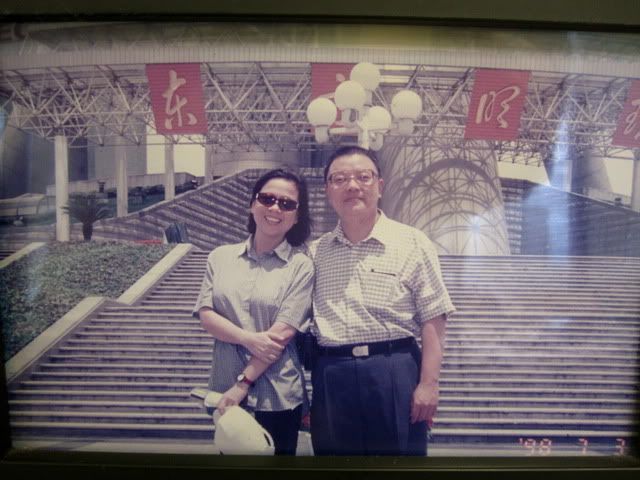 |
| The only photograph in Second Uncle Kwang-Hwa’s office: a somewhat cruel reminder to all the office ladies who enter that while they may not like him very much, there is someone at home who does, very much. |
But I have written it off as one of those karmic enigmas – perhaps in another life these women betrayed my uncle in some way so that now, they’re repaying him with their allegiance.
 |
| Speaking of Karma, the company has its own altar room. Perhaps the office ladies don’t use it enough. |
Every time I visit the office and see these women, some still quite young looking (though I feel this has more to do with a mental projection of their reluctance to leave a certain stage of life than with any skincare regime), I wonder, “Why don’t they leave? Why don’t they quit?” It’s a depressing sight, but I can only keep this to myself or speak in whispers, to my cousin who feels the same way.
We can fear them right now because we are young.
But who knows, one day we may know exactly how they feel when a young woman on the cusp of career or love or both, walks into the room. Or perhaps it’s just my superstitions talking. In companies all over the world (though it seems most visibly in Asia) women are trading job security for marriage. They work late hours, making it hard to socialize after work, and when the weekends come, they have barely any energy leftover to meet new people not to mention spend time with friends and family. Men go through the same thing too, but the alarmingly imbalanced ratio of women to men (the article is for Hong Kong, but Taiwan’s numbers are not too different) means that men can be far less proactive and still, some grateful young woman is likely to fall in his lap.
Regardless, I’ve vowed to never seek employment in the family business. In medical equipment and real estate, the company has made a comfortable living for all those associated. Where it has no business is Love. At least not for the office ladies.

No man is an island and if a man claims he is an island, I don’t trust him.

In my Hitchcock class, we are discussing “Vertigo,” which now, to my older, wiser and more critical gaze, is much more appreciated. Continue reading “Forests”
 VERY HIGHBROW