Ode on a Friend Named Courage, 2

Courage could not help herself from falling. Who can? Well some people… no, no. Everyone falls; the difference lies in how you soften your landing. Many of our friends are masters of their emotions. They hold on tight to words, smiles, hugs and tears, locking them inside that fist-sized muscle and only release them with a four letter combination. And even then, they must be careful.
“I never say I love you first.”
“I’ll never admit I want him back.”
“I’d rather die than call him first.”
 Courage and I have spent enough hours analyzing people both broken and whole to know that this is, in some twisted way, the formula: to win someone’s love, you hold back your own. It’s a strange game we’re both terrible at playing and which we’ve lost many times, despite all the literature. I lost first in high school, when I asked the object of my affection point blank: “Darling, why don’t you like me?”
“Because you’re creepy,” he said coldly.
Lesson learned. Disclosure invites disclosure, which is sometimes not what one wants to hear. I haven’t played since.  

From that day I loved from behind the veil of friendship. There was my own Golden Boy, then The Old Professor, then The Focused Genius, my relationships with them all variations on a theme: close, but platonic. Adoring, but distant. I never took the leap. Did not dare to. Why would I, and risk losing a friendship, even if said friendship was born upon the hopes of love? 


Courage agreed and we drew up a plan like two fat girls embarking on a newfangled diet. Yes, yes, everything in moderation. We would use time, gestures and looks as measuring cups and parse out our affections and affectations – what can be said and when. Too soon? Fall back, retreat. Plot. Design. Scheme. Yet a year and a half after meeting The Golden Boy, Courage forgot the rules and fell off the wagon. She had a taste of some treat – a smile, a whisper, a tantalizing hint of some greater feeling waiting to be peeled back and inflated – and released the archetype she had always embodied, even before she was Courage: ladies and gentlemen, I give to you The Romantic Idealist. And to make matters worse, at her core, the Romantic Idealist’s is also, unbelievably, Truth. What, you disagree? What is truthful about projecting your ideals upon some unsuspecting other? Is it not another form of lying to yourself? But stop. Stop and think: what are we if not our hopes and dreams? Are we not the most honest with ourselves when we finally hunker down and admit what it is we truly want for ourselves, no matter how improbable or out of reach it may be? This is what I want. Whether I want it after I get it, let me decide when the time comes.  

Eleven A.M.      1926      Edward Hopper,    Oil on canvas


“At length the truth will out.”  

Two school terms, a summer, and another school term pass. They get along swimmingly. A few days ago she told The Golden Boy she loved him. Or rather, he coaxed it out of her; not to be unkind, but to feed the human need to be loved more than we are worth. I was not there, I do not know what they were discussing, only that the discussion led to this:


“Courage,” he asked, “Are you falling in love with me?” 


In her weakest and most beautiful moment she answered him, “I am, I am.”


“Ah.” he said, “I was afraid of that.” 

The Golden Boy did not feel the same way. He liked her as a friend. He loved the Golden Girl, and he hoped that he and Courage could remain friends. 


She nodded, feeling neither surprised nor hurt, only the strange feeling of the world dropping out from beneath her feet. 


We spoke on the phone a few days later, our voices hushed almost as though we were discussing a death in the family. 

“I knew as soon as I said it,” her voice was strong, though tinged with resignation, “I could feel it drain from me, all the power I had when I loved him but never expressed it. I showed him all my cards, and now I have nothing.” 


I disagree, Courage. You will always have the words, because you have always known them. 

My mother came into my room shortly after and asked me what I was thinking. 

I was debating, marveling, admiring. Here was a woman who feared spiders and germs and dark alleys, but who, when asked a question that would have sent anyone else bumbling and stuttering and lying down a million different paths, spoke the truth in much the same vein as my high school crush (so thank you, High School Crush, for at least being direct). The Golden Boy did not react as Courage had hoped; in fact she had known his answer long before he said it. But to hear it was akin to having it carved upon her heart. But she never stopped hoping – and while to some this may seem pitiful or obtuse or masochistic, it is this openness that will allow another to wander in and find himself at home.

But at the time I could not put it into words until my mother surprised me with her reaction, her eyes tearing up and her voice cracking. 

“How brave!” she said, “How brave of Courage to admit something like that. And how wonderful of her to share it with you so that you might learn something too.” 


“It is a brave and stupid thing, a beautiful thing, to waste one’s life for love.”
— Andrew Sean Greer, The Confessions of Max Tivoli

“There is no fear in love; but perfect love casteth out fear: because fear hath torment. He that feareth is not made perfect in love.” Unknown Author 


“When old age shall this generation waste,
Though shalt remain, in midst of other woe
Than ours, a friend to man, to whom thou say’st,
‘Beauty is truth, truth beauty, – that is all 
Ye know on earth, and all ye need to know.” 
                                                              -Keats
Ode on a Friend Named Courage, 1

I have a friend I’ll call Courage. To those who know her, this name might seem funny or ill-fitting because Courage is actually afraid of many things, not all of which are readily visible or even understandable. She squirms at the thought of invisible germs and screams at tiny spiders. Once, on the verge of tears, she called her boyfriend to drive an hour to kill a spider crouching in the corner of her bathroom.
If I or any other of our friends were to walk down a dark alley by Courage’s side, others would point and say that Courage was a coward. In such places she walks with her shoulders high like a fortress around her ears, cold hands in a tense death grip around your arm. Regardless of whether you are a man or woman, she will make you feel obligated to protect her. Her grip tightens with every step you take, cutting off your blood supply so soon your fingers are turning cold too. Protect me, her hands say. Protect me from bums, from dark places, from vicious animals and from smelly trash bins. And if you are me, you roll your eyes and say, “Okay Courage, don’t worry. I’ll protect you.”
And yet I call her Courage. I call her so because she is one of the bravest women I know. We cannot all fear the same things; at what Courage fears I would not bat an eye (though this depends, surely, on the size of the spider or vicious animal), yet of what she is not afraid terrifies me and nearly every person I know.
            Disclosure, let’s call it. 

            A year and a half ago, Courage went off to law school, which to some is a very brave move – law school can be a scary place where the books are thicker than the skins of those who read them – and while I would argue that Courage actually did not – no, does not – belong in Law School (and depending on the weather, she will nod in fervent agreement), it is sometimes braver to see a bad decision through than to back out, drop out, and look back years later only to say, “Oh what if.” (I know nothing about this sort of regret).
Being first and foremost a writer, Courage found respite from the toils of law school in a small and intimate writing group. Composed of a handful of like-minded writer friends who had also bravely embarked upon law school without really knowing why, the group gathered every Monday at someone’s small, messy house and shared the creative writing they did in between legal writing: essays and short stories, some long, some short; some true, some not. They read them aloud and voiced their thoughts, sometimes too gingerly to be constructive. In this way, Courage grew close to the The Golden Boy, whom she had met in class and who was both an archetype and a very real person. He was tall, blonde, athletic, needlessly handsome and to top it off, impossibly smart. He had once been a swimmer on the cusp of Olympic stardom and had the body to show for it, though not the medals; a fraction of a fraction of a second, he said.
In his own way, the Golden Boy was equally brave, at least at the outset. He admired her writing, and said so. This, I know, is a difficult thing for a writer to say to another writer. Apart from writing, writers (especially ones who have not been published), spend much of their time turning their noses down at other writers. Some will say it is more cutthroat than the legal profession because writers can mask their aggression behind pages and pages of florid prose. But Courage had never shied from singing the praises of my or any of our other friends’ work. Which raises another question, not wholly unrelated: had I done the same for her? Her style is different, the product of a steady childhood diet of Anne of Green Gables and other romantic, slowly unfolding coming of age stories – bildungsroman for young girls.

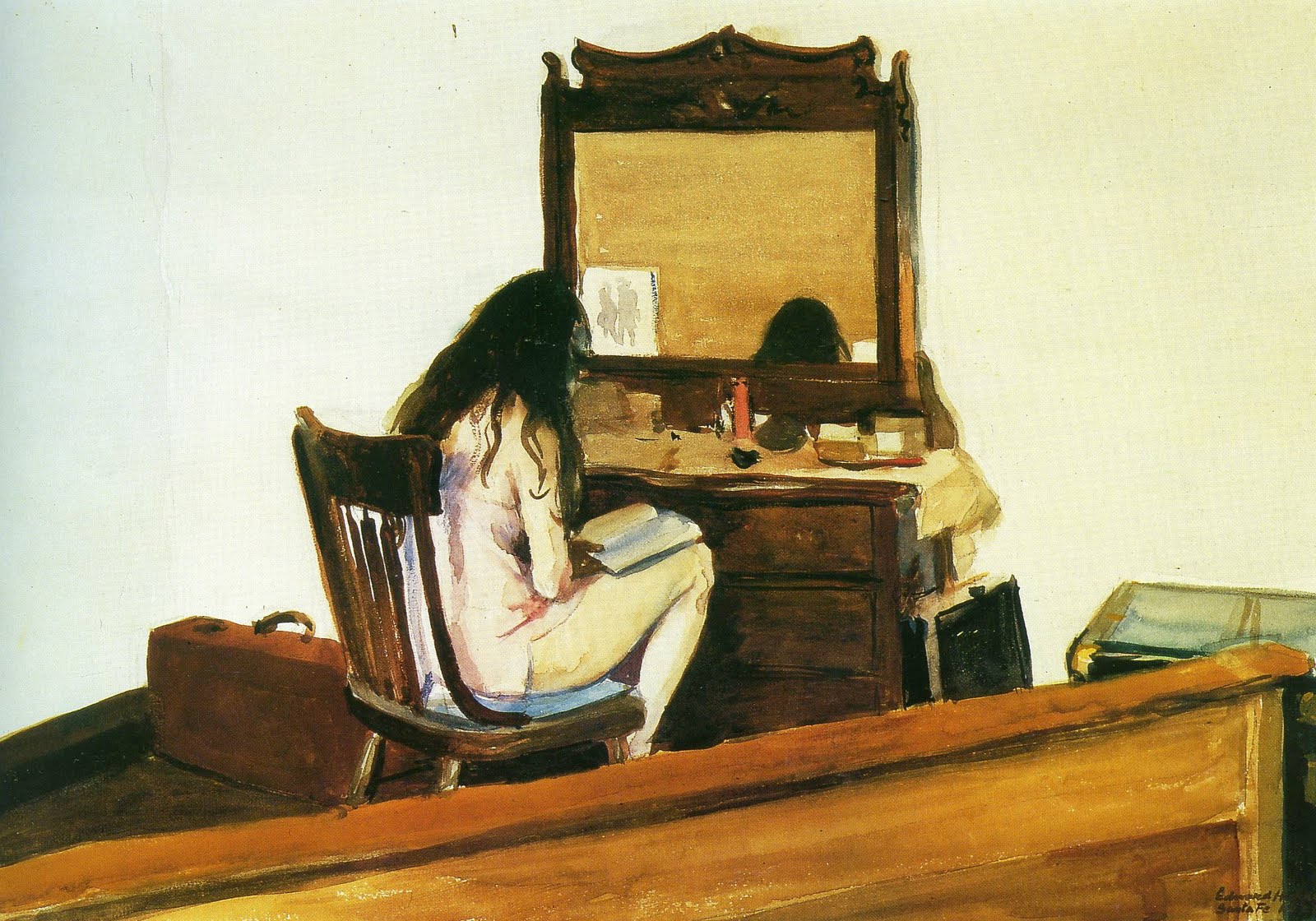
Interior, 1925 Edward Hopper, Watercolor

 As she grew into a young lady she fell headlong into the folds of Jane Austen’s dresses, into Hemingway’s Parisian feasts and seas, into Steinbeck’s Eden, Tolkien’s shires and into the very heart of C.S. Lewis’s God until one day, she emerged a woman. A woman with very particular literary tastes, though this is not to say she is narrow-minded. When Courage reads, she reads earnestly and adoringly, peppering the margins with her illegible chicken scratch. No matter whom she reads, if the writing speaks to her, she will read wholeheartedly. And it is because she was open in this way that the Golden Boy was able to wander in and find himself at home. 

They got along swimmingly. Slowly, the Golden Boy began to shape her days. They saw each other in class, and then studied together afterward. They were, of their writing group, the most serious about the “craft,” and were on occasion, the only two to show up, the others claiming academic exhaustion. Oh well. Between them, suppressed delight ensued. Courage and the Golden Boy would share a bottle of wine, read their work aloud, shyly at first, then talk late into the night.
Slowly, in the universal way that writers do when they fall in love, Courage began to write about him, for him, to him. And we women cannot help but hear the words as well – we learn to speak before we learn to write. To speak something is almost to believe something. One could not engage Courage in a conversation without the Golden Boy creeping his way in, and it was very clear to all her friends and perhaps even to her immigrant parents that their daughter had fallen in love. Who was this young man? What could explain his hold over her? Words love, words.
They exchanged emails, banter, texts, chats, blogs, and long, long essays about their pasts and their hopes for the future. Like a fish who had found a familiar undercurrent in a vast ocean, Courage felt that paradoxical warmth and cool refreshment one feels when they believe they have found “the one.” Emphasis on “believe.” 
You see, as an archetype, the Golden Boy and all the other male archetypes that follow (The Young Professor, the Old Professor, the Focused Genius) must always be in a relationship. He is invariably married or about to propose to a wonderful, equally brilliant and beautiful girlfriend who, even if she does not share the same interests, gives the impression that she is perfect for him. And the Golden Boy had such a woman in his life. She was more than just A Golden Girl, she was The Golden Girl: a lithe, blond-haired blue-eyed beauty with beautiful teeth to match her beautiful soul. She was, of all things, a wedding photographer – a complete artiste to the Golden Boy’s divided self. Was he a writer or a lawyer? It didn’t matter. He was the man. He would provide. The lawyer would do that while the writer would love and appreciate his woman’s art. After marriage he would prosecute or defend, depending on what his conscience could reconcile with his financial needs. But at night or perhaps in the early mornings, he would write. She would continue to photograph things people struggled to put into words: the adoring gazes of couples engaged, married, and later, the blank, doe-eyed stares of their round-faced children. Someday, the Golden Boy told Courage, he would meet his wife in the middle and become a full-fledged author.

Do Not Cry at Work

This Eulogy may very well be the most famous thing Mona Simpson will ever write. Reading it, I began to cry in the office – not loudly or anything, just sniffling in what I hoped was a covert manner. A few of my colleagues walked by, one of whom stared at my eyes and said, “Wow, you must have really bad allergies.”

“It’s this eulogy,” I said, my voice cracking.

“What?”

“This eulogy. Steve Jobs’ sister wrote it for his memorial service.”

“Oh,” my colleague said. She is normally extremely chipper to the point of being robotic. A consummate HR professional, she hides her feelings behind a saccharine smile and soft, musical voice. It is hard to decide if her eyes glint from perpetual glee or if it’s the glare of her oval glasses. From the day we first met she had categorized me in the same way: I was an admin, hired to meet and greet. She was in HR, in charge of welcoming new hires. It was our job to smile incessantly. Never stop smiling. Ever. Who was this teary-eyed Betty?

She stepped back, suddenly looking uncomfortable. Her expression reminded me of the time I placed my dead grandfather’s hat on my superstitious cousin’s head. She looked at the screen, and then back at my red rimmed eyes. “Well, I’m uh, sorry for interrupting your…” her eyes scanned the ceiling for the right word, “…feeling.” She raised her voice several octaves and patted my desk, a strange gesture considering my arm was also right there. “Feel better!”

As she walked away, the coworker across the way turned around. She had overheard the conversation (as she always does) and stopped typing in order to give her two cents (as she also always does). A strange quiet ensued, the kind that follows after a fan suddenly stops whirring, or when you are asleep in the car until suddenly the engine stops because you’ve arrived at your destination. She turned over her shoulder and looked at me, her eyes squinting in a strange way, as though she were studying me.

“You are such a softy,” she said. I disliked her tone. There was, crouching beneath it the subtle implication that I was somehow weak.

“What?” I said, “I cry easily.” I was thinking, “Give me a break woman, it’s a eulogy. They’re supposed to be moving.”

I emailed the eulogy to a friend. “Oh my goodness it’s so good I’m crying,” I typed into the message box.

“What the hell are you doing reading eulogies at work?!?” she wrote back, “Crying doesn’t help with productivity, does it?”

Another coworker came up a few minutes later to look for someone. He stopped in front of my desk. My tears had dried, but my eyes were still rimmed red.

“You sick or something?” his voice was monotone, his face expressionless. Did I want to explain myself to him?

I thought of saying, “Yes, I’m sick,” or falling back on the allergies thing, but the pitcher with big ears was still there and she would undo whatever lie I supplied. “It’s this eulogy,” I said lamely.

“Jesus,” he said, then, not finding whom he was looking for, walked away.

Lesson of the day: there is no place for tears at work.

In Praise of No Praise

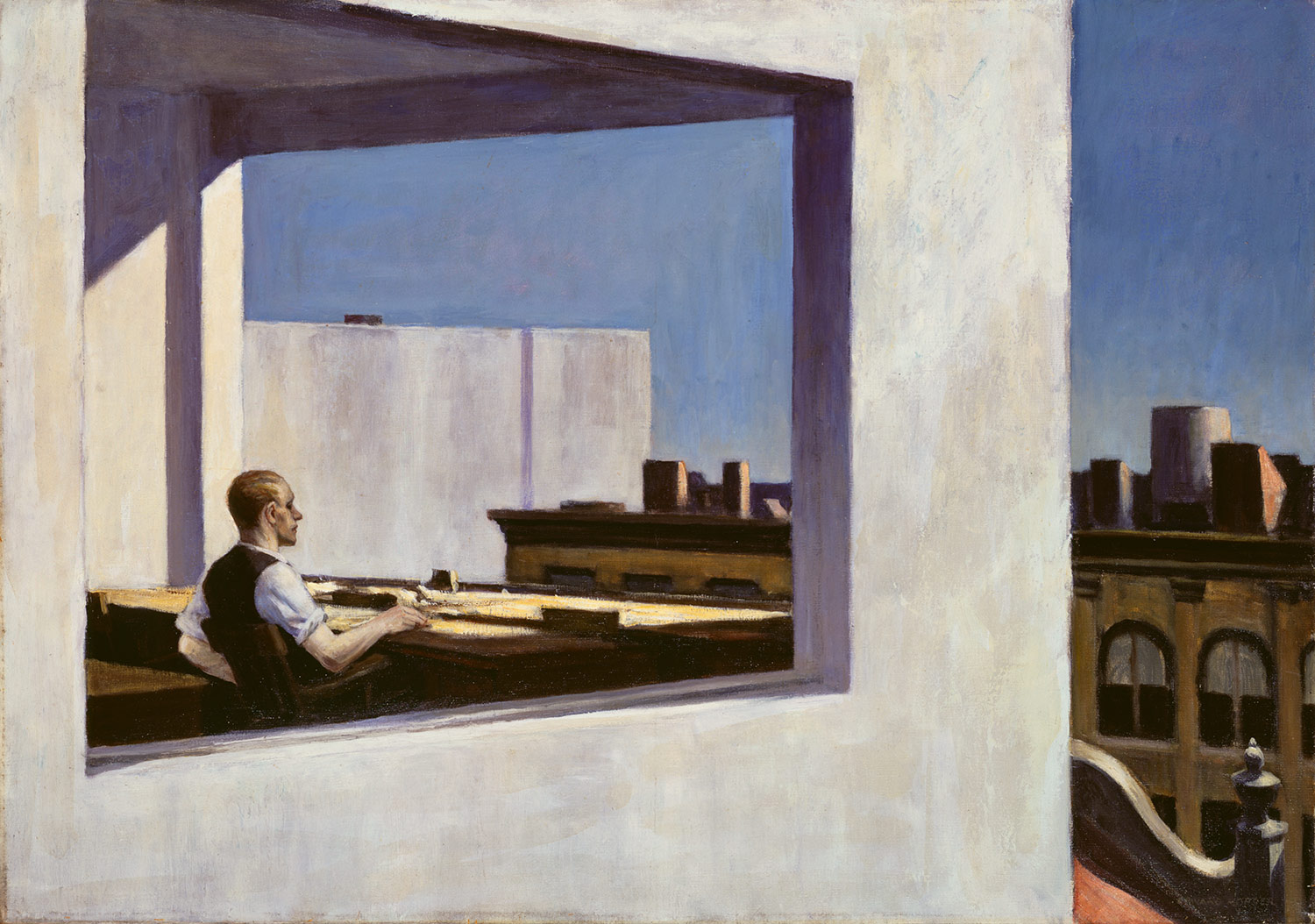
Office in a Small City, 1953 Edward Hopper, Oil on Canvas

Sometimes I hate emailing my boss because his replies, if any at all, are terse almost to the point of being cruel to someone like me, who writes almost as much as she talks. He writes, “Do this.” “Do that.” and, when he gets angry, he’ll attach an exclamation mark at the end. “Next time, don’t cc everyone!” or “The van is really dirty!” Yet in person, he is quite affable, and I like to think we have a good relationship.  Continue reading “In Praise of No Praise”

Steve Jobs, the Macbook, and Me: Connecting the Dots

“No one wants to die. Even people who want to go to heaven don’t want to die to get there. And yet death is the destination we all share. No one has ever escaped it. And that is as it should be, because Death is very likely the single best invention of Life. It is Life’s change agent. It clears out the old to make way for the new. Right now the new is you, but someday not too long from now, you will gradually become the old and be cleared away. Sorry to be so dramatic, but it is quite true.”

Steve Jobs (1955-2011) Stanford Commencement Speech 

A friend sent me Jobs’ commencement speech around the time of my own, much-delayed commencement, which I celebrated by driving away from Northern California, knowing that I’d never go back for longer than a weekend. Before, being the type of person who lusted after typewriters and fountain pens, I turned my nose up at Jobs’ creations. What use did I have for over-priced laptops, music players, and mobile phones, beautifully designed though they were?

My brother, the family gadget junkie, felt otherwise. He generously shared his interest with me, first by gifting me an Ipod for my high school graduation and a few years later, (when it became apparent that I would stop dropping out of college), by convincing my father that it was a Macbook I needed to replace my old black IBM. I was reluctant at first, wondering if I’d turn into one of those goons who waited in long lines outside the Apple stores, but friends, family, and the growing number of people in the streets, at school, on the bus – all glued to their iphones/pods/macs, assured me it was the right decision.

“I don’t know what I was doing before I bought my Mac,” said a friend, “It was like being in a bad relationship. You just put up with it because you don’t know any better. Until you walk into an Apple store.”

“Dude,” said another, not bothering to look up from his enormous MacBook Pro, “Don’t use that other shit.”

I was skeptical, but also tired of my PC’s petulance and general incompetence. It often stalled and made terrifying whirring noises that grew louder as my papers got longer – I typed in fear, wondering if it would crash just as I’d finished the last footnote. If it did, I would no doubt drop out yet again. Not to mention it was like a sickly child, constantly inundated with paralyzing viruses, a concept that mystifies me to this day. Why did such things exist in cyberspace? And why were they so similar to the viruses that plagued human beings – there seemed to be no cure for these viruses, only the dreaded “reboot” that erased everything you had ever written/photographed/saved, ever. Most of what I’ve ever written lives online, but regardless, the Macbook had a better immune system.

Finally the day came. The IBM choked, sputtered, and after much rebooting, died in a very electronic sense: It simply did not turn on. I bid goodbye to its dull black corpse and welcomed a shiny silver Macbook onto my desk.

My knowledge of computers and their inner workings is extremely limited – you may roll your eyes freely – but I do know that there is hardware (the tangible parts of the computer) and software (the dizzying code and algorithms that are built into tiny silicon cities). It seemed that in my old laptop, the hardware and software could not agree. A key could be pressed ten million times, but the command was ignored. There was a failure to communicate between the hard and the soft – and who knew: perhaps the software was in revolt. Perhaps the algorithms were rotting and the codes were corrupt, threatening to burn down the walls of the motherboard.

But it was immediately apparent that within and without the Macbook, peace reigned. Hardware and software worked together like well-fed, robotic peons of a happy commune. A button pressed was a command issued and I smiled, knowing I (or my father), had paid a little over one thousand dollars so that I too, could live in the present. Designed in the rolling green hills of Cupertino by Apple Engineers who loved their king, (though for some this love grew from fear), the Macbook’s keys felt and sounded different from my old laptop. This took some getting used to, but its quiet beauty, soundless breaths and smooth simplicity calmed me. Like with an easygoing coworker or classmate, I fell into a comforting rhythm. Each morning I pressed a smooth round button and it turned on. What a simple joy this was! I did not have to first brush my teeth, wash my face, eat breakfast and read the paper and come back into my room only to find that it was still initializing.

Upon it, I did my work and did not work. I blogged, wrote research papers, spent hours lazing about the internet, or in my room, with Pandora playing from speakers that were much more powerful than those in my old computer. I video-chatted with cousins in Taiwan and filled its memory with photographs from Rome, Paris, Berlin and London; recipes I hoped to try someday and half-finished essays that would likely remain half-finished essays. Then, at the end of each day, I would turn it off, knowing that it would turn on just as quickly the next morning. I could have done all of this and more on any other laptop. But the fact is, I did not. I did it on my Macbook.

I should have said “Thank you” to Mr. Jobs each evening, as his creation helped both my productivity as a writer and my connectivity as a human being living in the 21st century. (Though I will argue productivity is relative to connectivity, or has rather, an inverse correlation). And more recently, with the iPhone (another gift from my brother, whom I thank as well), he has hammered the final nail into the coffin of my fear. The internet in my hands! Email, wherever I go! And music, and Facebook, and an amazing camera phone etc. etc. etc. I can do all that on any other smart phone, but the fact remains, I do not. I do it on the iPhone.

So morbid as this may sound, To Death, the ultimate change agent, and to Mr. Steve Jobs, inventor and himself a powerful change agent. He had herded me, like a docile lamb, into his elegant and user-friendly pasture. And there – or here, I should say, as I am typing this upon my angel Macbook, I will stay.

Assistants 2

Gina left big shoes to fill. And rather than hire a girl with big shoes, HR hired a big girl.


“Well, Bonnie wasn’t big when they hired her,” a coworker named Cindy explained to me, herself the victim of career-related weight gain, “but she didn’t do her job very well…wasn’t really on top of things, which stressed her out, which made her eat, which, you know, made her fat.” 

“How fat?” (I had to ask.) 

It was afternoon and the dark circles under Cindy’s eyes were in danger of becoming permanent, but her eyes brightened when I posed the question to her. I could tell she’d be a rich and willing source of company gossip. She even had the gestures to match, and dramatically cupped her hand around her mouth, as though to shield her lips from whomever could see, though the office was mostly empty. 

“Thirty pounds,” she whispered loudly. 

My jaw dropped. 

“Thirty pounds? THIRTY POUNDS? In ONE YEAR? What the hell did she do? Eat one of the accountants?” 

“Shhh!” Cindy said in faux panic, as though the old executive assistant was still here, hiding in the vending machines. She nodded slowly and held out her pudgy hands and puffed out her cheeks, “Yes. It was a very dramatic change. She blew up like a balloon.”   

A few days later another coworker fleshed Bonnie out further. 

“It wasn’t even that she was fat,” said Jane, an athletic Asian girl in marketing whom I quickly befriended at the risk of seeming like a huge lesbian, “She was a bitch. She hated all the girls her age and was only nice to the boys. And on top of that, she like, got dressed in the dark or something. Totally did not know how to work with her…heft. She would wear these like puffy sweaters and jackets that only made things worse for her. And she’d always ask me, ‘Does this make me look fat?’ And I’d say ‘No, no,’ but really be thinking, ‘Hell yeah it does, fatso.’ It was bizarre.”  


Bonnie was a UCLA graduate who had apparently interviewed well. My boss expected her to bring the same energy and spunk she had showed during her interview to the job, but a few months into Bonnie’s employment, he felt duped. In addition to being rather piggy – “Bonnie was always eating something at her desk,” Cindy said – she was also lazy, preferring to surf the internet for long bouts rather than run errands or schedule meetings. Important emails went unanswered which led to tiny pockmarks in my boss’s public complexion.

Perhaps a member of Bonnie’s family. 

I imagined Bonnie to be a rather formidable figure – a nasty girl who abused her power (“Which she absolutely did,” Jane said dryly, “until I verbally bitch-slapped her, and then she at least didn’t give me attitude.”) and sat on her haunches waiting for things to be done for her. She was, after all, the EA for a year, which to me meant my boss put up with her. Had he been afraid of her? 

“Oh of course not,” Cindy said, rolling her eyes at my naivete, “Bonnie was terrified of him. But you know, so much of what she does doesn’t really get back to him. She could pawn her incompetence off as someone else’s by saying, ‘Oh well, so and so hasn’t gotten back to me about that, so I don’t know,’ or ‘I told him to do it, but he hasn’t done it yet.’ When really, she was the one who wasn’t doing anything.” 


Add to that the course of human nature: fear turns into hate; miscommunication turns into non-communication which exacerbates misunderstanding and prejudice. Fourth grade stuff. From what my boss has hinted at regarding their relationship, I gather that they did not get along in the end.

“Bonnie was not so great,” he said one afternoon. 

“Someone told me she was fat.” 

He looked up from his monitor and I could see the beginnings of a grin, but he pursed his lips and decided to take the high road. 

“It was her laziness,” he said, “Laziness is the young person’s death. You can be stupid, but you have to be willing to learn. And if you’re willing to learn, you cannot be lazy.” 

I made a mental note to never fall asleep at my desk in front of him.  

But it is also human nature to disdain those that cannot control what you try so hard to control in yourself. You think: well, I could do it, why can’t they? Around the new year my boss resolved to lose sixty pounds and to be, in general, a healthier individual. He had spent much of his life being fat. His words, not mine. When I first researched him, his pictures were pre-weight loss, and I walked into my interview surprised to see a much thinner man – (thinner, not quite thin). Later, I asked him why or where he got the motivation to lose weight. He shrugged, “I was fat!” 

It was a very straightforward answer and because there was no way for me to say with a straight face, “No, no you weren’t,” I merely nodded in agreement. 

“I’ve been fat my whole life,” he said, “so last year I decided to change. I started working out. I stopped eating carbs. Stopped drinking wine.” 

He looked at me, “You see my schedule, you know how often I have to go out to eat and drink and entertain.”

“I do,” I said, “There are lots of temptations.”

“Exactly. But I did it. I stuck to it. I’m not a lazy person, but you know, when it came to my health, I was for so long. So I decided to stop being lazy, to learn about my health, and I lost sixty pounds.” 

Life must have been awful for Bonnie around then. I imagined her waistline, butt and thighs gradually expanding while my boss arduously whittled himself down. He walked past her desk every day, a beacon of hope for all the fatties in the company while Bonnie gained in both mass and resentment. Why should a man nearing middle age be putting her youth to shame? I’m no psychologist, but I’m quite certain that Bonnie, at that time in her life, ate more than ever, teeth and tongue gnashing more viciously out of rage and contempt, both dangerously misdirected outwards towards her situation but were responses to her self. 

In the end, my boss lost sixty pounds of fat and to mark the occasion, he decided to cut some fat at the office as well. 

“Esther went around tell people that she’d gotten into a prestigious grad school,” Jane said, her face skeptical, “But I think she was fired.” 

I attempted to verify this with my boss. 

“So Gina was great, but Gina left.” 

“Yup.” My boss’s eyes remained on the monitor. 

“And Bonnie was not so great.” 

“Nope.” 

“So what happened to Bonnie?” 

“It didn’t work out,” he said vaguely. 

“Did she…” my voice trailed off, and my boss turned to look at me. 

“Don’t worry about it.” he said, “Just remember what I said about laziness.” 

I nodded solemnly and made a mental note not to get fat.  

Assistants*

"Office At Night" Edward Hopper, 1940  Oil on Canvas
“Office At Night” Edward Hopper, 1940 Oil on Canvas

*The following is fiction. Or vague facts blended with vivid fiction.

At work, I’ve been finding ways to inject my personality into things. My work space, for one. I cleaned out my desk in the first three days, which, if you can’t see my desk (which none of you can), doesn’t sound that impressive, but trust me, my coworkers were impressed.   Continue reading “Assistants*”

On Kindness, 1

It finally hit me today: the thing about kindness – what it is, what it is not.

For weeks, I’ve been running old conversations and scenes through my mind, playing and replying them like old, grainy, homemade films – or worse, depressing romantic dramas starring the likes of Ralph Fiennes and Carey Mulligan. I’ve been weighing the characters of all the men I know (not very many), and wondering what it is about the few I love or have loved, and about the rest for which I cared little. It must be said that my father, with whom my relationship is best described thick with cliche as “love/hate,” made the short list for both.  

Let me say this – I am nowhere near having as whole an answer as I’d always hoped, but if this was all the “eureka” I could squeeze out of this one nagging question, then I’m happy to hang it up as my North Star.

This afternoon, for the third time in a month, my boss lectured me about paying attention to detail. I made yet another mistake on his calender, blundered verbally – he was talking about one thing, I responded about another, and then laughed when he said he had gout. Yes. I can be quite insensitive at quite the wrong time – but my boss let it slide, chuckling at my candid insensitivity, and I warmed towards him, thinking, “Oh, what a kind man. He lets me laugh at his ailments.”

Then rather abruptly, he turned back to his computer screen and said, “Nothing else? Let me get back to work. If I need anything else I’ll let you know.”

What more could I want from that moment? He had pointed out what I had done wrong in a calm, even tone – no tantrums from him unless I really push him over the edge; overlooked the fact that I had joked about his gout (“You eat too well,” I said. He nodded in agreement), and as it was the end of the day, was more or less giving me the okay to call it a day. 

Yet something bothered me about his last words: “If I need anything else, I’ll let you know.” And here, at the risk of sounding too whiny, I admit I thought, “What if I need something else? Some more guidance? Some more information on how to do things right?” I bade him good evening and walked out of the office, then turned briefly around through the glass wall that separated my desk from his and saw him slumped low in his expensive ergonomic chair with adjustable armrests, clicking through his thousands of unread emails. I had walked out of his office, out of his mind, and the thought of me would never cross his mind again unless something, or someone called it to his attention.

Of all the exchanges with people I have had, why was this the trigger? Because then, loudly, a thought resounded, echoing something my friend Elena had tried to explain to me:

“Do not mistake duty for kindness.”
“Do not mistake indifference for kindness.”
“Do not mistake common decency or manners or all the other stuff you’re supposed to do because you’re living in civilized society and because you’re a social animal, for kindness.”
And most importantly, again, “Do not mistake indifference for kindness.” 

My handful of lunches with Ben flashed in my memory: the tour he gave, but also which I asked for, of Stanford; the lunch he paid for, the time he took to drive me around searching for the gym where my cousins twirled and whirled during their ballroom practice while I, deluded with my warped definitions of kindness, danced alone outside. And then a few months later, there was his willingness to meet me again for lunch, even though had I not called him, we would never have met up again. I mistook his delay in informing me of his engagement for kindness – and perhaps partly, it was, but he was mostly just being polite, not wanting to steal the thunder of my 25th birthday. And what thunder.

Excursion into Philosophy, 1959 Edward Hopper Oil on Canvas

I was on the road home from Vegas when Ben emailed me about his engagement – I read it and smiled a tired smile to no one in particular, wondering why he had waited to tell me then and not on my birthday a week earlier, when he had emailed to say, “Happy Birthday. I’ll write you a longer message later in the week.” But at that moment, it didn’t matter – my mind still lingered on the night before, on the memory of a first kiss traded in part for a glimpse of a tattoo, in part for a slim black tie that lay in the folds of tired shoes and short dresses in my suitcase. Leaving Las Vegas in the state that I was in, It was a strangely appropriate souvenir.