Monday Musing

In high school, our lesbian (? no one ever really knew for sure) English teacher had us write short, freestyle essays over the weekend to turn in on Monday. She called them “Monday Musings,” though a good handful of us thought “The Late Sunday Night Pain in the Ass” would have been a more fitting name. I liked the idea of them (even though I waffled in and out of the Pain in the Ass group), because it was a guaranteed page and a half that I had to write. I did it for the grade, the same reason for which I did most things in high school, but sometimes I’d stand by the printer and realize that what was coming out was something I was quite anxious to turn in.

The questionable lesbian wasn’t the best teacher, but she liked me (the first in a longer-than-it-should-be line of questionable lesbians) and wrote encouraging remarks on my papers with her blue felt-tipped pens. She had the loopy, elegant script of female English teachers and if one were to judge her by her penmanship alone, would never question her femininity. She enjoyed reading our work and wrote at a slant in the margins her thoughts on a particular line or paragraph and at our papers’ end, would suggest how we might further develop our ideas thought. Most student’s musings were half or quarter-assed, but for those who showed promise and who were unwittingly carried away by the writing itself, Ms. M’s slanted lines were some of the earliest encouragement us budding writers would receive. Sometimes she could be harsh if it was too obvious the student had written the Monday Musing during Monday lunch (which was at least an hour) or worse, during Morning Nutrition, which was just ten minutes.

“Please turn in something of better quality or nothing at all,” she’d write.

In her AP English class, I was the student who was always tired in a sad, mysterious way. I was an exhausted senior who had realized a little too early on that perhaps college wasn’t the answer to all of high school’s trivialities. That trivialities (pointless assignments, projects, etc.) continued in college and often, depending on the sort of job you landed, well into one’s career. Sometimes, trivialities followed people to their graves and were, just short of being engraved on one’s tombstone, worked into one’s eulogy. “So and so was a great colleague. Did great work, etc. Etc.”

Alright, perhaps I hadn’t thought so far…but I was dreading the murkiness I saw in front of me. This dread tired my young face and it showed. In the way unhappiness attracts nosy wonderment, I bathed in the Ms. M’s pity and concern whereas other exhausted students (such as my cheerleader friend Grace) only incurred her wrath. When it came time to turn in our senior projects, I had nothing despite that we had the entire year to work on it. The night before our projects were due, I sat in front of my computer and a blank poster board with a glum look on my face, a muted worry churning in my chest. I cared about my grades. But I didn’t really care. I had spent five dollars on that blank poster board, gone through the motions at Staples, stood in line and paid for it and drove it home, wondering how something so thin and light could feel so heavy. The intent, I suppose, was to fill it with lies. Back in September I had proposed to a small committee of over-enthusiastic teachers that I would learn the basics of Japanese. I would keep a weekly log, charting my progress and have knowledgeable adults (my father’s friend Greg Takino) sign off on my reports.

I did none of it. I knew the first five letters of the Japanese “alphabet,” and to whip up a log of all the rest that I hadn’t learned at 10PM sounded downright exhausting.

The poster board was a blinding white, yet I had never seen anything so abysmal. At eleven PM I decided that staring at the poster board for an hour was a good indicator that staring an hour more was useless. I shut my computer off and, if memory serves me right, went to bed or watched a movie or, as I often do in the summers, went swimming. I could have done it, created the project out of thin air, but there were some other things I wanted to do instead. It wasn’t nihilism per se, but in high school, on the edge of college enrollment, it was very very close. Maybe I swam. Maybe I didn’t. But it went quiet in my head and something had been cleared. I heard the faint buzz of the rest of my classmates pounding and pasting and lying away (because really, no one does the senior project) on their own blinding white poster boards, but in my room, there was no such noise. Just the silence of truth about to be delivered.

The next day I seemed strangely alert compared to the rest of my classmates, all of them bleary eyed from having stayed up late to “finish” their projects. A wall of poorly constructed poster boards lined the back of the classroom and sitting in the front of the classroom, I felt almost glad that mine was not there to join their shoddy ranks.

Class ended. I waited until all the other students filed out and approached Ms. M, who sat leaning on her podium. She looked up.

“Betty, I can’t wait to review all these senior projects,” her steely blue eyes stared past me and swept across the back wall. “Remind me again, what was your project on?”

I cleared my throat, “I proposed to learn Japanese. Well, the basics.”

“Oh wonderful! How did that go?”

“I wanted to talk to you about that.”

“Uh-oh.” She put her pen down, and put on her “I’m concerned about you” face, with widened eyes to match. “Are you doing okay? Do you need more time?”

“Ms. M, I don’t have my project.” 

“Okay, do you need more time? All you had to do was ask for an extension.”

“No. I just don’t have it. I didn’t do it.”

“Oh.” She looked crestfallen, as though she would have been the sole beneficiary of my senior project. “Why?”

I twisted my hands. It would have been too easy to cry then. And truly, I did ponder her question. Why? Why didn’t I do it? Why didn’t I feel the urgency or the weight of these final grades? Hadn’t I, at the beginning of the year, planned to finish strong? Hadn’t I promised myself and my parents that senior year was an important gateway to college – and that whatever bad habits I had were to be trampled until dead so I could fly away for college a sleek and disciplined bird? I didn’t know why I did not do the senior project. Or I did. I did not care.  

What I said was almost that. “I don’t know Ms. M. I don’t know. I just didn’t and I didn’t want to lie about it. I’m sorry.”

She stared at me long and hard. I watched her irises contract and widen, doing a quick calculation – what was wrong with this Betty? Was she depressed? Most likely. I had her for ninth grade English and she was a good student then, and still is, despite this senior project snafu and her occasional falling alseep, a good student now. It must be trouble at home. She wrote that one Monday Musing at the beginning of the year about being tired because she was arguing with her parents about her SATs.

It wasn’t that I had a particularly tough year. I went through the college admissions wringer along with the rest of my class, though “escaped” four months early by applying early decision to NYU and was accepted in December. Naturally, I mentally checked out of senior year as soon as I opened the mailbox and saw the big envelope.

“Now I can dick around,” I think, was my exact thought as I opened said envelope.

But Ms. M didn’t need to know that. What she saw wasn’t a student who no longer wanted to invest herself in her studies, but a student who couldn’t invest herself anymore because of unsaid troubles at home.

“Betty,” she said finally, “I’ve been watching you struggle for this whole past semester. I don’t know what is going on, but you can certainly, certainly talk to me any time about it.”

I nodded gravely, though really, there wasn’t much to say. I was staying up late most nights watching movies. My parents had stopped giving me shit about my grades and the SATs a few months back since I turned in my college applications and aside from the occasional warning about wasting their money at an expensive private school and studying something useless like Art or English, had pretty much checked out as well, tucking away their tiger tails.

“I appreciate your honesty.” Ms. M said, “It takes guts to tell the truth like that. I won’t penalize your final grade.”

The senior project was worth ten percent of our grade. had it been counted, it would have given me a B-plus in English, which for a socially awkward, video-game addicted Asian boy would be almost acceptable, but not for me, even in my academically apathetic state. I breathed a quiet sigh of relief and put my hands together in prayer, holding them up to my lips to hide my maniacal grin.

“Thank you so much, Ms. M. I know I don’t deserve this, but I’m really grateful you understand.”

“Remember Betty. You can talk to me anytime. I know this is a strange time for all you seniors.”

“It is,” I said,  already turning towards the door. Perhaps my next Monday Musing would be an ode to honesty.

Dirty Windows

“I assume, therefore I am wrong.” 

When I am a famous writer, that will be a famous quote.

In elementary school Lisa Casey chastised me for assuming something, I have long forgotten what.

“Never assume, Betty.” she said, her voice thick with undeserved authority. “Especially when you haven’t the facts. That’s a bad habit.”

She was precocious for her age, having learned too young from her detective father to distrust and manipulate. Her mother was a judge, and when I met them both, they seemed not as sharp as the detectives and judges I saw on TV, but Lisa was another story. I wish I remembered what it was I had assumed to better flesh out this story, but the point is that I made an assumption, was wrong, and was called out on it by a girl my age who knew most importantly that one must have the facts to make a true, sound judgement. I felt deeply ashamed. What I do remember are my cheeks burning and my self-questioning: why did I assume that? What gave me the right to jump to such conclusions? What a terrible and embarrassing habit!

If my brain were a processor, it would be the latest Intel whatever, albeit a defective one. I’m the queen of snap judgements, (if titles were given for that sort of thing), and what’s more (and worse), I tend to stick by my judgments until slowly proven otherwise. It is a terrible thing to be: judgmental and, for lack of a better word, narrow-minded. I am too lazy to do the research required to flesh out my skeletal judgments and instead, assign labels and story lines from afar. So and so much be such and such because of this and that. For some, “narrow-minded” and “judgmental” are synonymous. For me, they ought not to be. I have no qualms with being judgmental; rather, I’d like to be judgmental in a broad-minded and accurate way.

There is plenty of literature on judgment and more specifically, snap judgement. Most notably, Malcolm Gladwell’s Blink: The Power of Thinking Without Thinking, the title itself which in the wrong hands, can be misinterpreted as encouragement and, more recently, Daniel Kahneman’s Thinking, Fast and Slow which warns that we must recognize both the “power” allotted us by snap judgments as well as the limitations.

Whatever power I find in judgment is almost always without fail, taken away once I come to understand that which I judge. Usually, people. Over and over again I learn that my particular kind of judgment, based upon baseless assumptions, it is not power at all but a weak and brittle shield. It is a filthy glass window I erect between myself and the subject. Once this shield is up, I almost never choose to clean the glass first. They, unexpectedly more broad-minded than I, wipe a bit off their side, allowing me a glimpse into their world. Only then, with their light shining through, do I begrudgingly wipe some grime off my side.

August Renoir, Portrait of Madame Alphonse Daudet, 1876. Or, Me Judging You.

 Perhaps you have already learned. Perhaps you can meet someone and take them at face value – it is not a game to you because you are not judgmental in a bad way. You evaluate, sure, but you do not make a game of it by guessing their inner nature, interests, passions, relationships with their family, the way they treat their boyfriends, girlfriends, wives, husbands, children, employees, etc. etc. etc., but I play this game because that’s what writers do. It’s how fiction is born, how profiles are made – it’s safer, from a reporting standpoint to lay out the facts and let the readers assume what they will about certain people, but where’s the fun in that?

Fun yes. Dangerous, too.

Take the office, for example: ninety-nine percent of the assumptions I made during my first week have already been upended. The fact that my assumptions were proven wrong is not surprising – it is a large part of my life story, this never-ending sentimental education. What’s frightening is the smug certainty, still, with which I made these assumptions, each one so damning and limiting for both myself and others. 

I was so sure that the stony-faced IT guy with a name not unlike Howard David and who always wears a short-sleeved plaid shirt over a t-shirt was awkward and antisocial and lacked a sense of humor, until he came up to fix my computer and made me laugh uncontrollably with his straight-faced sarcasm. And even after many of these encounters, I still assumed unfairly, that he was single and had trouble getting girls, until I asked about his weekend plans and he said simply that he was going hiking with his girlfriend of two years rather than staying in and playing WOW, as I had imagined.

Along the same vein, I was so sure that Cindy, the overweight accountant who had generously supplied me with company gossip in her cloying little girl’s voice, was single. She had to be. She was fat, for one thing, and she dressed horribly in ill-fitting trouser shorts (a stupid sartorial oddity), fishnet stockings and knit-poncho tops in patterns and colors inspired, it seemed, by puddles of vomit in the streets of Downtown LA. She insisted on tying her hair up in a little top knot which from behind made her look like a retired, cross-dressing sumo-wrestler. Worse yet she had a FOB’s penchant for all things pink and Hello Kitty. I failed to notice the engagement ring, so distracting was her ensemble. And really, I thought, who would date her?

“She’s had a live-in boyfriend/fiance for the past two years,” Jane said dryly, which killed me just a little bit. If for some reason her man is tall, handsome, kind and successful, I may shoot myself in the face.

I was so sure that the short and stocky VP of Marketing was a pompous asshole with the world’s worst Napoleon complex until I began gathering evidence of the opposite: that he was just a yes man who struggles to please his boss along with the rest of us and has to, because of his position and his stature, put up a front of extreme confidence. How else would he be credible in his position? I learned that he is somewhat a broken man, his wife having left him some time ago, and that whatever is left of him is being torn across opposite sides of the country, his job tugging him to the west and his daughters to the east. Life is a balancing act, but he juggles too many people in too many states and the obligations they all come with, none of which can be neglected without painful emotional repercussions. I thought he had aged well, until I realized he was ten years younger than what I guessed.

I was so sure that Janet, a girl only a few years older and who had started out as the assistant to the President, would have much in common with me and would, when I suggested we have dinner one night, be as helpful and insightful as our dinner would be fun. I mistook the grime for beautiful stained glass and imagined a possible friendship with a woman who, at work, was pleasant with a sing song voice, all of which I now find to be fraud of the highest order. Instead, she was neither helpful nor insightful, but supremely condescending and as pretentious as our dinner was meatless (very, as we ate at a vegetarian restaurant). She had studied Chinese Art History at Yale and then was halfway through a PhD program at Cornell when she called it quits and via family connections, came to work at the company. When I asked why she quit, she shrugged and in the world’s longest non sequitur, rattled off all the PhD programs she had been accepted to – all the Ivies, essentially, except for Harvard, whose program was just “decent” anyway, and that she ultimately chose Cornell because it seemed like a great fit and blah blah blah… I tuned her out then, concentrating on my vegesoy patty and silently congratulating Harvard for having exercised excellent judgment in the case of denying Janet admission. Whatever others may say, it is indeed a world-class institution.

I was so sure that my Boss, in the easy, relaxed way he interviewed me and his overall calm demeanor, would not be as detail-oriented as he claimed to be. This was among the most dangerous assumptions to make and one that I am still struggling to correct, though in my defense I am certain my boss made the opposite assumptions about me, as I arrived on the scene on time and well groomed with a bright and vivacious energy I reserve expressly for interviews. Though perhaps this is more my acting and projecting an idealized version of myself rather than his assuming anything. 

I was so sure that Peter, the pale guy in marketing with the rather ostentatious fuel-guzzling German sports car and a penchant for tony, waterfront dining establishments was a modern princeling of sorts. In addition to the labor associated with a computer keyboard, his white hands seemed to know only the touch of his steering wheel and the stem of a full wine glass. He lived alone and I, curious about princeling’s dietary habits, once asked him if he cooked.

He thought for a moment, then replied, “I boil.”

I was unsurprised. His response nestled nicely into the formula of my assumptions, and I was hell bent on my faulty math, too focused on single variables rather than the whole equation. Thus I was immensely surprised when I learned that Peter was quite the handyman and rather enjoyed tools and building things.

“I’m all home projects, all the time,” he said, “Over Christmas break, I’m converting half my closet into a workshop. I need the space for my tools.”

“That’s so strange,” I said, “I never thought you’d be the type to do anything like that yourself.”

“Why?”

I mentioned our brief dialogue about his limited culinary repertoire.

“You thought I was a pussy who feared tools because I can’t cook? How are the two even related?”

Not quite that, and they aren’t, but it was futile to explain my though process because my final answer was wrong. I had flattened Peter out along with all the others, stepped on his dimensions and assigned him a role and a personality that fit as poorly as Cindy’s trouser shorts. I had turned the truth into a pale fiction and writer or not, that is never a good thing.

Edouard Manet The Execution of Emperor Maximilian, 1868-69

Chinese Opera

My grandma likes coleslaw. She fries some dumplings for my dinner, twelve more than I ask for, saying she will eat some as well. But she eats only four and then reaches into the fridge for a leftover carton of coleslaw from KFC.

“I like this…salad,” she says, “It’s one thing Americans make right.”

Before dinner I ask my grandpa if he likes dumplings, as this is my grandma’s specialty. In her heyday she could make over 400.

“That wasn’t news, honey,” she says, holding up her hands as though there were a watermelon sized ball of dough between them. “I could make that many easy. And I did so for many years. But then I fell and had to enlist your grandpa to roll out the dumpling skins.” She gives him a look, “That’s when productivity really went downhill.”

He isn’t listening. His hands are folded in his lap and his head is turned toward the television, where Beijing opera singers are warbling on a sparse stage. A man with a long black beard and fierce eyebrows is crying about something. I can’t understand, but my grandpa shakes his head, the old frown playing on his old face.

I try to make him smile and ask him a favorite question, one I know the answer to.

“Do you like dumplings?”

He shakes his head again, but the frown softens.

“Well you sure did marry the wrong person,” I say.

My grandma sits down slowly, using her arms to hold herself against the table. She has weak legs but strong arms, and she winces slightly from the bruises on her hips and shoulders. Weak legs caused her to fall against the windowsill the day before Thanksgiving. She split her forehead open, doused the carpet in blood and now she sports a Frankenstein cut over her forehead and the world’s most vibrant bruise down the right side of her face. Her right eye is swollen, but I can see it clearly when she rolls it. She is a hardy woman. She fell. Blacked out. Woke up a little dizzy half an hour later, her face covered in blood, and then proceeded to the bathroom to wash the blood off.

My grandfather woke to the sound of water running at 1AM and went to find his wife covered in blood.

My grandfather has a strong heart. He panicked, but dialed my uncle, who drove them both to the hospital. In the car, my grandfather wrung his hands in his lap. He wonders if he is lucky to have heard the water running, or lucky that my grandmother awoke at all, and did not bleed to death on the carpet. The whole way to the hospital, he is thinking this.

My grandmother has weak legs, but strong arms. Arms that were once capable of making over 400 dumpling in one morning, but now can probably only do a hundred and fifty or so.

“Seventy years is a long time to be married to the wrong person,” she says, rolling her eyes and nodding at my grandpa. “He’s a strange creature, that one. Strange.” If she spoke English, she would have said, “and a huge pain in my ass.”

Without a word, my grandpa rises slowly too – he has moderately weak legs and, when he was younger, a scholar’s hands. He walks slowly to the hot water dispenser and presses down on the top, filling his insulated tea mug with the hideous painted swans.

“Seventy years,” my grandpa says, in between pumps. I see him eying the mottled skin on his hands and thinking back, perhaps, to when he did not move so slowly and when the sound of running water at 1AM wouldn’t have meant anything. Seventy years. Seventy years. In Chinese he says, “how cruel life is,” but I know he is thinking, as I am thinking, how strange and wonderful.

“Marriage was different then.” My grandma leans back in her chair and puts one leg up, a sign that she’s about to tell me something. “I got married at eighteen and right away I moved in with your grandpa’s family. I had to take care of four generations. Four! I had to please them all and make sure the house ran smoothly. Women back then were different. We made everything by hand. We weren’t afraid of hard work. We had to make our own clothes, trousers, even shoes!

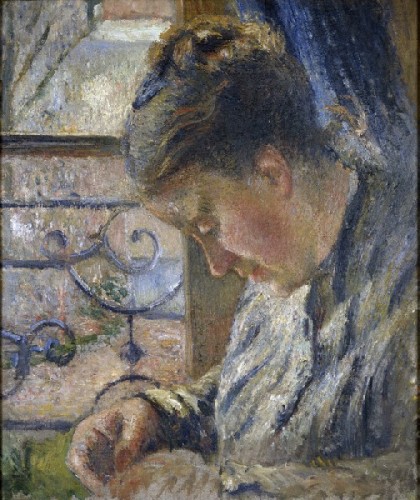
Camille Pissarro, Madame Pissarro Sewing, 1885

My grandpa’s mug is filled and he has seated himself back at the table. He nods along to my grandma’s words.

“Your grandpa was lucky – he married a smart one.”

I burst out laughing, and I can see a shadow of a smile on grandpa’s lips. But he nods.

“What! It’s true!” my grandma purses her lips. “I learned quickly. My mother raised me to be useful because my father died when I was thirteen. Women had work, but not all women did it. There were plenty of girls that just ran wild in the street, girls that didn’t even know how to hold a needle, but my mother wouldn’t let me become one of those girls.”

My grandma shakes her head sadly, as though I have just come in from running wild in the streets.

“If you weren’t married by 23, you were an old maid. No one wanted you then!”

Now it is my turn to give her a look.

“Well of course times are different now,” she says, “Back then you were defined by your marriage. If you look at me, you wouldn’t say I need a man.” She leans in close to me and lowers her voice, “Just between you and me, your strange egg grandpa would not last a week without me.” I turn to look at him, with his hands folded in his lap, his lips pursed. They would be pursed forever if it wasn’t for my grandma goading him to talk now and then. She leans back, content that I know who’s who in this relationship, then shrugs. “But that’s just how it was.”

“Women back then were different,” my grandpa says suddenly. He gives me a look and this time, smiles for real. I know he is thinking about me at family dinners, how my voice is the loudest. How I talk too fast. Say too much. Laugh too loud, and then says exactly what I expect him to say, “They didn’t talk so much, for one thing.”

My grandpa takes his blood pressure with his glasses on, recording the numbers in a little notebook. They seem wildly different from day to day, and I ask him how accurate the readings are. Not very he says, but continues to write down the numbers.

They are examining their medication cases, those long plastic bars that have a compartment for each day of the week.

My grandpa gives me a serious, thoughtful look.

What day is it?

Sunday.

Ah. I forgot to take these this morning.

My grandma roles her eyes. What else is new.

Ah well, he says, then motions for my grandmother’s arm. Let’s take your blood pressure. She lays it out on the table, one strong arm. Seventy years, I think. At least she must have made 400 hundred dumplings at least once a month. 4800 dumplings a year.

336,000 dumplings, just in the course of her marriage, not including when she wasn’t yet married and made dumplings for her own family.  

I write on my phone as the machine groans and squeezes my grandma’s arms.

146 over 56 my grandpa reads, and diligently writes it down next to his numbers. Blood pressure. Heart beats. Life in numbers listed on a clean white, lined square of paper.

Are you still writing your email? My grandpa asks me.

No no, I’m done with that. I’m writing about something else.

He nods. Someone in the family told him I like to write. He turns to my grandmother. Did you take your medicine?

I’m waiting for the water to cool.

On the screen, the actors wail. My grandpa turns back to watching Beijing opera just in time to see the actor with the long black beard disappear behind a curtain and emerge with a gray beard. My grandma asks him whats going on.

The man’s family was executed by the evil Emperor, and he too, is next on the list. He wants to escape, but cannot leave the palace. All the guards have their eyes on him and he has no way out. But he stays up the whole night fretting and his beard turns white from stress. The actor disappears again, and reemerges with a white beard. He laments his beard turning white, but knows it doesn’t matter, because he will die soon anyway. But the next morning, the executioner does not recognize him and he is able to escape with his life. The audience applauds wildly.

I don’t understand the opera, but with my grandpa’s translation, I can understand the relief the man with the white beard must feel. Or perhaps my grandma can better understand. Her face is bruised and battered, but she still has her strong arms, even her weak legs. She can still tell me stories and roll her eyes and call my grandfather a strange creature. 

It’s a nice story, sighs the strange creature with the strong heart. He sounds a little tired, but happy.

Edward Hopper Two Comedians, 1966 Oil on Canvas

"Beginners"

Hal: Well, let’s say since you were little and you always dreamed of some day getting a lion? And you wait and you wait and you wait and you wait, and the lion doesn’t come. Then along comes a giraffe. You can be alone, or you can be with the giraffe.

Oliver: I’d wait for the lion.

Hal: That’s why I worry about you.

-Mike Mills, Beginners 2010

Thanks, Giving

In kindergarten, we were asked, the day before Thanksgiving, to outline our tiny palms on orange construction paper. I remember removing my hand and seeing what my teacher promised would be a turkey and what a turkey it was! We were instructed to color in the lines of our fingers to represent the turkey’s plumage and to give the turkey a face and legs. Carefully with a brown crayon, I drew a wing, a crooked smile, and spindly turkey legs. With a black crayon, I gave it beady-eyed sight. A rudimentary leering bird: a child’s take on a symbol of gratitude.

That was the easy part, not necessarily the art.

On the back there were printed words followed by blank lines: “I am thankful for….”

Gratitude as a concept was rather foreign to me. As a four year old with strong opinions and a sense of self (which would sadly, come and go), I thought I grasped how the world worked. My relationships were simple and so was my life. School, Chinese school, screaming and yelling with my cousins took up the bulk of my time, along with the occasional spanking which resulted in more screaming and yelling.

I doubt I propped my elbows up on my preschool desk and twirled my black crayon in a thoughtful way. I doubt I asked myself: “What am I thankful for? A very good question indeed.”

What happened, (despite my memory being notoriously poor, I am certain this is 99% accurate) is I simply looked around to what my classmates were so furiously scribbling and saw the words, “Mommy”, “Daddy,” “Brother,” “Dog” and other generic words that compose a child’s world being scrawled out in illegible child’s script.

So I followed suit. Not because I was a lemming, but because my classmates reminded me then that “Hey, these bozos have the right idea! I am kinda grateful for my dad, my mother (even though she uses the belt) and my brother, (who saves me from the belt). These people/things are to be grateful for.”

An early lesson in gratitude.

Normal Rockwell Freedom from Want 1943 The Normal Rockwell Museum

Now two decades later I don’t have to think about it anymore because they are always on my mind. Give me the blank lines again and I’ll give you a book.

I am thankful for……

Family.
Friends.
My job and the smiling faces (and kind-hearted reprimands) that come with it, and all the other jobs I’ve had, never for the paycheck (because for many years there was never a paycheck) but for the stories.
Life in general, for more stories.

 And most importantly, because this medium commands it, I am grateful for you literate and “very highbrow” people who make time in your busy days to read my blog. Because writing a blog no one reads is like dancing alone – which on certain days can be just the right amount of fun – but usually, it is better with company.

Happy Thanksgiving.

All of the Lights

Across the street, my neighbors have already put up their Christmas lights. Yesterday, as I was backing out of the driveway on my way to a family dinner, I saw two young men standing on their front lawn, an intimidating tangle of Christmas lights at their feet. 

One of them had his hands on his hips, a concerned look on his face. The other was texting someone – it didn’t seem like they would get the job done anytime soon, but then again, they were professionals. I wished them a silent good luck and drove off. This morning, the “icicles” are up and dripping rainwater.

We used to put up Christmas lights, the only family on the block to get up on a ladder and do it ourselves. My brother, father and I would spend the morning untangling the lights, go in for lunch, and then come back out and hang them up on nails we had driven into the edge of our roof when we first moved here. At our old house we used the giant, multicolored bulbs that now, mostly evoke the 80’s and early 90’s, but moving here, we saw that the neighbors used the smaller white lights so we switched, too. A few years ago we stopped putting lights up. It was, as the excuse goes, “too much trouble.”

Too much trouble. Photo from digsdigs.com.

 And though I missed them at first, I too, was relieved when the holidays were over and there was one less thing to put away. On top of that, we live in a strange area which, once a year is assaulted by the Devil’s breath, also known as the Santa Ana winds. They blow ferociously around the house, knocking over my mother’s potted plants, rolling them into the swimming pool and sometimes, cracks brittle tree branches. They cause fires which is the last thing anyone needs around the holidays and make your skin dry and ashy, which is also blows (pun intended) when you are trying to look your best for friends and family and photographs. They tear the Christmas lights this way and that, and sometimes, damages the bulbs so that when we plug the lights in, half of the strand is dark. Our house then looks like a sullen face with one garish eyebrow.

But the winds can’t touch what’s on the inside (unless some idiot leaves a window or two open). 

—————–

Except for a few outlying years where Christmas was randomly held at my cousin’s or aunt’s house, the party is at our house. Those exceptions however, occurred three years in a row and burned themselves in my father’s brain – he began to think that perhaps Christmas would never be at our house again.

Somewhere in the middle of this, we remodeled our house. During, my father took stock of all the things we had in the garage and made the decision to clear out our junk. He informed me of his decision, and I applauded him. He, my mother and the rest of the Asian immigrants from their generation are notorious pack rats, so it was nice to see that he was making an attempt to be otherwise. And for a while, it did seem like we had more room in the garage. Except when the holidays rolled around and it was decided that our house, newly remodeled, would once again be the place to have the annual family Christmas party, I couldn’t find the Christmas decorations.

To be more specific, I couldn’t find our ornaments – none of which were particularly expensive, but they had great sentimental value – at least to me. There were ornaments my mother and aunts had made for their first Christmas here in the United States and a few others that solely by being manufactured three decades ago, were simply of better quality than ornaments today. Lastly, there were the half-dozen or so handcrafted popsicle stick ornaments my brother and I had made in preschool and elementary school – rudimentary but completely original creations with our childhood photographs in them. We wrote things like, “Merry Christmas Mom and Dad,” in our child’s script on the back of them, and even though they were meant for our parents, I would have been happy to take them with me to my future home.

Inexplicably, my father saw the ornaments as “junk” and kept instead the dozens of empty jars, boxes, paper bags, unused yet outdated appliances and suitcases – all utterly replaceable.

When I discovered that the ornaments were gone, glittering lonesomely in some distant landfill, I berated my father. What a Grinch he was, I cried (though I do not think there is a Chinese word for “Grinch,” and instead must have used the Chinese word for “shitty person”), how could he throw away things with so much history and keep all the junk?

“We stopped putting up lights so many years ago and haven’t had the party here for three years,” my father said, “I imagined it was only a matter of time before we stopped putting up the tree too.”

I was old enough then to accept that what was done was done and I said so.

“What’s done is done,” I said, “but we are going to put up a tree for as long as I live at home. That’s something I don’t ever want to give up.” 

My father nodded, “Yes.” His face was thoughtful, but he did not seem particularly sorry.

A few days later however, he accompanied me to buy the tree, and when we had stationed it in the corner of our newly remodeled living room, he stood back and said, “It is quite nice to have a tree, whether we have a party here or not, isn’t it?”

I nodded.

“Will you go and buy more ornaments?” he asked.

I nodded again, though my heart winced to think of our old ornaments.

“Buy some nice ones you really like,” he said, then with a sigh, “I didn’t know you’d want to put the tree up again.”

I looked at him then and realized he must have been feeling a subtle but supreme regret. He had had the best intentions when he was clearing out the clutter, but erred in his judgement.

It didn’t matter. It was Christmas and in a few days the family would be gathered at our house again, There would be presents and people around the tree; good food, rowdy laughter and fond memories. The ornaments, no matter how old or handcrafted, had never been the focal point of our gathering.

“Thanks Bah,” I said, “I’ll get them tomorrow. It’ll still be a beautiful tree.”

Letters

I spent the morning writing a letter to George, an old friend from high school who for one reason or other, became a pen pal after we both went off to college – he to Edinburgh and I to NYU. It’s clear now we were both trying to leave something behind – carrying our true selves to new places, his thousands of miles further than mine.

Three months later, I flew my true self back to California and sent George a few letters from home before relocating to Taipei. George adjusted the postage accordingly and our letters continued. Regardless of where I lived, George’s arriving steadily from small towns on the big Continent and mine trickled to him from Villa Park, Taipei, Berkeley, and now, Villa Park again.

Sometimes we do not correspond for months at a time, but I have at least two letters from George for every year since 2004, when we graduated from high school. Slowly, they are filling up a box at the bottom of my desk.   

Letter from George, 2008

In Berkeley, where I felt my most writerly self thanks to the plethora of quaint cafes with shaky wooden tables and the soothing hum of students studying and espresso machines hissing, I received some of George’s best work, not that his best work is behind him. He is a generous correspondent, stuffing his envelopes with not only his Jamesian letters, but postcards, bookmarks, and other flat trinkets he things I might “fancy,” a favorite word of his. And the best part of George the letter writer: when he says he will write, he writes. As a pen-pal, he is the most constant with both his word and the medium. A rarity in this day and age. I can always expect in the mail the fat, blue and red edged envelope with interesting postage.

I am less thoughtful, though I do sign with a flourish, with both my first and last name.

“Why do you do that,” someone once asked, “I only know one Betty.”

In truth, I do not know how to sign my name otherwise.

Our letters are long, often with pages numbering in the double digits. George prefers to write on graph paper, front and back, and I prefer horizontally lined pages – alternating between thick sumptuous paper from Japanese stationers or the translucent airmail specific sheets that come in a pad of fifty, light as a feather. Another friend with whom I often correspond via Snail Mail, Julia, prefers no lines at all. I marvel at her self control. I tried to write once on a blank page and found myself staring at an avalanche of words.

I use only one side and number the pages in case George is reading while walking and a breeze carries my pages away. George does not number his pages, and once, reading his letter on my walk home from school, a breeze did indeed come and blow the pages out of my hands. Gingerly, I rescued them from bushes and dewy grass, which smeared some of his words – it took me a while, but I put them back in order and made a mental note to, in my next letter, remind George to number his pages.

We both write in cursive. George’s words touch the bottom line. Mine do not – in a book on penmanship, I learned this is an indication of vanity. I neither agree nor disagree.

We write about our days, our studies, new friends we’ve made and people we are interested in but perhaps too shy to talk to. We read widely, but extremely differently – he writes sometimes about Marxist theories and his debates with friends regarding other things I know little about. I tell him about life in various Asian cities, and he paints portraits of the denizens of quaint German university towns, where he pursued graduate studies. We take great care to describe the cafes we are sitting in, the people we are sitting next to, and even if I am not in a cafe while I am reading one of George’s letters, I can almost smell the coffee.

Old Habits, Don’t Die

Many of the things I used to do, I don’t do so much anymore:

  • Read books. (As opposed to the constant stream of news and magazine articles I half-read at work). 
  • Watch movies. (“Drive” was the last film I saw and sitting in the dark room with a large screen felt almost foreign.)
  • Go to the library, which, I suppose, goes along with reading, though more and more I find myself missing the quiet atmosphere and smell. Ah, musty paper.
  • Cook/bake. (We had our Thanksgiving potluck at work today, something I had thought for a long time I would certainly bake something for, but the week rolled by and the only thing I contributed was my appetite). 
  • Clean my room. (Not that I ever needed to do this before; from ages 6-25, I had the energy to keep my room neat as a pin on a daily basis. I made my bed every morning, fluffing the pillows and tucking my sheets in just so – I liked that I could come back to a room that seemed like a freshly turned hotel room. In college, my roommates stared at my half of the room which seemed like a set from a stark, war-time barracks where everything was rationed. They wondered if I had perhaps spent some time at some women’s boot camp. When my roommate’s father visited, he whistled and said, “You could bounce a quarter off your sheets. That was the test back when I was in the army.” I merely shrugged, “I like things neat.”) 

Even after college, when everyone said, “Oh you’re not gonna have time to do that stuff anymore,” I found the time to watch a movie, visit the library and read a book at least once a week. Twice a week, I would bake hearty oatmeal cookies and banana bread to give to my relatives.

I had no idea these were all indicators of unemployment or poorly defined internships.

There are women at work who can do all of the above and their jobs quite well, but they were blessed with enviable energy reserves. Or perhaps not reserves at all, but energy. After a normal week at work I spend weekend mornings zoned out, putting from room to room in my pajamas and standing in front of my bookshelf, wondering if I should attempt to read something longer than a NY Times column. Though I do light up briefly in the evenings – just long enough for me to drive to LA, dance for two hours max (before my feet hurt), and drive back, only to spend the next day in an exhausted daze. On Sunday nights, I often go to bed at 8PM to prepare for the following week.

“You need to exercise,” my mother said, and like a good daughter, I recommenced hot yoga – but that is a false remedy. For some people, exercise is taxing. I feel better in theory; walking out of the studio, I think, “Ah, I am more energetic,” and for two hours following the class, I am – but when I really need to be energetic is at work, between the hours of 8:30AM to 5:30PM, when things need to be done with clarity and precision.

Instead, I smile as brightly as possible; say everyone’s name in a sing-song voice to mask my fatigue, and let my tired tail show anyway, by doing things like making coffee for my boss without that vital element.

This morning he walked into his office and then out again, holding his mug.

“Get me some coffee from the Keurig,” he said, handing me the mug filled with water tinged with brown. It seemed more like a weak earl grey than bold Sumatra roast coffee. “Look at this coffee. What’s the matter with it.” 

I stared at the water, wondering why the coffee had turned out so impressively weak. Painstakingly, I retraced my steps. I had filled the pot, poured the water in, closed the lid, pressed the button…

Damn.

“I forgot the coffee.”

“Yeah, the coffee,” my boss said, then he tapped his head and pointed at mine, “You need to put some beans in here.”

Housekeeping

My boss called me from Taiwan today, 4:30AM his time, which meant he was in a chauffeured car en route to the airport, where he’d board a small plane to Hong Kong and then from there, a larger plane to Melbourne where he is scheduled to play a few holes of golf with Tiger Woods, the world’s most famous philanderer.

Planning his trip, I asked him what else he’d like to do, should gambling or Tiger turn out to be rather uneventful. I imagined my boss tuning out as Tiger tried to show him the right way to grip a golf club. (“See here, you put your thumb here…the strippers love that.”)

“I’ve never been to Australia before,” my boss said, “I’d like to see the coastline.”

The words themselves were strangely romantic and he delivered them in an almost thoughtful way. I wondered if he would arrive at Lorne or Sorrento, kick off his shoes and run to the water. Calm, tiny waves (depending on the location of the moon), would lap at his toes as he stood with hands on hips, belly thrust forward, salty sea air whipping through his short hair. Perhaps he would wear a crisp white shirt. The collar, normally stiff, would bend and sway and eventually flip up and out, seduced by the sea. Perhaps he’d experience true quiet for a few moments – he would be in the land down under, surrounded by nothing but the sea and unfamiliar territory. There, he could be truly anonymous. As long as he put his phone on silent.

But I know my boss. He is half a dreamer, which means, give him enough time and he will inevitably retract the dream and replace it with something more immediate. A few days before he left he said, “Scratch the coastline. I don’t have much time. I think I’ll just walk around the city.”

I tried to picture my boss as flaneur, walking with his hands in his pockets, alone in a foreign city whose denizens were all uniformly tall, blonde, tanned, and great with wild animals (such is my stereotype of Australians). But this picture faded quickly; by now my boss was accustomed to being driven around. Perhaps his Australian chauffeur would be a washed-up ex-surfer who had been injured on the great barrier reef and who had tried his hand unsuccessfully at a string of jobs before discovering his love for the road. It was somehow comforting to drive powerful men around. The driver would be unusually chatty, intrigued by this portly Asian man with the furrowed brow and bulbous nose – who was he and why was he so important that he was playing golf with the world’s most famous philanderer? It didn’t matter. The driver would impress him with his knowledge of Australia. Why didn’t he want to see the coast? It was Australia’s crowning glory – a gift from nature, surely, but they did a better job than the Americans of keeping it clean. My boss would chuckle deeply in that misleading way of his, “Sure, sure,” and lean back, close his eyes, and remind whomever to change his driver tomorrow. This one was too chatty.

When the call came, I tensed up for a millisecond, the way I always do when he calls. He is, by all means, a low-maintenance sort of boss. He prefers me to email him, though not incessantly. I learned this on my first day, when the bubbly HR girl walked me up the stairs and said in a low voice, “Don’t ever, under any circumstances, just forward him things. He HATES that.”

I nodded solemnly. Of course. My job was to trim the fat – take away the million stupid little things that would irritate or worry him. So far, I think I have done alright, though in the beginning it seemed to be sort of a gamble: do I just copy and paste this message and pawn it off as my own? Does he want me to reply and then cc him? I did everything with bated breath and when all was quiet on his end, I accepted the possibility that my system, whatever it was, was acceptable.

So the call. On his last trip to Asia, his first since hiring me, he had warned me that there would be times when he would have to call me at odd hours.

“Just be prepared,” he wrote to me before boarding the plane, “I’ll try not to bother you, but sometimes, shit happens.”

I giggled, both endeared to the fact that he had said, “I’ll try not to bother you,” and that he had used such coarse language. If he was exercising the powers of reverse psychology, it worked.

“Don’t worry, Boss,” I typed back, “I read the job description.”

He was gone for a little over a week, and aside from the emails that pinged during the night, he never did call. People at the office who had seen the past two assistants slowly unravel were incredulous.

“You mean he hasn’t woken you up in the middle of the night?”

“Nope. Not once.”

“He never called.”

“Nope.”

“Not even when you didn’t respond to his emails right away.”

“No.” by then, I was wondering if we were still talking about the same person. Apparently not.

“Sounds like he’s changed a lot,” one of them said, “The last assistant always looked like a zombie whenever your boss went to Asia. She said the phone would ring nonstop sometimes.”

That’s horrible, I thought, and truly, every night when he was away I braced myself, wondering if I should just turn the phone off and feign to be a deep sleeper. But I left it on in case he were to call. I had read the job description. It said 24/7. But he never called.

Apparently, everything went smoothly. Before I knew it he was back in the office and certain executives stopped storming around my desk asking impatiently, “When is he coming back? Is he on vacation?”

But he called at 1:30PM this afternoon, which meant it was 4:30AM in Taipei. My heart constricted, so adept am I at handling stress. Did his driver not show up? Did the plane break down? Did he want to see the coastline after all?

I answered, my voice reminiscent of a strangled altar boy.

“Hello?”

“Betty?”

“Yes,” (ah, voice back to normal), “Hey Boss, what’s up? How are you? Is everything okay?”

“Haha,” his laugh sounded hollow and far away, not least because he was very far away, “I’m still alive.”

“Oh good.”

“So about my awards ceremony at the university.”

“Yes, yes, about that.”

I blanked out for two seconds before I remembered that he was being presented with an Entrepreneur of the Year Award at a local university’s school of business. Before he left he had mentioned buying a table and filling it with executives and VPs, as per usual.

“I want to do something a little different,” he said.

“Okay…”

“I think we can send out an invite to the executives, but if they want to come, they can buy their own tickets.”

“Got it. But do you still want to buy a table?”

“Yes, but I want to invite some younger people. We need to mix it up a bit.” he paused for a moment and I imagined him rubbing the sleep off his face, “Ask around. We have some younger employees with entrepreneurial spirit. I want them to come out to this event to represent our company. They can hear my story if they haven’t heard it before, and it’ll be nice for them to mix with the MBA students.”

“Got it.”

There was an awkward pause as I thought of something else to say.

“So… anything new?” He asked, “everything okay?”

I wondered if he really wanted me to fill him in on whatever was happening in addition to the emails he was sending me. Of course not.

“Everything’s fine,” I said, “Just housekeeping. Your uh, ice maker has been refreshed and the wireless HDMI kit is being installed. Everything should be ready when you return.”

“Ok,” he said. “that’s all?”

“That’s all.”

“Okay. I just thought I’d call about the Awards thing rather than write it out. Well, don’t worry. I’ll talk to you later.”

“Have a safe flight, Boss.”

“Thanks, thanks,” he said.

We hung up and I looked around the office. A few coworkers were staring at me expectantly.

“Is everything okay?”

“Yeah,” I said, “He was just checking in, I guess.”

“How nice of him to call during your regular working hours.”

“Yeah,” I said, thinking that maybe he would go see the coastline, “He’s cool like that.”