The Fool

When she was sixteen, Suzy’s mother came into her room one afternoon with a glass jar filled with fresh cut roses.

“Where do you want these?” her mother asked.

Suzy sat at her desk writing one thing or other – perhaps a school assignment or letter, but years later, when she looked back on that moment, she recalled very clearly the two distinct feelings she felt before and after her mother brought the roses. Of these, she would never fully revisit the first.

Suzy surveyed her room, wondering where she ought to put the roses. It didn’t happen very often, this offer to have fresh flowers in her room. Suzy’s mother had a green thumb, but she showered most of her attention on her orchids, her favorite type of bloom, and left the roses to the gardener’s shears.

Roses could essentially protect themselves, what with the thorns and all. And while educated pruning could ensure the most beautiful and stout blooms, it appeared that they grew and bloomed regardless of the care they received. There were certain breeds that were smooth stemmed, Suzy noticed, but they were different from the thornier roses. They seemed weaker, needing more wiring or perhaps a trellis to snake around for additional support. But Suzy’s mother had only one of those bushes and the blooms upon it were often the first to wilt.

Orchids were a different sort of flower, her mother once told her. They were like cats – paradoxically high and low maintenance. When you administered the right kind of care, they could be left alone for a long time. Though they required special bark instead of soil and thin green sticks to prop up their stems and a certain temperature to thrive, her mother’s orchids could bloom and bloom for weeks if not months with only light watering in between. It was a different kind of maintenance, but the result were stunning, exotic plants that all of her mother’s guests oohed and aahed over whenever her parents had dinner parties. Suzy noticed no one ever cooed over the roses. When an orchid began to show the slightest signs of tiring, her mother would whisk it off into the greenhouse and nurse it back to health until it was ready to show off its pristine blooms once more. If the roses began to wilt, she simply cut them off the bush.

But still, roses were beautiful in their own way and Suzy’s mother had a soft spot for them. She half-heartedly grew a dozen rose bushes in the planter in the side yard, where they kept their garbage cans. The soil there wasn’t really suited for much else. There had been a time before when orchids were a luxury, bought only on special occasions or received as a birthday gift. They were, as nursery hierarchies go, exotic blooms that could command exorbitant prices, but those were the early days, before her husband’s business stabilized and began to do quite well. By the time Suzy was a teenager, Suzy’s mother had loosened her flora budget so that almost every month a few new orchid plants would appear. The roses and indeed the other plants in their yard became the gardeners’ ward and the orchids, both in the house and in the greenhouse, Suzy’s mother’s sole focus.

And hardily, the roses bloomed for no one but whomever happened to take out the trash on Thursday evenings, though usually this happened at sundown and you couldn’t see them anyway. 

Except for this day. It was Sunday and the gardeners would come tomorrow, but Suzy’s mother took it upon herself to prune the roses. She waited patiently as Suzy considered a place to set the roses. Suzy tapped the pen to her head, her wrist on her knee. Suzy’s room was neat as a pin. She liked it that way, though for some reason new friends visiting for the first time were always taken aback, as though from Suzy’s person they had expected a less tidy room. There were plenty of open surfaces upon which to place the jar of roses but where would the roses look best? Suzy imagined someone coming in to snap a photo of her at work, bent over her diary or a letter she was writing, the roses sitting wanly on her bookshelf – but it was too dim there. Perhaps next to her desk lamp? It cast a warm glow on Suzy’s workspace and there was an old tin can in which she held her pens which would go nicely with the glass jar the roses stood in, as it was an old peanut butter jar with the label washed off. There. The lamp. The pens. The glass jar of roses.

“Put them here, mom,” Suzy said, tapping the space on her desk.

Her mother set them down and, like the photographer Suzy imagined, smiled and said, “Well isn’t that a pretty picture.”

The bouquet changed the entire landscape of her desk, making her feel feminine and artistic and smart, in the British sense of the word. Virginia Woolf probably kept roses on her desk.

Suzy leaned over and smelled the roses, taking a deep inhale of the largest bloom. Compared to the rest it didn’t smell like much, but that didn’t matter – it was so pretty to look at. 

But she admired the way one of the roses was apparently in full bloom. It did not have as vivid of coloring as the other roses, but it certainly took center stage in that its massive petals threatened to cover the other buds entirely.

“I like this one,” Suzy said, fingering one of the velvety light orange petals.

Her mother was silent and Suzy, expecting a murmur of agreement, looked up.

Her mother had a strange expression on her face, one which, as Suzy grew older, would come to adopt as her own when she found someone’s taste questioning. Truly it was a matter of taste, which bloom mother and daughter found attractive, but Suzy’s mother wanted her daughter know:

“That rose looks like a fool.”
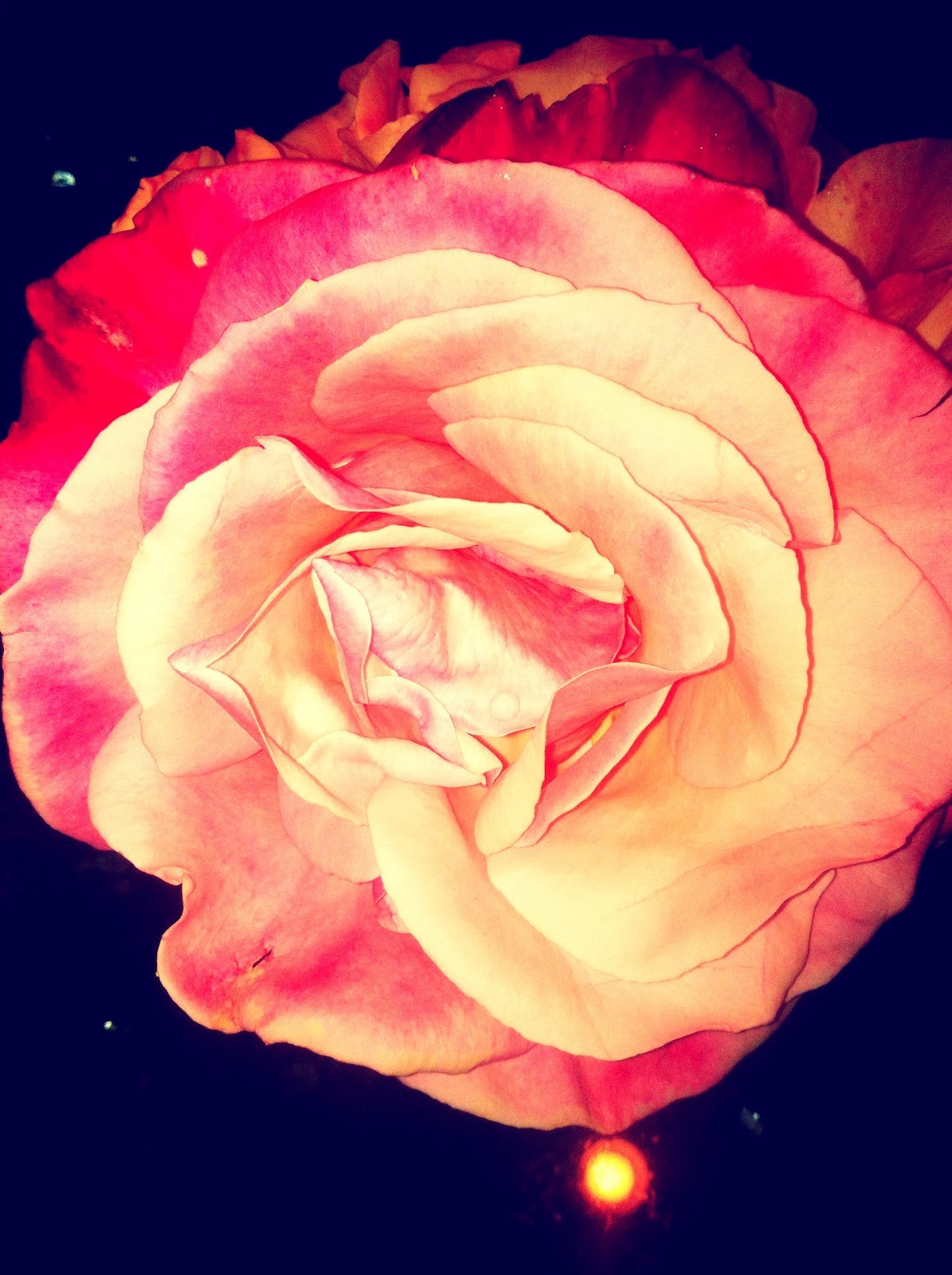
The Fool. 

 Suzy was taken aback. The rose, a fool? What had it done but bloomed beautifully for all to enjoy?

Her mother sighed, wondering if it was too early in her daughter’s life to impart one of the most important lessons a woman needed to learn, though it seemed that few did. She hadn’t even thought of her now apparent distaste for roses in this stage of bloom when she clipped it and only brought it up now because Suzy’s attraction to it brought it to her attention. There was a small but dangerous fire to be stamped out – a young woman’s identity was at stake.

“For one thing,” her mother said, “It is an inelegant bloom. Roses can be quite elegant, but not at this stage.”

Suzy acknowledged that the rose had probably bloomed to maximum diameter and was on the verge of wilting, but it surprised to hear her mother say this about a poor flower nearing the end of its short life.

 “Then why did you bring it in here with the rest?” Suzy asked, “Why didn’t you throw it away?”

Suzy’s mother searched for the right words. If she was absolutely honest she would have said that how the rose bloomed was no different from when a whore spread her legs for clients. There was no mystery, nothing secret to anticipate or unwrap. It had opened its very last petal to reveal all of itself so that even the fattest fly could trample around, freely spreading disease and God knows what else.

But Suzy was sixteen – a young, naive sixteen penning young, naive sixteen year-old thoughts in loopy cursive.

Instead Suzy’s mother replied, “It’s so open-faced,” then added, “There’s no mystery.”

She paused, wondering if Suzy understood what she meant. Were mother and daughter on the same wavelength?

“But aren’t your orchids the same way?” Suzy asked, “Aren’t they all open-faced too?”

Jester?

Suzy’s mother couldn’t help but be a little offended. They were, mother and daughter, still worlds apart in experience, and rightly so – but this would be, at the very least, a lesson in art. Suzy’s mother left the room briefly and returned with an orchid plant whose petal edges showed decline, but was still regal in bearing.

“Suzy,” her mother said, “Look at the rose and look at the orchid.”

Suzy did. From her seat at the desk, she looked down at the rose and up at the orchid, the blooms of which were suspended in a prim row, like pretty virginal sisters who had hung themselves from a slender green stem.

“They are both open faced blooms,” her mother conceded, “but isn’t the rose more inviting? If it was a person, would it not be more approachable?”

“Isn’t that a good thing, mother?”

“Yes and no,” and then Suzy’s mother turned to look at Suzy’s confused expression. As she did, she felt a mild panic, as though all this talk of roses and orchids wasn’t getting the important message across. That as a young woman, as any woman at any age, for that matter, Suzy had to keep something of herself for herself.

Her young daughter was on the brink of a long bloom, more rose than orchid. And there was nothing wrong with that. Suzy was and had always been that kind of girl – open and approachable, friendly, chatty, giddy. Though she did have her quiet moments, such as the one her mother had walked in on, with Suzy bent over a piece of writing. What did roses write about?

Suzy’s mother realized she had no idea. But she knew then that if her daughter was a rose, she wished her thorns – big fat thorns found on the hardiest of rose bushes. The rose bushes that during winter, still stood straight albeit barren, in three feet of snow. They wouldn’t always bloom, but you could tell, a mile away, that it was a rose bush and that sometime in the spring, the color would return and the petals would be soft and open and inviting, but the thorns would still be there.

Mother and daughter looked at one other, each searching the other’s face until finally Suzy’s confusion melted away and her mother’s very mild panic subsided.

And that was all. Suzy’s mother kissed Suzy on the forehead and left her daughter to her work, whatever it was. But Suzy was not quite ready to return to the thought her mother had interrupted minutes ago – what had she been writing? It no longer seemed important. She pursed her lips and furrowed her brow, her features suddenly feeling very heavy. Slowly, she turned the jar so that the fool faced the wall, then thought better of it. She plucked the fool out.

It was a ridiculous sized bloom, nearly the same span as her long-fingered hands. The stem was incongruously thin and quite useless – pliable, without a thorn in sight. Suzy held it like she would a pen, but it flopped to and fro, and Suzy felt almost irritated by it. It had bloomed itself to a point where it could not even hold up its own head. Finally, with a quick, sharp pinch, she snapped the stem in two, causing a few velvety light orange petals dropped to her desk. It was not indifference she felt but the strange subtle force of an unspoken vow – the kind young girls make to themselves when they are about to become young women – that provoked her next actions. She reached underneath her desk for the trash bin and putting her pen down for a moment, swept the fool away.

Because Some People Do it Better: John Steinbeck

Apparently I am having a long bout of writer’s block, also known as laziness. But I’ll leave you with this for the weekend…though perhaps not the whole weekend. The sky looks as though it’ll start sobbing any moment due to god knows what (in my dreams the clouds wring their fluffy palms and wail, “That Betty, why isn’t she writing?” and burst into tears) and a good rain sometimes, makes me feel like a diligent writer.

Any who, the following is a letter from John Steinbeck to his son Thom, who wrote to his father from boarding school confessing that he had fallen desperately in love with a girl there. It is, in the poorly populated genre of letters from fathers to sons, one of the sweetest things I have ever read.

New York
November 10, 1958


Dear Thom:

We had your letter this morning. I will answer it from my point of view and of course Elaine will from hers.

First — if you are in love — that’s a good thing — that’s about the best thing that can happen to anyone. Don’t let anyone make it small or light to you.

Second — There are several kinds of love. One is a selfish, mean, grasping, egotistical thing which uses love for self-importance. This is the ugly and crippling kind. The other is an outpouring of everything good in you — of kindness and consideration and respect — not only the social respect of manners but the greater respect which is recognition of another person as unique and valuable. The first kind can make you sick and small and weak but the second can release in you strength, and courage and goodness and even wisdom you didn’t know you had.

You say this is not puppy love. If you feel so deeply — of course it isn’t puppy love.

But I don’t think you were asking me what you feel. You know better than anyone. What you wanted me to help you with is what to do about it — and that I can tell you.

Glory in it for one thing and be very glad and grateful for it.

The object of love is the best and most beautiful. Try to live up to it.

If you love someone — there is no possible harm in saying so — only you must remember that some people are very shy and sometimes the saying must take that shyness into consideration.

Girls have a way of knowing or feeling what you feel, but they usually like to hear it also.

It sometimes happens that what you feel is not returned for one reason or another — but that does not make your feeling less valuable and good.

Lastly, I know your feeling because I have it and I’m glad you have it.

We will be glad to meet Susan. She will be very welcome. But Elaine will make all such arrangements because that is her province and she will be very glad to. She knows about love too and maybe she can give you more help than I can.

And don’t worry about losing. If it is right, it happens — The main thing is not to hurry. Nothing good gets away.

Love,

Fa

Duty

Behind me, men and women dressed in variations of cocktail attire sip on glasses of red and white wine. They talk excitedly (the women’s voices more animated than the men’s) against the live quartet, which plays a strange selection of classical music I associate with Shakespeare’s time.

I am sitting in a tiny alcove at the Ritz Carlton Dana Point where the hotel has set up a not very high-end version of a business center. There’s an outdated HP Deskjet in front of me, and an even older Lenovo computer and keyboard upon which I write this out. To my right, an off white hotel landline, the kind that normally hangs in the bathrooms in Las Vegas, right next to the toilet, in case you croak on the john.

I hadn’t planned on being here. On Thursday nights, I plan for yoga or some other exercise class. If I’m tired, I drive home slowly (to the frustration of other drivers), and have a simple dinner with my parents and then take a walk. If I’m really tired, I eat dinner, then stare at a blank blog post. But this afternoon my boss decided it would be a good idea if I went with him to an awards ceremony.

“If you’re busy, get someone else,” he said. But what do you say to that. “Oh yeah, I’m going to be busy. I was going to exercise.”

So I shook my head and said, “No no, busy? Pah. I’ll be there.”

So here I am, dressed in my not even very professional work clothes, hiding in the “business” alcove while women in sparkly tops and heavy perfume swish around behind me. The men look more or less the same, though some of them wear tuxedos that look so crisp it’s a bit too obvious that this is their first time at a function like this. Look at me. The executive assistant doing her own peculiar brand of sneering.

There are hobnobbers and then there are hobnobbers. Corporate climbers. Brown-nosers. Ass-kissers. Whatever you want to call them. You can spot them a mile away, but not before you hear them. They greet you a little too warmly. Shake your hands a little too firmly, as though willing you to remember their grip and their steely, semi-desperate stares.

At dinner later, I will meet a 50 year old female photographer, hired by the company putting on the event to take photos of all the honorees. She will have a hard look about her face, though maybe it’s because she’s tired of doing these events.

“Thirty years,” she’ll tell me, “I’ve been a photographer for thirty years, and before, I liked it. I worked for builders and took photos of houses and condos in progress, and it was fine. I went to shitty middle of nowhere places like Perris and Temecula and Fresno, but it was calming. I made little road trips out of it and memorized where all the In n’ Outs were, and when I got to where I was going, the houses would just be there and I would just photograph them and then head on out. There wasn’t no fuss.”

“What happened?”

She will scoff, as though it were obvious, but not unkindly, “Well the economy went to shit and all those builders stopped building, which is how I got roped into gigs like these. These corporate circus shows.”

She will talk a little too loudly and you will be grateful to be sat at a table in the corner, right next to the speakers so that the “corporate ring master” at the podium will drown her out somewhat, at least to the people at the surrounding tables.

She’ll tell you stories about the brown-nosers she’s met, because she’s done the circuit for almost a decade now, and which CEO’s are the real deal and which are full of corporate “baloney sawdust bullshit,” though more often than not the latter are hardly ever CEOs but people on the brink who for some reason, just can never quite make it to the top.

She’ll nod her head not too furtively towards the chairman of this or that and say, “Like him. That guy is SUCH a phony.” You will think that perhaps Salinger based Holden Caulfield on this wiry, rather mannish woman sitting next to you who rather than eat her steak and shrimp pushes them around the plate, an errant corral.

“My boss is very genuine,” you say, and she will nod in agreement, and you can tell she means it. 

“I know him,” she’ll say, “I’ve met him a couple of times and I can tell you, he doesn’t do that bullshit. I know who’s an ass kisser and I know your boss gets his ass kissed plenty and he doesn’t need to do none of that himself. He’s the real deal.”

You will look at your boss then, though you can’t see his face too clearly. He’ll be sitting at one of the head tables, dressed smartly in his tuxedo, which although pressed, is hardly new. He wears it well. His forehead will be a bit shiny from the warmth of the room, or all the bodies trying to introduce themselves to him and his wife will be standing next to him with the tired smile she puts on at events like this. He shakes hands with a tall gentleman and laughs, then turns slightly and his attention is quickly devoured by another shorter, rounder gentleman. He laughs again – a real, hearty laugh, from the belly. Or is it? You won’t be able to tell, but then again, does it matter? He’s doing his job. You’re doing yours. You turn back to the photographer, who hasn’t eaten any of the meat.

“He is the real deal,” you repeat, but she doesn’t hear you. She’ll be getting ready to stand up and has already lifted her heavy camera and hung it around her neck.

“Ugh,” she’ll say, “Save one of the desserts for me. I’m off to photograph some phonies.” 

Dragon Lady

A few months ago there was talk of hiring a Chinese teacher to come to the company once a week to teach a conversational Mandarin class during the lunch hour. It seemed like a great idea – we have many Mandarin speakers, but most of the people in Business Planning – the department that deals most closely with our mandarin-speaking suppliers – do not speak it. It was very strange to me. All the Mandarin speakers (myself included) were scattered across accounting, legal, logistics and HR (me). They used it sometimes on conference calls to Taiwan and/or China, but mostly Mandarin was most useful for gossip. I speak Mandarin most often with the overly enthusiastic HR girl downstairs, and with the President. With my boss, I speak Chinglish. It is the language in which we are both most fluent.

When the HR girl told me they were looking for a teacher, I said without thinking that my mother taught Chinese. What I meant was, “My mother has a large network of Chinese teachers and can probably find someone to do the job,” not, “I am nominating my mother for the job.”

But the HR girl clapped her hands gleefully and tugged at my arm and in an eerie baby-girl voice that both suited her yet was utterly inappropriate, said, “Oh my goodness that’s great! Have her come in and teach! I’m sure your mother is wonderful.”

HR girl was right. My mother IS wonderful. She is, in highly sophisticated parlance, a bomb-diggity Chinese teacher. Just listen to my accent when I speak Chinese. Oh wait, I don’t have one. I sound like a native. 

Dragon Lady and her daughter (right) in 1996 with a family friend, Pearl, who was at the right place at the wrong time. Children who unwittingly wandered into the Ho household during Chinese lessons were forced to participate as well.

As tutoring one’s offspring goes, my Chinese education was a tortuous road, filled with beatings and screaming and more sheets of grid paper (for writing each character fifty million times) than I care to count. What’s worse is my mother taught us in addition to our Saturday classes at Cerritos Chinese school, which took place at the run-down Artesia High School, a poor, backwater of a high school that was known for gang violence and underwhelming test scores. It’s interesting that on the weekends, the high school morphed into a center of success – not because kids actually learned Chinese, but because it would be flooded with over-achieving Chinese kids who aimed for perfect SAT scores and thought (and someone actually said this), that the kids from Artesia High would one day mow their lawns. They mostly attended only so they could write Chinese School down as another activity on their college applications. Chinese School was not so much a school as a messy, disorganized network of frizzy-haired and frazzled middle-aged women who had nothing better to do on Saturday mornings than exert power they had nowhere else and teach uninterested children of all ages a language none of them cared to learn.

Wow, that was really mean. That was me looking through the lenses of my bitter classmates – I actually liked most of my Chinese school teachers because they paled in comparison to my mother, who was ten times stricter and could use physical force as punishment. (Most of my classmates were also ruled with similar iron fists, though sadly, a majority of their parents were so eager for their kids to “make” it in the American school system that they let Mandarin fall to the way-side of violin, piano, tennis, golf, and supplementary math courses. A decade or so later, this decision would nip them in the bud when China woke up and said, “Hey, I’m gonna run this town.” (阿,我睡醒了). 

No, my mother saw early on that her children weren’t talented at much else – I hated the piano and my brother froze without fail at every single recital. We were athletic, but not marvelously so – my brother loved basketball but was about a foot too short to consider it seriously and I preferred climbing trees and doing crooked cartwheels to anything with a ball or court. She had unsuccessfully tried to sell golf to me, but I didn’t see the point in standing, squatting, and hitting a small ball as far as it could go. It was like asking a rambunctious two-year old to meditate.  

Most disappointing was that we didn’t even shine academically. Asian kids are nothing if not brainy – and we definitely weren’t. I had tested into GATE, but was always at the back of the class. I did well enough in “language arts,” but my math scores were dismal, way below those of my Asian peers. and my brother was one of those strange fearless kids who just couldn’t be bothered to do homework sometimes, and was able to lie about it. He could lie straight-faced through his teeth, earnestness oozing from his eyes. He once erased the “D” on his report card and changed it to a “B,” and when my mother found out (though even if she hadn’t, I’m not sure the punishment would have been different because you know, a B might as well be a D) was livid and took out the belt to give my brother a memorable thrashing. My brother bore the punishment heroically. He cried a bit, apologized, and when his tears had dried continued to lie in the same way many years down the road up to his college graduation, in which he walked, dressed in cap, gown, and goofy smile but was actually four units shy of a degree. We, the family, stood sweating on the lawn for four hours, wondering if our tired legs were being pulled. Lesson learned then forgotten as quickly as the belt leaves the skin. 

No, my mother was adamant that if we were going to be good at nothing else, we’d at least be fluent in Mandarin. Or else SHE wasn’t a Chinese teacher. She had a reputation to uphold, and as an active member of the Council of Chinese Educators (or something like that) as well as a teacher at the Cerritos Chinese school and eventual owner of her own Chinese school, she would look quite foolish if her own flesh and blood were walking around with stuttering, accented Chinese. So to the extent that she was involved with Chinese school, so were we. We were forced into countless speech and poetry recital competitions as well as National Chinese History Bees. We placed first at several (those were good days) second at some, and none at others (those were terrible, terrible dark days), and all in all, form a rather amusing strip of memories, moments of “Hey, this isn’t so bad if I let myself get as competitive as my mother wants me to be,” intertwined with my earnestly wishing, “Why can’t I have a white mother with lower standards.”

My mother is wonderful now. She went through menopause some seven or eight years ago when, luckily for my brother and I, something snapped in her brain and her personality turned towards the light. She became docile. Patient. Sweet, almost eerily so. The hot flashes also erased part of her memory. Ask her now if she ever raised or voice or hit us, and she’ll say with a look of horror, “Oh God no, I don’t remember ever hitting you two.” 

Really.

Six or seven years ago things were very different. Not to paint a bleak and bloody picture of my childhood, which was for the most part filled with laughter and fun, but there were moments of sheer terror. My my mother was not the same person. She wasn’t a tiger mom – no silly feline cliches for my mother – she was another cliche, born in the year of the Dragon and thus a bona-fide, fire-breathing Dragon Lady.

Ira Glass on Having taste, Talent and Being Successful

Yesterday Madame Receptionist and I took a stroll around the company parking lot. Sometimes, when my boss takes a long lunch or when things are not so busy I have the time to do so. Sometimes I come back a little late and he is already back from a not-so-long lunch, and instead of asking me, “Where the hell were you,” as I feared he would the first time I came back late, he merely nods as our eyes meet and turns back to his computer screen.

“I’m no slave driver,” he once said, when I asked him for two days off to visit Chicago, “Go, take a break. Have fun.”

When I returned a lady from accounting asked me if I had gone to visit a boyfriend.

“No,” I said, “Just a friend.”

She giggled and nodded towards my boss’s silent figure behind the glass.

“You know,” she said, “He told me you went to Chicago and I suggested that maybe you went to visit your boyfriend, and he said, ‘I hope so.’ Isn’t that funny?”

Anyway, that is beside the point.

On our stroll, we discussed various social media tools we used for our blogs. Mine is mostly writing – hers, a fashion blog, is mostly pictures. We both use twitter, Facebook and recently, Pinterest, an online pinboard that allows you to ‘pin’ images you like to customized boards. People can follow a select few or all of your boards: a more organized version of Tumblr, if you will. Yet I’m wary about using Pinterest in the same way I was wary about Tumblr – mainly, that it didn’t promote original content but the constant reblogging or “repinning” of others’ content.

I think before, it wouldn’t have bothered me so much. The internet is for sharing. Who cares if I’m unoriginal and I have nothing to post? I’ll just repost articles written by other people who made time in their days to generate original content. I’ll share pretty pictures I didn’t take, songs I didn’t write, clothes I didn’t make or outfits I didn’t put together. There’s nothing wrong with being an editor. 

Well. There is nothing wrong with being an editor – in fact, I suspect sometimes I edit better than I write (you’re welcome, dozens of people whom I’ve helped with college essays and letters of rec – except for the ones who didn’t get into the schools of your choice, in which case, you have only yourself to blame) just as there is nothing wrong with being a curator. And indeed there is “art” in curating and editing and tweaking something original so that it is enhanced, but nowadays with the proliferation of social media sights that promote sharing, those that merely share will take a back seat to those that create in addition to sharing.

Madame Receptionist and I discussed what it meant to have taste – or how having taste doesn’t necessarily translate to success. Recently, a member of the marketing team announced her departure for the apparel industry. She had started her career in tech and was indeed poached from a CE company to join ours, and while she never verbally expressed her interest in fashion, there were little clues to be found here and there. The steady stream of fashion magazines, for instance, that came in the mail for her, and the random compliments she paid both of us, “Cute shoes!” or “I love that skirt. Oh my God where did you get it?”

Perhaps the biggest clue she could have given however, was in her own dress, which unfortunately fit in a little too well with the other wardrobes of the tech industry, which is to say, she dressed rather drably. Her ensembles consisted of black or grey slacks, shiny polyester tank tops from Banana Republic or the Limited, and boring, pointy-toed pumps that could either be very expensive or very cheap – a choice you never want pose to people who care to guess. Her hair was a limp, depressing mess, and though her eyes seemed energetic enough, I wanted very badly to hand her a hairbrush and to convince her to eat some protein to promote healthier hair shafts. Critical, no? Yes. Very.

That’s my point – it’s easy to be a critic. When she announced her departure I asked her why and more importantly, wondered what the apparel company saw in or on her person that could possible convince them to lead marketing at their company. Surely it wasn’t the pointy-toed pumps? Perhaps they had thought them more expensive than they were?

“I’ve always loved fashion,” she said, “and they really liked what I did here and at my previous job for digital marketing, so they want me to help them do the same there, except it’s for clothes, which is much more geared towards my interests.”

I’m not say the woman did an amazing job at my present company (that remains to be seen), but whatever she created was eye-catching and most importantly, tangible to land her a “dream” position she really wanted. When it comes to design of website, clothing, interiors – it’s easy, if you read a lot of magazines, weblogs and come into contact with the actual things, to formulate opinions of what you like and dislike. What’s harder, and what few people actually push themselves to do, is go one step further and ask themselves why. At least I am very bad at this.

I used to think it was perfectly acceptable to say, “I like what I like, I don’t have to explain why,” and in certain contexts, it is. But not when you want to drive change, or innovate, or make something better. You have to be able to say why.

During my first week I got a head of myself. My boss asked me for more business cards and I found a box of them in my desk and, upon handing it over, remarked that they weren’t very pretty business cards.

He looked at me curiously and said, “Well, we are in the process of changing our marketing image, but why? What don’t you like about the card?”

I could answer that easily enough. I didn’t like the card stock (it felt flimsy), and the logo on the back seemed dated despite its being only a year old. The card was neither “timeless” nor clean, attributes I felt excellent designs had. The colors were also to dark for my taste. The card looked like a promotional item for a cheap nightclub or a bad movie poster.

“Okay,” my boss said, “Interesting opinions. But how would you change it?”

I wasn’t prepared to answer that – at least not in as much detail as my diatribe against the card warranted.

“Simplify it,” I said, after a while, “We can make it cleaner looking. Use thicker paper. Different fonts and perhaps a different logo. Less color.”

“Be more specific,” he said.

I had a vague idea of what I thought was an attractive business card in mind, but could I actually sit down and design one? I don’t know – probably, after a few days of researching and studying other business cards, but at the moment, I was ill-prepared to back up my assertions. Why should my ideas (criticisms) reasonably trump the existing design? I was merely being a critic and not ready to deliver any solution to the problems I had called out.  

My boss shook his head. “It’s great to have an opinion. It’s great to have taste, but you have to be able to support it. It’s easy for anyone with taste to say ‘Oh I don’t like this, I don’t like that,’ but are you actually creating anything to remedy what you think is bad taste?”

Okay, maybe he didn’t use the word “remedy,” but that is what he meant and it stuck with me. Probably one of the more important things I learned at work (in addition to never parking my boss’s car too close to the curb because it scratched the bottom of the car). Was that all I was? A spout of opinions? I have always been one to sprint to conclusions and shuffle towards reasoning, but at work (and slowly elsewhere, including on this blog), it’s becoming dangerous to do so, especially where other people have stronger opinions, stronger criticisms and the work ethic, stamina and reasoning skills to drive those opinions home.

Basically, it won’t do to just have taste. You (or I, really) have to do the work. Otherwise you’re just adding to the noise. 

That was much longer than I intended – really, I just wanted to share this wonderful video with you all. I didn’t create it, sadly, nor did I say the words, but in this case I’m acting as curator 🙂


Ira Glass on Storytelling from David Shiyang Liu on Vimeo.

Quote of the Day: David Foster Wallace

“The really important kind of freedom involves attention, and awareness, and discipline, and effort, and being able truly to care about other people and to sacrifice for them, over and over, in myriad petty little unsexy ways, every day. That is real freedom.” – David Foster Wallace 

Agreed. 

I’m beginning to see why so many of the depressives in my Creative Writing and English classes were so crazy about him and why that girl with the strong opinions and who always wore horn-rimmed glasses and thrift-shop sweater cried when he hung himself. 

The author of this article, Alexander Nazaryan, sums it up nicely: 

“[he writes about] all that messy stuff that goes into living a life, all the stuff that, if you try to write about it, you come off as either impossibly precious or…well, you’re going to come off as impossibly precious. 
But he didn’t. His mind was a diamond drill that reached as close as any to the opaque stuff inside us all.
And like the finest drills, it finally broke.”

My Father’s Stories

Somewhere in between high school and my second year at college, I stopped reading fiction. Not altogether – a small number of brilliant novels made its way into my hands via persistent recommendations from friends and family – but very, very rarely now, compared to my youth when fiction was all I would read. As a young girl visiting the library, I would make a beeline for the new fiction section. If it seemed I’d already gone through the choicest ones, I’d make my way to the back shelves. But I never wandered beyond the shelves marked “Fiction and Literature.” My memory is poor, but perhaps I have done that walk so many times this impression could not help but be ingrained: I remember one evening, hurrying past the biographies and wrinkling my nose in distaste at the thick tomes about real people. “Why would anyone want to read about real people when there is so much great fiction?”

My father was a hypocritical detractor of this mindset. He would shake his head whenever I walked in with a bag full of novels and say, “That stuff doesn’t grow your brain. It makes you dream,” and I’d roll my eyes and say that he had no heart. Fiction builds character, I said. Why do you think I’m so amazing?
I say hypocritical because my father grew up on a steady diet of classical Chinese literature – all of it fiction. You may know the most famous: The Dream of the Red Chamber, The Romance ofthe Three Kingdoms, and Journey tothe West – impossibly long and complicated stories written back then by people with plenty of time and imagination, for people with plenty of time and growing imaginations.

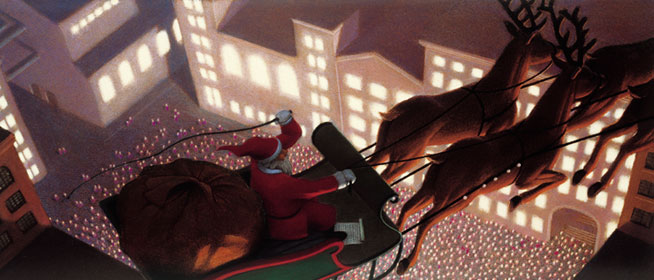
My favorite scene from “The Polar Express.” 

As a grown man with thoughts of career and family, he stopped reading fiction, but he never stopped thinking about it. I have often said that I remember little of my father from my childhood, though if I were to excavate the loose grey matter I hardly use, I would find him exactly where I needed him most.

He often picked me up from daycare and, if he came home later (though always in time for dinner), he would come bearing a large stack of children’s books from the palatial Cerritos Library. When we lived in the city, he took me there on weeknights or Sunday afternoons so that I could make my own choices and I will never forget that magical wing, designed to mimic a medieval castle with turrets filled with thin, colorful spines, each bearing a tale, not necessarily a lesson. But after we moved to a city some thirty minutes away, he often stopped by on his way home from work and picked out books with what he hoped was a discerning eye. To be honest, I don’t remember many of the books – The Polar Express, The Velveteen Rabbit and The Vanishing Pumpkin stand out (going online to see the covers of these books now, for some reason makes me cry) – but collectively, they comprised a lovely childhood.

What’s more, my father told us stories – at least, he tried to. It is a running joke in our family that my brother and I ought to know those stories by heart, at least the Journey to the West, because my father boasts of having played raconteur to us each night around bedtime. And he did, we do, but only parts. He always fell asleep after three or four lines so we never heard the ending. How did the sly monkey and pious monk get to the West? More than anything my brother and I know the sound of his snores, which now blend seamlessly with our perception of that tale. I know now, from Chinese school and later studies that the monk, the pig and the monkey eventually reached their destination, but it is vague to me, unlike my father’s introduction to the story, which still rings loud and clear. Indeed, you must be able to recall the fables and other bedtime stories your parents told you as a child – perhaps you never even set eyes on the words but you remember them and the images they evoke. It becomes innate – the stories as much a part of your genetic makeup as your hair and bones, your heart.

For years I rolled my eyes at my father, thinking he would never understand me because I loved novels and he seemed only to ever read business books and magazines, but looking back, I realize I had forgotten the source of this love.