Monday Musing: Frustration…

…is when you spend the better part of Saturday morning writing “Density part 3” despite not having slept well, finding yourself quite satisfied with the product, then upon clicking “publish,” discover that the internet connection has dropped off and Blogger is unable to publish the damn thing.

Then, because you haven’t slept well, you forget the wonderful thing that is cut and paste – the very last thing I think about when figuring out how to save my work but is probably the most obvious. Microsoft Word has its flaws but is still ten thousand times more reliable than the internet because you’re not relying on some connection outside the computer. That is probably not an educated way to discuss software or cyberspace, but it is what I feel.

Sometimes I think about getting a computer without internet. Is that even possible? I once typed at an old computer – or was it one of those electronic typewriters?- at my father’s office (they are not too eager to upgrade their technology…when I first started at this company my father asked if I was going to learn notation and shorthand. I gave him a blank stare.) I sat at this desk that was straight out of the seventies and typed away:

The quick brown fox jumped over the lazy dog. Hello my name is Betty. My. Name. Is. Betty. There once was a boy named Otto. He jumped over the lazy dog and called the Fox a liar.  

It’s a variation of what I type when testing out keyboards. Once, at Best Buy and on a different occasion at Costco, I left that little nugget on all the laptops. Anyway, at my father’s office on this antiquated behemoth of a word processor, I experienced a strange quiet. Firstly, it was quiet. My garrulous aunt was out of the office  and my father was readying some things before preparing to leave. I sat and clicked away, wondering if this was what it was like to be a secretary some decades back. I sat up straight and imagined my hair to be in a neat little bun. Horn rimmed glasses. Nylons and sensible heels. Polished nails. A memory that clicked just like the keys on the typewriter.Then my father came out wearing his faded Costco polo shirt and his beaten up briefcase, saying he was ready to go. He broke the quiet which I never quite forgot.

Later in the car, I fantasized about that machine. Just it and me in a small studio apartment high up in the city somewhere, overlooking half a park and half a city block – a writer’s window. No internet. Just a landline, disconnected and a refrigerator filled with iced tea and granny smith apples (I am trying to quit coffee and food in general). I remembered a story about Victor Hugo locking himself in a tower and not coming out until he’d written something like 1,000 pages. He emerged alright, emaciated but euphoric because he’d produced. Good stuff, the fruit of labor unadulterated by internet and text messages and other people’s noise.

I can’t imagine it now. Before, I had some semblance of being disconnected. I didn’t text or call much, and though I discovered chat rooms at an early age, didn’t use the internet for nearly as much as I do now. My blog grows. Hopefully my readership expands, but my diary and the solitude necessary to populate its pages in a meaningful way has all but disappeared from my life. They have taken a back seat to noise, to media, to my damn iPhone. A few weekends ago I bent down to the low cabinet in which I keep all my diaries dating back to when I was sixteen. Sixteen! A decade ago! Crouching there near my desk chair, peering into the belly of this low cabinet, I could make out the high and low shapes of the various notebooks I’d kept. Some were fat, some were thing, most had a few blank pages at the end when I became tired of the actual material of the notebook, like its pages were the interior of an old office I had seen one too many times. I squinted, almost hesitant to touch those notebooks but when I finally did couldn’t stop rereading them. Though really, was there a need to reread? What is that paradox? The words, the words. They ALWAYS come at me with that damned paradox. Familiar yet strange. Strange yet familiar. 16, 18, 20, 24, 25, and now 26. Have I always been at odds with myself. Have I changed at all?

But it’s not all in my diary. There are huge chunks of my younger self floating out in cyberspace. I’ve referred to them before – these aliases created on a whim but now alone can represent an entire era of my life. Dharris. Citizenneb (a failed attempt at sound French, which is dumb because the French word for ‘citizen’ is ‘citoyen.’ People kept asking me, “What’s Neb?” I still didn’t learn after the four or five years I spent on AIM as GeeLFocker because GLFocker was taken. (Seriously, when I was sixteen, I thought Gaylord Focker in “Meet the Parents” was the funniest thing. My friends asked, “What’s a Geel?” God what was wrong with me.) And finally, after much hemming and hawing in college, a clean slate – I cast away the Xanga so that people would stop saying, “You have a Xanga?” In the same tone you’d say, “You used to be a stripper?” 

I wonder if this plateau I detect in my supposed intellectual growth can be attributed to the internet. On one end it’s a goldmine of information, all of it (I hate to say it but there is no better way to say it but with this pedestrian cliche): seriously, ridiculously, literally right at my fingertips. On the other hand it’s a landmine of wasted minutes which together form hours which turn into days. Landmines because if you don’t watch your step, you end up blasting to bits hours of your life. If I add up all the hours I’ve spent surfing Facebook (mostly of strangers, because I know all I need to know about my friends), fashion, food and travel blogs, and dicking-around blogs (if you’re looking to dick around, these two are la creme de la creme: 1. 2. Okay, okay, and a third.)

Anyway. I didn’t mean to write such a long winded musing. Or even about frustration.

I had wanted merely to record the fact that I had wandered into my mother’s room in search of a qtip and on her vanity found a notebook on which she’d written: “Travel Diary,” in her light pencil. My mother is the queen of impermanence when it comes to writing. She prefers pencil to pen and doesn’t press down very hard, making her words seem faint and almost insincere. Were they meant to be written? Does she even really want to record this? I suppose. I never took my mother for a diarist, but there it was – a simple diary. Nothing so bloated and self-indulgent as her daughter’s tucked away tomes or blog – my mother, when I really think about it, can be quite laconic. I had early on, when I became aware of this attributed it to her aging, but when I think back to my childhood and when I can remember her castigating me for one thing or other, it wasn’t that she was wordy, but she spoke very sharply certain words. Like, “NEVER.” or “I DARE YOU.” or “BETTY.” Words that on their own are neither sharp nor round but out of her enraged throat could have been wrapped in broken glass. My father is a talker. My mother…it depends. Between us the tables have turned – she doesn’t live vicariously through me – her life is much richer than mine now that she has found her groove both as a teacher and wife, and as a mother, she has learned that her daughter and son,  26 and 31, respectively, are finding their own ways in the world and this path, this particular walk involves talking things through.

She lets me ramble. This may have something to do with my writing less. She lets me ramble, like a good mother should.

Anyway, I forgot about the Qtip and zeroed in on this notebook. I think nothing of reading other people’s diaries. Stories are meant to be read. If you write it down, you want it to be read. Perhaps not by me, but that’s not really in your control when you’re not in the room, is it?

She had written down her activities in the past week: a baby shower here, a birthday party there, a line dancing class here, here and there. Perhaps she had always kept something like this, but I’m a snoop: how did I miss it before? And it seemed like a recent endeavor, as the notebook was fairly new and…she was still  in the first few pages. There were no thoughts or elaborations, just a simple line or two for each day. What cities they’d visited on a recent trip to Taiwan, what relatives they ate with and where. It was interesting, but as the dates went on I gathered that she was gaining steam. I couldn’t read all the Chinese but felt the passages growing. Or were they? Who knows. It is never too late to start a diary. Never too late to dip ones toes into that wonderful white white space between lines on paper. That space! I call it optimism.

I wonder how long she will keep it up. Is it for the fond memories, or just for memory alone, the bare bones of why we write things down: fear of forgetting?

Many many walks ago I said to Courage, I am nothing if I do not write. Or something along those lines. I wonder if all along, it was a genetic thing.

“We work in the dark – we do what we can – we give what we have. Our doubt is our passion and our passion is our task. The rest is the madness of art.”   –  Henry James  The Middle Years 

Density (2)

In the ER waiting room I sat opposite a four year old Mexican girl with down syndrome and a bad haircut. She looked at me lazily from her mother’s lap, a piece of white gauze taped hastily to her forehead. Her father wore a dingy white t-shirt and worn baggy jeans that draped over workman’s boots. He seemed exhausted and furious, alternating between sitting down, tapping his foot impatiently and jumping up to pace about the room, causing the sliding doors to open whenever he got too close to the sensor. His wife was young. Probably younger than I. She seemed tired too, despite having on full makeup. They talked lowly, hurriedly in Spanish as their daughter drooled and wondered why her head hurt, if she could remember at all. Perhaps she just wanted to go back to bed. I watched as she tried to find a comfortable position on her mother’s lap.

I stared at her and she stared back. The father talked impatiently to the nurse.

“We’ve been waiting for over forty minutes. My daughter fell out of bed and hit her head. She was bleeding so badly.”

The nurse didn’t even bother to look past her window to the daughter, who was no longer bleeding. The little girl appeared fine to me too, except for her genetic disability. Her pajamas were stained. There was something sticky in her hair. I wanted to give her a bath. I wanted to give myself a bath, but I had gone to the bathroom and winced, noticing the skin missing from my left thigh and the brilliant red gash on my arm. Those parts wouldn’t be so fun to wash.

We were both injured, the little girl and I, but not seriously so. We would go home eventually, wake up very close to our parents, she perhaps in the same room as her mother, who was likely two or three years younger than I, and I just a hallway away from my parents, who were nearing their mid sixties. Well, my father at least. The father returned to his seat and resumed tapping his foot impatiently. I yawned and stared at my watch, then looked at my father. I had not noticed until now: how white his hair had become! How much looser his jowls seemed! It was late and no doubt I looked haggard as well – the car had knocked my ponytail loose and I couldn’t raise my arm to retie my hair.

The little girl stiffened her body and slid awkwardly out of her mother’s arms and her mother bent down with some difficulty to gather her again. For a minute my father’s and my reflection stared back at us from the sliding glass doors – I saw a gentleman on the cusp of being elderly – not quite there, but just a few years away, and a young woman who could, age wise at least, very easily have been hugging an injured child of her own and tapping her foot impatiently as the doctors and nurses tended to more serious injuries in the back. Instead I was twenty-six and my father sixty-three. I did not have much in common with the little girl’s mother who was fretting like a good mother should, despite the fact that the little girl would be fine. Perfectly. I did not have much in common with her at all.

The little girl and I, however, we weren’t so different.

Density

When I was nine or so, I fell out of a tree. It wasn’t the highest branch, but it was quite high. Halfway up the tree, my father had appeared at the window with his arms cross over his chest. He rarely monitored my outdoor activities and it was a rarity. Emboldened by an audience of one, I went higher than I normally did, to a branch more tender (or given that it snapped so suddenly, just dead) than the rest and plummeted several feet to the ground below. In the millisecond that I glimpsed my father’s face as I fell, I saw him lurch towards the glass. Even in a millisecond, I could sense his panic.

Gustave Caillebotte A Young Man at the Window 1875  

I hit the ground with a thud, muted by the soft dirt and fertilizer my mother kept beneath the tree for her flowers. Had my mother a penchant for small picket fences or cacti, I would have been a nine-year old human kebab. But I suppose that is what mothers think about, when they plant things underneath their daughter’s favorite climbing trees. Feeling slightly dazed but fine, I sat myself up and slowly turned to my father, still at the window. I waved and immediately his posture softened. Fear can freeze you – my father is a man of action, but for the seconds I traveled from branch to ground, he had become a statue.

For years that was the story he and I both told when discussing our bones. Genes are a source of pride in our family, not because any of us are particularly beautiful or talented, but because we are built, for lack of a better word, like fortresses. My father will invariably begin with slapping me on the back as though I were a football player, and say proudly, “She’s so thick! Look at this meat on her back! Look at these arms!” Then he will bend down and measure his knees with his forefinger and thumb, then move the fingers to my knees, adjusting them slightly so that they appear to be the same size.

“Her knees!” He will crow, “Look at her knees! The same width as mine!”

I have a strange relationship with this comparison. On one hand, I am glad to be healthy and athletic (looking) – on the other, it is hard to act or want to act like a lady when your father is constantly comparing you, physically, to himself, a man.

Beyond this, my father is not the type to spoil or coddle. Growing up neither he nor my mother were very generous with praise. I became very good at praising myself and my brother quite adept at changing his report card D’s and F’s to B’s and A’s. Athletically we were never pushed, but I had a hunch that if someone beat us up at school, we’d be shamed if we didn’t fight back. Luckily, no one ever challenged us on that front, though I did once kick a helpless classmate in the stomach when she had already been on the ground. Wisely, I kept this behavior from my parents.

Basically, my father is a straightforward man who only in his older age, is beginning to show his softer side. And even it is not so soft. My father is a critic of the most annoying kind: he zeroes in on your weaknesses and oversights and will loudly point them out at family parties, much to the embarrassment of both his immediate family and those being critiqued. He is very much, the kind of person to say, “I told you so!” And say it again and again and again until your knuckles have turned white from clenching your fists too hard and your teeth on the verge of being ground to dust. You are welcome to jab right back at him, but just know his skin is as thick as his ego is grand. Perhaps it should follow that empathy and emotional intelligence should also be lost on him, and while I’d like to think he is not nearly as attuned to these as I am, he has startling moments of insight into characters and situations, perhaps the product of the only fictions he has ever deemed worthy of reading: the breathtaking sagas of Classical Chinese Literature.

Smart, detail-oriented, excellent at cutting through bullshit and zooming in on mistakes that most people would overlook, my father would make a very good assistant, but for some reason, those that would make very good assistants are usually not assistants. Most curiously, despite being a man’s man, my father can also be a vicious gossip. I see very much of myself in him – but that just makes me a bitch.

But he is aging. As I’d written before about my mother, old age either hardens or softens. In a select few, it does both and in such a way that the person becomes more balanced. More well-rounded.

I don’t know yet what age has done to my father. I am under the impression it is a slow and ongoing process. But on Tuesday night, I saw my father up close for the first time in a long time, only because someone failed to see me at all.

On Tuesday night, I was struck by a car.

(…to be continued, obviously).

The Depths of (my) Laziness…

…entails posting photographs your brother takes of Paris because you are:

a. too lazy to write a substantive post

b. not in Paris.

c.  thinking about moving to that other city, close to Paris but vastly different in temperament (gloomier, but no less romantic).

d. All of the above.

*à mon frère chéri,

Cela frise le plagiat, mais je suis ta sœur. Ainsi, je ne m’inquiète pas.

Betty

Every tourist is required to take a photograph of this tower. But not every tourist does it well. My brother is not every tourist.

A view from the Seine. La Vie en Antique Filter.

*To my darling brother,

This borders on plagiarism, but I am your sister. I do not care.

Betty

Out of Water

My boss likes to say, “You should know __(insert habit/predilection/taste/leaning/whim)_about me by now!”

And I should. As an assistant, I should know many things about my boss – and I do. I know that he likes decaffeinated coffee in the mornings. I know that he likes to snack on nuts. I know that he is not a morning person. I know that he likes his assistant to pay attention to details and to know things an assistant should know: schedules, names, faces, addresses, phone numbers, important dates and promises made so that they can be kept.

It’s an odd job. Of course so are many other jobs (professional magician, production assistant for adult movies, mortician…) – but it is such an odd job. To think I know so much about one man, his family, his habits and tastes – someone I am neither related to nor in love with – is one whole facet of strange. Stranger still is the fact that I do know so much and yet for the most part feel myself uneasy and in the dark because, the question is: can you ever really know what someone else wants? Or more unsettling: know what they want but doubt your ability to deliver it? I feel uneasy everyday. I walk into work with a bright smile, but underneath it I am hollow, as though removed from my own skin. That’s a decoy walking in. I am standing outside the water. I haven’t jumped in.

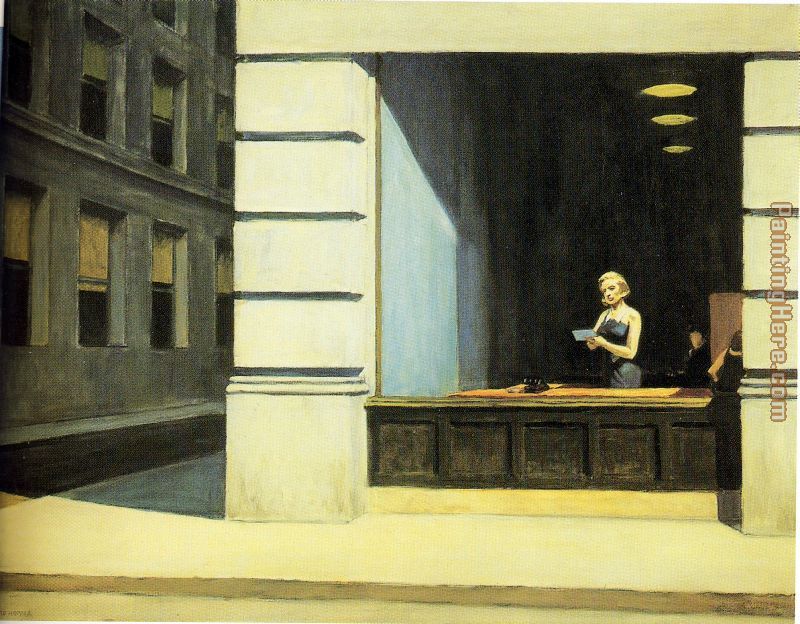
Edward Hopper New York Office

 But my boss is not a shark. He never gnashes his teeth. Never barks or bites; just wears me out with his heavy sighs and questions because I wear him out with mine. 

Lately, I have been spinning a downward spiral at work; an airplane with a clipped wing and a pilot who stunned, goes in and out of consciousness. The plane nose dives and the pilot wakes just in time to pull it back up. Then blacks out. The plane dives again. I can feel my boss’s frustration, even though I know he is too kind to say it full force. He sends me reserved emails instead, with exclamation points (!) to emphasize his exasperation.

“Why did you do this?” He cannot wail in person. It is unbecoming. Unprofessional. So he wails in a muted, manly, electronic way and I hear not the wail but the “ping!” of my phone’s email alert. It is a sound I have come to dread above all others.

In the beginning, I never wrote that I was sorry, because I wasn’t. I often made mistakes, but it was the first month. Then the second month. Then the third. Sometimes, it was a lack of guidance. No one held my hand and that’s fine – I could put two and two together. Boss hands me keys: his car needs gas. No? Then his car needs service. No again? Get something from the trunk. His wife calls. Something to do with: insurance. The company van. Picking up an ice cream birthday cake. Inquiries about my boss’s schedule so she can plan their vacation. But was I sorry to mess up? Sometimes. And if we were in the same room I would apologize profusely and earnestly, but there was something hollow about doing it via text or email. I simply didn’t bother.

But tonight I did, via text. Like a bad boyfriend. He said that he found himself reminding me to do things – simple things that should be rote by now – every three or four weeks. And I knew he didn’t mean it as a jab, but he added, “I hope you don’t need reminding to brush your teeth!”

I had just come in from a swim and stood dripping wet at my desk, feeling the carpet growing soggy beneath my feet. I typed my immediate reaction:

“I don’t. And you remind me more often than that.”

I stopped and wondered about the last two words still unwritten. How much would I mean them? I recalled an early conversation I had with my boss about being willing. “If you’re not smart, then you’ve got to be willing,” he had said. This heartened me at first, then bothered me. It exhausts me now. I am willing, just not willing enough for certain things. And the thing is, the main thing is: I am smart.

Slowly, deliberately, I tapped out the letters, smearing a few droplets of water that distorted the words, but did not make them any less true: “I’m sorry.”

I hit ‘send’, not sure if he would sense that I was serious, but I was.

The Wave

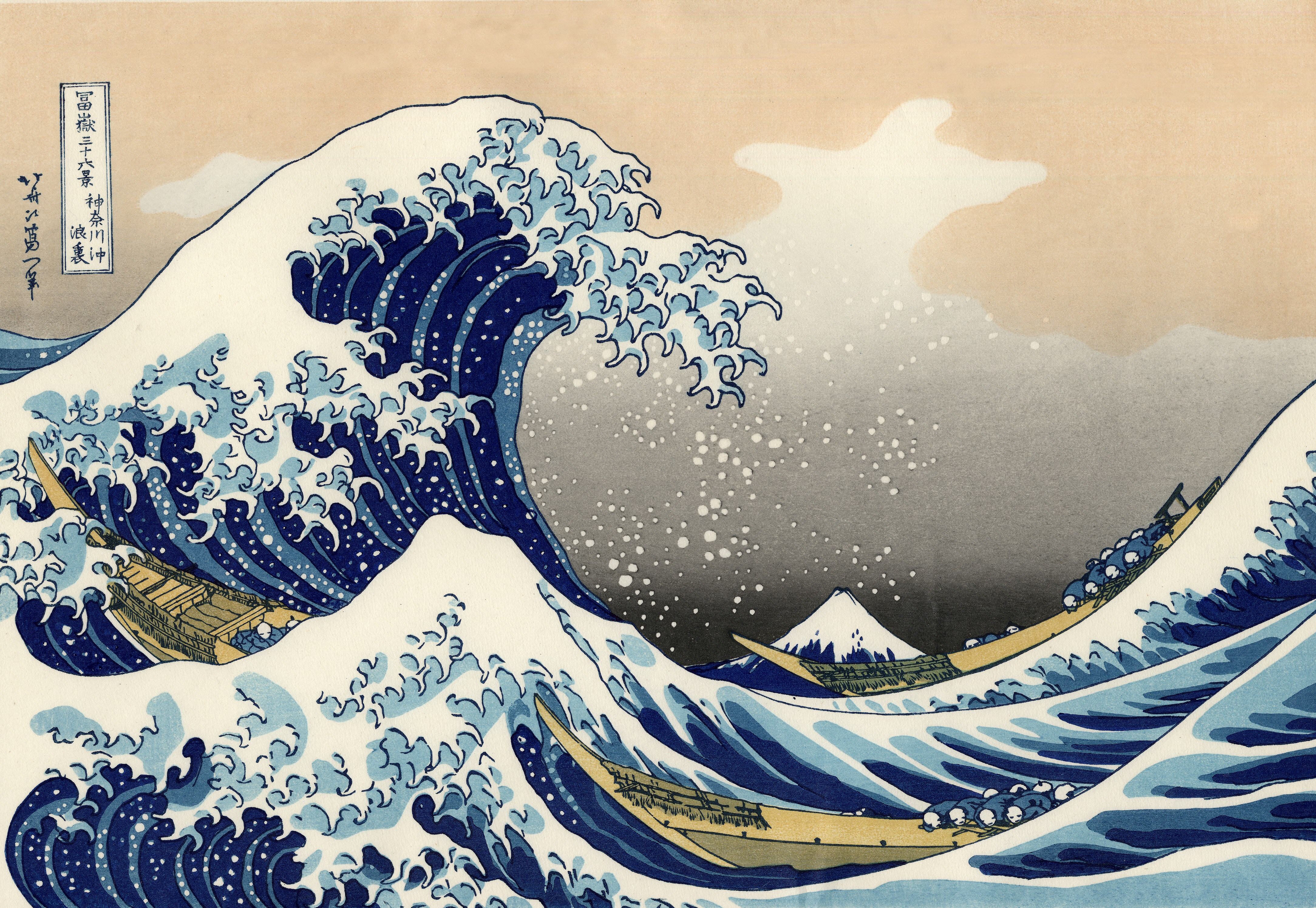
The Great Wave off Kanagawa, Hokusai  1830-33
The Great Wave off Kanagawa, Hokusai 1830-33

In the afternoon I swam and did a second load of laundry: the darks. It was a pitifully small load, devoid of my father’s thick navy polos purchased in bulk at Costco and my mother’s nylon badminton shirts. This is laundry when you live alone: just your dirty clothes in a small, limp pile. Small because you’re not the type of person to let the clothes pile up. I used half the detergent I normally use and closed the lid, suddenly unaccustomed to the silence.  Continue reading “The Wave”

Entertainment

A few days ago I cancelled a meeting without telling my boss. I didn’t think I had to. It was one of those things where the other party dictated what they thought should happen because it seemed like the common sense thing to do, and me, without applying common sense, agreed.

I can’t explain the thought process, perhaps because there wasn’t one, but the conversation went something like this:

J: “Hey Betty, can you cancel our Tuesday morning meeting with Boss man, Jeb isn’t in and we don’t have much to update Bossman on since our meeting with him last Friday.”

Me, wondering if it was a good idea, all the while knowing in my gut that it wasn’t, “Okay.”

Click. Click. Meeting cancelled.

On Wednesday morning, Bossman rolls in, nods at me, then goes to his desk.

A few minutes later my phone rings.

It’s Bossman. My voice cracks as I answer. He never calls this early in the morning, preferring to go quietly through his emails.

“Hell- o?”

“Come in.”

I get up and walk into his office, hoping that I haven’t forgotten the coffee again. I see that he has a cup on his desk. It’s not the coffee. He has a disgruntled look on his face, but then again, it is the morning. Early on he told me he wasn’t a morning person.

“Where’s my meeting,” he asks.

“Ah.” I mentally punch myself in the face. Here we go. “I cancelled it,” I say.

“Who told you to cancel it.”

“J did, Jeb’s out because there was a death in his family… and they said that as a team, they didn’t have any new updates to bring to you.”

“So you just cancelled it?”

“Yes…?”

“What is wrong with you? What’s the point of having a set, recurring meeting if you just go and cancel them at their whim? How does that keep them accountable? Oh so they have nothing to show me. Well, why don’t they just stay home? Maybe I shouldn’t even come to work?”

I stand awkwardly and nod along, wondering why he never raises his voice. I study his face. How tired of me is he? I’ve been here eight months…nearing nine now, and in a few days my employee evaluations are due – will he even bother to write it out? I imagine him pulling a huge guilt trip and telling me to fill it out on his behalf. “You tell me how you think you should be evaluated,” I imagine him saying. But back to the cancelled meeting.

“Sorry,” I say, “I wasn’t thinking. I figured…” I don’t know what I figured. I didn’t figure anything because…

“You weren’t thinking,” he says, “You don’t think. You don’t want to think. You just do. You just want to follow instructions, from anyone!”

I say nothing.

“If that’s the case, then you’d be better off working at Burger King. At Burger King, you just gotta follow instructions.”

He made an incongruous gesture with his hands, reaching up to pull some imaginary burgers down from imaginary shelves and placed them roughly on an imaginary conveyor belt. Had anyone been standing outside his office, it would have seemed like a terrible seated rendition of Michael Jackson’s “Thriller,” but he was really demonstrating to me what life would be like at Burger King.

Finally I say, “Do you want me to call J and them upstairs? We can still hold the meeting.”

“Forget it,” he said, “Just don’t cancel my meetings for stupid reasons next time. Don’t let them tell you what to do. You’re here to hold other people accountable, not just to me, but to themselves and their responsibilities.”

“Got it,” I say, then as I walk out, make a mental note to think more.

                                                            ————–

I have good, thoughtful intentions I swear. But brain cells and memory are no longer on my side. Whose side ARE they on?

This morning my boss rolls in again, and I am pretty sure that at least for the rest of the week the calendar is good. All meetings are on. Things have been confirmed and reconfirmed. I am excited like an eager ninth grader in honors bio who read the assigned chapter a couple of times. I almost want Bossman to test me.

He nods good morning as he saunters past my desk and I grin brightly, assured that we’re both off to a good start.

I hear “snap snap snap” and from the corner of my eye I see the lights turn on. Next stop, coffee pot. And once he pours himself a nice hot cup and settles into his chair…

“Betty.”

I snap my head towards him. He is walking towards the desk and motions for me to come in.

Oh goodness what now.

“Yes Boss?”

“You served me hot water again.”

My jaw slackens as though someone has hit me with a sledgehammer. The most obvious thing. ALWAYS, the most obvious thing. Concentrate on one thing and let another thing slip.

I rush to the coffee pot as my morning’s actions rush back toward me. My mental checklist failed again. It makes me sad that I need a mental checklist to make coffee. The fact that I had forgotten AGAIN to put coffee in the coffee pot seems the stuff of comedy and at the end of the day, my boss would tell David that it was his daily entertainment, a small, one woman show called, “What will Betty forget today?”

At this point, there is no point in explaining myself. I grab the coffee pot and laugh. What else is there to do?

I lift the cover and scoop the beans in. How could I have missed that smell this morning? And it’s almost like deja-vu, my standing there, scooping coffee into the the filter and thinking, “Good god I am so bad at this.” The conversation we had yesterday returns to me.

“I don’t even think I can work at Burger King,” I say.

“Nope,” he says without looking at me. He has already sat down in front of his computer and is running through his morning emails. He shakes his head and says drily, “Burger King would not want you.”

Barack and Genevieve

“The sexual warmth is definitely there — but the rest of it has sharp edges, and I’m finding it all unsettling and finding myself wanting to withdraw from it all. I have to admit that I am feeling anger at him for some reason, multi-stranded reasons. His warmth can be deceptive. Tho he speaks sweet words and can be open and trusting, there is also that coolness — and I begin to have an inkling of some things about him that could get to me.”

From the 1984 diaries of Genevieve Cook, one of Barack Obama’s ex-girlfriends 

I don’t know who she is, but I respect and admire her tremendously. And I will buy this book in hardback and read it from cover to cover the day it comes out. If I could, I would buy Genevieve Cook’s diary.

This morning, I read this post in the NY Times, which led me to this article in Vanity Fair, a magazine I stopped subscribing to but will now pick up again. 

I thought about a lot of things: first, that I should be more serious about journaling, not because I am dating anyone on the verge of greatness (though, who knows… perhaps I am) but because, as Genevieve Cook’s diaries indicate, a lover writing of her beloved produces some of the sharpest, most lucid and beautiful prose. The kind that blurs the divide between poetry and prose.  There is no audience – let me correct myself – the audience is the writer herself. 

“How is he so old already, at the age of 22? I have to recognize (despite play of wry and mocking smile on lips) that I find his thereness very threatening. Distance, distance, distance, and wariness.”

Lucid does not mean accurate. Barack’s demeanor to her could have been and probably was completely different from what he showed others, but I doubt any biographer, reporter, or profiler could get as full an account of anyone – especially someone as reserved as the President is portrayed to be – than a lover who writes. Barack was a lover too, and he wrote, but I doubt his pen was as focused on their love as hers was. And even if the focus was tantamount, Genevieve, I think, saw more. She had foresight:

“I’m left wondering if Barack’s reserve, etc. is not just the time in his life, but, after all, emotional scarring that will make it difficult for him to get involved even after he’s sorted his life through with age and experience.

Not only could Genevieve see herself from the outside, but also she could see beyond them and see into two separate futures. I’d like to say this is a woman writer’s prophetic talent, but it has nothing to do with being male or female and everything to do with the nature of ambition and the limits of introspection. Barack loved her but more so he loved a long brewing idea of himself – a portrait he, a consummate artist, was still painting. 


Self Portrait, 1930 Edward Hopper Oil on Canvas 

This limited his view of her. The irony is that this period in our President’s life is seen as one of growth and development, of shape-shifting. He was contemplating the road less-taken (and truly, is there a road less taken?  Only 43 had traveled that road before he did), yet without knowing it, was molding himself into someone strangely predictable despite his perceived mystery, someone whose future partner could be found and fitted in snugly, like the missing piece of a moderately difficult jigsaw puzzle.  

And here is Michelle, succinctly drawn up even before Barack meets her

“Hard to say, as obviously I was not the person that brought infatuation. (That lithe, bubbly, strong black lady is waiting somewhere!)”

 The young serious lover has a special perch, which, if I were asked to place it on the human body, would be roughly, where we as elementary school children pressed our right hands over our hearts during the Pledge of Allegiance. That is essentially where you stand as a hopeful young-but-serious lover: closer to his heart than his head, but not so far away from the latter that you can’t sense something stirring, some thought or ambition that could take him away from you. Sometimes it is a role so distinctly defined that once he assumes it, there is no looking back. The suit is buttoned, the tie tied tight, the papers signed and delivered that life stepped into, like a hot, steaming shower with a heavy glass door. Sometimes another hand turns on the faucet before you can say, “Life.” You are either with him or not.  

If not, you no longer stand on his breastbone. You, outside, can only put your hands on the glass and wonder at the figure shrouded in mist. 

“Barack — still intrigues me, but so much going on beneath the surface, out of reach. Guarded, controlled.”

I have been a young lover, but never a young, serious lover. I have written seriously my
share of studies of real men I have come to know and then not know, my writer’s conscious crouched near my heart, in the hollow of my collarbone, at the base of my throat. I have turned real men into fictions and watched, with a calm acceptance that surprises even me, as the real men walked away or I away from them. 

This has nothing to do with being male or female but with a very different kind of role. Am I more like Barack or am I Genevieve? At what point will I say, I am who I am meant to become and find the missing piece? Perhaps never. 

So for those who are loved by writers, be wary. Don’t be afraid to love her back, but be wary. Know this: a writer will consume you with every sense at her disposal. From the moment you meet, onto paper, blogs, stories both true and not, and into her memory. You are being written.  

Jo Painting 1936, Edward Hopper Oil on Canvas 

Late Afternoon

I returned to the water this afternoon, after weeks and weeks of dipping my toes in to test the temperature, only to find it disappointingly cold. I don’t know what changed today – the water was still cold and the despite the sun, the air was cooler than it was yesterday, when my cousin came over to lay out with me. There was a slight breeze in the air, and I, alone today, plugged my ears with Matt Kearney and fell asleep in the yogic dead pose.

I slept until my skin, on the verge of burning, tingled my nerves. The skin on my thighs felt as though on fire. The backs of my hands seemed ten thousand years older, I was afraid to look. I’m well aware of skin-cancer dangers – but like millions of women who would rather be tan than not, I eat plenty of vitamin c and cooked tomatoes and take my chances.

The water glistened, glittered, batted its watery lashes at me and said, “Today is the day. Come cool off.”

I dipped my foot in and it felt wonderful, the soothing coolness on my hot skin – but years of experience taught me that my extremities were more tolerant of cold than the rest of my body. But I felt like moving. Summer turns me into a semi-athletic human being whereas in the winter, you might as well call me Brown Bear Betty.

The wait is over, I declared. I have been patient long enough. Last summer seems so long ago – between then and now I transformed into a pale office rat. Swimming in the sun is now a weekend activity. I pushed myself up from the towel and walked to the edge of the water. Would I enter the slow, cautious way, step by step? First the ankles, then the knees, then the thighs and eventually, gingerly up to my chin?

The thought of it felt like torture, and a surefire way to never go completely in. It left too much room to back out in cowardice and retreat indoors. I wanted laps. I wanted to stretch out, to kick, to pulse through the water in my best impression of someone who knows how to swim. When I was young I pretended I was a mermaid. I let my hair down and kicked with my legs glued together. But today I was all business. I wanted laps.

I backed away from the edge of the pool. Turned to see my dad sleeping in the living room, the sound of the television playing faintly in the background. Somewhere, my neighbor’s dog barked. A car door slammed. A bird chirped and cars rushed down in the street below.

No more waiting. I ran towards the water and jumped.