Please Listen

Yesterday my mother came back later than usual from her badminton lesson, looking dejected rather than energized. She plays badminton two or three times a week with two other ladies, both of whom are much older, though in truth their athletic abilities are evenly matched.

“What’s the matter,” I asked, “Didn’t you have a good lesson?”

My mother nodded, her eyes ringed with fatigue, “Oh yes, the lesson was fine. But I didn’t practice much afterward.”

“Why not?”

“One of the new ladies came up to me after our lesson and asked if we could talk.”

“About what?”

“I thought she just wanted to get to know me better,” my mother said, “She started her membership some two, three months ago, but she isn’t the most social person. She doesn’t seem happy. Doesn’t really smile.”

The woman had approached timidly and spoke to my mother in a small, weak voice. My mother leaned in to listen.

“I know this is strange,” the woman said, “But I need someone to talk to. I’m so lonely. I don’t know anyone here, and it’s good for me to get out and exercise, but I’m also ashamed.”

 I’m not surprised that out of all the women in the club my mother was the one the woman felt comfortable coming to. My mother is quite judgmental, but you couldn’t tell by looking at her – she has a warm smile, soft inviting eyes, and a casual yet elegant manner that you can’t help but be drawn to. People see her and think, “Now there is a woman to whom I can pour my heart out to, who will be a friend and confidante.” More than a few times she’s had utter strangers approach her on long flights, tour buses and at conferences for Chinese teachers. They come up to her casually, feel about for mutual interests and when my mother seems receptive, unload their life stories upon her. Perhaps I’m making it seem too one-sided – my mother is a gifted conversationalist and a curious, inquiring woman, but it seems a bit excessive sometimes, the details she comes away with, and as she’s a master storyteller and I her favorite audience, she comes home and repeats the stories to me in such detail that I feel I’ve met them too and know their problems well.

“She told you all that?” I find myself asking, “And you met her when?”

“Just a few hours ago,” my mother will reply, as though it were normal to know so much about a complete stranger.

The Conversation Federico Zandomeneghi, 1895

When I was younger I scratched my head and thought, “What do they expect mother to do? How can she help?” But now, having had my own instances of over-sharing (though I hope not to a complete stranger), I know that they don’t expect her to do anything but listen; for some people, that is the ultimate help. Silence may be golden but talking to the right person can be quite therapeutic; my mother, and I know this from first hand experience, is not just an excellent and encouraging sounding board, but also that rare breed of person whose aura compels you to project your very best self – whatever hope and optimism you may harbor, however little of it is left – upon the conversation before you. That, I think, is the core of a good listener. They function like a diary you can write and write into, and the more you write the more at ease you feel, both within and without. The world is okay if you have a good listener.

This woman did not have a good listener. But she accurately detected one in my mother, and yesterday afternoon she waited on the pine green plastic bleachers, next to my mother’s racket bag, knowing that my mother would stop to wipe her forehead in between her lesson and her double’s game. My mother went to her bag and smiled at the woman, “Hello,” my mother said.

They traded pleasantries and my mother turned towards the court and her waiting friends when the woman asked her to wait a minute. Could they talk? My mother obliged – she hadn’t really worked up a sweat during her lesson, but what can you do when a lonely woman about your age asks you simply to listen? You cannot say, “Oh of course, but how about after I play two sets of 21 points?” Well, perhaps you could, but it isn’t the right thing to do.

Sensing desperation in the woman’s voice, my mother nodded, “Of course.” She placed her racket down on top of her bag, near the still-dry towel and turned to give the woman her full attention.

“What’s the matter?”

Return to Sender

“I’m sending you back to your parents,” my boss said.

It was my last day at The Company.

“Sorry?” I said, “I still live with my parents.”

He chuckled, “I know, but go home and tell them that I say, ‘Your daughter is going back under your care.’ My responsibility for you ends here.”

I laughed, wondering what he meant.

“This whole time, I felt like I was parenting you.”

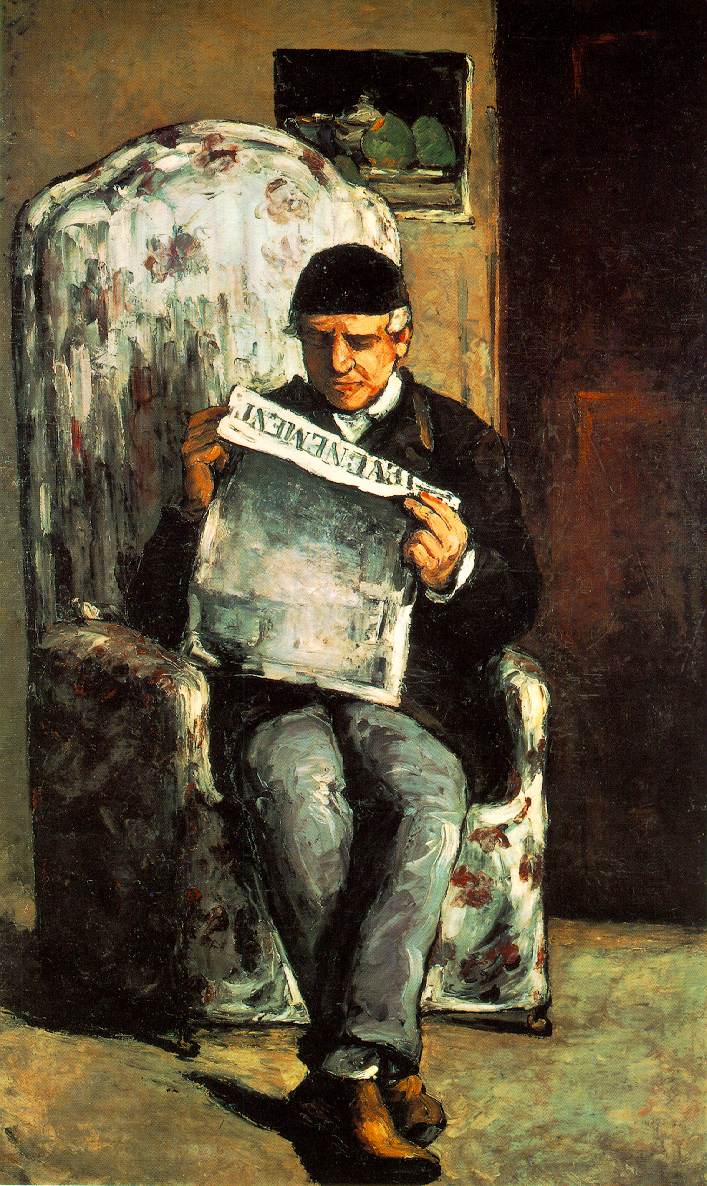
Portrait of the Artist’s Father, Paul Cezanne 1866 Oil on canvas.

 I recalled an awkward moment at one of my boss’s events, where after he’d accepted an award a mob of people swarmed our table to congratulate him. His wife was seated on his left and I to her left. Their daughter had taken the seat on my boss’s right but had gone to the restroom. His wife leaned towards me, asking me one thing or other as was cutting through my filet mignon. A man appeared over my shoulder, patted me on the back and said to my boss, “So is this young lady your daughter?”

I shook my head a little too hard and said five “No’s” in rapid succession so that the pink slice of steak I had so carefully speared quivered and loosened from the tines of my fork. It belly-flopped like a tiny, shitty diver onto my dress.

My boss’s wife laughed and my boss pretended not to see my little mishap. Though to my surprise, he didn’t falter or vehemently correct the man, who also pretended not to see though it was his stupid assumption that ruined my dress.

“Oh no,” my boss said, “She’s my assistant,” then pausing to think about it for a moment, “Well, yeah she could be my daughter.”

I dabbed at the steak stain, (thank god my dress was purple) and smiled in what I hoped was a winning manner at the man, who seemed less interested in me now that he found I wasn’t a blood relation to my boss. My boss’s daughter returned to the table and was immediately accosted by the man and a few elderly women wearing too much makeup.

“Of course she’s your daughter!” they squealed, “Look at the resemblance!”

My boss’s daughter, ever polite and modest, smiled and said thank you. Thank you, thank you.

———

In his office, my boss leaned back in his chair, “I hope you learned a few things from me. And I don’t mean all these tasks I gave you, but just as a person.”

I mentally ran through a few of our key lessons, but my boss did an oral review.

“You forget this and that, don’t plan ahead, pass information around before processing it…”

I nodded, “Yeah, yeah, I know. I’ll try not to do that in my personal life, or in my endeavors to become a writer.”

“So you don’t need a reminder to brush your teeth, right?”

I laughed and shook my head. One night a few months ago after a particularly terrible streak of forgetfulness my boss had sent me what was most likely his angriest text ever: “I feel I have to remind you to update my calendar when you make changes every two or three weeks. This is your job! I hope you don’t need me to remind you to brush your teeth!” 

I read the message at 10PM on Monday night – only Monday! – and wondered how I ought to respond. Should I even wake up the next morning or would he write an email to me that night asking me not to come in anymore?

In the end, acceptance seemed to be the best reaction. I typed, “No, you don’t need to remind me to brush my teeth. And you remind me much more often than that.”

He didn’t write back, not because he was furious at my response, but because there wasn’t anything else to say. What can you do when the person you are angry/disappointed/frustrated with knows exactly why you feel that way and they accept it? You let them bathe in the frustration and hope they remember the shame and the resulting exhaustion. You hope they never let it happen again. 

“Nope,” I said, “I can definitely remember to brush my teeth.”  

My boss grinned, “Good. You learned something. Hopefully you can remember all the other important stuff.”

The Replacement

HR worked fast and stealthily. For weeks they said they had not found anyone until suddenly the resume of “the perfect candidate” appeared in my inbox.

“Please let your boss review,” they said, “We think she is the perfect fit and want to get her in right away before she goes somewhere else.”

I printed the resume (two pages!) and before my boss walked in, devoured her work history and references. If I were gunning for the same job I’d have gulped. She was, as her meticulously curated resume indicated, a professional EA, having worked at least two or three years in each of the positions listed. I was impressed.

“How old is she?”

HR looked at me as though I were stupid. And rude.

“You can’t ask me that.”

Hm.

I’m no mathematician, but I can put two and two together. Her resume indicated that she’d graduated college some twelve years ago with a major she had no intention of applying in the real world. Or perhaps she did – who knows – but most of us are familiar with the fear that strikes so suddenly when we’re on the cusp of stepping into “the real world.” Aspiring filmmakers, psychologists, philosophers, dancers, and yes, writers promptly morph into accountants, tutors, administrators and restaurant hostesses, the ink on their diplomas hardly dry, in industries as far from our hearts as the college campuses we so blithely wandered upon for four years. Time flies, as they say.

I studied the woman’s resume, trying to picture her face, mannerisms and style of dress. From the paper alone I knew she would interview well – how else would she have moved from job to job with virtually no lost time between? I imagined her striding in, briefcase in hand, suit tailored to a T, vibrant red lipstick applied expertly over thin, unsmiling lips. She would shake my hand with a firm if not crushing grip as though silently communicating to me all my failings, “Go and play out your girlish dreams in the cushy meadows of grad school,” this handshake would sneer, “Leave a profession to the professionals.”

She would, as any good EA ought to be, a door closed both to herself and to her boss, an icy cool enigma rather than how I was, a foolish open book who in the beginning shared much more about my boss and his schedule than he felt comfortable.

“Your job is to keep my schedule and act as gatekeeper,” he’d once written to me, “STOP OVER SHARING!!!”

She would certainly not commit a fraction of the faux pas I so freely showered upon the poor man. The coffee! That damned coffee machine! My damned, leaky memory! Her resume still in hand, I ran through the series of unfortunate events during which I felt sorry for myself but really, when I think about it, was really subjecting my boss to the brunt of it all. I made appointments but forgot to record them, leaving poor, soft-spoken foreign gentlemen sitting alone at my boss’s various lunch clubs while he had no idea because they weren’t in his calendar. More than a few times, I’d put down the wrong address, the wrong phone number, and mailed concert tickets to the wrong people (though they didn’t complain). And the most dangerous mistakes of all involved my inviting people outside the company to internal meetings (though in my defense there are too many Asian men with the same damn names) thereby sharing internal agendas, memos and email addresses with people completely uninvolved who would politely write back, “Um, I don’t think you meant me….” or, “I think you have made a mistake I am not on the board of your Company!”)

No. The woman behind this particular resume would make none of these mistakes and if she did, would EXPECT to be fired. She would recognize the gravity of all these situations and in her utter professionalism say very gravely, “It will never happened again.” I tried this. But after the second or third time I remembered an old fable and did not say it again. You see, I could not guarantee it.  But this woman, though faceless, seemed to represent some sort of Executive Assistant Messiah – she would lead my boss to the promised land where all appointments were checked. Secrets kept. The company’s leader and as a direct result its underlings would be run like clockwork. The bullets shot out at me with measured precision: “Step. Aside. Little girl. Step. Aside. This is the big leagues and your boss has decided to play with a better team.”

My boss came in and I handed the resume to him.

“HR found someone they think you’ll like,” I said, “Her resume looks pretty good.”

“Oh?” He took it, gave it a quick scan, and turned it over to read her references. Then flipped it back to the front. His expression remained unchanged. I searched his face for some indication of agreement. Finally he spoke.

“This looks good to you?”

I nodded, “Yeah. I mean, she’s got good work experience.”

He scoffed. What did I know about work experience? Boss had a point – my whole resume, with nothing omitted, was a compendium of odds and ends – a curio cabinet on paper. I’d worked several internships, all more or less writing intensive until I started at the Company which was email intensive. But sandwiched in-between each unpaid but “career-building” internship was a paying job at Rite Aid, Costco, Calvin Klein and, most briefly, a Borders calendar kiosk. Then I started here and was gainfully employed for a whole year, with a salary, benefits, the whole corporate shebang I’d heard about but had never truly experienced.  

So again, my boss was partially wrong: I did know a lot about work history, not because mine was long, but it was undeniably populated. 

At the very least the woman’s experiences were each longer than two years. I pictured myself staying at the Company for another year but shuddered at the image of myself ten pounds heavier and ten years older in the soul. I’ll pass.

“She hasn’t stayed anywhere longer than two years,” my boss said, “This isn’t the best work history.”

I gulped. Had he even seen my resume?

“This is the longest I’ve ever worked anywhere,” I said to him, “and it’s barely over a year.”

He looked at me over the edge of the resume, glasses perched on the bridge of his wide, fortunate nose. There was something fatherly about his look.

“You’re just a kid,” he said, leaning back into his ergonomic chair, “You can still change your ways and get away with it. I’m telling you now to knock it off. All that waffling… You say you want to write, then write. Don’t do a little bit of this and a little bit of that and not really write and then five, ten years from now try to pursue a writing career. You’ll be older with less time and less choice. You’re lucky now! You have a choice!”

I nodded.

He joined his elbows together and made a “Y” with his arms, “You’re at a fork in the road, you know? Pick a path and stick to it.”

It was very profound. I shuddered again. I saw the resume he held in his hand and how really, it was no different from my own resume, which he had held in the same way, with the same fingers and probably wearing that same shirt a little over a year ago, when I was on the brink of walking into his office. The only difference between her resume and mine (aside from superficial formatting) was that hers spanned more time. I had the benefit of youth – and though I was a year older I saw that the benefit was still upon me.

Mr. Obvious

This morning my boss asked me to get a quote for a private jet. I should have known by now, not to go above and beyond on certain things because it invites more questions, for which I’m normally not prepared. But as it is my last week at work I shrugged and thought, “Why not?”

I inquired after the company we normally used for such trips and asked after another one, introduced to us by some friend of my boss’s. This other company was much cheaper by a few thousand dollars. I raised my eyebrows and scoffed, “Well, I guess I know which one Boss will want to go with.”

My Achilles Heel, my boss will tell you, is my tendency to assume.

“You assume things, and then you are wrong. Never think you know anything when you can’t even be bothered to ask the right questions.”

It’s half true. I do ask the questions, I just ask silently, in my own head for a millionth of a second. It is, I think, a natural response when you are handed two vastly different quotes from two companies for what is essentially the same flight, to pause and think “Why? What factors make the prices so different? Is it the type of plane? The personnel involved? The marketing materials one company uses over another?”

I asked these questions, but chose to forgo the actions that ought to follow the asking of said questions: to hunt for answers. And it pains me to acknowledge that yes, after a year, I am still that silly girl that just passes around the information.

My boss is quick. I told him the numbers and he asked, “What kind of planes?”

I gave him a sheepish look, “Very good question,” and went back to my desk to find out. This time, I was more thorough, asking both parties what types of jets they used and why their service was cheaper or more expensive. Both parties returned with mounds of information. I processed it minimally before going back to my boss.

“Well, company B’s quote is cheaper because they use an older prop jet.”

He looked at me with a bemused half-smile, “And what’s a prop jet.”

“Um. I think it has the…” for some reason the scene from Indiana Jones and the Last Crusade in which Indiana Jones flies a small plane into a flock of seagulls came to mind, and instead of using words I awkwardly tried to mime a prop jet. My boss sat and blinked.

“Prop,” he said slowly, prompting me.

“Yes. A prop jet,” I made the motion again, stirring my arms like an old egg beater with a failing engine. After a minute, my arms tired. “No? Am I wrong?” 

“Prop…” he looked at me expectantly.

“Yes…a prop jet…”

“Prop is short for…”

“The wings are propped up by the engines…?”

He was sitting on one of the short red armchairs and when I said this, collapsed back in amused frustration. I stood before him like a shitty comedian. This scene has played out many times in the past year.

“God,” he said, slowing straightening himself as though recovering from a punch, “Propeller! Prop! Propeller! How could you not know this?”

I shrugged.

“And what’s the other kind of engine?” he asked, ever hopeful that he didn’t hire an absolute ding dong.

I laughed mostly out of nervousness.

“I don’t know. Uh. The kind of engine that you find in a….car?”

He stared at me in the same way I stare at people I think are dumb as rocks – namely people who say things like, “Oh Taiwan! That’s in Thailand, right?” – and said, “A jet engine, Betty. A jet engine.”

Ah. Of course.

He went on to patiently explain the difference between the engines, using words like horsepower and thrust, drag and gas velocity, moving his hands through the air in a knowledgeable way. I could see the diagrams wafting crystal clear around his mind’s eye, just not in the air before me. I nodded slowly at his every pause, a check to see if I understood – not really – but still, I didn’t want him to think he was wasting his time. My boss was taking precious minutes out of his day to make clear the distinctions between prop and turbo jets, I wasn’t going to say, “Whoa whoa Boss, hold your horses. I drive a Prius and fly economy.”

So I stood very still and listened.

Finally, at the end of the lesson he smiled as though it were all very simple, “Get it?”

I nodded. Oh sure. Yes. Prop. Propeller. Yes. Of course.

“Okay,” he said, “So what’s the difference?”

“Um. Prop jets… use…propellers to push the air and…”

My boss shook his head, “Man, I thought everyone knew this. You learn this in high school physics.”

I pursed my lips and blinked and threw my arms up in the air, “Ah…I  I didn’t take that class.” Then I laughed because that’s what I do when I’m nervous and want to change the subject. 

He slowly pushed himself out of the armchair, almost dazed that I had been under his employment for so long. How did he let me get away with it? How did he let himself get away with it! A year with an assistant who not only made coffee without coffee, but didn’t even have enough beans to fill her own noggin.

“No you didn’t,” he said, “you definitely did not take that class.” 

Snails

For the past few weekends, I was away. I was on “vacation” on those weekends, short trips to Palm Springs, Las Vegas and San Jose, but there is nothing more relaxing than waking up in your own bed on a warm weekend morning, no alcohol in your bloodstream, no loud music from the night before, no sore soles from high heeled dancing shoes. Self-inflicted torment, I know. On Sunday evenings I would arrive home, exhausted from the drive and the combination of sleeplessness compounded from both the preceding workweek and the resulting weekend. YOLO, my friend Drake likes to say.

YOLO indeed, but there are many ways to YOLO.

This weekend I was at home for the first time in a long time. A delicious, nostalgia inducing state. I was reminded of those lazy summer days of my youth (and in truth there are about to be a lot more with my impending unemployment) where my sole responsibility was to make sure I swam after 4PM, when the sun was not so scorching. And even though this weekend was similar in its simplicity, it is never the same as when you were young. But I tried. I tried.

I ate popcorn and watched a string of Tom Cruise movies (“A Few Good Men” and “Jerry Maguire” – I know he is a crazy Scientologist but man can he deliver some lines!), read magazines from June and July, and went swimming to assuage my growing likeness to a beached whale.

Socially, I spent much needed time with family; lunching with them at a hot, crowded noodle house in Rowland Heights with slow service but enormous dumplings and then cooling off in my cousin’s airy new mansion with green carpeting and onyx vanities. We cooed over their new baby boy. In the afternoon my cousin came over to swim and we paddled and talked while my father dozed in the living room. When we came dripping inside, he gave us fresh cut watermelon. We showered and lounged on my brother’s bed, watching Jerry Maguire propose to Dorothy Boyd.

In the evening, I cut yam leaves from my mother’s garden and blanched them for dinner. It was an eyebrow raising dinner: an odd combination of tomato sauce on yam leaves, with some Parmesan sprinkled on top. My carb-free version of spaghetti. I ate before my mother came home from her line-dance class and when she returned and sat down to eat with my father, I for some reason wanted to stay and talk to them instead of retreat to my room as I normally. I ate a bowl of shaved ice while my father gnawed on leftover pork knuckles. My mother finished the fish she made two days ago.

We were very happy.

After dinner I started to write this, then stopped. I had spend enough time in front of a screen, probably enough for my entire life, though certainly there are several thousand hours ahead. I looked up across the street and saw my neighbor’s car pulling in. I imagined him giving his wife a peck on the cheek as he set his keys down on the kitchen counter. I had been in their house once as a child, and knew the layout. It was the same as ours, except with a second floor. I saw a couple walking their dog after their evening meal, most likely discussing their grown children who lived in other cities. My parents were less than a hundred feet away – we were at the same address and yet I often wondered what they were doing.

I stood up and walked to the living room. My father was asleep in the massage chair. There was a travel show playing, showcasing the gorgeous scenery of some place in Sichuan China. The back door was ajar and my mother’s house slippers at the threshold. It was getting dark and I wondered what my mother could do in the garden.

I called her name and I think she heard me better than I heard her. She was on the hill, crouched in the vegetable patch my father had built for her. The sun was gone and by what light was left I could make out a small plastic bucket in her left hand and the swift plucking motion of her right.

Dunk, dunk.

Whatever she was plucking made a small, satisfying percussion as they hit the inside of the bucket.

“Mom?”

“Hmm?” Her voice was almost singsongy, and though I couldn’t see her face I knew her expression – the slightly wan, but contented look she gets when she’s spent a few satisfying hours in the garden. Hours well spent.

“What are you plucking?”

Dunk, dunk. 

“Snails,” she said, “They come out after dark to eat my precious leaves.”

Dunk, dunk, dunk. 

“Sounds like there are a lot.”

There are. It’s terrible.”

“What do you do with them?”

“I dump them somewhere else.”

“Don’t you think it’s disgusting to touch them?”

Dunk, dunk, dunk.

“I did,” she said, then paused to examine a particularly large one, “I used to use chopsticks. But not anymore. It’s much faster this way.”

I could hardly see my mother then, and left her to her work. Walking back into the house my father stirred.

Where’s your mother?”

Plucking snails in the back,” I said, “They come out at night and snack on yam leaves.”

My father shifted in the massage chair, nodding as though he knew all about snails and yam leaves, “Yam leaves are very good for everyone.” Then he noticed how dark it had become.

Go help your mother,” he said.

I wrinkled my nose, “I don’t want to touch snails or step in the dirt. I’ve already showered.”

“It’s dark,” he said, “You could hold a flashlight for her, couldn’t you? Bring her a light.”

I guess so. I didn’t feel like writing. Not yet. I went to my father’s cabinet, where he kept random things like flashlights and radios and took out the most powerful flashlight he had. The kind that cops use when they are suspicious of someone. The kind that doubles as a weapon. It cast a cold beam, but was sufficiently bright and would illuminate a slimy snail on a clean yam leaf like a helicopter following a car on a high speed chase. Fox News with snails.

Wordlessly, I went back to my mother and clicked it on right where her hand was reaching next. She showed no surprise, as though she’d known all along I would come back with the light.

Point it here,” she said simply. I did as I was told. I held the light for her as she seized the frozen snails. I don’t think she got them all.

“I could never get them all,” she said, “but I did get many of them.”

She told me about a friend of hers who made a funny sort of escargot with the snails she found in her garden.

But I wouldn’t do that,” she said. The little bucket appeared to be about full and I stayed away, purposely not shining the light into the bucket. I think it would have made me squeamish. But my mother took the bucket to a withered avocado tree several feet away from the garden patch and turned the bucket over. She whacked the bucket against a branch. The snails tumbled onto the ground, a confused bunch writhing in the dark.

My mother smiled at me as she came up the cement steps.

“Don’t touch me,” I said.

She laughed. “Of course not. Thanks for your help.”

We stood for a moment and looked down into the garden. A shadowy patch of yam leaves freed from the at least one night’s onslaught of snails.

My father dozed in the light of the living room. My mother was very happy. Poor snails. All they wanted was a twilight snack.

The Milk Bath

At the moment there is a bare wall in my boss’s office, featuring only small empty sockets of where various nails and screws had been. The framed magazine and newspaper clippings in which he has been featured and that once hung on the wall are now lying patiently on the carpet, waiting to be rearranged and rehung.

A few weeks ago my boss showed me a light that had gone out in his bathroom.

“Fix it,” he said.

Simple enough.We emerged from the dim bathroom and he turned, as though just noticing something on the wall. He pointed at a gap between two large framed features of him in local business papers, “When I am away on vacation, I want you to close the gaps. I don’t like these gaps.”

I raised an eyebrow, “You don’t want gaps between the frames?”

“No.”

“But wouldn’t that look…bad?”

He paused to look at me, clearly thinking that I had crossed some sort of line. He was the visionary, the arbiter of taste around these parts – what was I doing, wasting my breath giving him my opinion on how he wanted his photos hung in his office?

“It won’t look bad,” he said..

“I think it looks better with gaps.”

“That’s not how I want it,” he said simply, “I don’t like the gaps. Rearrange it.”

Our conversations often go like that. He says something – the statement or request remarkable in its simplicity and utterly overwhelming (at least for me) in what it takes to bring it to fruition. I stared at the dozens of heavy frames – all different sizes and felt exhausted just thinking about it. It wasn’t like a hard math problem – just the energy it took to tackle something that would bring no one any enjoyment (my boss hardly looks at the wall) – I didn’t have it. I have a habit too, of staring at him blankly while I try and process the information – my mind is spinning, but uselessly: I spend the first ten seconds thinking, “Oh Lord, how does he expect me to do that?”

Doing well at a job, I have come to learn, comes down to two things: attitude and willingness. You don’t need brains – they are quite nice to have, but they don’t mean anything if you aren’t willing.

My boss said this to me during my first month here, raising two fingers and said, “You can be smart, that is great. But you have to be willing. If you are not willing, you are useless to me.” And at the time I thought, “Good thing I am willing.”

Well, things change.

I could be petty and petulant and all around unprofessional, blaming my dissatisfaction upon the requirements of the position, but it wouldn’t be painting the whole picture. I did for a long while complain about just those things (and on certain nights depending on the drive home, I still do): the many hours I spent on the road running strange, frivolous errands; the ear bending phone calls with his wife, who though generous and appreciative, also wields a rather grating voice with a thick accent; and of course the million of tasks ranging large to small that have to be done around the office because he likes things just so. It’s no different, I’m sure, than what other EAs endure and probably a lot less, judging from tales I’ve heard from other EAs, but all of it together – each grain of sand adds up like at the base of an hour glass until one day you look up and think, “My god my time is up.”

At another time of my life I might have approached it all with gusto, but that time has passed. Or perhaps that life has passed. I have more than just one caretaker’s bone in my body, but it is not meant to be applied to things that I care little for. I am quick to take care of my boss’s immediate needs: hunger, thirst, a headache – but beyond – the pruning of his work and social calendar – I haven’t the right tools for all that, nor do I care to hunt around the shed for them.

I have grown out of this position in spirit while the position has outgrown me in its physicality. It needs someone hardier, sharper – a stainless steel scalpel of sorts, one that is not afraid to cut right down to the bone of things, smiling or not, and get the man what he needs when he needs it. She must be more organized, more efficient and, I’ve come to realize, more ruthless. She can be kind, but at a price – because kindness is often accompanied by softness…the inability to say no, which I think, an EA must never ever succumb to. Most importantly, it’s best she possess an obstinacy to match my boss’s. I know him well enough to know now that he won’t say it outright: “I need you to be more comfortable with bossing me around,” but his molding, masked as “mentoring,” is not exactly getting him the results he had hoped for.

Some people have said to me,”Don’t take it personally,” when I lamented that my boss was somehow displeased with me, and I agreed with them at first. Why would I take it personally? It was just a job…nothing to do with me as a person.

But a good EA – a good employee of anyone, I think, would and should take it personally. If you don’t take the criticism personally, you disengage your core values from the work – if that has already happened and you are okay with it…then you are not doing what you should be doing.

So I take it personally.

I take it personally when my boss asks me why I’m not thinking. My response is, “I am thinking…just not the way you would hope.” I take it personally when my boss points out that I’ve forgotten yet another task, of course I take it personally! It is a personal shortcoming, specific to me as a person, and it affects my work as a professional. I take it personally when my boss asks me to be more professional at the office because it’s a criticism of my personality, which is not so professional. Some people flourish in these types of environments, and if not flourish, at least live quite comfortably. The rules, the hierarchies, the status quo of each corporate bubble, even the fluorescent lights blend together in a warm milk bath designed to soften and soothe. Don’t believe me? Argue with those who like their jobs: security is soothing.

The pressure is there of course, and sometimes the milk sours or the bubble bursts or worse, kicks you out into the cold, but for the most part, you’ll know you belong if you feel….differently from how I feel.

Density (3)

I didn’t tell my father I had been hit by a car until my arm began to hurt. I wasn’t trying to be strong; I just didn’t want to hear him nag. 

The car came from behind. Erica and I walked on the right side of the road, the side we always walk on, I on the outside and she inside. We were talking about something – boys, jobs, my frustration with both – familiar conversation on a familiar road, when suddenly a tremendous force struck my left arm and sent me tumbling violently to the ground. I groaned and was dazed – it didn’t occur to me that I had been hit by a car until a split second later when I turned to see the car speeding down the road. I heard Erica saying, “Oh my god, oh my god,” then when she registered what had happened, screaming, “Hey! HEY! GET BACK HERE!” 
In my dazed state I remember looking up at her from the ground thinking, “I wish she would lower her voice,” as it was late and the neighborhood, being filled with elderly folk, was mostly half asleep.
 Erica bent down, her voice now quieter and more hurried, more worried, “Oh my God, Betty. Betty. Are you okay? Where does it hurt? Don’t move.”
I didn’t know. I groaned because I was confused. Everything hurt and nothing hurt. Even though it was dark, I closed my eyes because it helped me concentrate – I had read something about trauma and how adrenaline or shock can trick you into feeling fine and moving what you shouldn’t be moving. One bone at a time, the article had said. I wiggled my toes. I moved my knees. I tapped the fingers of my right hand, bent my arm at the elbow, rolled my shoulder, my neck and with my right hand, felt my head. I saved my left arm for last because I was terrified that it was shattered but that I just hadn’t registered it. I didn’t look at it. It felt numb. But slowly, very slowly, the sensation came back and I could feel the tips of my fingers – though the left tips felt noticeably duller than the right. But the fact that I could move them – it meant my bones were fine. Nothing was broken.
I got up slowly, then turned my neck left and right. All good. My legs worked fine. And finally the arm. The left arm I let stay at my side – I didn’t want to shock the liquefied muscle. Erica stood by and watched silently, shocked that I was standing.
“Betty,” she said, “maybe you should sit down.”
“I’m fine,” I said.
“No. I think you hit your head.”
“I most certainly did not hit my head.”
“I think you did. You can’t always tell when you have a concussion…and then sometimes people just go to sleep and never wake up. Like Natasha Richardson.” Even in the dark, I could sense her worry, “Please sit down. I’ll get your parents.”
“Erica. I’m fine.”
We finished the walk and at the door, I assured Erica I wouldn’t die in my sleep. There were too many things I had to do. Like check my email.
An hour later, I sat at my brother’s desk, wondering how odd it was that I’d just been hit by a car. My parents had greeted me at the door and asked me how the walk went.
“Fine,” I said, “Great.”
And I went to the computer. I sat and typed something, deleted it, then as my thumb pressed the space bar a sharp pain shot up my left arm. I ignored it and continued writing, but the pain came back stronger and stronger until suddenly, I was fearful of moving any part of my left arm.
I looked at my watch. It had been exactly an hour since I’d been hit – wasn’t my response to the pain a tad too delayed? I imagined a hairline fracture splitting and splitting and the bone finally cracking in two an hour later. Is that what was happening now?
I suddenly had to know. I thought about my grandmother enduring severe constipation and stomach pains, not wanting to “bother” her children with her petty digestive issues until one day there was so much blood in her stool she was frightened. The diagnosis was a minute away from colon cancer and she ended up having a giant segment of her intestine removed.
I wasn’t going to be so stupid. A little nagging was a fair trade for having my father drive me to the hospital, as my left arm was in no condition now to turn a steering wheel.
I walked slowly into the dining room, where my mother sat typing away at her laptop. My father was in the kitchen, within view and earshot.
“Mom, dad,” I said slowly.
“Hm?”
“I have to tell you something, but please don’t freak out.”
My father stopped chopping the scarlet watermelon. My mother looked up from the laptop. Their worry thickened the air.
“I got hit by a car when I was walking.”
My mother gasped. My father put down the butcher’s knife with more force than was necessary. He walked slowly into the dining room, as though walking in too quickly would shatter me. He looked me up and down.
“What? Where? Where does it hurt? Are you bleeding? Who? Who? Did you get the license plate?”
I told them what happened, emphasizing that only my arm hurt – and on the arm, only my tricep…but the pain was increasing and I feared I had a fracture.
“We’ll go to the hospital right away,” my father said, and in the car and in the emergency room, I had to hear it: the long, drawn out “I told you so” about walking with a flashlight or a reflector vest. It was an old warning, often heard, never heeded.
“I’d rather walk in asphalt camouflage,” I’d say.
He’d shake his head, “Once is all it takes.”
And it’s true. Once is all it takes.
On the drive to the hospital I studied my father’s headlights and the area they covered – there was no way the driver did not see me. Perhaps he was inebriated and had slow reflexes. I imagined how – or how I hoped – he felt: filled with remorse. Hitting a pedestrian and driving away. Did he think I was a garbage can? I had bounced loudly off the side of his passenger side car door – a discovery I made later in the bathroom when I discovered a chunk of skin missing from my left hip. I wonder if the thud rang in his head as he tried to sleep that night, not knowing if it was a garbage can or a human. Either way, he had left something toppled over on the side of the road.  
We drove quietly with the Chinese radio playing softly in the background – my father driving jerkily, as though he couldn’t decide between speeding up or slowing down. I held my arm gingerly – trying not to think about the pain and worrying if I would have energy to go into work the next morning. My father finally spoke.
“He didn’t stop at all?”
“No.” I thought about the noise I heard, “I think he sped up.”
My father grunted. I turned to see his face glowing in the dim light of the dashboard and brightened intermittently by the pale yellow street lights we drove past. There were bags under his eyes. He seemed even more tired than I, but here he was, driving me to the ER at midnight. His expression was more disturbed than I had seen it in a while – in fact, he seemed angry.
“Look Bah,” I said, “I know I’m stupid. I should have been holding a flashlight or wearing a reflector vest. I will start walking with both.”
He snorted, “I’m going to buy you a neon reflector body suit. But you didn’t get a license plate? Nothing? Did you see him at all?”
I wondered why he was asking me – I had told him already. I didn’t see anything that could help me identify the driver – just the car from a distance as he sped down the hill and then nothing.
“No, Bah. I didn’t see anything.”
“He just drove away?”
“Yes!” exasperation crept into my voice, “He just drove away! What do you want me to do? I wasn’t exactly in a position to go and chase him down.”
My father shook his head.
“Dad, are you okay?”
 “Okay?” The car swerved slightly, “Of course I’m okay! I didn’t get hit by a car! But I didn’t just raise a perfectly good daughter for 26 years so that some….some… (and here my father said something quite shocking – a Chinese expletive I have no idea how to translate)… could run her over!”
I wonder if I had gotten a license plate or even a vague description, what my father would do. I don’t know. He is not vengeful, but I had never had occasion to see my father act protective. So charmed is my life. He is nearing his mid-sixties, which nowadays is not so old, but at that moment I sensed a strange desperate helplessness. True, HE was driving me to the hospital, not the other way around, but I felt sorry, suddenly, that I had brought this unnecessary stress upon him. How could I take care of them if I didn’t even have the sense to walk at night with a flashlight? But it was the light- the sallow, dingy yellow of the streetlamp that cast more shadows on my father’s face than necessary. It was the light and the time of night and the fact that he was driving me to the ER, something he had never done, and something he hoped he would never have to do again. 

I was still conscious and in one piece, still healthy, but we both knew it had been a close call. An inch closer to the left and I’d have been paralyzed, my spine the central point of impact. Now behind the wheel, he was in control. But there were times during which his daughter, under her own simple volition, would climb too high and out of his reach or step into a darkness into which he (and a others) could not see. 

The Gargoyle

The times, they are a changin’.

It is no surprise – at least I hope not – that my brother is now an engaged man, ‘engaged’ pronounced how I imagine old British men pronounce it, with the ‘ed’ pulled out. It happened some two weeks ago in Paris, and though my brother has yet to tell me the details, in my minds eye it happened along the Seine.

There is a rule: it is not a postcard from Paris unless there are at least 2 of the following:

1. The Eiffel Tower
2. The Seine
3. A barren tree along the Seine
4. A bridge.
5. A Baguette
6. A typical Parisian apartment building with the slanted roof and long, narrow windows.
7. A cloud in the sky (contrary to popular belief, photographers dislike the saying, “There wasn’t a cloud in the sky,” because clouds, like villains in a good story, create drama.)
8. A gargoyle – the starved, angry, muscular kind.

You doubt me? Go on, go through your shoe boxes of postcards from Paris and examine them. Oh, no one has ever sent you a postcard from Paris? My darling, I am sorry.

As a photographer you can choose to compose the shot however you like, but the photographer of this postcard, which my brother lovingly sent me, included all the aforementioned elements (even the baguette – c’est juste tres tres petite) yet chose to place the gargoyle in the forefront. He made a stylistic decision to dwarf La Tour Eiffel, the people, the river, the bridge, and the buildings, and yes, even the thin barren branches of the Linden trees that line the Seine. It is as though the gargoyle is scowling at Paris and saying, in thick, gravelly French: “Poo poo, Paris! Poo poo!” 

Lest you think I am a pessimist reading the glass half empty, let me share something else with you:


Before I received the postcard, I did indeed feel like a gargoyle. The City of Lights, my brother, his fiancee (and my future sister-in-law), all felt very, very far away, not just geographically, but spiritually, metaphorically, and however else things and people can feel far away. People have the odd ability to do so both tangibly and intangibly. (I know there are too many adverbs in this paragraph). 

I have a bad habit of taking analogies too far, but the postcard, the longer I studied it, seemed like a small paper mirror with some sort of cryptic solution on the back. My brother is no sage, and certainly he did not intend to see it this way – just like a writer’s voice I know my brother’s tastes – but kindly, unknowingly, my brother sent me a photograph of myself. Albeit less lean and muscular…

He has always been there for me. Having a younger sister like me and having seen me at my most unstable and tyrannical nadir (2004-2008, essentially) was as trying for him as it was for my parents. But he heard me out many times, for hours at a time until the sun was nearly up and through it all, listening to me while I wavered in and out of this and that, wailing to him about my future, my legacy, my long stalled writing career. And when he finally met the love of his life I repaid him with more whining and wailing, telling him that he could do better and calling my future sister in law a crazy. 

Well.

Looking back I think my brother knows crazy because for years I gave him a bona-fide grade-A example of crazy. It didn’t matter whom you met first – when people found out we were siblings it was always, “I can’t believe you’re related.” My brother knows better than anyone just how deeply Jackie Chan and Spielberg’s ET run through my veins and how both inform my facial expressions and aspirations. Jackie Chan is an entertainer. E.T. just wants to go home. And, at the same time, there is another half of me my brother doesn’t understand at all. And there is more than half of him I don’t understand. If he were a poet I would compare him to Carlos William Carlos and be constantly asking him: “What is your motivation?” But some things are meant to remain mysterious. Both he and I are completely OK with it. 

So maybe it’s crazy and a little desperate that I’m reading so much into a simple postcard. Maybe it’s crazy that I’m pretty much set on this decision – prepared to sail away from rough waters into calmer waves – at least for the time being before those waters again, turn rough, but a different kind of roughness. A roughness that I, a lonely sailor with a masochistic but ultimately rewarding relationship with Karma, asked for. The oceans are all connected on our round earth. Things, events, life – all are cyclical. I know how it goes, but I am trying something new.

In a few months’ time (or perhaps that is too generous an estimate… perhaps it could take years! Years!) when I return to the postcard, I will see the gargoyle but look at it fondly, like an ornery old friend I have since lost touch with but remember very very well. I’ll identify more with the birds in the air or with the small figures on the street along the Seine, the figures representing couples like my brother and his fiancee, holding hands, taking photographs, smiling, eating baguettes that are too small for the holder of the postcard or even the gargoyle to see, but the presence of which even the most cynical specimens of man would find difficult to deny. The baguettes are there. It is Paris, after all.