
On Southwest Flight 2503 from Chicago to SNA with a stopover in Denver, I boarded the plane and saw an empty middle seat in the first row on the right. Continue reading “The Soldier”
On Southwest Flight 2503 from Chicago to SNA with a stopover in Denver, I boarded the plane and saw an empty middle seat in the first row on the right. Continue reading “The Soldier”

I don’t think I could ever live long term in New York City. Continue reading “Life in the City”
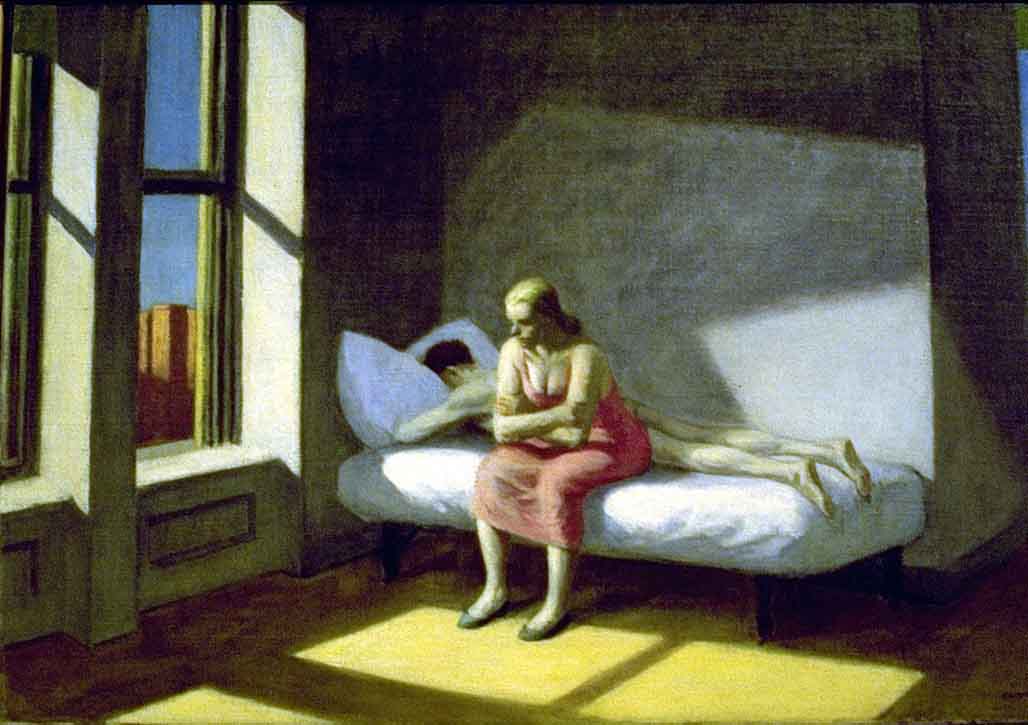 |
| Edward Hopper “Summer in the City,” 1949 Oil on Canvas |
My aunt invited my grandparents, parents and me over for dinner today. It wasn’t a special occasion or anything, she just bought a ton of groceries and decided to cook, and asked my dad to pick my grandparents up from their home in Cerritos on his way home from work. Dinners like these are a combination of things: an effort to eat healthier (my aunt cooks mostly vegetarian), to spend more time with her parents in addition to the countless hours they spend on the road and at various hospitals, and to spend more time with me. At least I like to think so.
A few years ago I would have shook my head no thanks, opting to stay at home or go out with friends, but in the past year and a half that I’ve been living at home I find myself looking forward to them. I like my aunt’s cooking, despite her dishes being bland and often, unsightly (lord help her presentation if she uses soy sauce or eggs). What’s more, there is the odd family practice of not really paying any attention to the younger generation. Growing up our family celebrations at restaurants and even at home were firmly divided into two tables: adults and kids. There are ten cousins and about as many adults, and my father was usually in charge of ordering for both tables. Thinking himself “hip” to what young people wanted, he would throw a fried noodle, rice or orange chicken dish in at the end of the meal at the kids table, assuming we’d go bananas over that stuff. (Most of the time, we were too stuffed to make a dent and he’d come over and help himself to a bowl, having wanted it for himself all along.) I think even now, with some of my cousins approaching forty and with kids of their own, we sort of still expect to be sat at a table together, separate from our parents.
These days at my aunt’s house I’m just one “kid,” and therefore expected to sit at the table with the “adults,” but their attention turns to me only when they’re concerned that I’m not eating enough or can’t reach a particular dish. It’s not strange until I think about how old I am and, according to society’s life map, where I’m supposed to be. I should be working late or perhaps out with my long-term boyfriend or, if I were married, home readying dinner for my husband and my own kids.
Instead I sit, eat, and listen. They talk about the dishes and how they can be improved (my father and grandma are most voluble when it comes to these matters). They talk about their mutual friends – who has cancer, whose children are getting married, whose parents are aging and on their way out, and who is a little miffed with whom but just too polite to say so. They talk about grandma and grandpa (if grandma and grandpa aren’t present) and their progress and about new and unborn babies, and how different child-rearing is nowadays. They love their children, but sometimes, in the lifestyles and within the marriages themselves, have a hard time recognizing that these children, now adults with houses and children of their own, came from their bodies.
It’s not a bad thing. None of it is bad – and they speak of these things in a matter-of-fact way, between bites of bitter melon, egg and tomato stir fry, pickled cucumbers, pan-fried rock cod, chicken curry, and yam leaves. They are both aware and unaware of time and how fast things change. When my grandparents are present you see on their faces everything that’s being said, those very changes that took place over all the long decades of their lives: the wars and revolutions, the migrations from there to there to here, the marriage and miscarriages and finally the births of these children who branched off into their own full lives with their own migrations and marriages and careers that enabled them to buy large houses in leafy suburbs and eggs in cartons of eighteen. They’ve done their share of fretting over their children. I guess, when you’re eighty-six and your back hurts no matter what position you’re in and you’ve tried every drug in the world, you sort of just realize, “Hey, life is short, don’t try to control what you can’t.”
And my parents and my aunt, they don’t try to control what they can’t. At least not anymore. All the variables have grown up and moved away. I’m not supposed to be around listening to these conversations, where they basically review everything they did right or wrong over the course of our young lives, but I am. What I’m listening to are the memories and realizations of retired tiger moms and formerly stern fathers (not my own, but my grandpa, certainly) who have pretty much stepped back and said, “They, my children, are no longer my responsibility. They have their own lives and I have mine.”
I’m learning a lot – but mostly that life, depending on how you look at it and how you spend it, can be quite short. Or I guess to be more optimistic: it’s long, but it goes by damn quickly.
Case in point:
After dinner my grandma wanted to poke around my aunt’s yard. My grandma loves gardens and plants and she loves to comment on other people’s plants. We encourage this behavior because it means my grandma is doing something somewhat active, even though my grandpa is always in a rush to go back home where he does nothing but sit and stare at the TV or listen to a wailing Beijing opera. We don’t understand his rush to do nothing, but at the same time this sort of pointless impatience seems to afflict most elderly Asian men I know. I think they were programmed to return home to their couches and beds. Anyway, this evening my grandma got up from her chair and walked to the back door.
“It’s so cool here by the door,” she said and without further ado, stepped out without her cane.
“Your cane!” my aunt said. I was done eating by then and rose to bring grandma her cane. I didn’t have to go very far, and since I was already there at her arm, I decided to walk out with her.
It was ten degrees cooler outside now that the sun was lower in the sky and I was instantly glad I had stepped out of my aunt’s warm kitchen. There was a soft breeze, coupled with the smell of grass and whatever plants my aunt kept on my left, that made the air so fragrant. Slowly, we walked around the kitchen window and came to my aunt’s garden patch. I smiled as my grandma poo-pahed my aunt’s plants, laughing at the scrawny tomatoes and tiny apples, but I could tell she was pleased that her eldest daughter, formerly a super successful real-estate agent who couldn’t keep a houseplant alive, now kept a garden at all. (Amusingly, my grandma kept on saying, “Your little garden,” even though my aunt’s yard is roughly, the size of my grandma’s entire house.) Aside from the fact that if my grandma had taken a fall I would have been the one responsible, I felt, standing there by her side, quite young and child-like. I had gone out barefoot and left my phone inside. My parents, aunt and grandpa were still inside chatting and finishing their meal, and for a few minutes it was just me and grandma in the garden.
We didn’t say much, I just stood by and watched her examine a leave here and there. Despite having no strength in her legs my grandma was quite strong in the arms and leaned heavily on her aluminum cane as she reached for a young fruit or browned, dead leaf, which she would pluck off with surprising vigor and thrust to the dirt. Eventually she decided my aunt’s garden was not hopeless and kept on walking beyond it to the pool, where two old lawn chairs sat side by side. She poked at one with her cane and, deciding that she didn’t care about the crusty bird shirt that covered the edges, sat down after bending her legs for what seemed like five whole minutes until her bottom touched the beige mesh of the chair.
She sighed and looked up at me, then twisted her neck around as though realizing for the first time that she was in her daughter’s backyard, “It’s quite nice here, isn’t it?”
It is, I said. Seeing that Grandma was safely seated, I stepped into the pool, wanting to cool my legs. I kicked a bit, stirring to the middle fallen leaves that had collected around the water’s edge.
“Oh my goodness!” my grandma exclaimed, “You kicked out all the dirty things.”
“They’re just leaves, Grandma,” but it was still light and I spotted my aunt’s pool net. I got out of the water and grabbed it, then tried as expertly as I could to gather up all the leaves I’d caused to float to the center of the pool.
“You missed a spot.”
I turned around. My grandfather had come out too and was standing at the opposite end of the pool, near the spa with one arm behind his back and another stretched out and pointing at the water.
“Got it,” I said, and moved to clean the area.
“Maybe you could work for your aunt and clean her pool,” my grandpa said, and chuckled to himself. What a jokester.
“I could, but I’d like to be paid in cash and not in vegetarian dishes,” I said.
He laughed, then walked around to where his wife sat. He bent down to brush the seat off, then sat down gingerly, wincing slightly as the crick in his back acted up.
I put the net down and walked over.
“Are you comfortable?” I asked, already knowing what his answer would be.
“At my age, there is no comfortable. There is only bad and not too bad.”
“Well, hopefully you’re not too bad.”
“Not too bad,” my grandpa nodded.
We sat, the three of us – they in the lawn chairs and me on the floor with my legs in the pool for the better part of an hour, talking about my cousins and their children, and guessing at who would marry next.
“You need to find someone,” my grandma said, then she thought about it and said, “Well, don’t rush it. It takes time to find someone really good.”
My father came out to take a phone call and we could hear his voice breaking in and out over the white noise of a garden in the evening.
My grandma turned to look, “Who’s he talking to?”
“He’s on the phone,” grandpa said.
My grandma looked at me, “Not sure what you, your mother, brother or what your grandpa and I did in our past lives to get a father, husband and son-in-law like him, but we are very blessed.”
I laughed. So I’ve heard from them many times.
My grandpa nodded in agreement, and for the next few minutes we didn’t say anything. Suddenly the pool lights came on along with the waterfall. My aunt had turned them on via remote control from her study. I waved at the window and saw a slim white arm wave back. The pool light, chosen by the previous owners who had no doubt predicted wild booze-filled pool parties, glowed in a myriad of garish colors: red, blue, white, then green. Silently we watched the water change colors, pausing just a few seconds on each hue before slowly changing to the next.
The three of us watched the colors change as though in a trance until my father finished his phone call and came to join us.
“I saw you clean your aunt’s pool.”
“Yup.”
“I told her she could clean her aunt’s pool for a living,” my grandpa said again, and my father laughed.
“Oh no,” he said, “She’s going back to school. At least, that’s what she tells me.”
“That’s the plan,” I said.
“Good, good,” grandpa said, “School is always good.”
My father scoffed, “Yes, but this one doesn’t study. I’m worried I’ll be throwing my money away. She majored in English and all she ever did was read a few novels.”
I shrugged.
“Saying you study is like watching ghosts fight.”
I thought my father was saying something poetic, about how a writer’s struggle is invisible, and for a minute I thought he was coming around. That he understood that my “studying” or “working” wasn’t always something you could chart. But just to make sure, I asked.
“What does that mean?”
“Have you ever seen ghosts fight?”
“No.”
“There you go.”
I rolled my eyes. What was there to explain? Nothing really. It was a nice evening. We had just eaten a healthy, home-cooked meal. I had just cleaned my aunt’s pool and was now sitting with my feet in the water. It felt good, and looking at my grandparent’s faces, they felt good too. My father, with his arms crossed and his phone back in his pocket, was smiling.
My grandpa must have noticed something then. The sun was nearly completely gone, but there was still enough light to see barely, the outline of their faces and mine too.
“You’re at your best right now,” he said suddenly, “this is your best time.”
I wasn’t sure what he meant: was he referring to my youth or intellectual potential or fertility? Maybe all three. Was it warning? Or perhaps in the dimming twilight my grandfather had briefly forgotten that I was twenty-six and spoke to me as though I were still a child, having just left the children’s table to accompany them to the edge of the pool.
I didn’t know and there was something about the moment that told me not to ask. His statement had been issued and I could do with it what I wanted. I kicked my feet up a bit and caused the water to ripple. The lights changed again, then again, and again, casting a glow on all our faces, sometimes warm and red, sometimes a cool blue and white. I wondered if the pool light had a sensor. If I jumped in, would the lights stop changing? Probably not.
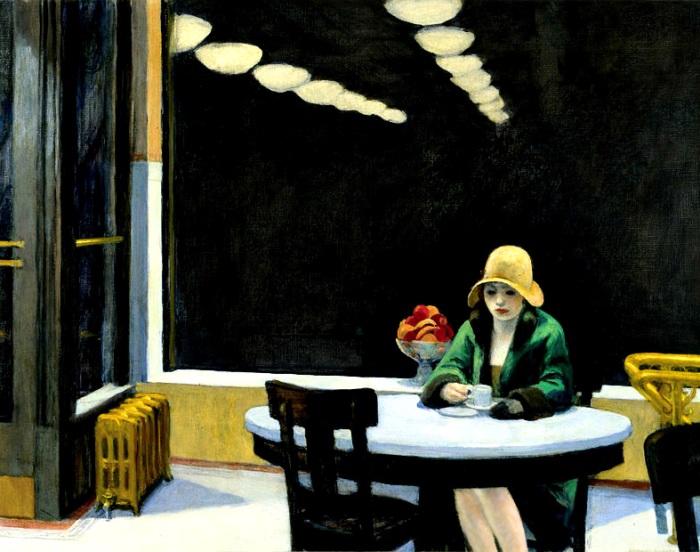 |
| Edward Hopper Automat 1927 Oil on Canvas |
The child was not easy. She was often sick, wailed at all hours of the night and for some reason, flinched at her mother’s touch. Continue reading “Distance”
Less than two months later the woman learned that she was pregnant and a collective sigh emerged from the breath of all those involved, namely, the woman and her husband. He came home from work early the evening she found out and held her hands tightly and looked at her in the same way he’d looked at her when they were still sweethearts in college. It stirred her heart, this look, and made her love her husband more. She felt proud, like she did when she was a little girl and brought home accolades from school, and her parents beamed but were not too lavish with the praise. They knew too much praise for tiny accomplishments would only lead to a lazy child who expected it.
Now however, the woman felt a strange sense of triumph, that she had somehow overcome an impossible obstacle. She knew nothing of medicine or the mysteries of what made this particular pregnancy possible, but she understood that it had felt like an impossibility for the longest time and now, here she was, sitting in her husband’s tender embrace, the beginnings of their child floating warmly in the womb.
It was not an easy pregnancy. She tossed and turned and suffered violent nausea that rocked her entire frame, which seemed to simultaneously swell up and diminish. How her back ached! How her feet hurt! How her stomach churned and churned! Had she not known any better she might have suspected that she was slowly being poisoned to death, but of course she said none of this to her husband, who although still spent much time away from home, was quite attentive when he returned, always making sure to bring her some sweets or noodles. Often she did not feel like eating, but her mother and her mother in law would tsk tsk and made sure she ate half her weight’s worth of herbal broths and such. They brought over entire chickens cooked in ginger broth, the pale, plucked skins of which sickened her to look at but which she ate dutifully, knowing it was for the baby. She put on twenty, then thirty pounds and by the time it was revealed that the baby was in fact, a girl, the woman could hardly recognize herself in the mirror.
A girl! The girl was safely tucked away in her mother’s belly, unable to see the ensuing disappointment on her parent’s faces, but perhaps she felt something – an intangible but audible rhythm that sprang from the valves of her mother’s pulsing heart, reverberated down the maternal spine and through the uterine wall; a miniscule shockwave, barely detectible except to the thin, translucent membranes of a developing fetus. The baby did not yet know the word “disappointment,” but she felt it early on. It was uncomfortable. In response, she kicked and kicked. The woman winced. A girl! This child would not be easy.
A mother ought to love her child, regardless of its sex, unconditionally. The woman knew this, but when the girl was born and placed into her arms, she was only exhausted. The labor had been brutal, nearing 32 hours. At one point the doctor had feared the baby would stop breathing and they would have to operate.
“It’s as though she doesn’t want to leave,” the nurse said.
The woman moaned through gritted teeth, “No, no,” she gasped, “She wants to kill me first.”
But both mother and daughter survived and the baby emerged shrieking, a loud, siren-like noise that seemed to belong to a much larger animal.
The woman leaned back into her pillow, relieved that the pressure she had felt for the past day and a half was no longer there, still unaware of the pain and discomfort that lay ahead. Beneath the sheets lay a bloody mess, but at least the baby had all ten fingers and toes. At least she was intact.
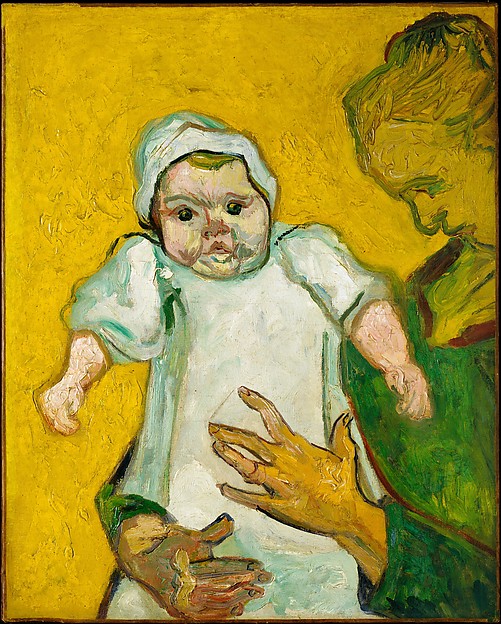 |
| Madame Roulin and her Baby, Vincent van Gogh 1888, Oil on Canvas |
Her mother placed her hand on her daughter’s warm forehead, brushing away the matted hair, “She’s a good girl,” the mother said, taking the baby from the woman’s arms, “She looks just like her father.”
The girl’s father was away at the office and would see his daughter a few hours later. He would take the little girl up in his arms and smile a contented smile – true, he had wanted a son, or did he? It wasn’t typical for a man to admit, but he had rather liked the idea of having a daughter – here was a person you could spoil and place upon a pedestal rather than worry if he, a son, could live up to your accomplishments. The man was still a young man at that point but he had foresight – just as he knew he had chosen a suitable and obedient companion in the woman, he knew he would be tremendously successful in his business ventures. It wasn’t a doubt he had ever experienced – he did not have the luxury of doubt. And now he had a daughter upon whom he could shower the spoils of his success. What a princess he held! His princess. His mother in law repeated what she’d said to her daughter and he nodded, looking into what might as well have been a tiny mirror. She did look quite like him.
It occurred to her some years later that at some point early on in the marriage the lovemaking had turned loveless, and that their only child had been conceived in such a perfunctory manner. It made sense then, did it not, that her relationship with their daughter was strained.
When their plans to have children began to form, she realized she was not the kind of woman who longed to have children. She could easily have lived the rest of her life with just her husband, singing to him alone, though lately she had seen so little of him she began to consider teaching choir at a nearby middle school.
But the woman was dutiful if nothing else. There were aging parents on both sides pestering them for children and at twenty-four her clock, though inaudible to her, was ticking. As husband and wife they knew the importance of working on a schedule and they approached it with the diligence they had both applied to their college entrance exams. The woman recalled this time with mixed feelings: she never felt closer to her husband, never saw more of him than at this moment in their lives. He came home, still exhausted from work, but rather than falling immediately asleep he came to her first.
He wanted a son; she could see it in his eyes. And because it was what he wanted, it became what she wanted. Each night and morning she bit her lip and willed herself and all her necessary organs to give the man a son, to give their parents a strong, healthy grandson, and to give herself – though she didn’t know it then – a companion. She imagined walking up and down the street with their toddler son while her husband worked and the neighbors nodding and smiling, “Now that is a handsome little boy,” they would say, “he will grow up to be tall and strong like his father, and shrewd too.” She would buy him little suits to wear at Chinese New Year and take him to lunch with his grandparents. He would enroll at the best schools, and perhaps take up choir too, but only if his father saw fit.
And slowly, this little boy yet unborn became as concrete as the man sleeping next to her. He was not an abstract thought – she could see his large bright eyes, the thick dark hair, and almost feel, when she clutched her husband’s back, the soft baby flesh that would come from the very same flesh.
Instead, weeks, months and then a year went by. She gave him nothing.
Her mother intervened, taking her daughter to the best Chinese doctors, acupuncturists and herbalists. The fortuneteller told the woman not to worry, she could conceive. Her husband’s business would flourish. They would have many houses, all over the world. He would invest much into this child.
 |
| The Fortune Teller, Charles Edward Halle, (1846-1919) |
“The child, our son,” the woman said, looking at the fortuneteller with imploring eyes.
“I cannot say,” murmured the fortuneteller, “but you have so much to look forward to. It is a good life, by anyone’s measure.”
On her way out of the fortuneteller’s office the woman stopped before the altar where the Bodhisattva Guanyin stood, looking down upon all who needed her. The woman did not like the gaze of this particular sculpture, Guanyin had an air of smug arrogance. What did this porcelain statue know and what could she give? The woman was dissatisfied with the answers she’d received. She had prepared a red envelope of eight thousand to give as an offering but felt that the fortuneteller’s answers were not worth so much. Things were supposed to get better, but her womb was still empty and her husband had less and less to say to her. She knew her husband’s business would do well – after all, he spent nearly all his breath there so that by the time he returned home he hardly had a word left for her. Whatever common ground they had shared was slowly disappearing so that the only thing they shared was a bed, if barely, considering the late hours he now kept entertaining his buyers. Furtively, the woman slid two fingers in and removed two crisp thousand dollar bills then placed the envelope in a the wooden bowl at Guanyin’s feet, next to waxed apples and fragrant oranges. Guanyin’s expression did not change but behind her the fortuneteller shook her head. Two thousand dollars. Was that the value the woman placed on truth?
She came from a fairly well-to-do family and was used to certain things. With this man she could see that materially, things could only get better. He had drive – her parents often told her this was more important than coming from a wealthy family, from where the children often lacked ambition and direction. The woman pitied the girls who had failed to find themselves husbands and for the first time she did not focus all her energies on her studies or even choir practice. Her grades slipped slightly but it didn’t matter. She quit trying to give weight and shape to the abstract career thoughts; instead, they took another shape altogether, that of the man she loved and the life they would lead together.
She and her beau spent hours discussing their future, strolling down the palm-lined walkways of their prestigious university on warm summer nights. Other young lovers walked the same paths at the same hours, but when she was with him she felt the path was theirs alone. The street lamps shone solely upon them, like spotlights on a stage that every young woman her age longed to be on. She would turn to look at him under the lamps’ soft glow, not saying a word as he talked animatedly with his hands about the businesses he wanted to start – something about computer parts or panels, she didn’t really understand and instead was mesmerized by the sheen of microscopic sweat forming on his brow and temples. The angles of his face glowed with promise. Such straight teeth! Such bright eyes and strong hands! She felt beautiful in his presence because she felt lucky – she was not picky with men and she did not need to be. He had selected her – of all the roses in the school, he had chosen her.
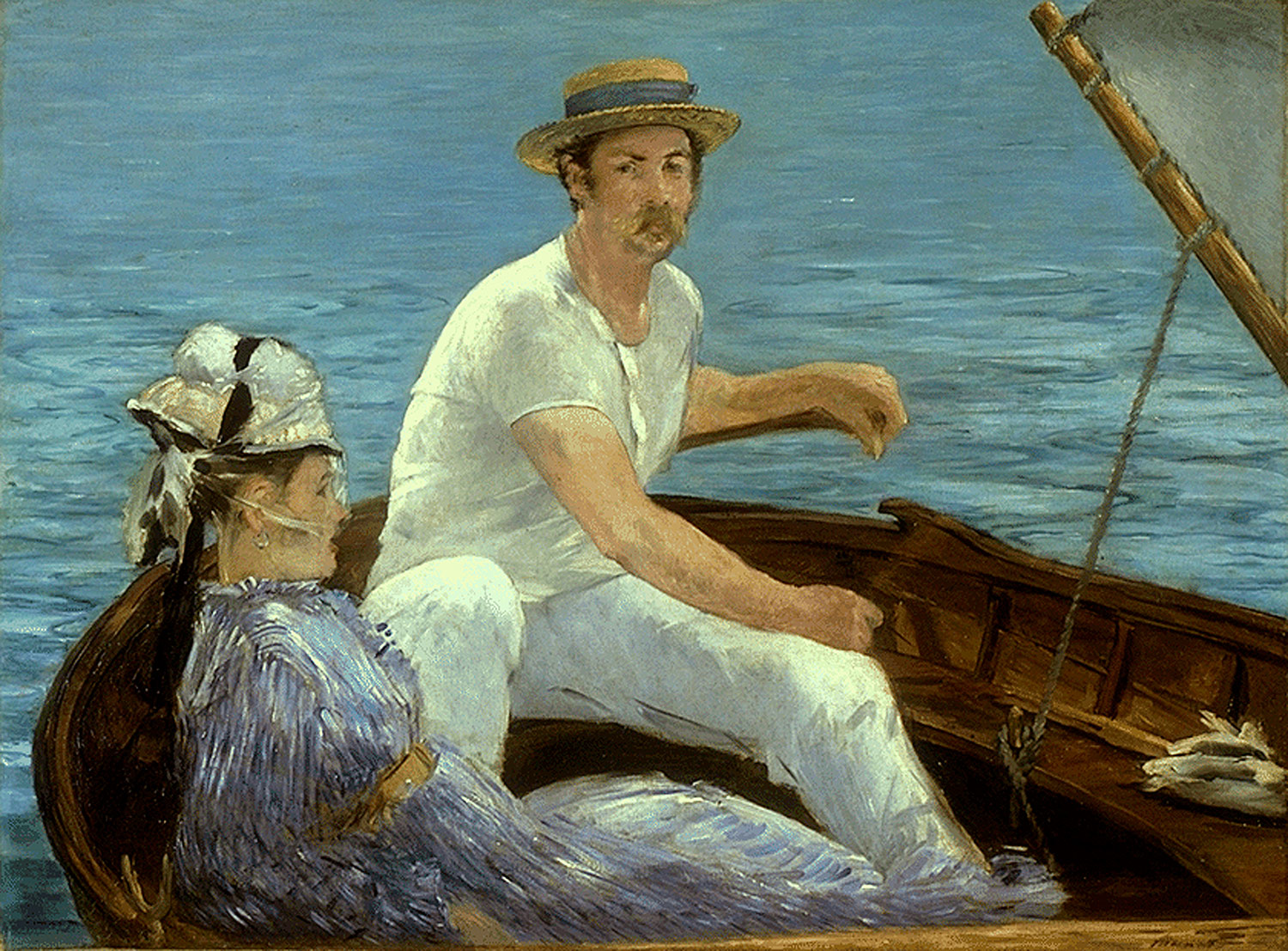 |
| Boating, Edouard Manet, 1874 Oil on Canvas |
They graduated, already knowing they were to marry. He made his intentions clear to her parents and they nodded, seeing the same promise their daughter saw. They gave them their blessing and showered the young couple with a borderline lavish ceremony. It was, the woman thought, one of the happiest days of her life. But that night she lay awake next to her toast-drunk husband and thought, “Why happiest?” She was so young. There was so much ahead of them. Things could only get better.
And for a while they did. His career took off with flying colors – he was a shrewd business man, unafraid of hard work and sacrifice. He made it very clear to his wife that it was for both of them. Within the first year his business doubled then tripled and showed no signs of slowing and the woman smiled contentedly, thinking herself his lucky charm. She let him leave her for long hours because in the beginning it was just him and a handful of his partners, none of who were married so they could stay late at the office without worrying about a wife waiting at home while dinner got cold. She understood these things, and anyway it didn’t matter; if he came home late – which was often – she would simply reheat the dinner she had cooked. She gave him no advice, took no role in his business – she had no head for such things – and sang to him when he returned home exhausted from work. Only once, when he couldn’t sleep for one reason or other did he ask her to quiet down. The other times his sleep was so deep he did not hear.
When did things begin to change?
When does any marriage begin to change?
When the woman could not get pregnant.
The woman tried hard not to cry, though it was apparent she’d been holding all she’d wanted to say inside for a long time. I know the feeling – when you’re exhausted and filled with unhealthy thoughts, the very littlest invitation to release can send you sobbing up a storm – but the woman, extremely self-conscious, knew she couldn’t just lose it in the middle of a badminton club. She stifled her tears, steadied her voice, and began to tell a story both my mother and I have heard many times before from the lips of other women, all similar in age, all immigrants from Taiwan.
She had come Stateside some fifteen years ago with her high school aged only daughter. In Taiwan, the girl had done poorly in her freshman and sophomore years and showed neither signs nor interest in improving. School wasn’t her strong suit, she said, and her mother shook her head. She knew the system was unforgiving and except for the diligent few that could study and study, shame inducing. At the end of every term their scores were posted alongside their names in the school courtyard for everyone to see. That was the system. One learned to work within it, with it, and if not, well hopefully you were someone else’s daughter. But it was her daughter having the trouble and the woman didn’t need to see a fortuneteller to know that if they stayed in Taiwan, what lay ahead for her daughter’s academic future was a dismal dead end.
The woman herself had been somewhat of a teacher’s pet. She sang alto in her school choir and marks-wise, consistently ranked in the top five percent of her class. She was industrious and diligent, her parents’ pride and joy. Around school she was recognized as such. She attended an all girl’s high school and though she was friendly enough, had no close friends. The choir was an unlikely breeding ground for competition, but it was one of the few places the girls could exercise talents other than who could sit and study the longest. The woman didn’t realize until years later how much or why she loved to sing, not until she woke up alone in a bed her husband had shared with her only once, in a large empty house halfway around the world. But in high school and then college, singing was just one more thing she felt, and rightfully so, that she did better than others.
She was not a great beauty, but always held her head high and sat with a straight back. The other girls thought her rather uptight, but there were always a handful of such girls at every school. She never laughed loudly or spoke out of turn. Sometimes the wild way certain other girls talked and laughed, throwing their heads back and baring all their teeth, gave her shivers – where they ladies or not? She felt sorry for their mothers. When she had a spare moment from her studies and various activities, she thought about having a “career” in an abstract sense, but never sat long enough to give it shape.
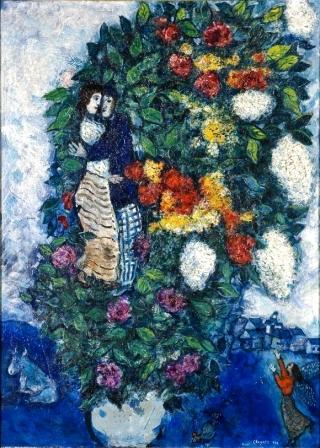 |
| Marc Chagall, Bouquet of Flowers, 1937 Oil on Canvas. Private Collection. |
When the time came to prepare for her college entrance exams she doubled down on study time, shut herself away and read until the prescription of her eyes grew more and more severe. To celebrate her inevitable success – admission into Taiwan’s top colleges – her parents awarded her with a new pair of glasses. They were considered a splurge at the time, Italian frames fitted with special thin lenses that masked the severity of her prescription, but their daughter was a rose on the edge of blooming and college was where such blooms were picked.
And picked she was. Reaped, more like it. She was not a particularly romantic woman, but she met a young man who showed a hunger for success and was not afraid to work for it. He wasn’t like so many of the other girls’ boyfriends she heard about in dorm gossip. The man called often and though he had very little money to spend taking her out, often said she was good for him.
“We are partners,” he would say, “I can tell a woman like you will bring me success.”
Partners. Fifteen later it would seem like a cruel pun.
 VERY HIGHBROW