Post-op

My grandmother had her left breast removed yesterday afternoon and is now camping out at the Taipei Veterans General Hospital, a towering behemoth of health care as well as neglect (though because of population and shortage of health staff, there is not much to be done). My grandma was lucky and went under the knife far more quickly than anticipated, as it seems much of Taiwan seems to be waiting for some procedure or other, but the doctor came and informed her that she is to be discharged this afternoon. They need the bed, he said, you’re going to be in pain either way, so why not choose home?

Though I could see my grandmother’s fill with doubt and fear – what does she know about nursing her own gaping wound, I see his point. The hospital – all hospitals, it seems – is filled with people. My grandma is on the tenth floor, yet on my way down in the elevator, we stopped on every floor and always, a crush of people waited to get in, to get out. Walking down the corridors, I couldn’t help but peak in every room, and just like a run-down hotel in a good location, they were all filled. People both old and young, upbeat and down-trodden. Life and not so much life.
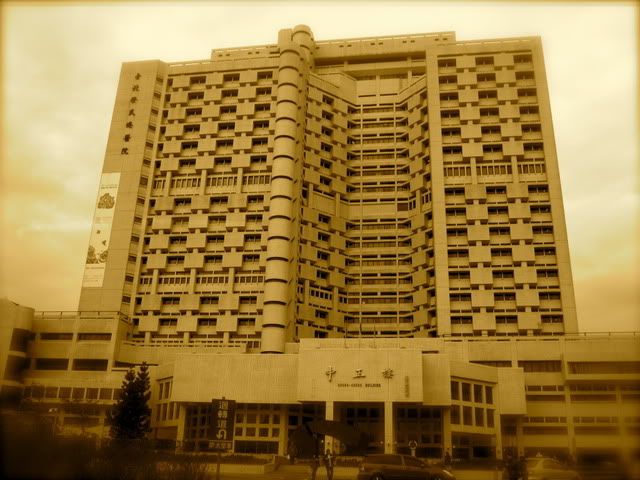
   The hospital’s main building.

The hospital’s seal. The word is rong and it means “glory and honor.” Rongming (榮民) is the phrase for “veterans,” meaning, honorable people who served their country.

The hospital’s lobby with a giant Taiwanese flag, just in case patients wake up on their way in or out and forget where they are.
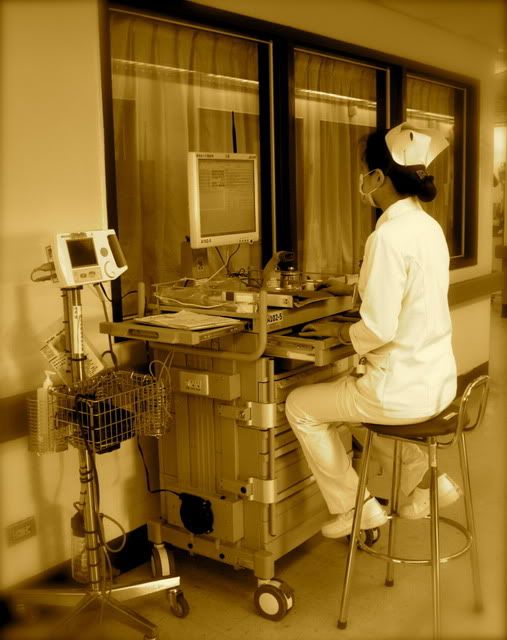
I got a kick out of the young nurses in their clean, white uniforms and their little hats, pinned to their hair. They are all very nice, soft-spoken young women, often cowed by the doctors.

The motto on the nurses’ carts. Is this true? I think so.
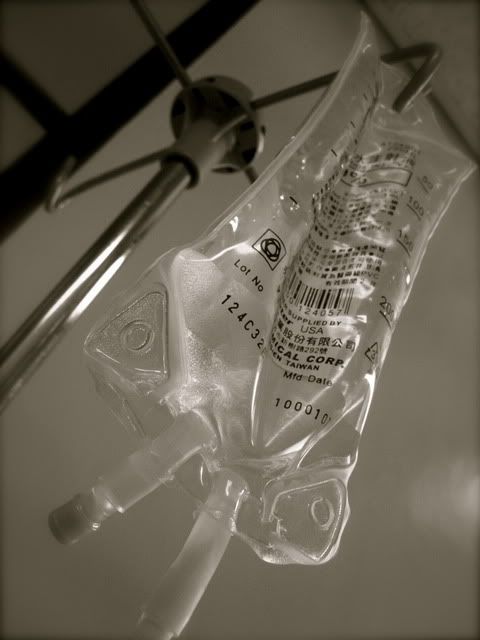
                       Chinese IV.
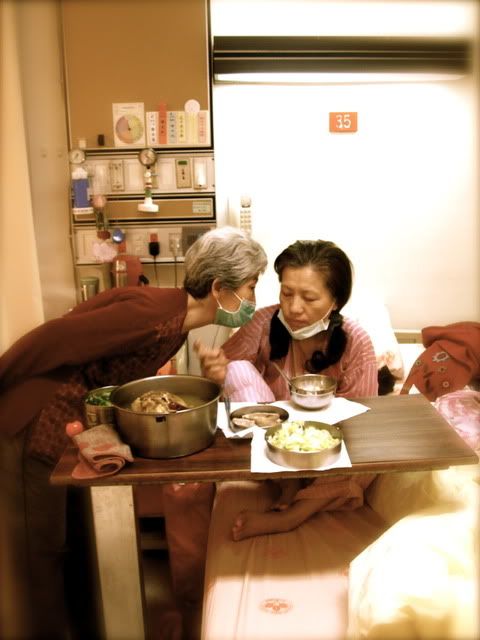
My grandma’s older sister, bending over to whisper something. When I asked U.S. medical students interning in Taiwanese hospitals what the biggest difference was between health care in the U.S. and in Taiwan was, they replied, “The role of family.” Taiwanese hospitals let families take a much bigger role in a patient’s wellness – but I think this has more to do with the culture as well.
A Sunny Day in Taipei

My first week here was extremely cold and I found myself regretting my decision to visit Taipei during the winter. Houses here – or our house at least – have no heat. Couple that with our new tile floors and with my aunt’s ardent belief that all windows must be kept open for constant circulation, well, you’ve got yourself a veritable ice box.

Somewhere in the middle of the second week however, temperatures became bearable (15 to 17 degrees Celsius) and then, a few days later, almost warm. The sun made its first appearance since my arrival at the tail end of Chinese New Year celebrations and my aunt, uncle and cats were eager to soak up the warmth. Now, the temperatures have dropped again and I am shivering, wondering if I’ll ever come back around this time of year. No matter, I can still revisit some recent, warmer memories…

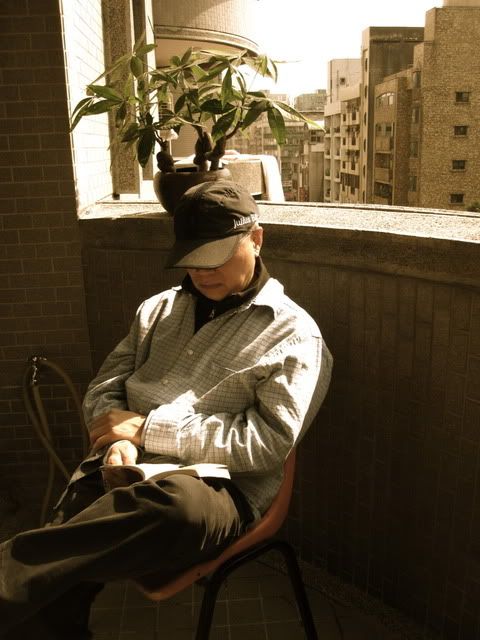
               My uncle, reading on the balcony. On weekends he prefers Buddhist scriptures and meditation to finance books and magazines.

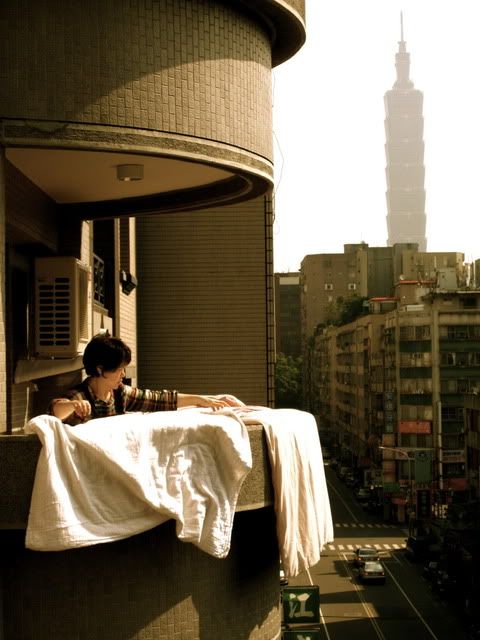
On the balcony over, my aunt spreads our blankets out to sun, believing with the rest of Asia (regardless of how smoggy their cities are, Asians prefer air-drying to dryers) that the sun’s rays kill germs.

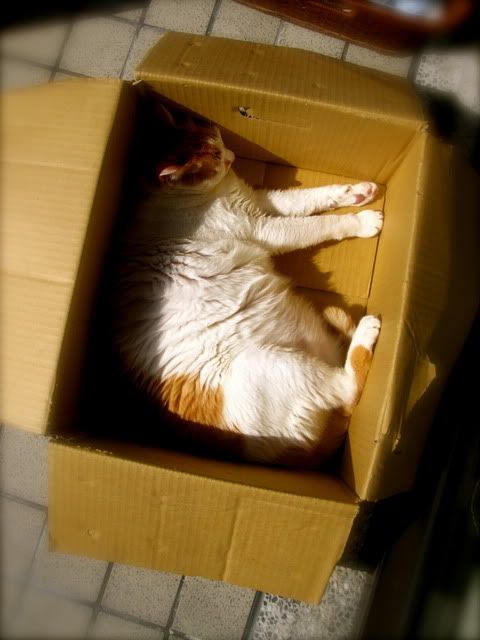
And at my uncle’s feet, Fat Cat (there are two cats – one fat, the other less so and called, unsurprisingly, Small Cat) suns in a cardboard box.

Taipei International Book Expo

Sorry for the long absence – I was wondering why (and smirking at) so many people were dressed like bandits and surgeons when I first got off the plane so it was only natural that I find out the hard way. I contracted the flu that’s been going around and while I didn’t get it as bad as my cousin (who’s been sick no less than three times in two months) feverish headaches are the surest way to neglect one’s blog. But the fever’s gone and my desire to walk about and be a part of the community has returned – though no doubt by refusing to wear a surgical mask I risk picking up another one of many flu strands that are going around…My visit to the Taipei International Book Expo yesterday, a Sunday, was probably going right to the disease’s center, but I love books – and I like to live on the edge.

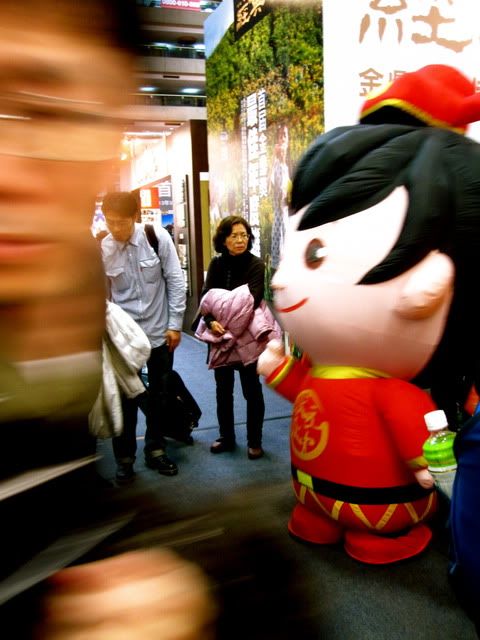
 Chinese/Taiwanese people love cheesy animal mascots – but I did like the artwork on this particular poster.

Ladies chatting on bright orange stools – not really reading. This was the booth for LiveABC, one of Taiwan’s largest publishers of English language learning materials.

 As I was flipping through this book a young sales girl came up to me and marketed rather aggressively, not giving me a chance to impress her with my English. I left with a brochure and the inability to socialize in English with confidence.

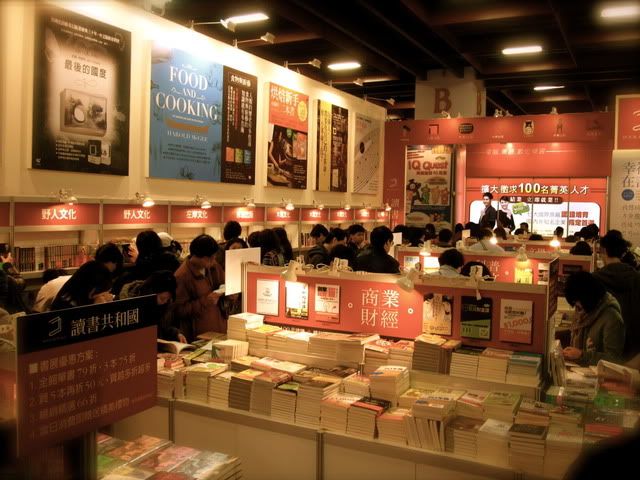
 The expo was packed – except for a few of the international booths (India and Turkey looked especially desolate while France and Japan were equally as crammed as Chinese language booths).

                       I have never heard of this magazine. Good luck to them and their stylist.

                       The expo atrium.

                      Never figured out what they were promoting.

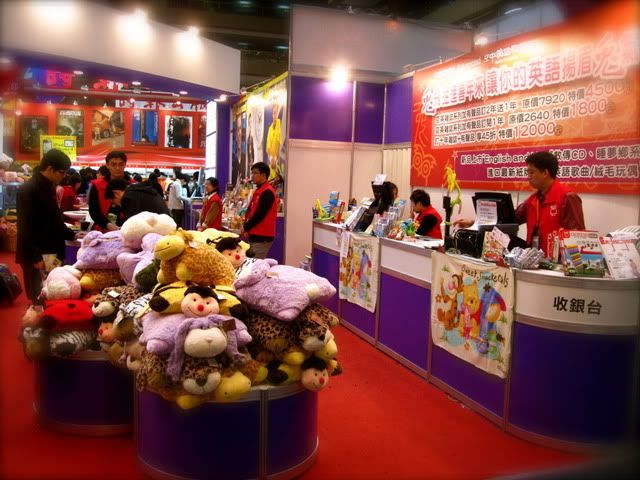
The booth for Studio Classroom, an immensely popular and effective English language learning magazine. I have no idea what the stuffed animals are doing in the middle…

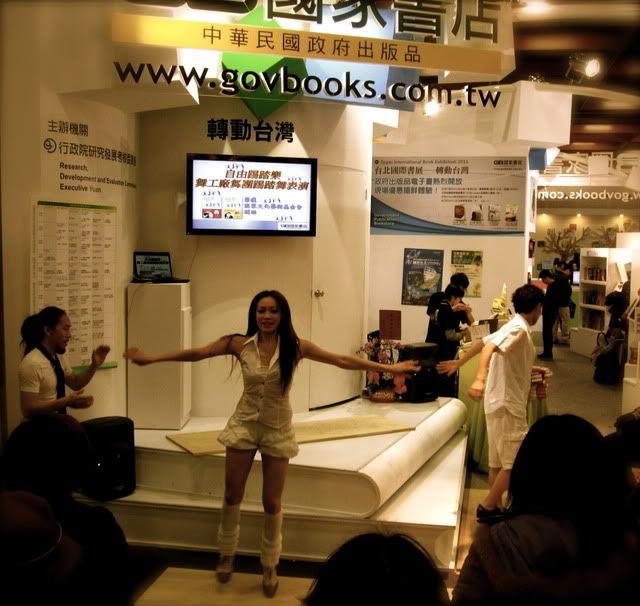
 …nor any idea what tap dancers are doing promoting government publications…

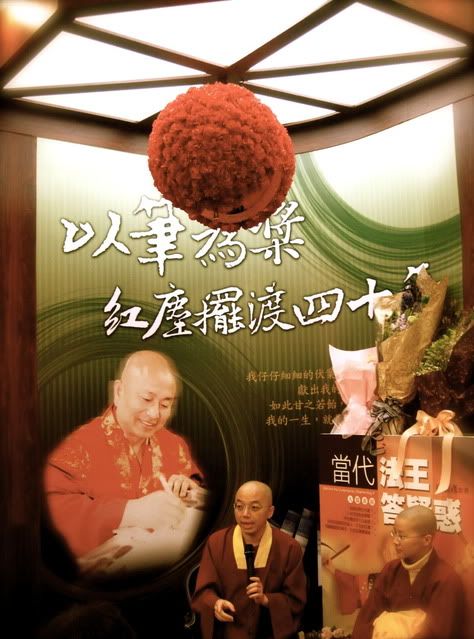
                       …or what this guy was talking about to attract the large crowd that stood before him, but these were just a few of the thousand plus booths I walked past.

I ended up buying just one novel at an English books booth after deliberating for more than ten minutes and reading for twenty. I’m a sucker for Victorian murder stories.

Just Another Day in Taipei…

Only in Taipei would I ever spend the morning at the temple and go straight to karaoke with my cousins. My grandfather’s name, along with those of our ancestors, are placed at Zhao Ming Temple in the outskirts of Taipei City. It’s a low-key temple, nestled in hills of Yang Ming Mountain.When I say “name,” I mean a placard that is meant to represent the spirit of these ancestors. A family buys the placard from the temple, which promises to keep it until the temple itself is demolished or destroyed. If it is not there materially, the name exists in spirit.

And when I say “low-key,” I mean, it’s not a garish temple outfitted in gold and marble. The nuns don’t all have their own laptops nor do they have a queen bee nun that is driven around in a bullet proof Mercedes (there are plenty of these “humble” religious leaders about in Asia). The temple is run by a handful of elderly nuns and their fresh-faced disciples, and all share in the household duties and worship services. They cook and serve meals on special occasions such as funerary ceremonies or on the first day of the new year, during which many families choose to eat vegetarian. After lighting incense for our ancestors and the deities that watch over them, we dined at the temple. We can choose, if for some reason the temple no longer pleases us, to move the placard to another temple, but at present we are very pleased with this one. Its name, Zhao Ming, means “Divine light.”

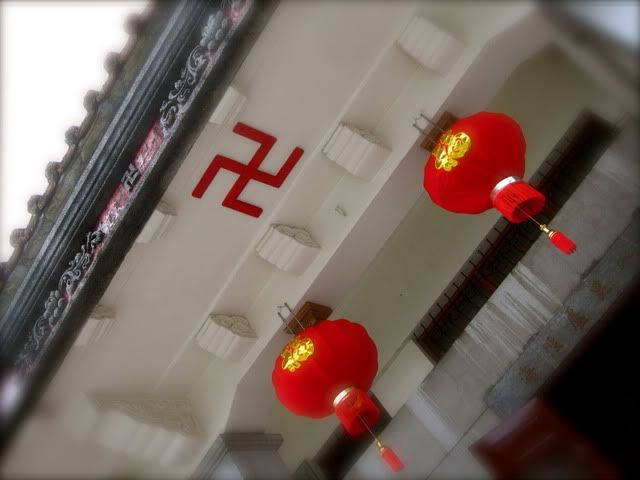
 The temple’s exterior.

It is the swastika, a word derived from the Sanskrit word “svastika” meaning any lucky or auspicious object. Buddhists believe it was stamped upon Buddha’s chest when he died and they call it the heart seal. You’ll find it on temples all over Asia – the Nazis have nothing to do with it. Hitler, after much deliberation, decided to use the Swastika on his flag to convey “the mission of the struggle for the victory of the Aryan man, and, by the same token, the victory of the idea of creative work.” Whatever.

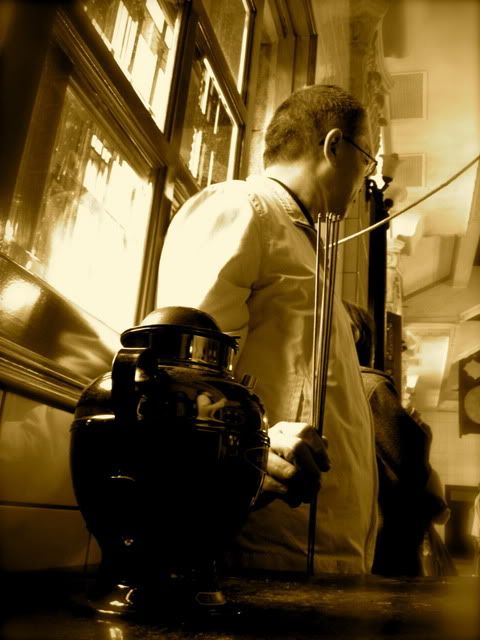
My uncle, holding his incense and waiting for his turn at the altar.

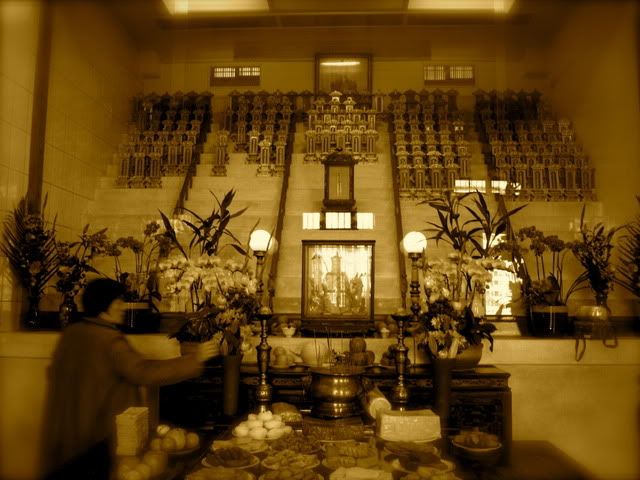
The altar for ancestors. Each placard represents one family. The food on the middle table is prepared by the nuns. After it is offered, they eat it. The side tables are meant for families to place fruit and other goods. Normally, after the fruit is offered, it is left there for the nuns to eat, but on the new year, they make an exception. Families take the fruit home for themselves because it’s lucky to eat on this day.

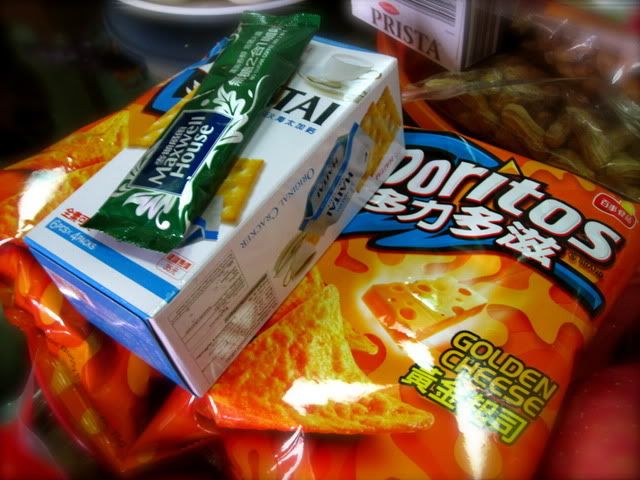
And because some kids don’t like fruit, no matter how lucky it is, parents make the most out of the situation…

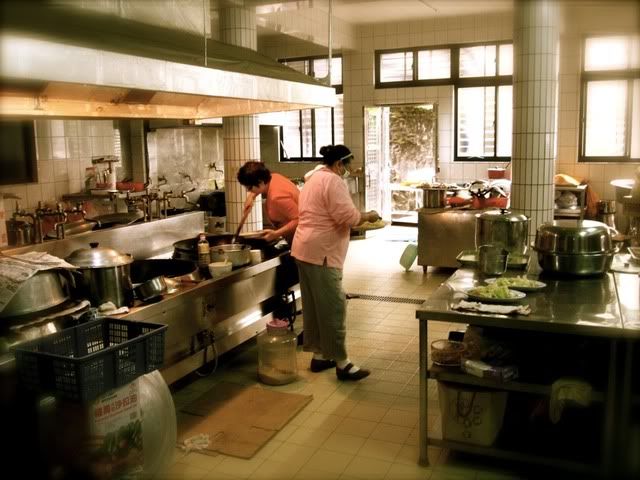
Volunteers cooking in the temple kitchen. No animals killed or cut in this kitchen ever. Truly vegan.

Our vegetarian lunch – less exquisite than New Year’s Eve dinner, but no less delicious, and far more refreshing.

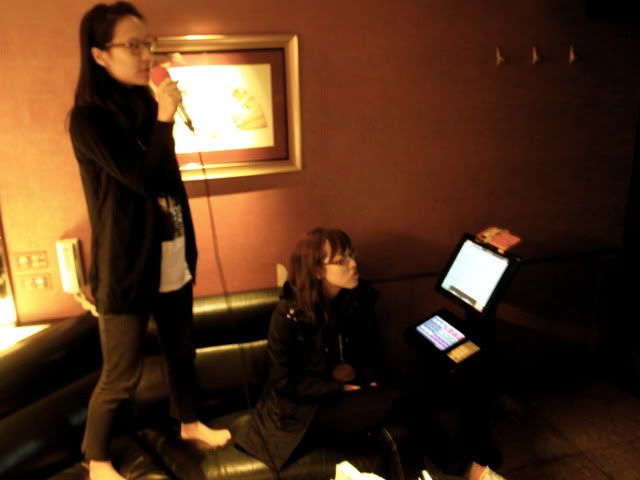
Karen and Melody – my cousins – singing in our tiny private room. Karen went from being one of those, “Oh I can’t sing, don’t make me sing,” girls to a mic hog that now jumps up and down sofas.

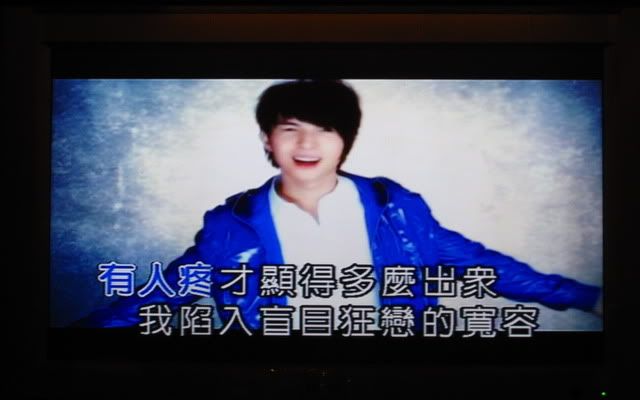
Taiwanese super idol. I have no idea who he is.

But I know who she is…

And that’s how I spent the first day of the Chinese New Year.

Goodbye Tiger, Hello Rabbit

Chinese New Year dinner was held earlier this year, and rather than two tables, we had just one. It is my first year in Taiwan without my grandfather, but looking around the table, I realized it wasn’t just my grandfather who was missing. Two great uncles had passed away shortly after my grandfather and my brother, my parents and two cousins were absent as well. At first I feared it would be one of those quiet, awkward dinners – with people keeping their heads bent low over their plates to avoid talking – but this is the Ho family dinner modus operandi: eat first, talk later. And as long as a few key players are present (namely, my aunt and two cousins), there will always be enough conversation to keep things rolling.

An hour before dinner, grandma and cousin Karen Skype with my brother, who is now in Shanghai. You can see his blog here.

My uncle, cousin and aunt’s younger sister, who is visiting from Taichung, a city in the middle of Taiwan.

On our way to the bus stop. Yes, we took the bus to dinner. It was just down the street.

First course: fruit salad with shrimp and crab.

The restaurant: Chao Jiang Yan (it was Chao Zhou style food).

Shark’s fin soup, which makes me sad. I would never order it. But if it’s cooked and served, I’ll eat it. Just don’t expect to see this at my wedding banquet.

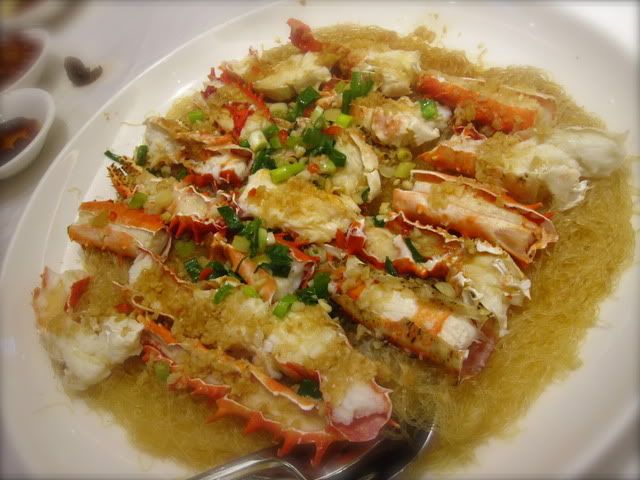
One of my favorite seafood dishes ever: steamed Alaskan king crab legs with garlic, ginger and served atop the best tasting vermicelli noodles ever. Sam Woo’s in Irvine actually makes this too.

Grandma Zhang reaching for a crab leg. They are an interesting couple – thoroughly Americanized (they both speak impeccable English and have jobs at the American school – and their daughter teaches English in Ethiopia. Every year,  I exchange one or two sentences with them and learn something cool.
In the foreground is the menu, on display so that diners can read ahead and know how to pace themselves. I discovered the menu too late and by the time dessert came around, was really stuffed. Thank God for my extra stomach.

Stir-fried scallops, squid, and broccoli.

This is actually one of the small appetizer dishes that are just put out on the table. We had a debate about it until the manager came to settle it for us: half the table said it was some sort of jelly, made to look like fish skin while the other half insisted it was fish skin. The manager said, just as I put it into my mouth, “It’s fish skin.” Tasted like crunchy jelly… it was good.

I don’t know about the rest of my family, but this was the savory highlight of my evening: sweet and sour pork surrounded by prawn, walnut, and mayonnaise wraps, fried and topped with crispy almonds.

Steamed fish, of which I just took the head. A Chinese New Year dinner would not be complete without fish. Chinese people love puns and “fish” is also a homonym for “happiness.” So eat the fish for happiness. (I actually forgot to eat the fish, I was so absorbed by the pork).

What we thought was the last savory dish: abalone mushrooms over spinach – don’t be fooled, this stuff is amazing.

Then there was a mix-up in the kitchen and we received an extra dish – banana-leaf wrapped steamed chicken and rice. We assumed it was a gift from the manager and dug in. The manager rushed out and said, “Uh, oh…okay well yeah my gift to you guys…yeah, my gift. Happy New Year!” We were like, “Wow, great. Thanks!”

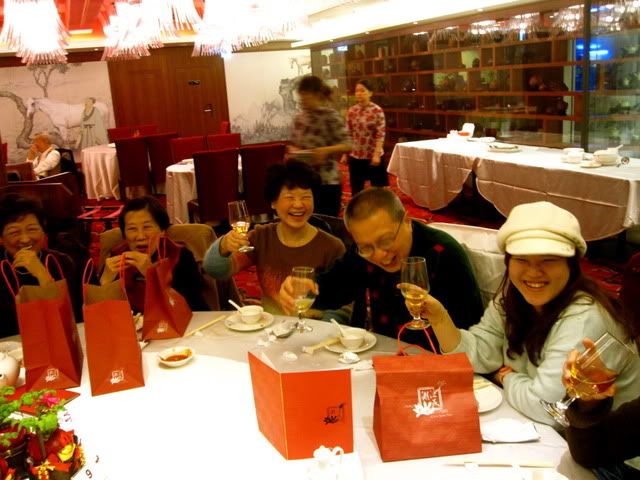
The group, smaller, but no less family – everyone’s visible except for my second uncle on the left.

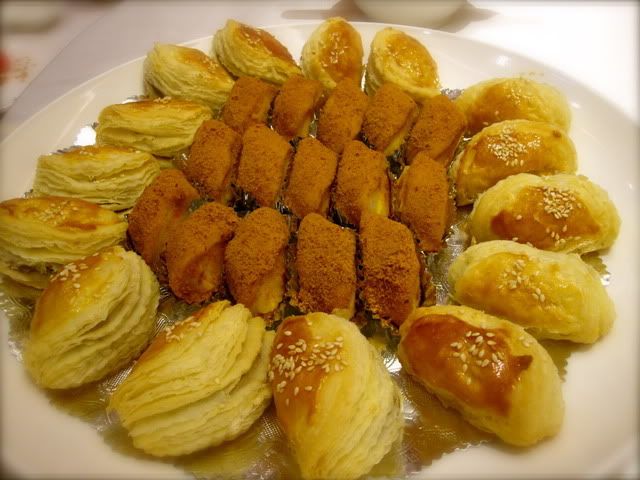
Dessert: mochi with yam hearts in the middle and curry pastries on the outside. Similar to some dimsum dishes – I think Chao Zhou is also in the south, close to Guangzhou.

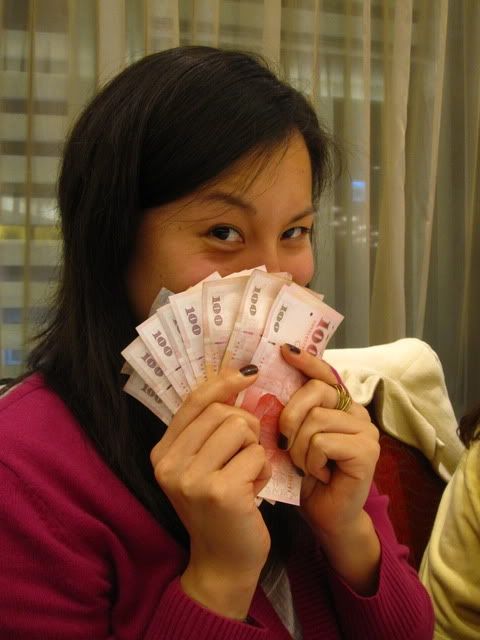
Posing with my favorite kind of paper. 100NTD = roughly 3USD. The manager, after giving us the chicken and rice, said, “You guys are a lucky table, you ought to buy lottery tickets!” There’s nothing like the lottery to get a bunch of Chinese people reaching for their purses and grinning big. Each one took out 100NT for a 1500 pot and we gave it to our great aunt to buy the tickets. Wish us luck 🙂

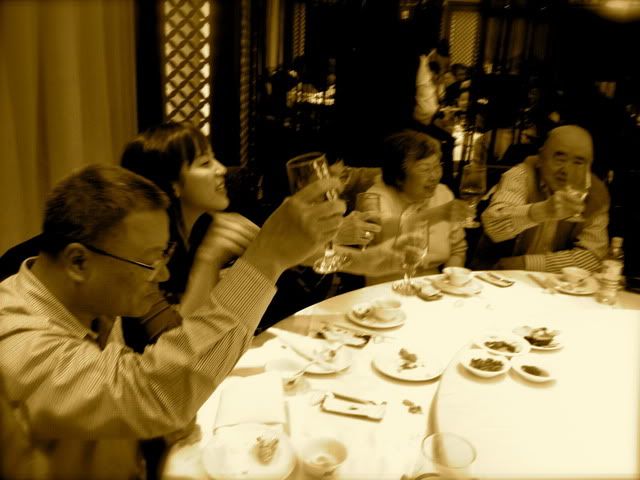
One of many toasts.

Another toast – to the New Year and to our lottery tickets. Just like that, another Lunar Year came to an end and we, grinning, welcomed the year of the Rabbit.

Preparing for Chinese New Year at the Hwang’s

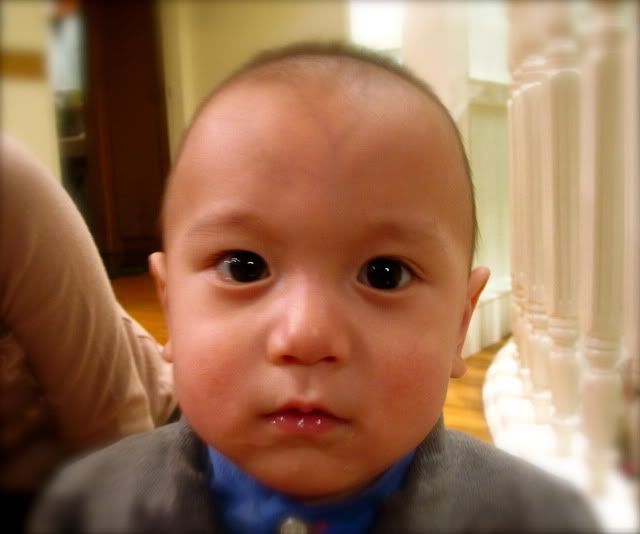
Longtime friends of my aunt and uncle, the Wang’s were finishing up some last minute Chinese New Year preparations when my cousin and I paid a visit to them last night, to visit this little guy:

Colin Chen, Mr. Hwang’s grandson. He’s going to be very handsome. I can tell.

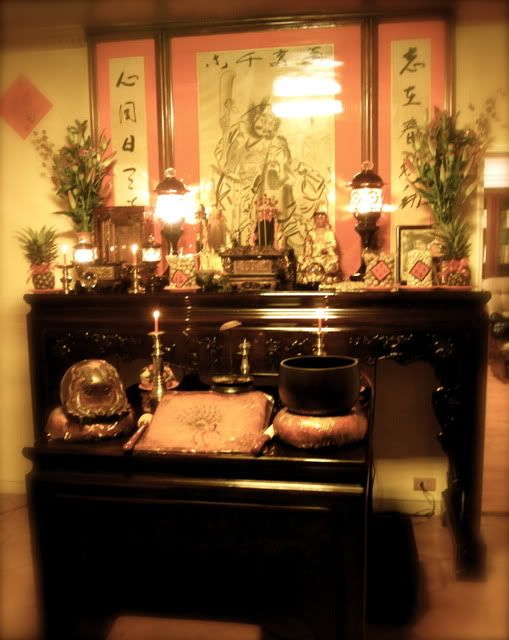
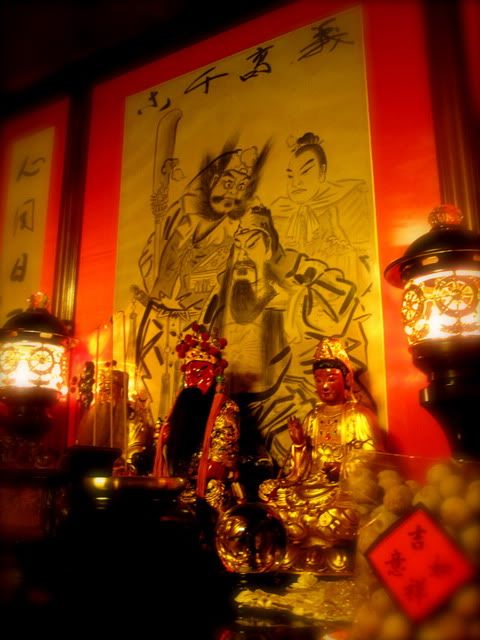
The Hwangs are a very traditional Taiwanese family and have an altar room in their house. In addition to weekly worship, Chinese New Year means a special offerings of fruits, nuts, and candies, all placed upon the altar. Mr. Hwang explained that they worship ancestors on the left and Guang Gong (關公), a Daoist deity, on the right.

On the front table there is a “wooden fish” on the left – a percussion instrument carved from one piece of wood, engraved with fishes. When struck with the muted baton next to it, it makes a crisp hollow sound which helps Buddhist and Daoist worshipers keep the rhythm of their prayers. On the right is a bronze bell. When struck, its resonance is meant to summon the spirits.

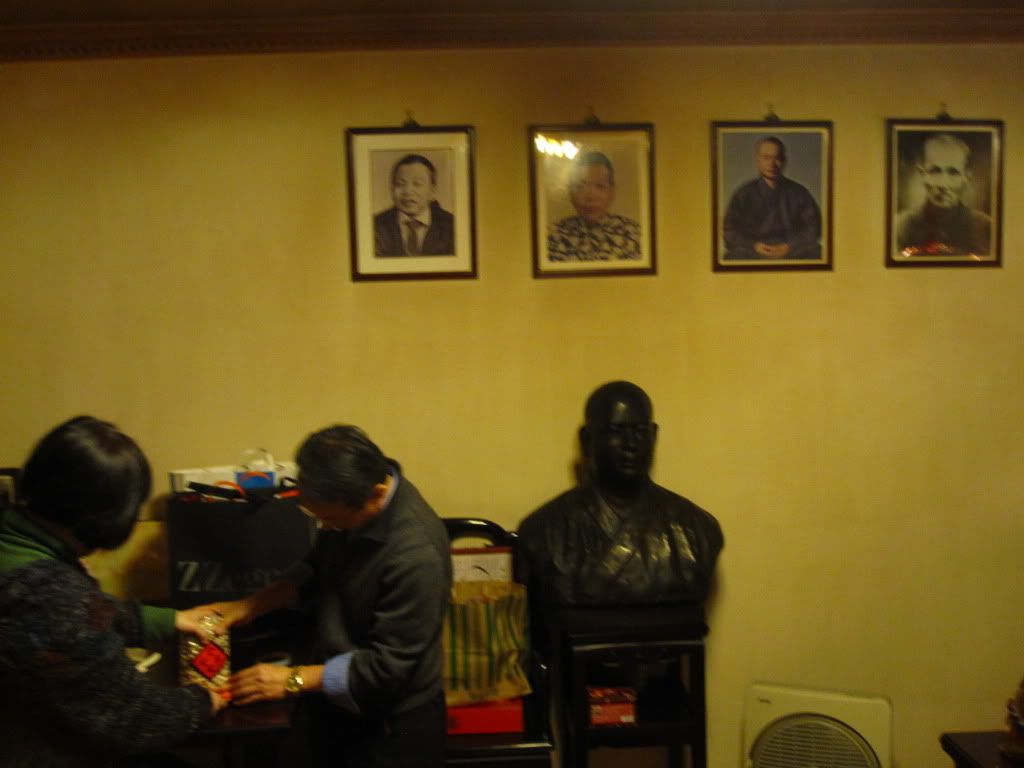
Mr. and Mrs. Hwang prepare goods on red plates to place upon the altar for offering. On the wall are portraits of Mr. Hwang’s deceased ancestors. From left: his older brother, who passed away at the age of twenty; Mr. Hwang’s mother, his father, and his grandfather. I forgot to ask who the bust is.

A close up of the wooden fish. No one in my family can decipher the second word (the first means “King”). I should have asked the Hwangs.

Guang Gong.

  
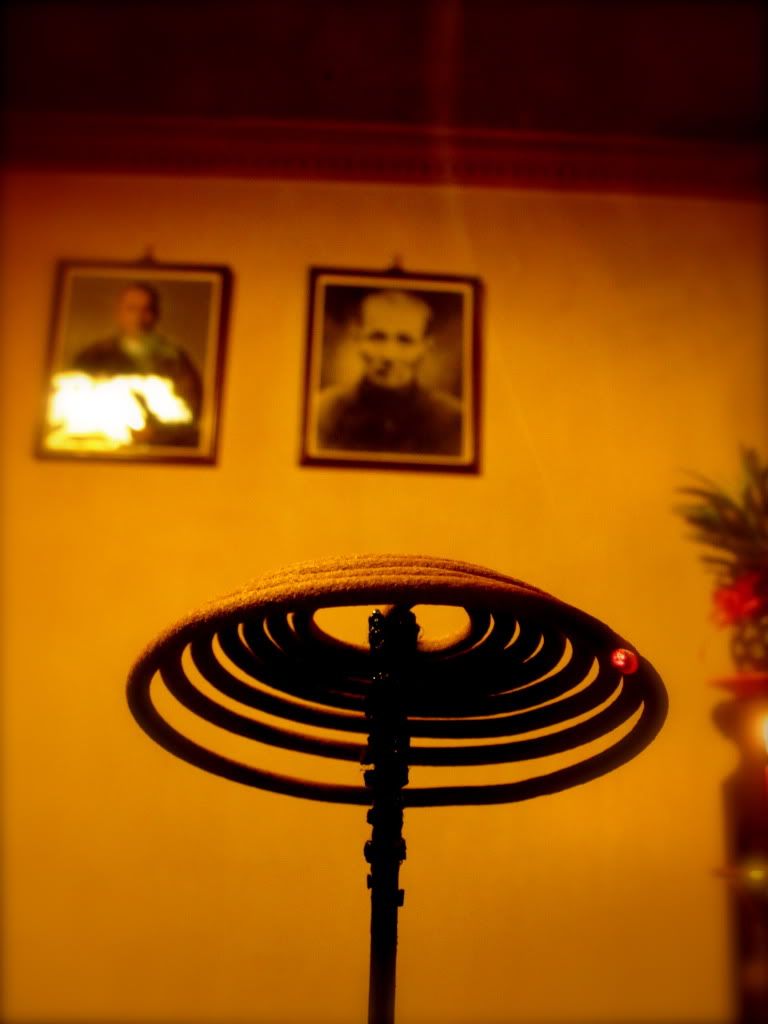
Coiled incense. 
Mr. Hwang and his spring posters: “fortune” on the left, and “spring” on the right. Traditionally, these are hung upside down on the front doors to signify the arrival of both. 
The beautiful red envelope Mrs. Hwang gave me. 
Now it’s time to prepare for our family’s Chinese New Year dinner. But I’ll leave you with this because everyone knows, babies bring good luck:
HAPPY CHINESE NEW YEAR!!!
 
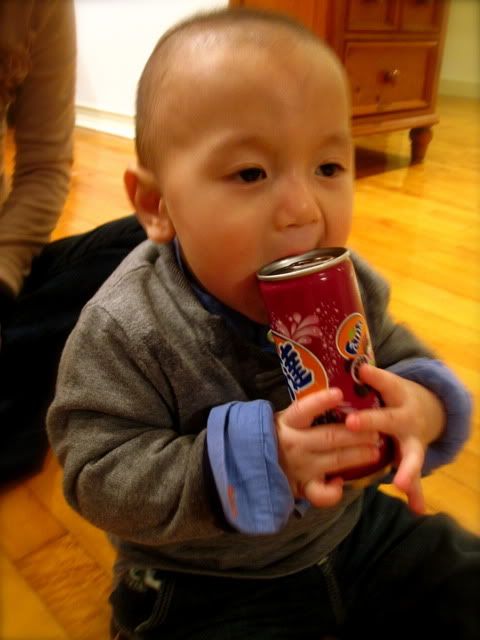
 FANTA!!!

The Perils of Consumerism

After my grandfather passed away, my family packed up their belongings and relocated to a new house across town. The idea was not to abandon our old home, a seven story building on a quiet street in a bustling part of town, but to renovate and move back in a year’s time. Most people know though, there’s nothing like a move to make you aware of how much stuff you have. Consumerism is a global epidemic and Americans are no less guilty of it than the Taiwanese, but because space is far more limited than the suburban sprawl of southern California – from the size of apartments to the width of the streets – the “problem,” (isn’t it a problem?) is paradoxically magnified. Pair this with the tendency to walk and take public transport and everyone’s shopping habits, however long the ride, are on display.

What to do, what to do? Nothing, if like what seems like ninety-nine percent of Taiwanese women and young men, you believe that retail therapy is the best therapy – a panacea for ailments such as a stressful job, broken heart, and worst of all, the green-eyed monster. In their small houses one can only hope they are organized or have the good sense to throw out or donate what they no longer need. If not, they might, during an earthquake, become victim to what my grandmother once joked as “the world’s most convenient morgue.”

And now: the Culture.

We start with things close to home: one of many drawers in my cousin’s closet. A penchant for t-shirts of any color. I folded them for her so that more could fit in one drawer and after having done so, said, “You cannot buy anymore t-shirts.”

 The as of yet unorganized storage room in my aunt’s house. When I first arrived, she opened the door to show me and shook her head, defeated, “Most of it is junk,” she admitted.

Somber Chinese paintings still waiting to be hung, some of which, because the new house lacks wall space (new cabinets to accommodate the stuff), will never be hung again.

The culprits. The instigators. The aiders and abetters.

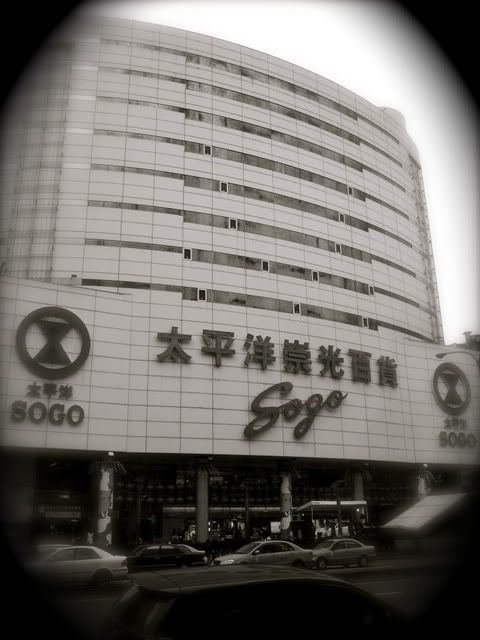
The original Pacific Sogo – a Japanese department store that despite its age, remains one of Taipei’s most popular if not THE most popular shopping destination. I ought to go right ahead and blame the Japanese, since most of the department stores here are of Japanese origin. In addition to Sogo (of which there are four in Taipei alone) there is Takeshimaya, Mitsukoshi, and the latest baby, Hankyu.

Even the ubiquitous 7-Eleven, founded in Dallas Texas, is now owned and operated by a Japanese parent company and stocked with Japanese goods. There is literally one of every corner. Sometimes, these convenient stores are the most dangerous places of all, especially when one is terrible at math and ill-informed about conversion rates. 

Fancy a drink? Good luck deciding.

 The Japanese really do take everything and make it better. I am addicted to the hot pot ones on the right. Addicted.

 FF for French Fries. Amazing.

 I am addicted to these as well. Damn the Japanese. Damn them! No, I take it back. I love these.
One of Taipei’s more popular bookstores (though the mother of all bookstores is Taiwan’s own Eslite Bookstore) is Japanese as well. In Kinokuniya, a woman skims a book she doesn’t need and if she buys it, won’t read (sometime I am often guilty of). 

But it would be wrong to blame the Japanese entirely.

Taiwan itself has its own national retail personality, comprised of a peculiar breed of shop: the tiny but exceedingly satisfying “We Sell Everything” hole-in-the-wall.

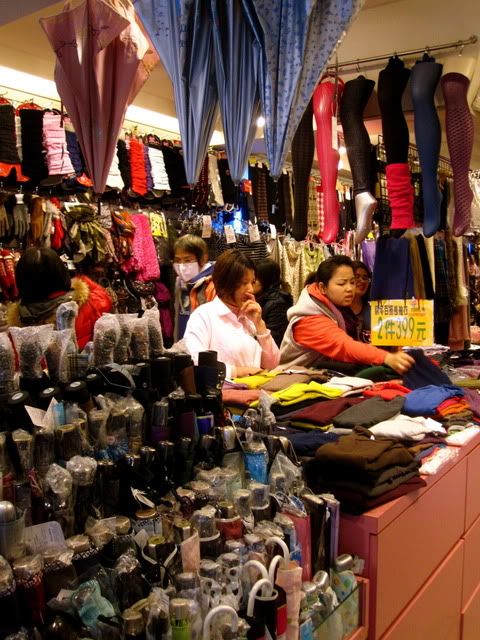
Socks, umbrellas, hosiery, and, towards the back, scarves, gloves, hats, bags…

 One of thousands, a random snack shop carrying everything from Japanese goods to cans of abalone, an expensive delicacy.

The victims:

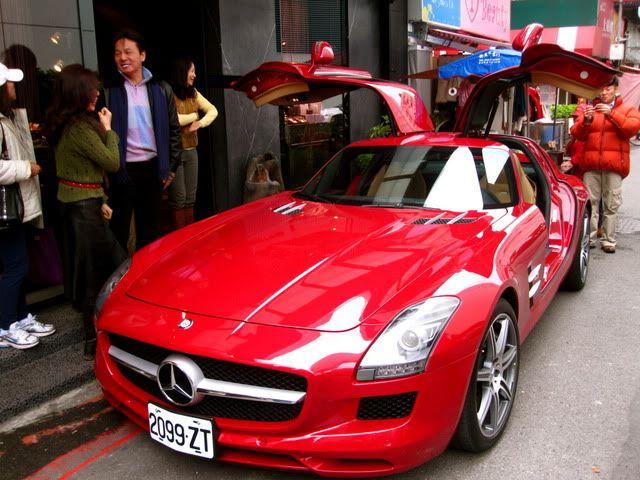
 This man stood proudly next to his car and told anyone who would listen how much it was. I forgot the number, it was so ridiculous.

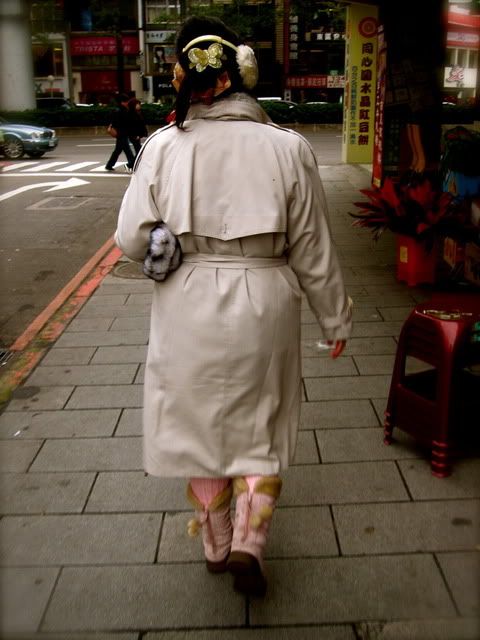
This morning she thought, “What should I wear today? Oh I know, EVERYTHING!”

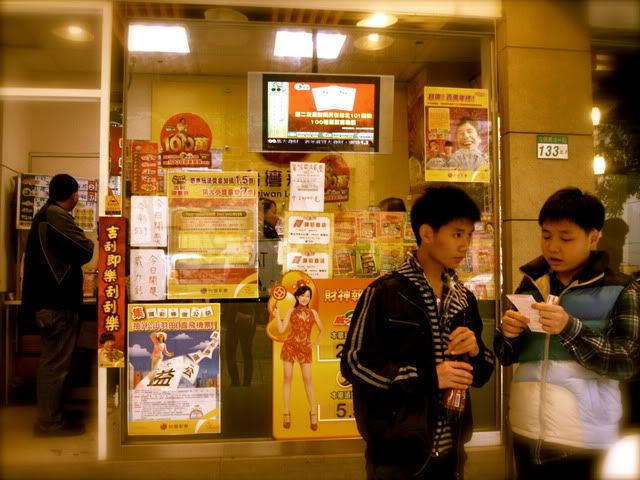
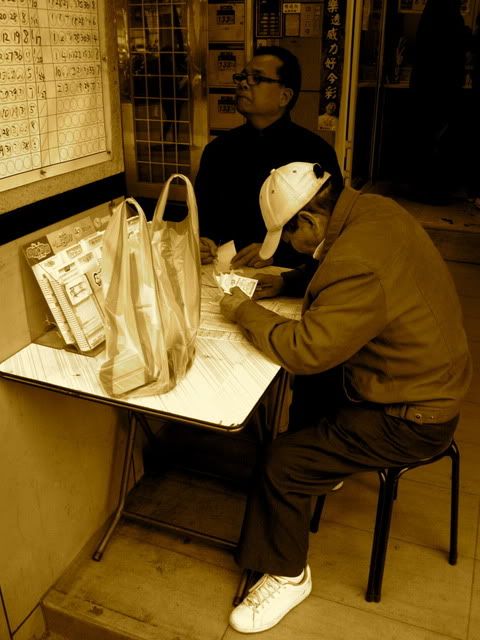
Young boys poring over their lottery ticket – big business in Taiwan – hoping to make it big the fast and easy way so that they might be like the man with the red sports car.

Older gentlemen wishing the same thing.

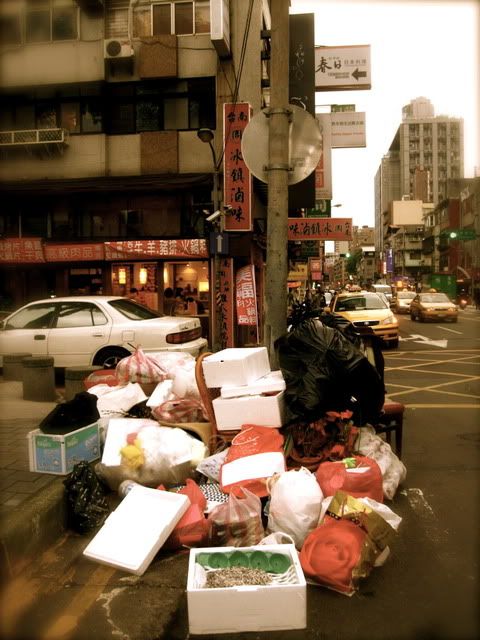
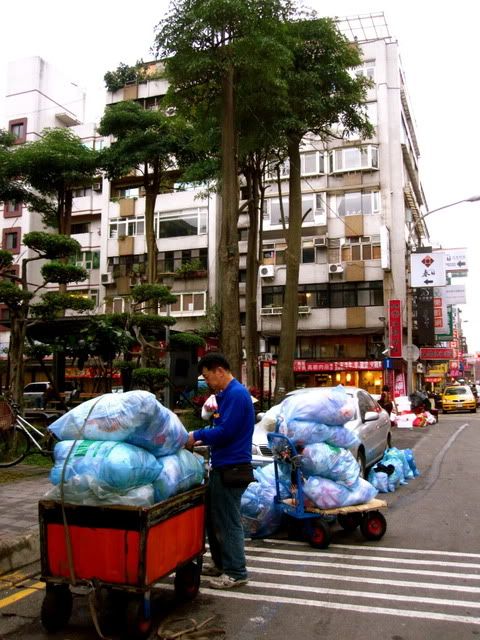
It doesn’t matter. It all ends up in the same place anyway:

Happy Birthday, Formosa

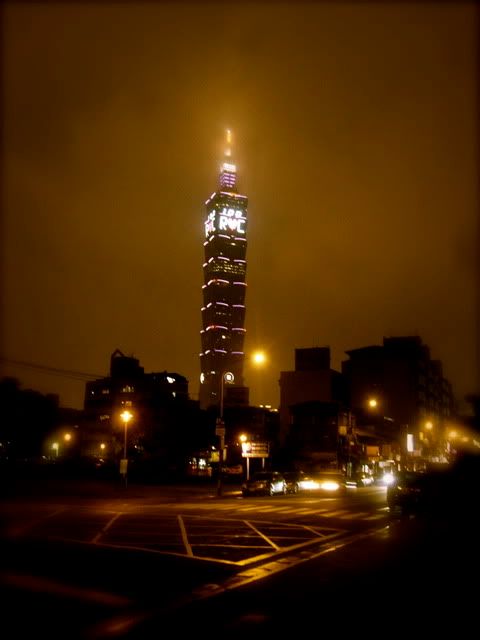
I never pay attention to things like this, but Taiwan turns 100 this year. Last evening I randomly accompanied my cousin to a company basketball practice and walking out, looked up and saw Taipei 101, formerly the world’s tallest building (that honor, I believe, now belongs to the Burj Khalifa in Dubai). I often forget that Taiwan is as young as it is, much younger than the United States. The humidity and smog – when it was bad – blackened the grout and discolored the porous tiles and bricks of certain buildings, giving them a gloomy, aged look comparable to people forlorn because they had aged prematurely. But contractors are getting wiser and more tasteful – now steel and glass are the materials of choice – or have long been, since construction on Taipei 101 began in 1999. I used to think the building was ugly, saying that it resembled a stack of take-out boxes, but now I cannot imagine Taipei’s skyline without it. Such things grow on you.

But that’s enough of an architectural digression – see for yourself.

To Market, to Market

When I was young, I hated going to the Taiwanese open air markets with my mother, preferring the air-conditioned grocery stores in the basements of department stores where produce prices would sometimes match that of the designer merchandise upstairs. During the summers it was hot and sticky and the market almost always guaranteed that your nostrils would be assaulted by a million smells from fish to pork to durian (the smelliest fruit in all the world and my mother’s favorite) and your face and vision by random billows of steam. Pushing and shoving in an endless train of other sweaty, shouting people also didn’t help, but somewhere between then and now, I grew up and while it’s not my favorite destination in Taipei, the open air market is one place where one can observe some of Taipei’s most interesting interactions: images of Taipei’s citizens from wealthy society ladies with their Philippino maids to aging grandmothers to young children dragged along by their young mothers, as I once was. People from all walks of life squeeze through, mingling and looking, all speaking the same language: food.

Now that Chinese New Year is fast approaching the markets are particularly packed with women (and some men, looking lost or hungry) on the hunt for the best meat, fish, poultry and produce to bring home so that they might prepare a meal whose quality rivals Taipei’s finest restaurants. Many families, such as mine, eat out, but it doesn’t hurt to stock up for those quiet days after Chinese New Year’s Eve, when groceries and markets close.

This is where I passed my first two mornings in Taipei: yesterday in East Gate Market and today in South Gate Market, one of Taiwan’s oldest open air markets, as old perhaps as the Republic itself. My aunt likes the company, though she complains that it’s rare for my cousin to go to the market with her. “You young women nowadays don’t know anything about picking produce and meats, and even less about cooking. I wonder what sort of wives you all will be.” I wonder too. My camera in hand, I touched nothing, occasionally bending down to take a macro shot or smell something. Most of the food was familiar to me, but only in that I knew how it tastes and not how it is prepared. My uncle laughed when I came home, looking slightly flushed from the crush of people. “To market, to market,” he said, “What’s tomorrow, West Gate Market?”

We’ll see. Here are a few photos from Taipei’s finest markets:

  
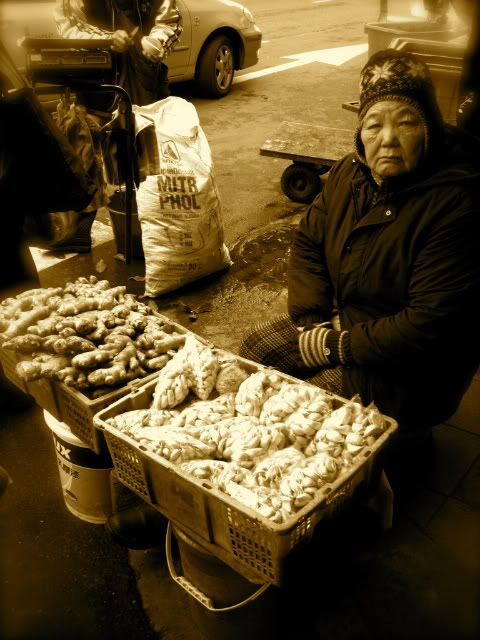
The Garlic and Ginger lady. 
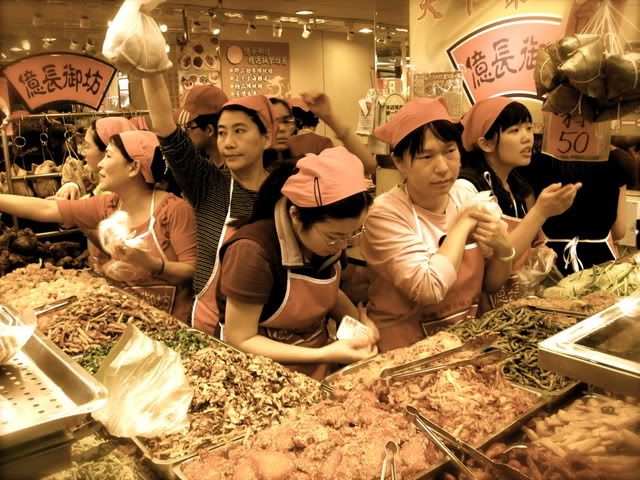
 Pink ladies – serving up some ready made, homestyle dishes for those ladies who, after shopping for groceries all day, will be too tired to actually cook them. 
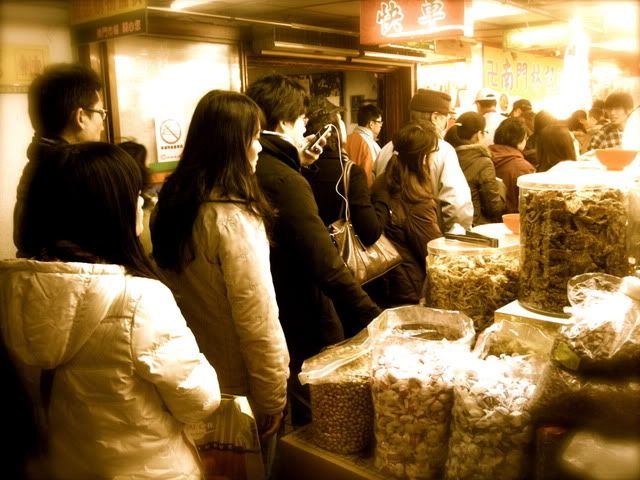
Faithful patrons waiting for their favorite brand of cured, dried pork. 
 One of many meat vendors, whose swiftness with their cleavers and calm amidst the chaos and corpses fascinates and unnerves me.
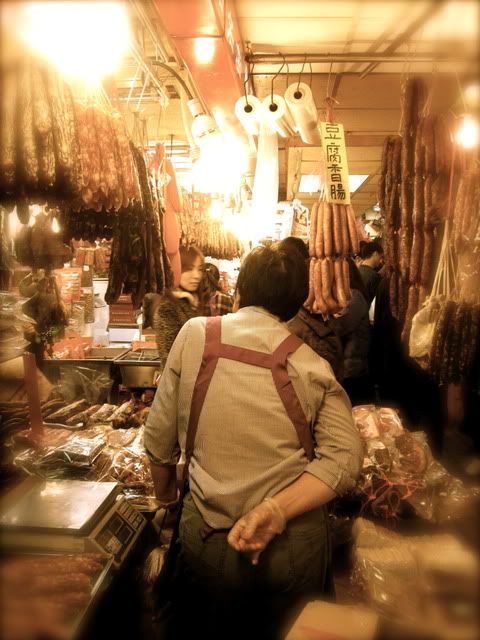
Her sister, the sausage vendor.
 At another sausage vendor, business is very good.
 Bright green chili peppers. After all that meat, some produce was refreshing.
A head above the rest. A colorful vegetable stand.
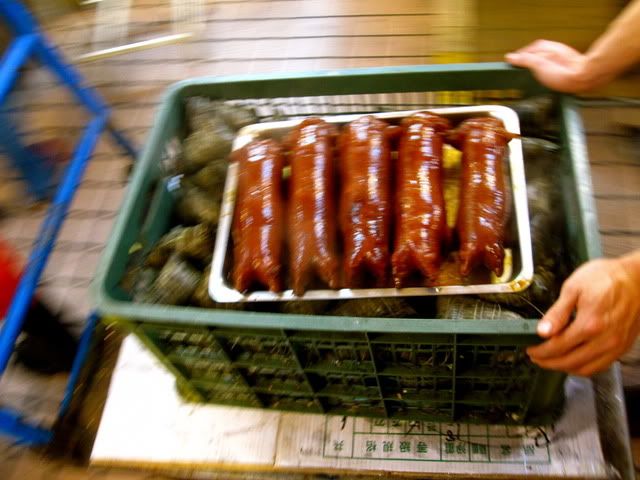
And then I turned around and saw this: a pan of roasted piglets… Just as quickly it was whisked away.
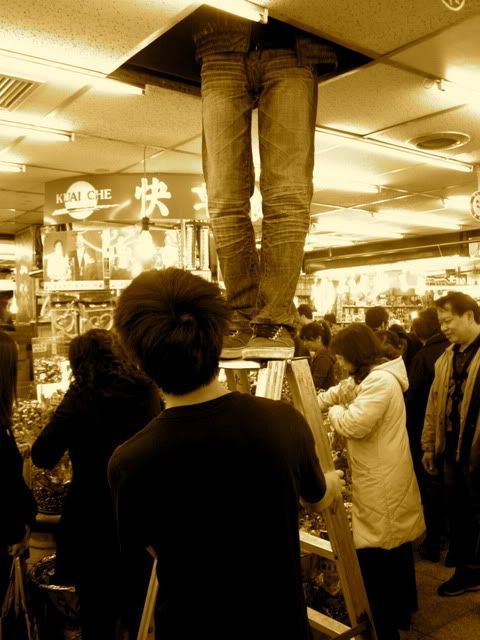
I hoped this guy was fixing something and not looking through inventory…
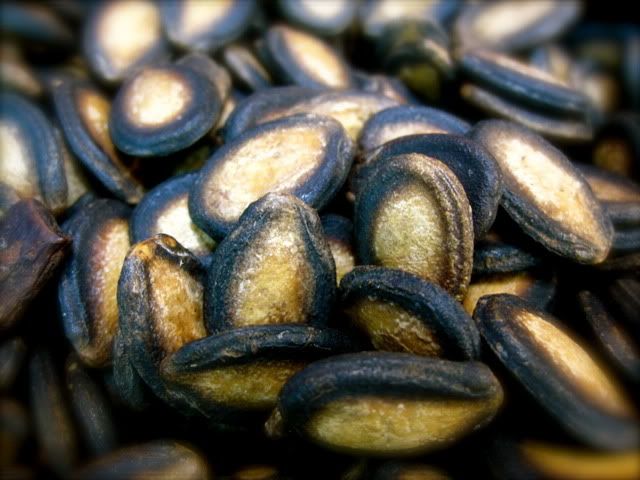
Roasted pumpkin seeds. 
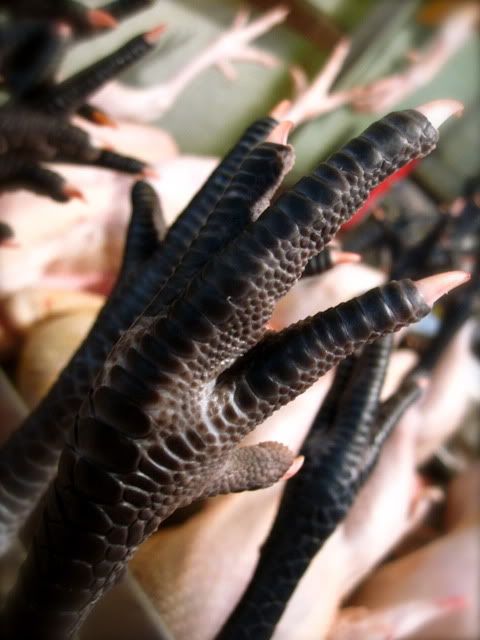
Black chicken feet, waiting to be steamed…actually, I’m not sure Taiwanese people eat it that way.
As it is the year of the Rabbit, these lascivious images were everywhere.
As were these decorated honeydew melons and other fruit. The character means “prosperity” but it’s upside down, which in Chinese is a homonym for “has arrived.” Thus: “Prosperity has arrived in the shape of a honeydew.”
A woman working in the rare, quiet corner of the market.
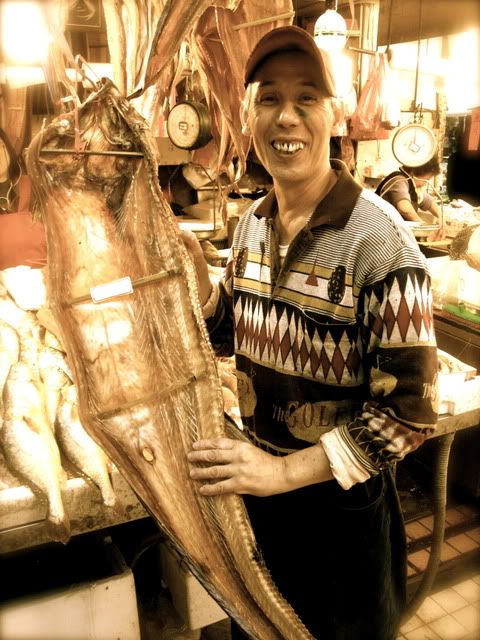
This man saw me eying his large, dried fish and said, “Here, take of picture of me and my fish.” I obliged, and it is a pleasant picture. Man and his work.
Hella mushrooms. 
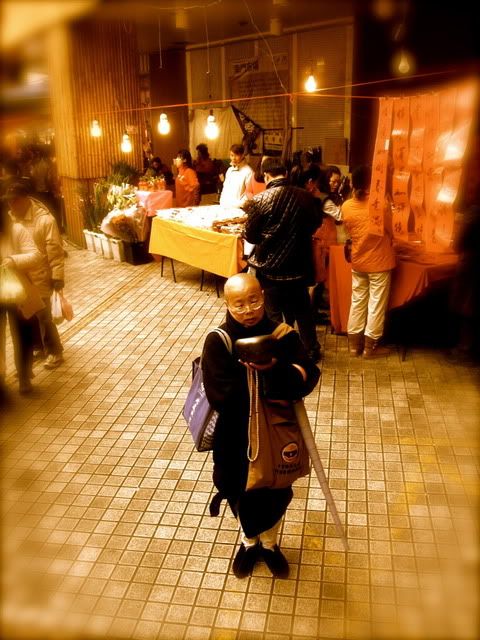
And in the middle of it all, a monk begging for alms.

Return to Taipei

The last time I was here was August 2009, for my grandfather’s funeral. Much has changed: the house (remodeled), my cousin’s job status (employed), and the location of my extended family (spread out in three points across Taipei). But some things never change – or at least they won’t for a long long while.
My uncle wakes up every morning at the crack of dawn to exercise. On weekends, he’s responsible for buying breakfast.

My uncle: the middle child (my father is the eldest).
Interests: long walks to the temple, the stock market, the newspaper, fried pork sung, and living to 100 at least.

My breakfast: Tuna sandwich with a cup of sweet hot black tea (or ‘red’ tea, as they call it here).

Chinese New Year is just around the corner…I can’t wait!