Post-op

My grandmother had her left breast removed yesterday afternoon and is now camping out at the Taipei Veterans General Hospital, a towering behemoth of health care as well as neglect (though because of population and shortage of health staff, there is not much to be done). My grandma was lucky and went under the knife far more quickly than anticipated, as it seems much of Taiwan seems to be waiting for some procedure or other, but the doctor came and informed her that she is to be discharged this afternoon. They need the bed, he said, you’re going to be in pain either way, so why not choose home?

Though I could see my grandmother’s fill with doubt and fear – what does she know about nursing her own gaping wound, I see his point. The hospital – all hospitals, it seems – is filled with people. My grandma is on the tenth floor, yet on my way down in the elevator, we stopped on every floor and always, a crush of people waited to get in, to get out. Walking down the corridors, I couldn’t help but peak in every room, and just like a run-down hotel in a good location, they were all filled. People both old and young, upbeat and down-trodden. Life and not so much life.

   The hospital’s main building.

The hospital’s seal. The word is rong and it means “glory and honor.” Rongming (榮民) is the phrase for “veterans,” meaning, honorable people who served their country.

The hospital’s lobby with a giant Taiwanese flag, just in case patients wake up on their way in or out and forget where they are.

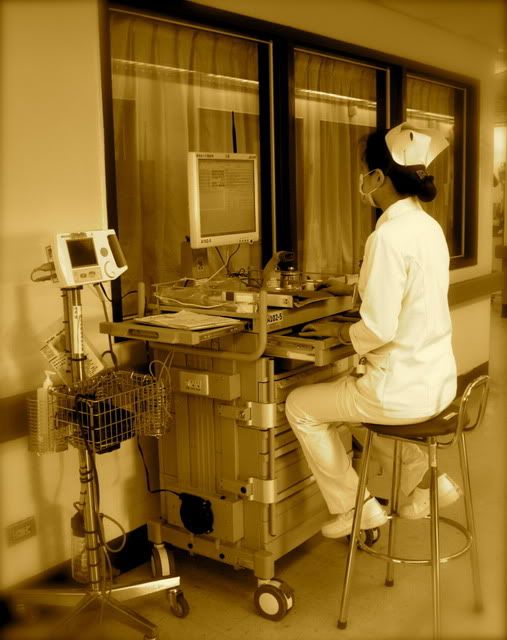
I got a kick out of the young nurses in their clean, white uniforms and their little hats, pinned to their hair. They are all very nice, soft-spoken young women, often cowed by the doctors.

The motto on the nurses’ carts. Is this true? I think so.

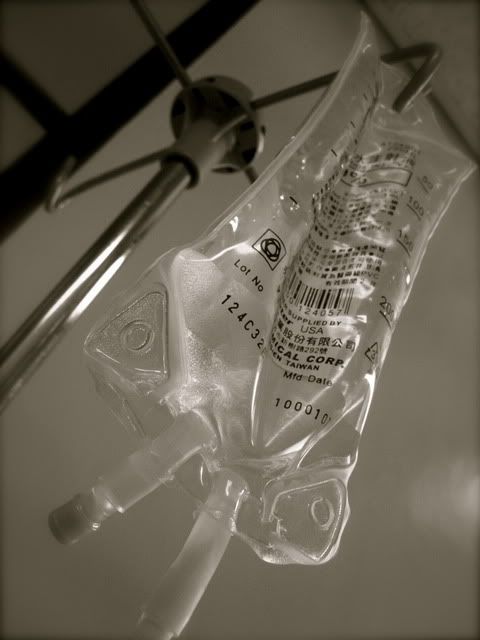
                       Chinese IV.

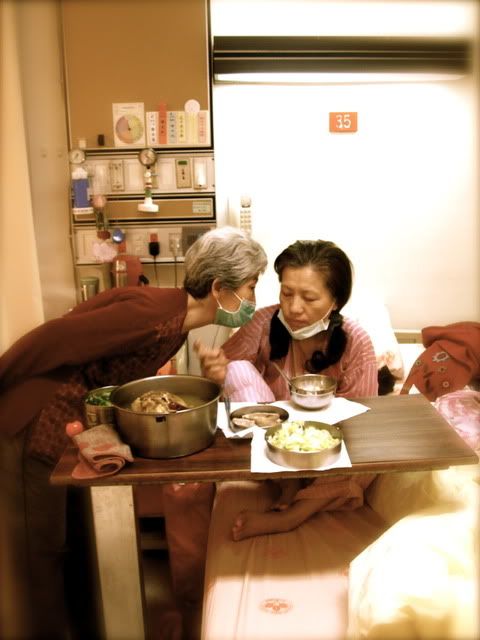
My grandma’s older sister, bending over to whisper something. When I asked U.S. medical students interning in Taiwanese hospitals what the biggest difference was between health care in the U.S. and in Taiwan was, they replied, “The role of family.” Taiwanese hospitals let families take a much bigger role in a patient’s wellness – but I think this has more to do with the culture as well.

A Sunny Day in Taipei

My first week here was extremely cold and I found myself regretting my decision to visit Taipei during the winter. Houses here – or our house at least – have no heat. Couple that with our new tile floors and with my aunt’s ardent belief that all windows must be kept open for constant circulation, well, you’ve got yourself a veritable ice box.

Somewhere in the middle of the second week however, temperatures became bearable (15 to 17 degrees Celsius) and then, a few days later, almost warm. The sun made its first appearance since my arrival at the tail end of Chinese New Year celebrations and my aunt, uncle and cats were eager to soak up the warmth. Now, the temperatures have dropped again and I am shivering, wondering if I’ll ever come back around this time of year. No matter, I can still revisit some recent, warmer memories…

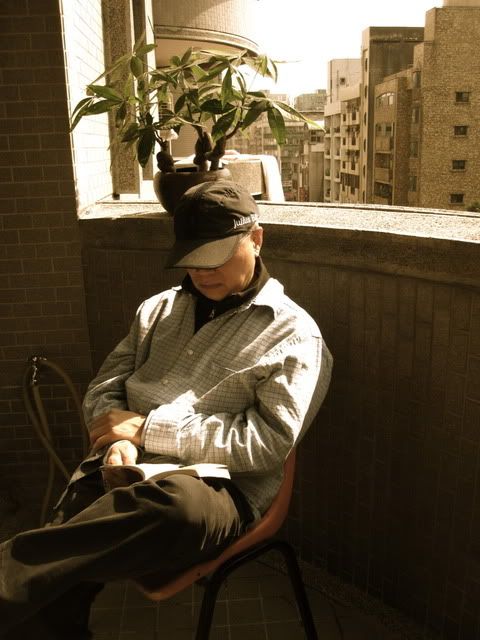
               My uncle, reading on the balcony. On weekends he prefers Buddhist scriptures and meditation to finance books and magazines.

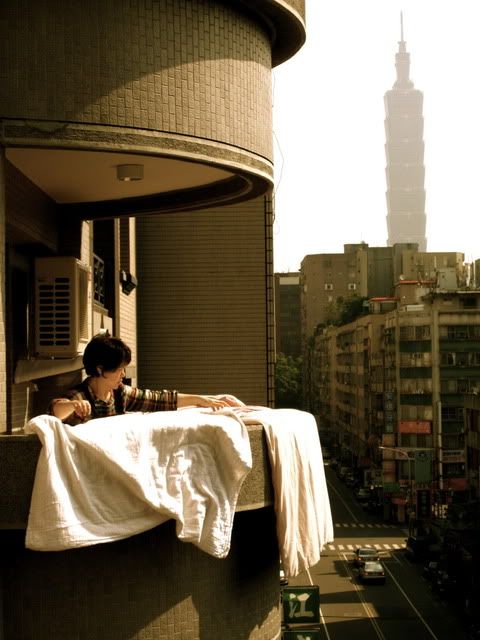
On the balcony over, my aunt spreads our blankets out to sun, believing with the rest of Asia (regardless of how smoggy their cities are, Asians prefer air-drying to dryers) that the sun’s rays kill germs.

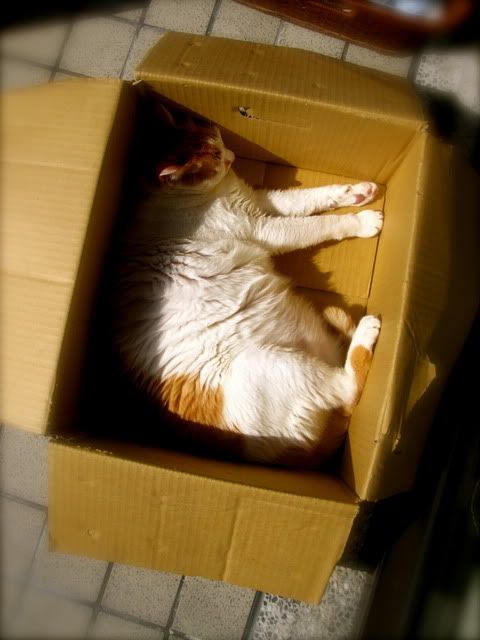
And at my uncle’s feet, Fat Cat (there are two cats – one fat, the other less so and called, unsurprisingly, Small Cat) suns in a cardboard box.

The Year of the Rabbit

My grandma was diagnosed with breast cancer two days before Chinese New Year. Before her trip to the States, she had felt a lump in her breast and wisely (for peace of mind, because what you don’t know for sure can’t really worry you) chose to get it biopsied after her month-long vacation. She didn’t think it would be anything, but it was very much something and the night she received her diagnosis she called my aunt’s house on the sixth floor. My cousin and I were sprawled out on the couch, watching an old movie on HBO when the phone rang. Languidly, I reached over and picked up. My grandmother’s voice was somber and immediately I sensed something was wrong, but she did not want to speak to me. Instead, she asked if my aunt was home.

My aunt took the receiver and after a brief moment said, “Oh god.” And then, “Stop crying. Stop crying. You have options, don’t cry.”

It could be worse, like many things, but at the same time, it could not be worse. It’s stage one, but to be safe, my grandmother has decided to have her whole breast removed. I was horrified at first, thinking, “Why, if radiation treatments will do?” But doctors have seen their fair share of women who, opting to just have radiation treatments for stage one, regret it years later when the cancer comes back with a vengeance and takes away more than their breasts.

I did speak to my grandmother that night, but not because I wanted to. She insisted to my aunt that she was fine, and that she wanted to be alone. Because I was sitting stone-faced in front of the TV, my aunt, cousin and uncle thought I could comfort her without becoming too emotional. They pushed the receiver to me, whispering for me to tell grandma that we would go pick her up and bring her here, so she wouldn’t have to pass the night alone – but I knew better. Common sense tells us that people, when faced with grief, need company. But experience tells me that solitude is the first and necessary step to accepting grief. What makes us strongest is the knowledge that there are certain moments we can handle alone. Because other people- our husbands and wives, our friends and family – as much as we want or hope, they too, can die and disappear. My grandma, having recently lost two siblings and her husband, knows this better than most people.

Thus when I took the phone, I wanted my grandmother to know that I would be there for her, in whatever capacity I could – but most of all, I wanted her to be strong. But I was not strong enough. My voice cracked as soon as I said hello and before she could say anything at all I was crying and she was softly trying to comfort me. “It’s okay, it’s okay!” she said, “It’s only stage one, see? You don’t have anything to worry about.”

For the time being, she is doing better. She has adapted to this new knowledge of herself and last night, called with the decision to have the breast removed. Her voice was steady, as was mine and what I had first sensed as false cheer was her new-found resolve.

“Are you sure?” I asked.

She was silent for a moment as though she wasn’t sure, but she was just searching for the right words. “By removing the whole breast,” she said, “I give myself the best chance possible.”

I nodded into the receiver, silenced by her bravery.

Just Another Day in Taipei…

Only in Taipei would I ever spend the morning at the temple and go straight to karaoke with my cousins. My grandfather’s name, along with those of our ancestors, are placed at Zhao Ming Temple in the outskirts of Taipei City. It’s a low-key temple, nestled in hills of Yang Ming Mountain.When I say “name,” I mean a placard that is meant to represent the spirit of these ancestors. A family buys the placard from the temple, which promises to keep it until the temple itself is demolished or destroyed. If it is not there materially, the name exists in spirit.

And when I say “low-key,” I mean, it’s not a garish temple outfitted in gold and marble. The nuns don’t all have their own laptops nor do they have a queen bee nun that is driven around in a bullet proof Mercedes (there are plenty of these “humble” religious leaders about in Asia). The temple is run by a handful of elderly nuns and their fresh-faced disciples, and all share in the household duties and worship services. They cook and serve meals on special occasions such as funerary ceremonies or on the first day of the new year, during which many families choose to eat vegetarian. After lighting incense for our ancestors and the deities that watch over them, we dined at the temple. We can choose, if for some reason the temple no longer pleases us, to move the placard to another temple, but at present we are very pleased with this one. Its name, Zhao Ming, means “Divine light.”

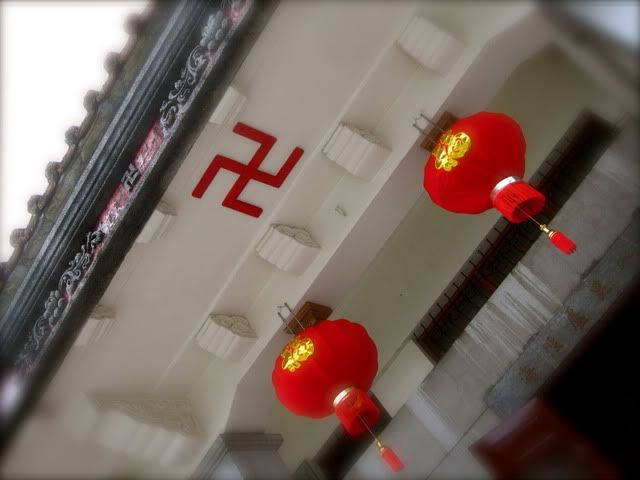
 The temple’s exterior.

It is the swastika, a word derived from the Sanskrit word “svastika” meaning any lucky or auspicious object. Buddhists believe it was stamped upon Buddha’s chest when he died and they call it the heart seal. You’ll find it on temples all over Asia – the Nazis have nothing to do with it. Hitler, after much deliberation, decided to use the Swastika on his flag to convey “the mission of the struggle for the victory of the Aryan man, and, by the same token, the victory of the idea of creative work.” Whatever.

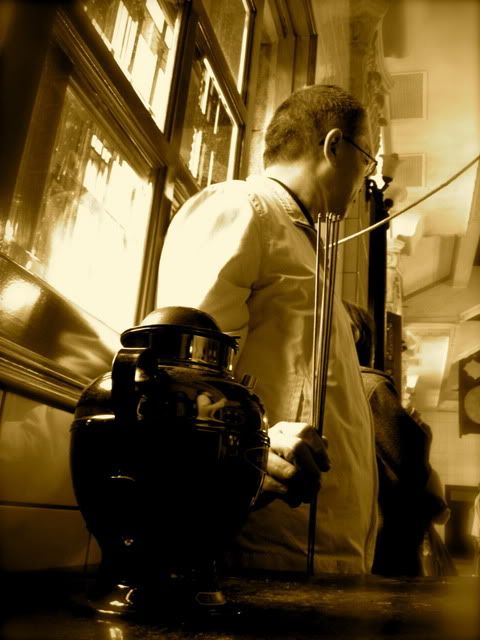
My uncle, holding his incense and waiting for his turn at the altar.

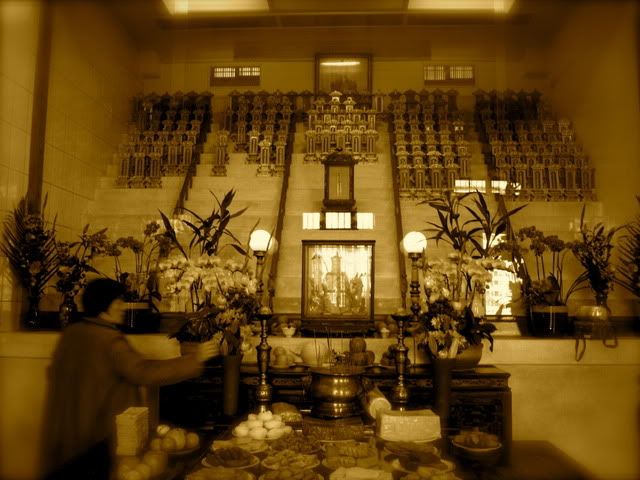
The altar for ancestors. Each placard represents one family. The food on the middle table is prepared by the nuns. After it is offered, they eat it. The side tables are meant for families to place fruit and other goods. Normally, after the fruit is offered, it is left there for the nuns to eat, but on the new year, they make an exception. Families take the fruit home for themselves because it’s lucky to eat on this day.

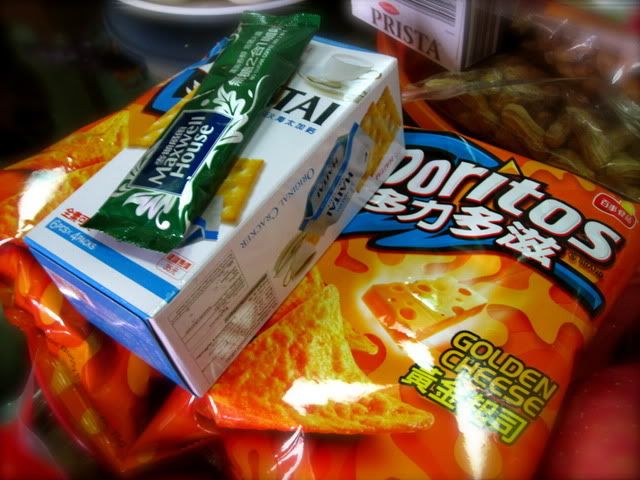
And because some kids don’t like fruit, no matter how lucky it is, parents make the most out of the situation…

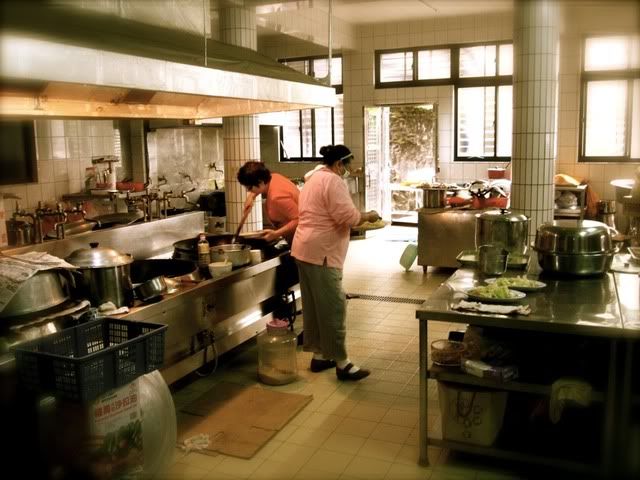
Volunteers cooking in the temple kitchen. No animals killed or cut in this kitchen ever. Truly vegan.

Our vegetarian lunch – less exquisite than New Year’s Eve dinner, but no less delicious, and far more refreshing.

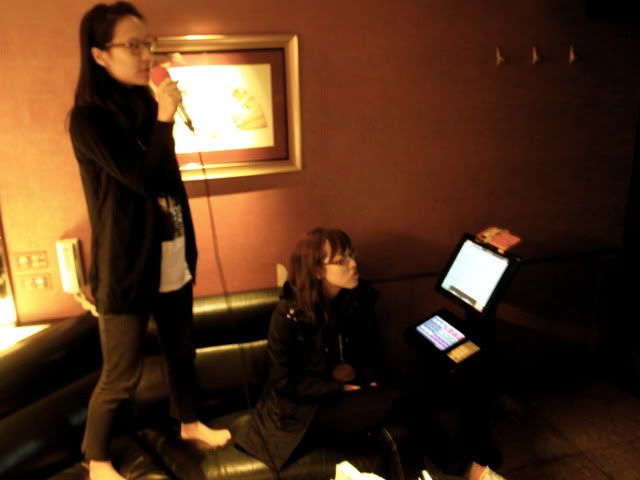
Karen and Melody – my cousins – singing in our tiny private room. Karen went from being one of those, “Oh I can’t sing, don’t make me sing,” girls to a mic hog that now jumps up and down sofas.

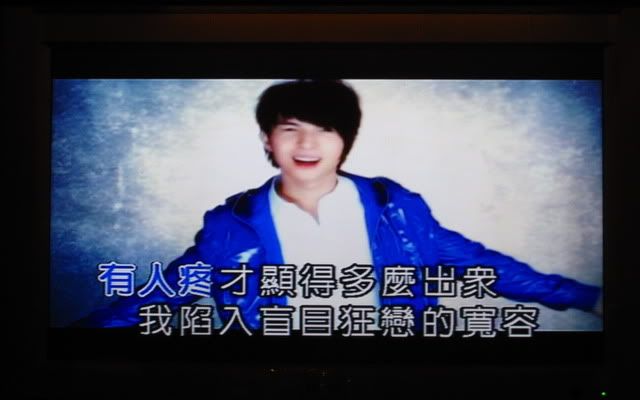
Taiwanese super idol. I have no idea who he is.

But I know who she is…

And that’s how I spent the first day of the Chinese New Year.

Preparing for Chinese New Year at the Hwang’s

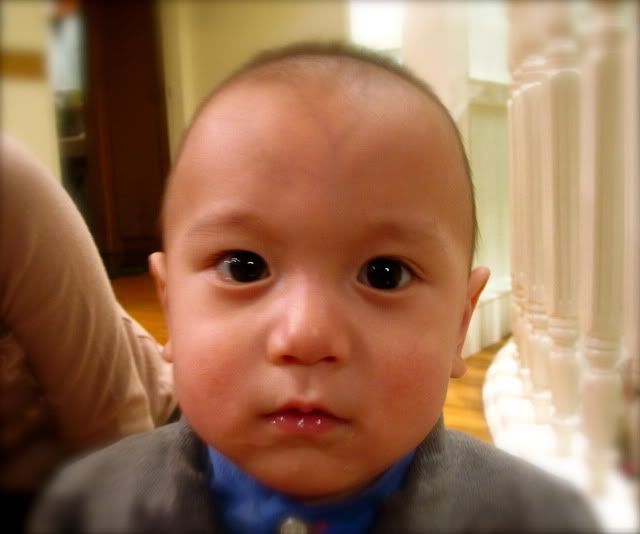
Longtime friends of my aunt and uncle, the Wang’s were finishing up some last minute Chinese New Year preparations when my cousin and I paid a visit to them last night, to visit this little guy:

Colin Chen, Mr. Hwang’s grandson. He’s going to be very handsome. I can tell.

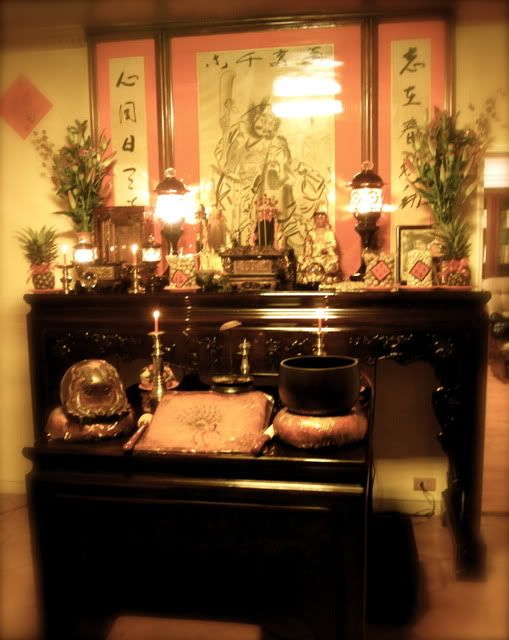
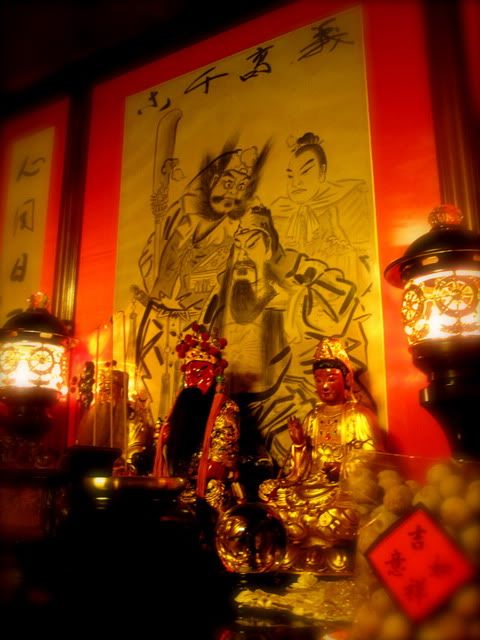
The Hwangs are a very traditional Taiwanese family and have an altar room in their house. In addition to weekly worship, Chinese New Year means a special offerings of fruits, nuts, and candies, all placed upon the altar. Mr. Hwang explained that they worship ancestors on the left and Guang Gong (關公), a Daoist deity, on the right.

On the front table there is a “wooden fish” on the left – a percussion instrument carved from one piece of wood, engraved with fishes. When struck with the muted baton next to it, it makes a crisp hollow sound which helps Buddhist and Daoist worshipers keep the rhythm of their prayers. On the right is a bronze bell. When struck, its resonance is meant to summon the spirits.

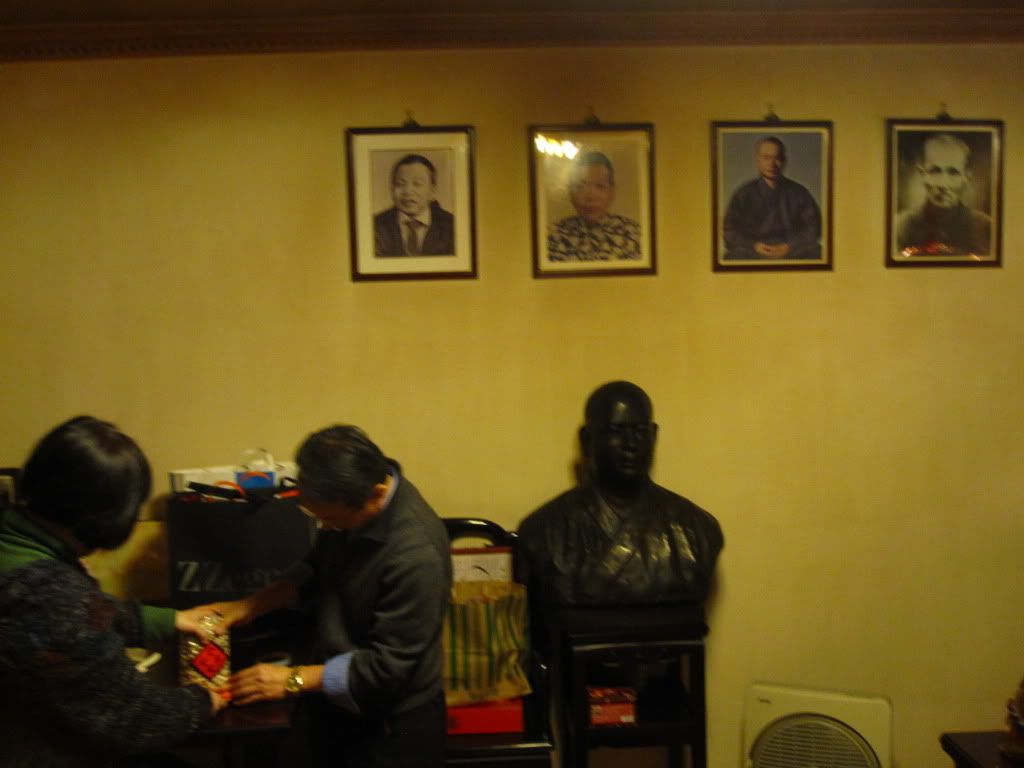
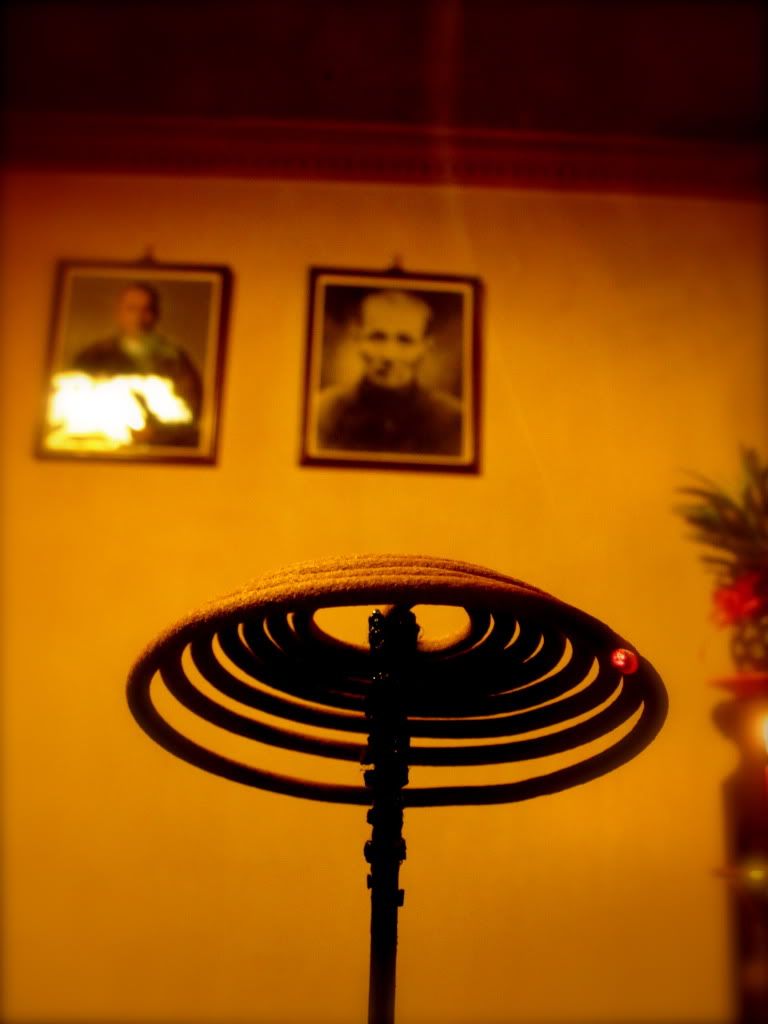
Mr. and Mrs. Hwang prepare goods on red plates to place upon the altar for offering. On the wall are portraits of Mr. Hwang’s deceased ancestors. From left: his older brother, who passed away at the age of twenty; Mr. Hwang’s mother, his father, and his grandfather. I forgot to ask who the bust is.

A close up of the wooden fish. No one in my family can decipher the second word (the first means “King”). I should have asked the Hwangs.

Guang Gong.

  
Coiled incense. 
Mr. Hwang and his spring posters: “fortune” on the left, and “spring” on the right. Traditionally, these are hung upside down on the front doors to signify the arrival of both. 
The beautiful red envelope Mrs. Hwang gave me. 
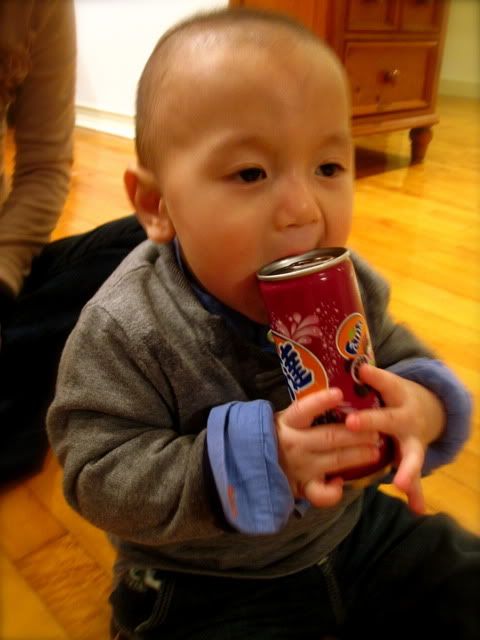
Now it’s time to prepare for our family’s Chinese New Year dinner. But I’ll leave you with this because everyone knows, babies bring good luck:
HAPPY CHINESE NEW YEAR!!!
 
 FANTA!!!

Return to Taipei

The last time I was here was August 2009, for my grandfather’s funeral. Much has changed: the house (remodeled), my cousin’s job status (employed), and the location of my extended family (spread out in three points across Taipei). But some things never change – or at least they won’t for a long long while.

My uncle wakes up every morning at the crack of dawn to exercise. On weekends, he’s responsible for buying breakfast.

My uncle: the middle child (my father is the eldest).
Interests: long walks to the temple, the stock market, the newspaper, fried pork sung, and living to 100 at least.

My breakfast: Tuna sandwich with a cup of sweet hot black tea (or ‘red’ tea, as they call it here).

Chinese New Year is just around the corner…I can’t wait!

You Lucky Dog

Leaving my grandfathers’ house after lunch, my mother was nearly out of the neighborhood when she braked suddenly in front of Sunshine Park, in which I had spent many hours as a child. She leaned forward, gazing into the rear view mirror and then out the passenger window.

“What is it mom?”

“That woman, she’s waving at us.”

I turned to look out the window and indeed a woman was jogging up the sidewalk, waving at us, though I didn’t recognize her. She was dressed in a faded peach, over-sized sweatshirt and in her puffy sleeves, cradled a small, anxious looking dog. A short man with graying hair stood next to her, wearing a fleece jacket and jeans that seemed several sizes too big. He pushed what seemed like a baby carriage until my mother had backed the car up considerably and I saw that it was, in fact, a dog carriage. Another small dog sat in the basket, peering out nervously from within the basket’s netted frame and as my mother parked, I rolled down the window to say hello to the strangers.

The woman was breathless, but held her dog firmly as she went around to my mother’s side. “I thought it was you!” She said, then, ducking down to peer into the window, saw me and her eyes grew wide.

“Is this Betty?”

“Yes,” my mother said.

“Goodness! The last time I saw you you were three or four!”

“Hello,” I said, then paused, knowing what was coming next.

“You look just like your mother!”

My mother smiled, then gave her usual spiel, “When she was younger, people said she took after her father, but now people are more likely to say she takes after me. I suppose it changes by age.”

“Speaking of age,” the woman said, still stooping into the window, “I’ve gotten so old you probably don’t even recognize me.”

“I’m sorry,” I said, “I don’t.”

Apparently her younger daughter and I used to play in the park as toddlers, but I had no recollection nor would, I’m sure, her daughter.

The woman sighed, “We’re all aging so fast.” She nodded in her husband’s direction and then down at the furry bundle in her arms, “Even our dogs.”

My mother raised her eyebrows as she looked down at the dog, but stood patiently to the side of the street as the woman commenced the long and complicated medical history of her aging fox terriers. Both dogs were seventeen years old, which in dog years is 119, and both were suffering from such a myriad of health problems that they could no longer walk but must be carried or carted. The dog the woman held in her arms was faring better than the one in the dog carriage, but both alternated between howling and whimpering at night so that the woman could only sleep for a few hours at a time.

 “I have to get up every three hours to comfort them, stroke them, give them pain meds, walk them to their bathroom,” she said, stroking the dog softly on the head, “It pains me to hear their pain, and my husband, well, he gets up early so I have to let him sleep.”

She looked at my mother with a pained expression, “It’s no way to live, but when you love them, it’s what you do. They’ve been with us for seventeen years and gave us so much happiness. How can I not?”

My mother and I nodded sympathetically. They continued talking so I left the car and went to talk to the man, who until then had stood quietly to the side, one hand on the dog carriage.

“She doesn’t look so old,” I said, touching the dog softly on the head. It’s eyelids drooped as I did so and I noticed how feeble her front legs were, shaking under the perceived weight of my hand.

“She is,” the man pointed at the dog’s white head, “The fur on her head used to be brown, and now it’s white, just like the hair on my head.”

I smiled and turned to look at my mother, whose hand had come up above her eyes to shield the sun’s rays.

“…You haven’t changed at all,” I heard the woman say, “Still look as young as ever…”

“…No, you’re right about age…” returned my mother, “…no one escapes it…I’ve just come from lunch with my father. He’s home alone now because my mother’s in the hospital with lung problems…”

“Oh I’m sorry,” the woman said, “I did notice I haven’t seen them walking in the park for a while.”

I turned back to the dog, sitting serenely in her basket.

“She’s deaf and blind now too,” the man said. There was a scar above her left eyelid and the man said it was an old wart, the least of her problems now. The dog had long suffered from spinal problems which necessitated the daily administering of pain meds, which he said, his wife lovingly crushed into the dog’s food.

“It’s hard work like my wife said, but I’m nearing retirement and I can work from home more often now,” he said, “So today, I thought I’d stay home and take the dogs out. I don’t know how much longer they’ll be around.”

He was an engineer at Raytheon, formerly known as Hughes (“We make missiles,” the man said.) and described his position as “The highest ranking Asian man” in his department.

“Sounds like you like it a lot,” I said and he nodded, not without a hint of smugness.

“I have a lot of freedom now. They used to send me on a lot of business trips, but now I can pick and choose my trips. I was supposed to go to Florida today, but I choose not to, and next week I’m due in the Stanford area. I’ll visit my eldest daughter there as well. She’s doing a PhD in physics.”

I smiled, wondering what it was like to jet around the country and advise engineers on missiles and radar and other things I had no idea about, but before I could ask anymore questions my mother called and said it was time to go. I could tell by her expression that she was tired and that she had not intended to stop for so long to talk to these people and inquire after their dogs. The woman waved enthusiastically and the man wished me good luck on my own job hunt, “The times are different,” he advised me, “You won’t necessarily find a career like mine that you stick to for over thirty years.”

“They seem nice,” I said as my mother turned onto the main road.

“They are. They’re nice people. Smart. Engineering PhD’s, the both of them with two highly intelligent, successful daughters.”

“I know,” I said, “The eldest one is at Stanford doing a PhD in Physics.”

My mother nodded, but her lips were pursed and I could sense that for whatever reason, she was less happy than she’d been before we ran into them.

“What did that woman say to you?”

“Hm?”

“What did you guys talk about?”

“Oh, her dogs, her younger daughter. Then she asked after grandma and grandpa.”

“That’s nice.”

“Yes, and I asked after her parents.”

“Okay. And?”

“Not doing so well either.”

“They’re sick too?”

“Yes. Her father passed away a while back. Her mother has Parkinson’s.”

My mother merged onto the freeway and I thought about the perpetually occupied rooms at the Alhambra Medical Center, where my grandmother currently stays, waiting to be discharged with an oxygen tank. Just two evenings ago, she was diagnosed with COPD, Chronic Obstructive Pulmonary Disease, a progressive disease resulting from years of smoking in enclosed parlors while playing mahjong. She had snorted at my hopes that she wouldn’t need the oxygen tank. “I’ll carry the damn thing if I have to,” she said, “If I need it to breath then I need it to breath. I didn’t live so long to just drop dead now, not with half my grandkids still unwed!”

On the freeway, my mother told me that the woman’s mother was in a bad way. The woman felt powerless to help her mother.”

“That’s how everyone feels when someone is dying of any awful disease like that,” I said, “Did you tell her all she can do is just comfort and care for them? Like her dogs?”

Now it was my mother’s turn to snort. Her voice rose sharply, “Exactly! Like her dogs!” Then softening, she sighed, “I don’t know what some people are thinking when they lavish such care on their pets but neglect the human beings closest to them.”

The woman’s mother ails in Canada.

“Does she have siblings there to care for her?” I asked.

“I don’t know,” my mother said, “I didn’t ask. But does it matter? Siblings or not, it’s her mother too. It’s not that she doesn’t have the money to go and see her.”

“Maybe she has to work.”

“She hasn’t worked since she got married twenty-some years ago. She has time. Her daughters are grown. Her husband is nearing retirement…” my mother’s voice trailed off, “But to each their own…”

My mother has a tendency, when she drives, to slow down when she speaks or is deep in thought. As cars filled with busy people on their ways whizzed past us, my thoughts returned to Grandma, who was no doubt taking another turn around the floor, peering with a combination of sadness and smugness into the rooms of other patients, few of whom had visitors as often as she did.

I admired her spirit, but I understood that our presence fueled that spirit. The continual flow of visitors confirmed to not only herself but to the nurses and the other patients that she had a family, that she had people who cared. She indulged in the attention showered upon her both by the nurses and by us, her children and grandchildren and despite her hacking cough, walked with her walker around her wing so often that the nurses have started to call her “Barbie.”

“She’s one of the most active elderly patients I’ve seen,” one nurse told me, “She doesn’t speak English, but she smiles. We all love her.”

As Tolstoy wrote, “All happy families are alike; each unhappy family is unhappy in its own way.” On the whole, we consider ourselves a happy family – large in number and strong in its ideology: love your family – every single member, and try to see the good in each person. I will venture to say that other happy families do the same, regardless of what intermittent, minor unhappinesses fly their way. To each their own, yes – people have jobs, children, diseases of their own, and a week goes by when other people and events and occasion crowd their calendars so that they say, “I’ll visit mom next week,” or “I’ll call dad tomorrow,” or “I’ll plan that trip with them next month,” etc., etc., but the week turns into two then three then four and suddenly seventeen years have gone by and they haven’t seen their parents, only spoken to them over the phone, their elderly voices faint with yearning. Seventeen years seems like an exaggeration, especially in this day and age with technology and cheap(er) flights, but as she drove, my mother listed friends and acquaintances who had poor relationships with their parents or were simply too busy to visit or to be there or to care. One woman did indeed let seventeen years go by between visits so that when she finally saw her mother again, the expression on the old woman’s face rivaled that of someone who had just seen a ghost.

I wanted to say to my mother that I would never allow seventeen years to go by without seeing her, but I knew she wasn’t telling me as a warning of how not to be. What would my reassurance mean to her, at my age, anyhow? I am, it seems, always about to leave – for school, travel, whatever. I can say plenty of things right now, promise worlds and worlds of care and tenderness, closeness, but it will mean nothing until the day comes and I am there. Assurance, security, my barb-tongued father teaches me, does not come with words but with actions. My mother, my aunts and uncles drive hours to and from the hospital; they discuss diagnoses, medications, visits to the doctors and make sure my grandpa, home alone, is cared for. They don’t do it because they have to. They don’t do it because they feel obligated and because it’s better to feel obligated than to neglect those obligations and feel shame or guilt – no, they do it because they want to. It’s their mother. It’s their mother now, was and could be their father later, and perhaps in the future it’ll be a brother, sister, son or daughter. Regardless, it’s family. Life only gives you one.
Preparations for Unrequited Love

701c0-chicago2

Five days before my second lunch with Ben, I did that creepy thing where I whitened my teeth. Whitening one’s teeth is not in itself creepy per se, but to whiten the teeth in anticipation of a lunch with a boy whose interest in you can be summed up with an amiable shrug – why, he lunches with anyone who asks! – is just the tiniest bit creepy.

Continue reading “Preparations for Unrequited Love”

Procrastination Kills

Recently, loved ones have taken to congratulating me prematurely.

“You’re almost done! You must be so excited!”

“Just three weeks away!”

“I’m so proud of you! Do you want anything for graduation?”

“A graduate! You’ll be just like Dustin Hoffman in that one movie with the ambiguous ending!”

No one’s actually said the last one to me, but it’s the statement to which I can provide the most accurate response.

Lately I’ve been stalling. I haven’t been writing except for lame one pagers in my diary (pining about ‘Ben,’ mostly) and I certainly have not been reading for or participating in class discussions. True, “graduation” is only three weeks away (two, if I subtract the week of Thanksgiving, as I will be home for its entirety) and true, time, in its inevitable way, will fly, but right now, this Tuesday evening, the unwritten pages of final papers are piling up and I haven’t a clue as how to tackle them. It’s no longer a question of motivation – I haven’t been motivated to do well in school since senior year of high school – but rather, an issue with…”What now?”

I didn’t expect this stupid, common question to hit me too like the proverbial ton of bricks, but it has and my face hurts and so I’m asking: What now? I can see into the immediate future. I will graduate. With above average grades, below average affection for my alma mater. (At the department store the other day, I overheard a teenage boy discussing Berkeley and Brown – “I like both,” he said. I looked up from black boots that didn’t exactly fit, my face red, “Choose Brown,” I said.)

I know myself – writing papers assigned by youthful and elderly professors alike is, regardless of my attraction to them, like pulling teeth – and I will write them. I will turn them in and if they are graded by professors, will garner generous grades. If not the professors, then bitter, stingy GSI’s (graduate student instructors), who, if the holiday spirit vacates their hearts at the wrong moment, will damn my papers and final grades to scholarly hell (any grade below an A minus). I don’t want to be cast into that hell, especially not in my last semester, but while it’d be great to leave Cal with an academic bang (3.9 decibels loud!), I am wearied by all this relentless reading and writing and listening. I have waited six years to tune out higher education and on the 17th of this December, 2010, I will finally plug my ears and walk away.

My dear aunt called from Taipei two evenings ago. It’s been my spoken plan now, to leave the States for one or two years and fashion a little expat life for myself on the seventh floor (the most modest penthouse there ever was) in our family’s building on Dong Fend St.

“There’s a fine English cram school near my work,” my cousin told me happily. Both she and my aunt anticipate my return, as though my presence would somehow breathe fresh life into their self-perceived dull ones.

“There’s no one here to make waves,” my aunt sighed into the phone, “And Karen wants to live with you on the seventh floor. Perhaps things will be more exciting this way.”

And I’ve no doubt things will be exciting – I’ll teach English, make a killing (especially now, with my degree!) and shop, dine, watch movies whenever I please – it will be a more mature, more fabulous version of my life in Taipei nearly five years ago, when I tutored privately and taught at the National Taipei College of Nursing. Karen and I grew up together and the plan is to continue growing (or perhaps halt the aging process) while living out our single girl life in Taipei. Is this viable? Is it possible? Am I merely planning some elaborate escape? Taipei, despite its cloying humidity and bustling streets, is my mental cryogenic freeze. I go there to pause. To put “real” life, whatever that is, on hold. Ought I do that for more than six months not to mention a year? Or two?

I have my concerns, not least of which is Taipei’s dating scene- a veritable pond sans fish for a big-boned, deep-voiced, giant shark like me. (I believe I did, yes.) The year and twenty-three summers I’ve spent in Taipei have revealed that my “type” of man does not exist in Taipei. And if he does, he is there only briefly, on a stopover perhaps to bigger and more important cities such as Shanghai, Beijing, Hong Kong or Tokyo. No, Taipei gets the stringy foreigners from Europe and middle America – the guys who are misinformed about but endlessly by idiot Taiwanese girls. They come with pale, blotchy skin, holey t-shirts, and those disgusting sandals with the velcro straps and in the heat, break out in the worst cases of yellow fever known to man. Speak perfect English and their eyes glaze over – they don’t want communication, they want dumplings spooned into their mouths with submissive coos.

Equally repulsive are the wealthy ABC’s (American Born Chinese) and TEABRGHTWFD (Taiwanese Educated Abroad But Returning Home To Work For Daddy). When we were younger, my cousin and I studied my aunt’s wealthy friends, dreaming that marrying into one of these families was certainly the fast track to wealth, power and consequently, happiness. Thank god we developed brains along the way. Despite our meager (future) jobs and pitiful paychecks, we still have, in our fathers and other men we admire, standards to adhere to. And I confess there’s a bit of self-loathing going on here – I’m terrified of being my parents’ charity case (hence the plan to teach English in Taipei) but I would hate to date or marry another charity case, regardless of how lucrative the source of the charity may be.

Thus one setback Taipei might pose is the potential throwing away of two perfectly good years of my twenties. I’m not getting any younger. The crows feet that have stepped into the corners of my eyes are only getting deeper (and funny, I’m not laughing all that much). I’m not thinking too much. I’m thinking critically about my situation as a woman in the world.

Another crux: professional progress. Of course I can pledge to write everyday about the sights and sounds of Taipei and of my family – and most likely, I will, but how diligently will I revise? And how ardently will I complete the applications for the MFA programs I’ve also been crowing about? That was the whole plan, after all – graduate, move, teach, write, apply, enroll (Brown, UCI, Iowa – in that order), learn, write, publish, teach at Harvard. The master plan.

And now that’s it’s written and will soon be posted, I feel better. Now that it’s written, I can see how far this plan is, how strange my fears sound and how very achievable it all is. My imagination is quite vivid. My age still young.

My essays all due in less than three weeks, still unwritten. As long as they remain unwritten, the master plan will seem hazy and far. I can’t have that now, can I?

To Nabokov, Milton, Hitchcock and Wagner (the last not a famous writer but an adorable professor with an unfortunately dull class) – may you all see me to the end.

Focus

This past weekend I caught a glimpse into the focused mind – a brain capable of tuning out and zooming in on whatever task or idea sits before the body. Ben, old Ben, changed but unchanged, with a sprinkling of gray hairs on his young head, stood a little straighter, dressed a little neater, walked a little faster than I remembered. He welcomed me with open arms to his new Alma Mater, Stanford University, granter of his future Doctorate in Computer Science. We walked through the campus; I saw everything and nothing.

But he unlocked the door to his office, which he shares with another PhD student and I began to pay attention. It was a narrow room with a large window at the end wall providing a refreshing vista of Stanford’s campus. “I like the view,” he said, and I nodded, knowing the need to look up from one’s screen sometime and wish to see something far and natural, like a tree, mountain or glistening lake. But whatever respite the eyes require, the focused brain at work can stop only for a minute, if at all.

The focus I speak of manifests itself in surprising ways: a dirty dry-erase board with a mysterious “Daruma” written on the top left corner; a messy desk nearly smothered by half-empty coffee cups and Gatorade bottles; conference papers spilling out of paper grocery bags and onto the floor. It was intoxicating. I imagined myself standing in a still life: “Genius at work”. I was lucky that the genius stood there with me, but had he been somewhere else, I would, by the contents of the room itself, have been bathing in the aura of genius.

His is not the only office I have seen that paints a passionate, concentrated mind at work – my lovely professor, the Nabokov expert, has a similar workspace. Every shelf crammed with books (all with creased spines indicating they have been read and reread) and every inch of flat surface covered with papers both his and his students; mine, the product of hours and hours of sporadic, half-hearted research, floating lightly on top, weighted down only by the ink and paper rather than solid ideas. In both offices, dust coats certain areas, but it does not matter – the true activity takes place in their skulls.

Contrast those still lifes with another of my room: consistently spotless; my desk, my closet, even the bottommost drawers of either, everything neat as a pin. Never an item out of place; the only thing on the floor are the legs of my furniture and a rug, which, if wrinkled or flipped, immediately straightened and righted. This is not only the sign of a budding (or full grown) obsessive compulsive, but also a dead giveaway for an unfocused, wandering mind. The brain that can’t focus must generate the illusion of being able to do so by making the physical environment seem orderly.

A decade ago, I was the same way, my symptoms in some ways more acute. My aunt asked me, after marveling at my various systems of organization, why I felt compelled to keep everything so neat. I thought for a long while, mulling over a suitable response before settling on a fact: I was, at least to my young self, quite “messy” inside. I understood my need to clean and wipe and stack and fold as an outlet to some inner rumblings – the confusion that comes with being as optimistic as I was, yet also painfully self-aware of potential limitations.

I wanted too many things, pursued too many interests, swam in a million shallow pools so that I would never have to get my hair wet. By keeping my room neat and my belongings pristine (for some reason, I was never one of those kids who wore out the soles of her shoes or came home with muddied, torn clothing – even after long afternoons spent in trees) was a precaution – I was creating a safe haven for my body to return to in case the clutter of my mind somehow reared its head and emerged. It’s the root of my many evils, this desire for superficial perfection, and rather than promote productivity or creativity, it constrains, corrupts, and desiccates whatever streams I might have flowing within so that I cannot write or read or do anything worthwhile without fretting that my clothes are not in order or that my desk drawers are not perfectly partitioned off. Staples here, paper clips there, empty stationery for letters I will never write, here.

I am getting better. Better at letting little things go here and there (people are now allowed to sit on my bed) and no longer worrying about letting papers pile up or books topple… but even these little allowances seemed forced, as though I am testing myself to see how long I can go before I reach out to straighten, no, completely reorganize everything in one long, dusty afternoon. But I am learning. I am learning to apply these methods of organization to my mental state. And I am writing. It is hard for me, but I do it.

As we strolled through campus, I asked Ben if every morning he walked to his office.

“I do,” he said, “I drive sometimes too, because I do get lazy, but I like to walk. It takes me roughly thirty minutes to get to my office and in a way, the walk saves me time.”

I nodded, about to say something about not having to go to the gym, but he continued.

“I like to use that time to process my thoughts. It’s a good time to think and organize. I can’t really do that effectively when I’m driving.”

So this was his reason – a far cry from mine, which had everything to do with the body and nothing to do with the mind. This was before he showed me his office, and already I was in awe. Later, we stepped out of his office and into Hoover Tower, a Stanford landmark which, I was pleased to see, was less aesthetically pleasing than Berkeley’s Campanile – but the view was pleasant, despite the greyness of the sky and the chill of the wind.

I remarked how lovely it was to see matching Spanish tile roofs. “So orderly here,” I said, “Unlike Berkeley, where the buildings don’t match.”

He looked at me for a minute, “Really? I like that the buildings in Berkeley don’t match.”

In the two years I’ve spent at Berkeley, I learned to find my pockets of neatness and order. There are certain houses I like to look at because the paint is not chipped, the windows are whole and clean and the lawns are not overgrown to the point of resembling a small jungle. I smile at these houses and wonder how they can stand to neighbor the more unsightly edifices. Walking to campus, I prefer the right side of my street to the left because the sidewalk is more even and the row of houses more favorable to me than the over grown students’ garden. Certain restaurants top my list not only because of the food, but because the tables, floors and bathrooms are clean and well-lit. I hate the smell of garbage, piss and shit (all of which occur in abundance in Berkeley) for the same reasons as everyone else does, and also because these odors transcend the membrane of my nostrils and threaten to sully my insides. The homeless, even though I feel for them, truly I do – I too, would talk to myself and yell obscenities – invade my vision. They remind me day after day of what I am not capable of cleaning.

I’ll end here, at the top of Hoover Tower, where it was strangely quiet despite the wind and a group of laughing Chinese families. I gazed out across the red tiled roofs, feeling happy and sad, composed yet on the brink of disintegration. Dear Ben with his gray hairs and kind smile that masked a gleaming mind and I with my shiny hair, my bright orange scarf – the first carefully brushed the second carefully selected – with my muddle of thoughts. A jumble of millions. The buildings with the matching roofs calmed me a bit. I stole a glance at Ben, who smiled at me. Tumble tumble crash crash. I wanted nothing more right then than to clean something.