
A few weeks ago my boss emerged from his office with his hair combed, wearing a suit and tie.
“Where are you going?” I asked.
“I told you,” he said, “A funeral.” Continue reading “Generic Death”
A few weeks ago my boss emerged from his office with his hair combed, wearing a suit and tie.
“Where are you going?” I asked.
“I told you,” he said, “A funeral.” Continue reading “Generic Death”
My boss called me from Taiwan today, 4:30AM his time, which meant he was in a chauffeured car en route to the airport, where he’d board a small plane to Hong Kong and then from there, a larger plane to Melbourne where he is scheduled to play a few holes of golf with Tiger Woods, the world’s most famous philanderer.
Planning his trip, I asked him what else he’d like to do, should gambling or Tiger turn out to be rather uneventful. I imagined my boss tuning out as Tiger tried to show him the right way to grip a golf club. (“See here, you put your thumb here…the strippers love that.”)
“I’ve never been to Australia before,” my boss said, “I’d like to see the coastline.”
The words themselves were strangely romantic and he delivered them in an almost thoughtful way. I wondered if he would arrive at Lorne or Sorrento, kick off his shoes and run to the water. Calm, tiny waves (depending on the location of the moon), would lap at his toes as he stood with hands on hips, belly thrust forward, salty sea air whipping through his short hair. Perhaps he would wear a crisp white shirt. The collar, normally stiff, would bend and sway and eventually flip up and out, seduced by the sea. Perhaps he’d experience true quiet for a few moments – he would be in the land down under, surrounded by nothing but the sea and unfamiliar territory. There, he could be truly anonymous. As long as he put his phone on silent.
But I know my boss. He is half a dreamer, which means, give him enough time and he will inevitably retract the dream and replace it with something more immediate. A few days before he left he said, “Scratch the coastline. I don’t have much time. I think I’ll just walk around the city.”
I tried to picture my boss as flaneur, walking with his hands in his pockets, alone in a foreign city whose denizens were all uniformly tall, blonde, tanned, and great with wild animals (such is my stereotype of Australians). But this picture faded quickly; by now my boss was accustomed to being driven around. Perhaps his Australian chauffeur would be a washed-up ex-surfer who had been injured on the great barrier reef and who had tried his hand unsuccessfully at a string of jobs before discovering his love for the road. It was somehow comforting to drive powerful men around. The driver would be unusually chatty, intrigued by this portly Asian man with the furrowed brow and bulbous nose – who was he and why was he so important that he was playing golf with the world’s most famous philanderer? It didn’t matter. The driver would impress him with his knowledge of Australia. Why didn’t he want to see the coast? It was Australia’s crowning glory – a gift from nature, surely, but they did a better job than the Americans of keeping it clean. My boss would chuckle deeply in that misleading way of his, “Sure, sure,” and lean back, close his eyes, and remind whomever to change his driver tomorrow. This one was too chatty.
When the call came, I tensed up for a millisecond, the way I always do when he calls. He is, by all means, a low-maintenance sort of boss. He prefers me to email him, though not incessantly. I learned this on my first day, when the bubbly HR girl walked me up the stairs and said in a low voice, “Don’t ever, under any circumstances, just forward him things. He HATES that.”
I nodded solemnly. Of course. My job was to trim the fat – take away the million stupid little things that would irritate or worry him. So far, I think I have done alright, though in the beginning it seemed to be sort of a gamble: do I just copy and paste this message and pawn it off as my own? Does he want me to reply and then cc him? I did everything with bated breath and when all was quiet on his end, I accepted the possibility that my system, whatever it was, was acceptable.
So the call. On his last trip to Asia, his first since hiring me, he had warned me that there would be times when he would have to call me at odd hours.
“Just be prepared,” he wrote to me before boarding the plane, “I’ll try not to bother you, but sometimes, shit happens.”
I giggled, both endeared to the fact that he had said, “I’ll try not to bother you,” and that he had used such coarse language. If he was exercising the powers of reverse psychology, it worked.
“Don’t worry, Boss,” I typed back, “I read the job description.”
He was gone for a little over a week, and aside from the emails that pinged during the night, he never did call. People at the office who had seen the past two assistants slowly unravel were incredulous.
“You mean he hasn’t woken you up in the middle of the night?”
“Nope. Not once.”
“He never called.”
“Nope.”
“Not even when you didn’t respond to his emails right away.”
“No.” by then, I was wondering if we were still talking about the same person. Apparently not.
“Sounds like he’s changed a lot,” one of them said, “The last assistant always looked like a zombie whenever your boss went to Asia. She said the phone would ring nonstop sometimes.”
That’s horrible, I thought, and truly, every night when he was away I braced myself, wondering if I should just turn the phone off and feign to be a deep sleeper. But I left it on in case he were to call. I had read the job description. It said 24/7. But he never called.
Apparently, everything went smoothly. Before I knew it he was back in the office and certain executives stopped storming around my desk asking impatiently, “When is he coming back? Is he on vacation?”
But he called at 1:30PM this afternoon, which meant it was 4:30AM in Taipei. My heart constricted, so adept am I at handling stress. Did his driver not show up? Did the plane break down? Did he want to see the coastline after all?
I answered, my voice reminiscent of a strangled altar boy.
“Hello?”
“Betty?”
“Yes,” (ah, voice back to normal), “Hey Boss, what’s up? How are you? Is everything okay?”
“Haha,” his laugh sounded hollow and far away, not least because he was very far away, “I’m still alive.”
“Oh good.”
“So about my awards ceremony at the university.”
“Yes, yes, about that.”
I blanked out for two seconds before I remembered that he was being presented with an Entrepreneur of the Year Award at a local university’s school of business. Before he left he had mentioned buying a table and filling it with executives and VPs, as per usual.
“I want to do something a little different,” he said.
“Okay…”
“I think we can send out an invite to the executives, but if they want to come, they can buy their own tickets.”
“Got it. But do you still want to buy a table?”
“Yes, but I want to invite some younger people. We need to mix it up a bit.” he paused for a moment and I imagined him rubbing the sleep off his face, “Ask around. We have some younger employees with entrepreneurial spirit. I want them to come out to this event to represent our company. They can hear my story if they haven’t heard it before, and it’ll be nice for them to mix with the MBA students.”
“Got it.”
There was an awkward pause as I thought of something else to say.
“So… anything new?” He asked, “everything okay?”
I wondered if he really wanted me to fill him in on whatever was happening in addition to the emails he was sending me. Of course not.
“Everything’s fine,” I said, “Just housekeeping. Your uh, ice maker has been refreshed and the wireless HDMI kit is being installed. Everything should be ready when you return.”
“Ok,” he said. “that’s all?”
“That’s all.”
“Okay. I just thought I’d call about the Awards thing rather than write it out. Well, don’t worry. I’ll talk to you later.”
“Have a safe flight, Boss.”
“Thanks, thanks,” he said.
We hung up and I looked around the office. A few coworkers were staring at me expectantly.
“Is everything okay?”
“Yeah,” I said, “He was just checking in, I guess.”
“How nice of him to call during your regular working hours.”
“Yeah,” I said, thinking that maybe he would go see the coastline, “He’s cool like that.”
This Eulogy may very well be the most famous thing Mona Simpson will ever write. Reading it, I began to cry in the office – not loudly or anything, just sniffling in what I hoped was a covert manner. A few of my colleagues walked by, one of whom stared at my eyes and said, “Wow, you must have really bad allergies.”
“It’s this eulogy,” I said, my voice cracking.
“What?”
“This eulogy. Steve Jobs’ sister wrote it for his memorial service.”
“Oh,” my colleague said. She is normally extremely chipper to the point of being robotic. A consummate HR professional, she hides her feelings behind a saccharine smile and soft, musical voice. It is hard to decide if her eyes glint from perpetual glee or if it’s the glare of her oval glasses. From the day we first met she had categorized me in the same way: I was an admin, hired to meet and greet. She was in HR, in charge of welcoming new hires. It was our job to smile incessantly. Never stop smiling. Ever. Who was this teary-eyed Betty?
She stepped back, suddenly looking uncomfortable. Her expression reminded me of the time I placed my dead grandfather’s hat on my superstitious cousin’s head. She looked at the screen, and then back at my red rimmed eyes. “Well, I’m uh, sorry for interrupting your…” her eyes scanned the ceiling for the right word, “…feeling.” She raised her voice several octaves and patted my desk, a strange gesture considering my arm was also right there. “Feel better!”
As she walked away, the coworker across the way turned around. She had overheard the conversation (as she always does) and stopped typing in order to give her two cents (as she also always does). A strange quiet ensued, the kind that follows after a fan suddenly stops whirring, or when you are asleep in the car until suddenly the engine stops because you’ve arrived at your destination. She turned over her shoulder and looked at me, her eyes squinting in a strange way, as though she were studying me.
“You are such a softy,” she said. I disliked her tone. There was, crouching beneath it the subtle implication that I was somehow weak.
“What?” I said, “I cry easily.” I was thinking, “Give me a break woman, it’s a eulogy. They’re supposed to be moving.”
I emailed the eulogy to a friend. “Oh my goodness it’s so good I’m crying,” I typed into the message box.
“What the hell are you doing reading eulogies at work?!?” she wrote back, “Crying doesn’t help with productivity, does it?”
Another coworker came up a few minutes later to look for someone. He stopped in front of my desk. My tears had dried, but my eyes were still rimmed red.
“You sick or something?” his voice was monotone, his face expressionless. Did I want to explain myself to him?
I thought of saying, “Yes, I’m sick,” or falling back on the allergies thing, but the pitcher with big ears was still there and she would undo whatever lie I supplied. “It’s this eulogy,” I said lamely.
“Jesus,” he said, then, not finding whom he was looking for, walked away.
Lesson of the day: there is no place for tears at work.
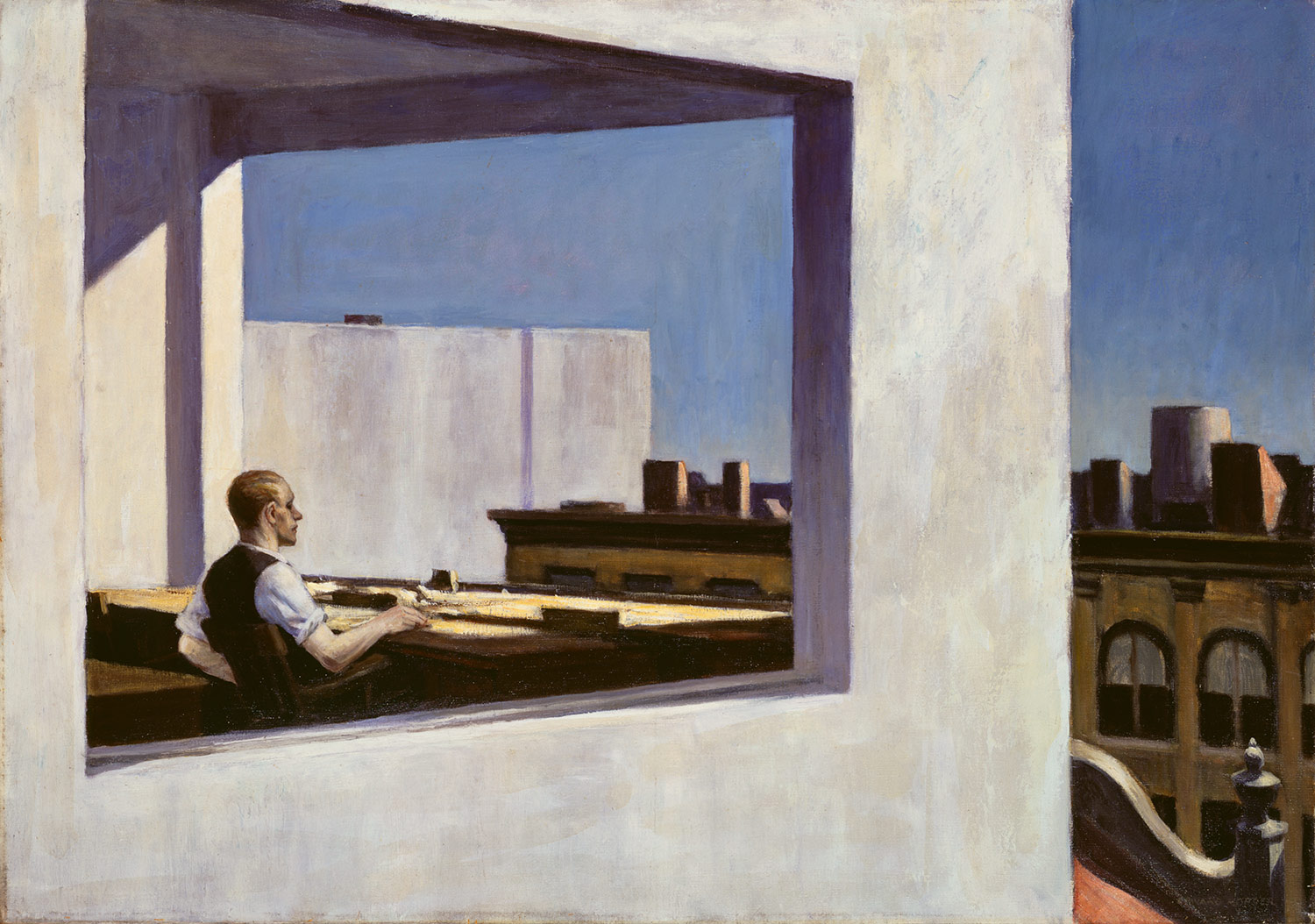 |
| Office in a Small City, 1953 Edward Hopper, Oil on Canvas |
Sometimes I hate emailing my boss because his replies, if any at all, are terse almost to the point of being cruel to someone like me, who writes almost as much as she talks. He writes, “Do this.” “Do that.” and, when he gets angry, he’ll attach an exclamation mark at the end. “Next time, don’t cc everyone!” or “The van is really dirty!” Yet in person, he is quite affable, and I like to think we have a good relationship. Continue reading “In Praise of No Praise”
Gina left big shoes to fill. And rather than hire a girl with big shoes, HR hired a big girl.
A few days later another coworker fleshed Bonnie out further.
“It wasn’t even that she was fat,” said Jane, an athletic Asian girl in marketing whom I quickly befriended at the risk of seeming like a huge lesbian, “She was a bitch. She hated all the girls her age and was only nice to the boys. And on top of that, she like, got dressed in the dark or something. Totally did not know how to work with her…heft. She would wear these like puffy sweaters and jackets that only made things worse for her. And she’d always ask me, ‘Does this make me look fat?’ And I’d say ‘No, no,’ but really be thinking, ‘Hell yeah it does, fatso.’ It was bizarre.”
Bonnie was a UCLA graduate who had apparently interviewed well. My boss expected her to bring the same energy and spunk she had showed during her interview to the job, but a few months into Bonnie’s employment, he felt duped. In addition to being rather piggy – “Bonnie was always eating something at her desk,” Cindy said – she was also lazy, preferring to surf the internet for long bouts rather than run errands or schedule meetings. Important emails went unanswered which led to tiny pockmarks in my boss’s public complexion.
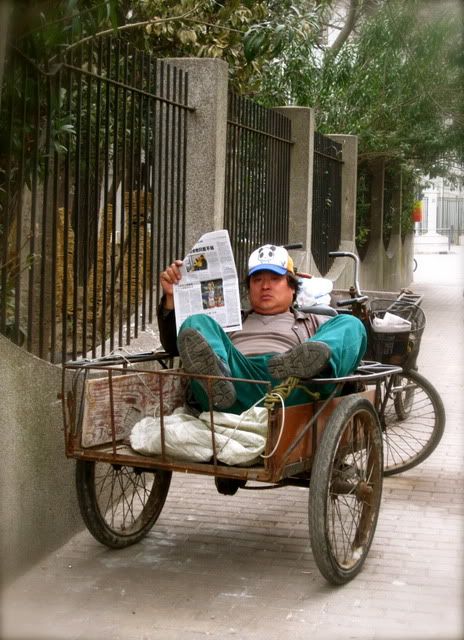 |
| Perhaps a member of Bonnie’s family. |
I imagined Bonnie to be a rather formidable figure – a nasty girl who abused her power (“Which she absolutely did,” Jane said dryly, “until I verbally bitch-slapped her, and then she at least didn’t give me attitude.”) and sat on her haunches waiting for things to be done for her. She was, after all, the EA for a year, which to me meant my boss put up with her. Had he been afraid of her?
“Oh of course not,” Cindy said, rolling her eyes at my naivete, “Bonnie was terrified of him. But you know, so much of what she does doesn’t really get back to him. She could pawn her incompetence off as someone else’s by saying, ‘Oh well, so and so hasn’t gotten back to me about that, so I don’t know,’ or ‘I told him to do it, but he hasn’t done it yet.’ When really, she was the one who wasn’t doing anything.”

*The following is fiction. Or vague facts blended with vivid fiction.
At work, I’ve been finding ways to inject my personality into things. My work space, for one. I cleaned out my desk in the first three days, which, if you can’t see my desk (which none of you can), doesn’t sound that impressive, but trust me, my coworkers were impressed. Continue reading “Assistants*”
It finally hit me today: the thing about kindness – what it is, what it is not.
For weeks, I’ve been running old conversations and scenes through my mind, playing and replying them like old, grainy, homemade films – or worse, depressing romantic dramas starring the likes of Ralph Fiennes and Carey Mulligan. I’ve been weighing the characters of all the men I know (not very many), and wondering what it is about the few I love or have loved, and about the rest for which I cared little. It must be said that my father, with whom my relationship is best described thick with cliche as “love/hate,” made the short list for both.
Let me say this – I am nowhere near having as whole an answer as I’d always hoped, but if this was all the “eureka” I could squeeze out of this one nagging question, then I’m happy to hang it up as my North Star.
This afternoon, for the third time in a month, my boss lectured me about paying attention to detail. I made yet another mistake on his calender, blundered verbally – he was talking about one thing, I responded about another, and then laughed when he said he had gout. Yes. I can be quite insensitive at quite the wrong time – but my boss let it slide, chuckling at my candid insensitivity, and I warmed towards him, thinking, “Oh, what a kind man. He lets me laugh at his ailments.”
Then rather abruptly, he turned back to his computer screen and said, “Nothing else? Let me get back to work. If I need anything else I’ll let you know.”
What more could I want from that moment? He had pointed out what I had done wrong in a calm, even tone – no tantrums from him unless I really push him over the edge; overlooked the fact that I had joked about his gout (“You eat too well,” I said. He nodded in agreement), and as it was the end of the day, was more or less giving me the okay to call it a day.
Yet something bothered me about his last words: “If I need anything else, I’ll let you know.” And here, at the risk of sounding too whiny, I admit I thought, “What if I need something else? Some more guidance? Some more information on how to do things right?” I bade him good evening and walked out of the office, then turned briefly around through the glass wall that separated my desk from his and saw him slumped low in his expensive ergonomic chair with adjustable armrests, clicking through his thousands of unread emails. I had walked out of his office, out of his mind, and the thought of me would never cross his mind again unless something, or someone called it to his attention.
Of all the exchanges with people I have had, why was this the trigger? Because then, loudly, a thought resounded, echoing something my friend Elena had tried to explain to me:
“Do not mistake duty for kindness.”
“Do not mistake indifference for kindness.”
“Do not mistake common decency or manners or all the other stuff you’re supposed to do because you’re living in civilized society and because you’re a social animal, for kindness.”
And most importantly, again, “Do not mistake indifference for kindness.”
My handful of lunches with Ben flashed in my memory: the tour he gave, but also which I asked for, of Stanford; the lunch he paid for, the time he took to drive me around searching for the gym where my cousins twirled and whirled during their ballroom practice while I, deluded with my warped definitions of kindness, danced alone outside. And then a few months later, there was his willingness to meet me again for lunch, even though had I not called him, we would never have met up again. I mistook his delay in informing me of his engagement for kindness – and perhaps partly, it was, but he was mostly just being polite, not wanting to steal the thunder of my 25th birthday. And what thunder.
 |
| Excursion into Philosophy, 1959 Edward Hopper Oil on Canvas |
I was on the road home from Vegas when Ben emailed me about his engagement – I read it and smiled a tired smile to no one in particular, wondering why he had waited to tell me then and not on my birthday a week earlier, when he had emailed to say, “Happy Birthday. I’ll write you a longer message later in the week.” But at that moment, it didn’t matter – my mind still lingered on the night before, on the memory of a first kiss traded in part for a glimpse of a tattoo, in part for a slim black tie that lay in the folds of tired shoes and short dresses in my suitcase. Leaving Las Vegas in the state that I was in, It was a strangely appropriate souvenir.
If you let them, some things die. Hopefully not this blog.
*
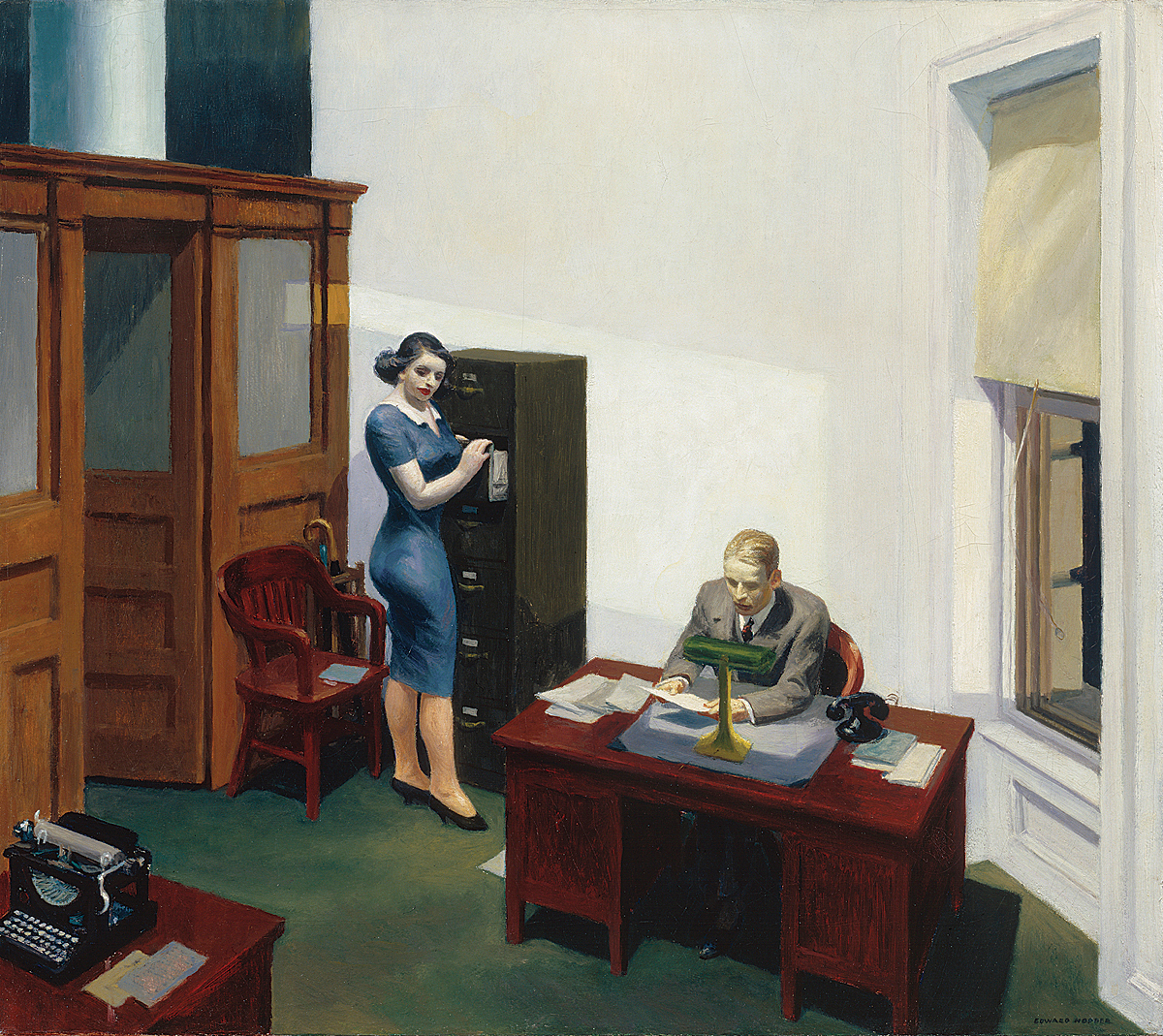 |
| Edward Hopper Office at Night, 1940. Oil on Canvas |
I’m two weeks into my new job as executive assistant and already experiencing doubts as to whether I’m “cut out” for it. Or any job. As a student (a time of my life which seems paradoxically distant yet recent), I had sat, curled on my bed one afternoon and read this book. In it she writes something along the lines of, “I became a writer because I couldn’t do anything else. No really. I was unemployable.” I had laughed then, wondering if I’d feel the same way once graduation came and went. And it did. That damn day crept up on me like the Lochness monster (by most accounts, the Lochness monster is quite stealthy) and before I knew it my mental bones had been ground and spat out onto the asphalt of the road I’m standing on now. I had to pick up the pieces and rebuild it to withstand the pressures of the real world. All I can say is, an architect I am not. I did so poorly. Very, very poorly.
*I will likely be reusing this painting in future posts.
On my 25th birthday I received a call from “Unknown.” It was 11:35 pm and my birthday had wound down without ever having wound up. I had woken up, gone to work, come home, napped, and putted around the house in my usual after-nap stupor. I ate a quiet dinner with my parents, neither of them bringing up the fact that I had just turned twenty-five. Why would they? Aside from the fact that I never could remember their birthdays (annoyingly, they chose to celebrate birthdays by the mysterious Lunar calendar, as though they were werewolves) May 9, 2011 was just like any other day, and would, judging by how things were unfolding, be like any other year. There would be a celebration in Las Vegas that following weekend, for which I was excited. Three friends and I would “party it up” young people style, meaning we would don short dresses and tall shoes and teeter about sprawling casino floors looking forward to dancing all night in massive, ornate nightclubs but really end up just wanting to sit down. The fact of the matter was that at age twenty-five, aside from one’s tall shoes and short dress not being nearly as tall or as short as those on twenty-one year olds, one’s energy is somewhat lacking as well.
But before that was to happen, I found myself at home in my childhood room, feeling strangely subdued. I stood barefoot in the narrow space between my desk and bed wondering where the time goes. I can re-connect my train of thought even if it didn’t necessarily happen like this:
“Goodness, I’m twenty-five now. I ought to write something. I ought to write a diary entry or something. Marking…this….strange ambivalence I feel.”
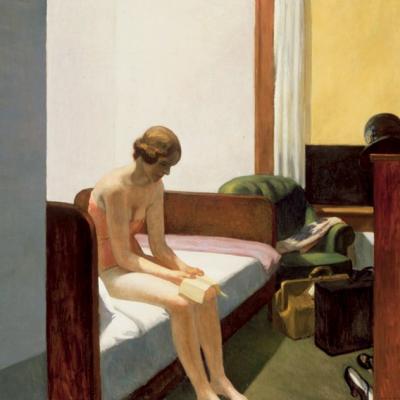 |
| Edward Hopper Hotel Room, 1931 Oil on Canvas |
It was ambivalence rather than the panic some of my friends reported feeling on their 25th birthdays. It wasn’t a quarter-life crisis, at least not yet. I didn’t feel lost or disappointed or much like questioning my life’s purpose (perhaps unwisely, I believe no one ought to ask themselves -not at twenty-five, anyway – unless they prefer the worst of mental agonies). Rather, I felt a numb surprise and mild amusement at what my sixteen or eighteen year old self would have said if she had foreseen her twenty-five year old self living in the same room and working at an aerospace transparency systems company.
Certainly, I went through these motions:
No. No reading or writing would be done on my twenty-fifth birthday. Though it was late my mind ticked hungrily, vaguely wanting something it could not find on the bookshelf or even within itself to write out upon paper. Something critical to my feeling centered and whole had been missing from the moment I woke and it was never regained or returned. It was not my parents’ lack of acknowledgment (however abusive or neglectful this makes them seem, this is simply who they are. They love me dearly, in other ways), nor was it anything from my friends or from myself, even.
I wanted to speak to someone very dear to me, someone who had been where I was and who knew me and could say something that would dispel the ambivalence, however silly and temporary it was. I am, for the most part, an emotionally stable person – but my self-purported stability pales in comparison to that of my brother. Ah. There it was, and wasn’t. He was not there. I went to my phone, which sat charging on my dresser. I had plugged it in immediately after work, leaving it on vibrate and throughout the afternoon it buzzed with various texts and calls from people wishing me a “good one.” Near dinner time however, I had gone out of the room and forgotten about it until now. And now I thought to revisit the slim gadget – a gift disguised as hand-me-down from my brother – two messages blinked from the screen – “One Missed Call: Unknown.” and, “One Voicemail: Unknown.”
Play:
“Hey Betty, it’s your brother.”
Always, that unnecessary yet singular self-introduction. I would know that voice anywhere, a younger, smoother, more articulate and unhurried version of my father’s. Better English.
“I just wanted to give you a call and say “Happy Birthday.” So hope you had a good one. I’ll talk to you later. Bye.”
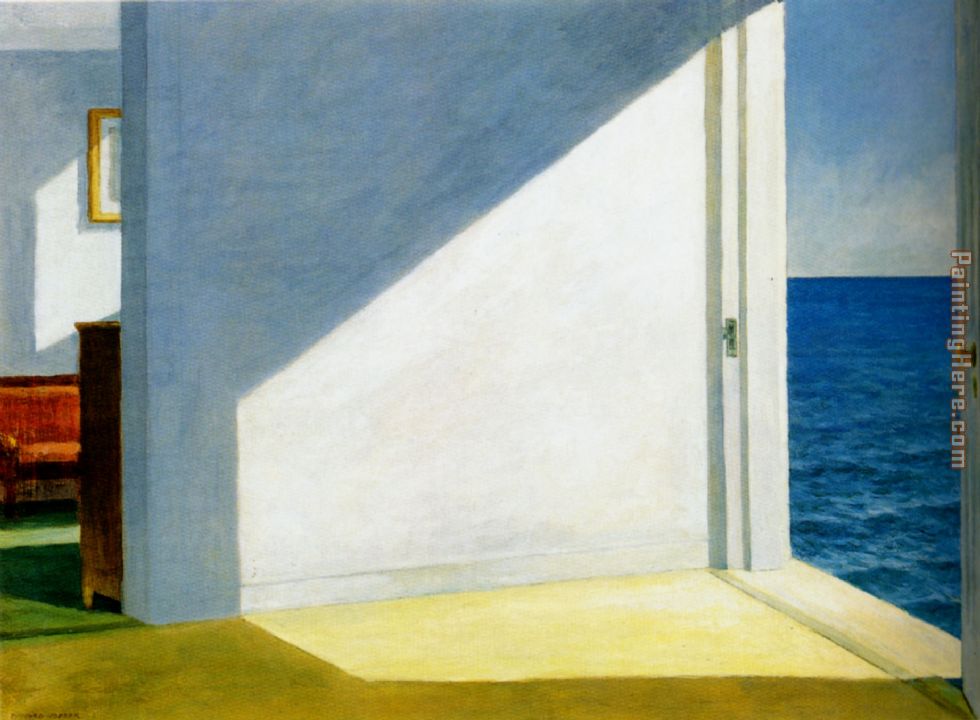 |
| Edward Hopper Rooms by the Sea, 1951 Oil on canvas. |
And that was all it took. It was, in the history of voice mails, perhaps not the warmest, or the most enthusiastic, and most certainly not the most sentimental, but my brother is all those things without overtly being any of those things. He was “Unknown,” but perhaps the only “unknown” I could ever, ever be certain about. He was away, yet right there in my hand. He had sent a sliver of his voice into the phone he had passed down to me and in doing so, filled a gaping void I felt most acutely that Monday morning. The missing piece was not to be read or written, but heard. And standing there in my childhood room at the age of twenty-five, I was grateful that from the swell of uknowns that lay before me, I could at least be sure of one.
When my mother goes abroad, which is often, her greatest fear is that we will let her garden die. And by “we,” I mean “I.” My track record for watering mom’s plants lags far behind even my brother’s, whose record would be deemed abysmal by any green thumb’s standards. If asked, he will water every other day for about a fraction of the required time, standing in one place like a statue in a fountain so that a very lucky spot in my mother’s garden will continue to flourish while all the plants around it wilt and wither to the ground like an empire fallen around a tyrant king. Occasionally, if he feels generous, my brother will flick his wrist to and fro, like tossing crumbs to serfs and peasants so that by the time my mother comes home those plants are clinging on for dear life, their stomata (a dusty word, pulled out of 9th grade biology fog) puckered beyond recognition.
But being male and being her son, my brother would only be mildly chastised by my mother’s furrowed brow. She would say, sadly, “Thank you for watering my plants,” before inevitably turn on me because really, watering the garden is a woman’s job, “Why didn’t you water the plants?” she’d say, implying, “Where were you when this massacre happened? Why did you not stop it?”
And really, if my only shortcoming as a daughter was a reluctance to water my mother’s plants, then I’d say, “Oh boo hoo, deal with it,” but this is far from my only shortcoming. For one, I love my mother’s garden in the same way I love Target. I love shopping there and would be terribly, terribly distressed if one day it were to implode and Wal-Mart became my only option for “cheap mega-stores in which to spend too much time and money,” but I would never in a million years enjoy working there. I will take from it (hell, if Target had a “blind employees only day”, I would don soft slippers and leave with an ungodly amount of stolen Hawaiian Tropic Sunscreen, cheap t-shirts, and NYTimes Bestsellers), get what I need to live my good life. But give back? Never!
And so too with my mother’s garden. She plants and tends to a variety of my favorite fruits, vegetables, and herbs: tomatoes, yam leaves, leeks, green onion, mint, basil, cilantro, doughnut peaches, apricots, and those are just what I can name off the top of my head. She does the harvesting as well as most of the cooking (though my father will beg to differ); I merely nod gleefully when she brings in basket after basket of my favorite produce.
With such a plentiful garden that makes so many people so happy (we often swap with my other green-thumbed aunts and grandma), it is only natural for my mother to worry about it in her absence. I worried too, briefly, wondering how many minutes of my day I’d have to devote to watering plants during her recent trip, as my brother would not be here to split the responsibility with me. Watering always turned out to be a rather enjoyable experience – I found I enjoyed the cool breeze at dusk and the grass between my toes, the soothing white noise of the water, but like many things enjoyable or not, I prefer selfish acts of indolence to productive acts of generosity that ultimately benefit myself as well. As it turned out, I needn’t have worried about touching the hose at all – not even once. My father, the jack-of-all trades that he is, saw to that.
If my mother is not traveling with my father, she knows in her heart that my father will take care of not only the plants but also of everything else. It is not in his nature to sit still for longer than an hour long news segment (unless it is very late at night), or to let things fall apart or stay in disarray. I inherited this from him, a desire to purge and clean and organize – though I do it almost exclusively in my own space. My father has a larger conscience than I – and even though rather annoyingly, he likes to be recognized for his “achievements, (“Do you see what I did with the bamboo grove today? Doesn’t it look so neat like a Japanese garden?” Or “Look at these lunches I packed you!”) I would be very narrow-hearted to say that he does not deserve it. Thus my mother knows that her husband – he who masquerades as a sloth on weekday evenings in front of the TV but in actuality, is the king of efficiency and productivity – will take care of the garden, take care of the house, take care of the lazy, easily fatigued, adult, live-at-home daughter in her absence because it is in his nature to do so.
But a smart woman, my mother knows better than to ask him directly. My father no doubt grew up thinking that old joke, “Today is opposite day” was endlessly amusing. In Chinese, we say people like that take great joy in “singing the opposite or minor chord” and for the most part, these people are huge pains, as my father is. But my father is also reliable in the way a man ought to be, especially if he is to talk so loudly and be, in general, a huge pain. He assumed the role of housewife upon my mother’s departure, donning yet another hat in addition to the ones he already wears: bread-winner (and maker, as lately he’s been tinkering with various banana-bread recipes), voice-of-reason, advice dispenser, organizer, laundry man (though this is one chore I do prefer), and a long list of other roles.
Long ago the divisions were made: my mother’s domain was the garden and the messy vanity area in their bathroom. Rather than makeup and perfume – the accoutrements of most women’s vanities – my mother had stacks of Chinese homework and textbooks, pens and pencils she scavenged from wasteful students, and special offers from nearly every Las Vegas casino resort, a testament that even otherwise frugal educators can have foolish and extravagant vices. My father lay claim to the family room, taking the central spot on our curved black leather couch and the small, wooden round table in the corner where he reads his emails, browses the paper, and clips Costco coupons. He is also in charge of cleaning and organizing the garage. The kitchen was like the middle part of a Venn Diagram, where husband and wife converged to cook grand dinners together when they entertained or simply, when they each had ideas about dinner that just so complimented each other.
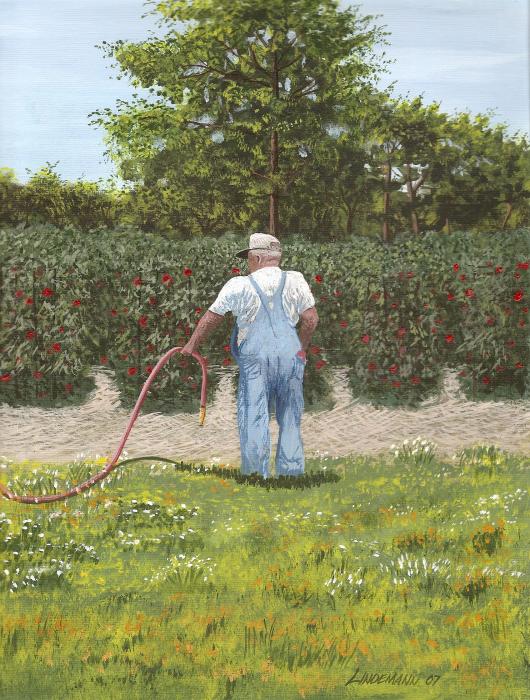 |
|
| Old Man in Garden by Don Lindemann |
Here’s the thing: when my father is gone, my mother stays in her domains and never ventures into my father’s. Why should she? She doesn’t read the newspapers, nor does she watch TV. The garage is just where she parks her car. But when my mother is gone, my father, though you could not tell from his face, almost gleefully assumes the role of gardener as well, and disappears into the yard for hours on end. The garden, because of what is produces, is closely tied to the kitchen and when my mother is home, the clanking pots, running water and tinkling glasses are usually an aural sign of her presence. However, sometimes the kitchen falls unexpectedly quiet and I come out of my room to find the kitchen empty and the back door slightly ajar, a pair of black house slippers awaiting my mother’s feet to re-inhabit them, sounds replaced by this simple image. Recently however, I still hear the clanking and the rushing and the tinkling, and sometimes, when the sounds stop, I enter the kitchen to see that there are pots bubbling on the stove, vegetables diced on the chopping block, and the back door slightly ajar with my father’s beige house slippers standing by. The television is invariably on, the sounds wafting into the kitchen – and the overall effect is calming, as is the knowledge that even without my mother, my father can keep things running smoothly for all of us.
Like clockwork he removes his socks after dinner each day and steps out and into the backyard to water his wife’s plants until the sun goes down. He does this after a full day’s work, after spending a half hour making dinner for himself and his adult, live-at-home daughter, who during the summers, comes home from work to swim and then sleep for an hour. She eats with relish because her father cooks what she loves, and after dinner, does the dishes, memories of her father being a huge pain briefly suspended in her gratitude for the meal, lovingly prepared. She soaps the dishes and thanks her father for dinner, reminding herself that nothing and no one, no matter how steady or reliable or invariable, ought to be taken for granted. The father nods, pleased that his daughter is both fed and happy and without further ado, steps out into the warm evening air to water the plants his wife adores.
 VERY HIGHBROW