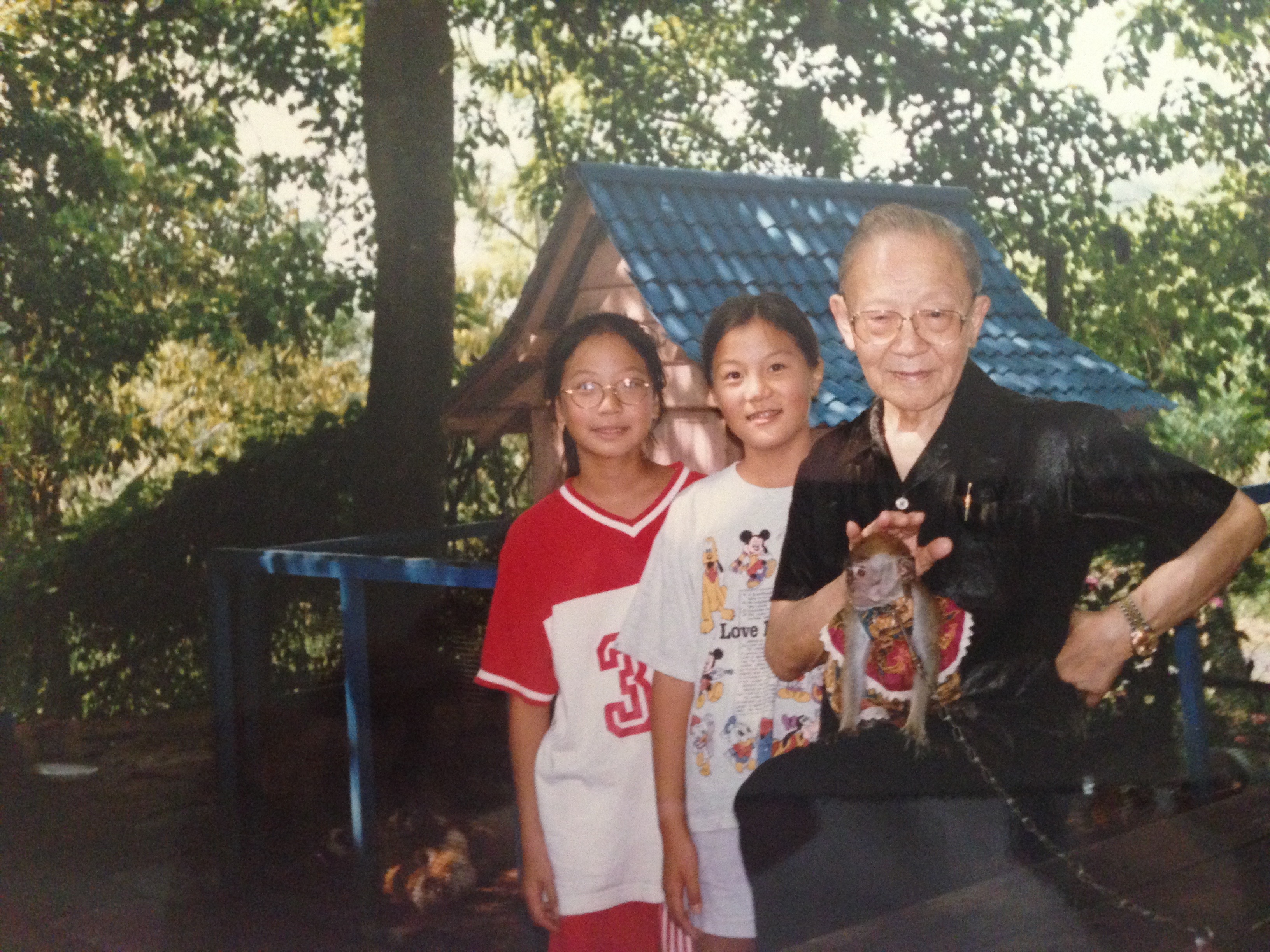
My Father’s Stories

Somewhere in between high school and my second year at college, I stopped reading fiction. Not altogether – a small number of brilliant novels made its way into my hands via persistent recommendations from friends and family – but very, very rarely now, compared to my youth when fiction was all I would read. As a young girl visiting the library, I would make a beeline for the new fiction section. If it seemed I’d already gone through the choicest ones, I’d make my way to the back shelves. But I never wandered beyond the shelves marked “Fiction and Literature.” My memory is poor, but perhaps I have done that walk so many times this impression could not help but be ingrained: I remember one evening, hurrying past the biographies and wrinkling my nose in distaste at the thick tomes about real people. “Why would anyone want to read about real people when there is so much great fiction?”

My father was a hypocritical detractor of this mindset. He would shake his head whenever I walked in with a bag full of novels and say, “That stuff doesn’t grow your brain. It makes you dream,” and I’d roll my eyes and say that he had no heart. Fiction builds character, I said. Why do you think I’m so amazing?
I say hypocritical because my father grew up on a steady diet of classical Chinese literature – all of it fiction. You may know the most famous: The Dream of the Red Chamber, The Romance ofthe Three Kingdoms, and Journey tothe West – impossibly long and complicated stories written back then by people with plenty of time and imagination, for people with plenty of time and growing imaginations.

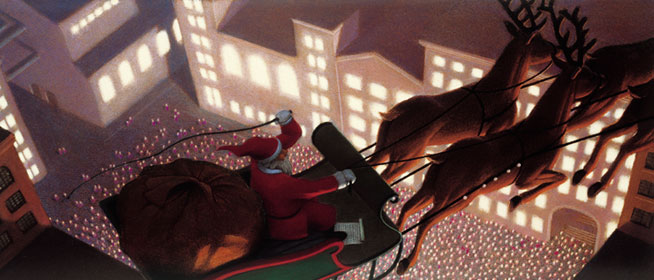
My favorite scene from “The Polar Express.” 

As a grown man with thoughts of career and family, he stopped reading fiction, but he never stopped thinking about it. I have often said that I remember little of my father from my childhood, though if I were to excavate the loose grey matter I hardly use, I would find him exactly where I needed him most.

He often picked me up from daycare and, if he came home later (though always in time for dinner), he would come bearing a large stack of children’s books from the palatial Cerritos Library. When we lived in the city, he took me there on weeknights or Sunday afternoons so that I could make my own choices and I will never forget that magical wing, designed to mimic a medieval castle with turrets filled with thin, colorful spines, each bearing a tale, not necessarily a lesson. But after we moved to a city some thirty minutes away, he often stopped by on his way home from work and picked out books with what he hoped was a discerning eye. To be honest, I don’t remember many of the books – The Polar Express, The Velveteen Rabbit and The Vanishing Pumpkin stand out (going online to see the covers of these books now, for some reason makes me cry) – but collectively, they comprised a lovely childhood.

What’s more, my father told us stories – at least, he tried to. It is a running joke in our family that my brother and I ought to know those stories by heart, at least the Journey to the West, because my father boasts of having played raconteur to us each night around bedtime. And he did, we do, but only parts. He always fell asleep after three or four lines so we never heard the ending. How did the sly monkey and pious monk get to the West? More than anything my brother and I know the sound of his snores, which now blend seamlessly with our perception of that tale. I know now, from Chinese school and later studies that the monk, the pig and the monkey eventually reached their destination, but it is vague to me, unlike my father’s introduction to the story, which still rings loud and clear. Indeed, you must be able to recall the fables and other bedtime stories your parents told you as a child – perhaps you never even set eyes on the words but you remember them and the images they evoke. It becomes innate – the stories as much a part of your genetic makeup as your hair and bones, your heart.

For years I rolled my eyes at my father, thinking he would never understand me because I loved novels and he seemed only to ever read business books and magazines, but looking back, I realize I had forgotten the source of this love. 

Low Expectations

One of the executives, David, is quite self-sufficient, preferring to take care of his own affairs. A while back I offered to help him manage his calendar and he was overjoyed, saying, “Oh wonderful! Wonderful I didn’t want to ask before, but since you offered, that is great.”

I regretted it almost instantly, thinking he was probably the busiest person in the company and his calendar would eat me alive. But he isn’t, and it didn’t. For the most part, he is a very low-maintenance man. (To be fair, so is my boss if I exercise the proper judgement and foresight to put out fires before they begin, but the relationship is very different.) He prefers to make his own arrangements, from airport services to restaurant reservations to, oddly, calendaring, as that was what I offered to do for him in the first place, but occasionally he will “bother” me (his word) with little tasks here and there that he simply does not have time to do.

Mostly, printing out Excel spreadsheets. For anyone with an ounce of common sense (and I like to believe I have at least 5 oz.), printing out an excel spreadsheet often requires more than two pages, depending on the content. Excel is a big part of most people’s job descriptions – accountants, business planning, sales analysts, etc. all seem to live and die by Excel. Can’t use Excel? Don’t work here. My job is a little different: don’t know how to print out Excel spreadsheets? Don’t offer to manage David’s calendar because essentially, what you’re offering is your willingness to put down whatever you’re doing and print out massive spreadsheets that span three or four pages, depending on how many rows and columns there are.

I confess in the beginning I had a bit of trouble, not because I did not know how to click “print,” but because I did not know that spreadsheets had tabs and such. I would print out the first tab and neglect the rest and David would look at it curiously and then at me and say, “Where’s the rest?” And then I would redirect the curiosity back to him and say, “Of what?”

That is when I learned about the tabs. Anyway, once the spreadsheet is printed, it follows that with just a quarter of an ounce of common sense, a person would glue or at the very least, if there were no glue, tape the spreadsheets together to recreate the impression that they were all on one sheet, just as though one were viewing it on a giant TV screen, as people do here. I did just that for David, not out of the generosity of my heart, but out of a sense of duty. He asked me to do a job. I wanted to do it well. I snipped the extra bits off and glued the sheets together, rather seamlessly, I might add. It was very beautiful work and only a nit-picky ass would say, “Oh this line is a hundredth of a fraction off. Please re-do it.”

David is not a nit-picky ass. Not at all. Instead, when I present the expertly glued spreadsheets to him, his eyes light up and his hands come together in a sort of delightful prayer, as though in the history of his time at the company, no one had ever thought to glue the spreadsheets together.

“Oh great! Great!” he says, every time, “This is perfect!”

And now, I don’t know if this is an insult to my intelligence, to my position, or to his general and apparently very low expectations for me, but he says, “You are so smart to glue them together like this! So smart! Excellent!”

I stand there and accept the compliments and the praise (something my boss does not dole out quite so generously) though I am quite unsure of their value.

100 Years of Vanity, Part V

She was a terrible cook, but nobody could peel shrimp, crack open a crab or a lobster, a mussel or a clam, or disassemble a German pork knuckle as adroitly as my grandmother could and to her liking. No one else could make friends with servers and maitre’ds and managers alike despite being with the most difficult customer many of them had ever known. She knew his appetites better almost, than she knew her own, and it was at the table that we learned how little we knew how to communicate with him – the least we could do was follow her lead. But it was too obvious, to both ourselves as well as to the rest of the world, that the family was at a loss on how to appease my grandfather should grandma step out for a moment.
But these moments were rare – for twenty years she was unfailingly by his side, always there to cater to his vanity, and on the morning of his one-hundredth birthday, she was there as well.
God knows what he dreamed during the night, but at four am his eyes shot open with an all-consuming hate for his aged complexion. Perhaps it was the thought of appearing before four hundred guests under bright ballroom lights, but being an innately vain man, he decided to take extra precautions. He shuffled resolutely into the bathroom and turned on the lights. A few feet away, my grandmother stirred in bed. Having spent the last twenty-years sharing his biological clock (one that wakes often at odd hours of the night to use the bathroom or read the paper-or both), she simply turned the other way and pulled the blanket up to her chin. My grandfather ran his fingers along the shelves, silently reading the minute labels until he found what he was looking for. He began his work.
The balcony, where my grandpa usually stood doing his morning exercises was empty. The bathroom door was closed, a strange phenomenon, for in his old age, the fear of an unheard fall led him to bathe with an open door. She was worried – aside from the hundred ticking clocks of my grandfather’s collection, it was oddly silent. No running water, no brushing of teeth or wringing of frayed undershirts. She went to the door and knocked. Nothing. She knocked again but not before hearing the distinctive click of a compact being closed.
“Can I open the door?” She asked.
“Hmm.”
“What are you doing in there?”
When my grandfather failed to respond she held her breath and turned the knob, bracing herself for what she was not sure, but certainly not to find her husband, a distinguished gentleman to all who knew him, with his face done up like a retired geisha who had failed to remove the makeup from her last night at the teahouse. He turned slowly, a crazy, hunched wax man, and had he the humor to give her a devilish grin she might have died of fright. Instead he said nothing, nodding subtly as though using up an entire bottle of foundation on one’s one-hundredth birthday was de rigueur, and went back to work.
My grandmother rubbed her eyes, not sure if she was dreaming. Why the mask? Why the rosy cheeks? Did he intend to celebrate his one-hundredth year as a lunatic? A transvestite? But the man had laid out his suit and shoes the night before, pairing a red-silk vest with a red-silk handkerchief and now, he apparently wanted his cheeks to match. Between gnarled fingers he held, gingerly, the blush compact in one hand and the brush in the other. Round and round he went on his left cheek, seeing only the perfection of perfection- he was merely enhancing what he always had. He was a handsome actor preparing for his greatest role ever.
Grandma, now fully awake, stepped in.
“You look…” she considered his one hundred year old ego, then thinking about the four hundred guests and her seat next to him, she considered her own, “You look ridiculous.”
I was getting my own beauty rest two floors above, but I imagine a small tussle took place in the master bath that morning as wife tried to wrestle away blush compact from husband.
But he said nothing. Chuckling softly at his handiwork, he handed the compact to her.
An hour later grandma had exhausted an entire box of Kleenex and half a bottle of makeup remover. Her husband’s skin glistened once again in its natural beauty and his cheeks glowed with the faintest pink, from having been rubbed with tissues.
“See,” my grandmother told him, tossing the final Kleenex into the wastebasket with its makeup-laden siblings, “You don’t need any of that makeup – you are handsome enough as is.”
He looked in the mirror and agreed, touching his face and enjoying the softness. Then he looked at her, his patient, adoring wife who had always known best. He looked at her tired face, the dark circles under her eyes, her fuzzy hair – she looked that way because of him, because of all the energy and love she spent on him. He loved her for that.
Still, it was his birthday and she would be sitting next to him.
“We haven’t much time,” he said, handing her the compact, “you’d better get started.”

The End 

100 Years of Vanity, Part IV

The young woman was thirty-two, the same age as my aunt, and forty-eight years younger than my grandfather. And she was beautiful. Petite with strong, high cheekbones, full lips and a full head of thick hair, a shock of surprise rippled through the family when they met her for the very first time. She was beautiful, my aunt recalled, but she had a hard look about her, as though something or someone was forcing her to marry this drastically older man. But far from it, her decision to marry my grandfather was entirely her own.
            She was working as an administrator at an appliance company, filing forms and payments on air conditioning units and refrigerators, when a coworker, the sister of an aunt, suggested that she meet an elderly man she knew.
            I was two at the time and living an ocean away in a leafy suburb of southern California, utterly oblivious to any grandmother but my mother’s mother, who lived in the neighboring city and made sweet buns for us at Chinese New Year’s. As I played in American sandboxes, the union that would provide me with a Taiwanese grandmother was being arranged in the humidity of Formosan air. The mental intricacies that would push a young woman of thirty to agree to meet a man of eighty with the implied expectation of a partnership remained uninvestigated for years, but as I grew older and my grandparents’ relationship became clearer, I opened my ears and became very still when my grandmother was out of the room and the other women remained behind. In this way I pieced together a shadowy history of my grandfather’s last wife. 
Five years prior to her marriage to my grandfather, she had been in love with a man closer to her own age. They had both come to Taipei from the poorer southern city of Tainan, hoping to make a new life for them in the big city. A friendly and sociable woman whose confidence was boosted by the move to a bustling city with the love of her life, she quickly found a job at the appliance sales company and worked diligently, saving most of what she earned towards buying a house with this man. He on the other hand, remains largely a mystery – my grandma only ever told my mother once, vaguely, about what happened – but what’s clear is that after five years of life in the city, her savings close to what was needed to buy a house, she came home from work one night to find the house empty and the man gone along with every penny in the bank.
I’m not sure what sort of conversations they had on their marriage night or in the days after, but I believe that my grandfather asked no questions. The ease with which he lived was the same ease by which others conducted themselves around him. His new wife felt this immediately. My grandmother, the only one I have ever known on my father’s side, did not marry for money per se – though of course the money was welcome – rather, she wanted a decent man. I am not one to explain the psychological process that leads one to marry a man forty-eight years older – maybe my grandmother was a little crazy – but in all the years I have known her, and him, neither grandma nor grandpa ever gave any indication that they were nothing but meant for each other.
Just as with wife number four, my Grandfather lavished his new bride with gifts and countless trips around the world, except this time with grandchildren in tow. Which suited my grandmother fine, because she was as humble as my grandfather was vain. She delighted in the old man’s vanity and even encouraged it, for she loved to comb his hair for him, to buy him the latest Japanese beauty creams, and to pick out brilliantly colored ties and handkerchiefs. In China, she bargained fearlessly for the best prices on suits and shoes, her Mandarin saturated with a heavy Taiwanese accent that would normally cause mainland vendors to disregard her, but her easy laugh and friendly nature made her hard to dislike. And while in the first decade and a half of their union my grandfather was fully capable of doing all these things himself, he delighted in her company and the looks they drew as they walked down the street and into restaurants.
Had the age difference not been so wide, they would still have made a strange couple, for my grandmother was notoriously the most tackily dressed member of the family. She wanted none of the finery so coveted by the fourth wife or the social status of the third. She wanted only the security of being with a good man, and my grandfather, aside from his narcissism, was a good man. It wasn’t until after his ninety-sixth birthday that the first signs of senility began to show, but even then my grandmother rose to the occasion. Though she had the financial means, my grandmother refused to hire a caretaker for my grandfather and gamely assumed the role of nursemaid, chef, driver and secretary. Despite his growing need to sleep and a diminishing appetite, my grandfather maintained a robust social schedule, keeping memberships at several of Taipei’s ritziest hotels, to where he treated his friends for lunch. When these men, many of whom were also retired customs officers had begun to die off, my grandfather took to treating officers from later generations or his colleagues’ grown children and their families. These elaborate, time-consuming meals were by no means exclusive to customs officers. I remember many a summer afternoon whiled away at a ritzy hotel buffet or within the dim, wood-paneled dining room of an upscale steakhouse. My grandfather specialized in treating people to the business lunch: three courses for the price of two. These meals became a family tradition – a rite of passage for anyone who wanted to know the family better and it was during these meals that any outsider, and the family as well, acknowledged just how necessary my grandmother was to my grandfather’s wellbeing. 

100 Years of Vanity, Part III

His sons were horrified. They warned their father about the rumor they’d heard: the woman’s last husband had died in a mysterious manner. Though extremely rational and normally disdainful of anything that bore the slightest whiff of the superstition, my uncles went to consult a fortuneteller (most likely on the recommendation of my second aunt, who seems to know all the good fortunetellers). The prophetess said this: “Beware this fourth wife: she has the qi (energy) of a husband killer!” What the fortuneteller meant was not that she had murdered her last husband, but she had a ruinous air about her – whoever married her would succumb to her insatiable karmic appetite and have his life drained from him. But my grandfather chortled, “Husband killer! Doesn’t she know she’s wife number four?”
Filial piety bound my uncles to let their father do whatever he wanted, including squandering a small fortune on the wedding, gifts and anything else his high-maintenance bride wanted. They honey-mooned for what seemed like half a decade, traveling across the world twice and taking photographs in front of every famous monument – their pictures have an air of glamour about them, my handsome grandfather in his three-piece pin-striped suits, arms crossed confidently across his chest, and his beautiful wife, dressed in luxurious silk and linen pantsuits, elegantly at his side. On the surface they were a beautiful couple, and when they weren’t abroad they were entertaining at home, attending parties and premiers, concerts and theater.
The things that brought them together – her beauty, his wealth – could only last so long, and as her looks faded she became more and more demanding, wanting each year to transfer more and more property to her and her children’s name. When his sons approached him to put a stop to it, my grandfather shook his head lightly and shrugged, “She loves money. What can I do?”
He put himself first and this meant avoiding confrontation at all costs. He would never be the one to suggest a divorce, or even think it. They were messy and in bad taste. Instead, my grandfather continued to live. It was around this time however, that he began to practice selective hearing and while his wife’s screeching for money became louder and louder, he perfected his inner calm, tuning her out to gaze at her once beautiful face.
One day, after nearly ten years of marriage she became enraged after being refused one thing or other and screamed, “I want a divorce!” Before she had paused to take a breath to reevaluate my grandfather stood up from his desk.
“You got it,” he said, and walked calmly out the door.
The marriage ended and my uncles breathed a sigh of relief, though they wondered if their stepmother had escaped with her life. However, not too long after, she too passed away from illness. She was a year shy of seventy.
By now, my grandfather was eighty years old, but looked not a day over sixty. His daily regimen persisted through the years and had served him well; it became apparent that he was in impossibly good health for a man his age – he would live a very, very long time. No one knew this better than my grandfather.
Months after the divorce he called in his second son’s wife, a sociable young woman with a large network of friends and family.
“I want to remarry,” he said.
“Of course,” she replied, “You’re in excellent health and have plenty of years ahead. You ought to remarry.”
“To marry someone young,” he said.
My aunt smiled, “I’m sure we can find someone who knows a nice woman of sixty or seventy.”
“No.”
“No?”
“No.”
At this, my grandfather leaned in and said more words to my aunt than he had spoken to anyone else in a long while, “I’m eighty,” he said, “And I know I will live for a very long time. If I marry someone now who is sixty or seventy, in ten years they will be seventy or eighty – and I don’t need to be a fortuneteller to know that they’ll need someone to take care of them by then. I don’t want to be old with old. I need someone who can take care of me – for however long I live.”
My aunt was stunned, perplexed. How young was her father-in-law thinking? Certainly not someone younger than fifty? A thirty-year age difference was cause for scandal, but then again, so was a money-grubbing B-list movie star. My aunt kept the conversation to herself, replaying it in her head and wondering what to do. She didn’t have to wonder long. A few days later, it was announced that for the patriarch, a new bride had been found. 

100 Years of Vanity, Part II

A man born in Shanghai carries Shanghai with him forever. Thus my grandfather neither bid farewell to Shanghai nor did he abandon all hopes of reunification with his daughters – he communicated with them frequently via letters and kept every epistle his daughters sent. When relations between China and Taiwan resumed, he returned twice each year to his native city and made sure his daughters and their children (by then two had married) were financially secure. But mostly now, his attentions were directed at his new wife, his three sons and, unwaveringly, upon himself.
It is hard for a vain man to be emotionally available, and my grandfather was no exception. Once I asked my father whether he recalled any heart to heart conversations with his father and without pause my father replied, “Nope.” But by no means was grandpa a cold man – he smiled generously and loved his wife, his sons and his friends in the best way he knew how: by spending time with them. He spoke little during his children’s upbringing, preferring to smile and watch rather than talk and interact. It was his third wife, my biological grandmother, who kept household affairs running smoothly, made sure their finances were in order and disciplined the boys; it was my grandfather’s job to go to work everyday, come home to dinner, and smile as they talked to each other. He appreciated the finer things in life and was lucky that his business-minded wife trained her three sons to be business-minded as well, buying land as a future investment, teaching them the value of the dollar and pressuring them to pursue graduate studies in the United States. My grandfather, in all his thrift, agreed with her, but pursued his own interests in ballroom dancing and attending parties. He loved to dine out (but never drink), dance and be seen at parties with his wife on his arm (a beautiful woman was always his best accessory) and he easily became the life of the party without saying more than a few words. His presence alone put everyone around him at ease and this was largely due to the fact that he neither tried nor was interested in persuading, entertaining or getting to know others. This was the other side of his vanity – the desire to know only himself, and superficially, those closest to him. As his sons grew into successful businessmen and his peers began to appear more and more disheveled and wrinkled with age, my grandfather seemed to grow more youthful with pride at his sons’ successes and his wife’s financial prowess.
“I never asked for any of this,” his smile seemed to say, “But you know, I am a lucky man.”
Luck, by definition, does not encompass the death of a spouse or, in my grandfather’s case, the death of multiple spouses. I should mention here that his second wife had died in Shanghai of tuberculosis shortly after she discovered my grandfather could not return from his post. His first wife had succumbed to the same disease. Thus twice widowed and in Taipei, my grandfather married a third time to the woman who would bear him three sons to pass down the family name. When my father had been working for only one year at his first job out of graduate school, his mother was diagnosed with terminal pancreatic cancer. Perhaps she had worried too much – her sons’ futures, their girlfriends (none of whom she liked, my mother included) and about the family’s finances – while her husband worried about nothing, but the cancer spread quickly and she was dead within a year. The whole family mourned along with much of Taipei’s high society, for by then my grandmother had, by shrewd investing and thrift, amassed a small fortune for the family, providing her sons with the capital to start their own business.
My grandfather was saddened but his two younger sons were consumed by their grief – they had been immensely close to their mother. My father, the eldest, was working in Hong Kong through much of her sickness, was sad but strangely detached – also, his relationship with his mother had been strained during her last months; she disapproved of my father’s wanting to marry my mother, of whose poor background she disapproved.
“Your grandmother was vain in a different way,” my mother said to me, “She worried about the face, the reputation of the family while your grandpa was always more concerned about his actual face.”
And it was true – less than a year later, my grandfather was on the hunt for wife number four, believing that the best beauty treatment to keep wrinkles at bay was to marry someone young and beautiful who would worry about the things he couldn’t be bothered by. With his children grown and their success growing, my grandfather felt it less important to find a “motherly” figure for his children than to find a stunning woman with whom he could be seen with out on the town. Likewise in his youth, my grandfather, at the ripe old age of seventy, was still quite a catch and there was no shortage of women who wanted to marry him. He finally set his shallow sights on a beautiful fifty-eight year widow who had in her younger days been a B-list movie star. She on the other hand, had her sights set on his money. 

100 Years of Vanity, Part 1

IMG_5034
At dawn on his one-hundredth-birthday, my grandfather shuffled quietly to the bathroom, closed the door, and began to powder his face. Though “powder his face” is an understatement. What he really did was raid my grandmother’s cosmetics cabinet and use up an entire bottle of foundation. He was working his way through a new blush compact when my grandmother intervened.

Steve Jobs, Again

I finally finished Walter Isaacson’s biography of Steve Jobs, three months after my boss’s brother dropped a copy off at my desk. I learned more about Apple than I cared to know, and was slightly disappointed by the lack of insight of and from his family, but that in itself is a facet of Jobs’ life. Yet I can’t imagine anyone else having written Jobs’ story as completely as he did. Isaacson is not my favorite biographer (that distinction belongs to Ron Chernow – yeah cry your heart out, Isaacson) but I don’t know if Jobs’ story, if written by another hand, could have been as illuminating, or if Jobs would have wanted his story told any other way,  which, I suppose, is why he chose Isaacson rather than the other way around.

I asked Jobs why he wanted me to be the one to write his biography. 

“I think you’re good at getting people to talk,” he replied. That was an unexpected answer. I knew that I would have to interview scores of people he had fired, abused, abandoned, or otherwise infuriated, and I feared he would not be comfortable with my getting them to talk. And indeed he did turn out to be skittish when word trickled back to him of people that I was interviewing. But after a couple of months, he began encouraging people to talk to me, even foes and former girlfriends. Nor did he try to put anything off-limits. “I’ve done a lot of things I’m not proud of, such as getting my girlfriend pregnant when I was twenty-three and the way I handled that,” he said. “But I don’t have any skeletons in my closet that can’t be allowed out.”

I leave it to the reader to assess whether I have succeeded in this mission. I’m sure there are players in this drama would will remember some of the events differently or think that I sometimes got trapped in Job’s reality distortion field. As happened when I wrote a book about Henry Kissinger, which in some ways was good preparation for this project, I found that people had such strong positive and negative emotions about Jobs that the Rashomon effect was often evident. But I’ve done the best I can to balance conflicting accounts fairly and be transparent about the sources I used.

“I had a lot of trepidation about this project,” [Steve Jobs] finally said, referring to his decision to cooperate with this book. “I was really worried.”

“Why did you do it?” I asked.

“I wanted my kids to know me,” he said. “I wasn’t always there for them, and I wanted them to know why and to understand what I did. Also, when I got sick, I realized other people would write about me if I died, and they wouldn’t know anything. They’d get it all wrong. So I wanted to make sure someone heard what I had to say.” 

-Walter Isaacson, Steve Jobs  

There’s so much of Jobs’ own voice in there that you don’t have to waste time wondering, “Well, did Jobs himself see it this way?” 

My boss had a copy of the book on his iPad, which he said he was reading during his workouts, but when I asked him about it a few weeks after the book came out, he scoffed and said he didn’t have time to read it.

He nodded towards his computer monitor where his inbox was displayed.

“I have to read all this other shit.”

More than a biography, Isaacson’s book is a great management tool, not just for companies but for oneself. This is what I loved reading about most: Jobs’ lifelong mantra of simplicity. Taking away rather than adding to, a funny math that leads to success and sometimes, a legacy.

Jobs’s intensity was also evident in his ability to focus. He would set priorities, aim his laser attention on them, and filter out distractions. If something engaged him – the user interface for the original Macintosh, the design of the iPod and iPhone, getting music companies into the iTunes Store- he was relentless. But if he did not want to deal with something – a legal annoyance, a business issue, his cancer diagnosis, a family tug – he would resolutely ignore it. That focus allowed him to say no. He got Apple back on track by cutting all except a few core products. He made devices simpler by eliminating buttons, software simpler by eliminating features, and interfaces simpler by eliminating options.

That focus has always eluded me and, I think, escapes not only my generation, but generations before and after. This was my fundamental problem upon entering college – I saw all the choices ahead of me and felt compelled to pursue all of them, which of course meant I could pursue none of them well. But now, I’m beginning to “get” it. What do I need? What do I want? For starters, I know what I don’t want.

But there will always need to be sacrifices in pursuit of this simplicity. Jobs sacrificed (or perhaps for him, “sacrifice” is the wrong word) better relationships with his family. What will I sacrifice? More importantly, what will I eliminate?

I’m working on it.

Security Blanket

A few days ago my mother came in to say goodnight and saw me hunched over my work phone, typing something out to my boss. I looked up, aware my eyes projected fatigue if anything.

She kept her hand on the door handle, as though deciding whether or not she should come in – it was late. She was constantly reminding me to sleep earlier but at the same time saw so little of me during the day that the evenings, right before bed, were the only time we really got to talk

I look forward to talking to my mother at night. Now, she is busier than my father (though he will never agree to this); after teaching a few hours she comes home to make dinner (unless my father, having left work early as he often does now, comes home to make it first) and then prepares to leave again to play two hours or so of badminton at the local club.

When I was younger and she didn’t play badminton, I often watched her sneak in a short naps here and there. I would come home from school and shout something to my brother who would say, “Shh. Mom’s sleeping.” And she’d be in the living room, stretched out primly on the flowered couch, her knees propped up or feet crossed at the ankles, a slight frown on her face. A light sleeper who stirred at the slightest sound, she was never fully asleep. I pitied her for it because my father’s snores are murderous – meaning you will either die from exhaustion, or kill him in the middle of the night.

Whatever my mother thought of her sleeping situation, she and my father worked it out long ago. She took to retiring earlier than he – to get a head start, I suppose. Her tactic was to enter REM before my father came to bed, and would thus be immune to the noise. But I doubt this. It is one of those sacrifices women make when they marry. My father gives her love, warmth, a family, the financial stability to pursue her non-profit Chinese school dreams – all that and more – in exchange for the restful slumber she had before she met him.

And yet to my surprise I observed that my mother slept poorly when my father was not there. As they grew old together, she came to rely on the rhythm of his breath to put her heart at ease. At the end of the day everything was fine – he was there, alive and well, and together they were whole. Her children may grow and fly the coop (though this has yet to happen with the youngest bird), but at the eleventh hour through the first, her husband was there, sleeping peacefully albeit noisily by her side. 

So perhaps it was not the sleep. Whatever it was, she seemed to be always tired, in the same way I feel now. For a long time we thought it was her liver. My mother is also very gullible – fatigue and gullibility do not mix. Fatigue makes one desperate, even more gullible than usual, and she bounced from one doctor to the next, collecting a docket filled with lies about her physical condition.

She was never known for being fair, yet one doctor said her skin appeared jaundiced, which indicated her liver was failing her. Another doctor pointed to the white hairs along her hairline, saying it was something to do with her blood. Lupus. Cancer. Hypothyroidism. We never really did figure it out, but thank goodness my mother, despite her gullibility, hates western medicine with a passion and refused to take any of the medication. “Why damage my liver further, if my liver is already weak?” she reasoned.

Chinese medicine, with its strange herbs and animals parts were another story – my mother believed in eastern medicine with the same principles with which she adhered to Buddhism. Not strictly, but willingly, out of familiarity. Eastern medicine could be explained in Chinese terms more readily than western medicine and procedures, and was, in general, a more holistic approach, which appealed to my mother’s nature-loving bent. She spent a small fortune on carefully measured packets of horsetail, cordyceps, starfish, feverfew and fenugreek which she dutifully boiled every night with dates and ginger root so that our house smelled not unlike the strange, dim doctor’s offices she visited on Taipei’s outskirts.

As a family we tried to persuade her to take on less. Cut her private tutoring classes. Forget doing the Chinese school – not only was it a non-profit, it bled money. Don’t serve on the advisory board of this Chinese committee and that. Stop editing Chinese textbooks for free. And for Chrissakes stop traveling to China and Taiwan for exhausting two-week long conferences while staying in shitty hotels with bad food.

But my mother is stubborn when she sets her mind to something and she had learned long ago that married or not, a woman must have her work. So she persisted in building her Chinese school, and despite our protests, took on more private tutoring students. For a while I feared she would die of exhaustion. And somewhere in the middle of all this, she began to play badminton, hours at a time, three or four times a week.

I thought, “Oh goodness. She will collapse one day.”

Instead, the opposite began to happen. She became more energetic, more lively, more ambitious. It wasn’t just the exercise but also the growing profile of her tiny Chinese school. The two together: a woman’s work and the care she devotes to her body – is a powerful combination for happiness. Yes, she still comes home exhausted some days, but for the most part I have never seen her look so vibrant. My father noticed too, and rather than continue to persuade her to quit, he now accepts his growing role as Mr. Mom – he cooks more, takes care of more things around the house – not that he didn’t before, but he is home more often than my mother is, and the role of half-house husband suits him well.

From my mother I learn that for a woman – or any person, really, to stick to their work, stick doggedly to it even though no one pushes them to do so, they must really love the work. She has the energy to do it because that is how the mind functions – it provides phantom energy, the most potent and secret kind, to help you accomplish what you most love and need in order to feel whole.

And now my mother, armed with phantom energy, comes into my room each night to ask me about my work.

“Does it make you happy?”

“Is your boss a nice man?”

“Do your coworkers like you?”

Yes, yes and yes, I say, but still, there is a feeling that everything about the job is fleeting, much like every other job I’ve held in the past.

I tried to go in with an open mind, thinking, “Who knows how long I’ll stay?” Maybe I will love it and end up staying three, four, five years. A decade?

I heard a hollow laugh when I posed the possibility to myself. 

I’m too young to think that any position I hold now will be my “career,” but I can’t shake the feeling – both paralyzing and liberating – that I may never have a “career,” not in the conventional sense of the word. What is industry? What industry? How should I categorize myself and where, in the vast career planes and skyscraping corporate verticals, do I belong?

“It was a great comfort to turn from that chap to . . . the battered, twisted, ruined, tin-pot steamboat. . . . I had expended enough hard work on her to make me love her. No influential friend would have served me better. She had given me a chance to come out a bit—to find out what I could do. No, I don’t like work. I had rather laze about and think of all the fine things that can be done. I don’t like work—no man does—but I like what is in the work,—the chance to find yourself. Your own reality—for yourself, not for others—what no other man can ever know.”

Joseph Conrad, Heart of Darkness 
Quote of the Day

At the office I had gotten into a rhythm of putting up a thoughtful quote each morning. I have a little whiteboard behind my desk, made from the frame of an old television – I don’t know what the old assistant used it for, but I doubt it was for something as wonderful as writing a quote of the day. The quote I put up before our Thanksgiving holiday was the last thing up there for a while, because around then things got busy. Absurdly busy. I didn’t have time in the mornings to look up a quote and write it down, so Thanksgiving, Christmas, the New Year, came and went and the Thanksgiving Quote stayed, like a withering Christmas tree no one had the time to take down.

“Thanksgiving, after all, is a word of action.” That was the quote for the last two months.

Anyway, some cheeky bugger walked by the other day and said, “Hey Betty, it’s time you updated that thing,” and I thought, “You’re right.”

I erased the Thanksgiving quote and resumed my old habit. At first I feared people would think I had too much time on my hands, but whatever. A quote of the day is a nice thing.

I like all the quotes, but today’s is one I wrote in my diary as well:

“It isn’t safe to sit in judgment upon another person’s illusion when you are not on the inside. While you are thinking it is a dream, he may be knowing it is a planet.” 

-Mark Twain (1835-1910), written in 1905. “Three Thousand Years Among the Microbes” Ch. 13 Which was the Dream?

How true! How very very true. Reminds me not to squash other people’s planets as I stand in my own.