Thanks, Giving

On my flight home for Thanksgiving, I flew Southwest with a stopover in Denver. I sat next to a woman from Denver who had just spent the past month nursing her daughter back to health. The girl was in most ways, an independent woman. She had graduated from Tulane University, moved to New York to work for a luxury carpet company and had done well enough to move into her own $2400 a month studio in the Lower East Side. Her mother said these things proudly until she came to her daughter’s condition. Something about the girl’s heart. She had fainted the other day and cracked her head open on the sidewalk. She had a swift surgery and with the help of her mother, was now recuperating. The woman did not want to leave her daughter for Thanksgiving, but the girl assured her mother that she had several friends who were staying in the city and that she’d be well taken care of. She had, over the five years she’d been building a life in New York, formed a strong circle of girlfriends, most of whom were either from Tulane or from Colorado. 
“So aside from that,” the woman said, “My daughter is doing really well in the city.” 
I nodded, wondering how many yards of carpet the girl sold each year to cover the cost of living. 
“But,” the woman said, “She can’t seem to meet a man.” 
The girl had, upon first arriving in the city, gotten into a relationship that cooled almost as quickly as it had gotten serious. The boy turned out to be, in the mother’s words, “not a very nice man.” He had what are known as wandering eyes, and hands. And lips. It was not a good first year for the girl, but she bucked up, threw herself into her job, strengthened her female bonds and was soon living the life of an independent young woman in New York with a wealth of contacts, nights out, favorite wine bars and lounges she could confidently rattle off to out of town visitors, and a strong if slightly dull career path – she was selling carpets, after all. But after that first fizzled romance there were only a string of measly dates or worse, half-assed bar pickups and no follow through. 
“I don’t know what it is,” the woman said, shifting in her seat, “She’s a great girl. Smart, funny, athletic. And I’m not just saying that because I’m her mother. Her friends are all great too…but none of them seem able to meet anyone. It’s bizarre.” 
We talked about their hometown. The girl was apparently quite good at keeping in touch with her childhood friends from home, most of whom had opted to return to Denver after college and most of whom were married by now. A few of them even pregnant or with children. 
“New York is a little different, I know,” the woman said, “But goodness how could all of her friends in Denver have found men and she just doesn’t seem to be meeting anyone?” 
The girl’s friends now, when they spoke on the phone or got together over holidays, tried to convince her to move home. The girl refused. She loved the city and she was convinced that she would find someone. 
Would she consider online dating? 
“I suggested it,” the woman said, “But she’s against it. She thinks it’s unnatural. And I don’t think it’s the best way, but if she’s going out and being social and meeting people in person and it’s not working out…I just think, why not give online dating a try? But she’s so stubborn. She gets mad when I bring it up.” 
I thought about my own experiences with online dating, some good, some bad, none of which turned out to be anything. I though too about my present situation with POI, which came about because of mutual friends. 
“Yes,” the woman said, “I have asked if she has friends or coworkers who could set her up, but honestly, all her coworkers are – she lowered her voice – gay, and all her friends are single too. They don’t have two eligible single guys to mush together, amongst the five of them.” 
“Timing and keeping an open mind,” I said sagely, though in truth I had and have not the faintest clue.  
The woman nodded, “I know. I know, that’s what I tell her. I think she’s too picky, but at the same time, I want her to be picky.” 
The flight attendant came by with our diet cokes and waters. There was an hour left in the flight. I would spend it asking the woman about her own marriage to a man who built mansions in the nicer parts of Denver. They had met through friends. The man liked her immediately but the woman was not so sure. They lived close by however, and one day, after the man had left for a month long trip, she realized she missed him. When he returned they began to date in earnest and a year later they were married. He built his houses. She was a school teacher. They had two children, the eldest, a son, who was married last year to a woman he met online and the girl, Leah, who channeled Flannery O’ Conner just a few hours before the woman left for the airport, “A good man is hard to find.” 
“Shouldn’t be,” the woman said, “Especially in a city like New York.”  
“But it is,” I said.   
The view outside John Wayne Airport, Terminal C. 

My father, a good man, drove with my mother at his side to pick me up from the airport.

“Your father washed and changed your sheets,” my mother said, “He knew you would not want to sleep in old dusty sheets.” 
I smiled at my father’s reflection in the rearview mirror. 
“I bought you a new set of suitcases too,” he said, “They’re in the garage. Let me know if you like them.” 
I clapped my hands, “You are the best,” I said, “The very very best.” 
A month before, upon returning from London, I had complained to my father about how heavy my old suitcases were. He had gifted them to me when I graduated from high school and was bound for New York. They were a distinct deep maroon, recognizable on the luggage belt from far away, and I had stuffed them mercilessly for the past ten years, dragged them around the world with me. But they were bulky, heavy even when empty. In London, POI had carried the suitcase up and down the stairs of our bed and breakfast in Bath and in and out of taxicabs. 
“That shit is ridiculously heavy,” he said. And I nodded, dreading hauling the suitcase back up to my studio when I returned home. Whenever I did, without fail, my arms would always be sore for the entire next day. 
When I returned from London and called to tell my parents about the trip, I mentioned in passing that my arms were smarting. 
“What’s wrong,” my father asked, “Did you get hurt?” 
No no, I said, the suitcase was just too heavy. 
“Well, come home and we’ll go pick out some new ones.” 
But he’d gone ahead and done it for me. They were sleek silver Samsonites – a set of two: one large and one carry-on. Light as a feather and with four wheels on the bottom for vertical rolling. I would travel in style. My arms would be spared. 
At home I spun the suitcases around, then happily brought them to my room, where the bed was made and my room was left just as I had left it. My father stood in the doorway, his arms crossed. 
“Happy?” 
“Very,” I said. 
I guess I brought it with me (the rain, if you can’t see it). 

It rained on Thanksgiving day. Loving as my parents are, they had other plans for Thanksgiving dinner, and I found (or invited myself) to dinner at uncle Jimmy’s house. I picked my grandfather up at 6PM. He had not wanted to go, preferring (outwardly) to stay home alone. Thanksgiving was very close to his wife’s passing and was the first holiday he spent without her. But he came with me and was seated next to the youngest member of the family.

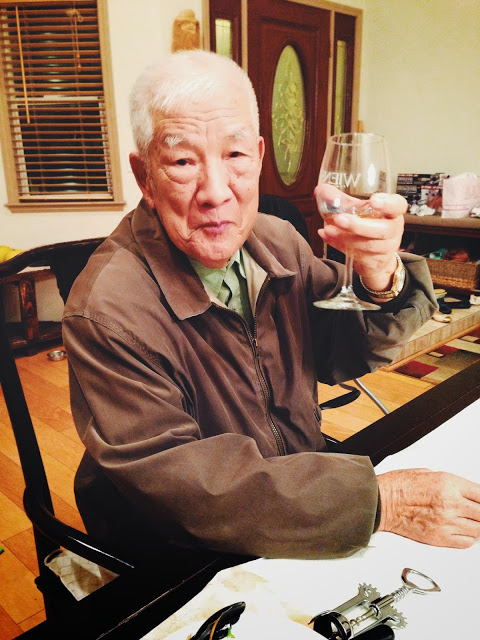
Grandpa, who is a fussy eater,  and baby Caden, who is not. 

My uncle Jimmy carved the turkey (from Lucille’s – a delicious deal if you’re not in the mood to make turkey).

Uncle Jimmy, the turkey, and his trademark grin. 

My grandfather had a shot of Jameson from a wine glass and began to giggle shortly afterwards. He was in a pleasant mood that night and I could tell he was glad to be there and not home alone.

“You talk too much, Betty,” is what he normally says. But on Thanksgiving, he simply said, “Cheers.” 
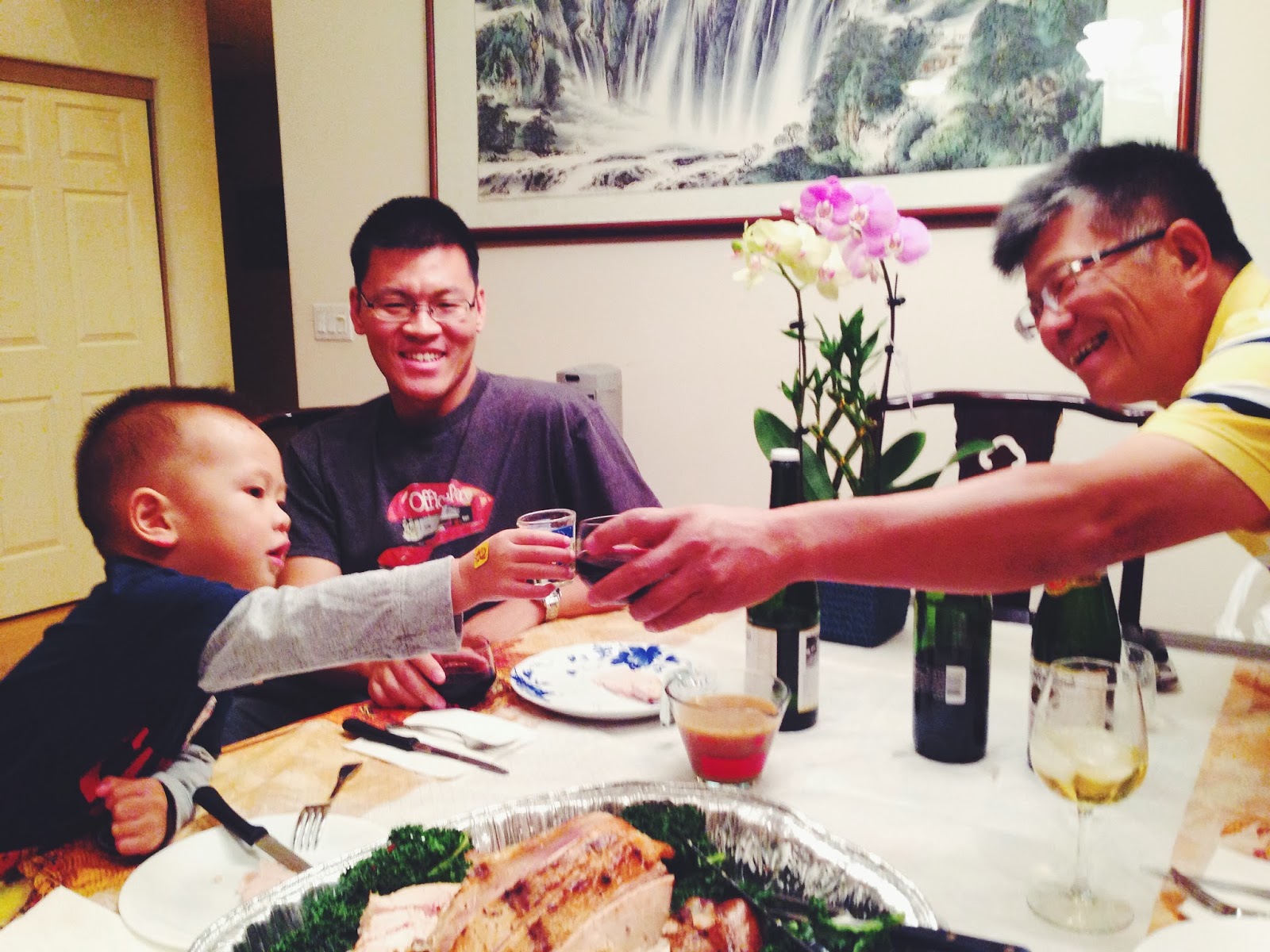
My uncle toasts his grandson. Good habits start early. 

The next morning, I woke to the sound of aerobic counting and found my mother, a family friend, Uncle Jimmy and my aunt exercising in the entryway. My aunt and uncle come over early at 7AM, as they’ve been doing ever since the summer, when my mother was diagnosed with Parkinson’s disease. Uncle Jimmy takes her and a family friend who also has Parkinson’s through a rigorous regimen of exercises. The point is to hold off on medications for as long as possible, and uncle Jimmy, who eats like a horse and drinks like a fish but is at his core a doctor of eastern medicine, drives an hour round trip every day to do this for his older sister before heading off to work or to teach more classes. My father makes breakfast for them afterward and that morning, he greeted me with a glass of freshly blended fruit smoothie.

“What fruits do you want in it?”

“Anything,” I said.

“I know just what you’ll like,” he said, and he was right.

When he learned my mother had Parkinson’s he watched her cry for a minute then told her calmly not to worry.

“I will put your shoes on for you when you are no longer able to,” he said.

My mother nodded, recalling that as a young woman she had dreamed about marrying a romantic man who would walk through the rain with her. My father hates the rain, but still, she had found that man.  

At the breakfast table, my aunt stirred her smoothie. “Your father is the nutritionist.”
“And uncle Jimmy is her trainer,” I said. 
My mother, her cheeks flushed and glowing, her forehead shiny with the faint sheen of sweat, smiled at the good men (and women) all around her. 
“A good man (like me) IS hard to find,” my father says. 

I took a walk on the road I always walk on. It had not yet started to snow in New York, but on that road it would not be strange to ask, “What is snow?”

A street near my street. 80 degrees that day. 

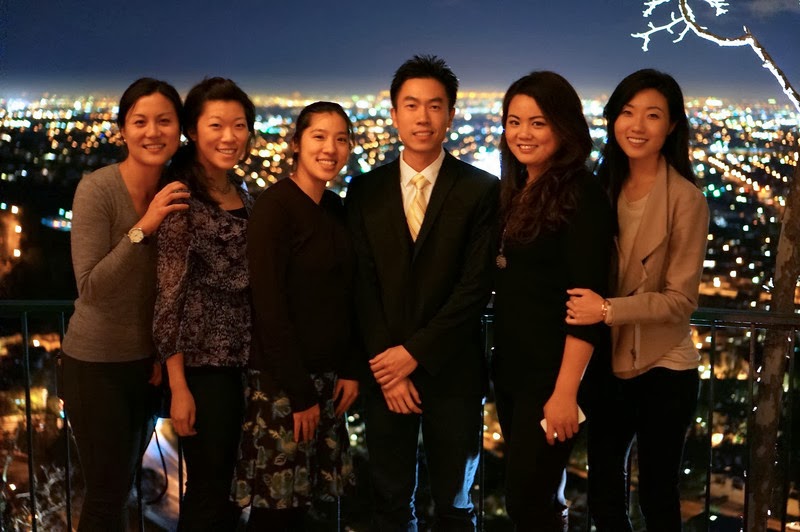
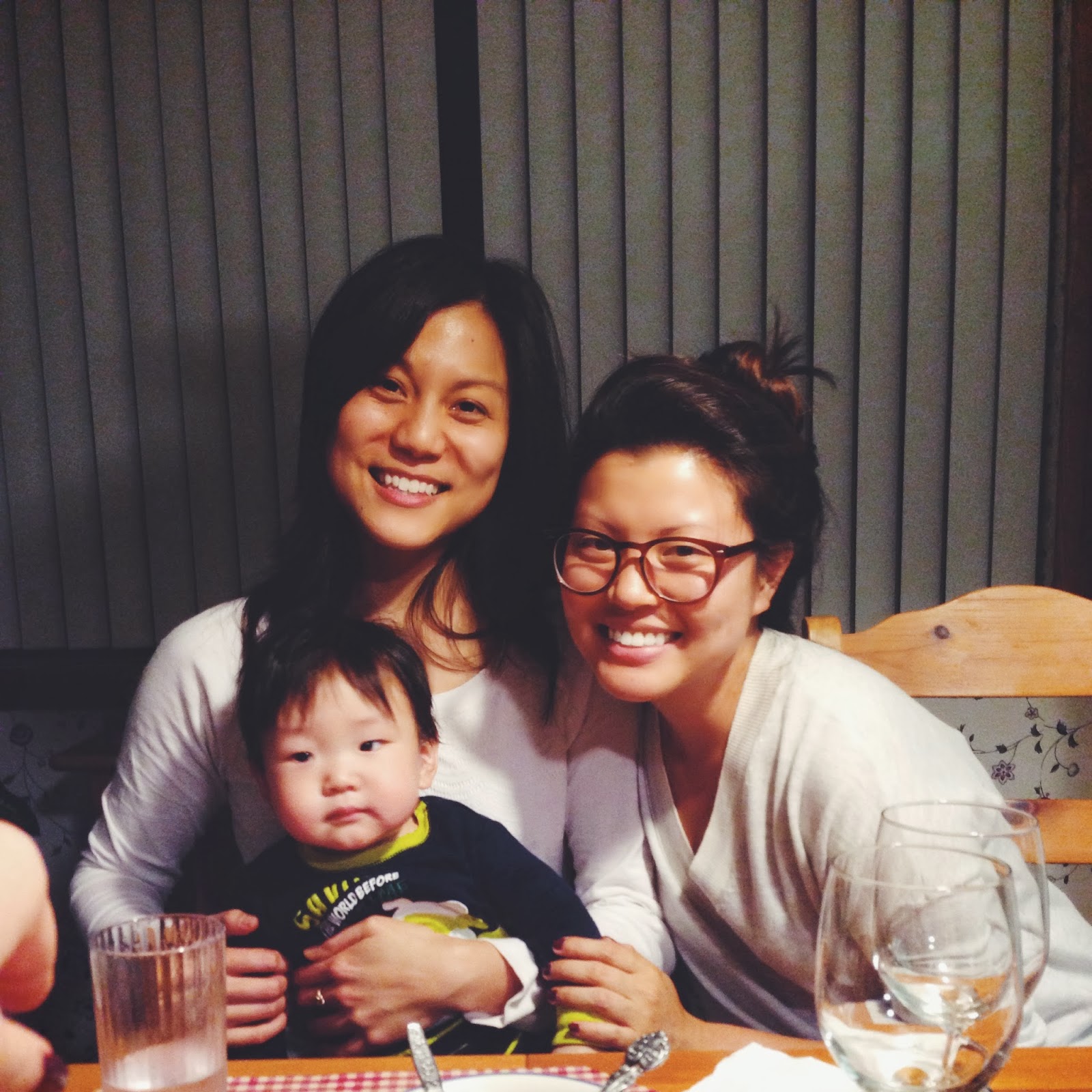
In the evening the entire family gathered at the Orange Hill Restaurant for Thanksgiving dinner after Thanksgiving. My brother and his wife were not there, but they were moving back from Shanghai and would join us for Christmas. We took many photos together, including the one below of the girl cousins and one male cousin-in-law, Lawrence, a new father to a baby girl. 

We looked at the photo and nodded to each other and to ourselves. Adults? Kidults? Whatever we were, we had turned out alright.

Cousins. And who is that stud? 

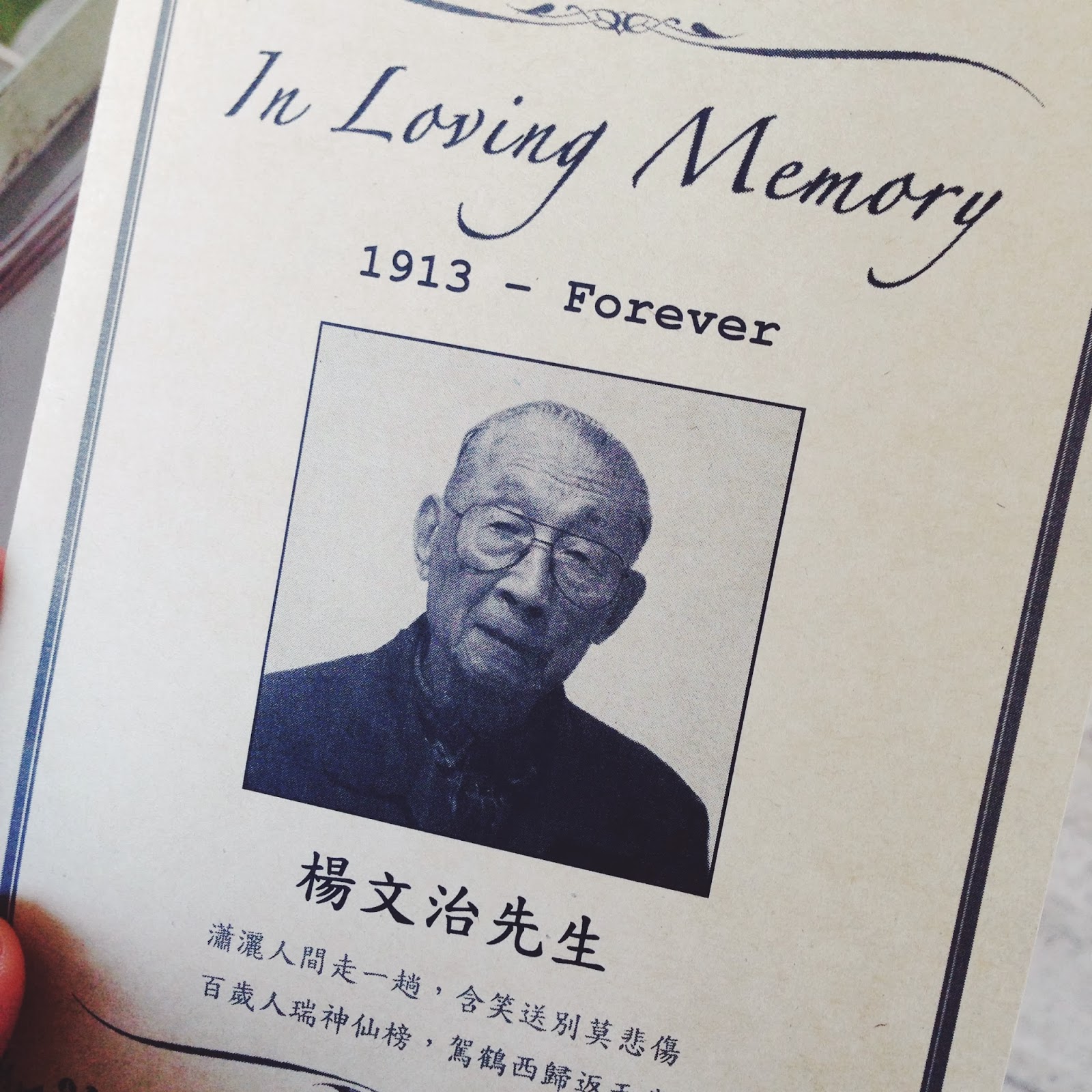
The next day, the family assembled again, though this time all in black. We found ourselves at the same cemetery and afterward, the same vegetarian restaurant as a little over a year ago, when my grandmother passed away. It was the funeral of a very peculiar man, my uncle Louis’s father who had smoked two packs a day until he turned ninety-six and simply decided to quit. He died quietly at 100, battling nothing really, but time.

Mr. Yang, Sr.: Laconic, stylish, (almost) everlasting. 

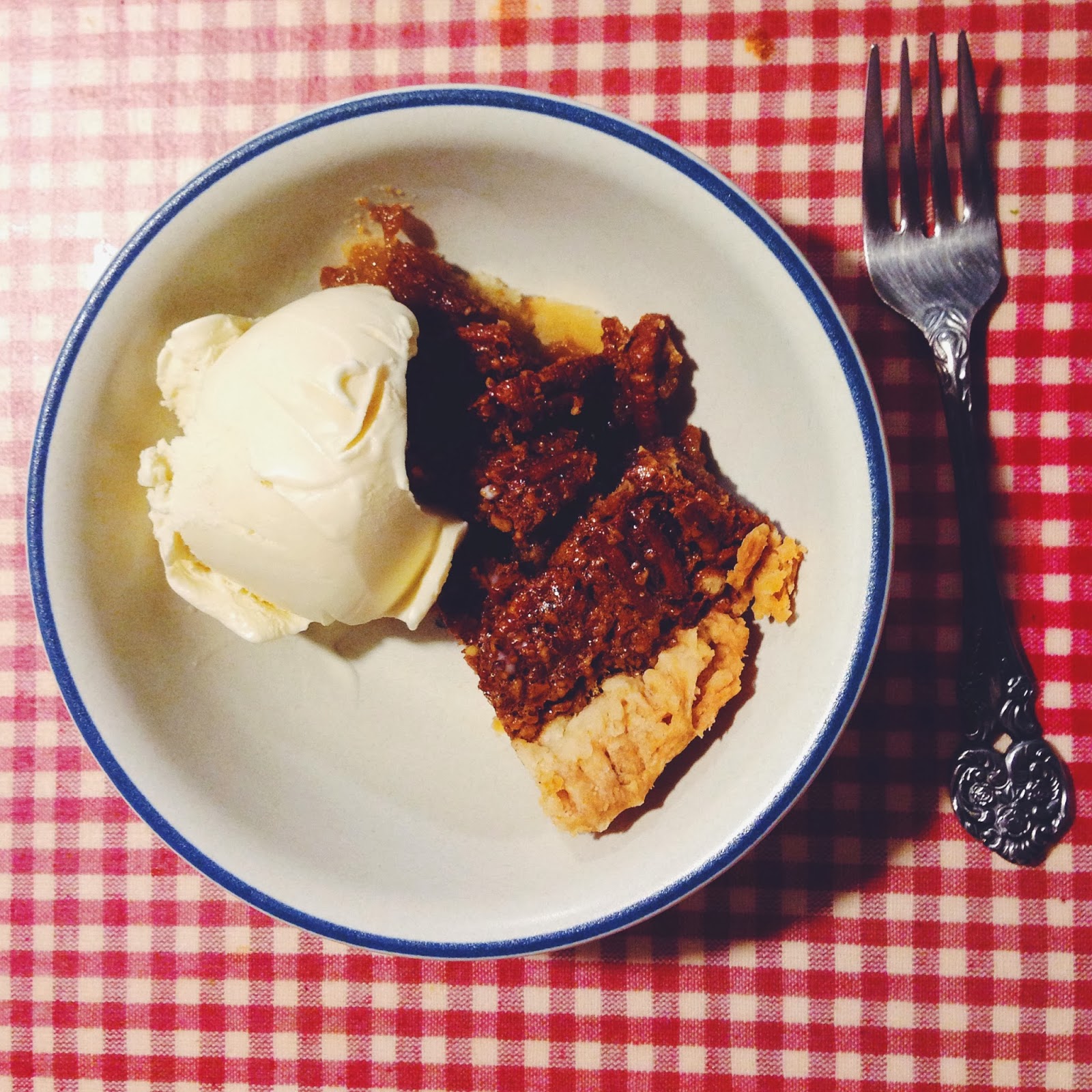
Later that evening, I reunited with my childhood friends in a childhood home for an annual leftover party, in which we simply show up and eat Grace’s leftovers. It is infinitely more scrumptious than I am able to make it sound. Smiling, Grace baked me a pecan pie.

She may be smiling, but she’s thinking, “The Chinese middle class can suck it.” 
Friends with pie. 

After dinner, we took turns holding her nephew, a child of improbable cuteness, and above his soft, fragrant head, talked about life and other things.

Modern Family 
One of us was working and considering buying a house. Two of us were in school, one for science, the other for art. The other made music on a daily basis, in a city whose tanned denizens said things like, “What is snow?” One of us was nearing the eighth year of her relationship and one of us was just stepping into her first. Two of us felt similar to the daughter of the woman I’d met on the plane. Bellies full, we moved to the couch and watched Jeopardy and then played charades, laughing like the kids we’d been in elementary school, where we all met. And now we had all returned to the same small town, nesting temporarily in our roots, looking up at budding branches. 
The End. 

Calling Home from a London Pub

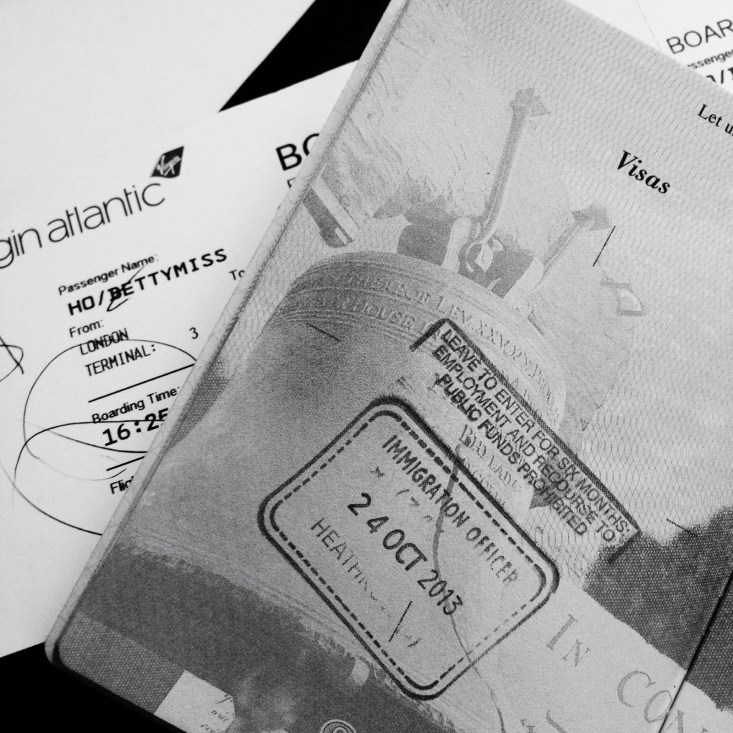
In London, this past week, I visited POI for a second time. On my second night there – perhaps it was my third, I can’t remember – it occurred to me I ought to call my parents. We were on the second floor of a pub in Soho when the thought occurred and I told POI that I’d be back. He handed me his work phone, saying the signal was better, and I took it downstairs, past the bar which was, at 10PM, packed with tall, well-dressed British men. In the States I would have assumed they’d all just come from work, but it was a Saturday night and they seemed to just be dressed that way, regardless. It had been overly warm in the pub and I did not bring my coat with me, finding the cool air outside refreshing. I wondered what I would say to my parents as I dialed. My father picked up, as my mother was teaching her Saturday morning Chinese classes.

“How is it?” my father asked.

“Good,” I said, “We’re out with his friends right now. I just thought I’d say hello. I haven’t called in a while.”

“Well, we’re doing fine too,” he said, and then did the thing he always did when I asked about their weekend plans, which was list all their upcoming dinner engagements. It was going to be a busy weekend for them as well. He listed the usual suspects and the usual restaurants. Same old same old, he said, though I knew he looked forward to it.

POI and I were headed to Cambridge the next morning, and I told my father as much.

“Ah,” he said, “Well. Didn’t you want to study there at some point?”

I laughed. It was typical that he would remember something like this. Every elite school I had ever even just vaguely remarked about wanting to study at, he remembered: Harvard, Cambridge, Oxford, Yale, Brown, “Yeah, and I still do…just not sure what.”

“Oh please, please,” he said jokingly, “One degree at a time. Finish the one you’re working on now.”

“I know,” I said. A group of young, drunk teenagers walked by, some stumbling more than others. They laughed loudly just as they were walking by.

“Are you at a party?” my father asked.

“Outside a bar,” I said, “We’re heading over to karaoke soon.”

“They karaoke over there in England?” he said, “You went all the way to England to karaoke?”

“More or less.”

Other photos from that night are expectedly blurry.

On the curb next to me, three young Chinese people stood staring at their smart-phones, trying to make Karaoke plans of their own. They heard me speaking Chinese and took turns stealing glances in my direction. I smiled. Had they called their parents yet? I wondered what they were studying.

“Well,” my father said, “Enjoy yourself, I suppose.”

“I know, I will,” I looked up to the steamed windows of the second floor, where POI and his friends,- three Asian Americans and two Italians chemistry students – stood chatting around tall pints. I told my father goodbye and to not miss me too much.

“And you try to miss us a little more,” he said, “But thanks for calling.”

“No problem.”

“Oh,” something occurred to him.

“Hm?”

“Write something,” he said.

“What?”

“Write something,” he said, “About your time there. About Cambridge or London or England or whatever it is you’re going to do. And share it with me. I should like to know even though I still think the words on that website of yours are too damned small.”

I nodded slowly, taking in the scene before me on the street on a corner in Soho square, thinking about the people upstairs, all of whom I’d just met. I thought too about the songs I was about to sing in a small, dark room. Inside the pub, one of POI’s best friends in London was buying shots of tequila at the bar. Somewhere down the road, friends of friends were making their way out of the Tube to meet us. More shots waited at another bar. Poorly performed covers of Miley Cyrus. U2 and Taylor Swift and Backstreet Boys. Rent.

I would write, I told him.

We hung up and I went back inside, running into POI’s friend at the bar. He handed me two shot glasses and a small plate of lime wedges.

“Can you handle all that?” he said, “One of them is yours.”

I nodded, and carefully ascended the narrow stairs, spilling just a single drop of Jose Cuervo on my left hand. I was aware that I wouldn’t write anything that night. Or the night after. I wouldn’t write anything for the next two weeks.

On Relationships: Home For Thanksgiving

Last Wednesday night before Thanksgiving, Grace called and asked if I knew about the storm. 
“What storm?” 
I pulled back my blinds and peered out from my fifth floor studio. The uppermost branches of the side walk trees swayed in the rain that hadn’t stopped all day, but there was nothing that could be labeled a storm. Three hours before I had come home from Magnolia Bakery at Rockefeller Center, shivering from rain. I had asked the frazzled girl behind the counter if she could saran wrap the cupcakes for me. 
“I’m sorry,” she said, leaning over, “Can you repeat that? I can’t really hear you over all this.” 
She made a sweeping motion behind me towards the crowd – hoards of people all trying to do the same thing: get cupcakes back home for Thanksgiving. Around me tourists and locals pondered Red Velvet Rockette Cupcakes or Banana Pudding; paperback or hardcover cookbook; T-shirt or onesie? Little girls huddled together, their hair but not their spirits slightly damp from the rain while their dazed parents stood behind them, holding dripping umbrellas. They seemed to be reading the menus but I could tell they were wondering what made them think that coming to New York for Thanksgiving would be a good idea. Despite the rain, the streets (at least around Rockefeller Center) were packed. Umbrellas poked you in the eye or scratched you on the neck. In New York City, Black Friday began on November 1st. 
“Can you saran-wrap them?” I said again, “I’m taking them home to California.” 
She looked at me as though I was the luckiest girl in the world. I certainly felt that way, minus the thought of lugging paper boxed cupcakes home and across country. First world problems, I get it. The weather report said California was somewhere in the seventies. Not a drop of rain in sight. 
Grace snorted into the phone, “Don’t you read the news, Betty?” 
“I looked at the New York Times just a few minutes ago. It didn’t say anything about a storm.” 
“Yeah you looked at the news, you didn’t read it.” 
I imagined her comfortably ensconced next to our best friend Amy on the squashy teal colored leather couch of her childhood home. They would be wearing sweatpants, t-shirts.  
I scrolled through the NYTimes website again, but didn’t see anything about a storm. Weather.com told a different story. Apparently the east coast was getting huge dumps of snow. But in New York City, it had only rained. All day. Still, major flight delays were anticipated. I looked at the cupcakes I had strategically stacked in my carry-on. I wasn’t bringing anything else home except a collection of James Baldwin’s Essays, on which I had a final paper due. 
“Shit,” I said, “Well. No point worrying about that now. Either I’ll make it home for Thanksgiving or -” I glanced at the cupcakes, and briefly a depressing image flashed in my mind: me alone in my apartment on Thanksgiving day surrounded by cupcakes with candy turkeys on them. I shuddered at how tight my pants would be – “I won’t.” 
“Yeah,” Grace said, “Make sure you bring a good book to the airport.” 
We hung up and I went back to staring at James Baldwin, who was in the middle of describing the Christmas he once spent locked up in a Paris prison. There were worse things than being stuck in New York over a major family holiday. But still, I had not missed home since arriving here at the end of August. I had not missed home until home was a day, a potentially delayed or cancelled flight away. 
——
On Thanksgiving Day, I woke up and lay still in bed, listening for sounds of a storm. But there were none, just some cheerful chatter on the sidewalks below. Sunlight poured in through my windows. The storm, if it had come at all, had passed. 
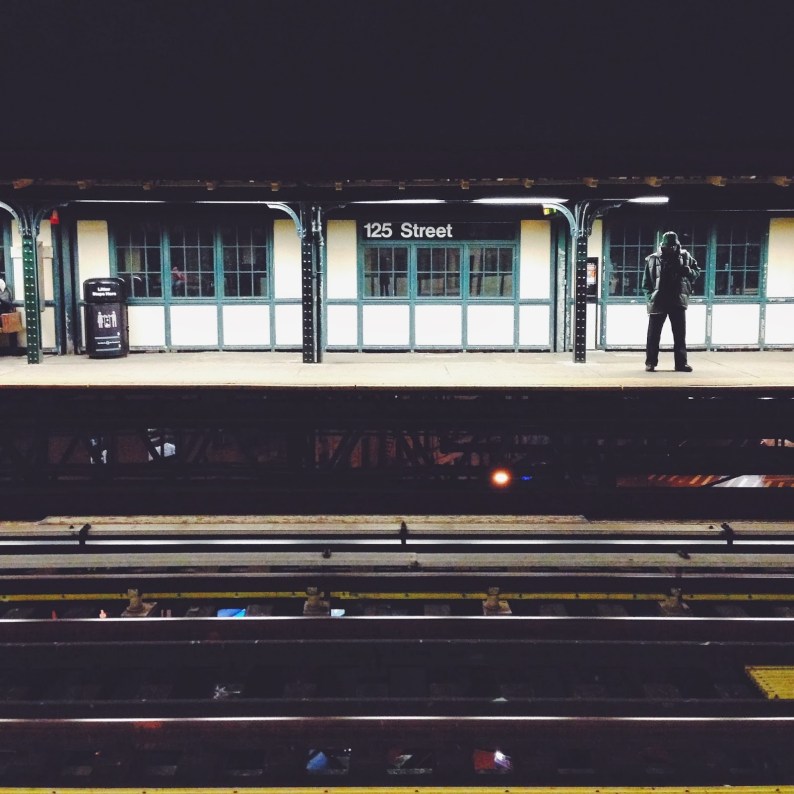
The view while leaving New York. 
The cab driver was from Kashmir. He arrived ten minutes before my requested time and groaned in mock protest when I asked him to wait ten minutes. 
“It’s Thanksgiving, lady! What you want to keep me from my family? You think you’re the only person who has to go home for the turkey?” 
I ran down the stairs, trying not to jostle the cupcakes or break my neck and apologized as I slammed the car door. He was smiling. 
“Oh you rush! No need!” he said, “I joking with you. But I guess you cannot tell over the phone. I ate my Thanksgiving dinner already.” 
He was in his mid sixties with curly once-brown hair and smiling, amiable eyes. Just an hour before, he’d left his house to begin his afternoon shift, mostly shuttling last minute stragglers like me out of town. His home had been quite lively when he left it: he had three grown children, all of whom were he said, “Doing good things, having good children.” 
“But still,” he said, “Even though they grown, when they come home, they are your children. They are always your baby children, no matter how old they are.” 
I nodded, knowing the feeling well. It is both a fear and a fallback and why I intend to stay in New York or move elsewhere – anywhere but back with my parents – after my program is finished. It sounds like the next logical step, but I know how comfortable life is back home and how well practiced I am to close chapters in cities far away only to reopen the doors of my parents’ home. 
“Just the other day,” the driver continued, “I went to see my mother and she told me to clean my plate like I was a five years old boy! I’m old man now, a grandfather! And still when I go home I become my mother’s baby. She told me to clean my plate just like she did when I was small boy, told me to clean it so the plate looked like there had never been food on it!” 
I laughed. He moved his hands with such emphasis and I could imagine his mother nagging him in Kashmiri, though I had no idea what the language sounded like. 
“My parents don’t nag me at all anymore,” I said, “And I don’t think they treat me like a child…” 
I revisited a long impromptu phone conversation I had with my father the week before. While browsing through West Elm I remembered to call him back regarding our Thanksgiving arrangements at Orange Hill Restaurant. I ended up wandering the two-story Broadway store for an hour and a half while we talked at length about school, writing, and POI. 
We discussed in detail the particulars of a possible thesis which I’d gone over with my professor the day before – a collection of essays with a spine, as she put it: a theme and tying them together, a story arc. Many essay collections lacked this, my professor warned, especially from new writers. I tended, she observed, to write largely about two things: family and relationships. I preferred to keep the two separate, but she didn’t see why I should.
“Your family is obviously a huge part of how you developed your view of relationships. They are very much at the back of your head when you write about relationships. I don’t think they ought to be kept separate at all,” she’d said. 
My professor and I discussed too, the market for someone with my particular “angle,” meaning, a twenty-seven year old woman with no prior history of having been in a serious relationship. 
“You’re far from the only one,” my professor said, “You might feel sometimes like a fish out of water but trust me, I’ve been listening to my friends, students, friends of friends… it’s a strange but increasingly common thing.” She thought for a moment, “Maybe not that strange.” 
“Market,” my father repeated, “Angle.” These were words he could wrap his head around. Publishing is after all a business and my father is a businessman. As I wandered through the recently discounted holiday bakeware and organic sheets, explaining the practical aspects of publishing: finding an agent, working with an editor, and marketing a book, I could feel him opening up, trying to view my mysterious world through his clear, practical lens. It made sense to him, he said, that the professor was telling us to keep our audience in mind and he set out to give me pointers. 
“Maybe you could organize your book by theme, or contrast the relationships people had back then, like your grandparents, your mother and I, versus the ones you’re seeing or aren’t seeing now among the people in your generation.”
I nodded, wondering if my father was watching TV at the same time, though it didn’t appear so. 
“If you think about it,” he continued, “You see so many types of relationships around you. Look at your mother’s parents versus my parents. Look at your different sets of aunts and uncles. Look at your brother and his wife, and now you and, what’s his name?” 
I reminded him, surprised that he brought POI up at all. My father is not one to talk about things like relationships and for the most part never refers to POI or when I do, says, “Who?” or calls him “That guy in London.” 
“Right,” my father said, “That guy.” 
We discussed my thesis for another half hour and I felt both in and outside the conversation, wondering at when the change, if there was indeed a change, occurred. I was never once frustrated and like creative partners discussing a new business venture, we batted around ideas. My father is a reader too. 
At some point I reminded my father that I was going back to London a week after Thanksgiving. 
“What are you doing that for?” 
“I told you,” I said, “To visit -“
“-that guy in London. Right, right.” 
“You’re okay with it?” 
“Am I okay with it?” my father snorted, “You’re going to go anyway. When did I ever – no, have I ever stopped you from going anywhere to see anyone?” 
“No, I guess not.” 
I squeezed past a young couple who were studying a stainless steel wall clock. I wondered if they were just dating, engaged, or married. They both still had their gloves on. 
“I do want to say though, Dad,” I lowered my voice even though I was speaking in Chinese, “I appreciate that you trust my judgment. And I wouldn’t be going if I didn’t trust him.” 
“Good,” my father said, “This is very important. You must be careful.” 
I nodded, murmuring assent and watched as the couple left the clock and split up, the woman heading towards a rather busy looking ornament display and the man towards bedding. Perhaps they’d meet at the register with items of vastly different purpose. One functional, one purely ornamental. One on sale, the other full price. One perennial, incapable of being broken, the other seasonal and fragile, needing to be wrapped in tissue paper and put away after the New Year.  
“What do you like about this guy in London?” 
Good question, Dad, I wanted to say, this is something I often ask myself. Not because I didn’t know but because more and more I was surprised by the answers. 
“We have good conversation,” I said. 
“You have good conversation with a lot of people.” 
True. I have good conversation with strangers on planes, trains and in hospital waiting rooms. This did not mean they were good relationship material. I remembered too a recent video chat I had with POI in which he fell asleep for five minutes while I left the screen for a few minutes to take banana bread out of the oven.  
“I guess it’s a bunch of things. Mostly,” I said, “He makes me laugh, makes me feel safe.” 
“Humor is important because you are a humorous girl,” my father said ‘humor’ in English, “Because your father is humorous.” 
“Actually,” I said, “In some ways he reminds me of you too.” 
“How so?”
“He says what’s on his mind, for one thing… doesn’t seem to care too much if he offends people.” 
“Ah yes,” my father said, “Beating around the bush is a waste of time.” 
“Yeah,” I said, “He’s not shy about making fun of me and can handle it too, when I make fun of him.” 
“Oh that’s important, especially for your kind of humor.” Again, ‘humor’ in English, “It’s no fun to be with someone too sensitive. If they can’t take a joke, it’s no fun.” 
“Yup.” 
 “But really,” my father said, “How can anyone compare to me? They don’t make them like me anymore.” 
I laughed, arriving at the very adult stage where your father’s cheesy jokes no longer aggravate and only endear. 
“So you think you are an adult now,” the driver said, as though reading my thoughts, “You think you are an adult going to visit your parents, but I know (he wagged his finger in the rearview mirror), I tell you now, you will feel just like a baby again when you’re home.”
I watched as the city rolled away and thought ahead to the drive from John Wayne Airport to The Park. I could see the streets: MacArthur followed by the curve of the 405 and the normally congested connection to the 55. I could anticipate the smell of my father’s car and the jerky way he braked and accelerated. If my mother went to the airport with him, I would sit tin the back and feel briefly, like a kid again. If my mother didn’t come and I sat in the passenger seat, I’d still feel like a kid. 
“This is the natural way,” the driver said, chuckling to himself and thinking perhaps of all the plates he’s cleaned in his mother’s presence, “Perhaps until your parents not there, this is the way it will always be.”

On Paying Attention

Last week, it happened twice. 

On Wednesday afternoon, I joined the masses of people who tune out the city by plugging their ears with headphones and boarded the uptown 1 train towards Columbia. At 96th street, I was listening to Ellie Goulding and through her thin, haunting voice heard the conductor make a strangled announcement, which I did not bother to decipher. The conductors (or “train operators?”) are always making strangled announcements in impatient voices thick with indifference. They hate their jobs. So they don’t bother to enunciate. Continue reading “On Paying Attention”

One Year

A year ago today, my grandmother passed away. The day would have gone by without my having given her or my grandfather a second thought had my mother not called me.

It was only 7:30AM back in California and I thought it strange to see my mother’s name flashing on the screen. She’s not one to wake too early, especially not on a Sunday, but I guess this isn’t like most Sundays. When the phone rang, I was standing in the kitchen, mid-sentence with a friend who had spent the night. We were talking about men and blogging. Things important to we the living. I picked up the phone and greeted my mother with the slightest impatience but became quiet when I could hardly hear her speak. She wasn’t crying and did not sound sad, but she seemed reluctant to let her voice rise above a certain octave. She was hesitant to remind me of something. She, along with everyone else, knows that in New York I’m having what is known as “a good time.”

I told my mother that my friend was visiting, hoping she would say, “Oh okay, I’ll call back later,” but instead she said a hollow, “Oh that’s nice,” and finally, after a soft “hmmm,” said, “You know, today marks one year since grandma’s passed away.”

“Oh my God,” I said, “It’s been a year.”

“Yes, so fast,” my mother said softly, “We’re going to her grave later, the family.”

I thought to my grandfather and asked after him, knowing that I would not under any circumstances call or speak to him today. Or tomorrow. Or the day after tomorrow.

“He’s…” my mother hesitated, “he didn’t feel well last night.”

“How so.”

“He felt last night he couldn’t breath and complained of a stomachache. Your aunt Joannie went to visit him and she found him lying huddled on the couch. It made her sad, your aunt said. Just an old man in a cold house, lying huddled on the couch. He told her he felt very cold and very ill.”

“It’s stress,” I said, not sure if I was using the right word in Chinese, “Today is a terrible day for him and it stressed him out last night. I would probably feel sick too.” But I knew exactly which couch and how cold. The house had been warm in theory when my grandmother was alive and well and it was filled with the smells of her cooking and lots of bodies coming in and out to eat with them. But in the winter, when the stove was off and it was just the two of them, when they were napping or quietly playing solitaire, the house could get incredibly cold. It was two stories, the second of which they never ventured to, and possessed an old heating system that struggled against the high ceilings and thin, drafty windows. I often walked in on winter evenings to find grandpa wearing a cap, hands stuffed into the deep, fleece-lined pockets of a black puffy down jacket my cousin Andrew had passed down to him. I would sit and chat, fully aware that my fingers and toes were turning purple.

“The heater…” I would say, and most of the time, grandpa would respond, “Such a waste. Just two people in a big house. We don’t need it.”

I didn’t know how to say ‘heartache’ in Chinese, or not the way I wanted to say it. I knew to say, “Heart hurt,” which was accurate, but for some reason, when applied to Grandpa, seemed just the opposite. It didn’t go with his tough-guy mien. But in any language it is apt, there is no better word for it. Still, I didn’t use it.

I could sense my mother nodding on the other end, looking off somewhere.

“He said he did not feel very good at all.”

“Are you guys going to take him to see the doctor?”

“I don’t know,” my mother said, “We’ll see.”

I looked over to my friend, who knew my family well and knew that my grandmother had passed away. She looked concerned, but I didn’t want her to be. There wasn’t much to be done from here, by either of us. I wanted to hang up and continue talking about men, about blogging, about the future.

“Well,” my mother said after a short silence, “Tell Angie we said hello.”

I said goodbye, almost adding, “I hope Grandpa feels better,” but stopped myself. It wasn’t a cold he had.

—————

Certain days in New York, when I’m walking down the street and see an elderly man or woman sitting alone on a park bench or shuffling slowly somewhere, I remind myself to call my grandfather to see how he’s doing. Mostly, I know. Or I think I know, in the general way you think you understand the feeling that comes with losing someone you’ve been married to for nearly seventy years. So I don’t know. I just know what he’ll say when I call to ask, “How are you doing?”

Ma ma hu hu,” he’ll say, the Chinese equivalent of “same old, same old,” or more accurately, “Whatever.”

Most days, he means this to be funny. My grandfather likes to play Negative Ned to my Positive Polly. It’s our special thing – he thinks I’m a ridiculous smart-ass ray of sunshine, mostly because he doesn’t read my blog and also because with him, I steer clear of certain topics that once broached would make me cry until I had no tears. I don’t always want to cry when I see him. Most of the afternoons we spent together were mild, happy affairs. I cooked a simple meal we would eat together, then I would ask him to split a dessert with me. He would say no. I would shrug and say, “Your loss.” He would chuckle, arms crossed over his chest and shake his head.

“You complain about gaining fat and you always always eat dessert.”

In between bites of chocolate ice cream or cookies or cake I would nod, “Very astute, Grandpa.”

And it went like that. I’d clear the dishes. He’d watch the Chinese news, read another article or two from the Chinese World Journal, and between 1 to 1:30PM, would stand up slowly, wincing as his bones creaked and say, “Nap time, nap time.”

I’d nod and say “Good night,” and he would roll his eyes because it wasn’t nighttime.

“It’s good afternoon,” he’d correct me.

“Good afternoon,” I would stand corrected.

He would nap for an hour. Sometimes, I slept too, lying on the couch in front of the TV with a book on my belly. Grandma used to nap here, and when she was here and I was here, she’d nap in the bedroom and let me have the couch. Now, Grandpa would wake before me and come back quietly to take his seat at the dining table. He would read like a literary phantom behind me until I woke and realized the time and turned to find him there, still and scholarly. An ancient man in a modern Chinese-American painting.

“I’ve been awake for a while,” he would say, and I would rub my eyes and yawn dramatically, kicking my legs out and stretching my arms past the edge of the sofa towards the garden my grandmother used to tend to but is now under grandpa’s care. I’d feeling comfortably childish like a granddaughter just risen from a warm delicious nap and who together with her grandpa, was waiting for grandma to wake too.

But it remained just the two of us for a good part of the afternoon. Grandpa would move to his favorite chair in front of the TV, turn it on in time for a travel-through-China show he liked to watch, and I’d read some more back at the kitchen table. Sometimes I would go to the garden and collect some snow peas, yam leaves or tomatoes and grandpa would be pleased, because he chose to keep watering the plants his wife had loved so much rather than let them wither. Sometimes I would vacuum and grandpa would lift the chairs even though it strained his back. Sometimes we’d talk, though hardly about grandma. And around two or three, I would get ready to go.

I’d stand up and start packing away my books and magazines. He would look up and say, “Going?”

“Going,” I said, “I’ll see you __,” whatever day I was scheduled to come next, though it was a self-imposed thing. I was unemployed and needed structure. Even more, I think, than Grandpa. I’d take my bag, wait a bit while grandpa rose from his chair to let me out, and I’d walk down the driveway towards my car, which was always parked across the street along the neighbor’s curb, beneath a shady tree.

He’d stand in front of the drafty old house, with its red brick and wrought iron front gate. The small, two door garage filled with old Chinese school textbooks and odds and ends from various points of their grown children’s and their children’s lives. Old Christmas gifts and filing cabinets. Large stock pots and steamers my grandmother had used during Chinese New Years’ past. There was a single rose bush near the living room window. There he would be, standing slightly stooped with his arms behind his back, a ballast of sorts, holding down this fort that was and was not his.

“See you later, Grandpa,” I always called out from my window. He’d smile and wave and, seeing my car wend around Sunshine Park and out of sight, he’d slowly turn and go back inside.

In those summer months before I left for school, I didn’t worry about whether he would feel cold. Alone, of course, but not cold.

This Is Not A Relationship

My cousin Melody is not dating a guy named Jim.

She’s not dating Jim, so he pretty much follows her around everywhere they, or mostly Melody, wants to go.

She’s not dating Jim, so he drives her to these places in his BMW.

She’s not dating Jim, so when she found an unpaid internship about a 15-minute drive away, she decided that rather than spend money she wasn’t earning on cab fare, Jim would work around his class schedule and find the time to drop her off and pick her up. Sometimes, on the way home, she’ll ask him to get her something to eat. He always does. He complains about this “abuse” she inflicts upon him but really (and everyone knows this) he does it to himself. He’s in love with her. Otherwise, he wouldn’t do it.

They take trips together, to New York, Montreal and Mexico. They eat at nice restaurants, go sightseeing, probably hold hands and kiss.

If there was a drug that made him feel the way Melody does, he would take it. I should tell Jim about Xanax.

But she’s not dating him. According to Melody, they’re just friends.

“Jim knows too,” she tells me, “I told him.”

And I nod, though as the words leave her mouth I am certain I can hear the sound of Jim’s heart tearing.

A few weeks ago Melody called to say she was coming to New York for a career fair. She’s a student in Boston, studying business something-or-other and sometimes the school suggests they go to career fairs in New York, where they’re supposed to network with potential future employers. But the networking events are dull, awkward and futile affairs and most of the students go with the fair as an afterthought. They mostly just end up meeting up with friends or, in Melody’s case, a cousin in the city.

I suggested afternoon tea at Bergdorf Goodman. It’s a girly thing to do. We’re both girls, Melody a considerably more accomplished one than I.

“Sure!” she said, “And I’ll be bringing my friend. You know, the boy.”

I did know, remembering a conversation we had during the summer, when we were both back in Taipei for my brother’s wedding. Melody had just finished her first year of graduate school and had not, as she put it, “met Mr. Right.”

I was doubtful. From her Facebook photos it seemed like she was constantly being swarmed by guys, most of whom I was sure harbored not-so-secret crushes on her. And then there were the photos she posted of her many excursions outside Boston in which she was the only one photographed, smiling sweetly into the camera from across the table at a fancy restaurant or in front of some tourist attraction. In my experience, girls traveling together usually take photos together. Couples traveling together even more so. It’s weird not to. But when you’re traveling with a guy you’re not exactly dating or even considering dating, taking a photo together is weird. So Melody’s photos were snapped by some adoring fanboy who didn’t mind taking multiple shots from multiple angles and who, at least in theory, didn’t mind not being in the photos.

Click. And the heart tears a little more.

“Really?” I pressed, “You’re not dating anyone?”

“Not really,” she said, shrugging.

“Melody. C’mon.”

“Well, there’s a boy,” she said, using the Chinese term for “younger boy” or “little brother.”

“A boy?”

“Yeah, he drives me around. Nice guy, but just a boy. Seriously, it’s not serious. We’re not dating.”

I laughed, unsurprised and already getting the gist of things. The photographer was the boy was Jim. But still, I wanted specifics. Melody is sometimes a treasure trove of feminine mystique.

“He drives you around?”

“Yeah. He has a car. He’s nice, comes from a good family who does real estate like ours, but I’m almost two years older than he is…” she shrugged and twisted her hair, jutting her chin out in the half-pout she has when she’s mildly dissatisfied with some person or situation, “…I just don’t date boys.”

“So you’re not dating.”

“No no. Not at all.”

“So you’re just friends with this ‘boy.'”

“Yeah.”

“Is this the guy you went to Canada with?”

“And a few other places, yeah.”

“Just you two?”

“Yeah.”

“He’s in love with you.”

She shrugged again, “I told him we’re just friends.”

“And still he just drives you around.”

She nodded blandly, “He doesn’t seem to mind.”

“Amazing.”

René Magritte,  La Trahison des Images, 1929  Oil on Canvas    Los Angeles County Museum of Art

Melody, despite her euphonic name and sweet nature, is a hammer head attached to a scalpel. She hits these poor fellows with her long limbs, pretty face, and care-free nature then slices their hearts open with the deft hands of a gifted neurosurgeon. But imagine a neurosurgeon who doesn’t know she’s a neurosurgeon. She’s a particular breed of female who always, wherever they go, leaves behind them a river of tears, like that Justin Timberlake song, except less spiteful. The tears are not Melody’s but rather those of young, ideal-driven men who’ve been dumped and told to stop calling but who still follow her around like crack addicts with empty pipes.

Girls like Melody don’t merely break hearts. Love is never simple, and neither is lust. Melody’s MO, blithe as she is to it, is thus: she fills these hearts with promises she never makes but subconsciously hints at by merely glancing, smiling, chatting benignly with these guys – all these little, meaningless interactions point, in the lust-struck brain, towards more substantial promise: the promise of Melody’s undivided attention, of requited love and adoration and somewhere down the line, of a relationship.

It feels like love, it feels like attention, it feels like affection, but the hitch of course – and isn’t there always a hitch? – is that the feeling is always one sided. It’s a dense, heady mist upon which the love story the guy wants to see is projected. But at some point the film stops rolling, the mist dissipates, and he’s standing alone in the cemetery holding a can of soda she wanted but didn’t drink, amidst the remains of other deflated hearts that crackle like empty Doritos bags.

But being objective, I see, as I’m sure you do, that the guys do it to themselves (as does everyone else who’s dumb in love). Melody is loved and in return, she mildly likes, with no particular ill-intent. It’s always, if you ask these girls, kind of an accident.

It’s like taking a walk after a spring rain and coming across a snail or worm on the sidewalk. They don’t really noticing and step down lightly though not lightly enough. Melody always hears the crunch beneath the soles of her Havianas sandals (her footwear of choice as she’s nearly 5’10) and she’ll look down and say, “Oh shoot.” But like the rain, the moment passes and she shrugs. “Nothing to do about it now.” She wipes her feet in the grass a bit and walks on.

So Jim, whom she is not dating.

They’re not dating, so Jim drove Melody all the way from Boston to New York for a career fair only she signed up for. He told himself he could visit friends while Melody (and the two other people whom Jim also drove from Boston at Melody’s behest) went to the career fair.

They’re not dating, so when Melody told him he was going to afternoon tea with her and her cousin, he nodded sure even though he hates tea, hates sandwiches, and hates sweets. He hates those things doubly when he’s hungover, as Jim is when I meet him.

They’ve arrived at Bergdorf’s a few minutes before me, and are sitting across from each other. Melody has her back to the window that faces Central Park and a full view of the dining room. Jim faces Melody, so that she’s the only thing he sees, her pretty face glowing by the light of the window. Seeing me, Melody calls out, “Hi!” and Jim turns around. He looks as though he’s just woken up.

“I’m Betty,” I say.

“Jim,” he says.

“The boy,” I think, and take a seat next to Melody, but not before raising my eyebrows at her in a knowing way. She smiles at me. She knows what I’m thinking, but mostly I’m feeling sorry for Jim and marveling, as I do, at Melody. Another girl would have thought the situation awkward and avoided inviting Jim altogether – why bother with the explaining? – but Melody, and this is part of her charm, tells it like it is. We are not dating, her eyes tell me, this is just afternoon tea with my friend and my cousin.

So this is Jim. The boy. Dressed like a boy. He’s wearing a striped Abercrombie polo, the polo shirt of choice of guys from Taiwan his age and of a certain mindset, which is, “what everyone else is wearing/doing/dating.” He’s more tan than most Taiwanese boys, though this could have more to do with his heritage than actually spending time out in the sun. His head and all the features on it are round. Round eyes, nose, mouth. I can’t decide if he’s cute in a homely way or homely in a cute way. He’s certainly no Adonis, but there’s something comfortable and non-judgmental about his open face. Still, he’s obviously scored a trophy in not dating Melody. And, a few additional points for Jim: he’s more sturdily built (though far from built) than most Taiwanese guys, who all seem, at least when I visit the island, to be on some culturally induced famine.

Despite being only twenty-four and still a graduate student however, Jim seems to have already sunk one foot into middle age. It’s an affliction of young, wealthy Asian men who have too much money and as a result, too little motivation to do anything but get away from overbearing, nagging mothers and find respite in girls like Melody, who don’t nag, not really, unless you’re late picking her up. In which case, you’re in for it. But for the most part, Jim is never late. Jim’s going soft around the middle and probably, in the brain. I guess his main ambition in life at present is to keep Melody happy.

I look at Melody, who despite her easy, languid smile, seems merely content in the specifics of the moment, still a few steps away from happiness.

We look at the menu, though really there’s nothing to think about since we’re here for the afternoon tea, which comes in a set. We just have to choose the tea.

“I’m not big on sweets,” says Jim, thrusting the menu towards Melody, “My secretary can choose for me.”

A comedic attempt to assert his dominance, which Melody quickly shuts down.

“It’s tea you’re choosing, my dear chauffeur,” the hammer says, “The sweets are set.”

Jim is hungover from karaokeing with friends the night before. Melody and their other friends stopped drinking early on and Jim felt it was his duty to block for Melody the alcohol that seemed to keep on coming. But apparently Jim wasn’t as drunk as one of his friends, who was smoking a cigarette and then when he turned to exchange some slurred words with Jim, stuck the cigarette in Jim’s face. Which explains the odd-looking birthmark right under Jim’s left eye.

“It’ll scar,” I said, showing him a cigar burn on my right forearm which I got from my freshman roommate at NYU. She wasn’t drunk. We were walking and she was smoking a cigar and she put it down rather carelessly right where my hand was swinging. I forgave her.

“I did it for her,” he said, pointing indignantly at Melody.

She shook her head, “You did it to yourself.”

He looks at me in mock-protest, “See how she abuses me?”

I laugh, shrug, then launch into the barrage of questions I ask everyone when I first meet them, especially when they’re not dating my cousin: Childhood, schooling, parents, siblings, professional aspirations, general philosophies.

Jim’s father passed away when he was in the fifth grade and his mother raised him and his older brother, though they have a huge family on either parent’s side, so his mom had a lot of help. She sounds like the typical over-bearing Taiwanese mother-in-law, every other word out of her mouth attached to a nag. The last time Jim went back to Taiwan, he changed his flight and returned to the States earlier than he’d planned. In the States, he’d gotten used to not having to hear his mother’s voice all the time.

Jim has an older brother also in the States. According to Jim, they have very different personalities. His brother is an introvert. Doesn’t like partying or drinking or, I’m guessing, chasing after pretty girls.

“My brother loves to say, ‘Please, not now. Please just do not bother me.'” Jim says puts his hands up and grimaces in an imitation of his brother, “We are very different.”

After high school, he moved to the US for college in Hartford, Connecticut. His English is pretty good, but could be better considering how long he’s been here, but then he’s made friends with pretty much every Asian person in Hartford and now Boston, and through a few key acquaintances, many more friends in Flushing, NY.

“He knows a lot of people,” Melody says almost proudly, then pauses, “Well, actually, he knows like this one really fat guy who knows all the Chinese people.”

Jim nods as a matter of factly, “Yeah. I do. That one fat guy.” Jim points to the cigarette burn, “He gave me this. But he’s a good guy. Good times.”

And grad school? He shrugs, assuming I already know the answer. I do. Kids like Jim (like Melody too and to some extent, myself) go to grad school because it’s a.) what everyone else is doing – like wearing Abercrombie polos, b.) supposed to bolster your job prospects c.) a safe haven or one last hurrah before you’re actually ready to start working in the real world. Jim has never worked before, and this is something Melody has an issue with. Even she has spent two years toiling away at a Taiwanese bank after graduating from college.

“I’m into real estate,” he says, “That’s my family business background, and I’d like to learn more, but honestly, trying to find a job or an internship here is so damn hard, and it’s really easy to lose motivation. That’s when I admit to myself that yeah, I’m just another spoiled kid without too much drive.” He chuckles as he says this, and I find myself nodding along to his honesty.

“But,” he continues, “I do want to learn more. It’s the one thing I’m pretty much consistently interested in.” (Besides Melody, I want to add).

“Why are you so good to her?” I say jokingly, when he’s listed all the things he does for her on a daily basis, most of them involving driving and waiting and driving some more.

“I’m good to him too!” Melody protests, “I do his homework for him!”

I look at Jim, so this guy’s getting something out of it too – if not a girlfriend, then perhaps better grades.

Jim nods like he can’t argue with that.

“I’m no good with numbers,” he says, “She definitely has a better grasp of all the projects and stuff we do.”

I stare at Melody, unable to hide my surprise. She’s not exactly known as the brainy one, but then again, when your older sister placed first in the nation for the grueling college entrance examination and then graduated as the top electrical engineering scholar at the nation’s best university (things like this are a huge deal in Taiwan where test scores pretty much predicate your success as a human being), it’s easy for the rest of the world (and to some extent, the family) to remember that you have a brain at all.

“So you do all his homework?”

“No,” Melody says, “But if we have a project, which is all the time, we divide up the assignments and I’ll just take on more of the work load because – (she waves dismissively at Jim, who shrugs like “What can I do?”) – he just takes forever and the quality of his work is not as good.”

Interesting. I look at Jim and think, “Well, you drive her around and she makes sure you don’t fail out of the program. Sounds like a fair-ish trade.”

He shrugs and rolls his eyes, but smiles, “Haha, I guess.”

Then I ask the cruelest question of all, but I feel like we’ve reached that point where it’s okay. It’s probably not okay, but something tells me Jim can take it.

“So,” I look at Jim, “You drive her around. And you,” I look at Melody, “Do his homework for him. You guys take a bunch of trips together, and spend most of your time together, studying, hanging out, whatever.”

They nod. Yes, yes, yes.

“But you’re not ‘together.'”

They shake their heads, Melody slowly, and Jim more jerkily.

“So you guys have some kind of agreement.”

“That’s right,” Melody says.

Jim is about to say something, then stops. He breaks out into a sheepish grin, having decided, I think, that he can be honest here. He’s in a safe place: the sunlight dining room of the Bergdorf Goodman restaurant, seven floors above the swarm of tourists, half of whom are congregating outside the Apple store, lining up for the new iPhone.

“She doesn’t love me, ah,” he says, “She doesn’t love me so that’s the agreement. What can I do about it?”

I am surprised and not surprised by this honest declaration, and my fondness for the boy grows. I look at Melody, who rolls her eyes but in an endeared way, if that’s possible.

“Oh shut up,” she says.

“She always complains that I’m ruining her game,” he says.

“You are! How am I supposed to meet Mr. Right if I’m sitting in your car all the time.”

“I’m driving you places!”

She laughs, “True, true.”

“Besides,” Jim says, “You’re ruining my game too.”

“But Jim,” I point out, “Melody is your game.”

He thinks about it for a millisecond then concedes, “She is, she is.”

He looks fondly at Melody, who can’t help but smile back.

Jim smiles a lot, a weird confident thing. He’s not afraid of losing her, I realized, at least not outwardly so. There’s nothing careful or uneasy about him. He doesn’t tiptoe around her nor does he shy away from my questions which can come off as prying because they are. But thus far, despite their ambiguous (unstated) relationship status, Jim takes them all in stride. None of them seem too personal for him to answer, and he does as a matter-of-factly, with a wry smile. His father’s death, his mother’s reaction to his father’s death, his odd brother, his vague career plans, the cigarette burn mark on his left cheek, and the fact that Melody doesn’t love him back. These are all facts of life.

But Jim is smarter than he looks and more self-assured than how I first imagined him. He’s playing solitaire for now, hoping she’ll one day see him in the light he wants her to see him in. And Melody too, is far from brainless. She likes Jim, I can tell. Despite her reservations about his age and the fact that they’re roughly the same height, she likes that he’s not a pushover, and that he’s open. She hasn’t met his family but from the sound of it, they’re not too different from ours. This sort of thing matters in the long run. And lodged somewhere in the chords her fine-tuned feminine intuition, she knows he’s a good guy with potential. She’s waiting for Mr. Right, but if she’s lucky and if Jim is smart, he’ll become Mr. Right. They’re both playing the long game, just using different investment techniques.

A server in a white coat comes by to replenish our tea, but they need to be heading back to their hotel soon, to pick up Jim’s car and the two other people they came with. Jim is feeling less hungover – he barely ate any of the sandwiches but already he’s wondering what he wants to eat for dinner. Something more substantial than tea and small sandwiches.

The check comes and Melody pays for Jim’s portion.

“I’ll figure it out with you later,” she says quickly, motioning for Jim to put his card away, though I know she won’t.

As we step out of the restaurant and wait for the elevator, I turn and realize Melody is also wearing a shirt from Abercrombie. And white cutoff shorts. And her Havianas sandals. Jim is wearing shorts and sandals. She’s tall and he’s not-so-tall, so they’re roughly the same height, and there’s something about their expressions, the two of them standing easily side by side that seems picturesque in the most stereotypical, young Taiwanese couple sort of way. But they’re not a couple. They’re not dating. The elevator comes. We step in, go down, step out. I hug Melody and, just for the hell of it, hug Jim. I may never see him again because Melody might decide to pull out of the game. She might meet Mr. Right at a gas station on her way home, or in her next class or at her next real job – a lot can happen. Jim could get tired of driving, though I think the former scenarios are more likely. But we hug and make vague plans for me to visit Boston.

“I’ll see you then,” Jim says, “We’ll go out with my friends.”

“Thanks,” I say and find myself wanting to add, “Hang in there, Jim. Because you never know.”

I wave them out and watch as they walk past racks of expensive handbags towards the revolving door. Watch a boy and a girl wearing Abercrombie shirts and sandals, holding hands and stepping out into the city. You never know. You never know.


Fat Cat Is Dead

On Sunday morning, my cousin Karen in Taiwan Whatsapped me a single line.

“Betty, Fat Cat is dead.” 
That was it. There were no emoticons or explanations, just a simple declarative sentence that conveyed a history that spanned some sixteen or seventeen years and a loss just short of devastating. The statement itself was something inevitable, but very hard to imagine. 
I typed back quickly, saying that I was sorry and that it would be okay because Fat Cat had had a good life. She didn’t respond. 
I thought back to a conversation we had on the sixth floor in my cousin’s room, probably around midnight some years ago.
“I will be very sad when Fat Cat passes away,” my cousin said, “I know it’s right around the corner.” 
At the time, Fat Cat was still fat, but not decrepit. He moved slowly if at all because he was lazy, and only sped up when one of my cousins walked into the kitchen, towards which he would suddenly charge, drawing upon the generous but seldom used reserves in his flabby belly. When I visited, which was often, Fat Cat followed me when I strolled into the kitchen, hours after my cousins had left for school or work.

“Meow,” it would say, and rub against my ankles, “Meow.”

In Cat-speak, this means, “I will love you for the next five seconds if you’ll take some canned cat food and put it in this here bowl.”

But I am not one to feed fat things, and so very rarely was Fat Cat ever nourished by me.

My cousins Karen and Larry, my aunt, and even, in a more removed, hands-off fashion, my uncle, had been very good to Fat Cat, a pale yellow and white tabby Larry had rescued many years ago when he was in high school. Fat Cat was such a hit amongst the members of that sixth floor nucleus that a few years later, Larry brought home a dark-furred stray that would aptly be named “Little Cat.”

With a master named Larry, one could hardly argue that his pets ought possess names with more flair.

Compared to Little Cat, Fat Cat was obviously much larger, less active, more blasé about life because he had a few years on Little Cat, was rescued first, had seen things Little Cat could only imagine. Little Cat was much scrappier than Fat Cat, who though born in the feline slums of Taipei, harbored an innate  and perplexing sense of entitlement. It was as though upon setting foot into the 6th floor apartment, he washed his paws of his past and developed almost instantly a taste for expensive canned foods. None of that pellet crap for him. Perhaps in a past life he had been the obese Queen of some weird tape worm tribe because Fat Cat definitely had something odd going on in the gut. He was never ever full and would have, had my cousins allowed it, eaten himself to death. A poster cat for the grossest sin of gluttony. But still, he had his moments.

I have a picture with Fat Cat when he wasn’t fat, and was just “Cat,” because he was the only one. I am about twelve or thirteen, wearing a worn-t-shirt and baggy athletic shorts and hair in a messy ponytail, strands framing my young, open face. During later summers, when I too was Fat, Fat Cat and I would pass each other in the cool hall of the 6th floor and I would think, turning to glare at his quivering haunches then down at my own, that “Fat Cat, you and I have both seen better days.”

But in the photograph, taken in the same summer of Fat Cat’s arrival, I am athletic, bright-eyed, an animal lover. I’m clutching Fat Cat close to my cheek, grinning at the camera while Fat Cat, in a slender and more awkward version of himself, looks unamused. His front legs are splayed out awkwardly and his legs are dangling uncomfortably above my crossed legs. His expression states quite plainly, “What the f***.” It was not his best photograph, but he needn’t have worried, for my cousin Karen made certain to photograph Fat Cat at least one thousand times a year, so that nearly his every non-movement is recorded for all eternity. Here is Fat Cat lounging on the chair. Here is Fat Cat lounging on the other chair. Here is Fat Cat sitting on Karen’s bed. On the other (my) bed. On Larry’s bed. Here is Fat Cat with Larry in college, who physically, is going the way of Fat Cat. Note the look of tenderness and adoration on Larry’s otherwise, at any other moment, dull and inexpressive face. If Larry loved any one thing more real than Star Trek, it was Fat Cat, upon whom he showered with slobbery, affectionate kisses that would make even his girlfriend cringe.

Here is Fat Cat in a mess of blankets because it is cold. On the floor, paws skyward, fleshy white belly undulating like a water bed because it is hot. Under the kitchen table, like a pervert. Peeking over the kitchen table, tiny pink tongue lashing out above the class, tasting about for my aunt’s broiled fish, which she inevitably, at meal times, will debone and put in a tidy little pile for him to lick up. Here he is looking up from the kitchen tiles, because he is expecting to be fed. And here, utterly full in gluttonous splendor, sunning himself on the balcony in the small woven basket he barely fits in but somehow still does, rolls of fur spilling over the basket’s edge.

Is he comfortable? Seems like it. Fat Cat Fat Cat Fat Cat. Click click click. And each year, he gets a little fatter, a little fatter, his eyes though, stay the same blank roundness. No questions, this cat. His hunger is literal. His philosophy is food. Sleep. Food. The occasional cockroach, killed with a sadistic remove, much to the delight of his cockroach fearing master, Larry. Click click. Fat. Cat. One need only to check my cousin’s Facebook or hack into her phone to realize not all cat ladies live in musty apartments and knit in their spare time.

But that is beside the point.

My own dismal track record with pets makes me an unlikely candidate to memorialize Fat Cat, even casually. On my watch, multiple generations of Russian Dwarf Hamsters, two chickens, a kitten who barely lived long enough to open its eyes, an insipid turtle, and a fish or two have perished. Most of these I buried or, as with the hamsters, when they became too numerous and their deaths too frequent, tossed in the trash with a simple prayer (I was always careful to wrap them in some sort of tissue or paper towel, but of course wearing rubbermaid gloves). The chickens were eaten by coyotes, the kitten dead before I came home from school. I found my mother sitting silently in the kitchen with the kitten still in her arms, her eyes rimmed with tears. She buried it the next day underneath an avocado tree on our back hill, and it seemed soon, the tree too was dead. If it did bear avocados they were usually small and withered and reminded me of the kitten itself.

These were technically my “pets” but in a way, they were never my pets. It was a polite label I assigned them because I did not understand what it meant, as a young child, what it meant to make something your pet. But can you blame me? Size matters. Just as I have trouble befriending people who are too short (midgets – oh I’m sorry, little people need not approach me) because I don’t like looking down so much, the little pets are hard to hold in high regard. Their needs, though quite real, seem small because they are small. I never cried when any of those animals died, only sighed and thought, “Again? Damnit where are the rubber gloves.”

But the larger animals that lived with my relatives and were, from the moment they arrived, treated like members of the family, I remember quite fondly, and it was from their interactions with these lucky animals that I learned what it means to be an honest-to-goodness pet owner. I should like to think the affection I saw doled out to these furry members of the family rubbed off on me too. At least, the lens through which they saw their pets, even if I only wanted ever to borrow their glasses for a minute. The warmth of their fur, the sound of their soft footsteps or their graceful movements bounding from chair to sofa to floor – those sounds and sights no less familiar to me than those my late grandfather made (indeed my grandfather spoke to me about as often as Fat Cat mewed to me).

Even before my cousins in Taiwan brought home Fat Cat, there had been Holly, my uncle Jimmy’s dog rescued some twenty years ago from the pound, a mix between a chow chow and something else, so that the violence of the chow was subdued and he had neither the lion’s mane nor any distinct attributes of the other breed and was simply, Holly. He had a tail that was shortened, so the length of his body ended abruptly in an adorable nub, and his coat was a dark, glossy ambery honey-wheat. If that is a color. Holly was just another member of the family and I said hello to him just as I did to my cousins, aunt and uncle each time I entered their house. Holly passed away while my cousin, the youngest in the family, was studying abroad in Beijing during her junior year of college, and her parents, wishing to spare her the pain, did not tell her until she moved back home and saw that Holly was gone. It was a strange feeling that day for me too, when I visited their house and realized a few minutes after walking in that Holly had not come bounding out the door to sniff around the door, making sure I was a member of the family and not some hood rat gangster from the neighboring city.

The sadness that comes is not overwhelming, but it is genuine. I’m never as close to the pets as their masters, but over the years I too, have become accustomed and on certain occasions, even fond, of their presence. It will be the same strangeness again, when I return to Taipei next year and am greeted only by Little Cat, who though more aesthetically pleasing (more cat-like, rather than walrus-like), has the odd, distasteful habit of pissing on dirty laundry and keeping quiet about it. I will, a perpetual student/unemployed person, wake up much later than my more productive, salary-earning cousins, my busy-body aunt and wander into the kitchen in search of breakfast. I will open the fridge and feel an unfamiliar chill about my ankles, hear only the sounds of the city entering late morning. No mews, no plaintive if feigned stares, no nips around my achilles tendon. Just me, alone in the kitchen, on the sixth floor, because Fat Cat is dead. 

Personal Statement – Other People Helped Me Do It Better

It seems appropriate today, on my first day of school (how quaint that phrase is!), to reflect upon how three years after graduating from college, I ended up in a small but airy classroom on the fourth floor of Columbia’s Dodge Hall. Let me, for a moment, pretend that this is an award acceptance speech (because you know, it’s so almost the same thing): I’d like to thank my friends for their undying support in my “craft” (even though I’d throw up before I referred to it that way without quotes), my family and especially my parents for acknowledging that hey, I’m probably not suitable for anything else, my professors for taking the time to write recommendations (or not – incidentally if you’re wondering how much weight Columbia’s MFA program places on letters of rec, one of my professors completely forgot to submit the letter, leaving me with two out of three required letters), and of course, I’d like to thank every darling who reads my blog.

Your readership means plenty if not everything because I don’t have other writing to show my dedication or seriousness. What you see here is what I write. On top of that, I’m a bit of a philosophical ham, which means if I write but no one reads it, it’s like that proverbial tree felled in the proverbial forest: is it really written if it’s not read? Didn’t think so. In short: thank you. A million thanks for taking the time.

And, lastly, for the nuts and bolts required to build the actual application, most painful of which is the Personal Statement, I’d like to thank Adam Gopnik.

It is not a stretch to say that Adam Gopnik helped me get into Columbia’s MFA program. I thought briefly about lifting entire passages from his book, Through the Children’s Gate and pawning them off as my own in my personal statement, but disgraced plagiarists told me that wouldn’t be a wise course of action. Instead, I used his book as a jumping off point, allowing his insightful paragraphs to act as muse:

What New York represents, perfectly and consistently, in literature and life alike, is the idea of Hope. Hope for a new life, for something big to happen, hope for a better life or a bigger apartment. When I leave Paris, I think, I was there. When I leave New York, I  think: Where was I? I was there of course, and I still couldn’t grasp it all. I love Paris, but I believe in New York and in its trinity of values: plurality, verticality, possibility. 

In the end, Gopnik gave me more than a leg up. This is what I submitted:

I did not start writing in New York, but in New York I began to see myself as a writer.
I was unhappy when I first started college eight years ago and blogging seemed to be a respectable way to broadcast it to friends back home and random web surfers who were interested to know how life was for a NYU freshman from SoCal. In New York, I learned the benefits of writing for oneself yet at the same time, discovered a small audience. Rather than attend class I began to explore nonfiction and often browsed independent bookstores around the city. I discovered Russell Baker and David Sedaris at the Strand; Adam Gopnik and Betsy Lerner at Shakespeare and Co., and heard chef Anthony Bourdain speak at Barnes and Noble in Union Square – a big chain store, but it stayed open late – before returning to the Strand to buy his books. Theirs was great stuff, much like the essays I aspired to write.
I ended up dropping out of NYU and six years later, graduated from UC Berkeley, where I was admitted to a creative nonfiction workshop taught by Bharati Mukherjee and Clark Blaise. In their workshop, I gained confidence practicing a well-worn cliché: writing what I know. It is the one thing I have done consistently, day after day, year after year. Some would say I know very little, but what I do know – my work history and its carnivalesque collection of colleagues; my family, divided amongst sprawling Orange County, the tiny island of Taiwan and the glitteriest of all glittering metropolises, Shanghai; and the myriad of tiny moments observed at home and abroad – I know quite well.
On a recent trip to New York I revisited the Strand, where Adam Gopnik’s Through the Children’s Gate lay on a display table. I had recently quit my job as Executive Assistant to focus on MFA applications, but visiting friends and eating cupcakes in New York was not particularly conducive to this. However, standing in the Strand and reading Gopnik’s descriptions of New York after having been away, I found myself immersed in his and his wife’s hilarious apartment hunt, their first Thanksgiving, and the beauty of New York’s “quiet places” of which Gopnik had lost sight until his children pointed them out again. He writes, “We fill our eyes and head with things already seen and known, and try to see them and know them again.” This, I think, is a writer’s – especially of nonfiction – ultimate goal. I was reminded of why I started writing in the first place, and why I want to do so at Columbia University. 

I’ve just been in the classroom for a day – not even, just a mere two hours – but I felt not-so-strangely (despite the presence of my strange-looking classmates – but that’s MFA superficiality for you) that it was a sort of homecoming. I’m not an academic (at least not yet?) but there’s something right about the classroom. A writer is always learning. Should always be learning. The classroom offers but a facet, but when it comes to writing and reading and talking about both, the classroom is probably a good place to start what I’ll never finish. So it was the right thing to do. A year ago, it was the right thing to write, and now I’m in the right place.