Movement

Firstly, thank you to those who have sent kind words and thoughts to my family. They are greatly appreciated.

As I write this, my grandmother’s lungs slowly fill with water. She has now been in the hospital for fifteen days, mostly lying down in a bed that is more flexible than she. To move her up or down for meals, we move the bed with the push of buttons conveniently labeled with enormous arrows. And while her arms are still quite strong, it is getting harder for her to push herself up. Occasionally she will sit up with a sudden, startling swing of her legs to the left side of the bed and point at the bedside commode*.

“Move it here,” she will say, “I’d like to sit for a while.”

At first I wondered why she would prefer the hard plastic seat of the commode to the soft mattress, but I thought to my own preferences when dining out, how I prefer chairs to banquets, tables to booths. Squashy seats take away any strength you might employ in your core, the muscles of which enable you to sit up straight and feel dignified, part of regular society. Sometimes she just wants to sit up in bed, but most of the time, if she has made it this far, she wants to sit on the commode. Not use it, just sit on it.

So whomever is at her side will stand behind the commode with arms outstretched in case she falls backwards and wait as she lifts herself up and off the bed, stands for several shaky seconds on her soft legs and turns around inch by inch, the bulk of her weight supported by her strong arms pressing down on the mattress until finally, her bottom is aligned with the top of the commode. With a heroic exhalation, she sits herself down. Panting. This has been for the past two weeks, my grandmother’s main source of exercise and movement, as well as the maximum distance traveled: less than a foot, from bedside to commode.

For all of us with clean, clear lungs and strong, straight legs that can take us from here to there, and even for those of us in physical states similar to hers, my grandmother is a paragon of patience and endurance. A single night in the hospital has me crawling for fresh air, release, sunlight, and did I mention fresh air? The room is like a vault of stale, overused air, far from sterile and filled with the smells of a million different medications, over-boiled hospital food, and of course, other patients plus all that they emit. It is perpetually dim, even near the window, which hospital administration thought necessary to coat with a darkening agent, as though sunlight was the last thing recovering patients needed. As such the interior is brightened only by the  light of two fluorescent bulbs, one deemed “room light” and the other “reading.”

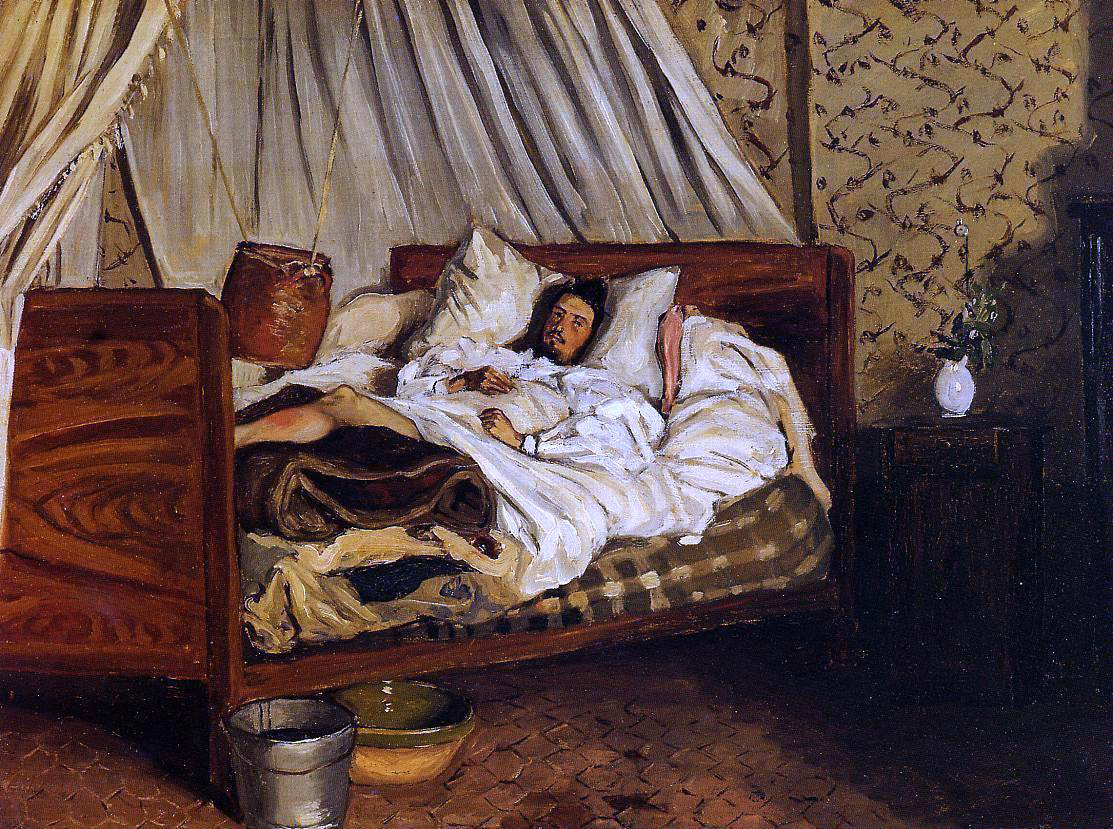
The Improvised Field Hospital     Jean Frederic Bazille, 1865 Oil on Canvas

There is a cheap grey cabinet where patients and family members can store their things, upon the doors of which hang plastic dry erase boards where at every change of shift an energetic nurse comes in with a marker and rigorously erases the last nurses name and writes her own. The board is a bare bones overview of every patient’s “needs,”: the name of the doctor, an elusive man named Hsu; the patient’s diet preferences which in my grandmother’s case is an unappetizing category called “mechanical soft,” and laughably, the “activity for the day,” which is more or less nothing, though hospitals prefer the term “bed rest.” Beneath it all is a row of yellow smiley faces, though not all smiling: they represent a range of emotions: a smile, a grimace, a frown, and a cartoonish scowl meant to signify extreme pain. This is the pain scale – and every patient has a “pain goal,” ranging from 0 to 10, though understandably, a 0 is written on every patient’s board.

To the side, there is a height-adjustable table with difficult wheels, for meals, and a single, vomit-colored chair for visitors. These cramped quarters are meant to accommodate two patients. In the past, before enormous hospital beds and giant breathing machines were invented, this might have been a semi-comfortable set up, but now the machines take up more than seventy percent of the space, forcing nurses and family members to do an awkward dance each time the patient needs something. A dingy yellow curtain divides the room in half, though only by sight, leaving everything else that ought to be blocked (light, sounds, smells) from the other side and the outside, utterly available to torment you and your neighbor. Due to the lack of space, the curtain almost always drapes over something: the vomit colored chair or the commode or the table where your food is placed. You wonder if the hospital ever launders that yellow curtain which is probably as old as the hospital itself and when you arrive at the conclusion, “Probably not,” shake the thought away because it is the wise thing to do.

Most awkward of all, as though privacy and the rest that might result from such privacy were, along with sunlight, unnecessary for full or at least partial recovery, is the fact that even if the room next door is empty, they will always fill the spare bed in your room first before using the empty room next door.

Thus for the past two weeks my grandmother has had a half dozen roommates whose faces she has never seen and some whose voices she has never heard but whose presence and sicknesses can be felt because they are less than three feet away. In years past my grandmother was always the first to leave. She was the one whose health rebounded quickly, astounding doctors and nurses alike. When she left, usually in a wheel chair, they would pat her on the back and say, “Don’t come back,” and she would nod happily, “Of course not.” But now the other patients have come and gone, come and gone, and my grandmother remains.

*For days I called it the “bedpan,” until a frustrated nurse corrected me. “This is the bedpan,” she said, holding up a plastic bedpan, “And this,” she pointed at the aluminum frame that held a plastic toilet seat which sat over a plastic tub for waste, “Is the bedside commode.” I stood there with my GRE textbook and said dumbly, “Thank you.” 

My Mother’s Nightmares

c22f3-15_thumb3

My father left the other day for a two week trip to Asia, not for business, but for fun with retired friends. He is the leader/tour guide, meticulously planning their itinerary from departure to return, in charge of booking all plane tickets and hotels and even drafting a list of must-eat restaurants in each destination: Taipei, Macau, Shanghai, and some province I’m not sure of.   Continue reading “My Mother’s Nightmares”

Let Her Talk

Last Wednesday I volunteered along with my uncle to stay overnight in the ICU, where my grandmother lay under yellow fluorescent lights with a monstrous BiPAP breathing machine strapped to her face like a giant muzzle. A giant muzzle with a blow dryer attached to it. The machine’s function was to push as much oxygen into the patient’s lungs as possible, since the patient’s lungs were most likely resisting their intended purpose, but the machine did not so much help its patients breathe it seemed, as make their last remaining breaths on earth extremely uncomfortable.

For twenty-four hours a day the BiPAP Vision (I have no idea what the “vision” part means) forced air into my grandma’s failing lungs with a horrible, constant whooshing sound, not unlike an industrial strength vacuum cleaner that made the deep, intimidating breaths of Darth Vader’s mask seem like a kitten’s purrs. It cracked her lips and parched her throat, but worse, the pressure of the air forbade her to take any food or water as there was the danger of the air blowing the food down the wrong pipe and causing an infection all over again.

The BiPAP machine should have prevented her from talking, but my grandma has not, for the past ten years (or for the past sixty-eight years that they’ve been married, if you ask grandpa) been one to shut up. The only time she was silent at the hospital was when she had to choose between speaking or breathing, and when that time passed, she was talking again as best she could through the racket of the BiPAP machine.

“Tell her not to talk so much,” my grandpa said over and over again when we visited her in the ICU, “She needs to rest.”

At the time, I had been crying for what seemed like two days straight and was overjoyed to see my grandma well enough to be talking, and I chastised her ornery, often sullen and always stoic husband, “Oh Grandpa, if she wants to talk, let her talk. Someday soon you might not be able to hear her voice at all.”

He looked at me. “What’s that supposed to mean?”

I thought it was obvious, but didn’t respond.

“Oh you mean if she’s dead?”

“Well, yeah,” I said, and my grandpa snorted angrily and walked away.

It was an insensitive thing to say to a man whose wife was hanging on for dear life, but still, I stood my ground. Grandma’s status was far from stabilized and I wanted her to have her say, lest she leave us with wise words unspoken. She never went to college and had little need for books or newspapers, preferring to spend an evening cooking for her progeny, but she’s been around for eight-seven years and it’s not lost on any of us that she raised four filial children, ten adoring grandchildren and maintained a bittersweet marriage to a very difficult man. On top of that she could, as my aunt put it, be the darned community leader of Sunshine Park, where she and my grandpa took their daily morning walks when her lungs still allowed it. I’m sure that for the past twelve days the denizens of their little cul-de-sac have been scratching their heads, wondering where darling talkative Mama Leu is. But word spreads quickly and my grandma’s hospital room has had from the very beginning a nonstop flow of visitors both related and not. People love her. The nurses love her. We love her. There is definitely something to be learned from so much love.

Grandma post ICU and BiPAP, reading about Warfarin.The hair is really something special.

During the first two evenings, when grandma’s vitals were all over the place and when her only hope of leaving the physical world in peace was upon morphine’s calming current, we leaned in close to the mouth cover of the BiPAP machine each time she wanted to speak. If she was at the end of her life, we reasoned, whatever words she spoke would take great effort and we wanted to make sure they were heard.

At first, she cried and we cried and when she spoke her speech waffled back and forth between acceptance of her fate: I’m ready to go, I’m not afraid, don’t be afraid, (I’m rattling them off now but in the moment those are very sad words); and flat out rejection: I’m not ready to go, I don’t want to go, I don’t want to go, I don’t want to go (these are ten thousand time more heart-wrenching and, it turned out, a reflection of her true heart). A few days later when the antibiotics and steroids had taken effect and the infection reduced, she was well enough to inform my grandpa thus: “Don’t listen when someone tells you they’re not afraid of death. Liars, all of them.”

As her condition improved however, thoughts of death and dying floated away and her mind busied itself with other things, namely, hubris and prejudice. That Wednesday night, two days after I’d admonished my grandpa for telling her to shut up, I found awake in the ICU at 2AM, wishing my grandmother would do just that.

Her nurse that evening was a pretty middle-aged black woman with long, curly hair and a perky butt, which according to her, was one reason she was constantly being hit on by reckless young fools in the ER. (“They don’t know I’m old enough to be their mother,” the nurse said smiling to herself). We chatted a bit here and there as she changed my grandmother’s iv, wrote down her vitals, and, occasionally, changed the bedpan – the most unassuming yet menacing reminder of our mortality, if there ever was one. Whenever she clicked her pen to go, I leaned down towards grandma, who even in the deadest hours of the night could not sleep due to the incessant pressure of the Bipap, and asked if she needed anything.

Grandma struggled to unclip her mask and I hurried to help her out of it, worried that she needed more pain medication, “What is it? What do you want me to tell the nurse?”

“Does she know you’re my granddaughter?”

I stared at my darling grandmother. It was two in the morning, she had just come back, it seemed, from death’s door. This was the most pressing question she had?

“What does she need?” the nurse asked kindly.

I chuckled,  aware that my face was, because of the time of night, a sickly yellow pallor, made worse by the unflattering ICU lights, “Oh nothing, my grandma just wants to know if you know that I’m her granddaughter.”

The nurse smiled, “Of course! Your grandma is really proud of her whole family. Earlier I think she was trying to tell me that she had what, twenty grand kids?”

“Ten,” I said. “Ten.”

The nurse nodded towards my uncle who was not quite nodded off, but headed there. He smiled at her.

“And is that your dad?”

“No, that’s my uncle.” 

Grandma tugged at the mask again, this time more hurriedly and I rushed to un-clip it.

“Tell her I’ve got two great-grand kids,” my grandma said, “And two on the way.”

I bit my lip, but the nurse looked at me expectantly. I told her. 

“Wow, that’s such a nice big family you guys have,” she said, “I saw a lot of people gathered around here earlier. She’s lucky to have you all be so close.”

“Yeah,” I said, and looking affectionately towards grandma, I nodded, “She’s pretty special.”

I reached down to clip the mask back on and right before her voice was muffled my grandma asked, “Ask her to guess how old I am.”

I told her to shush and get some sleep. The nurse had other patients in more critical states to attend to.

At four AM, I had all but given up on sleep and instead watched my grandma toss and turn and poke and prod at the plastic mask, one moment scratching the top near the bridge of her nose, at where the mask had dug a fresh red groove, and another scratching the back of her neck, where the Velcro straps no doubt caused a horrendous itch. It was a modern medical torture device and I wanted to rip it off as much as my grandmother did, but if it was removed for more than ten seconds, the blasted machine it was hooked up to would start an incessant beeping and the nurse would come rushing in to admonish us all.

The black nurse came in again to read the machines and a few minutes later a black respiratory therapist entered as well to administer a breathing treatment. They chatted quietly, keeping their voices low so my uncle, who had finally dozed off, could sleep and worked their way around the cramped perimeter of the bed. My grandmother watched them attentively.

The man left, pleased with my grandmother’s oxygen levels and the nurse turned to go to. I glanced at my grandmother to see if she needed anything, and true to form her arm shot out with an alarming urgency for someone supposedly old and tired, though all too lucid.

I unclipped the mask and whispered a little too loudly for the nurse to wait. She turned and said, “Is everything okay? Does Mama need anything?”

Grandma swallowed a couple of times and her eyes fluttered upward. I wondered if the morphine was wearing off. Her mouth opened and closed a couple of times, adjusting to the cooler air and finally, she spoke, “They’re married, aren’t they?”

I was confused for a minute, then realized she was referring to the black nurse and the black respiratory therapist. In her simple deductions of the world at large, the two black people who had by the chance scheduling of their occupations ended up behind the same curtain of the same ICU at the same time, must be married.

I gave my grandma an incredulous look that she ignored and said, “No grandma, they are not.”

“They’re not?” now it was her turn to be incredulous.

“No.” I thought to explain that the nurse was not even from California, that she was a traveling nurse here for 13 weeks, and hailed from Connecticut, but these details, invisible to my grandmother, would mean nothing to her. I could tell she didn’t buy my dissent and rolled her eyes. “They seem married,” she murmured.

“What does mama need?” the nurse said, and I turned to give her an apologetic look. The nurse had been nothing but kind and understanding, and if I’d read her correctly, would merely laugh at my grandmother’s harmless prejudices, but it was four in the morning and I wasn’t about to take any chances.

“She’s fine,” I said, “Doesn’t need anything. She says you guys are great.”

And as if right on cue, grandma waved her IV free hand in both the direction of the Respiratory Therapist that had just gone and then at the nurse. She gave a thumbs up and closed her eyes, attempting to sleep perchance to dream in a world where all black nurses were married to black respiratory therapists, at least those who were in the same room at the same time.

The nurse smiled, “Oh she is just the sweetest thing.” 

Do Not Resuscitate

When you lose your breath, it can go alarmingly fast.

On Friday, my grandmother fried a fish and made fresh green onion pancakes from scratch for dinner at her house. She kneaded the dough with the same strong strokes she’d always used, a little stronger than usual perhaps, as the pancakes came out tougher than usual. As they fried, she wiped away beads of sweat with a powdery white hand. After dinner she told me not to wash the dishes and slowly cleaned the kitchen in her own methodical way. I had my back to her, eating a Nestle Caramel Sundae and when I turned around to throw the wrapper away saw that the kitchen was sparkling clean. If my grandmother was hampered at all by severe shortness of breath or weak legs, you could not tell by the food she put on the table or by the spotless kitchen she kept. She joined us at the table and shared a Nestle Caramel Sundae with my grandpa. She laughed gleefully when I said her fish was unrivaled.

“As long as I can cook for my grandchildren, I will cook for them. Who else can make their favorite dishes the way I can?”

“They are our favorites because you made them so,” I said.

On Sunday, her steroids stopped working and the oxygen tank, with its efficient little whirring and long clear plastic tubing could not deliver enough air to her lungs, the function of which has deteriorated exponentially, as though racing with her frail legs. Which will fail first? It is a race we hope the lungs will lose.

She breathed deeply, desperately into the oxygen machine, hoping the relief would come, but instead her face grew redder and redder and her mouth gaped and gagged. My grandfather could no longer distinguish between a recent red scar she’d gotten from falling on her face and the rest of her skin. He called my uncles, who drove their suffocating mother to the hospital. They were worried, but the drive, her falling, her troubled breathing, these were all more or less routine for the past two years.

They stayed with her at the hospital through the afternoon and in the evening, bid her goodnight. Not because they wanted to leave, but sometimes, she does want them to leave but won’t say it.

On Monday, my uncles returned to the hospital in the morning and later in the afternoon, my mother joined them. The nurse pulled my uncle and mother aside.

“It doesn’t look good,” she said, “The oxygen we are giving her is not enough, and the steroids don’t seem to be taking effect. You and your family need to discuss the DNR.”

I called my mother shortly after this conversation and she cried into the phone. It was around six in the evening.

“Will you guys sign it?” I asked.

“I don’t know,” she said, I could see her face crumpling, “It’s terrible when they try to resuscitate someone. They cut into the throat…it’s just so violent and terrible and you’re never sure what happens after that. Sometimes they don’t come back and they’re just hooked up to the oxygen machine for years.”

It wasn’t my place or my decision, but a hundred images of other old people hooked onto said machines flashed in my head. I saw a lot of sad, fearful faces looking down at blank staring eyes perched atop freshly fluffed pillows. It’s a touchy subject, I know, but sometimes, sometimes you think about this thing called quality of life and dignity and even though I’m only twenty-six and years away from making a decision like that (knock on wood), I said what I felt: “Sign it.”

“We will wait until we’re all here,” my mom said, “But I think we will sign it.” I heard her face crumple again. We hung up.

At 11PM they reached a consensus. My grandmother was moved to the ICU as her DNR was signed.

It is Monday night and my grandma lies sleeping fitfully in the ICU, unfit to do anything, not even breathe. Last Friday, she was frying a fish and making fresh green onion pancakes.

A Decision

The woman could not place, if you asked her, the exact moment she decided that moving her and her daughter to America was the “smart” thing to do. It was most likely a steady accumulation of things: a name here and there of other wealthy people in their social circles who had sent their kids abroad to the very best boarding schools or public school districts and were now, seemingly, reaping the benefits of such decisions. It seemed drastic and unnecessary to some, including, later, the woman’s daughter when her mother’s plan was made known to her, but even the girl noticed how a handful of her friends had suddenly disappeared after middle school and how, some friends who remained behind talked almost wistfully of this option, if only their families could afford to do so.
Well certainly their family could afford to do so. But there were larger things at work: for one, sending one’s children abroad at middle or high school was fast becoming a cultural norm, something children of the economic upper class could expect to do. It was no longer enough to apply to college abroad; more and more, parents were realizing that sending them out earlier ensured a better grasp on the language and culture which in turn meant they had a better chance to apply and be accepted to the top US colleges. It would not be cheap, and would not always guarantee success, but the hope was that a US degree would be of more value years later, when their children finally returned home to Taiwan and pursued jobs there. On top of that, there was the added bonus of the possibility of citizenship, if for some reason things back home in Taiwan went to dust. At the very least they could hope to become US citizens, the benefits of which, though increasingly arguable, was a sort of golden ticket Taiwanese people had been ingrained to pursue from birth.
The woman recalled one of several pertinent instances: Mrs. Tsai, married to one of her husband’s early investors had remarked once how poorly their daughter Maggie fared in the Taiwanese education system and how once Maggie was shipped to America, she discovered an inner drive to do well. In America, Mrs. Tsai said, there was more freedom for her daughter to focus on what she wanted. Students in America were strong and athletic, they did extracurricular activities and in addition to their bodies were encouraged to exercise their opinions. They were taller, stronger, and more voluble than the pale students in Taiwan who often emerged from their bedrooms after all-night cram sessions like etiolated plants. Maggie ended up enrolling in UCLA and graduating with honors, now worked somewhere in West Hollywood at a company having something to do with movies or movie stars – the woman couldn’t remember which but what she did remember was the infuriating smugness with which Mrs. Tsai had talked about her daughter, who before the move to the U.S., had caused Mr. and Mrs. Tsai so much grief that they hardly ever mentioned her at parties. Now Maggie was all they could talk about. The Tsai’s had gone from feeling hopeless to utterly joyful at the mere mention of their Maggie, who had flourished under this new system and was now destined for great (American) things.
The woman recalled too, the horror stories of kids who had gone to the State unsupervised. Rich princes and princesses who were set up in sprawling houses in San Marino, Pasadena, Irvine, or at the chaotic homes of busy aunts and uncles, all places with minimal supervision and showered them with prodigious financial resources. These kids drove around in shiny BMWs and Mercedes and rather than study their books, learned the little black books of the other privileged rich. They spent hundreds of dollars on clothes, cars, lattes and evenings out at expensive night clubs with their new friends, all with similar pedigrees and life goals.
The woman shuddered. She did not doubt that her own daughter, without the right steering hand at her back, would fall right into this crowd. Her father was too generous with their money and the girl was coming to an age where she understood her father made up for his long absences by saying yes to whatever. The girl wasn’t materialistic, not yet, but it was only a matter of time. “No,” the woman thought firmly, “not my daughter.” A journey to the west would be an investment for their family, and their daughter, young, naive, and foolish still, would not ruin it at any cost. She would need a guardian to keep an eye and what better person to appoint than mother herself? It would be like an adventure, starring mother and daughter, and though they would be far away from both father and husband, the woman would be seen by her husband, by her mother in law, by her own parents, as a sort of hero. She was doing what any good mother with the means would do: her daughter would be grateful. So too, the woman felt most confident about this, so too would her husband.
———–
The woman decided upon California because of its excellent schools, weather and ample Chinese and Taiwanese population. She heard stories too, of how women set up whole new lives in California and who, when they returned to Taiwan to visit relatives and were asked when they planned to move back, would shake their heads and say, “Never, it’s much too good of a life over there.” The woman could see herself enjoying this new life and lifestyle. She knew how to drive and spoke enough English to get by. She had always wanted a garden, something she couldn’t have in a Taipei high rise and she was tiring of her husband’s ‘set’ anyway. The women were so stuffy and competitive, always eying each other’s diamonds and handbags. Such narrow minded simpletons! What’s more, she had lately been grating at the sound of her mother-in-law’s voice. The older woman seemed to think a child’s education was solely the mother’s responsibility. Her son worked too long and too hard to pay for expensive cram schools and tutors. The least the woman could do was make sure his money was being well spent.
“I’ll show her,” the woman thought, “I’ll show all of them. My daughter will not be the black sheep. A year in the states and mom won’t be able to recognize her own granddaughter. She’ll be proud of her. And of me.”
The woman made her case to her husband, though she did not have to try very hard. He was already very tired when she brought it up one evening when they were both in bed, his back turned towards her.

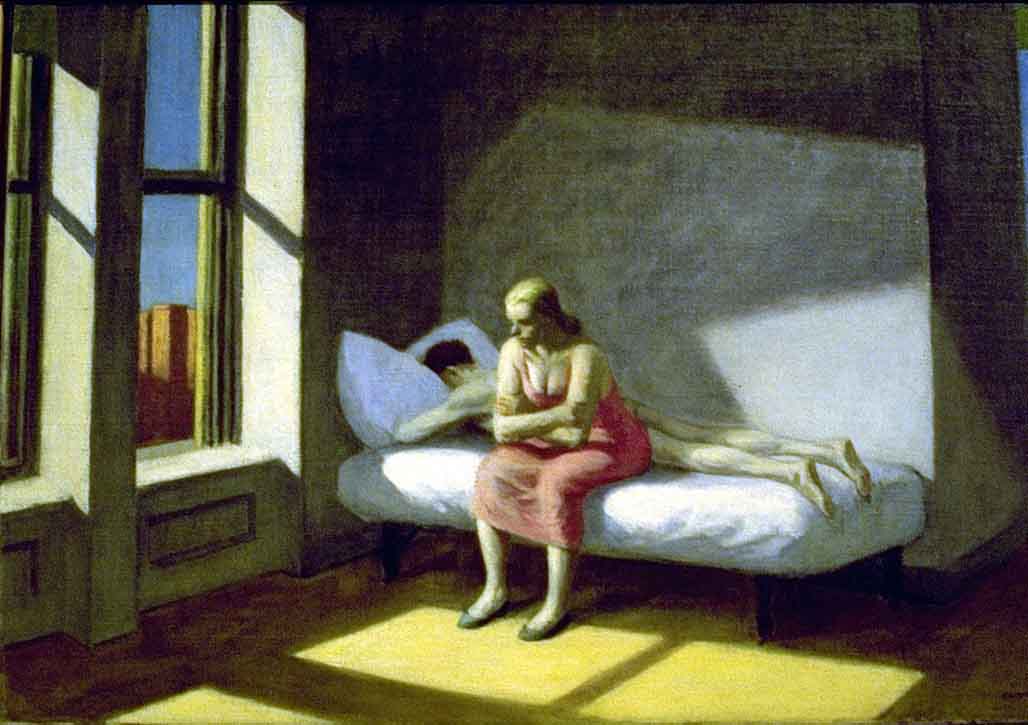
Edward Hopper “Summer in the City,” 1949 Oil on Canvas
“You really think that’s a better solution?” he asked, his eyes already closed.
“Of course dear, this is our daughter’s education we’re talking about. She’s struggling here, making all the wrong friends, and you and I both know times are changing. Going to the states means she can actually get the chance to attend a good US college, which is what most people are striving to do here anyway.”
Her husband turned halfway toward her and she felt the sheets loosen around her thighs. The dim light on her nightstand gave the room a warm, yellow glow and she was reminded of the early days of their marriage, when they still lived at the old, much smaller apartment with no Philappina maid down the hall, no angsty teenaged daughter doing god knows what on the computer. Just a young man and a young woman in bed, thinking very different things about their shared future. He would come home and they would chat lightly, then he would turn over and sleep, exhausted from the day’s work. She had always looked forward to those few short conversations when she asked him about his day, but tonight she wanted to do the talking. She knew he was tired, but she had made it a point to put her book aside and looked at him expectantly when he emerged from the bathroom. He hadn’t noticed she wasn’t reading. Or maybe he had, but chose to say nothing and went straight to bed. But not tonight. Tonight they needed to be on the same page about one very important thing.
“Who would she stay with?” he asked, after she’d given her proposal.
They were without close relatives in California, and given the woman’s standing with most of their relatives, not in any position to call and ask such an enormous favor.
“I would go with her,” she said simply.
“Move there with her?”
“Yes. We would go together.”
The woman waited for the man to say, “Well wait a minute, what about me? I need you too,” but he said no such thing. He merely turned back on his side and thought a minute. He closed his eyes. His wife was proposing to take their daughter and place some six thousand miles between them. He loved his daughter dearly, but it was difficult for a businessman as successful as he to also be a successful father. What he could be, he knew, was to be a pleasant and understanding man to be around, someone who provided financial and emotional security, though the former was much easier than the latter and sometimes, it seemed, interchangeable. He knew this and made it a point that every rare, brief interaction with his daughter was a pleasant one.  
“Where would you live?”
“We’ll find an apartment somewhere first. Mrs. Tsai was telling me about Irvine and Newport Beach, that those cities have good school districts. That is the most important thing. Then when we are more familiar with the area, we can look into buying a house. An investment for her,” the woman said, nodding in the direction of their daughter’s bedroom.
The man nodded. Financially, it wasn’t a problem. He knew several families who had done the same thing, and the housing market in America, although recovering from a decade long housing bubble, was still ripe for people with ample cash. Eventually too, he knew his daughter would end up in the states for school anyway. The only thing was trusting his wife’s taste in real estate. Perhaps he could accompany them first to make sure they were settled in and then return again when they were ready to buy. He knew his wife wasn’t profligate – this was one reason why he married her – but she was also not a rash woman and this decision, seemingly out of the blue, seemed a bit rash.
But it was late and he was tired. He turned again to look at her. From where he lay, his wife’s profile seemed to glow from the lamp on the bedside table. The left side of her face was in shadow but he could see that she had on some level already made up her mind. She looked straight ahead, her lips closed, her hands on the blanket, smoothing them over her legs, which if he lay very very still could be felt pulsing with an invisible energy. She was anxious and ready to embark on this new adventure she had conjured up. It seemed like just ten minutes ago that he’d gotten off the phone with his mother, who had called before he left the office. She had been on the verge of tears. Their granddaughter’s future was imperiled. The face of the family was imperiled. Both he and his wife had gone been such hard workers and gone to such good schools, but now – and of course she couldn’t call home and tell him this so that’s why she was calling him at the office – what was his wife doing? What did she do all day but nothing? What use was marrying a woman from such a good background if she couldn’t even instill the same diligence in her own daughter? A good wife was supposed to provide solutions and for god’s sake the girl was just one child. From what grandma saw, the girl was obedient enough – wasn’t there something he, the father, could do?
The man had nodded into the phone, “Yes mother, yes, yes, I’ll talk to them,” he had said, though he intended to do just the opposite and go straight to bed. Instead, after he’d brushed his teeth and washed his face, his wife had spoken to him in her sweet, even voice and provided it seemed, a perfect solution, suited to each and every member of the family. They had the money. His wife had the time and the mobility. He needed to work and come home to a quiet house. The maid would stay so that his clothes were washed and ironed and his meals kept hot. And wife and daughter would come back on long holidays, and during the summers. They would not be apart for very long, and when the daughter finally went to college, who knew, the woman would either move back to be with her husband or perhaps by then, he would have reason to move to the states. And there he had it, the woman he’d been wise to marry some thirteen years ago was now sitting up next to him bathed in a golden light, having worried on their behalf for their daughter’s sake and was now presenting him with a fully polished solution. He did not think about missing her because he did not think about missing her. Her plan was sound. He would take it.
“Okay,” he said, beginning to nod off, “Okay.” 
The woman looked down at her husband’s face. Was that the hint of smile? It didn’t matter. There was much to plan in the days ahead, and of course, the news they would need to deliver to their unsuspecting daughter, now asleep in the next room. It would not be easy, but some matters are not for children to decide. Mothers always, always know best. The woman reached over and switched the light off so that they were now both in the dark.

Reflections By the Pool

My aunt invited my grandparents, parents and me over for dinner today. It wasn’t a special occasion or anything, she just bought a ton of groceries and decided to cook, and asked my dad to pick my grandparents up from their home in Cerritos on his way home from work. Dinners like these are a combination of things: an effort to eat healthier (my aunt cooks mostly vegetarian), to spend more time with her parents in addition to the countless hours they spend on the road and at various hospitals, and to spend more time with me. At least I like to think so.

A few years ago I would have shook my head no thanks, opting to stay at home or go out with friends, but in the past year and a half that I’ve been living at home I find myself looking forward to them. I like my aunt’s cooking, despite her dishes being bland and often, unsightly (lord help her presentation if she uses soy sauce or eggs). What’s more, there is the odd family practice of not really paying any attention to the younger generation. Growing up our family celebrations at restaurants and even at home were firmly divided into two tables: adults and kids. There are ten cousins and about as many adults, and my father was usually in charge of ordering for both tables. Thinking himself “hip” to what young people wanted, he would throw a fried noodle, rice or orange chicken dish in at the end of the meal at the kids table, assuming we’d go bananas over that stuff. (Most of the time, we were too stuffed to make a dent and he’d come over and help himself to a bowl, having wanted it for himself all along.) I think even now, with some of my cousins approaching forty and with kids of their own, we sort of still expect to be sat at a table together, separate from our parents.

These days at my aunt’s house I’m just one “kid,” and therefore expected to sit at the table with the “adults,” but their attention turns to me only when they’re concerned that I’m not eating enough or can’t reach a particular dish. It’s not strange until I think about how old I am and, according to society’s life map, where I’m supposed to be. I should be working late or perhaps out with my long-term boyfriend or, if I were married, home readying dinner for my husband and my own kids.

Instead I sit, eat, and listen. They talk about the dishes and how they can be improved (my father and grandma are most voluble when it comes to these matters). They talk about their mutual friends – who has cancer, whose children are getting married, whose parents are aging and on their way out, and who is a little miffed with whom but just too polite to say so. They talk about grandma and grandpa (if grandma and grandpa aren’t present) and their progress and about new and unborn babies, and how different child-rearing is nowadays. They love their children, but sometimes, in the lifestyles and within the marriages themselves, have a hard time recognizing that these children, now adults with houses and children of their own, came from their bodies.

It’s not a bad thing. None of it is bad – and they speak of these things in a matter-of-fact way, between bites of bitter melon, egg and tomato stir fry, pickled cucumbers, pan-fried rock cod, chicken curry, and yam leaves. They are both aware and unaware of time and how fast things change. When my grandparents are present you see on their faces everything that’s being said, those very changes that took place over all the long decades of their lives: the wars and revolutions, the migrations from there to there to here, the marriage and miscarriages and finally the births of these children who branched off into their own full lives with their own migrations and marriages and careers that enabled them to buy large houses in leafy suburbs and eggs in cartons of eighteen. They’ve done their share of fretting over their children. I guess, when you’re eighty-six and your back hurts no matter what position you’re in and you’ve tried every drug in the world, you sort of just realize, “Hey, life is short, don’t try to control what you can’t.”

And my parents and my aunt, they don’t try to control what they can’t. At least not anymore. All the variables have grown up and moved away. I’m not supposed to be around listening to these conversations, where they basically review everything they did right or wrong over the course of our young lives, but I am. What I’m listening to are the memories and realizations of retired tiger moms and formerly stern fathers (not my own, but my grandpa, certainly) who have pretty much stepped back and said, “They, my children, are no longer my responsibility. They have their own lives and I have mine.”

I’m learning a lot – but mostly that life, depending on how you look at it and how you spend it, can be quite short. Or I guess to be more optimistic: it’s long, but it goes by damn quickly.

Case in point:

After dinner my grandma wanted to poke around my aunt’s yard. My grandma loves gardens and plants and she loves to comment on other people’s plants. We encourage this behavior because it means my grandma is doing something somewhat active, even though my grandpa is always in a rush to go back home where he does nothing but sit and stare at the TV or listen to a wailing Beijing opera. We don’t understand his rush to do nothing, but at the same time this sort of pointless impatience seems to afflict most elderly Asian men I know. I think they were programmed to return home to their couches and beds. Anyway, this evening my grandma got up from her chair and walked to the back door.

“It’s so cool here by the door,” she said and without further ado, stepped out without her cane.

“Your cane!” my aunt said. I was done eating by then and rose to bring grandma her cane. I didn’t have to go very far, and since I was already there at her arm, I decided to walk out with her.

It was ten degrees cooler outside now that the sun was lower in the sky and I was instantly glad I had stepped out of my aunt’s warm kitchen. There was a soft breeze, coupled with the smell of grass and whatever plants my aunt kept on my left, that made the air so fragrant. Slowly, we walked around the kitchen window and came to my aunt’s garden patch. I smiled as my grandma poo-pahed my aunt’s plants, laughing at the scrawny tomatoes and tiny apples, but I could tell she was pleased that her eldest daughter, formerly a super successful real-estate agent who couldn’t keep a houseplant alive, now kept a garden at all. (Amusingly, my grandma kept on saying, “Your little garden,” even though my aunt’s yard is roughly, the size of my grandma’s entire house.) Aside from the fact that if my grandma had taken a fall I would have been the one responsible, I felt, standing there by her side, quite young and child-like. I had gone out barefoot and left my phone inside. My parents, aunt and grandpa were still inside chatting and finishing their meal, and for a few minutes it was just me and grandma in the garden.

We didn’t say much, I just stood by and watched her examine a leave here and there. Despite having no strength in her legs my grandma was quite strong in the arms and leaned heavily on her aluminum cane as she reached for a young fruit or browned, dead leaf, which she would pluck off with surprising vigor and thrust to the dirt. Eventually she decided my aunt’s garden was not hopeless and kept on walking beyond it to the pool, where two old lawn chairs sat side by side. She poked at one with her cane and, deciding that she didn’t care about the crusty bird shirt that covered the edges, sat down after bending her legs for what seemed like five whole minutes until her bottom touched the beige mesh of the chair.

She sighed and looked up at me, then twisted her neck around as though realizing for the first time that she was in her daughter’s backyard, “It’s quite nice here, isn’t it?”

It is, I said. Seeing that Grandma was safely seated, I stepped into the pool, wanting to cool my legs. I kicked a bit, stirring to the middle fallen leaves that had collected around the water’s edge.

“Oh my goodness!” my grandma exclaimed, “You kicked out all the dirty things.”

“They’re just leaves, Grandma,” but it was still light and I spotted my aunt’s pool net. I got out of the water and grabbed it, then tried as expertly as I could to gather up all the leaves I’d caused to float to the center of the pool.

“You missed a spot.”

I turned around. My grandfather had come out too and was standing at the opposite end of the pool, near the spa with one arm behind his back and another stretched out and pointing at the water.

“Got it,” I said, and moved to clean the area.

“Maybe you could work for your aunt and clean her pool,” my grandpa said, and chuckled to himself. What a jokester.

“I could, but I’d like to be paid in cash and not in vegetarian dishes,” I said.

He laughed, then walked around to where his wife sat. He bent down to brush the seat off, then sat down gingerly, wincing slightly as the crick in his back acted up.

I put the net down and walked over.

“Are you comfortable?” I asked, already knowing what his answer would be.

“At my age, there is no comfortable. There is only bad and not too bad.”

“Well, hopefully you’re not too bad.”

“Not too bad,” my grandpa nodded.

We sat, the three of us – they in the lawn chairs and me on the floor with my legs in the pool for the better part of an hour, talking about my cousins and their children, and guessing at who would marry next.

“You need to find someone,” my grandma said, then she thought about it and said, “Well, don’t rush it. It takes time to find someone really good.”

My father came out to take a phone call and we could hear his voice breaking in and out over the white noise of a garden in the evening.

My grandma turned to look, “Who’s he talking to?”

“He’s on the phone,” grandpa said.

My grandma looked at me, “Not sure what you, your mother, brother or what your grandpa and I did in our past lives to get a father, husband and son-in-law like him, but we are very blessed.”

I laughed. So I’ve heard from them many times.

My grandpa nodded in agreement, and for the next few minutes we didn’t say anything. Suddenly the pool lights came on along with the waterfall. My aunt had turned them on via remote control from her study. I waved at the window and saw a slim white arm wave back. The pool light, chosen by the previous owners who had no doubt predicted wild booze-filled pool parties, glowed in a myriad of garish colors: red, blue, white, then green. Silently we watched the water change colors, pausing just a few seconds on each hue before slowly changing to the next.

The three of us watched the colors change as though in a trance until my father finished his phone call and came to join us.

“I saw you clean your aunt’s pool.”

“Yup.”

“I told her she could clean her aunt’s pool for a living,” my grandpa said again, and my father laughed.

“Oh no,” he said, “She’s going back to school. At least, that’s what she tells me.”

“That’s the plan,” I said.

“Good, good,” grandpa said, “School is always good.”

My father scoffed, “Yes, but this one doesn’t study. I’m worried I’ll be throwing my money away. She majored in English and all she ever did was read a few novels.”

I shrugged.

“Saying you study is like watching ghosts fight.”

I thought my father was saying something poetic, about how a writer’s struggle is invisible, and for a minute I thought he was coming around. That he understood that my “studying” or “working” wasn’t always something you could chart. But just to make sure, I asked.

“What does that mean?”

“Have you ever seen ghosts fight?”

“No.”

“There you go.”

I rolled my eyes. What was there to explain? Nothing really. It was a nice evening. We had just eaten a healthy, home-cooked meal. I had just cleaned my aunt’s pool and was now sitting with my feet in the water. It felt good, and looking at my grandparent’s faces, they felt good too. My father, with his arms crossed and his phone back in his pocket, was smiling.

My grandpa must have noticed something then. The sun was nearly completely gone, but there was still enough light to see barely, the outline of their faces and mine too.

“You’re at your best right now,” he said suddenly, “this is your best time.”

I wasn’t sure what he meant: was he referring to my youth or intellectual potential or fertility? Maybe all three. Was it warning? Or perhaps in the dimming twilight my grandfather had briefly forgotten that I was twenty-six and spoke to me as though I were still a child, having just left the children’s table to accompany them to the edge of the pool.

I didn’t know and there was something about the moment that told me not to ask. His statement had been issued and I could do with it what I wanted. I kicked my feet up a bit and caused the water to ripple. The lights changed again, then again, and again, casting a glow on all our faces, sometimes warm and red, sometimes a cool blue and white. I wondered if the pool light had a sensor. If I jumped in, would the lights stop changing? Probably not.
A Child Grows Up

“You know what the strangest part was,” the woman said to my mother, “I never once thought of leaving him.”
My mother thought she understood, but then asked the woman to clarify. It was common for women in the same predicament to stay in such marriages – we both knew a handful of women who had stayed but thought of leaving every single day. For the woman to say that she had not even thought of leaving seemed unlikely.
“No, I didn’t even think it,” the woman insisted. She stared up for a moment at the soft lights hanging above the badminton club – whatever she hadn’t thought about ten, fifteen years ago she was certainly thinking of now, but my mother recognized a look of genuine confusion.
“I don’t know why,” the woman finally said, “It wasn’t good at all, was it? Looking back, I had all the time in the world to think about it, but instead I just focused on raising my daughter and making sure she had everything she needed to succeed. And even then, with all my focus and energy she turned into someone who sees herself as my exact opposite.”
It was the most self realized statement my mother had heard the woman make thus far. My mother asked, “What makes you say that?”
Without a hint of irony, the woman replied, “Oh my daughter has told me a many times in fits of rage, ever since she was in middle school.”

Around the age of thirteen it became apparent to the daughter that she was self-aware in all the ways her mother was not. Daughter cringed at family parties, watching mother talk others’ ears off, wondering if it was very obvious that her mother talked merely for her own benefit, to hear the sound of her own voice. Studying the faces of relatives around her, she realized it was very obvious. Most people tried to avoid her mother. So did she.
At home, her mother sang until inevitably her father would say, “Can you please. Not now, I’m on the phone.” If she was not singing, she poked her head into her daughter’s business, thinking she was being helpful and that the best thing was perhaps to mold her daughter into a miniature version of herself, but the girl had other ideas. As she grew older, she opted to spend more time out of the house, preferring to study in the busy MacDonald’s around the corner from the most popular cram schools (though not at the actual cram schools) rather than at her own desk, which was only a short hallway and thin door away from her mother’s incessant nagging. Though the MacDonald’s was a notorious breeding ground for tomfoolery and time-consuming middle school romance, there, the girl found something of a haven. She found other adolescents from middle schools all over the city who more or less wanted to escape the restrictive and overbearing mothers, and who like her, were more concerned about the sudden proliferation of acne on their young faces or the fact that they, males and females, were beginning to see each other in a new and rather interesting light. 
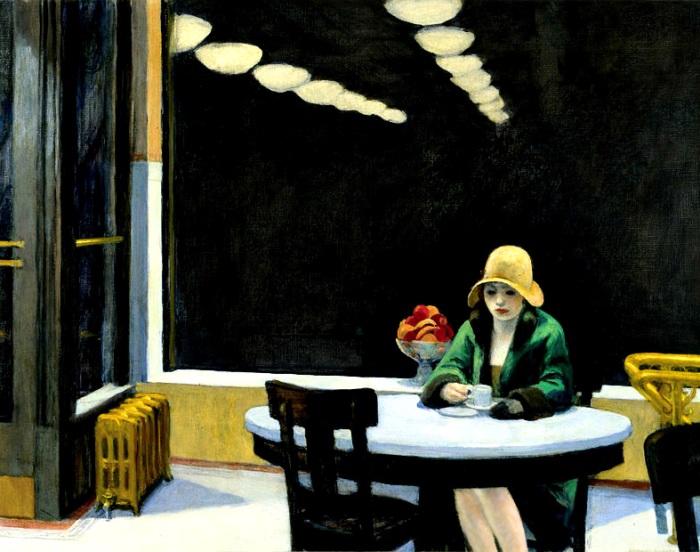
Edward Hopper Automat 1927 Oil on Canvas
 Over French fries and Chicken Nuggets she wrote notes to her girlfriends instead of studied the notes she took in class, whispering and giggling about several boys she found handsome and charming. She developed into a restless young woman who because of privilege and hormones and the desire to get away from home, could not apply herself as wholeheartedly to her studies as her mother would have liked. Her father, though doting, was hardly home and when he was, more or less echoed what her mother said, though to him she was much more receptive.
The girl was not academically gifted, not as her mother had been, and of this her mother never failed to remind her whenever her marks came home.
“When I was your age I never had any trouble testing into first or second place,” her mother said at every age, “School came easily. You need to sit down and apply yourself.”
Her mother, thank god, did not believe in corporal punishment as many of her friend’s parents did, but still, the girl felt an interminable animosity towards her mother. Sometimes she asked herself where the anger came from, but she couldn’t explain it. It was as though she were born to dislike the woman who had given birth to her. She tried hard to be civil, to hold her tongue and temper whenever her mother began to nag or imply just one of a hundred shortcomings she saw in her daughter, but it was very difficult. There were many types of abuse and the daily verbal reminders that she was never quite what her mother had hoped for in a child, not even the right sex, was enough to make the relationship brittle. Was that not reason enough that she found her own mother’s voice so grating?  
In her last year of middle school her extracurricular activities at the fast food joint caused the girl to test into a low ranking high school, from which the students were almost guaranteed to feed into technical colleges rather than prestigious universities where good, stable jobs were guaranteed. Her mother was mortified, herself having attended the second best high school in the nation. She spent the better part of an afternoon fluttering around the house wondering if her daughter’s future was damned.
“I don’t understand,” she said, “we pay for all those cram schools and still, you can’t even place into the top five?” Her voice became more and more shrill, and for once her daughter wished her mother would sing instead.
The berating revolved around her mother and her “reputation” – how would people perceive it when they found that the academic superstar had given birth to a daughter who couldn’t even place into the top five? The top five! That’s all she was asking. The girl had no excuse really, mother and father worked so hard to give her everything she wanted, sent her to the top cram schools and even offered to pay for extra tutors. They gave her freedoms, didn’t they? She had no curfew, could come and go as she pleased. And money! Didn’t the always keep her flushed with cash. When had they ever denied her anything? Materially, didn’t she have more than the rest of her classmates? And now look, she had gone and left herself behind in their more diligent, disciplined dust.
The girl wanted to scream, shut up mother, but she held her tongue. She had perfected a deadened look that she put on whenever her mother began to talk to her. Why was there was never any loving remark from her mother’s lips, only questions about grades or her appearance or if she had blown through her allowance yet. And now in her mother’s eyes the girl had failed in the penultimate way, but she didn’t care. Her mother, she knew, needed to be in control but she was older now and saw her mother controlled nothing. Her father disregarded her, and even the Philippina maid could sometimes be caught rolling her eyes at her mother. No one respected her.
Her father, when he learned the news, sighed heavily and suggested they enroll her into a private school.
“No,” the girl said, “I’m old enough to make my own decisions, and I’m fine with attending this school.”
“You are not old enough to make your own decisions. I am not fine with you attending that school,” the mother said.
The girl said nothing, but looked at her father, who seemed more tired than usual.
The father looked at his daughter and then at his wife. Had fourteen years really just flown by like that? Now his daughter was old enough to argue and it seemed like that’s all he heard when he came home, mother arguing with daughter, or mother nagging daughter and daughter sullen and quiet. He cared about his daughter’s educational future, but both he and his wife had been self-motivated enough to do well on their own, without parents having to push them. He trusted his daughter to do the same. Or at least he hoped she would; he didn’t have the time to pursue an alternative, and while his wife certainly did, he could see her technique needed improvement. Anyway he had work to do. Phone calls to make. A business trip to plan. 
“We’ll talk about it later,” he said. And by saying so, he gave his wife time to think.  

Birth

Less than two months later the woman learned that she was pregnant and a collective sigh emerged from the breath of all those involved, namely, the woman and her husband. He came home from work early the evening she found out and held her hands tightly and looked at her in the same way he’d looked at her when they were still sweethearts in college. It stirred her heart, this look, and made her love her husband more. She felt proud, like she did when she was a little girl and brought home accolades from school, and her parents beamed but were not too lavish with the praise. They knew too much praise for tiny accomplishments would only lead to a lazy child who expected it.

Now however, the woman felt a strange sense of triumph, that she had somehow overcome an impossible obstacle. She knew nothing of medicine or the mysteries of what made this particular pregnancy possible, but she understood that it had felt like an impossibility for the longest time and now, here she was, sitting in her husband’s tender embrace, the beginnings of their child floating warmly in the womb.

It was not an easy pregnancy. She tossed and turned and suffered violent nausea that rocked her entire frame, which seemed to simultaneously swell up and diminish. How her back ached! How her feet hurt! How her stomach churned and churned! Had she not known any better she might have suspected that she was slowly being poisoned to death, but of course she said none of this to her husband, who although still spent much time away from home, was quite attentive when he returned, always making sure to bring her some sweets or noodles. Often she did not feel like eating, but her mother and her mother in law would tsk tsk and made sure she ate half her weight’s worth of herbal broths and such. They brought over entire chickens cooked in ginger broth, the pale, plucked skins of which sickened her to look at but which she ate dutifully, knowing it was for the baby. She put on twenty, then thirty pounds and by the time it was revealed that the baby was in fact, a girl, the woman could hardly recognize herself in the mirror.

A girl! The girl was safely tucked away in her mother’s belly, unable to see the ensuing disappointment on her parent’s faces, but perhaps she felt something – an intangible but audible rhythm that sprang from the valves of her mother’s pulsing heart, reverberated down the maternal spine and through the uterine wall; a miniscule shockwave, barely detectible except to the thin, translucent membranes of a developing fetus. The baby did not yet know the word “disappointment,” but she felt it early on. It was uncomfortable. In response, she kicked and kicked. The woman winced. A girl! This child would not be easy.

—————–

A mother ought to love her child, regardless of its sex, unconditionally. The woman knew this, but when the girl was born and placed into her arms, she was only exhausted. The labor had been brutal, nearing 32 hours. At one point the doctor had feared the baby would stop breathing and they would have to operate.

“It’s as though she doesn’t want to leave,” the nurse said.

The woman moaned through gritted teeth, “No, no,” she gasped, “She wants to kill me first.”

But both mother and daughter survived and the baby emerged shrieking, a loud, siren-like noise that seemed to belong to a much larger animal.

The woman leaned back into her pillow, relieved that the pressure she had felt for the past day and a half was no longer there, still unaware of the pain and discomfort that lay ahead. Beneath the sheets lay a bloody mess, but at least the baby had all ten fingers and toes. At least she was intact. 

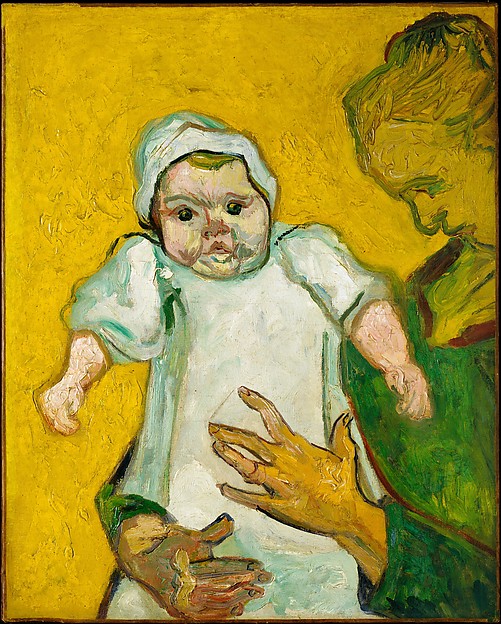
Madame Roulin and her Baby, Vincent van Gogh 1888, Oil on Canvas

Her mother placed her hand on her daughter’s warm forehead, brushing away the matted hair, “She’s a good girl,” the mother said, taking the baby from the woman’s arms, “She looks just like her father.”

The girl’s father was away at the office and would see his daughter a few hours later. He would take the little girl up in his arms and smile a contented smile – true, he had wanted a son, or did he? It wasn’t typical for a man to admit, but he had rather liked the idea of having a daughter – here was a person you could spoil and place upon a pedestal rather than worry if he, a son, could live up to your accomplishments. The man was still a young man at that point but he had foresight – just as he knew he had chosen a suitable and obedient companion in the woman, he knew he would be tremendously successful in his business ventures. It wasn’t a doubt he had ever experienced – he did not have the luxury of doubt. And now he had a daughter upon whom he could shower the spoils of his success. What a princess he held! His princess. His mother in law repeated what she’d said to her daughter and he nodded, looking into what might as well have been a tiny mirror. She did look quite like him.

Conception

It occurred to her some years later that at some point early on in the marriage the lovemaking had turned loveless, and that their only child had been conceived in such a perfunctory manner. It made sense then, did it not, that her relationship with their daughter was strained.

When their plans to have children began to form, she realized she was not the kind of woman who longed to have children. She could easily have lived the rest of her life with just her husband, singing to him alone, though lately she had seen so little of him she began to consider teaching choir at a nearby middle school.

But the woman was dutiful if nothing else. There were aging parents on both sides pestering them for children and at twenty-four her clock, though inaudible to her, was ticking. As husband and wife they knew the importance of working on a schedule and they approached it with the diligence they had both applied to their college entrance exams. The woman recalled this time with mixed feelings: she never felt closer to her husband, never saw more of him than at this moment in their lives. He came home, still exhausted from work, but rather than falling immediately asleep he came to her first.

He wanted a son; she could see it in his eyes. And because it was what he wanted, it became what she wanted. Each night and morning she bit her lip and willed herself and all her necessary organs to give the man a son, to give their parents a strong, healthy grandson, and to give herself – though she didn’t know it then – a companion. She imagined walking up and down the street with their toddler son while her husband worked and the neighbors nodding and smiling, “Now that is a handsome little boy,” they would say, “he will grow up to be tall and strong like his father, and shrewd too.” She would buy him little suits to wear at Chinese New Year and take him to lunch with his grandparents. He would enroll at the best schools, and perhaps take up choir too, but only if his father saw fit.

And slowly, this little boy yet unborn became as concrete as the man sleeping next to her. He was not an abstract thought – she could see his large bright eyes, the thick dark hair, and almost feel, when she clutched her husband’s back, the soft baby flesh that would come from the very same flesh. 

Instead, weeks, months and then a year went by. She gave him nothing.

Her mother intervened, taking her daughter to the best Chinese doctors, acupuncturists and herbalists. The fortuneteller told the woman not to worry, she could conceive. Her husband’s business would flourish. They would have many houses, all over the world. He would invest much into this child.

 The Fortune Teller, Charles Edward Halle, (1846-1919)

“The child, our son,” the woman said, looking at the fortuneteller with imploring eyes.

“I cannot say,” murmured the fortuneteller, “but you have so much to look forward to. It is a good life, by anyone’s measure.”

On her way out of the fortuneteller’s office the woman stopped before the altar where the Bodhisattva Guanyin stood, looking down upon all who needed her. The woman did not like the gaze of this particular sculpture, Guanyin had an air of smug arrogance. What did this porcelain statue know and what could she give? The woman was dissatisfied with the answers she’d received. She had prepared a red envelope of eight thousand to give as an offering but felt that the fortuneteller’s answers were not worth so much. Things were supposed to get better, but her womb was still empty and her husband had less and less to say to her.  She knew her husband’s business would do well – after all, he spent nearly all his breath there so that by the time he returned home he hardly had a word left for her. Whatever common ground they had shared was slowly disappearing so that the only thing they shared was a bed, if barely, considering the late hours he now kept entertaining his buyers. Furtively, the woman slid two fingers in and removed two crisp thousand dollar bills then placed the envelope in a the wooden bowl at Guanyin’s feet, next to waxed apples and fragrant oranges. Guanyin’s expression did not change but behind her the fortuneteller shook her head. Two thousand dollars. Was that the value the woman placed on truth?