Peeping Toms

My mother is like a child, though not in a bad way. I marvel at her ability to marvel at the things I take for granted or give little to no thought at all – and push away thoughts of Alzheimer’s to the nether regions of my brain, hoping never to have to retrieve them – and wonder what the switches in her mind look like and who is running them. Happy, mischievous little elves, those switch operators. 

“Look here!” they say, “Look there! Bet you never noticed that before.” 

And obediently my mother will turn and look. Her eyes will grow wide and she will look at me with the kind of earnest surprise that only earnest surprise can generate. Her long index finger will point, and she will ask me something or other, the most obvious question. A restating of the facts themselves, but with a question mark at the end. 

My reaction is always a slackening of the lower jaw and the wrinkling of the top left corner of my nose – a physical embodiment of incredulity

“Mother,” I will inevitably say, “nothing has changed. It has always been like this.   

Last night  she walked into my room and noticed that the louvers on my shuttered windows were open. Let me provide some history. Those windows have been on the south side of my room since the beginning of the house itself. The owners before us outfitted them with shutters that open towards the inside. On a sunny day, the idea was, the girl in the room could open the shutters and enjoy the flowers blooming in the side yard and smell the clean scent of freshly washed laundry sunning on the clotheslines. Such was the function of the side yard: a drying place for clean clothes, a sunning place for pretty white rose bushes or other flowers the lady of the house preferred. 

That elderly couple moved away some twenty years ago and sold their beloved one story house to a young Chinese couple with two young children. The Chinese man was quite fastidious – he was partly by nature and partly by upbringing and training punctual and organized, kept documents in files labeled by date and kept his clothes neatly hung or folded in the closet. He was not obsessive compulsive by any means, but he liked things neat and believed that everything had its place. He was raised in an orderly, tasteful house that blended spare Chinese elegance (his mother) with spots overflowing with shiny English knickknacks (his father). Despite this difference in aesthetic tastes, both parents were punctual and neat. It is odd then, that he married a woman who arrived an hour late to their first blind date and would, for the rest of their married lives, cause him to arrive at least ten minutes late and with high blood pressure to any functions they attended together. This woman was not organized by nature or by training, though to sustain the marriage she tried. She was also by nature a hoarder and this tendency extended to her love of flora. 

When husband and wife moved to their new home formerly occupied by the tasteful elderly couple of Anglo-Saxon descent, the woman immediately set about filling the back and side yards with her hodgepodge of greenery. What had once been a nice, orderly aisle reserved for clean laundry and a few carefully pruned rose bushes was now overrun with pots large and small filled with odd plants of eastern origin, none of which the daughter, whose windows faced this side yard, found aesthetically pleasing. Her mother liked weird spiky plants whose arms looked like crab legs or were wide and flat like ugly green belts. She was loathe to part with any plant and her female relatives took advantage of this, and over the years, added to her mother’s unsightly collection by bringing over their own ugly houseplants that were on the verge of death. 

“Here,” they said to the girl’s mother, “I no longer know what to do with this plant. Perhaps you can nurse it back to health and make it bloom again.” 

Potted Plants,  Paul Cezanne 1890 

It may come as a surprise to some, but a dying ugly plant does not look too much different from a thriving ugly plant. But when one is a plant hoarder, a plant is a plant. The girl’s mother also liked orchids, but these she kept hidden in a green house that sat on the hill, at the back. Instead of complain to her mother, the girl decided at a young age to keep the shutters closed but the louvers open to let in sunlight. She found the light itself pleasing, and did not think about the mess her mother had made of the side yard. At night, it did not matter. Everything was dark, and as the side windows faced the side yard, through which no one ever walked but her mother, the girl did not bother to close the louvers. Ever.

For some twenty years, it can be said, the girl’s mother would come into her bedroom at the end of the night and chat with the girl, telling her stories and doling out the advice only a mother is able to provide. The girl’s bed is positioned directly underneath the shutters, the louvers cast downward at whomever should sit or lie in the bed. They have always been positioned so, and even when the house cleaners come and wipe at the dust and alter the angle of the tilt, the girl will always, always re-position the louvers just so. See, unlike her father, the girl is more than fastidious, she is particular. Especially in regards to the position of the louvers.

They are never closed. The girl believes this takes away from the room’s dimensions. Makes it seem more narrow than it is. So there you have it, the essential point of that history: the louvers are never closed.

Back to last night. I looked up from the book I was reading and stared at her, wondering what in the world she was talking about.

“Your windows are open!” she said again, “You must close them at night!”

“Whatever for?” there was audible alarm in my voice, though my mother failed to notice and instead turned to me with alarm written over her face, as though she couldn’t believe I didn’t know what dangers lurked outside the windows of our small, quiet town.

“It’s not safe! Someone could peek inside and see you!”

“Mother, these windows face the side yard, which is not even connected to the road.”

She waved her hand at me, “You don’t understand. It’s not safe. There could be a bad man out there.”

“No mother, there are only hideous plants.”

She smiled and sat down in her usual spot on the edge of my bed, then proceeded to tell me about the peeping tom that had plagued her and her sister when they were young ladies in their teens.

“Your aunt Joannie and I shared a room and one night I felt someone looking at us, and when I looked to the window, there was a peeping tom! Leering at us right from the window! I screamed and then of course he ran off, but see, there are so many strange people out there.”

I nodded slowly, amused by both the story and my mother’s imitation of her younger self, a personality which emerges constantly and uncannily in her person’s current version. She is, despite her poor memory, someone I would deem ‘ageless.’ And yet in spite of her poor memory something about my south windows prompted a scene of her younger self. We all have those moments, I suppose.

“If I lived in a bad neighborhood in a big city, I’d keep the windows shuttered,” I assured her, “but here…” -I looked up between the louvers and scanned the darkened windows, half expecting to see a pair of bright, leery eyes, but was met with only the faint reflection of my bedside lamp – “I don’t think we need to worry about it.”

“Even so,” my mother said, “even so. You can never be too careful.” But she made no movements to close the louvers.

We chatted some more and she rose to leave, though not before taking one last look outside the windows. She saw nothing, I’m sure – it was a darker night than usual, the moon was off somewhere being bashful – but instead smiled to herself, thinking not of the peeping tom that had frightened her so many years ago but of all her darling odd plants, spiky leaves and waxy arms reaching out or hanging from the old clothesline. They stand in the dark in messy, uneven clusters like poorly conditioned soldiers of a decrepit army. Perhaps they protect me when I sleep.
Baby Steps 2

Now, I’m having lunch with grandpa three days a week and I don’t bring a camera or even a notebook with me. The time is still not right, and there may be a chance it will never be “right.” It takes only a day or two to become accustomed to standing over my grandmother’s stove, stir frying peas and slender green onions from her garden. Slicing navel oranges for dessert. He watches TV as I cook, and when everything is ready (it usually takes fifteen minutes or less to assemble everything), I say, “Let’s eat!” and he shuffles over to take his seat.

Lunch is a quiet affair, the only sound being the TV’s, and my occasional question. “Do you like this? Can you bite this? Do you want more?” It’s alright. Yes. No. Sometimes, I ask him questions about the past and he answers tersely, with a word or two, not angrily or sullenly, just matter-of-factly. Though sometimes he will say dismissively, “You don’t understand.” I don’t. But don’t is different from “will never.” And it’s okay. I let him dismiss me because we are on different planes. There must be much on his mind, both their past and his future, though the latter is slowly taking priority. More than ever he refers to the house as “my father’s house” or “Kwang-tien’s House.” He is wondering about place, his place. About “home” and life and living. 

But I am patient. I lean towards the positive, as, pleasantly apparent sometimes, does he. After lunch on Monday we took a walk in the park, the first time since the previous Wednesday my grandpa has left the house on a weekday. The clouds from the morning rain had parted and it was surprisingly warm outdoors. There was sun. My grandpa agreed easily to the walk and I hid my surprise, pretending that this was his usual routine. Better to fake it till he makes it so. Nearing the park’s cul-de-sac, we spied an old man in a wheelchair, using his toes to shuffle himself forward.

“That’s old man Zhang,” my grandpa said, nodding towards the diminutive figure, “he lives with his daughter. His legs are no good and he can’t hardly see, but his ears are very sharp.”

In a rare demonstration of his social abilities, grandpa nodded towards Old Man Zhang. “Let’s go say hello.”

We crossed the street and Grandpa called to him. The man slowly turned the wheelchair around with the tips of his toes, and I was surprised to see how healthy and pleasant he looked. His eyes, though cloudy with cataracts, glistened and his complexion was unmarred by liver spots. Aside from his obvious handicap, he seemed to be in good health, and in good spirits. He nodded at me and said hello.

“Taking in some sun?” Grandpa asked him.

“Yes, yes,” Zhang said, “I haven’t left the house for days.” It feels very nice out here.”

 “The rain,” grandpa said, “now it’s stopped.”

“”Yes, yes, finally,” Zhang said. “Very nice indeed.” 

The conversation was short as it usually is with two elderly men who do not know each other very well. 

 “Well, we’re just taking a walk,” grandpa said, and Zhang nodded kindly for us to continue on our way.

“They came to your grandma’s funeral,” he told me as soon as we were out of ear shot.

“That’s nice, but I don’t remember seeing anyone in a wheelchair.”

“Not him, don’t be ridiculous,” grandpa said, exasperated, “He can’t go anywhere in that state.”

“What’s wrong with his legs?”

Grandpa looked at me like I was stupid, “He’s old! That’s what happens when you get old. Your legs fail and you can’t walk. A lot of old people are rolling around in wheelchairs.”

I pointed to grandpa’s legs, “But you walk just fine.”

He scoffed, “That’s because I’m not old.”

I laughed. I really was that stupid. “Oh of course you’re not,” I said quickly, “Far from it.”

The sun was still shining and the air was oddly balmy. We had walked one lap around the entire park. Grandpa said he could walk a few more just around the playground.

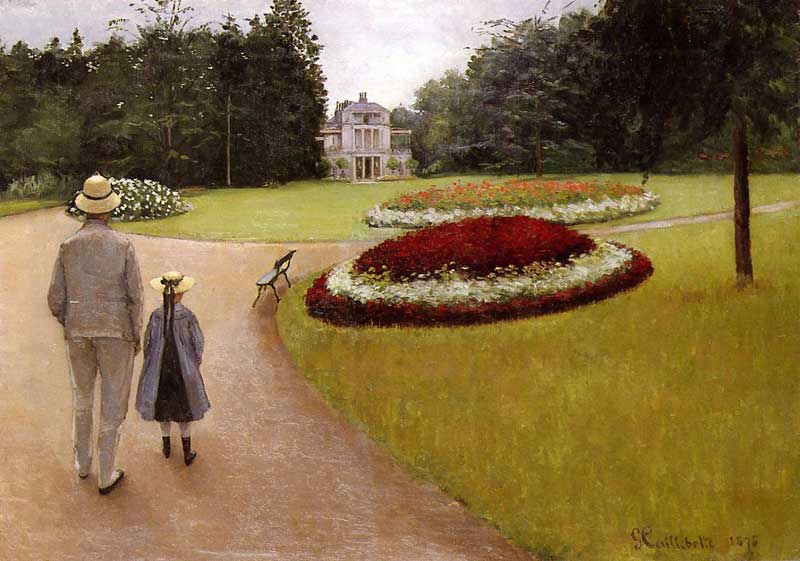
Gustave Caillebotte The Park On the Caillebotte Property at Yerres, 1875 Oil on Canvas

 “Good,” I said. I eyed the changed landscape of the playground that had once been filled with a seesaw, monkey bars and a small jungle gym, but now had only a swing set with four swings. It would do. “I’ll be on the swings.”

“You do that,” he said, and for the next half hour it was just the two of us at the park, doing things we used to do all the time when we were younger. 

Baby Steps

Initially, I sought to spend every other weekday afternoon with my grandfather to make good on a suggestion I’d made the evening my grandmother was hospitalized. I had just had dinner with a friend in town from Switzerland – she was a flight attendant – and, having heard from my mother that she was headed to the hospital, I thought, “Well, I’m heading back from Long Beach, so I’ll stop by grandpa’s house to keep him company.”

My grandfather is a tortured introvert. He can keep to himself forever and he very nearly would if it weren’t for the constant flow of sons and daughters and grandchildren visiting him, even long before grandma fell ill. She was the social one whose voice could always be heard, not necessarily telling stories, but doling out advice on how best to fry a fish, knead the dough for a green onion pancake, pinch the seams of the perfect dumpling – my grandfather would sit in either of two spots: his chair at the table, slightly tilted left so he could watch the tv as well, or a heavy mahogany chair with his back to the sliding glass door that led to the backyard. The latter was his TV chair, though it faced the wall ajacent to the TV rather than the TV itself. Only recently I asked grandpa if his neck had any issues, from spending hours twisted in one direction. He looked at me blankly and shook his head. The neck was fine.

That October evening, my entire family was still ten years younger. I was driving away from a friend I’d made in another country, my head brimming with the plans we made to travel in the near future. She, as a flight attendant, could request destinations a few months in advance and had yet to see Asia, where I planned to be in less than three month’s time. Our lives felt fuller from the conversation alone, conducted over a small cafe table near my grandfather’s house. I had just dropped her off at the hotel when my mother called me.

“It doesn’t look good,” she said, and I shook my head in the dark, silently accusing my mother of jumping as she usually did to the worst conclusions. Grandma being in the hospital was nothing new. She would be out again in a few days’ time.

Still, this time was heavier – not final, just heavier – the result of accumulated fear and anxiety and of course, facts. The fact that grandma had been falling more than usual, had more difficulty breathing than usual. Throughout all this my grandfather sort of faded into the background of our worried brains. He was okay for now, tough as nails, the stoic, the stone. I dialed his number as I drove past the dark freeway on ramp. It was 9PM – on a normal evening grandpa and grandma would be winding down, watching one last Chinese variety show or news broadcast before turning in – but tonight he answered the phone as though he’d been standing by it all evening.

“Hello?”

“Hi Lao Ye,” I said, “It’s Betty.”

“Oh Betty,” he said. It was not unusual for me to detect disappointment in his voice when his wife was at the hospital and someone not at the hospital with her called.

“I’m just passing through,” I said, “Can I stop by?”

“Sure sure.” He hung up in his usual way, before I could say goodbye. It didn’t matter, I would see him soon.

I drove as my grandfather most likely slept that night and the many nights after that: fitfully, building upon the worry my mother had transferred to me over the phone, and wondering how he felt right now. He’d been the one to find her so many times, more than once covered in blood in the middle of the night, her head cracked open, her eyes swollen and cheeks bruised. I thought about the last time I saw grandma without a nasty bruise or scar on her face…I couldn’t remember. As an octogenarian with poor lung function and an inflammatory diet (high in fat, salt and sugar), she healed slowly if at all. She would pass away with the mother of all scabs on her upper lip, but at the moment, the scab was still small.

I parked across the street from the familiar house in which I’d lived until I was six, when we moved to the Park and my parents asked my mother’s parents to move in. My grandpa, a tortured believer in self-reliance who despises handouts to this day refers to the house, at least to me as, “your father’s house.” It is my father’s house, as many things belong to many people, though in name only. I rang the doorbell and almost instantaneously a voice called out, “Ah Jun?”

“Yep, it’s me, Grandpa.”

The garage door rolled up and my grandfather stood in the narrow doorway, one hand on the door frame, the other on the large white garage door control.

“Come in then,” he said.

We sat staring at each other for a while. The TV was off, though it buzzed faintly with cathodes still cooling and as usual there was only the long fluorescent light on over the tiled, built-in dinner table – anywhere else I would describe the light as a harsh, but that particular light over that particular table I have come to associate with my grandparents brightly lit faces, looking at me over the steam of a hundred delicious dishes. But tonight the table was bare except for napkins and reading glasses, and my grandfather’s insulated tea mug. We chatted about what, I forget now, and suddenly, I began to cry.

“What? What?” grandpa asked, looking horrified. Had I stopped by to sob uselessly?

“Grandma,” I choked, then could say nothing more.

He sighed and told me not to cry, “This is just how it is when you get old,” he said, as he’s said a million times before.

I nodded, though inside I disagreed. I did not think that old age had to be this way, filled with falls and hospitalizations and the fear and uncertainty all these things generated. My old age would not – and, looking at my grandfather that evening, I hoped his wouldn’t either.

I stopped crying then, convincing myself that partly, I was just tired from driving and for making those very ambitious plans with my Swiss friend. It was 9:30PM and grandpa did not seem to be tired at all. We began to speak again, though this time about other things, about the past – a favorite subject with old people, no? I started asking questions to pass the time, to get him talking, and that evening, he talked for much longer and with much more energy than I’d ever heard or seen him. We talked about the early days of his marriage, about running away from the communists on foot, with nothing but the clothes on his back, the various friends he’d made and the one or two he miraculously reconnected with decades later in the United States. He told me about the barbarism back then though barbarism is my word. He was thirteen when he witnessed his first decapitation.

“You saw someone murdered?” I said, my eyes wide with horror.

“Not just one!” he said almost indignant, “Dozens! I saw them decapitated right before my eyes.”

He made a motion with his hands, thrusting ten fingers upward, “The blood like this in the air. And the body,” one hand fell limply at the wrist, “just like that.”

“What did you feel? Were you terrified?”

And, so odd to me, he cocked his head to one side and pursed his lips as though he were trying to retrieve the feeling that had accompanied the observation.

“I don’t remember what I felt,” he said, “That’s just how it was in those days. Lives were not of much value.”

By then I had pulled out a small notebook and had filled nearly five pages with spotty notes. I wanted to listen, but knew I would forget – and looking up I saw the clock. My hand was tired from writing, and I still had to drive home. Though grandpa looked as though he could talk forever.

“I have so many stories,” he said, “You don’t even know.”

Vincent Van Gogh Self Portrait with Bandaged Ear 1889

 “I’d like to hear them,” I flipped the pages in my notebook, wondering if this was how biographies are written. “You know, Grandpa, if you don’t mind, I’d like to video tape you next time you tell me stories. I could write them down and share them with the rest of the kids. They’d like that.”

Secretly, I could tell that he too, would like it very much. He was introverted, sure, but at some point (around the decade your mortality rises to look you in the eye) a man wants to share what he knows, wants to be heard. My grandpa was on some strange raconteur’s high that night, and he did not disagree to my idea.

“I have so many stories,” he said again.

I stood up and nodded, “And I’d like to record them.”

We bid each other good night and I wondered if he had gone to bed with his old stories swimming around his head, or if, as I think is the case now, he heard nothing but the overwhelming silence of the empty spot next to him.

———————–

A few weeks later, driving grandpa to the hospital on the same day grandma would later pass away, I asked grandpa if he remembered my suggestion.

“I do,” he said, “but not now. With your grandma in the hospital like this, it is hard for me to say anything. The feeling is not right.”

“Okay,” I said and didn’t bring it up again.

Taking my Grandpa to the Cerritos Library

Grandpa reading.

The Cerritos Library employs a small army of vigilant volunteers who patrols the stacks with straight backs and stern expressions that become sterner if its bearer spies a prohibited Starbucks cup or neon bag of Cheetos. They interrupt the quiet yet unfocused studies of various sleepy, glum-faced students and say, “Sir/Miss, you’re not allowed to have that. Please throw it away outside.” It is no wonder the Library, though having been renovated nearly a decade ago, is still pristine. Continue reading “Taking my Grandpa to the Cerritos Library”

At the Library

I took my grandfather to the library today, hoping that I could use his driver’s license to get myself a card to what is arguably, one of the best public libraries in Southern California. I had gone in there a few times since we’d moved away, but because the city was no longer my city, I did not feel as tied to it as I once had.

As we walked toward the building, he looked up at the English words and said, “What is it called again, this place?”

“Library,” I said, using the English word.

“Ah yes,” he nodded. The letters made sense again, “Library.” 

The children’s section, where I whiled away many evening hours of my childhood, was still on the left near the entrance, where I remembered it, though this time instead of the facade of a castle at the entrance there was giant glass aquarium filled with an impressive coral arrangement and a half dozen bulgy-eyed dory-fish swimming around, lost in thought. I wondered what it was like to be surrounded by all that information and not have any access to it. I paused before the tank, thinking perhaps grandpa would want to stop and look at the aquarium, something my paternal grandfather would certainly have done, but all old people are not created with equal interests.

There was a small exhibit of Chinese paintings, among them a comical scroll of simple swans painted with a single stroke. They seemed like calligraphic cartoons, and I thought too, that grandpa would take interest in this, but he merely glanced at the paintings, acknowledged that they were Chinese art (as though it were expected the library feature Chinese art at the precise moment he decided to return) and walked ahead.

“Go ask them about the card,” he said, nodding towards the circulation desk.

A young Hispanic girl kindly informed me that as the card would be under my grandfather’s name, he would have to be present each time I wanted to check something out, even if it was for him.

And what if I were to get my own, but as a non-resident?

“It’s one hundred dollars a year,” she said.

I looked around at the marbled floor, the high glass ceilings, the art on display in various glass cases and on the walls. I saw a “Periodicals” section that seemed to have every magazine in the world on display, along with row after row of shiny computers all connected to the world wide web where whatever wasn’t on the shelves could be accessed via a single click. A giant Christmas tree stood at the far end of the library, decked out with expensive looking ornaments and surrounded by beautifully wrapped gifts. Opposite the children’s “wing,” was a reading corner, lavishly done up like some English baron’s living room, replete with a working fireplace, comfy arm chairs, and wood paneled walls. The library had real wood shelves, none of the aluminum fixtures used at most public libraries I’d visited, and the bathrooms rivaled those of any five star hotel. And of course there were the books! The Multimedia! There were multiple copies of the latest bestsellers, which at my town’s library were only available for rent, and a wide array of literary paperbacks, all carefully wrapped in sturdy plastic, though almost all of which seemed brand new. The books were barely touched, as most of the kids didn’t really seem to read anymore, but came to the library in droves anyway, to digest comic books and use the computers. In the corners and along the sides there were sturdy study desks with bright lights and electricity sockets – just like the ones found at any fine university library – and almost all were occupied by students from the local high school (right across the street!) and the community college.

Auguste Renoir Woman Reading 1875-1976

I thought self pityingly of my town’s small library, about the size of a three car garage, with its six outdated computers and a paltry magazine selection that was only possible because of generous donors. New releases were rented out for profit to keep the librarians fed, and I had the feeling the library survived off the failing memories of various seniors, whose forgetfulness meant late fees… it was a sad thought, but probably true. If it ever came down to a battle of resources, my town’s library would not even be David’s toe to the Cerritos Public Library’s Goliath. They had a sculpture garden. We had a rolling cart with out of print (not the kind you collect) books for sale. What our local library had were plenty of children’s books and an impressive selection of DVD’s and audiobooks considering the library’s limited sized, but then again most of the patrons – young children and senior citizens – had limited tastes or simply did not get their reading materials from the library anymore. A good library, one a city found worthy of sustaining, was hard to find.

If my grandfather wasn’t there with me, I’d have paid the 100 dollars. 

But he was there in all his frugality and I told him the price.

“That’s steep,” he said.

“But look at this place, Grandpa. You’ll just have to come with me once a week or so.”

He nodded with his faux grim expression, as though I were twisting his arm, but I could tell he didn’t mind.

“I can’t remember the last time I was here,” he said, as the girl started typing in my grandfather’s information.

“Cousin Wendy’s wedding,” I said, “She got married upstairs somewhere, in that nice bright room.”

“Oh that’s right.”

The girl finished typing and told grandpa he’d have to stand up to take an ID photo for the card.

“Wow that is hi-tech,” I said.

She laughed. With the resources at stake, it made sense.

Grandpa stood up and stared at the small camera mounted in the wall next to the circulation desk.

“Step back,” the woman said, and I repeated this to him in Chinese.

He stepped back as directed and gazed into the little lens. Just before she took the photo, he removed the blue baseball cap he was wearing. He smiled, though slightly too late. The photo came out as his photos usually do: him looking mildly stunned, as though processing some revelation. In this case it may have been, “What the hell am I doing at the library at 3 in the afternoon?”

The card came out and the girl smiled as she handed it to grandpa.

“It’s a good photograph,” she said, “Very handsome.”

He smiled and said thank you as he took it. With this wonderful key, we went off to look for books.

Odd Philosophy

A few days before Thanksgiving my mother and I began taking walks together in the morning. At first it was a way for us to start talking again, not that we were angry with each other, but because Grandma’s passing on top of our already disparate schedules had made our once nightly talks impossible. She often came home from class or badminton or dinner with my grandfather with little time left to get her classroom affairs in order never mind an hour to talk with me. There were students to Skype with and new teaching techniques to learn, also via Skype. And of course, there was the obligatory time spent with her husband, who has long groused about (but is still secretly quite proud of) his wife’s teaching career.

My mother is a busy woman, and I like walking. So we walk.

Claude Monet Woman with Parasol, 1875

On our last few walks however, it seems whatever I had wanted to say to my mother and whatever she wanted to impart to me during these rare quiet mother-daughter moments has been said, which means there are longer silences as we meander through our quiet, leafy neighborhood. Having discussed our entire family at length (our favorite subject being her husband, my father) we now gaze admiringly at our neighbor’s well-manicured lawns and window treatments, their Christmas decorations and their choice of flora, of which my mother, with her proud green thumb, is the ultimate critic.

I have always seen my mother as an emotionally intelligent person. She possesses an uncanny ability to place herself in others’ shoes, which makes her a talented imitator and performer. A fortuneteller once told her that she would have made a great actress, the kind the spotlight couldn’t get enough of, but that she was blessed to not have to work so hard. Instead, my mother teaches Chinese to students young and old and she teaches about life to me and whomever else can recognize a good life teacher when they see one.

My mother is wise when it comes to relationships – it takes an emotional quotient near genius to stay married to my father for so long – and possesses an interesting and enviable blend of blithe disregard for what others think. I would not say necessarily, that she is a complex woman, especially not after what I am about to write, but the fact that what follows comes from the woman who has also written the handbook of the heart which I carry to and through all my relationships, makes her a most complex figure.

This morning, after we’d been walking for ten minutes  in complete silence, my mother asked, “Grace (referring to my friend Grace, who currently resides in Miami), did she leave already?”

“Yes,” I said, “She left yesterday.” 

“I have been thinking,” my mother said, nodding to herself “That every day, many people fly here and there. So many flights take off every day.”

I stopped and looked back at her, wondering if she would say anything more, but that was it. She had arrived at a conclusion and she shared it with me.

Whether my mother notices my strange stares is questionable, but she has a habit of walking with her eyes up in the air, a soft, relaxed expression on her face. Perhaps these walks is when she lets her mind, as her feet do, wander.

Much of what she says is a result of mental autopilot – the stuff we are compelled to say when the weather is particularly nice and the road seems more peaceful than usual. She has been saying much of it for years, if not to me, then silently to herself when she used to walk alone:

“The weather is perfect today!” (As ninety-nine percent of the time the weather is, in Southern California).

“We are so lucky to live here. It is just like a big park.” (It is, hence our city’s name).

“Look at those trees just beginning to change. Those colors are gorgeous!” (Despite not liking the fall, my mother has endless compliments for it).

But my mother does not just gush. She is not without her knives – razor sharp (often racist, always obvious) observations and judgements that slash through any canvas.

If a fat person is walking our way: “Oh ho, a fat person.”

If an Asian  person walks our way (and in a slightly subdued voice): “Asian,” then a rapid succession of guesses at what kind of Asian until they walk close enough to clarify: “Oh, so they were Korean/Chinese/Japanese.” 

And a rare but occasional sight, a fat Asian person, “How could an Asian person be so fat?” 

If we walk by a particularly beautiful front yard: “This yard is beautiful.”

If the yard has been neglected: “This yard is hard to look at.”

Her expression will be the same one she dons when I emerge from my room wearing heels that are too high or with my hair down, which she won’t shy away from saying makes me look “wild.” If the owner of said yard were to peer out from their kitchen window at precisely the same moment two Asian women are walking by, they would see the younger woman walking a few steps ahead, bemusedly waiting for her mother to catch up with her, and the older woman standing with arms behind her back, neck slightly outstretched and eyes furrowed, lips pursed into a frown – judging, judging. My mother, should their eyes meet, would smile and nod politely though be thinking, “Fix your yard. It is an embarrassment.”

Then she will continue walking slowly towards me and thank goodness the houses are all set quite a ways back from the road, because my mother does not (or does not care to) know how to whisper. She will administer the clincher: “I’ll bet they are Asian.”

And here I will give her my own disapproving look, but she will smile at me and keep on walking.

Also, this morning, a blonde woman leading a blonde horse and an aged German Shepherd walked our way. The horse’s hooves clopped as my mother began her narrative. This is probably what the Caucasians dislike about us: Asians who speak Asian in front of them, but at a time like this I would prefer the Caucasians not understand my mother.

“A horse,” she said.

“Yep,” I said.

“It’s blonde.”

“Yep.”

“Just like the woman.”

When the woman came closer, we both smiled and said good morning, noticing that the woman was in fact quite pretty, with bright blue eyes and a clear complexion. She wore no makeup and had her hair in a loose ponytail. She carried herself with the easy elegance that comes with having the kind of money that allows you not only to own a horse but also know how to ride it correctly, and despite being in her mid forties (though in truth with Caucasian women it is not uncommon for Asians to over guess their age), kept a trim figure. As soon as she was out of earshot (or at least to our backs), my mother and I turned to each other to voice the obvious things we were both thinking.

“She was really pretty,” I said, “Very elegant.”

“Yes,” my mother agreed.

A few moments later, I had stopped to pick up some pine cones, planning to paint them gold and silver for holiday decorations. My mother, seeing the trouble I was having trying to hold them all, offered to help.

From my bunch of about ten, she took exactly one.

I waited for her to take a few more, but she seemed lost in thought. Processing. 

“If I were white,” she finally said, “I would only marry a white person.” 

Clutching the pine cones to my chest, I was reminded of my grandmother’s stay in the ICU and her reaction to seeing a black nurse and black respiratory therapist working at the same time. She assumed that they, both being African American, must be married. Surely this sort of prejudice wasn’t genetic? Surely my mother had a more… sophisticated reason for saying something like this?

“Why?” I asked, though it may have been more appropriate to say, “What the -” followed by an expletive. I was aware that my fingers were beginning to cramp.

Perhaps my mother was thinking of all the Asians we had walked by in the last few days, probably all on their way back to houses set behind neglected yards. Whatever the thought, she merely responded, almost wistfully, “There are so few white people left.”

I looked at her, the pine cones poking my hands and wrists, and marveled at her strange opinions. In the Park, statistically speaking, we Asians were still very much a minority. But despite her role as an educator, my mother has never been one to cite statistics (and god help you if you choose to believe any statistics she does cite. They all fall, invariably, under one kind: unreliable). Rather, she views the world at a driveway’s length and calls it as she sees it, not necessarily (or ever, really) as it is. Political correctness and tact figure not at all. At first I worried about this. But then I thought about her world, parts of which are also my world: the Chinese school, the large Chinese family, the mostly Chinese badminton club with a handful of white people, and the yearly two or three week long trips to China and Taiwan.

I thought too, of other worlds and of the times my mother visited them – how when going through her photos of her first ten country tour to Europe I had asked where several of the photographs were taken and she answered earnestly, “Oh it’s written on the back.” I flipped each photograph over to find “Europe” written in my mother’s educated hand.

I don’t think it is worth my worry. More often than not, our bubbles protect us by keeping us away from others, and on top of that, my mother has that magical quality where even the most cutting remark can seem painless and in the recipient’s best interest. She is like a surgeon, sometimes. 

And of course, there is her garden, the less tended to aspects of which are behind and to the sides of our house. Though, and I would never tell my mother, our front yard, I think, screams to any passersby who care to note: “Chinese people live here.”   

Alone on Thanksgiving

Unexpectedly, a small army of my mother’s badminton friends banded together to buy several lavish flower arrangements for my grandmother’s memorial service and for my mother. A massive pot of stunning purple and violet orchids were delivered to the chapel and a few days later, a young Hispanic man showed up at our door with two smaller but no less gorgeous arrangements for our home. Together, they cost a pretty penny and my mother was grateful.

“I ought to do something for them,” she said, “They really didn’t need to spend so much money and send so many flowers.”

It was decided that to show our thanks, she would buy them little candies and I would bake cookies to put together in pretty gift bags.

I baked an assortment of holiday spiced cookies: molasses gingerbread, cinnamon oatmeal lacies and pumpkin spiced walnut cookies and give each contributor a dozen or so to share with their family. I kept the oven on for what seemed like two days straight to bake enough for seventeen people, and when everything was packaged and wrapped, my mother was delighted in the overall effect.

So were the friends at the badminton club.

She came home on the evening after all the gifts had been delivered and I asked her how it went.

“Oh they were all so happy,” she said, “especially Ju Pei.”

“Who’s Ju Pei?”

“Don’t you remember the woman with the daughter that doesn’t like her?”

I did. I had very nearly written a novella about her.

“She loved the cookies,” my mother said, then her eyes got wide, “and she ate the whole dozen right in front of me.”

I stared at my mother. My cookies are known to be larger than the average sized cookie – whatever that means – and I always end up making ten or so less than the recipe calls for because of this.

“She ate all twelve in one sitting?”

“In less than thirty minutes,” my mother said.

My mother had presented her the gift bag upon her arrival at the club and Ju Pei was there, forty-five minutes earlier than when her lesson was scheduled to start. She often did that, as she disliked being alone in her house and passed most of the afternoon at the badminton club.

“She was so happy when I handed her the bag, and even happier when she saw the cookies. We started talking and she just reached in, eating one after another. By the time her lesson was starting, the bag was empty.”

“Didn’t she feel sick?”

My mother shook her head, her expression as surprised as mine, “No, not at all. She just kept on saying how delicious they were and how lucky I was to have a nice talented daughter who took the time to bake things for her friends.”

“Wow,” I said, “Well, that’s really nice of her. I guess I can make more for her next time, since she liked them so much.”

“Yes…” my mother said slowly, “Though she plays so much badminton to maintain her sixty pound weight loss…so I’m not sure if you should make her quite so many cookies.”

After her lesson Ju Pei came to chat with my mother again, asking if my mother and her husband were free to have dinner with her on Thanksgiving.

“I was thinking,” Ju Pei began, “I’d like to take you and your husband out to dinner on Thanksgiving. To Capital Seafood in Irvine. We’ll have lobster and crab! You can bring your daughter too.”

“That’s very nice,” my mother said, and trying to phrase the obvious as gingerly as possible, “but we spend Thanksgiving with our family.”

Ju Pei’s expression, my mother said, could not be described as crestfallen, but discouraged was certainly apt.

“Who the hell invites someone to dinner on Thanksgiving?” I asked, incredulous.

“Well she didn’t know that we made a big to-do about it, because she never celebrates with her daughter.” 

“Why not?”

“She says her daughter never asks her to dinner at her house, never mind Thanksgiving.”

“That’s really a pity,” I said, feeling terrible for the woman. I thought ahead to all the faces I looked forward to seeing on Thanksgiving and how warm my aunt’s house felt, no matter how cold it was outside, no matter that we had just lost our grandmother. I imagined the woman eating alone at the Seafood Restaurant, a glistening, sautéed lobster on the table before her.

“I don’t know what you do as a mother, as a woman to end up like that,” my mother shook her head, “but I sure hope I’m not doing it now.”

I kissed my mother on the cheek, knowing that it wasn’t a so much a difference in action as it was in souls. The woman wasn’t a bad person – she had just been ill-advised and then, it seems, too narrow-minded and nearsighted. Impulsive too, perhaps. But from what my mother told me the woman was beginning to change.  She was definitely someone worth studying, but perhaps not right now. My mother and I had Thanksgiving with our family to think about.

Mahjong

The Art of Playing Mahjong

A few years ago I visited my grandparents at the same time an old friend of theirs, Grandma Dai, was visiting. She and her husband, a short man with spectacles and a shiny head shaped like a cod liver oil pill, were my grandparents’ longtime mahjong buddies. When they were all in relatively good health, Grandpa Dai would drive to grandma’s house, where an aluminum card table and four folding chairs would already be set up in the garage, along with a small TV dinner table where they would put nuts, an ashtray, and thermoses of tea. They would crack the garage door just enough so that the fumes from their many cigarettes would have somewhere to go, and the game would commence, stretching from the late morning until late evening.

It was an unspoken agreement my grandparents had with their children: either call before you visit, or simply drive on by when you noticed an unfamiliar car parked before a partially open garage door. My grandparents lived in a curious sort of denial: they didn’t smoke if we didn’t see it. They didn’t play mahjong for hours and hours if we didn’t see it. On occasion however, if my brother and I or any of my cousins happened to be in the vicinity, we would drop by anyway and what could my grandpa do but open the garage door fully to let us in? (For some reason, most of my family prefers to use the garage door as their home’s main entrance, leaving the front door for “company” and trick-o’-treaters.) The garage door would raise slowly, creakily, and an impressive amount of acrid second hand smoke would waft out. Even by the time the door was fully raised, much of it still lingered, casting a carcinogenic haze around the mahjong table and its players. A single 60 watt bulb lit the garage, hanging bleakly over the shiny white tiles. It was a depressing sight, and looking back, I wonder why they didn’t just play in the backyard where the sun was shining, the air was fresh, and they would be surrounded by my grandmother’s fragrant fruit trees.

On one such impromptu visit, I recall seeing my grandfather standing imposingly at the front of the garage door, several feet away from the recently vacated mahjong table, his hands behind his back, an impatient expression on his face. I had never played mahjong at the time, but I remember how the table looked: the long flat clear green plastic bars standing against a stout army of green-backed white tiles still unplayed. A small pile of used tiles sat in the middle: there was no mistake that we had interrupted them in the middle of an epic game. He bid us hello, and through the haze we saw Grandpa and Grandma Dai sitting at the table but in process of pushing themselves away. Grandma and Grandma Dai’s hair seemed to blend in with the smoke. Each had a small pile of pennies in front of them, small stakes for a game whose tiles are based on ancient Chinese currency, and on the tv tray next to them I spied the small lacquered guitar-shaped ashtray, a kitschy relic from God knows where, filled with smoking butts, some of which still burned like incense.

“Hello, children,” Grandma Dai would say, and we would say hello and nod politely, stiffly, for we knew that smoking was wrong and caused diseases and we could sense my grandparents’ discomfort that we had seen this relatively reckless side of them.

Sometime before I went to college or perhaps when I was in college Grandpa and Grandma Dai stopped coming around, and my grandparents gave up smoking. We no longer saw Grandpa Dai’s car in the driveway and the garage door was either completely open or completely closed. The Mahjong table stood folded next to the refrigerator in the garage, alongside the plastic drawers where my grandma stored her “special” shoes for going out. Over the years the smell of smoke, which had permeated the wooden walls of the garage, dissipated and was replaced by the smell of laundry, footsteps, and dust.

My grandparents still played the occasional game of mahjong, with whom I know not, but as the years stretched on, occasional petered out to never. I suppose hours and hours of the same game can get exhausting, but on some level mahjong, along with smoking and whatever other things they enjoyed in their younger years, seemed to them a thing of the past, intrinsically tied to their younger years (“younger” is also relative. I am talking about their seventies). When I visited and happened to see the mahjong table, I would ask about Grandpa and Grandma Dai, and my grandparents would say, “They are doing well, I think.” Then a few years back, before I saw Grandma Dai again, the story changed to “Not too well, Grandma Dai is sick.”

She had some sort of intestinal thing, my grandparents couldn’t say exactly, but each time I mentioned her grandma would shake her head and say, “She hasn’t got long.”

Then that day a few years ago, I was at grandma’s house when Grandma and Grandpa Dai suddenly dropped by for a visit. She came walking in through the garage door and I was surprised to observe that she was much thinner than when I’d last seen her. All the silver that had been in her short, curly hair back in their mahjong days had disappeared. Her entire mane had become a pure, clean white, as though her sickness and its subsequent “cure” had shocked her. Her complexion was clear, free from sunspots and though at that moment her body radiated fatigue and frailness, her eyes seemed bright. Whatever disease she had, she had fought it and now had energy to stay and chat a while to chat with grandma, whose health at the time was still quite robust.

When the Dai’s left, I turned to grandma and said, “She looks quite good, and she’s lost some weight.” Grandma huffed and shook her head in the way she does when it’s clear there are too many things I don’t understand, “She’s too thin, and she is weak. She hasn’t got long.”

That was many years ago.

Last Sunday November 11 at my grandmother’s funeral, I spotted Grandma Dai’s white mane from a mile away. She walked slowly on her granddaughter’s arm towards the chapel where two long lines of grandchildren stood all in black to welcome attendees. As her figure grew closer I saw that she wore a single black glove on her right hand and oval spectacles fitted with transition lenses. Aside from the mournful expression on her face, she appeared to be in good health. She had maintained her slender frame despite having shrunk a few inches since we last met and walked more steadily than my grandmother could in the last two years. Grandpa Dai was just a few steps behind, also in good health. They both moved, at least it seemed to me, without pain or shortness of breath, without walkers or canes, apparatuses that had become necessary in my grandmother’s last year. When they saw my grandfather, now an old widower, grandma Dai broke out into silent, heaving sobs. He patted her on the back and told her to buck up.

“My old half is in a better place,” he said.

After the service my family stood in a line, facing those who had attended and thanked each guest. They made a long line that wrapped around the chapel to view the body for a final time and when it was Grandma Dai’s turn, she crumpled again, grasping each of her departed friend’s children and burying her face into lapels and black cardigans. From where I stood near the end of the line, I could see her white hair disappearing into the arms of first my uncle, then my aunt, then my other uncle and my mother. She made her way slowly down the line until the casket was in view again just beyond her small figure.

Soon she was standing before me, the frail woman my grandmother had so many years ago, said with utmost certainty would not make it. She cried with hearty gasps of air into clear, healthy lungs. I thanked her for coming and she grasped my hands, putting the gloved hand on top of mine, an odd combination of paper and cloth. Grandpa Dai nodded with a sad smile. She let go of my hand and I watched them go, certain that they had more than a few years ahead of them. I looked back at the casket, my grandma’s own salt and pepper hair just visible atop the cherry wood edge. I wished her spirit patience. She would have her old mahjong gang back to play at a celestial table with heavenly cigarettes whose fumes would form clouds – that was certain as Mahjong’s prevailing East wind – but she would have to wait.

How to Pass Time in the Hospital

For most of the time now, grandmother sleeps, in a body that she hardly seems to recognize. Her mouth is filled with canker sores. The scab on her upper lip, a result of her fall nearly three weeks ago, still has not healed – a paradoxical side effect of the oxygen mask she needs to keep her alive. She has lost weight and I was startled last night to feel how thin her calves had become, how loose the skin. But still, I repeated loudly what the nurses had said to me two weeks ago, “Grandma, all the nurses say you have excellent firm skin for someone your age.” We think she is sleeping, but we know too, that when you sleep all day, it is always a half sleep, never deep.

Before, when she still had energy to speak she lifted the oxygen mask just long enough to look at my mother and say, “How did it come to this?” 

It seems like half a year ago that the doctor deemed her well enough to commence physical therapy, but in truth it was just last week, when she showed signs of improvement and when her body was still hers. When we visited that week, we found two towels stuffed into the sides of her bed. We pondered these towels until evening after dinner she grabbed one between both hands, held it shoulder width apart, and began to twist and twirl them through the air in a choppy figure eight. It was an oddly elegant motion, and my grandmother performed it with a similar albeit shaky elegance, eyes closed and lips pursed. At times it appeared as though she were chanting. Even this tiny movement caused her to wheeze and I wondered about its effectiveness. My grandmother’s arms are strong, much more so than her legs which have undoubtedly been weakened further after two weeks of bed rest, but I suppose at this point you strengthen what you have and pray the rest will follow.

At the very least, the exercise helped pass the time. If you are a bed-ridden patient in the hospital, there is plenty of time. Twenty-four hours a day for fifteen days and counting, every hour blends seamlessly with the rest because in the hospital room with its darkened windows, one really cannot rely on the sun. My aunt, uncles and mother, my grandmother’s four children, take turns spending the night with her, given a break only occasionally by me, the unemployed grandchild with nothing but time and a stack of unread magazines. When the lights go out and my grandmother tries to sleep (though it is rare that she sleeps for an hour straight), I take out my CD player (a relic, nowadays) and listen to an audiobook. My aunt often asks me not to go – I am too young, I need my rest, etc. etc. but I stare at her sixty-year old face and say, “Yi-Mah, I’m twenty-six, it’s nothing to me.” And of course a few all nighters here and there are nothing, but she and I both know that if my grandma’s status were to suddenly take a turn for the worst, it had better be one of her own children than me, a grandchild with hardly any history. In the grand scheme of things, my life is but a tender, green branch, near the top of a towering oak tree.

Morning arrives and my grandmother stirs in her monstrous mechanical bed, not because she is well rested but because she is exhausted and tossing and turning is the only thing she can do to pass the night. I look at the clock; it is 6AM and neither of us has had any sleep. Between the beeping of her oxygen monitor and other patients’ IV drips and nurses who, so accustomed to their nocturnal lifestyles, forget to lower their voices in the hallway and the hourly visits of the Respiratory Therapist and the Nurse’s Assistant and the Nurse to administer one or two of my grandmother’s dozen steroid-based medications via the painful IV in the thin skin of her hand (re-positioned every two days to prevent infection) or the respirator or through the mouth, rest is clearly the only thing not administered to a patient in a hospital bed.

But still, the sun is just beginning to show itself and despite my brain crying for sleep and the danger of driving home in this exhausted state, I find myself striding out of the hospital’s sliding glass doors, slamming my car door and weaving in and out of traffic, racing home to my own bedroom which is free of other patients, free of fluorescent lights and free of commodes and bedpans and IVs. Anything but the confines of that small, dim space, to which my grandma is chained both by the oxygen tube that keeps her alive and by the weakness of her legs. Anything but that dim space in which she will remain until God or Zithromax and her seemingly impotent cocktail of corticosteroids are finally able to oust the stubborn phlegm in her lungs, though today it is clear that God is waiting because the drugs have failed.

To call myself a prisoner when I am free to leave at any time is to rub my grandmother’s present eternity in her face. But in truth I am trying to contrast a portrait of youth, myself, who knows nothing of patience and the most patient of patients, the etymology of which I am only beginning to grasp.