Immunity

The plan was to fly from Seoul to Shanghai, spend a few quiet days with my brother and his wife before my cousin Karen came into town, at which point we would change out of tennis shoes and into heels and go out into the booming, boozing haze of Shanghai’s nightlife. Then, on Sunday morning we’d beat ourselves awake at 6AM, eyes painfully sensitive to air and light, hair still smelling like last night’s smoke and board a six-hour bus ride southwest to the Yellow Mountains in Anhui Province. We joked about the photos we’d take: done up, mascara’d young women in nightclubs and lounges, tired hags in the clouds high atop the Yellow Mountains.

“You guys have very diverse interests,” my sister in law mused.

That was the plan. What happened instead was I arrived in Shanghai from Seoul at 2:30PM, was greeted with icy cold rain, a half-hour wait for a taxi cab and then an hour long ride from the airport (the closer one, no less) to my brother’s place. I was underdressed and a bit tired from all the waiting, but still, I was in Shanghai and even though my body said, “Heeey, maybe you outta take a nap,” I shrugged off the fatigue, threw on an extra sweater and took a long walk with my sister-in-law before heading to dinner with my brother and his coworker in what seemed like the outskirts of town.

The coworker, a Korean named Daniel, had asked my brother a few months earlier if it would be alright to send some vitamins via his sister. They were much cheaper in the States where their safety and purity was assured. My brother said sure why not and a few weeks later a shoebox-sized packaged arrived from GNC at our house in Orange County, filled with fish oil and men’s daily vitamins, the latter of which made my mother wonder what the hell I was doing to my body. I explained that they were not for me and packed them into a largish suitcase with my scarves and shoes and brought them back to Taipei. My brother then came to Taipei from Shanghai for Chinese New Year and I handed him with the vitamins for his Korean coworker. Upon receiving the vitamins the Korean was pleased.

“When your sister visits Shanghai, I will treat her to dinner for her troubles.”

It really was no trouble (I marveled at the Korean man’s patience, waiting nearly three months for vitamins!) but this is why, after leaving Seoul, my first meal in Shanghai was a Korean feast in Shanghai’s Korea Town, adjacent to a Korean shopping center called Seoul Plaza.

My medical expertise tells me it was the sudden change in weather and not the food that made me sick. The dinner was delicious – a spicy mix of seafood and vegetables paired with endless Korean pickled side dishes and the most excellent bowl of white rice I’ve ever had the pleasure of chewing through – though I still get a bit nauseous thinking about that night’s dinner. I ate more than I normally would have, an unfortunate side effect of fatigue, but was otherwise in good spirits and looking forward to the night’s slumber. Walking out of restaurant into the freezing Shanghai air, I imagined that the Korean food had warmed me. Back at the apartment I changed into pajamas and clearly remember thinking as my head hit the pillow, “I will sleep very well tonight.”

And I did, until 6AM when I woke feeling ill in a vague, indescribable way. It was as though an insidious night terror had crawled down my mouth in the middle of the night and lodged itself in the core of my body, a limbo neither esophageal nor gastric. There was the faintest nausea with an indeterminate discomfort in my belly and a feeling of occupancy at the base of my throat – symptoms which on their own would cause me no worry but experienced altogether made me feel unsure about my existence. What was it? Like a word on the tip of one’s tongue, I could only say over and over again, when my brother woke and asked what was the matter with me, that I “did not feel well.” It was the understatement of the year. I was no stranger to stomach flu or cold and fever, but now the symptoms came from all directions and muddled my mind. Later my aunt would guess that I’d become victim to Taiwan’s latest flu virus, something that sounded like Nola, but without going to the doctor, we couldn’t be sure. I lay in bed ailing, the more coherent parts of my brain deciding whether to stay in Shanghai and calculating what the loss would be if I went home early: 500 RMB fine for canceling the Yellow Mountain tour package and a 700RMB fine for changing the flight and most painful of all, my cousin’s utter disappointment.

Going to the mountains was her idea and I was surprised that she had suggested it. I don’t know anyone else in my generation who would say, “Yes, let’s go clubbing in Shanghai and have a fancy dinner and all that, but please, let’s also see the Yellow Mountains.” That’s my cousin Karen for you. But I suppose when one is an overused and under-appreciated cog in a giant accounting machine, anywhere outside the office building would seem a respite. It makes sense then that the Yellow Mountains in Anhui, the backdrop to such films as Ang Lee’s “Crouching Tiger, Hidden Dragon,” and inspiration for James Cameron’s Pandora in “Avatar” were, at least two weeks ago, Karen’s much anticipated escape.

It would be better to see the mountains with her than not at all and she gamely researched and booked the trip, finding two of the mountain’s best-rated “resorts” (dismal two star motels at best, by most traveller’s standards) and looking up the area’s most popular trails for us to traverse. She had, a few days before her departure to Shanghai, assembled a respectable collection of borrowed hiking gear: a friend lent her his backpack and a coworker a pair of walking sticks, the kind that folded up into a tiny cane when not in use.  To everyone she talked excitedly about our plans. Some of her coworkers looked on enviously before turning back to their computer screens.

My aunt, not wanting her daughter to freeze to death in one of the world’s most famous mountain ranges, took Karen to the department store to buy a full set of Gore-tex outerwear to guard against the chilly mountain air. Karen had perused various online travelogues that advised travelers to prepare sustenance as food up in the mountains was expensive, so she’d gone to 7-11, stocked up on instant noodles and stolen a few packets of instant oatmeal from her office, where on Thursday evening she was only half-heartedly discussing convertible bonds with her manager. Her heart was already climbing the vertical steps leading up the Yellow Mountains and she could very nearly smell the crisp mountain air when she received the string of woeful text messages I sent her from the chilly guest room of our Shanghai condo.

“Hey Karen, I’m really sorry, but I got really sick all of a sudden. I don’t think I can go out never mind go to the Yellow Mountains. I think you should cancel your flight….”

She didn’t respond until a few hours later, but what happened, I learned after returning to Taipei, was that at 5PM on Thursday evening, she’d gleefully told her director that the convertible bonds would have to wait until after her trip to Shanghai. With a skip in her step, she went to check her phone to see if my aunt had called about her coming home for dinner, and instead saw the texts. She read them with the cliched sinking feeling all humans experience at one point or other and with her heart no longer light and her feet suddenly slow and lethargic, heavy, went back to her manager. She asked him to continue about convertible bonds with a muted expression.

“It can wait,” the manager said, waving her away. He knew when the underlings were checked out.

“I’m not going to Shanghai anymore,” she said and glumly explained what had happened.

Her manager laughed, not meanly, but patted her arm and said, “Well, since you’re not going anywhere, we’re not exactly pressed for time. Go tie up your loose ends and we’ll talk about it tomorrow. “

She cancelled her flight, the tour package, and on Friday, arranged to return all the things she’d borrowed. She’d unfortunately cut the tags off the Gore-tex stuff which made it hers forever, and the noodles, well, the noodles would stay uneaten in the kitchen cupboard.

The next morning, her friends and coworkers either jeered or looked at her strangely, “Aren’t you supposed to be partying in Shanghai?” they asked.

She hunched her shoulders and muttered something about her cousin’s weak constitution. The computer screen blinked with the likeness of convertible bonds, whatever the hell they look like. Karen blinked too. She shook her head. Expectations, she decided, were a dangerous thing. About 700 kilometers away in a much bigger and colder city, her cousin dragged herself out of bed, rushed to the toilet and threw up the remnants of a Korean feast.

Please Define: Non-Fiction

My father doesn’t understand non-fiction.

“What does it mean, exactly,” he asks, “This ‘non-fiction.'”

“I write stories that are true.”

“About what?”

“You, me, our family. People I meet. Things I see and think about.”

He looks at me, confused. Something is terribly wrong. “Why,” he says, “Why would anyone want to read about that? Who cares about you or me or our family?”

My father is not being rude, at least I don’t see it this way – he is genuinely curious as to what in the world makes me think this is a good career option.

“I don’t know dad,” I shrug, because I honestly do not, “This is a risk you take when you write. You write what you know and hopefully people want to read it.”

“And if they don’t?”

“Then…I get a day job and do something else in addition to write.”

My father is not satisfied. He’s about to pay a lot of tuition money. He’s a businessman, born to a woman who counted every penny and invested heavily in two things: land and her three sons’ educations. The former so that her sons could pursue careers in real estate development and the latter just in case they bungled it all away.

“Money must be spent on the knife’s sharpest edge,” she liked to say, and even though she passed away long before I was born, her words are from time to time echoed to my cousins and I via our fathers. The sharpest edge would be studying something like Electrical Engineering or becoming a doctor or, as my father had hoped for me early on, plunging into the world of accounting and economics (his eyes were always pretty open to my other faults, but for some reason my ineptitude at math eluded his gaze). Most of my cousins have landed right on the blade. I seem to hover somewhere near the hilt.

“I don’t understand why you won’t write fiction,” my father continues, “What about something like Harry Potter? That woman made a lot of money.”

Ah. The old Harry Potter comparison. As if I could ever in a million years do what Rowling did.

“Dad,” I say, irritation seeping into my voice, “I can’t just sit down and write some seven volume fantasy series. That takes…”

“What does it take? You know I saw a TV special about her – she was homeless! She didn’t even have pens and papers! You have everything! You don’t even have to work and you can’t do what she did?”

I look at him, eyebrows raised and mouth slightly open to say something that would emphasize my exasperation, but nothing comes out. I close my mouth, lower my eyebrows. Dim my eyes.

“Dad, I don’t want to write about things I don’t know or don’t have interest in.”

“Didn’t you like Harry Potter? You have all her books.”

“Yes! But reading something you like is totally different from wanting to write. I like reading about a lot of things, but I don’t necessarily want to write about those same things.”

“Why not?”

“Because it wouldn’t be the same or as good as the other people who write it. Everyone writes what they know, and if they don’t know, they do a lot of research, but normally when they are willing to do the research they’re interested in the subject. I like writing about our family and whatever else I’m interested in.”

My father leans back, “I don’t understand,” then looking up, he sees the look on my face. Not a sad look, just tired. The one I get right before I tell him that it’s better that we live far away from each other so I don’t murder him in his sleep. Time to change the approach.

“Okay,” he says, “just explain to me what non-fiction is. You say you write about family but I don’t understand why people would want to read about that. Show me some examples of people who write the kind of non-fiction you want to write and maybe I can understand.”

I think about David Sedaris, Adam Gopnik, and Anthony Bourdain, and how my father would not understand their appeal, even though all their books are bestsellers. Better to use a Chinese example, but I can’t think of any.

“Gun Germs and Steel!” my father says before I come up with anything, “That’s non-fiction, right? That’s a very good book.”

“Yes, it was,” I say, “I liked it too -“

“You could write something like that!”

“I could, but again, not my thing. That’s like history and social science…not really creative non-fiction.”

“Ohhh,” my father leans back, nods slowly. Is he starting to get it? “So you write more creatively.”

I nod, “I tell true stories from my perspective,” I pause. That sounds like a euphemism for lying, but then again, that’s a whole other bag of worms I don’t want to open. “It’s not research,” I say, “Well, there could be research involved, but that’s to add to the story rather than the story itself.”

My father is silent for a while. I’m not sure what he is thinking, just as he is not sure what I am thinking.    I’m thinking that I need to find a better way to explain this to my father, whose friends nod fervently when he tells them, when they ask, “How are your kids doing?”

But he knows that look. “Your daughter wants to be a writer! That’s fantastic!” they say, clapping him on the back, but inwardly they breath a sigh of relief, “Better your daughter than mine.”

“True stories,” he says, leaning forward now.

“Yes. True stories.”

“But what’s so creative about telling the truth?”

He has me there. I’m not sure, actually, and I tell him so. I don’t make things up – at least not now. I tell it like it is, but hopefully there’s something beyond that. Maybe in the future, I may have to start making things up, to protect people I love or fill in the blanks or satisfy some deep-rooted craving for fantasy or whatever other reasons some writers become novelists and others essayists or biographers.

I turn to go and my father doesn’t ask me any more questions.

“Hm,” he says simply.

It bothers me that I can’t explain it better. But then again, that’s not the kind of writing I do.

——– 

“Good writers define reality; bad ones merely restate it. A good writer turns fact into truth; a bad writer will, more often than not, accomplish the opposite.”  – Edward Albee

“Exploit the things you’re good at.”  – Jason Lee

Practical Advice: Father Knows Best

Two years ago around this same time, I found myself back in California looking for a job. I had just returned from a long weekend trip in Carmel, celebrating my Uncle Louis’s second, for-real retirement (at the eyebrow-raising age of 70) from an aerospace company. Before Carmel I’d been in Asia for a two month-long “waiting” period in much the same vein as I now await graduate school admissions decisions (more on that later) though back then it was for a Fulbright. The Fulbright didn’t come through and I went home to celebrate my uncle’s retirement and mourn my own entry into corporate America, hoping companies wouldn’t ask what I did immediately out of college.


“Well, I was banking on getting this scholarship thingy that would allow me to continue dicking around Asia.” 

“Please leave.” 
I clawed at my face, “What does this mean?” I asked my friends, most of whom were well into graduate studies or about to be or had been working full time for a while. 
“Get a job,” my friends said, “Get real.” 
I didn’t panic, but rather listlessly sent my resume out to random, underpaid Craigslist listings with job titles all containing the word and or variations of ‘assistant’ which I have now come to recognize as a synonym for ‘underpaid, sometimes severely.’ For a few weeks, nobody called. My parents knew the hunt was hard – it was hard for their friends’ children, most of whom were more accomplished and goal-oriented than their daughter – so it was perhaps wisest to inquire politely from time to time and give me no further pressure unless I started looking at plane tickets again. 
One evening, having sent out two dozen or so resumes and cover letters (do people even read those things) to companies that I knew vaguely about, I shut my computer down and went to the living room where my father sat with his feet up on the round glass coffee table, watching the Taiwanese news. He did this every night and mostly did not like it when I tried to speak to him over the pretty news anchor with the light but forceful, staccato voice. I needed an ego boost, something my father, he of the “you could stand to lose about ten pounds,” or “don’t stand like such a man,” or “girls who roll their eyes at their fathers usually stay single forever,” was unlikely to provide, but he was a working man and more importantly he supported me with his work. As of late, having sent more than a hundred resumes out into cold black cyberspace and hearing only radio silence, I realized the possibility that he’d need to do so for a few years more. I needed to know that my father would be okay if I were to be unemployed forever. 
“What,” he said, not bothering to look up from the TV screen.
“The job hunt.” 
He looked up, and kudos to him, read my face, “Not going well?”
“Not at all.” 
He sighed, “I’ve been telling you and telling you. Nothing in this world is easy. You’re the only idiot your age who didn’t rush into the job hunt out of college. You should have started looking in school.” 
“I was applying for a Fulbright!” I sputtered, incredulous though not deservedly so, (applying for a Fulbright is quite different from completing a Fulbright or discovering a cure for Lupus), “I didn’t want to get the job and then get the Fulbright and have to be like, ‘Oh sorry, psych! I have to go and be a Fulbright Scholar now, ha ha.'” 
My father shook his head, “Who cares? It’s always easier to say ‘no’ to a job offer than say ‘yes’ to nothing. You should have started looking a long time ago.” 
This was not the ego boost I was looking for. I did not want the conversation to continue down this particular path, nor did I want to go back to my room to continue the job hunt, but to do anything else would have seemed frivolous. Apparently I should have been making up for lost time and been trolling job postings 24/7, but at that moment, I wanted my dad to make me feel better. Mostly because my mother wasn’t home. She was playing badminton. If anything, I could have used a pep talk and decided to prompt one. 
“Sometimes,” I said grandly and with as serious a look as I could muster – so serious that it was borderline comical, “Sometimes I just want to marry a rich man.” 
My father looked up at me with a sudden, grave interest. He leaned forward and turned off the TV, something he almost never did unless we were arguing and I yelled at him to turn it off. I was mildly surprised and I thought, “Here we go, here’s where Dad goes, ‘Hell no my daughter won’t think like that. I raised her to be a smart, independent woman who will work hard and not have to rely on anyone else to take care of her.” I braced myself, it was a fatherly monologue I needed to hear. 
Instead, over the barely audible buzz of the darkened TV cathodes, my father nodded and say, “That’s okay too.” 
Excuse me. 
My father nodded at me, “I said, that’s okay too.” 
“Dad!” I looked at him with a confused grimace and he at me with eyebrows raised and eyes wide, a strange, hopeful smile on his face as though I had just presented him the solution to the world’s oldest riddle. 
“No, I’m not joking,” he said, “some girls don’t aspire to much, at least career wise.”
“I have aspirations!” I said. 
“You say you want to write! You’ve said that forever! But I don’t see you writing!” 
“I do!” though in fact at that point, I hadn’t, not very much, and not very seriously. I was saving my creative juices for the Fulbright, though in fact I just needed an excuse to not do anything at all for a while. 
My father shook his head, “Look, that’s beside the point. I know you don’t have huge career aspirations. But Jesus, look at you, you don’t even have huge feminine aspirations! You want to marry a rich man but where are you going to find him? And how are you going to find him looking like that?”
He waved at my person, tsk-tsking at my limp hair and pajamas (uniform of the unemployed), sallow, uncared for skin, and just general lack of feminine mystique. I didn’t know whether to laugh or cry, but then again, I am my father’s daughter and it seemed more appropriate to laugh.
“What are you talking about?” I said. 
“Invest in yourself if you don’t see yourself investing too much in a career,” my father said, “Go buy some makeup! Lose some weight and get some new clothes!”
“Dad,” I said, “You’d have to pay for the makeup and clothes.” 
“Okay!” he said, getting more worked up as he spoke, “It’ll be an investment! Make yourself pretty and for God’s sake go out more with your friends to where young people go. All you do is sit around at home and eat and tell me not to eat. You think you’ll meet a rich man loafing at home all day in your pajamas nagging your dad?”
I did not, but I was also still stunned by the conversation in general. What had happened to all that talk before about hard work and self-reliance? Did something change in me or in him? Did my father see (or not see, perhaps) something in me that made him think “investing” in my physical appearance would somehow lead to a more secure future? 
“Do you think I’m incapable of supporting myself?” I wasn’t angry, just curious to know. If my father was anything he was honest. 
He leaned back into the couch and turned the TV on, though kept the volume low. 
“I don’t think you’re incapable,” he said, already beginning to tune out, “My daughter was born capable. But I’m saying you need to set some goals and work towards them. Don’t waffle. Don’t wait. Act. Act now, act fast. You want a job, you prepare for it, right? You want a rich husband? Well, there are preparations for that too.” 
I lay on the couch and watched the news but didn’t listen or register any of it. I was thinking. Slowly, the volume crept back up and five minutes later looked at my father’s face; his eyes were back at their usual after-dinner diameter. 
I pushed myself up, and looked back down at my father and smiled. He smiled back. 
“Thanks Dad,” I said, “I’ll go invest in myself now.” 
“Good. You made a decision.” 
I did, but not fully the one that was implied. As my father began to nod off, I walked away smiling to myself with the memory of the time in the sixth grade, when all the cool girls were wearing Lucky Brand jeans that cost $60, an obscene amount of money to spend on jeans, especially when most of my clothes were hand-me-downs. 
“I’d really really really like a pair of these jeans that everyone at school has,” I had said to my dad, whose clothes are almost exclusively from Costco (polo shirts) or JC Penney (trousers and Hush Puppies), “But they’re kind of expensive.” 
“That’s okay,” my father said, taking out his wallet, “Go buy yourself a pair. How expensive can they be?”
Before I could respond, he took out a twenty dollar bill and pushed it into my hand with the self-satisfaction won from being a father who knows he can always provide for his daughter, “That should do it, no?” 
Back in my room the computer stayed off. The job hunt would continue, that was for sure – better to invest with my own funds than shock my father with the brutal truth of what beauty and its upkeep cost – but for now, I needed my beauty rest. That was free. 

The Eyes Have It

When my grandfather was eighty-six, the spots in his left eye began to impede his vision.

Cataracts, the doctor said, treatable with surgery.

“I’d like to have the surgery,” my grandfather said.

The doctor appraised the octogenarian who appeared much younger than his age. He had bright shining skin, a full head of hair and had walked into the exam room with a sureness of foot that he, the doctor, himself a relatively young fifty-five, rarely saw in men this age. Still, the doctor had over the years seen countless seemingly healthy geriatric patients who were suddenly diagnosed with this or that or who, though healthy this year, experienced a rapid decline into senile decrepitness the next.

Age was a volatile thing. He was also a reasonable doctor, not in it for the money. He operated only when he deemed necessary and in my grandfather’s case, the doctor felt it was not. The patient said that he could see and read through the dingy yellow tint of the cataracts, but that sometimes the left eye was a bit cloudy. This was bothersome.

“Your eyes will serve you well for another ten years,” the doctor said assuringly, though to himself he said, “Though you will likely only need them another five at most.” “If the cataracts are worse by then,” he said to my grandfather, “come back and see me. Then we will remove them.”

My grandfather, not one to take a doctor’s words lightly, nodded and went on his way.

Ten years flew by during which my grandfather read the newspaper each day with yellow tinted eyeballs. The eye doctor continued his practice, advising elderly patients to forgo cataract surgery. He turned sixty-five and some nights, when he was particularly exhausted or not feeling well, he wondered how much longer he had. Twenty years, he hoped, twenty years at least.

The doctor forgot about the eighty-six year old man he saw ten years ago until one day, the man, now ninety-six appeared in his exam room.

“It’s been ten years,” the elderly gentleman said.

The doctor blinked. The man seemed to have aged little. His back was slightly more curved, his skin a few degrees more papery and his eyelids a smidge droopier, but the skin still shone and the walk, though slower, was still steady.

“It has been ten years,” the doctor said, “And the cataracts…”

“I want them out,” said the patient.

The doctor felt a sudden roil of regret in his gut – he had denied this man ten years of better vision. But surely now the gentleman did not have much longer. However, it would be rude too, to say, “Wait ten years more.”

The doctor nodded and, because he was a man of his word said, “We will remove them.” He excused himself to arrange his calendar with the nurse and thought, as he closed the door, you just never know.

A few days later my grandfather opened his eyes.

Grandpa at ninety-nine, three years after his cataract surgery. Wearing a tie that is too long.

His wife and sons and their wives crowded around him.

“How do you feel? What do you see?”

My grandfather blinked and smiled a newborn’s smile, gazing beyond their concerned faces.

“The walls,” he said, pointing at the walls that had always been there, a small, wondering smile on his lips, “The walls are white.”

Monday Night Blather: Large Chinese Family Edition

Lately, I don’t feel like writing much. I also don’t feel like reading much, and this may or may not have something to do with the fact that this trip to Taipei, I’m living on the 7th floor instead of the 6th, where my aunt, uncle, and cousins live. My aunt has a key so she comes in whenever, often when I’m in the middle of doing yoga (in the morning) or on the computer (in the evening), and I go down to the 6th floor for my meals when I don’t eat out.

Anyway. I was afraid of this (but I doubt it can be remedied now), the brain drain I lamented in the States shortly before coming here. Two years ago I stayed in Taipei and stood at some sort of existential crossroads. I was waiting for a Fulbright and rationalized that I could dick around for a while before the die was cast. I mean, I wasn’t going to go through the hassle of finding a job and then have to quit just in case I got the Fulbright, right?

Well, it’s kind of similar this time, except I harbor a (not so secret anymore) fear that God’s like, “Dude, you’re having way too much fun because you think you’ll get into grad school.”

“Well God,” I say back, “Won’t I?”

He shrugs, “Perhaps.”

I try to write every day, to be productive by my productivity standards, which are already low by any means. Please don’t compare your life with mine because you can bet your butt I don’t compare my anything with yours – yeah, you there, with the job, the doting boyfriend/fiance, the master’s or imminent doctorate. I’m keeping my eyes and ears open and trying to remember everything I’m seeing and hearing and thinking, but there’s a lot going on – almost too much, in fact, in and around my family and my internal organs (mostly my brain). That kind of means I should be writing all of it down, but instead I sit in front of the computer or my diary and am frozen.

I don’t want to do anything but look at pretty pictures on other people’s consistently updated blogs, or read fluffy articles in the NYTimes (yes, they have fluffy articles). Oddly, I love reading about longevity and how to achieve it, even though my life is looking pretty murky right now. What’s the point of living as long as my grandfather did if sometimes all I want to do is watch “Transformers 3” again? It is without a doubt that Shia LaBeouf and his shiny robot friends will save earth yet again, though I’m not too sure what I’ll feel like at the end of the week. I’m not talking about the doubt that comes with thirteen grad school applications in a field that is more subjective than your take on Damien Hirst’s latest piece, but the doubt that seems to plague my generation (and probably future generations as well – but not my kids, hell no) in general.

Like… what….am….I…..doing? Not just today, but tomorrow and the day after and the day after that?

Well.

I’ll tell you a little story that may have colored my worldview today. Who knows – tomorrow I may write something entirely different and say, “Wow! Look at the colors of the sky! Look at the rain! How fresh and fragrant! The banyan trees lining DunHua South Road – so romantic, those aging silvan soldiers!”

My aunt caught up with me today as I was heading home from a long walk in the XinYi district. She had rushed to the organic produce store around the corner to get two little plastic trays of basil and cilantro – she was going to stir fry some clams for dinner, and the herbs complete the dish.

“Do you remember your San Gu Gu’s husband?”

I nodded. San Gu Gu is Third Aunt, my dad’s half-sister from my grandfather’s second marriage. She is about seventy-seven or so. We saw her and her family about every three or four years as she lived in Shanghai. I do not like San Gu Gu – she seems fake and has a reputation for asking my dad and uncles for money one too many times, even though she’s done quite well for herself as a doctor in Shanghai. I do however, like her husband very much. He’s a simple guy with simple tastes. He and his highly educated wife had three rather spoiled, lackluster children, one of who is slow and has stayed home all his life, and two others who went to expensive colleges in Japan (it was apparently the “vogue” thing to do for upper class Shanghai folks back in the 80’s) before moving to the States, where the daughter quickly married a lackluster guy and their son, Cheng, had his own spoiled, lackluster son named Jimmy with his wife, whom he met and married in Japan. They usually come over for Christmas and everyone shakes their head at Jimmy’s stunted emotional development and limited palate and widening girth – apparently Jimmy is a picky eater who really, according to his mother, “can only eat MacDonald’s so what can I do?” Well, don’t bring it to his room on a silver platter so that he can stuff his face without interrupting his video games, for one… but then again, he’s not my kid.

They didn’t come to Christmas this year because Jimmy’s mom, my cousin-in-law, I guess, if we’re going to get technical with family terms, was diagnosed with stage four pancreatic cancer and is now dying in a hospital in Downtown LA. Cheng put his job as a LA Area Chinese tour guide on hold to take care of his wife and Jimmy dropped out of school. I can’t imagine what Jimmy’s going through right now, but my impression of that kid is so poor I think he’s relieved to be able to sleep in this semester. It’s a terrible way to think because god knows I’d drop out of school ten times over if anything happened to my parents, so I shouldn’t judge a thirteen year old kid, but god he was spoiled. I can’t even begin to fathom how Cheng is doing.

“San Gu Zhang, your cousin Cheng’s dad, passed away last night at midnight,” my aunt said, “He had a stroke a few months ago and then I guess he just didn’t make it.”

My aunt opened the fridge to take out the clams. I noticed in the sink that she had broccoli stalks soaking in a large plastic bowl. My aunt was pretty paranoid about pesticides (as most people who cook for their families should be, I suppose), and always insisted on soaking and resoaking and rinsing the vegetables thoroughly.

“Was anyone there with him?” I asked.

I asked because Cheng, his wife and kid were all in the States, and San Gu Gu had fallen last month on her way home from the hospital. A particularly harsh cold front hit Shanghai just as her husband was hospitalized, and she had slipped on the ice that’d formed on the hospital steps. She broke her hip and was herself hospitalized and then confined to bedrest, far too incapacitated to visit her husband everyday as she’d hoped.

“No,” my aunt replied, “he died alone. The hospital called San Gu Gu who had to arrange a nurse friend of hers to take their youngest son, the slow one, to the hospital to see his dad one last time. Your San Gu Gu arranged to have her husband’s body donated to science.”

I thought about how sad it is to die alone in a cold hospital room, especially during a Shanghai winter. I hoped his room at a window at least.

“The strange thing is, your San Gu Gu knew she would never see him again after she fell.”

A few weeks earlier, when she’d first fallen, she had called my aunt, “My blasted hip,” she said, “I don’t think my husband and I have the karma to be together when either of us departs this earth. Of course, he will probably leave first – I don’t think I will ever see him again.”

This she said in a bed less than a few miles from her husband’s.

“It was such a cold cold thing to say,” my aunt said, slicing the broccoli. A small pot of water was boiling and I could smell the ginger and wine my aunt had tossed in with the clams, “But in the end, she was right. She knew it, somehow.”

I watched my aunt assemble the night’s dinner in silence. The clams simmered and slowly opened. The ginger puffed up with water and the small chili pepper my aunt sliced in cut through fragrant steam emanating from the wok. The broccoli bubbled and turned over and over – my aunt fished each stalk out with chopsticks. The rice steamer clicked. I set the table – just three spots tonight: me, my aunt and my uncle – all in relative good health. My cousins stayed late at work.

My aunt sighed as she carried out the last dish, a spicy minced pork. A Thai dish that she’d bought ready made at a gourmet grocery store in the basement of our favorite department store. My aunt is all about trying new things.

“Your cousin Cheng is probably having the worst year of his life. And it’s only February. First his dad, and now his wife…”

I nodded, but wondered if Cheng had the strength to tell himself that things could only get better from this point, well, some future point, not too far off. His wife is still here, not exactly fighting the cancer but not exactly giving up. I did not know her that well, but she wide-eyed and kind. The kind of person you describe blandly as, “wouldn’t hurt a fly,” and “simple-minded” who ended up being a bad mother because she was only trying to be the best mother possible, never saying no to her kid.

When my parents went to visit her at the hospital, I did not go. I didn’t want to.

The last bit I heard about her: her lungs too, like my grandmother’s, are filling with water. She was so skeletal my mother had a hard time staying in the room, because all she wanted to do was cry with pity.

“Pity is useless,” my father says, but even he was oddly quiet after he returned from the hospital.

At the dinner table my aunt and uncle shook their heads, thinking about all the older relatives we’ve lost these past few years. They rattled off their names like lottery numbers, and I was startled to realize that there had been so many deaths. I knew them all, varying degrees of vagueness. They touched my face at some point, told me I looked like my mother or my father, held my soft young hands in their old papery ones and said, each of them I’m sure, “How good it is to be young!”

“Tell your mother not to work so hard anymore,” my aunt said suddenly, chopsticks pointing at me.

“Why?”

“Life is so short, you see? She needs to enjoy it now, while she can. Go to the places she wants to go. Spend time with the people she wants to spend time with.”

I nodded, but inside, was shaking my head. When you’re a twenty-six year old kid like me, your parents are still the same parents who used to spank you and make you practice piano for an hour each day. They age, sure, but it’s like a flash. You go away somewhere for a little bit, and come back a few months later and notice that while your room is exactly the same and the sun still lands in the same spots on the carpet, your father has a lot of grey hair and your mom moves at a glacial pace. She’s always moved at a glacial pace, but Jesus now she’s really slow. Her back used to be so straight and now she’s slightly hunched. You wonder about your dad’s blood pressure.

“Mom enjoys teaching,” I say, “But I know what you mean.”

My uncle, ever the optimist, pushes back his plate – filled with empty clam shells – and smiles at me. Life is short, the eyes say, handle what you can handle.

“Me?” he asks, as though I’ve asked him, though I guess my look is searching. He gets up to get fruit from the fridge and brings it back with a flourish, “I’d like to live forever.”

“Don’t we all.” My aunt rolls her eyes, motioning with her chopsticks for me and her to finish off the last four clams.

I oblige then take a chunk of honeydew with slightly salty chopsticks. The cold juice floods my mouth and I wince. It’s too sweet for me.

The Family Way …or Why I Have a Thick Skin (But Am Crying Inside)

My aunt busies herself in the kitchen, chopping vegetables, rinsing pots and pans, ready to make soup for dinner, among other dishes. She comes out to wipe the table for what seems like the fourth time in an hour. Something on her mind? Since I’ve arrived I feel as though there’s been some question or statement playing on her lips. My aunt is a straight shooter who considers herself tactful, which means whatever she wants to say will eventually be said, sometimes sooner than you think.

I’m lying on the carpet reading a Taiwanese beauty magazine, aware of enormous discrepancies between the way the models look and the way I look on a day-to-day basis.

“Betty,” my aunt says, wiping vigorously at someone’s sticky fingerprints. Probably my cousin Larry’s. He’s a slob. Not yet thirty but balding, paunchy, bow-legged. He’s got a master’s degree from Purdue, which in French means “lost” because when the French who and who first arrived and saw nothing but cornfields that’s how they felt. Larry has a Master’s degree in Finance or something about as interesting from the University of Lost. Larry works 9 to 6 then comes home, eats dinner, showers, plays video games on his phone or checks stock prices on his computer. Sometimes he will chat with his father, who is like an older, more put together, more religious version of Larry. The elder is in bed by 10PM. They are both about as exciting as vegetarian compost. Larry also has a girlfriend who is much more attractive (not even on a sliding scale), and who is two years older than I am, and who, you can see it in her eyes, is ready to get married. To Larry.

“Hm,” I reply. Interesting liquid eyeliner technique.

“Betty,” my aunt says again, and this time she stops wiping and looks at me, “I’ve been thinking.”

“What?” I look up. I don’t think I will ever perfect this liquid eyeliner technique. For one thing, I do not possess liquid eyeliner.

“I can’t stand it anymore,” she throws the rag down on the table, “You and Karen really need to find boyfriends soon. Neither of you are getting any younger. I worry every night that you two won’t get married.”

I look at her. The eyeliner technique now seems crucial.

“Don’t…worry,” I say.

“But I do!” My aunt picks up the rag again and starts to wipe down the chairs, which are of lacquered wood. Fingerprints show up easily there too, “You know back in my day women your age would not only be married, they’d have one or two kids by now.”

“Well, it’s kind of different now.”

“Yes, I know, but still, time is running out. You are ladies now, not girls. Time to make yourself pretty and concentrate on the few fish still left in the pond.”

Jesus. I look at the magazine filled with pretty young girls with perfect makeup and hair, probably only twenty one or something, with hoards of guys chasing after them. I think about Larry, who most likely does not even know that his girlfriend takes a half hour if not more to apply her makeup and do her hair, or that she even wears makeup or does her hair – he probably thinks she just looks like that…naturally. I think about Larry’s long singledom which I thought for sure might be permanent and then my surprise when he brought home a very pretty girl with absolutely nothing wrong with her except her curious taste in men and remember, Oh, right. Larry has a good education, a decent steady job…and right, and Larry is a man. I look at my aunt, who though with my uncle is hardly a billboard for storybook romance, is still somehow an advertisement for a happily married woman with purpose and a sense of pride and achievement. All good things, completely and utterly fine to have been gained from a strong marriage. And instead of looking at the blank television screen where my reflection would only stare dully back, I reach for the remote and turn it on. HBO. When in need of tuning out, HBO.

A new movie is just about to start – and as the opening credits begin to run with familiar names laughing snowball from hell: “Bride Wars.”

Red Lanterns

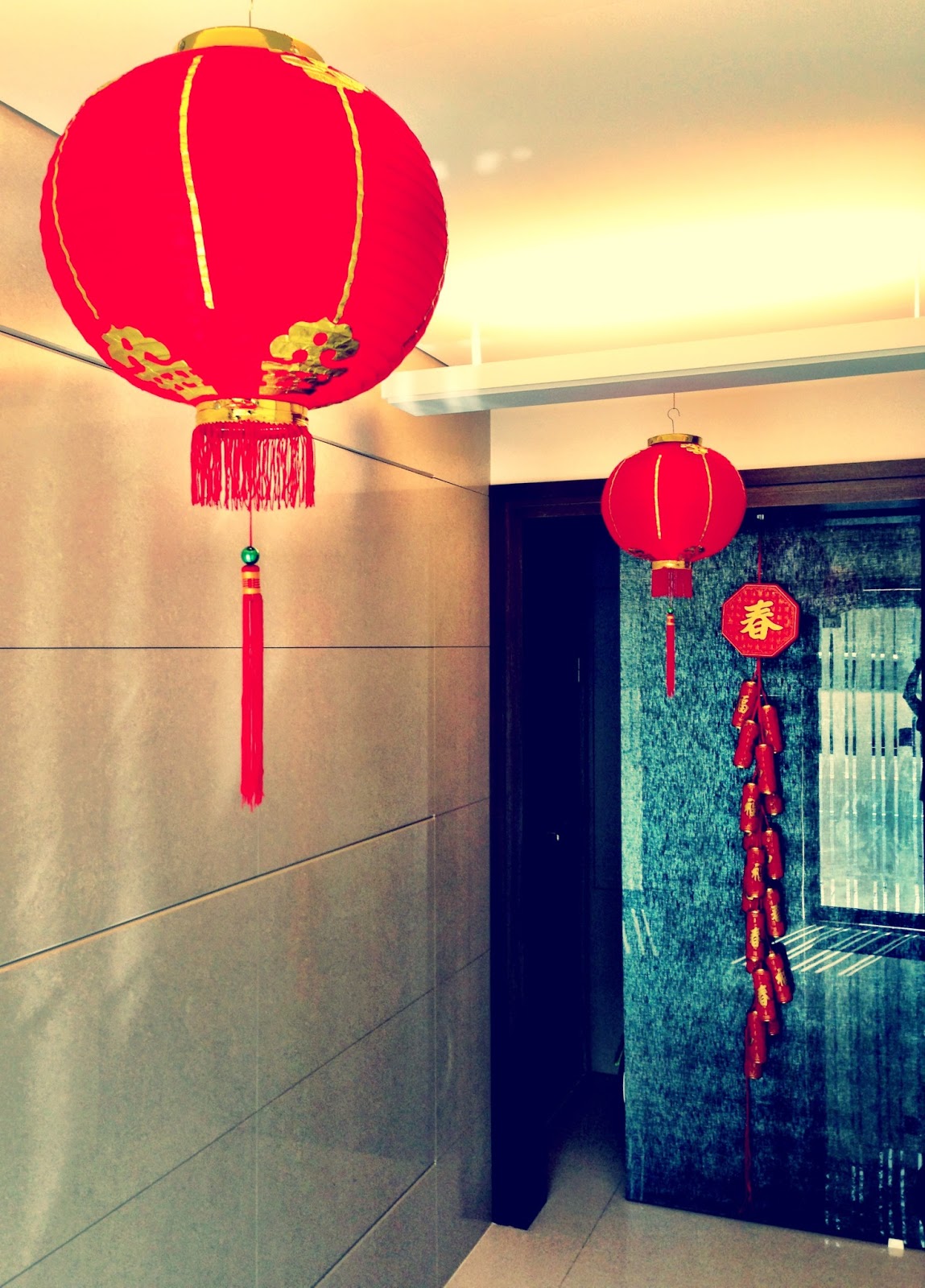
Last night my aunt pulled two red paper lanterns out of a plastic shopping bag. My cousin and I were sprawled on the couch, she watching “Moneyball” on HBO and I reading a British Vogue I had rented from a small magazine rental shop around the corner. It was more economical to rent foreign magazines for 1USD a week rather than buy the latest issue for 20USD. We both turned to look at my aunt as she pulled the lanterns open with a loud “Braaaap.”

“When’d you get those?” My cousin asked.

“Yesterday,” my aunt said, inspecting the lanterns for any rips. “I watched a news story about lobby decoration.”

My cousin turned to give me a smirk that said, “There she goes again” but my aunt did not see.

“I don’t think the firecrackers are enough. I want to hang these from the lights. The lobby will seem more festive.”

A week ago, my friends and I had come home to find the small Christmas wreath my aunt had hung in the lobby replaced by a giant strand of bright red firecrackers. Merely decorative, of course, to signal the impending Lunar New Year. It was a nice touch, a bit of vibrancy in our otherwise spare and understated lobby. If one can call it even that. Other buildings had doormen, twenty-four hour surveillance systems, sitting areas for guests to wait in and accompanying association fees, but our building was tall and narrow, one unit per floor, the living areas of which were maximized by doing away with all frivolities one associates with “fancy” buildings.  One walked in and in two steps was in front of the elevator. There was no ceremony, no association fees.

My aunt rearranged the tangle tassels that hung below the lanterns and tied gold string to the hooks.

“I’m going down to hang them now,” she said, and dumbly, we nodded.

“I’ll need your help,” she said, “I’m not tall enough.”

Of course not. My aunt is barely 5’1″. I lept up while Karen remained seated, her eyes glued to Brad Pitt’s aging but still handsome face. He looked frustrated.

“I’ll come help you,” I said, and it was my aunt’s turn to give her daughter a smirk.

“Of course you will, Karen will just sit here with her legs crossed like a queen. How useful.”

My cousin protested half-heartedly, “Well it’s not like you need two of us.”

I laughed and grabbed one of the lanterns, “She has to work overtime, all the time,” I said, “I’ll help you hang these up.”

My aunt picked up a little foot stool from her entrance way, the one we sat on to put on our shoes.

“This should be tall enough,” she said.

It wasn’t. I could barely reach the top of the light casing and was feeling oddly…imperiled. The stool shifted a bit with my every breath and I wondered if I would break my neck trying to hang these cheap paper lanterns to liven up our lobby in which no one ever spent more than two minutes, which was how long the elevator usually took to go all the way down. My aunt must have felt my unspoken alarm and after watching a few more of my futile attempts asked me to step down.

“We need a step ladder,” I said, out of breath. I realized how out of shape I was.

“I think we have one on the 8th floor,” my aunt said, “In the stairwell. I’ll go check.”

I waited in the lobby, wondering if I should have gone to get the stepladder instead. The elevator stopped at the 7th floor and the 8th was accessible only by stairs which were dark and dusty. We stored things we didn’t often use in the stairwell, but still it was no place for a woman of my aunt’s age to go poking around. Last I checked there were plenty of heavy things leftover from our building’s remodeling that could topple over and cause serious injury. The minutes dragged by as I waited for my aunt to return. Perhaps the stepladder was very heavy and she could not move it, or perhaps she would fall and clatter with it down the stairs. My aunt was getting older, but not so old that she couldn’t carry a stepladder, but still – it didn’t feel right, even if just an hour earlier at dinner we had shared a good laugh about just how hardy she was.

“When I was pregnant with your cousin Larry your grandpa asked me to hang a picture up in the stairwell of the old house.”

“When you were pregnant?” I said? “How pregnant?”

“Six or seven months,” my aunt said.

“That’s messed up.”

“Yes, well, your grandpa would rather have me get up on the high chair than his beloved son.”

“I would have gotten in a fight with grandpa,” Karen said.

“I would have told my husband to go up there in my place,” I said, giving my uncle a look. He did not seem to be paying attention to our conversation and was instead, looking at his watch wondering when us women would stop jabbering and head home. He liked to be in bed by 9PM.

“You were seven months pregnant!” we both said.

My aunt shrugged, no big deal. She was the definition of hardy. She could do whatever her husband couldn’t or wouldn’t and more too, like take initiative and put up Chinese New Year decorations in an otherwise mausoleum like lobby. But still, my cousin Larry was nearly thirty now and she shouldn’t be the one fetching step ladders from dark stairwells. I watched the elevator stay on the 7th floor and was just about to run up when it slowly began its descent. I felt like a useless twenty-seven year old who could barely stretch without losing her breath.

The elevator doors slid open and my aunt came out with the ricketiest looking stepladder I had ever seen. It wasn’t even a stepladder, but a wooden painter’s ladder, hand-made, it seemed, by a blind carpenter who had a very rudimentary idea of what ladders looked like and who had only the shittiest bits of wood, the rustiest screws, and the oldest, crustiest bits of rope to work with.

“That looks… decrepit,” I said, “I doubt it can hold my weight.” I suddenly regretted eating the green tea ice cream and the donut I had for dessert.

My aunt waved impatiently at my consternation, “Nonsense, if it can hold all those construction workers it can definitely support you.”

I thought about the wiry Taiwanese construction workers I’d often passed by on the streets, none of whom seemed to weigh more than half of what I weighed. They were always perched lightly upon these same rickety ladders like chimpanzees, working as carefree as though the ladders were extension of their own bodies. I was not so skilled. I studied the ladder and wondered how it even stayed standing – it was haphazardly slapped together with just a single bolt on either side of the “rungs” and with a simple dirty grey rope in between to hold the two sides together.

“You have to lean on it to stabilize it,” my aunt instructed.

I hesitated, and before I could step up my aunt said, “It’s okay, I’ll go up.”

Whoa whoa whoa, auntie, calm down. Sure, she was not pregnant, but she was nearing sixty and I was…not about to let my aunt climb up the world’s oldest hand-made ladder and let her fall and break her hip. Where had my courage gone? I was, at one point in my life, obsessed with climbing trees and doing cartwheels and swimming in icy cold rivers. Now, I was fearful of breaking my neck in the entrance of my home which was just a stone’s throw away from the hospital.

“No,” I said, “I’ll do it. I’ve seen the workers use these ladders and I know how it works.”

Sometimes, lying out loud makes it easier to believe. I climbed the ladder as solidly as I could, feeling the ominous creaking of old wood pressing into rusty screws and realized I wouldn’t just break my neck but also possibly endure the pain of a trillion splinters.

“Steady?” my aunt asked.

Not really, but I nodded and my aunt handed me a lantern and a push pin, which, after much difficulty I pressed into the wood of the light casing.

Gingerly, I hung the lantern up and willed the push pin to hold. It did.

“Okay,” I said.

“Next one,” my aunt said.

Up again, a long, stressful reach and applied pressure to the small head of the pushpin. Another red lantern up. I climbed down from the step ladder one last time and breathed a huge sigh of relief.

The tassels of one of the lanterns was tangled again, but it was low enough for me to adjust it from the ground.

“Now it looks like Chinese New Year,” my aunt said, gazing at our work.

Welcome home. 

It was a simple enough job, and though the minutes up on the step ladder felt interminable, had taken altogether less than ten minutes. I looked at the red lanterns swaying slightly from what, I wasn’t sure – the door was closed and I could feel no draft, but perhaps they were just happy to be out and about, on display for all of ten tenants to enjoy. It did look good, those two simple lanterns in a beige marbled lobby.

My aunt folded the ladder and made to haul it back upstairs.

I grabbed it from her, “I’ll take it back up,” I said. Her work was done, at least for tonight.

The Return

In two, no – three days, I will see this view again though less sunny and less filtered (I am challenging myself to both take more photos and to use less filters, except for on Instagram, in which case filters are the only way to go.)

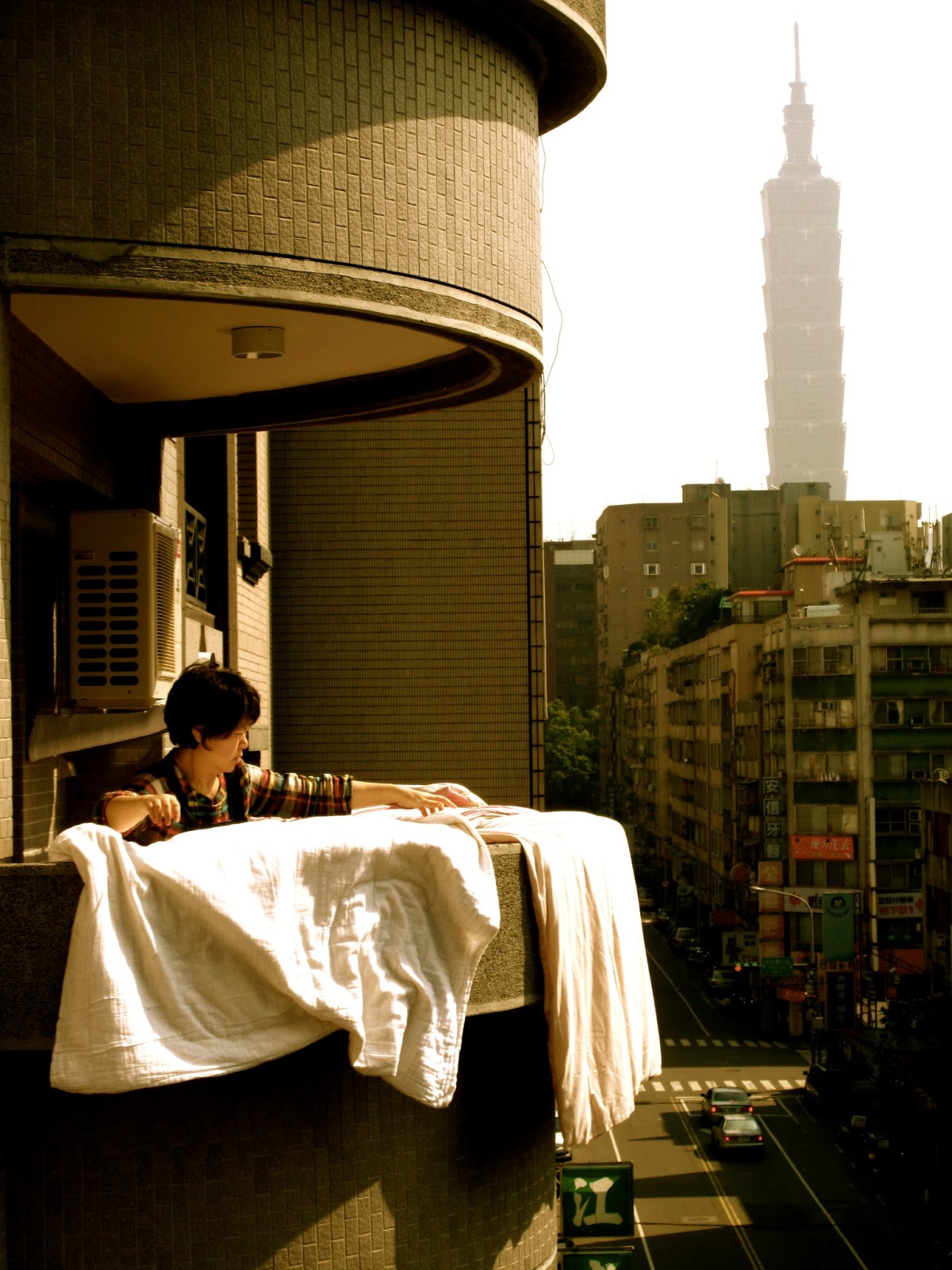
My aunt sunning the blankets on the balcony, at the start of 2010. 

For now, my brain is mush. (Partly, this is a result of my last trip to Vegas. “Balls to the walls!” my cousin instructed, and I nodded in heady assent, thinking it necessary to buy my first – and likely last – set of shot glasses from the most opulent Walgreen’s I’d ever set foot in. It wasn’t until the next morning when I realized it was actually just the balls of my feet that went to the walls while the rest of me wanted nothing more than to slide to the floor. Hello, 2013, ye harbinger of my late twenties!)

My closet has been gutted so its innards now lay strewn about the bed and carpet. Collared shirts, wool sweaters, short and long skirts, pants that may or may not fit lay anxiously on my duvet, wondering if they’ll make the cut. I always overpack when I go to Taipei because I always think I’ll transform into the best version of myself – stylish and purposeful, places to go, people to see – but without fail I turn into a creature who spends entire days in pajamas lounging around her aunt’s sixth floor living room without purpose, without agenda. Before my cousin Karen was my partner in sloth, but now she works like any respectable, able brain and bodied, twenty-seven year old. So Mondays through Fridays I sloth alone.

On more ambitious days I stroll around the well-maintained track at the nearby middle school while uniformed students with sallow faces and greasy hair keep their heads bent low in fluorescent lighted classrooms. Sometimes I go to the department store and touch things, accept samples from pale, slender girls around my age who think I could probably benefit a whole lot by using the same beauty products they do. Why are all the American girls so big boned? I shrug; I wish I knew.

In the afternoons my aunt cooks dinner while I watch. She tells me stories; I put down my book and sit down on a small stool, staring at the ties of her gingham apron and listen. The afternoon sun shines softly down on my aunt’s short hair – only a few strands of which are grey – and there is something bucolic about the scene except we are on the sixth floor of a building in a bustling city. Outside, far below the balcony a car horn honks. A cellphone rings with a Taiwanese pop song.

My uncle comes home from the office, puts his frayed nylon laptop bag on the low mahogany cabinet behind the couch and goes to wash up. The slender cat jumps atop the bag. He will likely stay there until his dinner.

We humans take our seats around the rectangular dining table upon which my aunt has assembled the night’s simple dishes. Always white and brown rice with two or three vegetable stir fries. A pan-fried fish with scallions and soy sauce. The fat, older cat paws our knees and hoists himself up on the empty chair to get a taste. That is the fat cat at his most productive. If they make it home in time for dinner (which since 2010 has been rare), my cousins talk about their day. A pretty fresh faced female anchor reports the same news that was reported in the morning.

At night the city comes alive and I find a reason to change out of my pajamas just as my uncle changes into his.

“He will sleep at nine even if the Empress of China herself were to call at 9:15,” my aunt has said drily for her entire marriage.

Sometimes my cousin Karen and I revisit the same department stores, though now they are bursting at the seams. The young, sallow-faced high school and college students and office workers are now fresh-faced and energized. They milk the night, or the few precious hours left of it. I see the lights of a million billboards and shop windows, smell the exhaust of thousands of scooters, cabs and buses, hear the chattering of a million souls packed into two square kilometres, perhaps less. I see, smell and hear precisely what I miss most about Taipei when I am in Orange County.

Sometimes, I stay in my pajamas and we watch an American movie or TV show with Chinese subtitles. Or a Chinese show with Chinese subtitles. We discuss her coworkers and her friends. The night is long, but so is the next day, and at 12 or 1AM Karen is fast asleep. Taipei does not; this energy wakes us all the next morning, and the next and the next.

Sometimes, in between all of this, I write.

For now, two massive, aspirational suitcases wait to be filled, just as I do, though with different nourishment.

Marbles

As I write this, my Taiwanese grandmother arranges and rearranges the contents of two Samsonite suitcases in my brother’s room, where she has slept for the past month. She is leaving tomorrow on a two-thirty China Airlines flight. My father will take her to the airport at around 11:30AM and I will go to my grandfather’s house as usual. I will not make a big deal of saying goodbye, nor will she; we will see each other in less than two weeks, when I return to Taiwan for Chinese New Year.

She visited two years ago, also around the holidays, a little over a year after my grandfather passed away. Her hair was still black then, though after a month her roots started to show and I learned that holy cow, all her hair was white. 

That was the year I finally graduated from college and my brother from business school and my grandmother from the dark cloud of fresh widowhood. We were all about to embark on new chapters, and though my grandmother was still a widow, she was also only fifty-five years old with several decades ahead of her. My mother had invited her to stay with us almost immediately after my grandfather died, asking her to come at the beginning of November and stay through the New Year, but that first year my grandmother shook her head. It was too soon.

The next year my mother brought it up again.

“We will help Betty move back home from school, and you’ll experience the rowdiness of an American Christmas.”

My Taiwanese grandmother agreed and flew across the world alone for the first time in twenty-two years. No well-dressed old man at her side. I didn’t tiptoe around her. None of us did. My grandfather’s death, at the age of one-hundred, was hardly a surprise and from the look of things – the easy way my grandmother fell into our lifestyle and the warm welcome she received from my mother’s side of the family and my parents’ friends – my grandmother had more or less “moved on.”

She laughed and shopped and ate with much gusto, and though now my memories from that time have blurred, I do remember her having a pretty good time overall. I think it was fresh for her, to be back on American soil and to be with us, an oddly American extension of the family she knew forward and back in Taiwan. In our quiet American suburb with no sidewalks or street lamps, we seemed very far from the sights and smells of Taipei city, most of which I’m sure at the time, reminded her of her late husband. We were Chinese, but in some ways so decidedly American – and my grandmother was game for all of it. She ate at our fatty American restaurants and toured our expansive American universities and shopped in the endless stretches of American malls and shopping centers. At the time however, I was too busy wondering about my own future to consider seeing our America through her eyes. I regret not looking more closely – I think I could have learned a thing or two.

I do remember her being surprised by my anger. She watched in silent awe as I argued constantly with my father and snapped at my mother and rolled my eyes at my brother. At one point she conceded that yes, my father was very difficult, but then later she told my mother she was surprised I had such a temper. Where did this impatience and disrespect come from? Was I not the same sweet and happy-go-lucky pre-teen she played marbles with for hours some twelve, thirteen years ago? Did she wonder? I wondered. I was so ill at ease and even two years later, at the edge of another open door, she seems to still have caught me in a lurch.

I often wonder where the rift began. If I am looking for some sort of emotional origin story I would say it happened at the end of their visit that year I was thirteen and in middle school. I was struggling not to grow up, knowing that becoming a “young adult” was inevitable but still fighting it with every neuron. I went to classes, wore the damn forest green uniform with the horribly unflattering pleated navy shorts and tube socks, and then came home and left it all at the door. My awkwardness (which I didn’t even realize at the time as awkwardness) my abilities, and my status as a middle schooler. I had friends, some of whom I’m still friends with to this day, but for the most part I was distracted. Some things aren’t worth explaining. I doubt I’m the only person who would rather middle school never occurred. My grandmother came from Taiwan that winter with my polished grandfather on her arm, bearing suitcases and suitcases filled with gifts and foodstuffs, and with her sharp, hearty laugh and my grandfather’s enviable vitality (he was around ninety years old by then), filled our house with smiles and good cheer.

I played marbles with her nearly every day after school, not a real version (whatever that is), but one I made up and constantly revised the rules to. With my brother we played cards, and sometimes my grandfather would join too and my brother and I would howl with laughter when grandma challenged grandfather to War, winning us twenty dollar bills for each high hand. At Christmas she won multiple gifts at Bingo and I think, I think, around that time we must have gone to Las Vegas too, where her luck followed her and gave us more quarters than necessary to play in the arcades. It is at times like this I wish I had a better memory, or at least had the good sense to keep a proper diary. But I can only share with you the vague description of warmth that only a grandmother in winter could provide. I was thirteen and that winter stands out as one of the happiest because the surrounding days seem so bleak in comparison. I was never bullied in middle school. I had good friends. I think I liked most of my teachers. But my god I so looked forward to going home and being with my grandmother that winter break.

We took a family photo that year. In it, I wear my middle school uniform and my brother with his awkward high school haircut and glasses. My mother and father looking years younger than they do now, standing around my grandfather who sits squarely in the middle with my grandmother leaning on his shoulder. She wore a tailored suit that day with large, square shoulders, and had her hair clipped in a low, elegant ponytail. Her bangs are curled and piled high up on her narrow face and she is thin, with slightly hollowed cheeks but full lips. Here eyes are bright and though I never thought of her as such, there is something powerful about her. She married the old man, made him happy, which made her happy. Some people are built that way. You could cut the rest of us away and see a perfectly happy man and wife, but you look at the young girl’s smile and can see that at that moment, she’s the happiest one in the photograph.

All good things…you know how it goes. I came home from school one day in early January and they were gone. It shouldn’t have been so dramatic – I’m certain we said goodbye, and I was going to see them in a few months when I went to Taiwan in the summer – but it was so sudden. Perhaps it was all just poorly timed. Perhaps my grandparents left on the same day I started school again; always a sad day when you’re a kid. But I don’t remember those details; mostly I remember how the house went from six noisy people to four, all suddenly subdued. The guests were gone. The lights and ornaments were put away, the tree hacked into thirds and dumped at the end of the driveway. The guest room was now dark and empty, void of my grandmother’s creams and my grandfather’s colorful ties, even the bed seemed bare now that the sumptuous emerald green comforter reserved expressly for my grandfather had been rolled up and zipped away.

I remember walking down the hall from the guest room back to my own room, but stopping outside my parents room where a nuclear family photo hung, taken when I was six. We had gone to a portrait studio one hot summer day in Taiwan, my brother came directly from school and had no suit to wear or rent. My mother gazes lovingly at the camera, while my father and brother have varying dim looks – men never really photograph well – and I am standing at the center, wearing a frilly white dress, a small white flower between my fingers. I am smirking, smug because I don’t know anything about anything. But looking at it then I felt two people missing. They were never in that photograph to begin with, but now I felt four was such a small, quiet number. Not at all a whole family.

I cried to myself that night, wondering what the heck was wrong with me and feeling, rightly so, like a baby. I missed my fun, young grandmother and the steady, smiling albeit stoic presence of my quiet grandfather. I missed the dull clink of poorly aimed marbles and the laughter that they brought to our cold house. My parents, if they noticed my dull mood, said nothing. My brother, if he missed them as much as I did, was most likely more reasonable and told himself to be patient. But I think then I was on the cusp of something. I was changing, growing, hardening somehow. It’s not fair but it makes sense. My grandmother left that winter and along with her left my childhood. I don’t think I ever felt that light or loose again. There were more fun winter breaks and summers and regular days ahead – I have hundreds of photographs to attest to the fun that came later, with and without my grandmother – but never to that extent, never at that funny awkward age when you are able, when you come home from school, to leave the rest at the door.

I closed the bucket of marbles that winter and never opened them again. A few years later my mother took a few handfuls for her plants and I dropped the rest off at the salvation army.

Whatever happened between that memory and the next of spending time with my grandmother in Taiwan doesn’t matter. The pebble had already cracked the windshield and it wasn’t her doing or my doing, but just life in general. Suddenly I was in high school. She picked me up for lunch and I noticed that I had nothing to say. It was around that time too, that I began to scrutinize the relationships around me and ask questions. I was looking for answers, motives. I wasn’t yet a “writer” in that indulgent self-labeling way, but I was certainly judgmental enough. I was also trying to divine the future – my own, mostly – by learning from others’ pasts. It struck me as odd that she had married my grandfather. He was very old and she was very young. Around that time too, I began to listen more closely when the women talked and she was out of the room. My cousin was developing in the same way and late at night when the rest of the house was asleep we lay awake and dissected people’s pasts. What made them the way they were? But it was all just part of life, wasn’t it? My grandfather was aging finally, in real time, and my grandmother was most likely discovering the downside of marrying someone fifty years her senior. Her attitude never wavered, but I’m sure my grandfather’s life, or whatever was left of it, hung heavily over her head.

It wasn’t disrespect I felt for her, but if emotions could smell, it was the faint whiff of pity. She became a strong, fun woman I looked up to to someone whose welfare seemed to depend on the whims of a weakening ninety-year old man. But that is unfair, and has nothing to do with how she has always treated me: nothing but love, hands on, undiluted. There was no blood between us but whatever ran was much thicker. And yet. I felt as though I had evolved beyond her. Though of course I was doing just the opposite. I was self destructively closing myself up to the warmth in her that had always been there, for me, my cousins, all of us.

I did it to myself. I closed myself off from her specifically, holding an inexplicable and unreasonable grudge. I blame that winter break when with her, I had too much fun. She made me feel I would need no one else but her and perhaps a deck of cards and a bucket of marbles. And then just like that she left. You can’t play those games by yourself.

Now she is leaving again and I am well prepared. She is struggling with four Glad containers of oatmeal cookies she asked me to bake (“Less sugar, more raisins, please.”) and though I am happy that I will have the bathroom to myself again and that I won’t have to worry about what she’d like to do or eat or where she’d like to go tomorrow (not that she ever, EVER has any demands in regards to any of those things), I feel an imminent sadness for when she leaves. It is silly, believe me. I will see her in less than two weeks’ time, on her turf too. But this time it’s regret, the kind that comes when you’re old enough to feel the kind of nagging responsibility you owe to your aging relatives. Was I less cold to her? Did I make spend enough time with her? Did I make her feel welcome? Does she know I love her?

I tried, but could have tried harder. I tried, but could have tried harder. I tried, but could have tried harder. I don’t know, but I hope she does.

Museums

Mothers, aunts and grandmothers are simple people. I took them to the Getty Center in Los Angeles today, an attempt to play tour guide and to get my poor grandmother, a visitor from Taiwan, out of the confines of our small town. So far, she’s taken multiple trips to Costco, Target, and the Desert Hills Premium Outlets where she and even more aggressive women from China (with deeper wallets) nearly cleared out the Coach factory story. We failed miserably two years ago to show her any culture and decided this time to take her to some museums and whatnot.

A few days ago they had such a marvelous time at the Huntington Gardens that I suggested they might like to see the Getty as well. My aunt was overjoyed and reshuffled her appointments before I could retract my suggestion and before I knew it it had turned into a day trip of sorts, the kind where grandmother feels compelled to move all her Tai-Chi videos from her camera to her computer to make room for the thousands of photos she might take at the Getty and Aunt Yang comes prepared with thermos full of hot water and a nylon sack filled with nuts and oranges. 
I suppose I encouraged this. At the Huntington Gardens I had come alive when I came across Hopper’s “The Long Leg,” a part of the Huntington Art Gallery’s permanent exhibit, and told them everything I knew about Hopper (which I’m proud to say isn’t little), and then got in the habit of talking about the rest of the art in general (I did take half a European Art History Survey course at Berkeley, don’t you know, which makes me nearly an expert) and ended up playing docent. My aunt and grandmother thought it marvelous and thought it the best museum tour they had ever taken because well, it was given by me. 
“You know you are the most marvelous young person I have ever met,” my aunt said to me over and over again, “You must know how special you are to be willing to spend so much time with us old people, and to drive us here and there and to explain the art to us! This Hopper fellow! The Long Leg! I will try very hard to remember it. You have educated me today, made me less of a savage.” 
My mother, not so easily impressed, pointed at a sculture of Pandora and said, “So she must be holding a box of soap and is about to bathe.” 
It was quite a busy day at the Getty. We arrived around 11:30AM and at 12:30PM joined a forty-five minute garden tour led by an enthusiastic woman named Debbie who spoke much more and more loudly than the average docent, but who was quite good, and kept her whole group of about twenty people whose ages ranged from 12 – 77 enrapt at what she had to say. I have now forgotten the names of most of the plants and trees she pointed out, but will forever remember the sight and smell of a low, long leaved shrub called “society garlic.” 
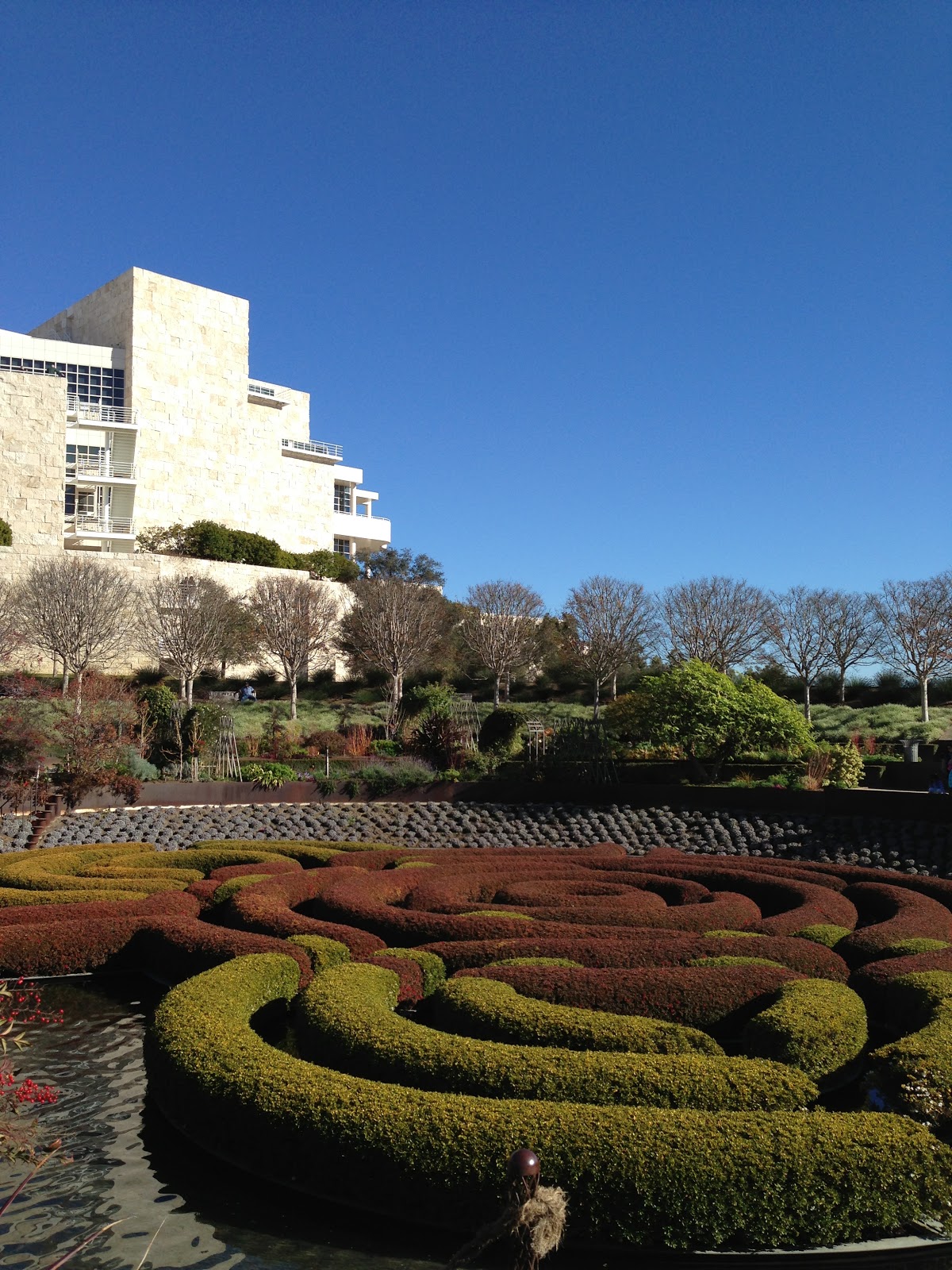
The day was sparkling clear with just the faintest layer of smog hanging over Downtown, and everywhere we looked it was just miles and miles of Los Angeles in all its spread out splendor. There! West Hollywood and UCLA; there! that tall cluster, Downtown LA, and over there, Santa Monica, sitting before the deep crystal blue of the Pacific and of course the long undulating hump of Catalina Island. And before all that there were the Getty’s own beautiful gardens. The older women walked, more often in silence than chattering, as I thought they would, with their heads either bent low or looking up, hands held lightly behind their backs. They wondered about the various plants and the stones and the logistics of construction. 
“How did they get all these heavy stones up here?” my mother asked over and over again. 
“Machines,” I said. 
Photo by Very Highbrow on Instagram. 
An hour or so later she asked again and I wondered if she had forgotten that the center was built in the early 90’s and that it was not one of those eerie mysteries such as Stonehenge or Easter Island, but I had to admit the building itself had an ageless quality about it. My grandmother busied herself photographing everything that caught her eye, from the buildings to the tiniest succulents that looked up at all who walked by, to indolent, confused poodles who sat sunning themselves on the pale pink tile stones. Young children squealed about, running up the wide flat steps, swinging from the handrails, and then rolling down the wide expanse of lawns. We saw young couples on well-intentioned “let’s do something cultural” dates, young people dragged there by their parents and young college students back for winter break trying to place what they’d learned in their very first art history survey courses. We saw elderly couples wearing comfortable shoes, sweater vests and blazers who in their retirement rediscovered the leisure necessary to truly enjoy art and who made up the bulk of the guided tours. From them I made a mental note to enjoy my old age. We heard German, French, Italian, Korean, and of course Chinese being spoken around every bend, and marveled at various sculptures and the shape of Robert Irwin’s Zen. 
According to the docent this is a puzzle to tickle the garden goer’s 6th sense: spirituality. 
After the garden we went to see the art, though we skipped the current exhibition of Renaissance art. Not my favorite. I took them straight past the most crowded room where Van Gogh’s Irises were being photographed into oblivion and into a darker room in the corner, where light seemed almost unwelcome. There, we saw Degas’ “The Star,” and Lautrec’s “The Model Resting.” 
The Star or Dancer Taking a Bow, Edgar Degas 1877
                
The Model Resting Henri de Toulouse-Lautrec 1889
Both paintings gave me something to think about. I love the first but was drawn like a magnet to the latter, for reasons I can’t quite place. 
We left at an hour or so before sundown. Emerging from the West Pavilion we were met with the following view. 
Photo by Very Highbrow on Instagram. 
 Taking the tram back down to the parking structure my mother, aunt and grandmother looked tired from walking and squinting at both the sun and the tiny details of a hundred paintings, but they were happy. 
“What a wonderful day you’ve given us,” my aunt cooed, and I could only nod in assent. Not because I gave them anything, but because there were places like this, filled with beautiful art and surrounded by glorious sun-kissed vistas to which I could bring them.