Preparing for Chinese New Year at the Hwang’s

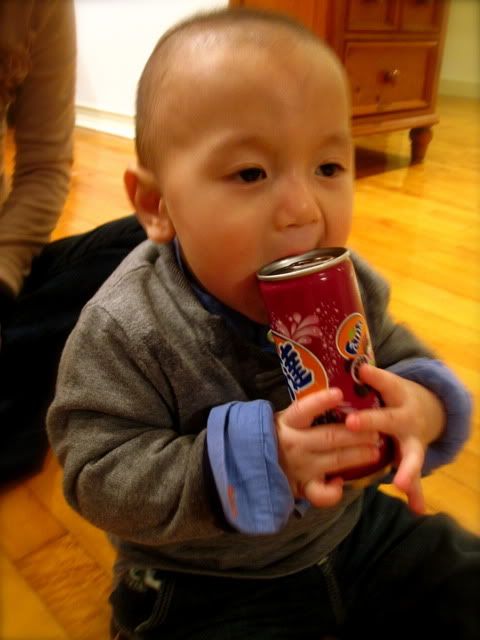
Longtime friends of my aunt and uncle, the Wang’s were finishing up some last minute Chinese New Year preparations when my cousin and I paid a visit to them last night, to visit this little guy:

Colin Chen, Mr. Hwang’s grandson. He’s going to be very handsome. I can tell.

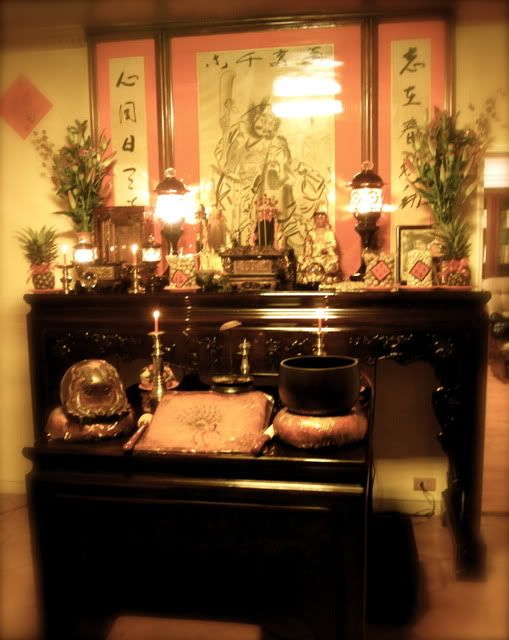
The Hwangs are a very traditional Taiwanese family and have an altar room in their house. In addition to weekly worship, Chinese New Year means a special offerings of fruits, nuts, and candies, all placed upon the altar. Mr. Hwang explained that they worship ancestors on the left and Guang Gong (關公), a Daoist deity, on the right.

On the front table there is a “wooden fish” on the left – a percussion instrument carved from one piece of wood, engraved with fishes. When struck with the muted baton next to it, it makes a crisp hollow sound which helps Buddhist and Daoist worshipers keep the rhythm of their prayers. On the right is a bronze bell. When struck, its resonance is meant to summon the spirits.

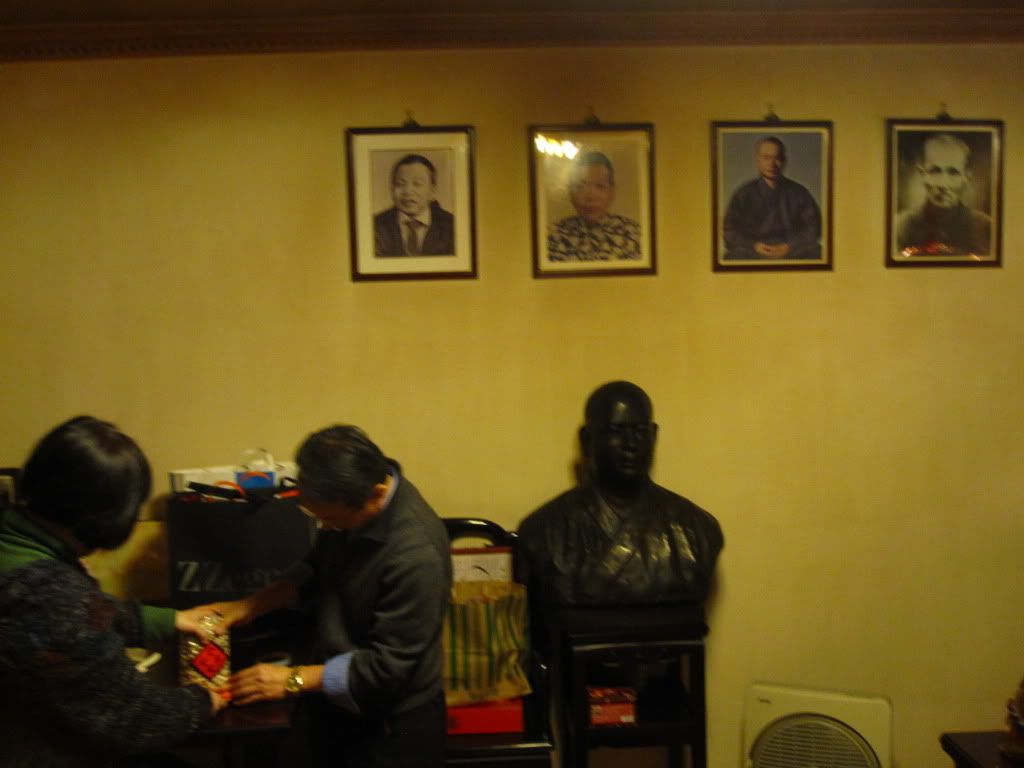
Mr. and Mrs. Hwang prepare goods on red plates to place upon the altar for offering. On the wall are portraits of Mr. Hwang’s deceased ancestors. From left: his older brother, who passed away at the age of twenty; Mr. Hwang’s mother, his father, and his grandfather. I forgot to ask who the bust is.

A close up of the wooden fish. No one in my family can decipher the second word (the first means “King”). I should have asked the Hwangs.

Guang Gong.

  
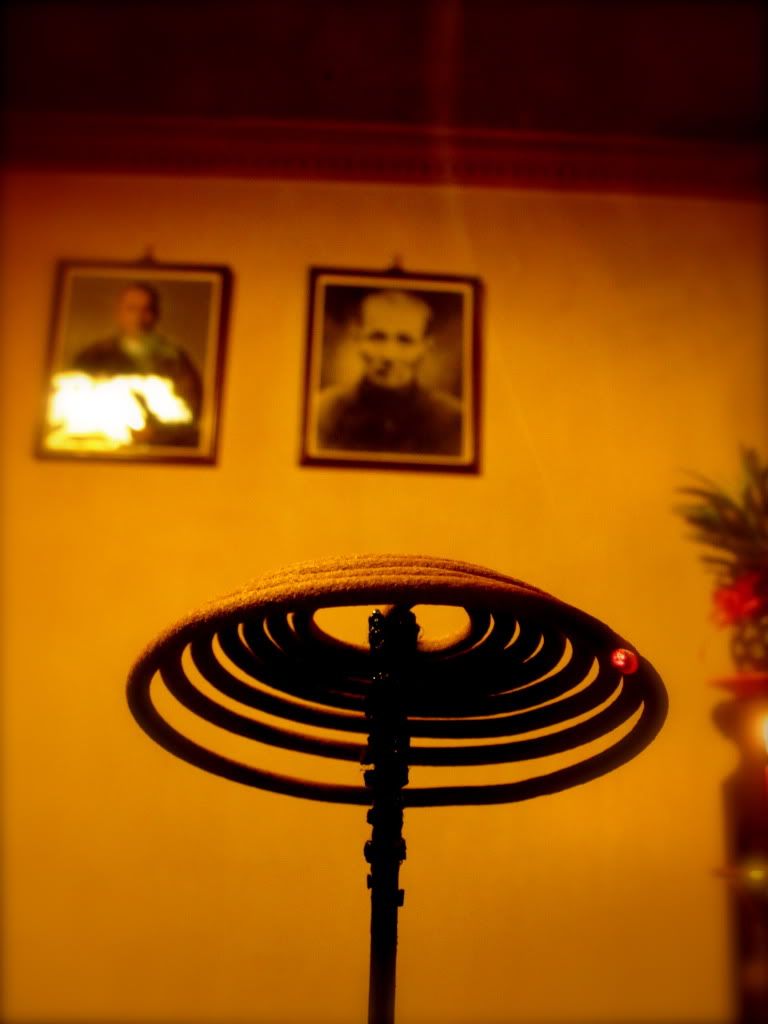
Coiled incense. 
Mr. Hwang and his spring posters: “fortune” on the left, and “spring” on the right. Traditionally, these are hung upside down on the front doors to signify the arrival of both. 
The beautiful red envelope Mrs. Hwang gave me. 
Now it’s time to prepare for our family’s Chinese New Year dinner. But I’ll leave you with this because everyone knows, babies bring good luck:
HAPPY CHINESE NEW YEAR!!!
 
 FANTA!!!

Return to Taipei

The last time I was here was August 2009, for my grandfather’s funeral. Much has changed: the house (remodeled), my cousin’s job status (employed), and the location of my extended family (spread out in three points across Taipei). But some things never change – or at least they won’t for a long long while.

My uncle wakes up every morning at the crack of dawn to exercise. On weekends, he’s responsible for buying breakfast.

My uncle: the middle child (my father is the eldest).
Interests: long walks to the temple, the stock market, the newspaper, fried pork sung, and living to 100 at least.

My breakfast: Tuna sandwich with a cup of sweet hot black tea (or ‘red’ tea, as they call it here).

Chinese New Year is just around the corner…I can’t wait!

You Lucky Dog

Leaving my grandfathers’ house after lunch, my mother was nearly out of the neighborhood when she braked suddenly in front of Sunshine Park, in which I had spent many hours as a child. She leaned forward, gazing into the rear view mirror and then out the passenger window.

“What is it mom?”

“That woman, she’s waving at us.”

I turned to look out the window and indeed a woman was jogging up the sidewalk, waving at us, though I didn’t recognize her. She was dressed in a faded peach, over-sized sweatshirt and in her puffy sleeves, cradled a small, anxious looking dog. A short man with graying hair stood next to her, wearing a fleece jacket and jeans that seemed several sizes too big. He pushed what seemed like a baby carriage until my mother had backed the car up considerably and I saw that it was, in fact, a dog carriage. Another small dog sat in the basket, peering out nervously from within the basket’s netted frame and as my mother parked, I rolled down the window to say hello to the strangers.

The woman was breathless, but held her dog firmly as she went around to my mother’s side. “I thought it was you!” She said, then, ducking down to peer into the window, saw me and her eyes grew wide.

“Is this Betty?”

“Yes,” my mother said.

“Goodness! The last time I saw you you were three or four!”

“Hello,” I said, then paused, knowing what was coming next.

“You look just like your mother!”

My mother smiled, then gave her usual spiel, “When she was younger, people said she took after her father, but now people are more likely to say she takes after me. I suppose it changes by age.”

“Speaking of age,” the woman said, still stooping into the window, “I’ve gotten so old you probably don’t even recognize me.”

“I’m sorry,” I said, “I don’t.”

Apparently her younger daughter and I used to play in the park as toddlers, but I had no recollection nor would, I’m sure, her daughter.

The woman sighed, “We’re all aging so fast.” She nodded in her husband’s direction and then down at the furry bundle in her arms, “Even our dogs.”

My mother raised her eyebrows as she looked down at the dog, but stood patiently to the side of the street as the woman commenced the long and complicated medical history of her aging fox terriers. Both dogs were seventeen years old, which in dog years is 119, and both were suffering from such a myriad of health problems that they could no longer walk but must be carried or carted. The dog the woman held in her arms was faring better than the one in the dog carriage, but both alternated between howling and whimpering at night so that the woman could only sleep for a few hours at a time.

 “I have to get up every three hours to comfort them, stroke them, give them pain meds, walk them to their bathroom,” she said, stroking the dog softly on the head, “It pains me to hear their pain, and my husband, well, he gets up early so I have to let him sleep.”

She looked at my mother with a pained expression, “It’s no way to live, but when you love them, it’s what you do. They’ve been with us for seventeen years and gave us so much happiness. How can I not?”

My mother and I nodded sympathetically. They continued talking so I left the car and went to talk to the man, who until then had stood quietly to the side, one hand on the dog carriage.

“She doesn’t look so old,” I said, touching the dog softly on the head. It’s eyelids drooped as I did so and I noticed how feeble her front legs were, shaking under the perceived weight of my hand.

“She is,” the man pointed at the dog’s white head, “The fur on her head used to be brown, and now it’s white, just like the hair on my head.”

I smiled and turned to look at my mother, whose hand had come up above her eyes to shield the sun’s rays.

“…You haven’t changed at all,” I heard the woman say, “Still look as young as ever…”

“…No, you’re right about age…” returned my mother, “…no one escapes it…I’ve just come from lunch with my father. He’s home alone now because my mother’s in the hospital with lung problems…”

“Oh I’m sorry,” the woman said, “I did notice I haven’t seen them walking in the park for a while.”

I turned back to the dog, sitting serenely in her basket.

“She’s deaf and blind now too,” the man said. There was a scar above her left eyelid and the man said it was an old wart, the least of her problems now. The dog had long suffered from spinal problems which necessitated the daily administering of pain meds, which he said, his wife lovingly crushed into the dog’s food.

“It’s hard work like my wife said, but I’m nearing retirement and I can work from home more often now,” he said, “So today, I thought I’d stay home and take the dogs out. I don’t know how much longer they’ll be around.”

He was an engineer at Raytheon, formerly known as Hughes (“We make missiles,” the man said.) and described his position as “The highest ranking Asian man” in his department.

“Sounds like you like it a lot,” I said and he nodded, not without a hint of smugness.

“I have a lot of freedom now. They used to send me on a lot of business trips, but now I can pick and choose my trips. I was supposed to go to Florida today, but I choose not to, and next week I’m due in the Stanford area. I’ll visit my eldest daughter there as well. She’s doing a PhD in physics.”

I smiled, wondering what it was like to jet around the country and advise engineers on missiles and radar and other things I had no idea about, but before I could ask anymore questions my mother called and said it was time to go. I could tell by her expression that she was tired and that she had not intended to stop for so long to talk to these people and inquire after their dogs. The woman waved enthusiastically and the man wished me good luck on my own job hunt, “The times are different,” he advised me, “You won’t necessarily find a career like mine that you stick to for over thirty years.”

“They seem nice,” I said as my mother turned onto the main road.

“They are. They’re nice people. Smart. Engineering PhD’s, the both of them with two highly intelligent, successful daughters.”

“I know,” I said, “The eldest one is at Stanford doing a PhD in Physics.”

My mother nodded, but her lips were pursed and I could sense that for whatever reason, she was less happy than she’d been before we ran into them.

“What did that woman say to you?”

“Hm?”

“What did you guys talk about?”

“Oh, her dogs, her younger daughter. Then she asked after grandma and grandpa.”

“That’s nice.”

“Yes, and I asked after her parents.”

“Okay. And?”

“Not doing so well either.”

“They’re sick too?”

“Yes. Her father passed away a while back. Her mother has Parkinson’s.”

My mother merged onto the freeway and I thought about the perpetually occupied rooms at the Alhambra Medical Center, where my grandmother currently stays, waiting to be discharged with an oxygen tank. Just two evenings ago, she was diagnosed with COPD, Chronic Obstructive Pulmonary Disease, a progressive disease resulting from years of smoking in enclosed parlors while playing mahjong. She had snorted at my hopes that she wouldn’t need the oxygen tank. “I’ll carry the damn thing if I have to,” she said, “If I need it to breath then I need it to breath. I didn’t live so long to just drop dead now, not with half my grandkids still unwed!”

On the freeway, my mother told me that the woman’s mother was in a bad way. The woman felt powerless to help her mother.”

“That’s how everyone feels when someone is dying of any awful disease like that,” I said, “Did you tell her all she can do is just comfort and care for them? Like her dogs?”

Now it was my mother’s turn to snort. Her voice rose sharply, “Exactly! Like her dogs!” Then softening, she sighed, “I don’t know what some people are thinking when they lavish such care on their pets but neglect the human beings closest to them.”

The woman’s mother ails in Canada.

“Does she have siblings there to care for her?” I asked.

“I don’t know,” my mother said, “I didn’t ask. But does it matter? Siblings or not, it’s her mother too. It’s not that she doesn’t have the money to go and see her.”

“Maybe she has to work.”

“She hasn’t worked since she got married twenty-some years ago. She has time. Her daughters are grown. Her husband is nearing retirement…” my mother’s voice trailed off, “But to each their own…”

My mother has a tendency, when she drives, to slow down when she speaks or is deep in thought. As cars filled with busy people on their ways whizzed past us, my thoughts returned to Grandma, who was no doubt taking another turn around the floor, peering with a combination of sadness and smugness into the rooms of other patients, few of whom had visitors as often as she did.

I admired her spirit, but I understood that our presence fueled that spirit. The continual flow of visitors confirmed to not only herself but to the nurses and the other patients that she had a family, that she had people who cared. She indulged in the attention showered upon her both by the nurses and by us, her children and grandchildren and despite her hacking cough, walked with her walker around her wing so often that the nurses have started to call her “Barbie.”

“She’s one of the most active elderly patients I’ve seen,” one nurse told me, “She doesn’t speak English, but she smiles. We all love her.”

As Tolstoy wrote, “All happy families are alike; each unhappy family is unhappy in its own way.” On the whole, we consider ourselves a happy family – large in number and strong in its ideology: love your family – every single member, and try to see the good in each person. I will venture to say that other happy families do the same, regardless of what intermittent, minor unhappinesses fly their way. To each their own, yes – people have jobs, children, diseases of their own, and a week goes by when other people and events and occasion crowd their calendars so that they say, “I’ll visit mom next week,” or “I’ll call dad tomorrow,” or “I’ll plan that trip with them next month,” etc., etc., but the week turns into two then three then four and suddenly seventeen years have gone by and they haven’t seen their parents, only spoken to them over the phone, their elderly voices faint with yearning. Seventeen years seems like an exaggeration, especially in this day and age with technology and cheap(er) flights, but as she drove, my mother listed friends and acquaintances who had poor relationships with their parents or were simply too busy to visit or to be there or to care. One woman did indeed let seventeen years go by between visits so that when she finally saw her mother again, the expression on the old woman’s face rivaled that of someone who had just seen a ghost.

I wanted to say to my mother that I would never allow seventeen years to go by without seeing her, but I knew she wasn’t telling me as a warning of how not to be. What would my reassurance mean to her, at my age, anyhow? I am, it seems, always about to leave – for school, travel, whatever. I can say plenty of things right now, promise worlds and worlds of care and tenderness, closeness, but it will mean nothing until the day comes and I am there. Assurance, security, my barb-tongued father teaches me, does not come with words but with actions. My mother, my aunts and uncles drive hours to and from the hospital; they discuss diagnoses, medications, visits to the doctors and make sure my grandpa, home alone, is cared for. They don’t do it because they have to. They don’t do it because they feel obligated and because it’s better to feel obligated than to neglect those obligations and feel shame or guilt – no, they do it because they want to. It’s their mother. It’s their mother now, was and could be their father later, and perhaps in the future it’ll be a brother, sister, son or daughter. Regardless, it’s family. Life only gives you one.

Procrastination Kills

Recently, loved ones have taken to congratulating me prematurely.

“You’re almost done! You must be so excited!”

“Just three weeks away!”

“I’m so proud of you! Do you want anything for graduation?”

“A graduate! You’ll be just like Dustin Hoffman in that one movie with the ambiguous ending!”

No one’s actually said the last one to me, but it’s the statement to which I can provide the most accurate response.

Lately I’ve been stalling. I haven’t been writing except for lame one pagers in my diary (pining about ‘Ben,’ mostly) and I certainly have not been reading for or participating in class discussions. True, “graduation” is only three weeks away (two, if I subtract the week of Thanksgiving, as I will be home for its entirety) and true, time, in its inevitable way, will fly, but right now, this Tuesday evening, the unwritten pages of final papers are piling up and I haven’t a clue as how to tackle them. It’s no longer a question of motivation – I haven’t been motivated to do well in school since senior year of high school – but rather, an issue with…”What now?”

I didn’t expect this stupid, common question to hit me too like the proverbial ton of bricks, but it has and my face hurts and so I’m asking: What now? I can see into the immediate future. I will graduate. With above average grades, below average affection for my alma mater. (At the department store the other day, I overheard a teenage boy discussing Berkeley and Brown – “I like both,” he said. I looked up from black boots that didn’t exactly fit, my face red, “Choose Brown,” I said.)

I know myself – writing papers assigned by youthful and elderly professors alike is, regardless of my attraction to them, like pulling teeth – and I will write them. I will turn them in and if they are graded by professors, will garner generous grades. If not the professors, then bitter, stingy GSI’s (graduate student instructors), who, if the holiday spirit vacates their hearts at the wrong moment, will damn my papers and final grades to scholarly hell (any grade below an A minus). I don’t want to be cast into that hell, especially not in my last semester, but while it’d be great to leave Cal with an academic bang (3.9 decibels loud!), I am wearied by all this relentless reading and writing and listening. I have waited six years to tune out higher education and on the 17th of this December, 2010, I will finally plug my ears and walk away.

My dear aunt called from Taipei two evenings ago. It’s been my spoken plan now, to leave the States for one or two years and fashion a little expat life for myself on the seventh floor (the most modest penthouse there ever was) in our family’s building on Dong Fend St.

“There’s a fine English cram school near my work,” my cousin told me happily. Both she and my aunt anticipate my return, as though my presence would somehow breathe fresh life into their self-perceived dull ones.

“There’s no one here to make waves,” my aunt sighed into the phone, “And Karen wants to live with you on the seventh floor. Perhaps things will be more exciting this way.”

And I’ve no doubt things will be exciting – I’ll teach English, make a killing (especially now, with my degree!) and shop, dine, watch movies whenever I please – it will be a more mature, more fabulous version of my life in Taipei nearly five years ago, when I tutored privately and taught at the National Taipei College of Nursing. Karen and I grew up together and the plan is to continue growing (or perhaps halt the aging process) while living out our single girl life in Taipei. Is this viable? Is it possible? Am I merely planning some elaborate escape? Taipei, despite its cloying humidity and bustling streets, is my mental cryogenic freeze. I go there to pause. To put “real” life, whatever that is, on hold. Ought I do that for more than six months not to mention a year? Or two?

I have my concerns, not least of which is Taipei’s dating scene- a veritable pond sans fish for a big-boned, deep-voiced, giant shark like me. (I believe I did, yes.) The year and twenty-three summers I’ve spent in Taipei have revealed that my “type” of man does not exist in Taipei. And if he does, he is there only briefly, on a stopover perhaps to bigger and more important cities such as Shanghai, Beijing, Hong Kong or Tokyo. No, Taipei gets the stringy foreigners from Europe and middle America – the guys who are misinformed about but endlessly by idiot Taiwanese girls. They come with pale, blotchy skin, holey t-shirts, and those disgusting sandals with the velcro straps and in the heat, break out in the worst cases of yellow fever known to man. Speak perfect English and their eyes glaze over – they don’t want communication, they want dumplings spooned into their mouths with submissive coos.

Equally repulsive are the wealthy ABC’s (American Born Chinese) and TEABRGHTWFD (Taiwanese Educated Abroad But Returning Home To Work For Daddy). When we were younger, my cousin and I studied my aunt’s wealthy friends, dreaming that marrying into one of these families was certainly the fast track to wealth, power and consequently, happiness. Thank god we developed brains along the way. Despite our meager (future) jobs and pitiful paychecks, we still have, in our fathers and other men we admire, standards to adhere to. And I confess there’s a bit of self-loathing going on here – I’m terrified of being my parents’ charity case (hence the plan to teach English in Taipei) but I would hate to date or marry another charity case, regardless of how lucrative the source of the charity may be.

Thus one setback Taipei might pose is the potential throwing away of two perfectly good years of my twenties. I’m not getting any younger. The crows feet that have stepped into the corners of my eyes are only getting deeper (and funny, I’m not laughing all that much). I’m not thinking too much. I’m thinking critically about my situation as a woman in the world.

Another crux: professional progress. Of course I can pledge to write everyday about the sights and sounds of Taipei and of my family – and most likely, I will, but how diligently will I revise? And how ardently will I complete the applications for the MFA programs I’ve also been crowing about? That was the whole plan, after all – graduate, move, teach, write, apply, enroll (Brown, UCI, Iowa – in that order), learn, write, publish, teach at Harvard. The master plan.

And now that’s it’s written and will soon be posted, I feel better. Now that it’s written, I can see how far this plan is, how strange my fears sound and how very achievable it all is. My imagination is quite vivid. My age still young.

My essays all due in less than three weeks, still unwritten. As long as they remain unwritten, the master plan will seem hazy and far. I can’t have that now, can I?

To Nabokov, Milton, Hitchcock and Wagner (the last not a famous writer but an adorable professor with an unfortunately dull class) – may you all see me to the end.

‘Old Friends’

When you write about love, people respond. I did a bit of writing a few mornings ago, in an uncharacteristically sentimental email (in Chinese!) to my mother, who is currently in Osaka, Japan, playing in a Ladies (euphemism for ‘old women’) Badminton Tournament. Now temper your surprise – she’s not a famous athlete; in fact, my father scoffed when she told him and I said, “Well, at least you can tour Japan after you lose.” This is in fact, what she plans to do with my father, aunt, uncle, and another retired couple. They will all skip the tournament and join her this Friday.

How quaint and cozy, the six of them will be, with their giant red Costco parkas and expensive digital cameras, which not one of them will know how to operate. They will bus around the sites, frame by the gorgeous flaming reds, oranges and yellows of the Japanese fall. A heartwarming group they’ll be, obvious old friends, fighting over dinner bills and buying things in the old fashioned Chinese way, with the belief that Japan is still a stalwart of quality goods that unknown to them, are often available for cheaper, abroad. I too, had planned to tag along – I am after all in my last semester, a final stretch of academia no one takes seriously. But my father was stern: “You’re in your last semester,” he said, his voice thick with disagreement.

“Exactly,” I said, “It doesn’t matter if I miss class. I can talk to my professors about it.”

“No, no. You’re a student. I think you should attend your classes.”

I gave up after a while. I’ve been to Japan many times in the past, and once for badminton too (though as a spectator, not a player) and shrugged off this lost opportunity.

As the saying goes, a door closes and somewhere, a window opens. (Or something more poetic). This semester, instead of jetting off to here and there and screwing up my attendance records, I’m appeasing myself by having friends come visit me and by taking small trips. And I do mean small: an hour south to Sunnyvale to see my cousins; a short flight north to Denver this coming Veteran’s Day to visit an old housemate; and another trip south, to visit another set of cousins and an ‘old friend’.

So it was with these little trips in mind that I composed the email to my mother, who despite wanting me very much to graduate on time, also wanted me to accompany them to Japan. She likes traveling with me – many people do – it’s something I’ve learned, I do quite well. But alas, I woke this morning in Berkeley, California and she retired to bed in Osaka, Japan and there was nothing to do but write her.

“Dear Mom,”I wrote, and began telling her of my weekend plans (another old friend – a different kind – is staying a few nights. I am quite excited), and of next weekend’s plans to visit my cousin Ming Jie and her fiance Vikas in San Jose. I’ll spend Friday night with them and Saturday morning, be dropped at Stanford to meet with an ‘old friend’. This dogged insistence on calling him an ‘old friend’ arises from two truths: 1.) he is, in a categorical sense, an old friend. We are friends from home, first having met in elementary school, though the actual friendship did not commence until many years later, and 2.) While I would love to use his name, his character in the narrative I’m about to tell is a character familiar to us all. Man or woman each of us knows of such an ‘old friend.’

They are of the opposite sex and significant because at heart, you hold (not ‘held’, this sort of thing cannot dissipate, not even in death), a special place for them. Count them on one hand – because a person really can only have so many ‘old friends’ and think about them for a minute. Who are they? Where did you meet? What was your first conversation? And most importantly, why them? Why her? Why him?

For my fingers’ sake, I’ll call him and all the rest Ben – an umbrella name for all my past ‘old friends’. I met Ben in the fourth grade upon admission into the Gifted and Talented Education program. Yes. I was and occasionally, still am. Ben was two years older, a sixth grader with floppy hair, big tennis shoes, and a penchant for too-big striped polo shirts that amplified his rail thin arms and neck. Now, acknowledging the lust I have for my professor who dresses in a similar fashion, I can see that Ben was an early, miniature version of my professor. Superficially, I liked Ben because he was kind. I knew this even without speaking to him for the year we were at the same school. he played easily with the “popular” kids in our GATE class and always smiled at whoever smiled to him. My memory is poor, but I do recall quite clearly liking Ben from afar and watching him from the corner of my eye on the field during recess or in class, grinning to myself as he eagerly raised his hand to answer some question or other. I do not remember speaking to him.

Early on, I developed the habit of not speaking to the object of my affections, and this might also have something to do with Ben. He was ‘smart’ in every sense of the word and while I too, was educated under that label, I could feel my intellect (whatever intellect one has in the fourth grade), paling in comparison. I knew nothing of academic grandeur, college was a decade away, but I was keen to the fact that Ben had reaped plenty of awards in the academic decathlon and that our teachers, my treasured Mrs. Mann and Mrs. Carter, saw him as a vessel of potential and me as a talkative nuisance with a poor head for numbers.

I did not pursue Ben. In the fourth grade, my main occupation was the impossible task of finding a close knit circle of girlfriends. I was included, then pushed out, then included, and pushed out again from the gyrating vortex of schoolyard cliques, but through it all I kept Ben in the corner of my eye and in my heart’s pocket. Summer arrived and Ben moved on to middle school and, just as I escaped elementary school (miraculously intact) to embark on my own middle school voyage, he took flight once again for high school, just down the street. He left in his wake, a bevy of impressed teachers, all of whom I had failed to impress in my awkward, ill-focused battle through fifth, sixth and middle school. Despite the proximity of our schools and the veritable hamlet they stood in, we would not cross paths again until I was a freshman and he a junior in high school.

Regardless of how poor one’s memory may be in the grand scheme of things, I remember that meeting as clearly as I know my mother’s face. I was lost. Thinking high school the biggest campus on planet earth, I was trying to make my way to one class or another, a ratty schedule in hand when I saw him coming from around a corner of blue lockers. Though he had been absent from my life for four full years, in spirit he had continued to grow and develop in my heart’s pocket. Several inches taller with even knobbier knees and lankier arms, he leaned slightly forward wearing a faded polo shirt, cargo shorts, and tennis shoes – the same outfit he favored in elementary school, only larger – his hair was still floppy, his face still kind. His dimensions had changed, but he was still Ben – the boy I had known and secretly admired in elementary school.

If what I had felt for him in the fourth grade was admiration, then his reappearance in my ninth grader’s vision ignited and imploded that admiration. Never had admiration roared so close to love’s burning edge and a moment later, nearly toppled into the fire when, not stopping to think whether he would remember me I called out, “BEN!”

My being lost was forgotten; I had found someone in the serendipitous way one does when one isn’t even looking and this made me bold. And Ben, my lovely Ben, in his easy way and his god-given photographic memory (for this is the only reason I can attribute to his remembering), smiled and said, “Betty! Hey!”

Fireworks! One-sided fireworks! My grin came close to ecstatic, maniacal – it didn’t matter – he knew who I was! He remembered my name! As he came closer however, my smile lessened; I realized I had nothing to follow my greeting with. After all, I had never said anything to him before.

‘Old friends’ are often instant friends. And Ben, even better at it than I, let me ramble on with my questions as though we had been best friends before. I took our concurrent year at GATE as a launching point and asked him questions to which the answers were obvious. What was he doing here? At school, like me. How was he? In one piece, apparently. How did he like it? He liked it very much. He was a junior now, which to me, meant we had two precious years together on the same campus before he left for the great black void of college. Finally in all my blathering I couldn’t bear it anymore and pointed out what seemed to me, the greatest discrepancy at our meeting:

“Ben,” I said, “I can’t believe you remember me!”

“Of course I remember you!” Kindness, kindness. And from that day on, we became old friends.

For those of you who understand the social intricacies of high school, nomadic freshmen (as I was that first year), did not hang out with nerdy juniors, who evidently, ate lunch in the Biology classroom. But as the year progressed I came to know Ben’s haunts, – he adored and was adored by the biology teacher, whom I detested for his yellow teeth and balding head, marks of a bitter man, not quite middle-aged, who had relinquished himself to teaching high school Biology after having failed the MCATs. But as much as I disliked the man, he was famous amongst the college bound (myself, at that time, included) for “knowing his stuff” and for being the most sought after teacher for letters of recommendation and approval in general. Girls did not swoon beneath his gaze, but nearly did when he awarded them A’s.

I’m not certain if Ben has outgrown his “respect” for Mr. H, but perhaps Ben was just returning a favor. To the sixteen year old Ben, Mr. H was powerful and recognized Ben as a prodigy, a boy capable of accomplishing great things with just his brain. Mr. H, with a quality I do appreciate, made class lively with discussions about everything from politics to what horrendous outfits we paraded ourselves in. He never shied from lambasting his students for not caring enough about their education (once calling to everyone’s attention that I was falling asleep) or for lauding those who did.

“Ben ______” he said one afternoon, “Do you guys know Ben _____?” Several of my classmates nodded and I sat up. He immediately earned my full attention. “Ben _____ is the smartest guy I have ever met and what makes him a really impressive,” he paused, glaring at some of the other “smart” kids in the class, “What makes Ben _____ really impressive is that Ben _____ is not lazy. He is curious. He studies, even though he doesn’t have to, and he works hard. He asks questions, he moves forward and will continue to move forward because he really does want to know.” He paused, knowing that there were many of us hoping we’d be the subject of a similar lecture some day, “You guys just wait. You’ll read about Ben _____ in the papers someday. I guarantee it.”

Not enough time has passed for Ben to make it into the papers, but time did pass – he graduated, yet again, to college and I stayed at my high school for two more years, picking up another Ben (for another story) along the way…but the candles that never burn can never be put out, and so I thought about the first Ben from time to time, wondering what mark he was making on this small world, and wondering if I would ever run into him again.

Less than two years later I too was a high school graduate, lounging around my uncle’s house in Taipei wondering what to do. The world stretched out before me in a long, languid heat – I had only to enjoy the summer, a most difficult task. What does one do in another country? Use the computer, of course – I signed on, as I always did, to AIM, the preferred mode of communication during those days, and saw Ben’s screen name boasting an interesting update: He was in Taiwan, studying at a technology research center less than an hours’ drive away. Emboldened by this God-given coincidence, I messaged him in GIANT CAPITAL LETTERS, lest my enthusiasm at being on the same tiny island (what were the chances?) as he was escaped him.

He was friendly, as I knew he would be, and as though it were the most natural thing in the world, we arranged to “hang out.” He brought along two of his research partners and a girl they had met on the subway who turned out to be excellent company, and I brought along two cousins and my brother – it didn’t occur to me then, but I had essentially orchestrated a meeting of strangers – but is this not the strange essence of chemistry backed by history? Ben and I went way back, and now we had finally caught up in the present – Taiwan was new to him and I did my best to show him what I thought were the very best things about Taipei: shopping malls, food halls, night markets, and movie theaters – half of that list can be found quite easily in America, but to share them with a startlingly homogeneous group of people can be an exhilarating experience. We ate, shopped and even watched “The Last Samurai” as one giant group, and still I managed to learn more about Ben than I could have ever hoped, and what’s more, I got to examine him up close.

There is something alarming about seeing an admired person up close. The danger of placing someone up on a pedestal becomes apparent when you are allowed to step up to the pedestal, or if the admired person voluntarily comes down. Ben, not knowing he had been placed on a pedestal, remained where he was. I seized the opportunity (the island was my stepladder) and I climbed with my magnifying glass to peer more closely at the bones and flesh that made him who he was and, tilting the glass a certain way, tried too, to peer into his soul.

He slouched a bit more than I would have liked, and during some of the film’s more violent scenes, flinched more than I think a man should flinch (I’m not one for a sensitive nature, being rather insensitive myself), but overwhelmingly the portrait I had painted was quite close to the original. Ben in the flesh, through and through, was just as I had imagined and hoped and desired. And he was kind.

The summer ended and that was the last I ever saw him in the flesh. After, life continued – he finished his research in Taiwan and returned to the states a few weeks after I had already departed for New York. Perhaps then I shut him out – or thought nothing of it because what was there to think? We had a good time – nothing too personal or romantic – and we left on a high note. He had seen my favorite place outside of Orange County, my second life and met important members of the family (all of whom thought Ben the bee’s knees) and it was all so easy. That meeting reinforced for me the knowledge I had already possessed of him, and being more reasonable than I have been in a long time, I tucked the information away along with the fond memories and went on with my own life. We kept in touch – or rather, I sporadically wrote long emails to him from various places in the world and in each one blathered on and on about whatever interested me that particular day, and each time, rather promptly, he would reply in a rather dry (Ben is not a writer) but earnest way, what he was up to. He graduated from college. Was accepted to a prestigious graduate school. Was working on this and that (computer jargon I have no hopes of ever understanding). He envied my travels, reminisced about the summer in Taiwan (saying more than once that it was the happiest two months of his life) and, like small tap to my cheek, let me know that he was dating someone.

One year, two years, three years four – and now, it has been a total of 6.5 years since that summer in Taiwan – he is still with his girlfriend and I am still in college… But other people, their relationships, their work, other people move so fast. But a few weeks ago I messaged him, a short, friendly message asking him generically, how he was doing.

I did not expect much of a response but he replied quickly and I, sensing an opening window, arranged to meet him for lunch next week. Breaking the rules? No, no, the girlfriend is still very much in the picture, along with wedding bells and babies and silicon valley success (Acuras, tennis lessons, birthday dinners in the city). No. by now, we are ‘old friends,’ in my book at least. I’m driven by curiosity – sin enough in itself, an old blind poet once said – and I want to know what forces caused me to take notice of him at the young age of nine and to never forget him, his floppy hair, his slouched shoulders, his calculator brain and his kind, crooked smile. His name. Every time I think it, it is thus: We are old friends now.

I wrote this to my mother, though with less expression, unnecessary because the subject itself is tinged with a muted sadness. There is no regret; I was never in a position to create regret, but sadness, yes.

My mother wrote back two days later:

“Dear Betty,

Thank you for taking the time to write me such a wonderful long email. I am doing fine in Japan. I leave tomorrow to tour the country with your father…I have to return to the tournament now, but I wanted to say: Don’t waver, don’t rush. One day, my darling daughter will find her knight in shining armor.

Love Mom”
Peaches

Not two minutes ago, my phone rang. It was my grandma, my mother’s mother who lives in Cerritos, about thirty minutes away.

“Where are you?” she asked, not bothering to say hello.
“I’m at home.”
“What are you doing?”
“Nothing, just reading.”
“Well, are you going to pick the peaches in the backyard?”

I knew exactly what she was worried about, and without missing a beat I assured her that I had picked some peaches yesterday, but that my father had given them to my aunt last night when he went over to play ping pong.

“There are more peaches on that tree,” my grandma said pointedly.
“Of course there are, and I shall pick them tomorrow and bring them to you on Friday.”
“Well, if you don’t have time to pick them, I’ll go over and pick them myself.”

I rolled my eyes, wondering how in the world she planned on doing this, but of course she had no such plan. Of course I would pick them and of course I would bring them over, just as she wanted me to. She was calling to make sure I would clean out the tree so none of the fruit would go to waste.

“Don’t let them rot on the tree,” she said, “Those are good, sweet peaches.”
“I know, Grandma. I’ll pick them all and bring them to you on Friday.”
“Good. Don’t forget.”
“I won’t,” I assured her and began to say goodbye, but the line was already dead. My Grandmother never says goodbye on the telephone.

Yes, yes.

One recent afternoon my father was hacking up another watermelon when my aunt phoned. I was eating left over Indian curry from the night before, chewing slowly while trying to catch the gist of the conversation from my father’s end.

“Don’t worry about inviting so and so,” he was saying, “The old man wants to take people out to dinner, then let him, but just keep it small…

“…I know this is a special occasion, but there’s no need to make him go all out and take us to Sam Woo…it’s too expensive, there’s no need…”

Sam Woo is the Cantonese seafood restaurant in which my family practically celebrated every birthday, Father’s and Mother’s day. They specialized in crab and lobster stir-fries, which were always begun with a server bringing the live animal to our table to show you both how large and alive it was. My father, who usually did the ordering, would peer into the bucket and smile, nodding both to the server and back at us, “Oh, it’s a big one.”

We ate there so often that for a while, I feared going there. But now, having been away for school for so long, it sounded like a refreshing treat. Assuming “the old man” was my Uncle Louis, my ears perked up and I wondered if indeed, we would soon be dining at Sam Woo. My Aunt Joanie and Uncle Louis moved less than a year ago to a house less then fifteen minute’s walking distance away from ours. They often ate dinner together, alternating houses as well as palates (heavy, salty and meaty at our house, light, bland and vegetarian at theirs) and occasionally they would choose to take the party outside and treat the other family to a restaurant meal.

My father hung up and returned to butchering the watermelon, taking occasional hunks and putting them into his mouth. Between stupendously slurpy sounds, he said, “That was your Aunt Joannie calling (slurp), Grandpa Yang wants to treat everyone to dinner (slurp) and she’s getting a headache deciding where.”

“Grandpa Yang?” I said, my expression bordering on incredulity.

“Yup (slurp).”

“He said those words? He said, “I want to take everyone out to dinner?”

“(Slurp) Yep.”

“When?”

“Last night.”

“Are you sure? He said the words? He spoke?”

“Yes!”

My father understood my disbelief yet let me sputter on for ten minutes as I asked him variations of the same question. It seemed incredible to me that the “old man” had opened his mouth to speak, when the only sounds I ever heard from him were soft snores from when he was asleep on the mechanical massage chair, which, after his bed, was his second favorite spot in my uncle’s home, and the slurping of soup when he ate. At ninety-eight years old, he reminded me of my own grandfather, who had passed away last year at one hundred at one, but Grandpa Yang was nowhere near as vain or health conscious as my grandpa was.

For one thing, he disliked the taste of water so would drink none of it and ate about as many vegetables as there were worries on his mind, which were few if any at all. Additionally, it was only this past year that he quit smoking two packs a day, a habit he had sustained for nearly seven decades. When I asked my aunt why he quit, she shrugged.

“He just did.”

For the better part of my childhood, I saw Grandpa Yang only at large family gatherings, especially the ones my Aunt and Uncle hosted at their home in Cerritos, though Grandpa Yang didn’t live with them. After his wife passed away he moved to a sparsely furnished house in a nearby city and recommenced a short-stint of bachelorhood. I distinctly remember his arrival at a Chinese New Year party one year, walking through my Aunt’s wrought iron door with a short, squat woman trailing behind him. Her name was Grandma Miao and her face was round and wrinkled like a dried Chinese pork bun that had been left out too long. She must have been around sixty-five or seventy at the time, way past the “dating” age in my book, and yet she was introduced to the children as Grandpa Yang’s “girlfriend.”

I must have snickered, but not any more than the adults did. I could detect a tiny hint of sarcasm in my aunt’s voice whenever Grandpa Yang’s girlfriend came up, while my uncle sounded slightly defeated. But the secret to old age, they realized, was to care little for what others thought, and so Grandpa Yang came and went with his girlfriend on his arm, utterly oblivious to what the younger generations were saying about them. I grew to see them as a sterling example of love’s second wind.

My mother snorted when I shared my view on Grandpa Yang’s relationship.

“It’s more that a man can’t live very long without a woman,” she said, citing my own grandfather’s multiple marriages as sterling examples, “It’s not love, Betty, it’s companionship.”

Maybe so, I said, but I couldn’t help but see them as an “item” – an utterly adorable couple who had the luck to find each other after their first loves had passed away. I imagined them holding hands, sitting side by side on the couch while Chinese game shows glowed at their hunched figures from the television. I imagined Grandma Pork Bun fixing breakfast for Grandpa Yang each morning, rising early to make sure the congee was just the right texture for the few real teeth they both had left. I imagined them sharing their pasts with each other, shopping for groceries together, playing mahjong and laughing with friends together…

“No way,” my aunt Yang said to me the other day, when I shared my geriatric fantasies over dinner at her house. Grandpa Yang was silently drinking soup, though to me, he appeared to be asleep.

“They didn’t get along at all.”

“But they were together for fourteen years!” I sputtered.

“Yeah, but this one” – she nodded towards Grandpa Yang – “only got older and more deaf. Grandma Pork Bun complained that he was stingy, and that he was a pervert.”

“A pervert!”

Somewhere between my high school graduation and my semesters at college, the adults had become less wary of talking around me and it was through this new access to adult conversations that I learned my rosy colored vision of Grandpa Yang’s relationship had been grossly idealized. My mother was right; it wasn’t love that brought the two together but a need for companionship. Because the dating pool for people in their eighties was extremely limited, our family thought it had struck gold in Grandma Miao, the widowed mother of a woman my mom knew through Chinese school circles. A set up was arranged and two people were brought together for no other reasons than that they were old, their spouses dead, and they were of the opposite sex.

Their first meeting, I’m certain, went well. It was only recently that I became interested enough to take a good close look at Grandpa Yang’s physiognomy, which, though old, is far from decrepit. Grandpa Yang, at fifteen years younger than his current ninety-seven, showered and groomed, must have presented remarkably well. He was tall and thin with a full head of hair, which he slicked back with hair oil. He had a swarthy complexion, which had been passed down to my uncle and two of my cousins, the older of which was often mistaken for a Philippine, and regardless of whether it was hair oil or face cream, he always sported a shiny forehead that gave him an air of health and vitality.

When in books I first learned the phrase “aquiline features,” I immediately thought of Grandpa Yang, who with his prominent nose and beak-like mouth, reminded me of a regal hawk or owl. This comparison complimented Grandpa Yang’s career as a police officer in China before immigrating to the United States. He had been an eagle-eyed officer, vigorously chasing after thieves, burglars, and prostitutes. My uncle told me that Grandpa Yang had been a formidable figure both on the task force and at home as a father, but his stern countenance belied the fact that he had been a Chinese Casanova.
“He only married once,” Uncle Louis told me, “but he had many girlfriends. He was very handsome. Very handsome.”

Grandpa Yang and Grandma Miao had money issues. Grandma Miao complained that he was stingy – an iron rooster who refused to part with even one feather- while he sat stoically when accused and only shook his head. She wailed that he never gave her enough money for groceries, yet when my uncle inquired to see if this was true, he discovered that Grandpa Yang had been giving her enough grocery money to feed a family of four. As for the accusations of being a pervert, my aunt merely shrugged and said that the old man did enjoy an off color joke every once in a while. But my mother would later tell me an interesting fact that Grandpa Yang had revealed to her many years ago: when he was younger and when his creative juices flowed more freely, he liked to write erotica.

“I would strip naked and write them,” he said gleefully, “and I sent them in to be published too!” My mother edged herself away from him but understood that he was, after all, a man. However, to Grandma Miao, whose sex drive had all but deserted her and to whom nature had bestowed a face reminiscent of a steamed Chinese delicacy, Grandpa Yang’s testosterone-fueled interests were appalling.

Their relationship ended not too long ago. The deafness that plagued Grandpa Yang’s ears grew too much for Grandma Miao – she had walls enough back home to speak to – and she left in a dramatic huff. Grandpa Yang, I’m guessing, didn’t even say goodbye. The bachelor pad was sold and my aunt and uncle briefly entertained the thought of putting Grandpa Yang in a senior home. They had just purchased their new home for less than a year however, when Grandpa Yang was brought over for a visit.

By then he rarely spoke, unless it was a soft “Yes, yes” in response to a question or a querying look, no matter what the right answer was. In his old age, he became a “Yes, yes,” man, as in “Yes, yes, please be quiet,” and “Yes, yes, I’ve been alive much longer than you can imagine and my deafness suits me fine because you younger people make so much fuss and noise.” And deafness makes other activities less enjoyable. He slowly stopped watching television, preferring instead to stare contentedly into the atmosphere, and as his walking slowed to a shuffle, he did that less too, choosing to sit for hours at a time in a single spot while the world moved around him.

It was this older, quieter, seemingly detached version of Grandpa Yang that came to visit Uncle Louis’ new home and after slowly touring the house’s many rooms, the glittering swimming pool out back surrounded by a sun-soaked lawn, and the flat, mostly one-story layout, the bachelor noticed that the only other inhabitants of the house would be his son and daughter-in-law, both of whom were nearing senior-citizen status themselves.
It would be a quiet house, Grandpa Yang thought, and relishing this thought, he spoke the longest sentence since a while.

“I would like to live here at Louis’ place,” he said.

My aunt and uncle obliged him immediately and moved the old man in, bringing over his few belongings – an old TV set from the early eighties and a few clothes that now only hung upon his wiry frame.

Now, living in my uncle’s home, he sank deeper and deeper into his own world. He was far from senile, but his ears were giving out and he disliked wearing a hearing aid for the same reason my grandfather disliked it: it was too loud, the sound too crisp – often, they heard more than they wanted to. His head bathed in a perpetual aural cloud and drooping eyelids threatened to cover his sight, but he remedied that by choosing to close them in slumber most hours of a day. And just like that his first, then second, then third, fourth, fifth, and sixth month passed under the wing of filial hospitality. My aunt and uncle continued to talk loudly inches away from his ear when it was time to eat or bathe, and he alternated between a lawn chair in the backyard, in which he sat directly under the sun’s rays for five hours straight and the massage chair in the living room, in which he logged so many hours that the leather arm and headrests began to thin. In this way, we all expected him to live out the rest of his days, saying nothing, seeing nothing, wanting nothing.

And so the sudden desire to treat the entire family to dinner. It came out of the blue, utterly independent from anyone’s coaxing or prodding, and, according to my aunt, was a startling show of energy from a man she had begun to see as a social lost cause.

Without further ado, a restaurant was chosen, the dishes selected, and the guests rounded up – unfortunately, the children were excluded. The dinner passed without a hiccup, except that by then Grandpa Yang had reverted back to his old, stoic ways. He had sat quietly at the dinner table and spoke to no one, merely nodding when Uncle Louis put more food on his plate. When he was full, he leaned back and waited for the rest of the guests to finish, nearly falling asleep. The bill came and Uncle Louis paid with the cash Grandpa Yang had him take out of his bank account on the night he suggested the dinner. Only in that it was Grandpa Yang’s money could the dinner be attributed to him; cash aside, it was as though he hadn’t been present at all.

“It was very strange,” my aunt admitted, several days after the dinner occurred, “I don’t know where he got all the breath but he was positively enthusiastic when suggesting the dinner party. ‘Invite everybody!’ he kept on saying, ‘I want to take the whole family out to dinner!’” my aunt paused to look at me, “your expression is very strange,” she said.

And so it was, but I couldn’t help but remember my own grandfather’s actions in the months leading up to his death. Less cryptic than Grandpa Yang, but no less telling.
He was one hundred years old and it was winter. The following summer would mark his one hundred-and-first birthday, a mark he knew he would hit. But beyond that – well, perhaps he knew as well. Like Grandpa Yang, my grandfather had become mute – his ears were not hard of hearing, but he chose not to hear. It had been like that for the past five or so years, that grandpa stopped talking, and we were used to it. That winter however, he looked up suddenly one night at dinner and noticed how big the round table was and, in comparison, how few family members were sitting around it. He had spawned a larger clan than this, he was certain of it.

“I’m old,” he said, and the family froze to listen, “I haven’t many days left, but I would like it if we could eat dinner together as a family for the rest of those days. All of us.”
He motioned for my aunt to call my aunt and uncle and two cousins down from upstairs to have dinner and she obeyed. Moments later, the round table was filled with his sons, daughters-in-law, and grandchildren, save for my brother and I, who were in the states at the time. Less than half a year later, he passed away.

“It’s not exactly the same,” I said to my aunt, “but perhaps he knows his time is coming, and he wanted to give something back.”

“Perhaps, perhaps,” my aunt said. We were in her kitchen then, clearing the dishes from another bland, home-cooked meal. The soft whirr of the mechanical massage chair could be heard from the general direction of the living room. I walked over, drying my hands on my shirt and stood in front of him, blocking the glare of the television. He must have sensed the sudden change in light, or perhaps the machine shifted gears, but he opened his eyes and gazed at me.

Knowing he couldn’t hear me, I waved but couldn’t stop myself from thinking, “Is it time?” Certain I wasn’t going to say anything he smiled, lips sealed shut. He didn’t have to say it, now or ever – but the answer, as always, was “Yes, yes.”

After a Long Absence, Back to New York

Earlier this month I took a trip to New York.
“Unnecessary,” my father said, “What business do you have in New York?”
“Absolutely necessary,” I replied, “Grace will be there, and besides, I’ll have two free places to stay.”

The first place was with J, the son of a family friend who I had imagined to be some sort of shipping magnate. J’s mother is an artist, a generous woman with flowing hair and luscious lips. She travels all over the world in expensive linen outfits, renting beautiful houses for months at a time. Sometimes she takes art classes from local masters to improve her technique. One Christmas she presented my parents with a painting of an enormous sunflower.

“It’s in the impressionist style,” she said with an artist’s authoritative air.

Standing behind my parents, I heard some of my relatives snicker.
My father, not known for tact, laughed heartily and said, “Whatever the style, the frame will probably cost more than the painting will ever be worth.”

J’s mom, luckily, is extremely thick skinned and slapped my father playfully on the arm.

“Thank you anyway,” my father said, “We will hang it right here, above the fireplace.”

Her generosity however, extended far beyond her willingness to give away her art. She was also quite generous with her timeshare. She took me and my parents to Paris in the spring of 2006. Her husband, the shipping magnate, came along as well, and contributed to what was a most memorable trip because there were two middle-aged, moderately wealthy men with nothing better to do but fight to pay for every meal. I sat quietly to the side and ordered escargot and steak frites.

Last summer, J’s mom (I’ll call her L), took me, my brother and mother to Venice. J couldn’t go because he had just started working for his father, who also couldn’t make it.
L petitioned heavily for her husband to let J take a vacation, but the shipping magnate was adamant, “I can’t just let him go on vacations with you whenever you want. He’s my son, but he’s an employee now. I have to treat him like one.”

Tough love, I thought, when L told me the story. Sitting in St. Mark’s square with the sun on my back, I popped another Baci into my mouth.

A year later, I ran into J at my cousin’s wedding and asked why he went to work for his father.

“Well, it’s hard to go out there and start something on your own.”

No duh, J.

He smiled, “So might as well do some shipping.”

He chose the New York office because it was in New York. His parents still lived in Southern California along with his older brother W, who also worked for their father. I asked W why he didn’t also move to New York to live and work with J.

“J seems to be having a lot of fun,” I said.
“He is,” W said, “But honestly, I’m old enough to know now. I need supervision.”

W is 27.

As J and I spoke, his mother came up to us.
“Betty! J has a great apartment in New York. You can stay there if you ever go to New York.”

My eyes grew wide and calculating.

“How big is it?”

“Five bedrooms,” J said.

That was all I needed to hear. It sounded like a mansion by NYC standards, and I was sure, as J’s father was a shipping magnate and as his mother traveled in high style and as J, in his designer tie, watch and everything else, the apartment could be nothing but spacious, clean and luxurious.

Well.

Just because you think someone’s father is a shipping magnate doesn’t mean they actually are. In March I made plans to visit New York and foolishly invited myself and Grace too, to crash at J’s mansion. Five bedrooms, I thought, that ought to mean he’s got an empty one for guests.

Where do I get these sort of ideas? I blame television and girls named Blair and Serena.

J, as it turns out, was being sorely overworked by his father and had, since the last time we talked, rented out the last bedroom to a girl whose boyfriend had also come as part of the package. The apartment was in a nice building on 14th St, which on paper sounds like a nice address but on foot is actually a helluva walk from the nearest subway station. Five bedrooms too, sounds great, especially when you’re talking about New York, but if you can build walls, anyone can turn a large studio into five small bedrooms. Six people used the one bathroom that wasn’t part of the master bedroom, which was not occupied by J but by another female roommate. It is shocking, the smell of a bathroom that is used daily by six people. The gist of my story is that there were five bedrooms, two bathrooms, too many people and not enough furniture. From what I remember, J’s “mansion” was furnished with two enormous futons, a dining room table, an ironing board, and a giant flat screen tv that blasted first the Laker’s game, then the latest video game J’s roommate had been dying to play.

“I’ll only play for thirty more minutes,” he said at 1 am.
“It’s fine,” I said, my eyes bleary from fatigue, “I’m not even sleepy.”

As he shot at cowboys and slutty cowgirls, I used the only perk J’s apartment (apart from being free) had to offer and signed onto Expedia.com and booked a hotel room for the next three nights.

It was expensive, so before clicking, “Confirm,” I called my dad to let him know.

“Absolutely unnecessary,” he said, shaking his head into the receiver.
“I know,” I said, but thought, “Waaaay necessary.”