Kharma

We’re not a religious family. Once, when my Christian friends in elementary school asked why it was that I slept in on Sundays rather than attend church, I shrugged and said, “I go to Chinese school on Saturdays.” 
They stared at me blankly and said, “Yes, but that’s not the same thing.” And hearing them talk about their church activities and romances and holiday festivities, it didn’t sound like the same thing. They seemed to enjoy church and I, at least on Saturday mornings before I arrived, did not enjoy Chinese school. It was not my religion. It was the linguistic and utterly necessary (now when I look back) facet of my culture. That wasn’t a distinction I was wise enough to make as a child. 
So my friends went to church on Sundays while I slept in. One Sunday (or perhaps it was another day, but for narrative’s sake, let’s pretend it was Sunday), I asked my father, “Why don’t we go to church?” 
Without looking up from the TV he said, “You can go if you like.” 
“I know,” I said. My parents were very open that way. They encouraged me to try this and that, at least my father did, because it meant I would have less time to pester him during the Taiwanese news.
“But why don’t you go to church?” 
“I don’t need it,” my father said shortly. I didn’t see him move, but I detected a slight increase in the volume of the television. A young, pretty Taiwanese news anchor rapidly announced the evening’s headlines. It never seemed strange to me that my father was always watching the news in Taiwan. Because we had a fancy satellite dish, we got it in real time. I grew up with the sharp voices of young female anchors in the background. 
I asked my father what was then, for a 9 year old, a very thoughtful question, “You don’t need church or you don’t need religion?” 
“Neither,” he said, “But if you want to go to church, go.” He raised the volume one notch more before I could ask another question. I’m sure my father would have asked me to go to Church at that moment juts to stop bothering him. 
Later, I posed the same question to my mother, who answered more thoughtfully: “I’m not religious, but if I had to align myself with a particular faith, it would be Buddhism.” 
This made perfect sense. We celebrated Christmas, but not because of Jesus or anything, and I think the only times my mother stepped inside churches were weddings or the time she visited Europe. “That’s all they have in Europe,” she said, “Giant churches that all look the same. And pigeons.” A few years later, when I was going through a shoebox of photos from that trip, on which she’d gone to 8 or 9 different countries, I asked her where a few of them were taken. “It’s written on the back,” she said. I turned the photographs over and saw that she’d written “Europe” on all of them.

Aside from Christmas and the odd Easter dinner at so and so’s house, we really didn’t do anything else remotely religious. At least not in America.

Rene Magritte Golconde ,1953 Oil on Canvas. Houston, Texas, The Menil Collection

In Taiwan, we are religiously, a different family. This came to head when my grandfather passed away and suddenly all of us Ho’s became almost monkish in our devotion to the temple where our name plate was displayed. “Name plate” is a rough translation – a more direct one would be “ancestral name placeholder.” Basically it’s a small, standing plaque with our family name on it. You pay “rent” (actually I don’t know why I put that in quotes. It is actual rent) to the nuns at a temple to have it displayed (either prominently, which means more rent, or less so) and it represents the souls of your ancestors. I think it’s a convenience thing, as going to a local temple to worship the plaque is a lot more convenient than driving to the actual grave site, normally located in the countryside.

Apparently you have more than one plaque, because families, as you know, can be quite complicated. We had one for my grandma and her aunt, an old woman with no teeth who came to Taipei from Shanghai and helped raise my dad and uncles. They called her, in Shanghainese, “Nn’na.” I think their plaque is under “Hu,” my grandmother’s maiden name (some day my parents will read this and tell me, ashamedly, that I got everything wrong).  For many years their plaque was displayed at a temple that wasn’t very good about the upkeep. As happens with limited storage space, more nameplates kept on crowding in because other people in other families kept dying and pretty soon the “Hu” plaque was pushed back to a dark, dusty corner of the display case. Also, people weren’t too good about paying their rent – either that or the nuns at that temple were just lazy jerks and just let things fall to the wayside. Whatever it was, my grandma’s spirit was getting really sick of it. My grandma wasn’t a flashy woman, but she had been the proud matriarch – mother to three well-to-do sons and the third wife of a well-to-do customs’ agent who, even if he didn’t bring home too much bacon, made enough so that she could invest it in property. The property passed down to her sons, who built things on it and sold the things to people who needed such things (namely, housing and office space) and yeah, she was kind of proud of all that.

It made perfect sense that a woman who had built a small fortune around property should be in want of good real estate, even long after she’d left earth. She was disappointed with the set up her sons had left her in and decided to do something about it.

This is where things get weird. In Chinese numerology people born on certain days at certain times are said to be “lighter” in spirit than others. Their spiritual “weight” is lighter than average, meaning they can, if they’re not careful, drift to and fro between realms. I’m not explaining it too well, but I’ll quantify it with two stark examples. If 1 were extremely light and 10 was extremely heavy, my father, the man who doesn’t need religion but isn’t quite an atheist, would weigh in, spiritually, at around 7 or 8. Oddly enough, he studied numerology on a whim in his late twenties and, when my brother was born, predicted his son’s future physical attributes and certain personality traits quite accurately. By the time I came around he’d lost the instruction booklet.

Rene Magritte The Beyond, 1938 L’au-dela Oil on Canvas Private collection

But with children and the responsibility that comes with, my father more or less planted his already firm feet more firmly into the present, earthly life. When his father passed away, he worshiped at his grave out of respect to the rest of the family, still living, not because he actually felt my grandfather could hear what he was saying. (Indeed during a particularly long chanting session – I’ll more into detail about that later – my father fell asleep while kneeling and almost keeled over until a nun came to nudge him awake. My family was embarrassed. My father said, “What? What?”). My mother on the other hand, despite her relative poopooing of western churches, is extremely open minded to religious practices and other matters of the heart and spirit. She is not only receptive to Buddhist teachings, but also, on the whole, a spiritual person. She is the one that first brought to my attention the idea of Kharma – that what you do in this life could very well affect your next life – and while I know some people who resign themselves to this idea that their life now sucks because they’re paying for something bad in their past life, I don’t buy it – or at least try very hard not to. But on the spiritual weight scale, my mother is probably a 2 or 3.

If a spirit floated into the room where my mother and father sat watching television, the spirit would have a better chance getting my mother’s attention because a.) my mother doesn’t really watch too much television and b.) my father would, should the spirit successfully make faint contact, just turn up the volume. Even if the spirit happened to be his own mother.  

The Fool

When she was sixteen, Suzy’s mother came into her room one afternoon with a glass jar filled with fresh cut roses.

“Where do you want these?” her mother asked.

Suzy sat at her desk writing one thing or other – perhaps a school assignment or letter, but years later, when she looked back on that moment, she recalled very clearly the two distinct feelings she felt before and after her mother brought the roses. Of these, she would never fully revisit the first.

Suzy surveyed her room, wondering where she ought to put the roses. It didn’t happen very often, this offer to have fresh flowers in her room. Suzy’s mother had a green thumb, but she showered most of her attention on her orchids, her favorite type of bloom, and left the roses to the gardener’s shears.

Roses could essentially protect themselves, what with the thorns and all. And while educated pruning could ensure the most beautiful and stout blooms, it appeared that they grew and bloomed regardless of the care they received. There were certain breeds that were smooth stemmed, Suzy noticed, but they were different from the thornier roses. They seemed weaker, needing more wiring or perhaps a trellis to snake around for additional support. But Suzy’s mother had only one of those bushes and the blooms upon it were often the first to wilt.

Orchids were a different sort of flower, her mother once told her. They were like cats – paradoxically high and low maintenance. When you administered the right kind of care, they could be left alone for a long time. Though they required special bark instead of soil and thin green sticks to prop up their stems and a certain temperature to thrive, her mother’s orchids could bloom and bloom for weeks if not months with only light watering in between. It was a different kind of maintenance, but the result were stunning, exotic plants that all of her mother’s guests oohed and aahed over whenever her parents had dinner parties. Suzy noticed no one ever cooed over the roses. When an orchid began to show the slightest signs of tiring, her mother would whisk it off into the greenhouse and nurse it back to health until it was ready to show off its pristine blooms once more. If the roses began to wilt, she simply cut them off the bush.

But still, roses were beautiful in their own way and Suzy’s mother had a soft spot for them. She half-heartedly grew a dozen rose bushes in the planter in the side yard, where they kept their garbage cans. The soil there wasn’t really suited for much else. There had been a time before when orchids were a luxury, bought only on special occasions or received as a birthday gift. They were, as nursery hierarchies go, exotic blooms that could command exorbitant prices, but those were the early days, before her husband’s business stabilized and began to do quite well. By the time Suzy was a teenager, Suzy’s mother had loosened her flora budget so that almost every month a few new orchid plants would appear. The roses and indeed the other plants in their yard became the gardeners’ ward and the orchids, both in the house and in the greenhouse, Suzy’s mother’s sole focus.

And hardily, the roses bloomed for no one but whomever happened to take out the trash on Thursday evenings, though usually this happened at sundown and you couldn’t see them anyway. 

Except for this day. It was Sunday and the gardeners would come tomorrow, but Suzy’s mother took it upon herself to prune the roses. She waited patiently as Suzy considered a place to set the roses. Suzy tapped the pen to her head, her wrist on her knee. Suzy’s room was neat as a pin. She liked it that way, though for some reason new friends visiting for the first time were always taken aback, as though from Suzy’s person they had expected a less tidy room. There were plenty of open surfaces upon which to place the jar of roses but where would the roses look best? Suzy imagined someone coming in to snap a photo of her at work, bent over her diary or a letter she was writing, the roses sitting wanly on her bookshelf – but it was too dim there. Perhaps next to her desk lamp? It cast a warm glow on Suzy’s workspace and there was an old tin can in which she held her pens which would go nicely with the glass jar the roses stood in, as it was an old peanut butter jar with the label washed off. There. The lamp. The pens. The glass jar of roses.

“Put them here, mom,” Suzy said, tapping the space on her desk.

Her mother set them down and, like the photographer Suzy imagined, smiled and said, “Well isn’t that a pretty picture.”

The bouquet changed the entire landscape of her desk, making her feel feminine and artistic and smart, in the British sense of the word. Virginia Woolf probably kept roses on her desk.

Suzy leaned over and smelled the roses, taking a deep inhale of the largest bloom. Compared to the rest it didn’t smell like much, but that didn’t matter – it was so pretty to look at. 

But she admired the way one of the roses was apparently in full bloom. It did not have as vivid of coloring as the other roses, but it certainly took center stage in that its massive petals threatened to cover the other buds entirely.

“I like this one,” Suzy said, fingering one of the velvety light orange petals.

Her mother was silent and Suzy, expecting a murmur of agreement, looked up.

Her mother had a strange expression on her face, one which, as Suzy grew older, would come to adopt as her own when she found someone’s taste questioning. Truly it was a matter of taste, which bloom mother and daughter found attractive, but Suzy’s mother wanted her daughter know:

“That rose looks like a fool.”

The Fool. 

 Suzy was taken aback. The rose, a fool? What had it done but bloomed beautifully for all to enjoy?

Her mother sighed, wondering if it was too early in her daughter’s life to impart one of the most important lessons a woman needed to learn, though it seemed that few did. She hadn’t even thought of her now apparent distaste for roses in this stage of bloom when she clipped it and only brought it up now because Suzy’s attraction to it brought it to her attention. There was a small but dangerous fire to be stamped out – a young woman’s identity was at stake.

“For one thing,” her mother said, “It is an inelegant bloom. Roses can be quite elegant, but not at this stage.”

Suzy acknowledged that the rose had probably bloomed to maximum diameter and was on the verge of wilting, but it surprised to hear her mother say this about a poor flower nearing the end of its short life.

 “Then why did you bring it in here with the rest?” Suzy asked, “Why didn’t you throw it away?”

Suzy’s mother searched for the right words. If she was absolutely honest she would have said that how the rose bloomed was no different from when a whore spread her legs for clients. There was no mystery, nothing secret to anticipate or unwrap. It had opened its very last petal to reveal all of itself so that even the fattest fly could trample around, freely spreading disease and God knows what else.

But Suzy was sixteen – a young, naive sixteen penning young, naive sixteen year-old thoughts in loopy cursive.

Instead Suzy’s mother replied, “It’s so open-faced,” then added, “There’s no mystery.”

She paused, wondering if Suzy understood what she meant. Were mother and daughter on the same wavelength?

“But aren’t your orchids the same way?” Suzy asked, “Aren’t they all open-faced too?”

Jester?

Suzy’s mother couldn’t help but be a little offended. They were, mother and daughter, still worlds apart in experience, and rightly so – but this would be, at the very least, a lesson in art. Suzy’s mother left the room briefly and returned with an orchid plant whose petal edges showed decline, but was still regal in bearing.

“Suzy,” her mother said, “Look at the rose and look at the orchid.”

Suzy did. From her seat at the desk, she looked down at the rose and up at the orchid, the blooms of which were suspended in a prim row, like pretty virginal sisters who had hung themselves from a slender green stem.

“They are both open faced blooms,” her mother conceded, “but isn’t the rose more inviting? If it was a person, would it not be more approachable?”

“Isn’t that a good thing, mother?”

“Yes and no,” and then Suzy’s mother turned to look at Suzy’s confused expression. As she did, she felt a mild panic, as though all this talk of roses and orchids wasn’t getting the important message across. That as a young woman, as any woman at any age, for that matter, Suzy had to keep something of herself for herself.

Her young daughter was on the brink of a long bloom, more rose than orchid. And there was nothing wrong with that. Suzy was and had always been that kind of girl – open and approachable, friendly, chatty, giddy. Though she did have her quiet moments, such as the one her mother had walked in on, with Suzy bent over a piece of writing. What did roses write about?

Suzy’s mother realized she had no idea. But she knew then that if her daughter was a rose, she wished her thorns – big fat thorns found on the hardiest of rose bushes. The rose bushes that during winter, still stood straight albeit barren, in three feet of snow. They wouldn’t always bloom, but you could tell, a mile away, that it was a rose bush and that sometime in the spring, the color would return and the petals would be soft and open and inviting, but the thorns would still be there.

Mother and daughter looked at one other, each searching the other’s face until finally Suzy’s confusion melted away and her mother’s very mild panic subsided.

And that was all. Suzy’s mother kissed Suzy on the forehead and left her daughter to her work, whatever it was. But Suzy was not quite ready to return to the thought her mother had interrupted minutes ago – what had she been writing? It no longer seemed important. She pursed her lips and furrowed her brow, her features suddenly feeling very heavy. Slowly, she turned the jar so that the fool faced the wall, then thought better of it. She plucked the fool out.

It was a ridiculous sized bloom, nearly the same span as her long-fingered hands. The stem was incongruously thin and quite useless – pliable, without a thorn in sight. Suzy held it like she would a pen, but it flopped to and fro, and Suzy felt almost irritated by it. It had bloomed itself to a point where it could not even hold up its own head. Finally, with a quick, sharp pinch, she snapped the stem in two, causing a few velvety light orange petals dropped to her desk. It was not indifference she felt but the strange subtle force of an unspoken vow – the kind young girls make to themselves when they are about to become young women – that provoked her next actions. She reached underneath her desk for the trash bin and putting her pen down for a moment, swept the fool away.

Because Some People Do it Better: John Steinbeck

Apparently I am having a long bout of writer’s block, also known as laziness. But I’ll leave you with this for the weekend…though perhaps not the whole weekend. The sky looks as though it’ll start sobbing any moment due to god knows what (in my dreams the clouds wring their fluffy palms and wail, “That Betty, why isn’t she writing?” and burst into tears) and a good rain sometimes, makes me feel like a diligent writer.

Any who, the following is a letter from John Steinbeck to his son Thom, who wrote to his father from boarding school confessing that he had fallen desperately in love with a girl there. It is, in the poorly populated genre of letters from fathers to sons, one of the sweetest things I have ever read.

New York
November 10, 1958


Dear Thom:

We had your letter this morning. I will answer it from my point of view and of course Elaine will from hers.

First — if you are in love — that’s a good thing — that’s about the best thing that can happen to anyone. Don’t let anyone make it small or light to you.

Second — There are several kinds of love. One is a selfish, mean, grasping, egotistical thing which uses love for self-importance. This is the ugly and crippling kind. The other is an outpouring of everything good in you — of kindness and consideration and respect — not only the social respect of manners but the greater respect which is recognition of another person as unique and valuable. The first kind can make you sick and small and weak but the second can release in you strength, and courage and goodness and even wisdom you didn’t know you had.

You say this is not puppy love. If you feel so deeply — of course it isn’t puppy love.

But I don’t think you were asking me what you feel. You know better than anyone. What you wanted me to help you with is what to do about it — and that I can tell you.

Glory in it for one thing and be very glad and grateful for it.

The object of love is the best and most beautiful. Try to live up to it.

If you love someone — there is no possible harm in saying so — only you must remember that some people are very shy and sometimes the saying must take that shyness into consideration.

Girls have a way of knowing or feeling what you feel, but they usually like to hear it also.

It sometimes happens that what you feel is not returned for one reason or another — but that does not make your feeling less valuable and good.

Lastly, I know your feeling because I have it and I’m glad you have it.

We will be glad to meet Susan. She will be very welcome. But Elaine will make all such arrangements because that is her province and she will be very glad to. She knows about love too and maybe she can give you more help than I can.

And don’t worry about losing. If it is right, it happens — The main thing is not to hurry. Nothing good gets away.

Love,

Fa

Dragon Lady

A few months ago there was talk of hiring a Chinese teacher to come to the company once a week to teach a conversational Mandarin class during the lunch hour. It seemed like a great idea – we have many Mandarin speakers, but most of the people in Business Planning – the department that deals most closely with our mandarin-speaking suppliers – do not speak it. It was very strange to me. All the Mandarin speakers (myself included) were scattered across accounting, legal, logistics and HR (me). They used it sometimes on conference calls to Taiwan and/or China, but mostly Mandarin was most useful for gossip. I speak Mandarin most often with the overly enthusiastic HR girl downstairs, and with the President. With my boss, I speak Chinglish. It is the language in which we are both most fluent.

When the HR girl told me they were looking for a teacher, I said without thinking that my mother taught Chinese. What I meant was, “My mother has a large network of Chinese teachers and can probably find someone to do the job,” not, “I am nominating my mother for the job.”

But the HR girl clapped her hands gleefully and tugged at my arm and in an eerie baby-girl voice that both suited her yet was utterly inappropriate, said, “Oh my goodness that’s great! Have her come in and teach! I’m sure your mother is wonderful.”

HR girl was right. My mother IS wonderful. She is, in highly sophisticated parlance, a bomb-diggity Chinese teacher. Just listen to my accent when I speak Chinese. Oh wait, I don’t have one. I sound like a native. 

Dragon Lady and her daughter (right) in 1996 with a family friend, Pearl, who was at the right place at the wrong time. Children who unwittingly wandered into the Ho household during Chinese lessons were forced to participate as well.

As tutoring one’s offspring goes, my Chinese education was a tortuous road, filled with beatings and screaming and more sheets of grid paper (for writing each character fifty million times) than I care to count. What’s worse is my mother taught us in addition to our Saturday classes at Cerritos Chinese school, which took place at the run-down Artesia High School, a poor, backwater of a high school that was known for gang violence and underwhelming test scores. It’s interesting that on the weekends, the high school morphed into a center of success – not because kids actually learned Chinese, but because it would be flooded with over-achieving Chinese kids who aimed for perfect SAT scores and thought (and someone actually said this), that the kids from Artesia High would one day mow their lawns. They mostly attended only so they could write Chinese School down as another activity on their college applications. Chinese School was not so much a school as a messy, disorganized network of frizzy-haired and frazzled middle-aged women who had nothing better to do on Saturday mornings than exert power they had nowhere else and teach uninterested children of all ages a language none of them cared to learn.

Wow, that was really mean. That was me looking through the lenses of my bitter classmates – I actually liked most of my Chinese school teachers because they paled in comparison to my mother, who was ten times stricter and could use physical force as punishment. (Most of my classmates were also ruled with similar iron fists, though sadly, a majority of their parents were so eager for their kids to “make” it in the American school system that they let Mandarin fall to the way-side of violin, piano, tennis, golf, and supplementary math courses. A decade or so later, this decision would nip them in the bud when China woke up and said, “Hey, I’m gonna run this town.” (阿,我睡醒了). 

No, my mother saw early on that her children weren’t talented at much else – I hated the piano and my brother froze without fail at every single recital. We were athletic, but not marvelously so – my brother loved basketball but was about a foot too short to consider it seriously and I preferred climbing trees and doing crooked cartwheels to anything with a ball or court. She had unsuccessfully tried to sell golf to me, but I didn’t see the point in standing, squatting, and hitting a small ball as far as it could go. It was like asking a rambunctious two-year old to meditate.  

Most disappointing was that we didn’t even shine academically. Asian kids are nothing if not brainy – and we definitely weren’t. I had tested into GATE, but was always at the back of the class. I did well enough in “language arts,” but my math scores were dismal, way below those of my Asian peers. and my brother was one of those strange fearless kids who just couldn’t be bothered to do homework sometimes, and was able to lie about it. He could lie straight-faced through his teeth, earnestness oozing from his eyes. He once erased the “D” on his report card and changed it to a “B,” and when my mother found out (though even if she hadn’t, I’m not sure the punishment would have been different because you know, a B might as well be a D) was livid and took out the belt to give my brother a memorable thrashing. My brother bore the punishment heroically. He cried a bit, apologized, and when his tears had dried continued to lie in the same way many years down the road up to his college graduation, in which he walked, dressed in cap, gown, and goofy smile but was actually four units shy of a degree. We, the family, stood sweating on the lawn for four hours, wondering if our tired legs were being pulled. Lesson learned then forgotten as quickly as the belt leaves the skin. 

No, my mother was adamant that if we were going to be good at nothing else, we’d at least be fluent in Mandarin. Or else SHE wasn’t a Chinese teacher. She had a reputation to uphold, and as an active member of the Council of Chinese Educators (or something like that) as well as a teacher at the Cerritos Chinese school and eventual owner of her own Chinese school, she would look quite foolish if her own flesh and blood were walking around with stuttering, accented Chinese. So to the extent that she was involved with Chinese school, so were we. We were forced into countless speech and poetry recital competitions as well as National Chinese History Bees. We placed first at several (those were good days) second at some, and none at others (those were terrible, terrible dark days), and all in all, form a rather amusing strip of memories, moments of “Hey, this isn’t so bad if I let myself get as competitive as my mother wants me to be,” intertwined with my earnestly wishing, “Why can’t I have a white mother with lower standards.”

My mother is wonderful now. She went through menopause some seven or eight years ago when, luckily for my brother and I, something snapped in her brain and her personality turned towards the light. She became docile. Patient. Sweet, almost eerily so. The hot flashes also erased part of her memory. Ask her now if she ever raised or voice or hit us, and she’ll say with a look of horror, “Oh God no, I don’t remember ever hitting you two.” 

Really.

Six or seven years ago things were very different. Not to paint a bleak and bloody picture of my childhood, which was for the most part filled with laughter and fun, but there were moments of sheer terror. My my mother was not the same person. She wasn’t a tiger mom – no silly feline cliches for my mother – she was another cliche, born in the year of the Dragon and thus a bona-fide, fire-breathing Dragon Lady.

My Father’s Stories

Somewhere in between high school and my second year at college, I stopped reading fiction. Not altogether – a small number of brilliant novels made its way into my hands via persistent recommendations from friends and family – but very, very rarely now, compared to my youth when fiction was all I would read. As a young girl visiting the library, I would make a beeline for the new fiction section. If it seemed I’d already gone through the choicest ones, I’d make my way to the back shelves. But I never wandered beyond the shelves marked “Fiction and Literature.” My memory is poor, but perhaps I have done that walk so many times this impression could not help but be ingrained: I remember one evening, hurrying past the biographies and wrinkling my nose in distaste at the thick tomes about real people. “Why would anyone want to read about real people when there is so much great fiction?”

My father was a hypocritical detractor of this mindset. He would shake his head whenever I walked in with a bag full of novels and say, “That stuff doesn’t grow your brain. It makes you dream,” and I’d roll my eyes and say that he had no heart. Fiction builds character, I said. Why do you think I’m so amazing?
I say hypocritical because my father grew up on a steady diet of classical Chinese literature – all of it fiction. You may know the most famous: The Dream of the Red Chamber, The Romance ofthe Three Kingdoms, and Journey tothe West – impossibly long and complicated stories written back then by people with plenty of time and imagination, for people with plenty of time and growing imaginations.

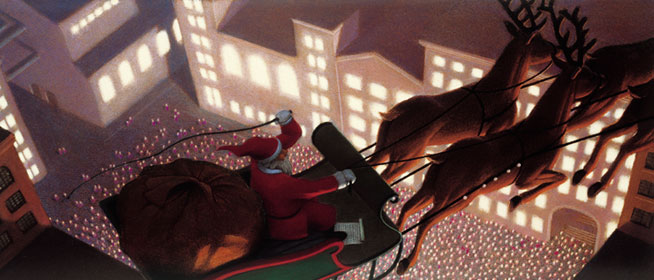
My favorite scene from “The Polar Express.” 

As a grown man with thoughts of career and family, he stopped reading fiction, but he never stopped thinking about it. I have often said that I remember little of my father from my childhood, though if I were to excavate the loose grey matter I hardly use, I would find him exactly where I needed him most.

He often picked me up from daycare and, if he came home later (though always in time for dinner), he would come bearing a large stack of children’s books from the palatial Cerritos Library. When we lived in the city, he took me there on weeknights or Sunday afternoons so that I could make my own choices and I will never forget that magical wing, designed to mimic a medieval castle with turrets filled with thin, colorful spines, each bearing a tale, not necessarily a lesson. But after we moved to a city some thirty minutes away, he often stopped by on his way home from work and picked out books with what he hoped was a discerning eye. To be honest, I don’t remember many of the books – The Polar Express, The Velveteen Rabbit and The Vanishing Pumpkin stand out (going online to see the covers of these books now, for some reason makes me cry) – but collectively, they comprised a lovely childhood.

What’s more, my father told us stories – at least, he tried to. It is a running joke in our family that my brother and I ought to know those stories by heart, at least the Journey to the West, because my father boasts of having played raconteur to us each night around bedtime. And he did, we do, but only parts. He always fell asleep after three or four lines so we never heard the ending. How did the sly monkey and pious monk get to the West? More than anything my brother and I know the sound of his snores, which now blend seamlessly with our perception of that tale. I know now, from Chinese school and later studies that the monk, the pig and the monkey eventually reached their destination, but it is vague to me, unlike my father’s introduction to the story, which still rings loud and clear. Indeed, you must be able to recall the fables and other bedtime stories your parents told you as a child – perhaps you never even set eyes on the words but you remember them and the images they evoke. It becomes innate – the stories as much a part of your genetic makeup as your hair and bones, your heart.

For years I rolled my eyes at my father, thinking he would never understand me because I loved novels and he seemed only to ever read business books and magazines, but looking back, I realize I had forgotten the source of this love. 

100 Years of Vanity, Part V

She was a terrible cook, but nobody could peel shrimp, crack open a crab or a lobster, a mussel or a clam, or disassemble a German pork knuckle as adroitly as my grandmother could and to her liking. No one else could make friends with servers and maitre’ds and managers alike despite being with the most difficult customer many of them had ever known. She knew his appetites better almost, than she knew her own, and it was at the table that we learned how little we knew how to communicate with him – the least we could do was follow her lead. But it was too obvious, to both ourselves as well as to the rest of the world, that the family was at a loss on how to appease my grandfather should grandma step out for a moment.
But these moments were rare – for twenty years she was unfailingly by his side, always there to cater to his vanity, and on the morning of his one-hundredth birthday, she was there as well.
God knows what he dreamed during the night, but at four am his eyes shot open with an all-consuming hate for his aged complexion. Perhaps it was the thought of appearing before four hundred guests under bright ballroom lights, but being an innately vain man, he decided to take extra precautions. He shuffled resolutely into the bathroom and turned on the lights. A few feet away, my grandmother stirred in bed. Having spent the last twenty-years sharing his biological clock (one that wakes often at odd hours of the night to use the bathroom or read the paper-or both), she simply turned the other way and pulled the blanket up to her chin. My grandfather ran his fingers along the shelves, silently reading the minute labels until he found what he was looking for. He began his work.
The balcony, where my grandpa usually stood doing his morning exercises was empty. The bathroom door was closed, a strange phenomenon, for in his old age, the fear of an unheard fall led him to bathe with an open door. She was worried – aside from the hundred ticking clocks of my grandfather’s collection, it was oddly silent. No running water, no brushing of teeth or wringing of frayed undershirts. She went to the door and knocked. Nothing. She knocked again but not before hearing the distinctive click of a compact being closed.
“Can I open the door?” She asked.
“Hmm.”
“What are you doing in there?”
When my grandfather failed to respond she held her breath and turned the knob, bracing herself for what she was not sure, but certainly not to find her husband, a distinguished gentleman to all who knew him, with his face done up like a retired geisha who had failed to remove the makeup from her last night at the teahouse. He turned slowly, a crazy, hunched wax man, and had he the humor to give her a devilish grin she might have died of fright. Instead he said nothing, nodding subtly as though using up an entire bottle of foundation on one’s one-hundredth birthday was de rigueur, and went back to work.
My grandmother rubbed her eyes, not sure if she was dreaming. Why the mask? Why the rosy cheeks? Did he intend to celebrate his one-hundredth year as a lunatic? A transvestite? But the man had laid out his suit and shoes the night before, pairing a red-silk vest with a red-silk handkerchief and now, he apparently wanted his cheeks to match. Between gnarled fingers he held, gingerly, the blush compact in one hand and the brush in the other. Round and round he went on his left cheek, seeing only the perfection of perfection- he was merely enhancing what he always had. He was a handsome actor preparing for his greatest role ever.
Grandma, now fully awake, stepped in.
“You look…” she considered his one hundred year old ego, then thinking about the four hundred guests and her seat next to him, she considered her own, “You look ridiculous.”
I was getting my own beauty rest two floors above, but I imagine a small tussle took place in the master bath that morning as wife tried to wrestle away blush compact from husband.
But he said nothing. Chuckling softly at his handiwork, he handed the compact to her.
An hour later grandma had exhausted an entire box of Kleenex and half a bottle of makeup remover. Her husband’s skin glistened once again in its natural beauty and his cheeks glowed with the faintest pink, from having been rubbed with tissues.
“See,” my grandmother told him, tossing the final Kleenex into the wastebasket with its makeup-laden siblings, “You don’t need any of that makeup – you are handsome enough as is.”
He looked in the mirror and agreed, touching his face and enjoying the softness. Then he looked at her, his patient, adoring wife who had always known best. He looked at her tired face, the dark circles under her eyes, her fuzzy hair – she looked that way because of him, because of all the energy and love she spent on him. He loved her for that.
Still, it was his birthday and she would be sitting next to him.
“We haven’t much time,” he said, handing her the compact, “you’d better get started.”

The End 

100 Years of Vanity, Part IV

The young woman was thirty-two, the same age as my aunt, and forty-eight years younger than my grandfather. And she was beautiful. Petite with strong, high cheekbones, full lips and a full head of thick hair, a shock of surprise rippled through the family when they met her for the very first time. She was beautiful, my aunt recalled, but she had a hard look about her, as though something or someone was forcing her to marry this drastically older man. But far from it, her decision to marry my grandfather was entirely her own.
            She was working as an administrator at an appliance company, filing forms and payments on air conditioning units and refrigerators, when a coworker, the sister of an aunt, suggested that she meet an elderly man she knew.
            I was two at the time and living an ocean away in a leafy suburb of southern California, utterly oblivious to any grandmother but my mother’s mother, who lived in the neighboring city and made sweet buns for us at Chinese New Year’s. As I played in American sandboxes, the union that would provide me with a Taiwanese grandmother was being arranged in the humidity of Formosan air. The mental intricacies that would push a young woman of thirty to agree to meet a man of eighty with the implied expectation of a partnership remained uninvestigated for years, but as I grew older and my grandparents’ relationship became clearer, I opened my ears and became very still when my grandmother was out of the room and the other women remained behind. In this way I pieced together a shadowy history of my grandfather’s last wife. 
Five years prior to her marriage to my grandfather, she had been in love with a man closer to her own age. They had both come to Taipei from the poorer southern city of Tainan, hoping to make a new life for them in the big city. A friendly and sociable woman whose confidence was boosted by the move to a bustling city with the love of her life, she quickly found a job at the appliance sales company and worked diligently, saving most of what she earned towards buying a house with this man. He on the other hand, remains largely a mystery – my grandma only ever told my mother once, vaguely, about what happened – but what’s clear is that after five years of life in the city, her savings close to what was needed to buy a house, she came home from work one night to find the house empty and the man gone along with every penny in the bank.
I’m not sure what sort of conversations they had on their marriage night or in the days after, but I believe that my grandfather asked no questions. The ease with which he lived was the same ease by which others conducted themselves around him. His new wife felt this immediately. My grandmother, the only one I have ever known on my father’s side, did not marry for money per se – though of course the money was welcome – rather, she wanted a decent man. I am not one to explain the psychological process that leads one to marry a man forty-eight years older – maybe my grandmother was a little crazy – but in all the years I have known her, and him, neither grandma nor grandpa ever gave any indication that they were nothing but meant for each other.
Just as with wife number four, my Grandfather lavished his new bride with gifts and countless trips around the world, except this time with grandchildren in tow. Which suited my grandmother fine, because she was as humble as my grandfather was vain. She delighted in the old man’s vanity and even encouraged it, for she loved to comb his hair for him, to buy him the latest Japanese beauty creams, and to pick out brilliantly colored ties and handkerchiefs. In China, she bargained fearlessly for the best prices on suits and shoes, her Mandarin saturated with a heavy Taiwanese accent that would normally cause mainland vendors to disregard her, but her easy laugh and friendly nature made her hard to dislike. And while in the first decade and a half of their union my grandfather was fully capable of doing all these things himself, he delighted in her company and the looks they drew as they walked down the street and into restaurants.
Had the age difference not been so wide, they would still have made a strange couple, for my grandmother was notoriously the most tackily dressed member of the family. She wanted none of the finery so coveted by the fourth wife or the social status of the third. She wanted only the security of being with a good man, and my grandfather, aside from his narcissism, was a good man. It wasn’t until after his ninety-sixth birthday that the first signs of senility began to show, but even then my grandmother rose to the occasion. Though she had the financial means, my grandmother refused to hire a caretaker for my grandfather and gamely assumed the role of nursemaid, chef, driver and secretary. Despite his growing need to sleep and a diminishing appetite, my grandfather maintained a robust social schedule, keeping memberships at several of Taipei’s ritziest hotels, to where he treated his friends for lunch. When these men, many of whom were also retired customs officers had begun to die off, my grandfather took to treating officers from later generations or his colleagues’ grown children and their families. These elaborate, time-consuming meals were by no means exclusive to customs officers. I remember many a summer afternoon whiled away at a ritzy hotel buffet or within the dim, wood-paneled dining room of an upscale steakhouse. My grandfather specialized in treating people to the business lunch: three courses for the price of two. These meals became a family tradition – a rite of passage for anyone who wanted to know the family better and it was during these meals that any outsider, and the family as well, acknowledged just how necessary my grandmother was to my grandfather’s wellbeing. 

100 Years of Vanity, Part III

His sons were horrified. They warned their father about the rumor they’d heard: the woman’s last husband had died in a mysterious manner. Though extremely rational and normally disdainful of anything that bore the slightest whiff of the superstition, my uncles went to consult a fortuneteller (most likely on the recommendation of my second aunt, who seems to know all the good fortunetellers). The prophetess said this: “Beware this fourth wife: she has the qi (energy) of a husband killer!” What the fortuneteller meant was not that she had murdered her last husband, but she had a ruinous air about her – whoever married her would succumb to her insatiable karmic appetite and have his life drained from him. But my grandfather chortled, “Husband killer! Doesn’t she know she’s wife number four?”
Filial piety bound my uncles to let their father do whatever he wanted, including squandering a small fortune on the wedding, gifts and anything else his high-maintenance bride wanted. They honey-mooned for what seemed like half a decade, traveling across the world twice and taking photographs in front of every famous monument – their pictures have an air of glamour about them, my handsome grandfather in his three-piece pin-striped suits, arms crossed confidently across his chest, and his beautiful wife, dressed in luxurious silk and linen pantsuits, elegantly at his side. On the surface they were a beautiful couple, and when they weren’t abroad they were entertaining at home, attending parties and premiers, concerts and theater.
The things that brought them together – her beauty, his wealth – could only last so long, and as her looks faded she became more and more demanding, wanting each year to transfer more and more property to her and her children’s name. When his sons approached him to put a stop to it, my grandfather shook his head lightly and shrugged, “She loves money. What can I do?”
He put himself first and this meant avoiding confrontation at all costs. He would never be the one to suggest a divorce, or even think it. They were messy and in bad taste. Instead, my grandfather continued to live. It was around this time however, that he began to practice selective hearing and while his wife’s screeching for money became louder and louder, he perfected his inner calm, tuning her out to gaze at her once beautiful face.
One day, after nearly ten years of marriage she became enraged after being refused one thing or other and screamed, “I want a divorce!” Before she had paused to take a breath to reevaluate my grandfather stood up from his desk.
“You got it,” he said, and walked calmly out the door.
The marriage ended and my uncles breathed a sigh of relief, though they wondered if their stepmother had escaped with her life. However, not too long after, she too passed away from illness. She was a year shy of seventy.
By now, my grandfather was eighty years old, but looked not a day over sixty. His daily regimen persisted through the years and had served him well; it became apparent that he was in impossibly good health for a man his age – he would live a very, very long time. No one knew this better than my grandfather.
Months after the divorce he called in his second son’s wife, a sociable young woman with a large network of friends and family.
“I want to remarry,” he said.
“Of course,” she replied, “You’re in excellent health and have plenty of years ahead. You ought to remarry.”
“To marry someone young,” he said.
My aunt smiled, “I’m sure we can find someone who knows a nice woman of sixty or seventy.”
“No.”
“No?”
“No.”
At this, my grandfather leaned in and said more words to my aunt than he had spoken to anyone else in a long while, “I’m eighty,” he said, “And I know I will live for a very long time. If I marry someone now who is sixty or seventy, in ten years they will be seventy or eighty – and I don’t need to be a fortuneteller to know that they’ll need someone to take care of them by then. I don’t want to be old with old. I need someone who can take care of me – for however long I live.”
My aunt was stunned, perplexed. How young was her father-in-law thinking? Certainly not someone younger than fifty? A thirty-year age difference was cause for scandal, but then again, so was a money-grubbing B-list movie star. My aunt kept the conversation to herself, replaying it in her head and wondering what to do. She didn’t have to wonder long. A few days later, it was announced that for the patriarch, a new bride had been found. 

100 Years of Vanity, Part II

A man born in Shanghai carries Shanghai with him forever. Thus my grandfather neither bid farewell to Shanghai nor did he abandon all hopes of reunification with his daughters – he communicated with them frequently via letters and kept every epistle his daughters sent. When relations between China and Taiwan resumed, he returned twice each year to his native city and made sure his daughters and their children (by then two had married) were financially secure. But mostly now, his attentions were directed at his new wife, his three sons and, unwaveringly, upon himself.
It is hard for a vain man to be emotionally available, and my grandfather was no exception. Once I asked my father whether he recalled any heart to heart conversations with his father and without pause my father replied, “Nope.” But by no means was grandpa a cold man – he smiled generously and loved his wife, his sons and his friends in the best way he knew how: by spending time with them. He spoke little during his children’s upbringing, preferring to smile and watch rather than talk and interact. It was his third wife, my biological grandmother, who kept household affairs running smoothly, made sure their finances were in order and disciplined the boys; it was my grandfather’s job to go to work everyday, come home to dinner, and smile as they talked to each other. He appreciated the finer things in life and was lucky that his business-minded wife trained her three sons to be business-minded as well, buying land as a future investment, teaching them the value of the dollar and pressuring them to pursue graduate studies in the United States. My grandfather, in all his thrift, agreed with her, but pursued his own interests in ballroom dancing and attending parties. He loved to dine out (but never drink), dance and be seen at parties with his wife on his arm (a beautiful woman was always his best accessory) and he easily became the life of the party without saying more than a few words. His presence alone put everyone around him at ease and this was largely due to the fact that he neither tried nor was interested in persuading, entertaining or getting to know others. This was the other side of his vanity – the desire to know only himself, and superficially, those closest to him. As his sons grew into successful businessmen and his peers began to appear more and more disheveled and wrinkled with age, my grandfather seemed to grow more youthful with pride at his sons’ successes and his wife’s financial prowess.
“I never asked for any of this,” his smile seemed to say, “But you know, I am a lucky man.”
Luck, by definition, does not encompass the death of a spouse or, in my grandfather’s case, the death of multiple spouses. I should mention here that his second wife had died in Shanghai of tuberculosis shortly after she discovered my grandfather could not return from his post. His first wife had succumbed to the same disease. Thus twice widowed and in Taipei, my grandfather married a third time to the woman who would bear him three sons to pass down the family name. When my father had been working for only one year at his first job out of graduate school, his mother was diagnosed with terminal pancreatic cancer. Perhaps she had worried too much – her sons’ futures, their girlfriends (none of whom she liked, my mother included) and about the family’s finances – while her husband worried about nothing, but the cancer spread quickly and she was dead within a year. The whole family mourned along with much of Taipei’s high society, for by then my grandmother had, by shrewd investing and thrift, amassed a small fortune for the family, providing her sons with the capital to start their own business.
My grandfather was saddened but his two younger sons were consumed by their grief – they had been immensely close to their mother. My father, the eldest, was working in Hong Kong through much of her sickness, was sad but strangely detached – also, his relationship with his mother had been strained during her last months; she disapproved of my father’s wanting to marry my mother, of whose poor background she disapproved.
“Your grandmother was vain in a different way,” my mother said to me, “She worried about the face, the reputation of the family while your grandpa was always more concerned about his actual face.”
And it was true – less than a year later, my grandfather was on the hunt for wife number four, believing that the best beauty treatment to keep wrinkles at bay was to marry someone young and beautiful who would worry about the things he couldn’t be bothered by. With his children grown and their success growing, my grandfather felt it less important to find a “motherly” figure for his children than to find a stunning woman with whom he could be seen with out on the town. Likewise in his youth, my grandfather, at the ripe old age of seventy, was still quite a catch and there was no shortage of women who wanted to marry him. He finally set his shallow sights on a beautiful fifty-eight year widow who had in her younger days been a B-list movie star. She on the other hand, had her sights set on his money.