Old Habits, Don’t Die

Many of the things I used to do, I don’t do so much anymore:

  • Read books. (As opposed to the constant stream of news and magazine articles I half-read at work). 
  • Watch movies. (“Drive” was the last film I saw and sitting in the dark room with a large screen felt almost foreign.)
  • Go to the library, which, I suppose, goes along with reading, though more and more I find myself missing the quiet atmosphere and smell. Ah, musty paper.
  • Cook/bake. (We had our Thanksgiving potluck at work today, something I had thought for a long time I would certainly bake something for, but the week rolled by and the only thing I contributed was my appetite). 
  • Clean my room. (Not that I ever needed to do this before; from ages 6-25, I had the energy to keep my room neat as a pin on a daily basis. I made my bed every morning, fluffing the pillows and tucking my sheets in just so – I liked that I could come back to a room that seemed like a freshly turned hotel room. In college, my roommates stared at my half of the room which seemed like a set from a stark, war-time barracks where everything was rationed. They wondered if I had perhaps spent some time at some women’s boot camp. When my roommate’s father visited, he whistled and said, “You could bounce a quarter off your sheets. That was the test back when I was in the army.” I merely shrugged, “I like things neat.”) 

Even after college, when everyone said, “Oh you’re not gonna have time to do that stuff anymore,” I found the time to watch a movie, visit the library and read a book at least once a week. Twice a week, I would bake hearty oatmeal cookies and banana bread to give to my relatives.

I had no idea these were all indicators of unemployment or poorly defined internships.

There are women at work who can do all of the above and their jobs quite well, but they were blessed with enviable energy reserves. Or perhaps not reserves at all, but energy. After a normal week at work I spend weekend mornings zoned out, putting from room to room in my pajamas and standing in front of my bookshelf, wondering if I should attempt to read something longer than a NY Times column. Though I do light up briefly in the evenings – just long enough for me to drive to LA, dance for two hours max (before my feet hurt), and drive back, only to spend the next day in an exhausted daze. On Sunday nights, I often go to bed at 8PM to prepare for the following week.

“You need to exercise,” my mother said, and like a good daughter, I recommenced hot yoga – but that is a false remedy. For some people, exercise is taxing. I feel better in theory; walking out of the studio, I think, “Ah, I am more energetic,” and for two hours following the class, I am – but when I really need to be energetic is at work, between the hours of 8:30AM to 5:30PM, when things need to be done with clarity and precision.

Instead, I smile as brightly as possible; say everyone’s name in a sing-song voice to mask my fatigue, and let my tired tail show anyway, by doing things like making coffee for my boss without that vital element.

This morning he walked into his office and then out again, holding his mug.

“Get me some coffee from the Keurig,” he said, handing me the mug filled with water tinged with brown. It seemed more like a weak earl grey than bold Sumatra roast coffee. “Look at this coffee. What’s the matter with it.” 

I stared at the water, wondering why the coffee had turned out so impressively weak. Painstakingly, I retraced my steps. I had filled the pot, poured the water in, closed the lid, pressed the button…

Damn.

“I forgot the coffee.”

“Yeah, the coffee,” my boss said, then he tapped his head and pointed at mine, “You need to put some beans in here.”

Generic Death

Edouard_Manet_-_The_Balcony_-_Google_Art_Project
The Balcony, Edouard Manet  1868   Oil on Canvas

A few weeks ago my boss emerged from his office with his hair combed, wearing a suit and tie.

“Where are you going?” I asked.

“I told you,” he said, “A funeral.” Continue reading “Generic Death”

Housekeeping

My boss called me from Taiwan today, 4:30AM his time, which meant he was in a chauffeured car en route to the airport, where he’d board a small plane to Hong Kong and then from there, a larger plane to Melbourne where he is scheduled to play a few holes of golf with Tiger Woods, the world’s most famous philanderer.

Planning his trip, I asked him what else he’d like to do, should gambling or Tiger turn out to be rather uneventful. I imagined my boss tuning out as Tiger tried to show him the right way to grip a golf club. (“See here, you put your thumb here…the strippers love that.”)

“I’ve never been to Australia before,” my boss said, “I’d like to see the coastline.”

The words themselves were strangely romantic and he delivered them in an almost thoughtful way. I wondered if he would arrive at Lorne or Sorrento, kick off his shoes and run to the water. Calm, tiny waves (depending on the location of the moon), would lap at his toes as he stood with hands on hips, belly thrust forward, salty sea air whipping through his short hair. Perhaps he would wear a crisp white shirt. The collar, normally stiff, would bend and sway and eventually flip up and out, seduced by the sea. Perhaps he’d experience true quiet for a few moments – he would be in the land down under, surrounded by nothing but the sea and unfamiliar territory. There, he could be truly anonymous. As long as he put his phone on silent.

But I know my boss. He is half a dreamer, which means, give him enough time and he will inevitably retract the dream and replace it with something more immediate. A few days before he left he said, “Scratch the coastline. I don’t have much time. I think I’ll just walk around the city.”

I tried to picture my boss as flaneur, walking with his hands in his pockets, alone in a foreign city whose denizens were all uniformly tall, blonde, tanned, and great with wild animals (such is my stereotype of Australians). But this picture faded quickly; by now my boss was accustomed to being driven around. Perhaps his Australian chauffeur would be a washed-up ex-surfer who had been injured on the great barrier reef and who had tried his hand unsuccessfully at a string of jobs before discovering his love for the road. It was somehow comforting to drive powerful men around. The driver would be unusually chatty, intrigued by this portly Asian man with the furrowed brow and bulbous nose – who was he and why was he so important that he was playing golf with the world’s most famous philanderer? It didn’t matter. The driver would impress him with his knowledge of Australia. Why didn’t he want to see the coast? It was Australia’s crowning glory – a gift from nature, surely, but they did a better job than the Americans of keeping it clean. My boss would chuckle deeply in that misleading way of his, “Sure, sure,” and lean back, close his eyes, and remind whomever to change his driver tomorrow. This one was too chatty.

When the call came, I tensed up for a millisecond, the way I always do when he calls. He is, by all means, a low-maintenance sort of boss. He prefers me to email him, though not incessantly. I learned this on my first day, when the bubbly HR girl walked me up the stairs and said in a low voice, “Don’t ever, under any circumstances, just forward him things. He HATES that.”

I nodded solemnly. Of course. My job was to trim the fat – take away the million stupid little things that would irritate or worry him. So far, I think I have done alright, though in the beginning it seemed to be sort of a gamble: do I just copy and paste this message and pawn it off as my own? Does he want me to reply and then cc him? I did everything with bated breath and when all was quiet on his end, I accepted the possibility that my system, whatever it was, was acceptable.

So the call. On his last trip to Asia, his first since hiring me, he had warned me that there would be times when he would have to call me at odd hours.

“Just be prepared,” he wrote to me before boarding the plane, “I’ll try not to bother you, but sometimes, shit happens.”

I giggled, both endeared to the fact that he had said, “I’ll try not to bother you,” and that he had used such coarse language. If he was exercising the powers of reverse psychology, it worked.

“Don’t worry, Boss,” I typed back, “I read the job description.”

He was gone for a little over a week, and aside from the emails that pinged during the night, he never did call. People at the office who had seen the past two assistants slowly unravel were incredulous.

“You mean he hasn’t woken you up in the middle of the night?”

“Nope. Not once.”

“He never called.”

“Nope.”

“Not even when you didn’t respond to his emails right away.”

“No.” by then, I was wondering if we were still talking about the same person. Apparently not.

“Sounds like he’s changed a lot,” one of them said, “The last assistant always looked like a zombie whenever your boss went to Asia. She said the phone would ring nonstop sometimes.”

That’s horrible, I thought, and truly, every night when he was away I braced myself, wondering if I should just turn the phone off and feign to be a deep sleeper. But I left it on in case he were to call. I had read the job description. It said 24/7. But he never called.

Apparently, everything went smoothly. Before I knew it he was back in the office and certain executives stopped storming around my desk asking impatiently, “When is he coming back? Is he on vacation?”

But he called at 1:30PM this afternoon, which meant it was 4:30AM in Taipei. My heart constricted, so adept am I at handling stress. Did his driver not show up? Did the plane break down? Did he want to see the coastline after all?

I answered, my voice reminiscent of a strangled altar boy.

“Hello?”

“Betty?”

“Yes,” (ah, voice back to normal), “Hey Boss, what’s up? How are you? Is everything okay?”

“Haha,” his laugh sounded hollow and far away, not least because he was very far away, “I’m still alive.”

“Oh good.”

“So about my awards ceremony at the university.”

“Yes, yes, about that.”

I blanked out for two seconds before I remembered that he was being presented with an Entrepreneur of the Year Award at a local university’s school of business. Before he left he had mentioned buying a table and filling it with executives and VPs, as per usual.

“I want to do something a little different,” he said.

“Okay…”

“I think we can send out an invite to the executives, but if they want to come, they can buy their own tickets.”

“Got it. But do you still want to buy a table?”

“Yes, but I want to invite some younger people. We need to mix it up a bit.” he paused for a moment and I imagined him rubbing the sleep off his face, “Ask around. We have some younger employees with entrepreneurial spirit. I want them to come out to this event to represent our company. They can hear my story if they haven’t heard it before, and it’ll be nice for them to mix with the MBA students.”

“Got it.”

There was an awkward pause as I thought of something else to say.

“So… anything new?” He asked, “everything okay?”

I wondered if he really wanted me to fill him in on whatever was happening in addition to the emails he was sending me. Of course not.

“Everything’s fine,” I said, “Just housekeeping. Your uh, ice maker has been refreshed and the wireless HDMI kit is being installed. Everything should be ready when you return.”

“Ok,” he said. “that’s all?”

“That’s all.”

“Okay. I just thought I’d call about the Awards thing rather than write it out. Well, don’t worry. I’ll talk to you later.”

“Have a safe flight, Boss.”

“Thanks, thanks,” he said.

We hung up and I looked around the office. A few coworkers were staring at me expectantly.

“Is everything okay?”

“Yeah,” I said, “He was just checking in, I guess.”

“How nice of him to call during your regular working hours.”

“Yeah,” I said, thinking that maybe he would go see the coastline, “He’s cool like that.”

Do Not Cry at Work

This Eulogy may very well be the most famous thing Mona Simpson will ever write. Reading it, I began to cry in the office – not loudly or anything, just sniffling in what I hoped was a covert manner. A few of my colleagues walked by, one of whom stared at my eyes and said, “Wow, you must have really bad allergies.”

“It’s this eulogy,” I said, my voice cracking.

“What?”

“This eulogy. Steve Jobs’ sister wrote it for his memorial service.”

“Oh,” my colleague said. She is normally extremely chipper to the point of being robotic. A consummate HR professional, she hides her feelings behind a saccharine smile and soft, musical voice. It is hard to decide if her eyes glint from perpetual glee or if it’s the glare of her oval glasses. From the day we first met she had categorized me in the same way: I was an admin, hired to meet and greet. She was in HR, in charge of welcoming new hires. It was our job to smile incessantly. Never stop smiling. Ever. Who was this teary-eyed Betty?

She stepped back, suddenly looking uncomfortable. Her expression reminded me of the time I placed my dead grandfather’s hat on my superstitious cousin’s head. She looked at the screen, and then back at my red rimmed eyes. “Well, I’m uh, sorry for interrupting your…” her eyes scanned the ceiling for the right word, “…feeling.” She raised her voice several octaves and patted my desk, a strange gesture considering my arm was also right there. “Feel better!”

As she walked away, the coworker across the way turned around. She had overheard the conversation (as she always does) and stopped typing in order to give her two cents (as she also always does). A strange quiet ensued, the kind that follows after a fan suddenly stops whirring, or when you are asleep in the car until suddenly the engine stops because you’ve arrived at your destination. She turned over her shoulder and looked at me, her eyes squinting in a strange way, as though she were studying me.

“You are such a softy,” she said. I disliked her tone. There was, crouching beneath it the subtle implication that I was somehow weak.

“What?” I said, “I cry easily.” I was thinking, “Give me a break woman, it’s a eulogy. They’re supposed to be moving.”

I emailed the eulogy to a friend. “Oh my goodness it’s so good I’m crying,” I typed into the message box.

“What the hell are you doing reading eulogies at work?!?” she wrote back, “Crying doesn’t help with productivity, does it?”

Another coworker came up a few minutes later to look for someone. He stopped in front of my desk. My tears had dried, but my eyes were still rimmed red.

“You sick or something?” his voice was monotone, his face expressionless. Did I want to explain myself to him?

I thought of saying, “Yes, I’m sick,” or falling back on the allergies thing, but the pitcher with big ears was still there and she would undo whatever lie I supplied. “It’s this eulogy,” I said lamely.

“Jesus,” he said, then, not finding whom he was looking for, walked away.

Lesson of the day: there is no place for tears at work.

In Praise of No Praise

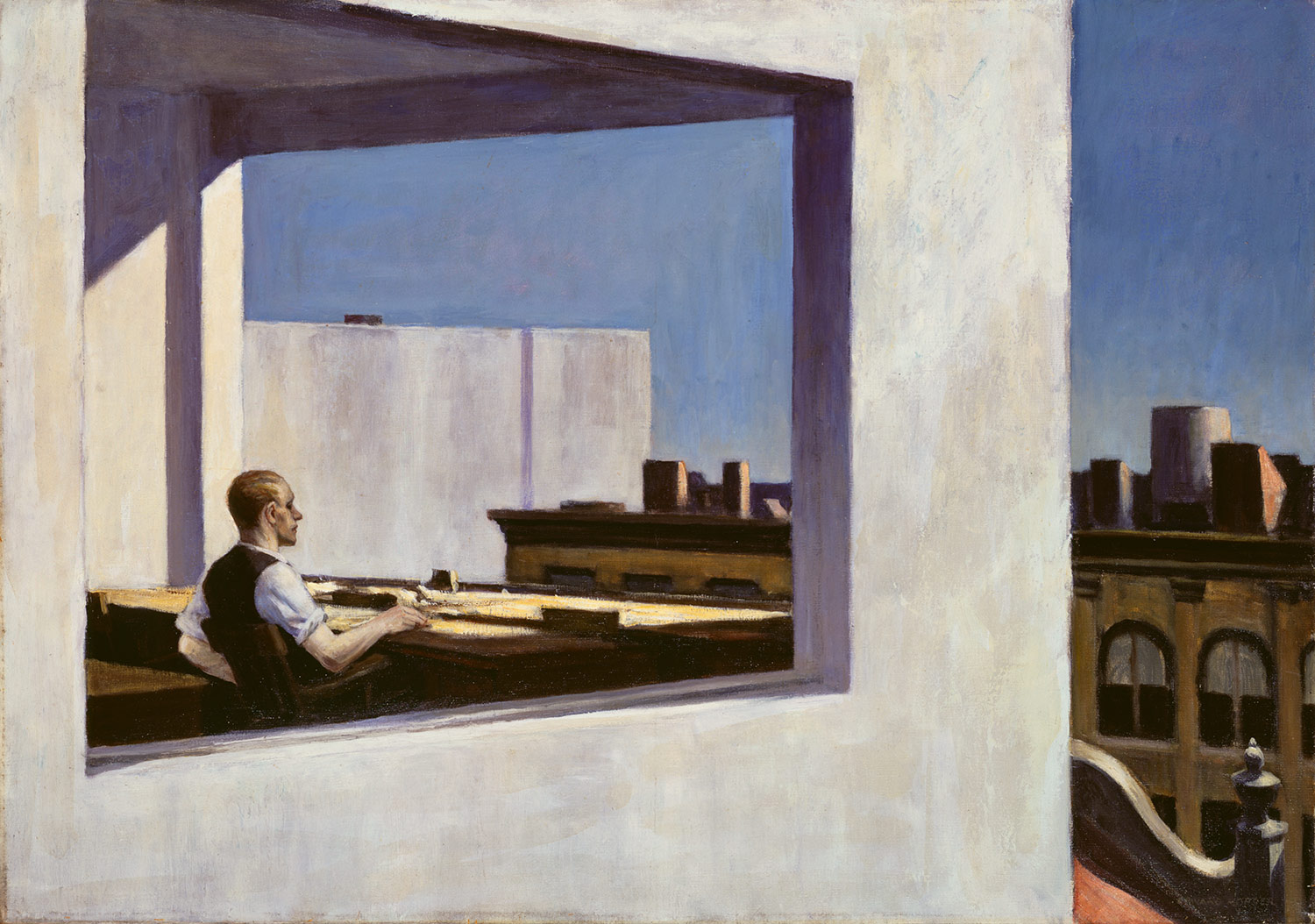
Office in a Small City, 1953 Edward Hopper, Oil on Canvas

Sometimes I hate emailing my boss because his replies, if any at all, are terse almost to the point of being cruel to someone like me, who writes almost as much as she talks. He writes, “Do this.” “Do that.” and, when he gets angry, he’ll attach an exclamation mark at the end. “Next time, don’t cc everyone!” or “The van is really dirty!” Yet in person, he is quite affable, and I like to think we have a good relationship.  Continue reading “In Praise of No Praise”

Assistants 2

Gina left big shoes to fill. And rather than hire a girl with big shoes, HR hired a big girl.


“Well, Bonnie wasn’t big when they hired her,” a coworker named Cindy explained to me, herself the victim of career-related weight gain, “but she didn’t do her job very well…wasn’t really on top of things, which stressed her out, which made her eat, which, you know, made her fat.” 

“How fat?” (I had to ask.) 

It was afternoon and the dark circles under Cindy’s eyes were in danger of becoming permanent, but her eyes brightened when I posed the question to her. I could tell she’d be a rich and willing source of company gossip. She even had the gestures to match, and dramatically cupped her hand around her mouth, as though to shield her lips from whomever could see, though the office was mostly empty. 

“Thirty pounds,” she whispered loudly. 

My jaw dropped. 

“Thirty pounds? THIRTY POUNDS? In ONE YEAR? What the hell did she do? Eat one of the accountants?” 

“Shhh!” Cindy said in faux panic, as though the old executive assistant was still here, hiding in the vending machines. She nodded slowly and held out her pudgy hands and puffed out her cheeks, “Yes. It was a very dramatic change. She blew up like a balloon.”   

A few days later another coworker fleshed Bonnie out further. 

“It wasn’t even that she was fat,” said Jane, an athletic Asian girl in marketing whom I quickly befriended at the risk of seeming like a huge lesbian, “She was a bitch. She hated all the girls her age and was only nice to the boys. And on top of that, she like, got dressed in the dark or something. Totally did not know how to work with her…heft. She would wear these like puffy sweaters and jackets that only made things worse for her. And she’d always ask me, ‘Does this make me look fat?’ And I’d say ‘No, no,’ but really be thinking, ‘Hell yeah it does, fatso.’ It was bizarre.”  


Bonnie was a UCLA graduate who had apparently interviewed well. My boss expected her to bring the same energy and spunk she had showed during her interview to the job, but a few months into Bonnie’s employment, he felt duped. In addition to being rather piggy – “Bonnie was always eating something at her desk,” Cindy said – she was also lazy, preferring to surf the internet for long bouts rather than run errands or schedule meetings. Important emails went unanswered which led to tiny pockmarks in my boss’s public complexion.

Perhaps a member of Bonnie’s family. 

I imagined Bonnie to be a rather formidable figure – a nasty girl who abused her power (“Which she absolutely did,” Jane said dryly, “until I verbally bitch-slapped her, and then she at least didn’t give me attitude.”) and sat on her haunches waiting for things to be done for her. She was, after all, the EA for a year, which to me meant my boss put up with her. Had he been afraid of her? 

“Oh of course not,” Cindy said, rolling her eyes at my naivete, “Bonnie was terrified of him. But you know, so much of what she does doesn’t really get back to him. She could pawn her incompetence off as someone else’s by saying, ‘Oh well, so and so hasn’t gotten back to me about that, so I don’t know,’ or ‘I told him to do it, but he hasn’t done it yet.’ When really, she was the one who wasn’t doing anything.” 


Add to that the course of human nature: fear turns into hate; miscommunication turns into non-communication which exacerbates misunderstanding and prejudice. Fourth grade stuff. From what my boss has hinted at regarding their relationship, I gather that they did not get along in the end.

“Bonnie was not so great,” he said one afternoon. 

“Someone told me she was fat.” 

He looked up from his monitor and I could see the beginnings of a grin, but he pursed his lips and decided to take the high road. 

“It was her laziness,” he said, “Laziness is the young person’s death. You can be stupid, but you have to be willing to learn. And if you’re willing to learn, you cannot be lazy.” 

I made a mental note to never fall asleep at my desk in front of him.  

But it is also human nature to disdain those that cannot control what you try so hard to control in yourself. You think: well, I could do it, why can’t they? Around the new year my boss resolved to lose sixty pounds and to be, in general, a healthier individual. He had spent much of his life being fat. His words, not mine. When I first researched him, his pictures were pre-weight loss, and I walked into my interview surprised to see a much thinner man – (thinner, not quite thin). Later, I asked him why or where he got the motivation to lose weight. He shrugged, “I was fat!” 

It was a very straightforward answer and because there was no way for me to say with a straight face, “No, no you weren’t,” I merely nodded in agreement. 

“I’ve been fat my whole life,” he said, “so last year I decided to change. I started working out. I stopped eating carbs. Stopped drinking wine.” 

He looked at me, “You see my schedule, you know how often I have to go out to eat and drink and entertain.”

“I do,” I said, “There are lots of temptations.”

“Exactly. But I did it. I stuck to it. I’m not a lazy person, but you know, when it came to my health, I was for so long. So I decided to stop being lazy, to learn about my health, and I lost sixty pounds.” 

Life must have been awful for Bonnie around then. I imagined her waistline, butt and thighs gradually expanding while my boss arduously whittled himself down. He walked past her desk every day, a beacon of hope for all the fatties in the company while Bonnie gained in both mass and resentment. Why should a man nearing middle age be putting her youth to shame? I’m no psychologist, but I’m quite certain that Bonnie, at that time in her life, ate more than ever, teeth and tongue gnashing more viciously out of rage and contempt, both dangerously misdirected outwards towards her situation but were responses to her self. 

In the end, my boss lost sixty pounds of fat and to mark the occasion, he decided to cut some fat at the office as well. 

“Esther went around tell people that she’d gotten into a prestigious grad school,” Jane said, her face skeptical, “But I think she was fired.” 

I attempted to verify this with my boss. 

“So Gina was great, but Gina left.” 

“Yup.” My boss’s eyes remained on the monitor. 

“And Bonnie was not so great.” 

“Nope.” 

“So what happened to Bonnie?” 

“It didn’t work out,” he said vaguely. 

“Did she…” my voice trailed off, and my boss turned to look at me. 

“Don’t worry about it.” he said, “Just remember what I said about laziness.” 

I nodded solemnly and made a mental note not to get fat.  

Assistants*

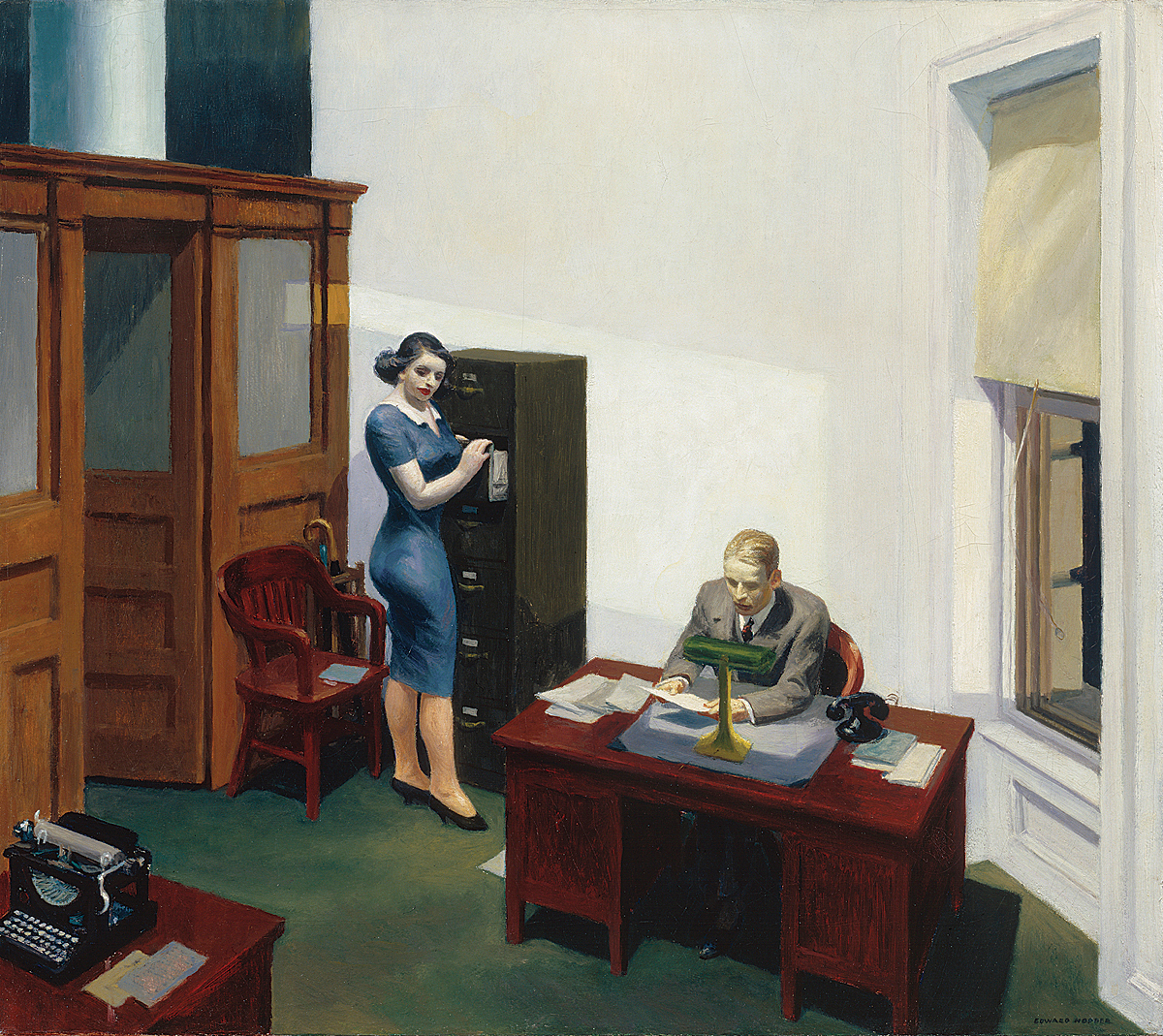
"Office At Night" Edward Hopper, 1940  Oil on Canvas
“Office At Night” Edward Hopper, 1940 Oil on Canvas

*The following is fiction. Or vague facts blended with vivid fiction.

At work, I’ve been finding ways to inject my personality into things. My work space, for one. I cleaned out my desk in the first three days, which, if you can’t see my desk (which none of you can), doesn’t sound that impressive, but trust me, my coworkers were impressed.   Continue reading “Assistants*”

On Kindness, 1

It finally hit me today: the thing about kindness – what it is, what it is not.

For weeks, I’ve been running old conversations and scenes through my mind, playing and replying them like old, grainy, homemade films – or worse, depressing romantic dramas starring the likes of Ralph Fiennes and Carey Mulligan. I’ve been weighing the characters of all the men I know (not very many), and wondering what it is about the few I love or have loved, and about the rest for which I cared little. It must be said that my father, with whom my relationship is best described thick with cliche as “love/hate,” made the short list for both.  

Let me say this – I am nowhere near having as whole an answer as I’d always hoped, but if this was all the “eureka” I could squeeze out of this one nagging question, then I’m happy to hang it up as my North Star.

This afternoon, for the third time in a month, my boss lectured me about paying attention to detail. I made yet another mistake on his calender, blundered verbally – he was talking about one thing, I responded about another, and then laughed when he said he had gout. Yes. I can be quite insensitive at quite the wrong time – but my boss let it slide, chuckling at my candid insensitivity, and I warmed towards him, thinking, “Oh, what a kind man. He lets me laugh at his ailments.”

Then rather abruptly, he turned back to his computer screen and said, “Nothing else? Let me get back to work. If I need anything else I’ll let you know.”

What more could I want from that moment? He had pointed out what I had done wrong in a calm, even tone – no tantrums from him unless I really push him over the edge; overlooked the fact that I had joked about his gout (“You eat too well,” I said. He nodded in agreement), and as it was the end of the day, was more or less giving me the okay to call it a day. 

Yet something bothered me about his last words: “If I need anything else, I’ll let you know.” And here, at the risk of sounding too whiny, I admit I thought, “What if I need something else? Some more guidance? Some more information on how to do things right?” I bade him good evening and walked out of the office, then turned briefly around through the glass wall that separated my desk from his and saw him slumped low in his expensive ergonomic chair with adjustable armrests, clicking through his thousands of unread emails. I had walked out of his office, out of his mind, and the thought of me would never cross his mind again unless something, or someone called it to his attention.

Of all the exchanges with people I have had, why was this the trigger? Because then, loudly, a thought resounded, echoing something my friend Elena had tried to explain to me:

“Do not mistake duty for kindness.”
“Do not mistake indifference for kindness.”
“Do not mistake common decency or manners or all the other stuff you’re supposed to do because you’re living in civilized society and because you’re a social animal, for kindness.”
And most importantly, again, “Do not mistake indifference for kindness.” 

My handful of lunches with Ben flashed in my memory: the tour he gave, but also which I asked for, of Stanford; the lunch he paid for, the time he took to drive me around searching for the gym where my cousins twirled and whirled during their ballroom practice while I, deluded with my warped definitions of kindness, danced alone outside. And then a few months later, there was his willingness to meet me again for lunch, even though had I not called him, we would never have met up again. I mistook his delay in informing me of his engagement for kindness – and perhaps partly, it was, but he was mostly just being polite, not wanting to steal the thunder of my 25th birthday. And what thunder.

Excursion into Philosophy, 1959 Edward Hopper Oil on Canvas

I was on the road home from Vegas when Ben emailed me about his engagement – I read it and smiled a tired smile to no one in particular, wondering why he had waited to tell me then and not on my birthday a week earlier, when he had emailed to say, “Happy Birthday. I’ll write you a longer message later in the week.” But at that moment, it didn’t matter – my mind still lingered on the night before, on the memory of a first kiss traded in part for a glimpse of a tattoo, in part for a slim black tie that lay in the folds of tired shoes and short dresses in my suitcase. Leaving Las Vegas in the state that I was in, It was a strangely appropriate souvenir.

That Other Life

If you let them, some things die. Hopefully not this blog.

*

Edward Hopper Office at Night, 1940. Oil on Canvas

I’m two weeks into my new job as executive assistant and already experiencing doubts as to whether I’m “cut out” for it. Or any job. As a student (a time of my life which seems paradoxically distant yet recent), I had sat, curled on my bed one afternoon and read this book. In it she writes something along the lines of, “I became a writer because I couldn’t do anything else. No really. I was unemployable.” I had laughed then, wondering if I’d feel the same way once graduation came and went. And it did. That damn day crept up on me like the Lochness monster (by most accounts, the Lochness monster is quite stealthy) and before I knew it my mental bones had been ground and spat out onto the asphalt of the road I’m standing on now. I had to pick up the pieces and rebuild it to withstand the pressures of the real world. All I can say is, an architect I am not. I did so poorly. Very, very poorly.

*I will likely be reusing this painting in future posts.