Writers, Copywriters 2

Fifth Avenue Bridge  Martin Lewis  1928. Drypoint. 

My coworkers were so different from my classmates. I thought about my workshop from last semester – a group of misfits who oddly enough, when arranged together around rectangular tables in a small classroom, seemed to fit perfectly together. There was the failed actress turned sex columnist; the former (and probably current) meth/crack/heroine addict, the spastic magazine writer with an unidentified eating disorder; the pretty but awkward Brazilian sportswriter who’d slowly gone in a downward spiral until she underwent gastric bypass and discovered that she was actually a genius and joined MENSA (“You know what we do in MENSA?” she said to me over lunch one day, “We compare medications.”)

There was the old woman who sat defensively with her shoulders hunched nearly to her ears and whose hair was so dry I feared it would burst into flames at the slightest friction. I detested her at first because her first essay sucked, and then I sort-of-kind-of reluctantly admired because she took the writing teacher’s advice and made it much better when it was workshopped again. There was the Indian girl who had, back in India, been in an abusive relationship. She had fought with her parents until they agreed to let her come study in the States and was now, according to Facebook at least, in a loving same-sex relationship. And there was the professor, in her late thirties and beautiful in a devil-may-care way and slightly aloof. A winning combination for any professor or woman, for that matter. Everything about her I learned from the sex-columnist and other classmates who adored her and wanted very much to take another workshop with her, though I felt distanced from her, partly because she didn’t seem, most of the time, to want to be in the classroom. She was an adjunct and had another real, full-time job as the editor of an online magazine. I went to visit her once at her office and we had a short conversation (“I’d like you to speak up more in class,” she said. I nodded. “Anything else?” I shook my head. “Okay then.”) before it became clear that she had to get back to work, real work. The kind that paid the bills. 

And there were my counterparts – the girls like and unlike me – who had grown up in loving suburban families, who had never done drugs (until they did finally do drugs), who had held a string of odd part-time jobs (strip club waitress, 9/11 archivist, Costco cashier assistant), who had traveled and who wanted to continue traveling but who, at the same time, wanted some sort of internal anchor to keep us centered even when we were in the air. We could write well about a few things, but weren’t sure in the long run if that’s what we could do without running out of words or energy.

Suddenly, with birthday pizza on my lap in the copy room of Company X, I felt like I was in class again – Introduction to Real Life…?– surrounded by the corpses of English majors past that had now been repurposed into living breathing copywriters, all dressed almost exclusively in Madewell and J. Crew (the higher up you are the more full-priced items you can buy!). I got a weird sinking feeling that I and my thrift-store wearing, Brooklyn-living (except I live in the Upper West Side), part-time job-holding, chain-smoking classmates were fooling ourselves in thinking that writing for ourselves could somehow bring us the emotional and material life we wanted. It seemed that these girls, even that damned playwright who seemed to fit in so well despite his side job (though seriously, which job did he consider his “side” job?) must have, at some point, had similar dreams. Until the morning they woke up and turned uncomfortably onto their sides, seeing through the open window, “Oh! Reality.”

I wasn’t depressed, not quite, not yet, but I left the office feeling like a new cog in a giant, though much more fashionable, start-up-ish wheel. It didn’t help either that the walk home that night was bone-chillingly cold. The sounds of the street, usually welcoming after spending an entire day cooped up in my studio, seemed abrasive. I was now one of the hundred thousand people walking home from a tiring day at work. The wind hit my cheeks in sharp, icy slaps. I wasn’t underdressed, but was cold to begin with because I had sat and sat, staring at painfully cheery copy until my innards froze from physical inactivity and my right hand, on the mouse, had turned blue as it usually does when I leave it in that position. The light above my work desk had gone out so my corner had been a monotonous grey except for the blinding glow of the computer screen. 

I frowned about these things as I went down into the subway. I frowned as I stood waiting with other people just getting off work, most of them also frowning or bearing no expression at all. In the subway, a man played Spanish guitar and several people frowned a little less as they walked by, deciding after a few steps to return and drop a dollar or two in his open guitar case. On the train, I frowned as I was shoved to the left side doors, then to the right side doors, then towards the middle of the car. I frowned too, when a dirty old homeless black man boarded and began to sing, “I’ve got sunshine on a cloudy day,” informing us that he was in fact, “singing for supper.” I looked away, still frowning. When he left for the next car, I looked at the young men and women and at the not-so-young men and women around me, most of them tired, all of them trying to make a living in various fields. I guessed that most too, had more responsibilities than I, to children, to wives, husbands and parents. To themselves.

I wasn’t being fair. I didn’t have to be, but I ought to try. Especially with former English majors who had read the same books I read, loved the same authors and poets and used, when they could, the same language. Their jobs didn’t define them anymore than an MFA would define me, than the sour smell of the homeless man defined him. They had merely gone a different way and I was passing through, looking. 

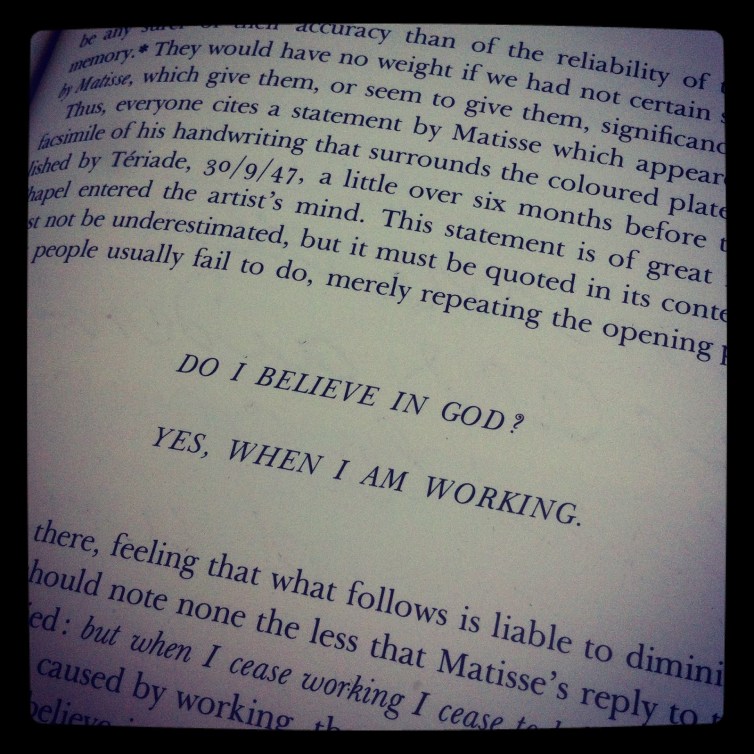
I stopped frowning, but I didn’t smile either. I was dreading the stairs up to my apartment. I held my keys ready as I came out from underground and walked passed the two bums, one of whom was already fast asleep, himself undoubtedly having gone through a trying day and the other still “working,” though he shivering, stomped his feet and blew onto his hands. His gloves were thin and filled with holes. His sign was crumpled, but I could make out the two words that seem to appear in every homeless man’s message: “Help…God.”

“I get it, God,” I thought, looking up, “I get it.”

In the dark chilly skies above my warm apartment, God shrugged. He hadn’t said anything. 
Writers, Copywriters

On my second day at work, we celebrated my supervisor’s birthday. She’s a tall, quiet vegetarian, a year younger than I and was one of the two who interviewed me. On screen she’d reminded me of certain British actresses, pretty in that romantic English rose way (though she’s from Vermont), with bright eyes, dark lashes, flushed freckled cheeks, thick brows and curly hair that she keeps in a low, messy but elegant bun. She’s slightly more expressive over our office instant messenger than in person, but only slightly. She’s very polite. Wears chunky sweaters and jeans, worn boots, simple jewelry. Her legs are strong and I wonder if she took horse-riding lessons when she was younger, or if she still does. She’s from a good, probably privileged family, but I’m guessing her father is a stern man who doesn’t believe in treating his daughters like princesses. When she sits, she keeps her hands folded between her legs and rubs one thumb with the other. One gets the feeling that she’s waiting for something better – a better job, a better guy – but also that she doesn’t know what she’s waiting for. One gets the feeling that she is, at her core, a very patient young woman.

At noon, the smell of cheese and tomato sauce filled the cold air of the copy room and in unison, a handful of girls yelled, “Surprise!” I turned around to find that a few senior girls from the copy team had ordered pizza, beer and Ben and Jerry’s and had quietly arranged it all over a giant round table in the center of the room. We pulled our chairs up around it and ate with plates on our laps.

“Any fun birthday plans?” we asked the birthday girl. She shrugged, her face flushing. She embarrasses easily. 

“Just dinner with my parents,” she said softly.

“How’s it feel to be 26?” asked a 24-year old. 

The girl groaned, as though she had been thinking all morning how to answer, “I don’t know,” she said, shaking her head, “It feels the same.” 

“It’s all downhill from here,” someone said jokingly, and the half of the room that was older than 26 (but only slightly) turned to glare. 

A few of the girls began inane conversations about old jobs, of which there had been just one or two, or none at all. I’m one of four new hires and on the older side of the copy team – 27 going on 28 – while most of the other proofreaders are 24, 25 and one new hire being just 23. 23 is the only black girl in the copy room (and so far, the only black girl I’ve seen in the company). She is exceedingly bubbly and, despite her obvious hurry to accumulate the markers of adulthood, seems childish compared to the more reserved, reticent copywriters. For one thing she joked twice in one morning about needing coffee (“Sooo much coffee. It’s so bad, I know. So bad,”) though she was just drinking it because she imagined real adults did so. She was clearly still running smoothly on the fumes of youth. She started working a week before I started; not long enough yet to tire of her commute from her parents house in Westchester County, which is about an hour and twenty minutes by train, her last transfer being the one, the same line I take to get downtown. Though judging by how fresh faced 23 seemed coming out of the subway station compared to my morning death mask (and my commute was only half the time of hers) I felt she could and would handle it for as long as necessary.

On my second morning we had exited the subway station together and I said hello at the crosswalk. She tugged out her headphones and smiled, “Oh hey!” and we walked into the building together. In the elevator she learned that I lived on my own in the Upper West Side.

“That is so cool,” she said, clasping her hands together, “My goal is to move out and have my own place in the city by 2015. I wanna move out here so baaaad.”

23 loves the job more than it will love her back – genuinely friendly people, according to disenchanted employees on the company’s GlassDoor profile, don’t make it far at Company X’s New York office, which is run at all levels by competitive, high achieving and mostly female staff– but 23 is well, 23. She’s starry-eyed. Optimistic. All the things a 23-year old should be. And she’s especially enthusiastic about the company’s perks, which include a gleaming kitchen filled with healthy, organic free-for-alls, unlimited soda, fresh fruit, tubs of Greek yogurt, a beer tap (yes, you heard that right. A beer tap. On my first day I filled a mug thinking it was hot water. “It’s beer,” someone said. I nodded, looking into the foam and then quickly dumped it), bagel Fridays followed by a weekly company-sponsored happy hour, discounts to high end gyms and team outings and plenty more – though admittedly, my gluttonous self is happy about these things too.

At the birthday lunch 23 was the most voluble and gushed about how much she was liking it so far at Company X.

“So different from my old job,” she said, telling us she’d worked at a textbook publisher, “You guys actually celebrate birthdays here and that’s awesome.”

She proceeded to share several more things about the company she found “awesome,” and I sensed the senior copywriter, the one who had probably hired twenty-three, doubt the 23-year old’s vocabulary.

No one asked me about my last job, which seemed very long ago. Instead, a few of them had heard through the grapevine that I was a grad student.  

“English?” one of them guessed.

“Creative writing,” I said. Then it occurred to me to ask, “Was everyone here an English major in college?”

They looked around at each other at first, hesitating as though I had accused them of something embarrassing, until one by one they began to nod. All the girls save for two said yes (we are all girls except for one guy, a part-time copywriter whom I can’t decide is gay or not. He’s an actor and-playwright and is currently starring in a Fifty Shades of Grey parody called “Cuff Me.”). The exceptions had studied psychology and art history (“But with an English minor,” she said with a conspiratorial smile).

I nodded, “Oh cool.”

They too thought it was “cool”, that I was studying creative writing, but I got the feeling they meant “cool” in the way things you used to want were cool, until your priorities shifted and you decided that having a stable job with health benefits and a retirement plan were cooler. I don’t blame them. Security and a sense of direction (up, up that ladder!) can be pretty cool. I sensed that to this particular, well-dressed group, being an English major and all the fleeting little hopes that came with it (wanting to be a writer, maybe getting a PhD and teaching or working as an editor at a publishing house or magazine) had fallen away as the realities of making a living anywhere (and especially in New York City) manifested. 

It was like a dress they used to love but couldn’t bear to part with, so instead they kept it in the back of the closet. They still took it out to look at from time to time but either couldn’t fit into anymore or simply had no place to wear it.

Flight

*Bringing back some old stuff I removed, just to remind myself that it exists. 

In a few days my boss will leave on vacation. In his absence, I am to drive to his house twice a week, once to make sure the main water line is on (horizontal) and once to make sure it is off (vertical). Before his departure, I must see that his dog Fluffy (one cannot make up such a creative pet name) is safely boarded at a dog hotel and that his housekeeper is driven to her home in South Central LA, worlds away from her “office,” just as my mind is often, at the office.

When I first interviewed, the woman asked me if I would be okay doing the occasional personal tasks for my boss. I nodded gamely, thinking that personal things wouldn’t occupy more than twenty percent of the job. My main station, after all, was still at the office, at the massive desk right outside my boss’s office. I had my own printer, was just a stone’s throw away from the fax machine, and had drawers stocked with office supplies and company swag. But things change. Or more accurately, certain situations reveal themselves slowly…. roses bloom then wither and fade. Job descriptions can do that too. 
Here’s the sad part. I’m pretty damn good at the personal stuff because it doesn’t take much brain power. Driving to and from my boss’s house is easy. Making sure his wife knows when the Kogi truck is in town so I can stand in line and buy fifteen burritos, fifteen tacos and four quesedillas before she comes to pick them up is easy. Making sure his kid has a ride to and from tennis camp is VERY easy. But when you’re tired all the time and you just don’t want to do it- any of it, regardless of whether it’s personal or for the company – everything becomes hard. 
This afternoon my boss gave me a brief lesson on booking flights. The itinerary itself was slightly more complicated than his usual LAX – wherever – wherever – LAX. It was something like LAX – wherever – wherever – wherever – wherever -wherever – LAX. I showed him several options for the whole trip, then he started to ask questions about specific legs. 
“What about from wherever to wherever? And what if I left at this time? How much is first class? How much is business class? Can I fly direct from LAX  to wherever? Are the business class seats completely flat?” 
None of this in one go, but in spurts. So I started to answer his questions in spurts and in doing so, confused the shit out of myself. I wasn’t blessed as my boss was, with razor sharp memory. I hang on to the tiny morsels – crumbs, really – of memory that I have and pray, like I did in high school biology, that those morsels would be exactly what he wanted to know. But of course it never is. Booking these damn flights took me a week. 
“I could pick up the phone right now, call the agent, and get it done in ten minutes,” he said, “But you need to learn how to do this. You need to learn how to make it simple.”
He strolled to the easel he has in his office for grand ideas and quickly wrote down the route options I’d given him with the corresponding times. I watched in awe – I had read the itineraries over and over and still did not know a single one by heart. 
“Look at it,” he said, “You’re making it too hard for yourself. I don’t know what you do that.” 
The only thing he was missing now, he said, was the price for each route, “That’s the only information I need you to get now.” 
I had gone bleary eyed trying to give him details about the shorter flights in-between, confusing myself and irritating him in the process, giving him B, C, D, E, and X, when really he just wanted to know the three different options from A to Z and how much each would cost.
He drew a squiggly line in between the A and Z and said, “All that shit in the middle is important, but you can tell me that later, when I’m done deciding the big picture, how to get from A to Z. When deciding A to Z, I need to know two things: how long, and what does it cost.” 
He held up two fingers and said, “It’s all very logical when you think of it this way Betty. Time and money, right? I have money, so sometimes that allows me to save time. But I still want to know what it costs. How can I get there in the shortest amount of time and with the best value? Those are the two most fundamental things when it comes to making decisions in life: time and money.” 
My boss doesn’t know it, but he’s quite the philosopher. I agree wholeheartedly with his statement but will add another fundamental: energy. 
It seemed that this particular exchange, above all others, underlined to me exactly why my time at the Company is drawing to a close.  

Practical Advice: Father Knows Best

Two years ago around this same time, I found myself back in California looking for a job. I had just returned from a long weekend trip in Carmel, celebrating my Uncle Louis’s second, for-real retirement (at the eyebrow-raising age of 70) from an aerospace company. Before Carmel I’d been in Asia for a two month-long “waiting” period in much the same vein as I now await graduate school admissions decisions (more on that later) though back then it was for a Fulbright. The Fulbright didn’t come through and I went home to celebrate my uncle’s retirement and mourn my own entry into corporate America, hoping companies wouldn’t ask what I did immediately out of college.


“Well, I was banking on getting this scholarship thingy that would allow me to continue dicking around Asia.” 

“Please leave.” 
I clawed at my face, “What does this mean?” I asked my friends, most of whom were well into graduate studies or about to be or had been working full time for a while. 
“Get a job,” my friends said, “Get real.” 
I didn’t panic, but rather listlessly sent my resume out to random, underpaid Craigslist listings with job titles all containing the word and or variations of ‘assistant’ which I have now come to recognize as a synonym for ‘underpaid, sometimes severely.’ For a few weeks, nobody called. My parents knew the hunt was hard – it was hard for their friends’ children, most of whom were more accomplished and goal-oriented than their daughter – so it was perhaps wisest to inquire politely from time to time and give me no further pressure unless I started looking at plane tickets again. 
One evening, having sent out two dozen or so resumes and cover letters (do people even read those things) to companies that I knew vaguely about, I shut my computer down and went to the living room where my father sat with his feet up on the round glass coffee table, watching the Taiwanese news. He did this every night and mostly did not like it when I tried to speak to him over the pretty news anchor with the light but forceful, staccato voice. I needed an ego boost, something my father, he of the “you could stand to lose about ten pounds,” or “don’t stand like such a man,” or “girls who roll their eyes at their fathers usually stay single forever,” was unlikely to provide, but he was a working man and more importantly he supported me with his work. As of late, having sent more than a hundred resumes out into cold black cyberspace and hearing only radio silence, I realized the possibility that he’d need to do so for a few years more. I needed to know that my father would be okay if I were to be unemployed forever. 
“What,” he said, not bothering to look up from the TV screen.
“The job hunt.” 
He looked up, and kudos to him, read my face, “Not going well?”
“Not at all.” 
He sighed, “I’ve been telling you and telling you. Nothing in this world is easy. You’re the only idiot your age who didn’t rush into the job hunt out of college. You should have started looking in school.” 
“I was applying for a Fulbright!” I sputtered, incredulous though not deservedly so, (applying for a Fulbright is quite different from completing a Fulbright or discovering a cure for Lupus), “I didn’t want to get the job and then get the Fulbright and have to be like, ‘Oh sorry, psych! I have to go and be a Fulbright Scholar now, ha ha.'” 
My father shook his head, “Who cares? It’s always easier to say ‘no’ to a job offer than say ‘yes’ to nothing. You should have started looking a long time ago.” 
This was not the ego boost I was looking for. I did not want the conversation to continue down this particular path, nor did I want to go back to my room to continue the job hunt, but to do anything else would have seemed frivolous. Apparently I should have been making up for lost time and been trolling job postings 24/7, but at that moment, I wanted my dad to make me feel better. Mostly because my mother wasn’t home. She was playing badminton. If anything, I could have used a pep talk and decided to prompt one. 
“Sometimes,” I said grandly and with as serious a look as I could muster – so serious that it was borderline comical, “Sometimes I just want to marry a rich man.” 
My father looked up at me with a sudden, grave interest. He leaned forward and turned off the TV, something he almost never did unless we were arguing and I yelled at him to turn it off. I was mildly surprised and I thought, “Here we go, here’s where Dad goes, ‘Hell no my daughter won’t think like that. I raised her to be a smart, independent woman who will work hard and not have to rely on anyone else to take care of her.” I braced myself, it was a fatherly monologue I needed to hear. 
Instead, over the barely audible buzz of the darkened TV cathodes, my father nodded and say, “That’s okay too.” 
Excuse me. 
My father nodded at me, “I said, that’s okay too.” 
“Dad!” I looked at him with a confused grimace and he at me with eyebrows raised and eyes wide, a strange, hopeful smile on his face as though I had just presented him the solution to the world’s oldest riddle. 
“No, I’m not joking,” he said, “some girls don’t aspire to much, at least career wise.”
“I have aspirations!” I said. 
“You say you want to write! You’ve said that forever! But I don’t see you writing!” 
“I do!” though in fact at that point, I hadn’t, not very much, and not very seriously. I was saving my creative juices for the Fulbright, though in fact I just needed an excuse to not do anything at all for a while. 
My father shook his head, “Look, that’s beside the point. I know you don’t have huge career aspirations. But Jesus, look at you, you don’t even have huge feminine aspirations! You want to marry a rich man but where are you going to find him? And how are you going to find him looking like that?”
He waved at my person, tsk-tsking at my limp hair and pajamas (uniform of the unemployed), sallow, uncared for skin, and just general lack of feminine mystique. I didn’t know whether to laugh or cry, but then again, I am my father’s daughter and it seemed more appropriate to laugh.
“What are you talking about?” I said. 
“Invest in yourself if you don’t see yourself investing too much in a career,” my father said, “Go buy some makeup! Lose some weight and get some new clothes!”
“Dad,” I said, “You’d have to pay for the makeup and clothes.” 
“Okay!” he said, getting more worked up as he spoke, “It’ll be an investment! Make yourself pretty and for God’s sake go out more with your friends to where young people go. All you do is sit around at home and eat and tell me not to eat. You think you’ll meet a rich man loafing at home all day in your pajamas nagging your dad?”
I did not, but I was also still stunned by the conversation in general. What had happened to all that talk before about hard work and self-reliance? Did something change in me or in him? Did my father see (or not see, perhaps) something in me that made him think “investing” in my physical appearance would somehow lead to a more secure future? 
“Do you think I’m incapable of supporting myself?” I wasn’t angry, just curious to know. If my father was anything he was honest. 
He leaned back into the couch and turned the TV on, though kept the volume low. 
“I don’t think you’re incapable,” he said, already beginning to tune out, “My daughter was born capable. But I’m saying you need to set some goals and work towards them. Don’t waffle. Don’t wait. Act. Act now, act fast. You want a job, you prepare for it, right? You want a rich husband? Well, there are preparations for that too.” 
I lay on the couch and watched the news but didn’t listen or register any of it. I was thinking. Slowly, the volume crept back up and five minutes later looked at my father’s face; his eyes were back at their usual after-dinner diameter. 
I pushed myself up, and looked back down at my father and smiled. He smiled back. 
“Thanks Dad,” I said, “I’ll go invest in myself now.” 
“Good. You made a decision.” 
I did, but not fully the one that was implied. As my father began to nod off, I walked away smiling to myself with the memory of the time in the sixth grade, when all the cool girls were wearing Lucky Brand jeans that cost $60, an obscene amount of money to spend on jeans, especially when most of my clothes were hand-me-downs. 
“I’d really really really like a pair of these jeans that everyone at school has,” I had said to my dad, whose clothes are almost exclusively from Costco (polo shirts) or JC Penney (trousers and Hush Puppies), “But they’re kind of expensive.” 
“That’s okay,” my father said, taking out his wallet, “Go buy yourself a pair. How expensive can they be?”
Before I could respond, he took out a twenty dollar bill and pushed it into my hand with the self-satisfaction won from being a father who knows he can always provide for his daughter, “That should do it, no?” 
Back in my room the computer stayed off. The job hunt would continue, that was for sure – better to invest with my own funds than shock my father with the brutal truth of what beauty and its upkeep cost – but for now, I needed my beauty rest. That was free. 

Return to Sender

“I’m sending you back to your parents,” my boss said.

It was my last day at The Company.

“Sorry?” I said, “I still live with my parents.”

He chuckled, “I know, but go home and tell them that I say, ‘Your daughter is going back under your care.’ My responsibility for you ends here.”

I laughed, wondering what he meant.

“This whole time, I felt like I was parenting you.”

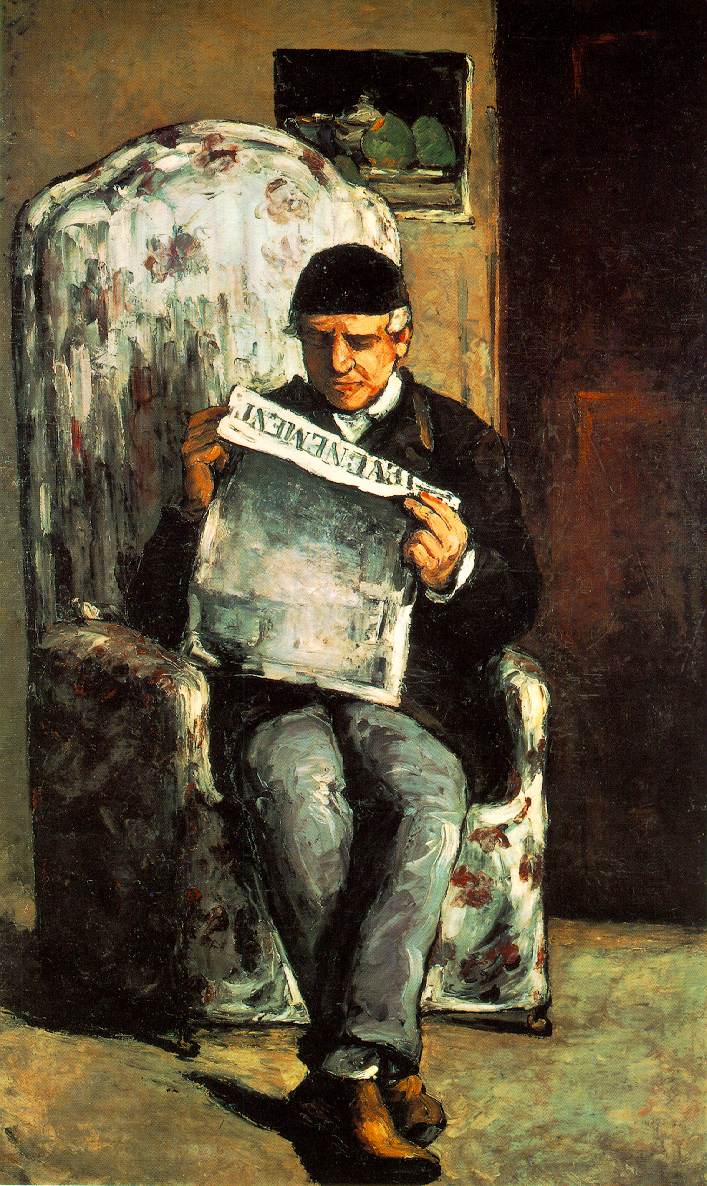
Portrait of the Artist’s Father, Paul Cezanne 1866 Oil on canvas.

 I recalled an awkward moment at one of my boss’s events, where after he’d accepted an award a mob of people swarmed our table to congratulate him. His wife was seated on his left and I to her left. Their daughter had taken the seat on my boss’s right but had gone to the restroom. His wife leaned towards me, asking me one thing or other as was cutting through my filet mignon. A man appeared over my shoulder, patted me on the back and said to my boss, “So is this young lady your daughter?”

I shook my head a little too hard and said five “No’s” in rapid succession so that the pink slice of steak I had so carefully speared quivered and loosened from the tines of my fork. It belly-flopped like a tiny, shitty diver onto my dress.

My boss’s wife laughed and my boss pretended not to see my little mishap. Though to my surprise, he didn’t falter or vehemently correct the man, who also pretended not to see though it was his stupid assumption that ruined my dress.

“Oh no,” my boss said, “She’s my assistant,” then pausing to think about it for a moment, “Well, yeah she could be my daughter.”

I dabbed at the steak stain, (thank god my dress was purple) and smiled in what I hoped was a winning manner at the man, who seemed less interested in me now that he found I wasn’t a blood relation to my boss. My boss’s daughter returned to the table and was immediately accosted by the man and a few elderly women wearing too much makeup.

“Of course she’s your daughter!” they squealed, “Look at the resemblance!”

My boss’s daughter, ever polite and modest, smiled and said thank you. Thank you, thank you.

———

In his office, my boss leaned back in his chair, “I hope you learned a few things from me. And I don’t mean all these tasks I gave you, but just as a person.”

I mentally ran through a few of our key lessons, but my boss did an oral review.

“You forget this and that, don’t plan ahead, pass information around before processing it…”

I nodded, “Yeah, yeah, I know. I’ll try not to do that in my personal life, or in my endeavors to become a writer.”

“So you don’t need a reminder to brush your teeth, right?”

I laughed and shook my head. One night a few months ago after a particularly terrible streak of forgetfulness my boss had sent me what was most likely his angriest text ever: “I feel I have to remind you to update my calendar when you make changes every two or three weeks. This is your job! I hope you don’t need me to remind you to brush your teeth!” 

I read the message at 10PM on Monday night – only Monday! – and wondered how I ought to respond. Should I even wake up the next morning or would he write an email to me that night asking me not to come in anymore?

In the end, acceptance seemed to be the best reaction. I typed, “No, you don’t need to remind me to brush my teeth. And you remind me much more often than that.”

He didn’t write back, not because he was furious at my response, but because there wasn’t anything else to say. What can you do when the person you are angry/disappointed/frustrated with knows exactly why you feel that way and they accept it? You let them bathe in the frustration and hope they remember the shame and the resulting exhaustion. You hope they never let it happen again. 

“Nope,” I said, “I can definitely remember to brush my teeth.”  

My boss grinned, “Good. You learned something. Hopefully you can remember all the other important stuff.”

The Replacement

HR worked fast and stealthily. For weeks they said they had not found anyone until suddenly the resume of “the perfect candidate” appeared in my inbox.

“Please let your boss review,” they said, “We think she is the perfect fit and want to get her in right away before she goes somewhere else.”

I printed the resume (two pages!) and before my boss walked in, devoured her work history and references. If I were gunning for the same job I’d have gulped. She was, as her meticulously curated resume indicated, a professional EA, having worked at least two or three years in each of the positions listed. I was impressed.

“How old is she?”

HR looked at me as though I were stupid. And rude.

“You can’t ask me that.”

Hm.

I’m no mathematician, but I can put two and two together. Her resume indicated that she’d graduated college some twelve years ago with a major she had no intention of applying in the real world. Or perhaps she did – who knows – but most of us are familiar with the fear that strikes so suddenly when we’re on the cusp of stepping into “the real world.” Aspiring filmmakers, psychologists, philosophers, dancers, and yes, writers promptly morph into accountants, tutors, administrators and restaurant hostesses, the ink on their diplomas hardly dry, in industries as far from our hearts as the college campuses we so blithely wandered upon for four years. Time flies, as they say.

I studied the woman’s resume, trying to picture her face, mannerisms and style of dress. From the paper alone I knew she would interview well – how else would she have moved from job to job with virtually no lost time between? I imagined her striding in, briefcase in hand, suit tailored to a T, vibrant red lipstick applied expertly over thin, unsmiling lips. She would shake my hand with a firm if not crushing grip as though silently communicating to me all my failings, “Go and play out your girlish dreams in the cushy meadows of grad school,” this handshake would sneer, “Leave a profession to the professionals.”

She would, as any good EA ought to be, a door closed both to herself and to her boss, an icy cool enigma rather than how I was, a foolish open book who in the beginning shared much more about my boss and his schedule than he felt comfortable.

“Your job is to keep my schedule and act as gatekeeper,” he’d once written to me, “STOP OVER SHARING!!!”

She would certainly not commit a fraction of the faux pas I so freely showered upon the poor man. The coffee! That damned coffee machine! My damned, leaky memory! Her resume still in hand, I ran through the series of unfortunate events during which I felt sorry for myself but really, when I think about it, was really subjecting my boss to the brunt of it all. I made appointments but forgot to record them, leaving poor, soft-spoken foreign gentlemen sitting alone at my boss’s various lunch clubs while he had no idea because they weren’t in his calendar. More than a few times, I’d put down the wrong address, the wrong phone number, and mailed concert tickets to the wrong people (though they didn’t complain). And the most dangerous mistakes of all involved my inviting people outside the company to internal meetings (though in my defense there are too many Asian men with the same damn names) thereby sharing internal agendas, memos and email addresses with people completely uninvolved who would politely write back, “Um, I don’t think you meant me….” or, “I think you have made a mistake I am not on the board of your Company!”)

No. The woman behind this particular resume would make none of these mistakes and if she did, would EXPECT to be fired. She would recognize the gravity of all these situations and in her utter professionalism say very gravely, “It will never happened again.” I tried this. But after the second or third time I remembered an old fable and did not say it again. You see, I could not guarantee it.  But this woman, though faceless, seemed to represent some sort of Executive Assistant Messiah – she would lead my boss to the promised land where all appointments were checked. Secrets kept. The company’s leader and as a direct result its underlings would be run like clockwork. The bullets shot out at me with measured precision: “Step. Aside. Little girl. Step. Aside. This is the big leagues and your boss has decided to play with a better team.”

My boss came in and I handed the resume to him.

“HR found someone they think you’ll like,” I said, “Her resume looks pretty good.”

“Oh?” He took it, gave it a quick scan, and turned it over to read her references. Then flipped it back to the front. His expression remained unchanged. I searched his face for some indication of agreement. Finally he spoke.

“This looks good to you?”

I nodded, “Yeah. I mean, she’s got good work experience.”

He scoffed. What did I know about work experience? Boss had a point – my whole resume, with nothing omitted, was a compendium of odds and ends – a curio cabinet on paper. I’d worked several internships, all more or less writing intensive until I started at the Company which was email intensive. But sandwiched in-between each unpaid but “career-building” internship was a paying job at Rite Aid, Costco, Calvin Klein and, most briefly, a Borders calendar kiosk. Then I started here and was gainfully employed for a whole year, with a salary, benefits, the whole corporate shebang I’d heard about but had never truly experienced.  

So again, my boss was partially wrong: I did know a lot about work history, not because mine was long, but it was undeniably populated. 

At the very least the woman’s experiences were each longer than two years. I pictured myself staying at the Company for another year but shuddered at the image of myself ten pounds heavier and ten years older in the soul. I’ll pass.

“She hasn’t stayed anywhere longer than two years,” my boss said, “This isn’t the best work history.”

I gulped. Had he even seen my resume?

“This is the longest I’ve ever worked anywhere,” I said to him, “and it’s barely over a year.”

He looked at me over the edge of the resume, glasses perched on the bridge of his wide, fortunate nose. There was something fatherly about his look.

“You’re just a kid,” he said, leaning back into his ergonomic chair, “You can still change your ways and get away with it. I’m telling you now to knock it off. All that waffling… You say you want to write, then write. Don’t do a little bit of this and a little bit of that and not really write and then five, ten years from now try to pursue a writing career. You’ll be older with less time and less choice. You’re lucky now! You have a choice!”

I nodded.

He joined his elbows together and made a “Y” with his arms, “You’re at a fork in the road, you know? Pick a path and stick to it.”

It was very profound. I shuddered again. I saw the resume he held in his hand and how really, it was no different from my own resume, which he had held in the same way, with the same fingers and probably wearing that same shirt a little over a year ago, when I was on the brink of walking into his office. The only difference between her resume and mine (aside from superficial formatting) was that hers spanned more time. I had the benefit of youth – and though I was a year older I saw that the benefit was still upon me.

Mr. Obvious

This morning my boss asked me to get a quote for a private jet. I should have known by now, not to go above and beyond on certain things because it invites more questions, for which I’m normally not prepared. But as it is my last week at work I shrugged and thought, “Why not?”

I inquired after the company we normally used for such trips and asked after another one, introduced to us by some friend of my boss’s. This other company was much cheaper by a few thousand dollars. I raised my eyebrows and scoffed, “Well, I guess I know which one Boss will want to go with.”

My Achilles Heel, my boss will tell you, is my tendency to assume.

“You assume things, and then you are wrong. Never think you know anything when you can’t even be bothered to ask the right questions.”

It’s half true. I do ask the questions, I just ask silently, in my own head for a millionth of a second. It is, I think, a natural response when you are handed two vastly different quotes from two companies for what is essentially the same flight, to pause and think “Why? What factors make the prices so different? Is it the type of plane? The personnel involved? The marketing materials one company uses over another?”

I asked these questions, but chose to forgo the actions that ought to follow the asking of said questions: to hunt for answers. And it pains me to acknowledge that yes, after a year, I am still that silly girl that just passes around the information.

My boss is quick. I told him the numbers and he asked, “What kind of planes?”

I gave him a sheepish look, “Very good question,” and went back to my desk to find out. This time, I was more thorough, asking both parties what types of jets they used and why their service was cheaper or more expensive. Both parties returned with mounds of information. I processed it minimally before going back to my boss.

“Well, company B’s quote is cheaper because they use an older prop jet.”

He looked at me with a bemused half-smile, “And what’s a prop jet.”

“Um. I think it has the…” for some reason the scene from Indiana Jones and the Last Crusade in which Indiana Jones flies a small plane into a flock of seagulls came to mind, and instead of using words I awkwardly tried to mime a prop jet. My boss sat and blinked.

“Prop,” he said slowly, prompting me.

“Yes. A prop jet,” I made the motion again, stirring my arms like an old egg beater with a failing engine. After a minute, my arms tired. “No? Am I wrong?” 

“Prop…” he looked at me expectantly.

“Yes…a prop jet…”

“Prop is short for…”

“The wings are propped up by the engines…?”

He was sitting on one of the short red armchairs and when I said this, collapsed back in amused frustration. I stood before him like a shitty comedian. This scene has played out many times in the past year.

“God,” he said, slowing straightening himself as though recovering from a punch, “Propeller! Prop! Propeller! How could you not know this?”

I shrugged.

“And what’s the other kind of engine?” he asked, ever hopeful that he didn’t hire an absolute ding dong.

I laughed mostly out of nervousness.

“I don’t know. Uh. The kind of engine that you find in a….car?”

He stared at me in the same way I stare at people I think are dumb as rocks – namely people who say things like, “Oh Taiwan! That’s in Thailand, right?” – and said, “A jet engine, Betty. A jet engine.”

Ah. Of course.

He went on to patiently explain the difference between the engines, using words like horsepower and thrust, drag and gas velocity, moving his hands through the air in a knowledgeable way. I could see the diagrams wafting crystal clear around his mind’s eye, just not in the air before me. I nodded slowly at his every pause, a check to see if I understood – not really – but still, I didn’t want him to think he was wasting his time. My boss was taking precious minutes out of his day to make clear the distinctions between prop and turbo jets, I wasn’t going to say, “Whoa whoa Boss, hold your horses. I drive a Prius and fly economy.”

So I stood very still and listened.

Finally, at the end of the lesson he smiled as though it were all very simple, “Get it?”

I nodded. Oh sure. Yes. Prop. Propeller. Yes. Of course.

“Okay,” he said, “So what’s the difference?”

“Um. Prop jets… use…propellers to push the air and…”

My boss shook his head, “Man, I thought everyone knew this. You learn this in high school physics.”

I pursed my lips and blinked and threw my arms up in the air, “Ah…I  I didn’t take that class.” Then I laughed because that’s what I do when I’m nervous and want to change the subject. 

He slowly pushed himself out of the armchair, almost dazed that I had been under his employment for so long. How did he let me get away with it? How did he let himself get away with it! A year with an assistant who not only made coffee without coffee, but didn’t even have enough beans to fill her own noggin.

“No you didn’t,” he said, “you definitely did not take that class.”