Low Expectations

One of the executives, David, is quite self-sufficient, preferring to take care of his own affairs. A while back I offered to help him manage his calendar and he was overjoyed, saying, “Oh wonderful! Wonderful I didn’t want to ask before, but since you offered, that is great.”

I regretted it almost instantly, thinking he was probably the busiest person in the company and his calendar would eat me alive. But he isn’t, and it didn’t. For the most part, he is a very low-maintenance man. (To be fair, so is my boss if I exercise the proper judgement and foresight to put out fires before they begin, but the relationship is very different.) He prefers to make his own arrangements, from airport services to restaurant reservations to, oddly, calendaring, as that was what I offered to do for him in the first place, but occasionally he will “bother” me (his word) with little tasks here and there that he simply does not have time to do.

Mostly, printing out Excel spreadsheets. For anyone with an ounce of common sense (and I like to believe I have at least 5 oz.), printing out an excel spreadsheet often requires more than two pages, depending on the content. Excel is a big part of most people’s job descriptions – accountants, business planning, sales analysts, etc. all seem to live and die by Excel. Can’t use Excel? Don’t work here. My job is a little different: don’t know how to print out Excel spreadsheets? Don’t offer to manage David’s calendar because essentially, what you’re offering is your willingness to put down whatever you’re doing and print out massive spreadsheets that span three or four pages, depending on how many rows and columns there are.

I confess in the beginning I had a bit of trouble, not because I did not know how to click “print,” but because I did not know that spreadsheets had tabs and such. I would print out the first tab and neglect the rest and David would look at it curiously and then at me and say, “Where’s the rest?” And then I would redirect the curiosity back to him and say, “Of what?”

That is when I learned about the tabs. Anyway, once the spreadsheet is printed, it follows that with just a quarter of an ounce of common sense, a person would glue or at the very least, if there were no glue, tape the spreadsheets together to recreate the impression that they were all on one sheet, just as though one were viewing it on a giant TV screen, as people do here. I did just that for David, not out of the generosity of my heart, but out of a sense of duty. He asked me to do a job. I wanted to do it well. I snipped the extra bits off and glued the sheets together, rather seamlessly, I might add. It was very beautiful work and only a nit-picky ass would say, “Oh this line is a hundredth of a fraction off. Please re-do it.”

David is not a nit-picky ass. Not at all. Instead, when I present the expertly glued spreadsheets to him, his eyes light up and his hands come together in a sort of delightful prayer, as though in the history of his time at the company, no one had ever thought to glue the spreadsheets together.

“Oh great! Great!” he says, every time, “This is perfect!”

And now, I don’t know if this is an insult to my intelligence, to my position, or to his general and apparently very low expectations for me, but he says, “You are so smart to glue them together like this! So smart! Excellent!”

I stand there and accept the compliments and the praise (something my boss does not dole out quite so generously) though I am quite unsure of their value.

My Kind of Bookstore

Bookworks, Chicago  

I like to read. It follows that I like bookstores. I’m not picky: If it’s got books, great. My kind of bookstore. But if it’s got used books, oh my God banana pants, fireworks from my heart and eyes.

In New York there was Shakespeare and Co. right down the street from the building in which I took Astronomy 101 (my first and last F – in college!). I spent many a rainy afternoon in there, browsing through books about depressed lonely girls, knowing I looked like an advertisement for Prozac. It wasn’t a used bookstore, just an independent bookseller with wonderful dark, wooden shelves, warm lighting, and that smell only certain well-loved bookstores have.

Then in Berkeley, I discovered Moe’s, a four-story behemoth of used books. They had a small selection of diaries, postcards, and new and notable best sellers, but I loved Moe’s for the breadth of what it offered in terms of literature. I rediscovered the classics, only because there were so many versions, sold by English majors past – or perhaps those people from other majors that dabble in English courses and, unlike English majors, could actually bear to part with their books. Moe’s stands today because I, along with dozens of other literary hopefuls, bought ten books every other week. (I say dozens because we Moe’s frequenters often saw each other’s familiar faces). There is nothing I love more, in a used bookstore, than opening front covers and seeing a very affordable price, usually a 6.- with a dash, very euro style – on the title page.

If I miss ANYTHING about Berkeley, it’s that bookstore, and the other two I frequented – Mrs. Dalloway’s on College Ave., purely for browsing, and Half-Price Books and Pegasus in my final semester because Moe’s, on South Side, was simply too far to visit as often as I’d liked. But Moe’s – I carry the memory of its familiar red and white striped sign and its endless, bountiful shelves in my heart of hearts. 

I didn’t intend to go bookstore browsing in Chicago, but Alicia and I were waiting for an Improv show to start and wandered past this gem. I noticed it, but didn’t ask to go in, but was relieved when Alicia grabbed my arm and said, “HEY! Let’s check this out!”

You can tell a lot about a person by what they look for in a bookstore. Alicia called out right away, “Do you have any books on organic farming?”

I thought about the books I had yet to read at home and the pain I’d cause myself if I were to go on one of my usual book-buying binges and have to haul all the loot home. I love books. I love used bookstores and believe we should support them absolutely – all bookstores, actually – but my carry-on would stay a carry on. I wandered through the shelves and thought how much Bookworks reminded me of Moe’s.

I went up to the register and asked the man, “Do all you used bookstores know of each other?”

He shrugged.

I said, “Moe’s? In Berkeley? Have you heard of Moe’s?”

He shook his head and I was disappointed in him. But then he furrowed his brow.

“I know of Pegasus in Berkeley.”

I almost shrieked because it was like meeting someone in another country and realizing you have a mutual friend. I went to Pegasus, located on the same corner as a bus stop for the 51. I would stand on the corner and wait and wait, and the damn bus would take forever, and I KNEW I would miss the bus if I went into the bookstore, but I’d go in, start browsing, and two 51’s would ramble by. That’s life.

If I were a denizen of Chicago, Bookworks would be a frequent haunt, a good friend. 

Instead I was a tourist:

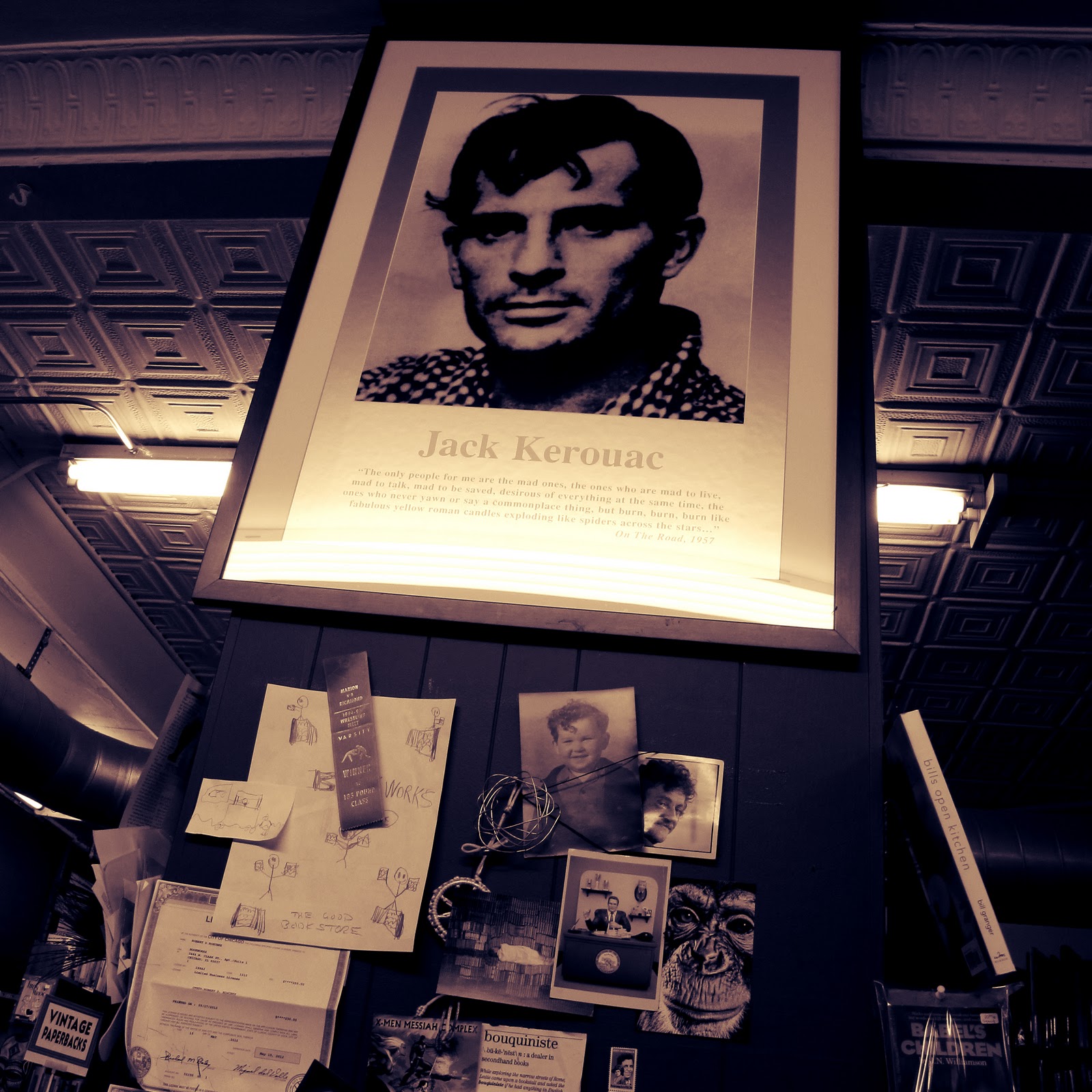
Not someone I’ve read or will read or look up to in particular (except while snapping this photo). His legion of thrift-store clad fans at my alma mater who felt like they were special because they understood/got through “Howl” sort of turned me off to him. But he has an interesting face. As does the chimpanzee (do you see it?).
I realize the filters I put on this photo make it seem like a haunted, prison library. (“And from that pipe is where ole’ Johnny Scarface hanged himself…” ) But it was much warmer than this. But I do like haunted prison libraries. 
Crazy postcards. If this turns up in your mailbox and someone writes “I’m thinking about you,” they are creepy, and also, probably me. 

“Practical Chess Openings,” vs. “Impractical Chess Openings.” Story of my life.

I kind of wish I bought this.
Here is the link that explains why they did not make it big. I’m no Jazz connoisseur, but 240 views on Youtube sort of means dead.

I don’t know who’s creepier: he (with his crazy receding hairline and half-assed mullet) or me, furtively snapping a picture from a stand filled with children’s books. Probably him. 


For your address book:
Bookworks 
3444 N. Clark
Chicago, IL, 60657

Quote of the Day

“Most of us who turn to any subject we love remember some morning or evening hour when we got on a high stool to reach down an untried volume, or sat with parted lips listening to a new talker, or for very lack of books began to listen to the voices within, as the first traceable beginning of our love.”

George Eliot (1819-1880), British Novelist. Middlemarch, book 2, chapter 15 (1871).

Steve Jobs, Again

I finally finished Walter Isaacson’s biography of Steve Jobs, three months after my boss’s brother dropped a copy off at my desk. I learned more about Apple than I cared to know, and was slightly disappointed by the lack of insight of and from his family, but that in itself is a facet of Jobs’ life. Yet I can’t imagine anyone else having written Jobs’ story as completely as he did. Isaacson is not my favorite biographer (that distinction belongs to Ron Chernow – yeah cry your heart out, Isaacson) but I don’t know if Jobs’ story, if written by another hand, could have been as illuminating, or if Jobs would have wanted his story told any other way,  which, I suppose, is why he chose Isaacson rather than the other way around.

I asked Jobs why he wanted me to be the one to write his biography. 

“I think you’re good at getting people to talk,” he replied. That was an unexpected answer. I knew that I would have to interview scores of people he had fired, abused, abandoned, or otherwise infuriated, and I feared he would not be comfortable with my getting them to talk. And indeed he did turn out to be skittish when word trickled back to him of people that I was interviewing. But after a couple of months, he began encouraging people to talk to me, even foes and former girlfriends. Nor did he try to put anything off-limits. “I’ve done a lot of things I’m not proud of, such as getting my girlfriend pregnant when I was twenty-three and the way I handled that,” he said. “But I don’t have any skeletons in my closet that can’t be allowed out.”

I leave it to the reader to assess whether I have succeeded in this mission. I’m sure there are players in this drama would will remember some of the events differently or think that I sometimes got trapped in Job’s reality distortion field. As happened when I wrote a book about Henry Kissinger, which in some ways was good preparation for this project, I found that people had such strong positive and negative emotions about Jobs that the Rashomon effect was often evident. But I’ve done the best I can to balance conflicting accounts fairly and be transparent about the sources I used.

“I had a lot of trepidation about this project,” [Steve Jobs] finally said, referring to his decision to cooperate with this book. “I was really worried.”

“Why did you do it?” I asked.

“I wanted my kids to know me,” he said. “I wasn’t always there for them, and I wanted them to know why and to understand what I did. Also, when I got sick, I realized other people would write about me if I died, and they wouldn’t know anything. They’d get it all wrong. So I wanted to make sure someone heard what I had to say.” 

-Walter Isaacson, Steve Jobs  

There’s so much of Jobs’ own voice in there that you don’t have to waste time wondering, “Well, did Jobs himself see it this way?” 

My boss had a copy of the book on his iPad, which he said he was reading during his workouts, but when I asked him about it a few weeks after the book came out, he scoffed and said he didn’t have time to read it.

He nodded towards his computer monitor where his inbox was displayed.

“I have to read all this other shit.”

More than a biography, Isaacson’s book is a great management tool, not just for companies but for oneself. This is what I loved reading about most: Jobs’ lifelong mantra of simplicity. Taking away rather than adding to, a funny math that leads to success and sometimes, a legacy.

Jobs’s intensity was also evident in his ability to focus. He would set priorities, aim his laser attention on them, and filter out distractions. If something engaged him – the user interface for the original Macintosh, the design of the iPod and iPhone, getting music companies into the iTunes Store- he was relentless. But if he did not want to deal with something – a legal annoyance, a business issue, his cancer diagnosis, a family tug – he would resolutely ignore it. That focus allowed him to say no. He got Apple back on track by cutting all except a few core products. He made devices simpler by eliminating buttons, software simpler by eliminating features, and interfaces simpler by eliminating options.

That focus has always eluded me and, I think, escapes not only my generation, but generations before and after. This was my fundamental problem upon entering college – I saw all the choices ahead of me and felt compelled to pursue all of them, which of course meant I could pursue none of them well. But now, I’m beginning to “get” it. What do I need? What do I want? For starters, I know what I don’t want.

But there will always need to be sacrifices in pursuit of this simplicity. Jobs sacrificed (or perhaps for him, “sacrifice” is the wrong word) better relationships with his family. What will I sacrifice? More importantly, what will I eliminate?

I’m working on it.

Quote of the Day

At the office I had gotten into a rhythm of putting up a thoughtful quote each morning. I have a little whiteboard behind my desk, made from the frame of an old television – I don’t know what the old assistant used it for, but I doubt it was for something as wonderful as writing a quote of the day. The quote I put up before our Thanksgiving holiday was the last thing up there for a while, because around then things got busy. Absurdly busy. I didn’t have time in the mornings to look up a quote and write it down, so Thanksgiving, Christmas, the New Year, came and went and the Thanksgiving Quote stayed, like a withering Christmas tree no one had the time to take down.

“Thanksgiving, after all, is a word of action.” That was the quote for the last two months.

Anyway, some cheeky bugger walked by the other day and said, “Hey Betty, it’s time you updated that thing,” and I thought, “You’re right.”

I erased the Thanksgiving quote and resumed my old habit. At first I feared people would think I had too much time on my hands, but whatever. A quote of the day is a nice thing.

I like all the quotes, but today’s is one I wrote in my diary as well:

“It isn’t safe to sit in judgment upon another person’s illusion when you are not on the inside. While you are thinking it is a dream, he may be knowing it is a planet.” 

-Mark Twain (1835-1910), written in 1905. “Three Thousand Years Among the Microbes” Ch. 13 Which was the Dream?

How true! How very very true. Reminds me not to squash other people’s planets as I stand in my own.

The Dead Don’t Care

A shy anonymous member of D’s team passed around decorated sheets of paper (the kind you buy for formal letters and invitations) to the employees and asked them to “write something to D.” I say anonymous because I still do not know her name and only saw her rarely, as her desk was tucked away somewhere I seldom ventured. She passed the sheets of paper around in long manila envelopes with”instructions” pasted on the inside covers, a sort of starter message to get people’s eulogistic juices running. At first I misunderstood.
“Do you want me to copy the words?”

“Write something to D,” she said softly in poor English.

“To him or to his family?”

“To him.”

“Oh.” I took the folder and stared at her blankly, “Okay.”

She asked me to write carefully and to use the same pen. Heaven forbid the messages be in various colors and that the sheets look like a birthday card. The point, I think, was to make a scrapbook for his family. I don’t know. Maybe at the memorial service tomorrow we will throw it into the ground, atop his coffin. Someone set about gathering photographs. I heard that someone had posted on his facebook a photo of D, sandwiched between me and the receptionist, all of us smiling, D more because he was drunk.

I never added him, so I won’t see it.

I did not avoid his desk this morning – there was no reason for me to other than the fear that I would start crying, but I need not have feared so much. I said hello to the receptionist, who had been at Disneyland when she heard the news. I took the front stairs and did not whistle as I do sometimes, but said good morning to the accountants once I got to the top. It smelled and sounded just like any other day, though slightly subdued. I found to my surprise the executives assembled in the boardroom, though it wasn’t Monday. Were they perhaps convening on D’s behalf? The room was dark and I looked to the projector screen on the wall – bar graphs. Line graphs. Dollar signs. Something about revenues and margins and units – things the living occupy themselves with in dark enclosed spaces. I could not blame them. We were running a show of sorts, and the show must go on.

Around noon HR issued a statement about an employee’s passing, advising the time and place of D’s memorial service. It was a Frankenstein email, copy and pasted from various sources. I wrinkled my brow, thinking the mismatched fonts in poor taste, though I would have done the same thing, only taken more care to hide the hurry with which these things are actually done. Then people began to ask around, not unlike the way people check to see who’s going to a party.

“You going to the service?”

“You carpooling?”

“What time are you leaving?”

I asked these same questions. Stopped in front a friend’s cubicle to do s, and then laughed loudly about something or other right after we established that we were carpooling.

In the afternoon I went downstairs to talk to someone who sat opposite D’s desk. I wondered who’s idea it was to set up the desks like a damn labyrinth. Briefly, I thought, “Here it comes. His desk. Don’t lose it.”

And I didn’t. I walked right by, and on my way back, even stopped for a millisecond to see that someone had left a candle, a vase of white flowers and atop his laptop monitor, a note that said, “Please respect D’s desk. Do not touch or remove anything.” Among other things, that’s one difference between being fired and dying: only the latter warrants turning your desk into a shrine. We are not, it seems, in a hurry to find anyone to replace him – and if we are, the person definitely won’t sit there. And if they do sit there, the rest of us will keep our mouths shut.

Later in the afternoon the head of HR called to ask if anyone had ordered flowers for D’s memorial service. I rolled me eyes. Of course not. I was the person who did that sort of thing because I had the corporate card.

“Could you do that?”

“Sure.”

“Great. Thanks.”

I called the memorial park. They didn’t have a floral service and recommended a local florist who asked me, of all colors, “Do you want blue flowers on white?” I talked at length with the woman on the phone about using white lilies in a standing spray. I was an old hand at this now, having ordered flowers for other employees, both alive and deceased. I thought about adding red roses in the spray, because D seemed to like the color red. Or did he? I don’t know. I saw a few red items on his desk. I shook my head, “No, no. All white.”

“And for the message?”

“From your family here, at the company,” I said, without thinking.

“Okay, great.”

They didn’t take American Express. The clock was ticking. I wanted to go home. I did not want to spend my last few minutes at work searching for florists that took American Express. Not when the show must go on.

I took out my personal Visa and rattled off the numbers. Gave the woman the office fax number so she could send me the receipt. I hung up and finished answering some emails. In a month, I will file an expense report for a standing spray, all white.

 “…there is nothing, once you are dead, that can be done to you or for you or with you or about you that will do you any good or any harm; that any damage or decency we do accrues to the living, to whom your death happens, if it really happens to anyone.” 

– Thomas Lynch,  The Undertaking

One for the New Year: Memento Mori

It is not my usual thing, to write about death on New Year’s Day, but a series of unfortunate events has made it almost necessary.

Yesterday afternoon a coworker called me with a worried note in her voice. I was driving my grandfather and cousin home from lunch and tensed at the sound of my work phone’s ring – it is not unlike the theme song to “Jaws” and while I wonder why I have not changed it, I think subconsciously I prefer not to. If the work phone rings on the weekend, it is 99% of the time my boss or my boss’s wife, neither of whom would call unless something were wrong. I risked both a ticket and my grandfather’s peace of mind regarding my driving and reached for it. On the screen shone the pretty Greek name of a pretty coworker.

“Have you heard anything about D?” she asked.

D was our company’s IT guy -at least that is how I knew him in the beginning. We had an IT team, but D was the the go-to guy if your computer, phone or anything electronic broke down or malfunctioned. We called him first and if he sent someone else in his place, you couldn’t help but be slightly disappointed. I knew vaguely that he handled more serious issues like our connectivity and server security, but in my first few days I work I learned D was, to me at least, indispensable.

“No,” I said, “Why?”

“I heard he was in a bad accident and that he didn’t make it.”

I was driving. I had stayed up late the night before, and had just consumed an enormous lunch. It was information I could not readily process.

I stopped at a red light and my grandfather looked at me, not understanding but sensing that something was wrong. Was it my boss? Had I messed up again? Grandpa was always chiding me to take my job more seriously. At that moment, I had a very serious expression on my face.

“Is it true?”

“I don’t know,” my coworker said, “That’s why I’m calling you. I got some cryptic text messages from the receptionist and was wondering if you heard anything.”

“I haven’t,” I said. I wanted to add that I liked D a lot, but we weren’t close. He had asked, indirectly, to hang out after work a few times, but I always declined. I said instead, “I don’t know anything about anything.”

We exchanged a few more pointless affirmations then hung up, though I was certain of two things: that if D was dead, I wouldn’t be surprised and that I was feeling quite tired.

————–

I met D on my first day of work and while normally not attracted to men of his ethnic origin, found him quite handsome. He was lean then and had a strong, regal profile with thick brows, bright, wide eyes and jet black hair which he styled into a subtle rising tide atop his forehead, giving him the appearance of always leaning forward. I was standing in front of the receptionist’s desk, waiting for the head of HR to come and receive me when he walked in the door, holding a motorcycle helmet and wearing a fitted rider’s jacket. He didn’t smile at me and instead nodded hello to the receptionist and started toward his desk.

“D!” the receptionist said, “Meet Betty! She’s new.” Almost reluctantly, he paused to acknowledge me. We shook hands and I smiled his solemn face, thinking (assuming) that he was just a shy Pakistani man with a wife and kids. I painted. He comes to do his job, socializes little, if at all, then quietly goes home. I didn’t put the clues together, that normally men with young families did not ride motorbikes.

The Spirit of Adventure, 1962. Renee Magritte Oil on Canvas

 It was strange in the beginning, our relationship, which mirrored the way I interacted with the rest of the company. As a newcomer, my policy was to be open and friendly to all. Friends and enemies alike would show themselves in time. But D was, for the first month, an enigma. I sensed that he was avoiding me for mysterious reasons, among them my work mobile, for which D was responsible and which I made do without for the first two weeks because he would not give it to me. Each morning I called his desk and asked, as sweetly as I could, “D, is my phone ready?” And he would say, “Oh soon, soon. There is just one more issue,” then promptly hang up.

I grew impatient (so keen was I to become the best assistant ever), but wasn’t ready to joke with him in my usual manner. If he saw me walking towards him, he would go the other way. If he had no other way to go, he would turn and talk to someone else. I wondered if he had been close with the previous assistant and if he resented that I replaced her. Or perhaps he thought I was fake? I worried about this at first: I had unwittingly taken on a “ray-of-sunshine” role at the office and perhaps the solemn Pakistani with a dark past could see right through it. Let him think what he wants, I thought. I just want my damn work phone.

Thus I sat patiently at my desk and hoped that one day, my phone would be ready. And finally it was. He came by my desk one day and dropped it off, explaining to me how it worked and why it had taken him so long (it was some IT issue I don’t remember). I was overjoyed to finally have a work phone (now the bane of my existence) and told him so.

“You’re very welcome,” he said, his slight Pakistani accent coming out, “Let me know if you have any trouble.”

That was perhaps the kindest thing he had said to me in the beginning.

A few weeks later Jane from marketing called to invite me to an informal interview. I thanked her for the invitation, but was it okay that I wasn’t on their team?

“D is coming,” she said, “He’s one of the cool kids,  and we like you, so just come.”

My niceness had paid off, it seemed, but I warned Jane, “I don’t think D likes me. He’s always avoiding me.”

Jane was surprised, “What! D is The. Nicest. Guy. You just have to get to know him.”

I said okay and that evening went out to dinner. Marketing was interviewing a young woman from up north – the formal interviews with the managers and VPs would take place the next morning. The evening out with the younger folks was a way of loosening her up.

The point of the evening then, was for them to get to know the candidate, but I went in with the selfish mindset. I would finally get a chance to know some of my new coworkers and they, me. We drowned her out, certainly, and who knows, might even have scared her away. We exchanged stories about certain VPs and executives, and they corrected or affirmed my many assumptions. We warned the girl, who grew increasingly silent and nervous, not sure if such a rowdy “interview” was a joke, that if she came to work, there were certain people she’d need to avoid. I was learning too, slowly absorbing information about my new colleagues, especially D.

I learned that he had lost both his parents some years ago in an accident, and a week after they passed, his brother died too. This had come up during dinner in a joking manner and I had brushed it off as a joke, until D kindly corrected me, “Yes, it’s true,” with a soft smile on his face as though he too, couldn’t believe his misfortune. What understatement. I marveled at him then, that he was able to come out and socialize and live a relatively productive life. I thought of my parents and brother and the support they provided me, whenever I needed it. I complained often about living at home, at my father’s annoying habit of having the television on too early in the morning and my brother’s definition of “clean,” but they were alive and well. I could reach out and talk to them whenever I pleased.

I learned that D was ten years older, and that we had gone to the same high school. We had taken P.E. a decade apart under the tutelage of the same teacher, one Mrs. Smith whom ten years after D graduated, would still astound my class with effortless pushups. 

I learned from Jane, when he left for the restroom, that he had an ill-defined romance with the girl in legal whom I found annoying. She was a drama queen disguised as a legal counsel who had also gone to Berkeley and had, perhaps for this reason alone, pegged me as someone worthy of being her new bosom buddy. I begged to differ in various ways, begging out of offers to carpool (we live, unfortunately, in the same town) and invitations to dinner. This did not stop her from dropping hints about her love life. She wanted to lure me with “girl talk” as she called it and, when she had a moment’s free time at the office, would stand by my desk and update me on her romantic liaisons. Apparently she was torn between two men, one who was local and treated her like a queen, and the other, an asshole in another state who had treated her like shit until local man started to pay her more attention.

It didn’t take a detective to figure out that local man was a colleague, considering legal girl worked long hours, leaving little time for outside-the-company romances. When I asked her, she grew huffy and said, “I’m not going to answer that question.” This essentially, answered my question, though I still didn’t know exactly who. Thanks to Jane, I now knew. I questioned D’s taste in women, but thought, whatever floats your boat

And then I caught a glimpse of what Jane meant when she said that D was The. Nicest. Guy. Somethings actions/words you will never forget because they come so out of the blue, yet when they do, you realize you had misread someone, or really, it is a culmination of all the subtleties you had sensed but were too busy worrying about things like work phones to evaluate correctly.

At one point over the din, D noticed I had not yet ordered a drink (I was not planning to drink), and with a concerned look, waved for the server.

“Please sir, could we get the lady a drink?”

It was a line from another era and it melted the ice I had frozen around him.

We drank, ate, laughed. The evening ended and we stood in the parking lot saying goodbye.

“This was fun,” I said to D, and he nodded, a cigarette in his hands.

“We used to do this all the time,” he told me, “back then when some other people were here… but the company went through some changes and those people aren’t here anymore. But yeah, we should do this more often.”

I never saw the interviewee again, but was confident then that I would see D et al. the very next morning.

And I did. The next day my boss had an issue with his cellphone, and I brought it down to D. His desk was as a busy IT person’s should be: stacked with old laptops and cellphones and bundles of wires. His many monitors blinked with interfaces I would never understand  – I did not bother to look too closely. On the walls of his cubicle were pinned a small company banner and a photo of a motorcyclist on a race track, leaning dangerously close to the road.

“And how can I help you?”

I turned and there he was, the kind sir who had made sure I got my drink the night before. I handed him my boss’s phone.

“I’ll take care of it,” he said.

Later that afternoon it was ready and to save him a trip upstairs, I said, “I’ll come down and get it.”

“Okay,” he said, “You could use the exercise.”

Ah. The solemn Pakistani jokes. I wrote back, “Great. I’ll start by punching you in the face.”  

He really enjoyed that. We became friends in the tentative way you become friends with someone at work. He was not whom I thought he was and I was certainly not the “sweet and lady-like” whatever he thought I was. His comment opened the doors for me to joke in return and for a few weeks after he would, whenever I appeared, pretend to duck or say, “Oh no, do I need to grab my helmet?”

Around this time legal girl began to pester me more and more about her love life. She was torn. The asshole was coming back and wasn’t so much of an asshole anymore. He wanted her back. Wanted to move in. Did this imply marriage? He told her he loved her, and even though he had treated her like shit, she wanted to be with him. This left local man out of the equation.

“I feel terrible,” legal girl said, “I’m going to tell local man soon that I’m going back to the asshole. He’s going to be so pissed. He’s going to say I led him on.”

I’ll never know what series of events or what train of thought led D from storming around legal girl’s desk, embittered by her rejection of him to his sudden attention to me, but it would not be far-fetched to say the two were related. Legal Girl had said that D was looking to settle down and get married – that he had not proposed to her, but had proposed, in one conversation or other, a future together. He could envision it…could she?

She had shaken her head vehemently. She was Christian! Her parents were missionaries, for Christ’s sake, literally. He was a Pakistani man with a foggy yet intact Muslim background. She had laughed at the thought of them being together and needless to say, he was enraged, then despondent. All this from legal girl’s lips and never from D’s. I’ll never know the whole story – but regardless of whom pursued who, D was pissed at Legal Girl because according to him, she had pursued him. I surmise he had grown to like her, and then she had turned around and chosen an asshole when from the very beginning, even when D wasn’t interested, he had been The. Nicest. Guy. Ever.

Shortly after legal girl chose, D and I bitched about her on a long drive from our office to LA, where there was a company event. We rode with the receptionist and an IT contractor from Australia who had instantly become one of D’s best friends, and they laughed at our vindictive comments. That evening in LA however, I learned that D could drink far too much and still, frighteningly, feel confident enough to drive us all home.

“You aren’t driving,” I said, “Give me the keys.” And holding a drink, his millionth one that night, he put his hands up and smiled in what he thought must have been a charming manner, but to me, looked purely foolish.

“I can drive, Betty,” he said, “No problem. You seem so fun but now you’re just uptight! Just dance!”

It was nearing two in the morning and I had to work the next day. We all did, but I need more sleep than the average employee and wanted to get home. Alive.

“You’re not driving, D.”

“I can drive.”

“You can’t. You won’t.”

“I can drive.”

It went on like this for several more minutes until it became clear to him that for me and the receptionist, who had already taken off her painfully high heels, the evening was over. I drove them back to the office, a shadow having crossed my overall impression of D. I am judgmental. Undeniable and unapologetic. It irritated me to see a thirty-four year man drink so recklessly. Offer to drive four people home so recklessly.

As the weeks went on, I gathered that that reckless might as well have been D’s middle name. From other coworkers I learned that he liked to drink. A lot. What happened in LA had happened many times in the past: at the company Christmas party, on dozens of happy hours with “the old crowd,” and most likely every night in his apartment. He lived alone with his dog, an aging chihuahua with a bevy of joint and organ problems. He loved the dog dearly and would often go home to walk and feed it in the afternoons. Often he would respond to my emails with a house phone. “What are you doing at home,” I’d ask. “I’m feeding my dog,” he said. “I don’t like to leave him alone for too long.”

From D himself I learned his passion for fast cars, motorbikes and racing.

“Isn’t that dangerous,” I said.

“Nah.” he said, then thought for a moment, “Well, yeah, but I’m not scared or anything.” Later he forwarded me photographs of a car he had totaled – I had driven the same car in high school and knew it was something of a tank, more likely to crush other cars than be crushed. But the photographs showed a vehicle so mangled it seemed impossible that the driver was alive and sending me the photos.

“That’s awful,” I said without humor.

“But I’m fine. It happened. It’s done,” he said lightly. He shrugged as though it were no big deal and I thought about his dead parents and brother. Would I shrug too, if I had lost so many loved ones in a week?

It had not been my intention to create some sort of alliance with D regarding legal girl, nor did I intend to send him an invitation to woo me. Though slowly, uncomfortably, I sensed a redirection of his attention from legal girl to me. I was neither flattered nor mortified, just bemused – what a quick turn of interest! 

Little treats began to appear on my desk. The Australian, an eager wing man, began to make more and more trips upstairs to ask me about my weekend plans on D’s behalf.

“D and I are going to do this or that,” he would say, offering me a chocolate covered cherry or some other sweet treat, “It’s going to be wicked.”

“Sounds fun,” I’d say, chewing.

“Are you interested? D’s gonna drive and he says he can pick you up.”

Thanks but no thanks, I said, and, “The chocolates are great! Thanks for bringing them up.”

“Don’t thank me,” the Australian would say, “Thank D. He told me to bring them up here.”

I was not being coy, but straightforward. Or at least I hoped. And I always did thank D for whatever he did for me, but I invited nothing further. What was the point? I had painted him once, been wrong, and he had repainted himself – the nicest guy, true true, but not my guy. Not in a million years.

——–
In the middle of this, D discovered my blog. In truth, I don’t remember if I shared the link with him or if he found out via his mysterious IT ways. But he began to read. 
I warned him to keep his mouth shut, because I was writing about people we both knew – legal girl included – and he said in that light, no-big-deal way of his, “Of course. Your secret is safe with me.” 
Except it wasn’t. He had seen a post about my boss playing golf in Australia and mentioned it to his boss, an avid golf player, who then wrote me and said, “Your blog is beautiful.” I was angry and warned D again. Don’t tell ANYONE, I said. And he said again, “Of course, of course.” 
A few days later my boss called me into his office. 
“Don’t tell anyone what’s on my calendar. I told you this before,” he said. 
“I don’t tell anyone anything.” 
He stared at me, “You told D that I went golfing in Australia and he told Greg, and Greg, he gets jealous whenever I golf with a celebrity and I have to hear about it.” 
I apologized and made a mental note to really punch D in the face. 
Though I never got the chance. 
Last week. 
His last week. 
On Tuesday after Christmas, I walked in the office and found on my desk a small shopping bag. Atop it lay a small red square of cardstock, cut, it seemed, from a poster. I knew it was from D – I recognized the handwriting. But it was going to be a busy week – my boss had been away on vacation and due back the next day. I had to clean house. I read it swiftly: 
“To a talented writer…” 
I don’t remember the rest because someone called me away and it was many hours later that I finally found the time to open the gift. There were two: the first an angry birds beanie that he perhaps bought on a whim because he thought it was cute, though it almost embarrassed me to hold it up. I quickly stuffed it back to the bottom of the bag, along with the red card. I thought, “Does he know me at all?” The other was carefully selected, which showed me that on some level, he did.
It was a Cross pen, masculine and sleek, not unlike the motorbike D was riding when he lost control at a bend in the road and was hurled into a tree stump.
———–
He “lived” for less than twelve more hours before the game of telephone began, which is how my pretty coworker came to call me on New Year’s Eve with a worried note in her voice. A few hours later my boss called to see if I had heard. 
“I’m not sure of anything,” I said, which was half true, “What have you heard?”
“I heard that D is dead.” 
It was strange to hear the word, “dead” for which “He didn’t make it” is a euphemism. My boss is not one for euphemisms. 
“Let me call HR,” I said. Both our voices were without emotion. I called HR, who sounded as though she’d been crying. 
“I heard that D died,” I said, “Is that true?” 
“Yeah,” she said, “He was in an accident.” 
We exchanged a few more pointless affirmations and I called my boss back. 
“Oh,” he said, his voice then sounded younger, almost childish, and I pictured a seven year old boy watching as his tower of legos came crumbling down, “Ask if there’s anything we can do.” 
“Okay,” I said, though I knew of course there was nothing.
———

On Tuesday, as per my rule of not leading him on, I said nothing until he messaged me.

“Did an angry bird drop by your desk or something?”

I feigned ignorance until then, “So it was you!” I wrote, “Thanks D! That’s so thoughtful of you!”

The rest of the week passed in a blur. The Cross pen sat unopened and unused on my desk at home. I cried in front of my boss on Wednesday. Wondered how long I could stay at my job on Thursday and spoke briefly to D on the phone Friday afternoon because he wanted to know if one of the VPs was upstairs. I answered him absentmindedly, annoyed that he was calling me about this when I was already so busy, and when ten minutes later he appeared he seemed irritated as well.

“Betty, the whole point of my calling you to ask was so you could save me a trip upstairs.”

I wanted to murder him. I was dying, couldn’t he see that? But I remembered the pen and the card – where did I put that small red card? – and apologized. “I’m sorry D. I’m just…not paying attention today.”

“You okay?” he asked.

“I’m fine. I’m just tired. I’m sorry.”

“It’s okay, no big deal.” He shrugged in that easy way of his and walked towards the door that led to the back stairs.

I turned away from my computer and watched him go, thinking about the note he had written on the small red card.Where was it? Had I thrown it away? He opened the door, and before it closed, turned to smile. I waved then turned back to my monitor. Emails. So many emails. All urgent.

Or were they? I started to type again, then heard one of the accountants say to another, “See you next year!”

I winced. To D, I had forgotten to say, “Happy New Year.”
Monday Night Lament

I realized just now, five minutes ago, that this was my first winter sans winter break. In all fairness, I did have a winter break: a measly two days tacked onto this whirlwind holiday weekend, but four days(!) pales in comparison to the two week or month long breaks I was accustomed to in the past.

It’s strange to think that this time last year, I was moving out of Berkeley. I was eating at my favorite restaurants one last time, packing all my stuff into my dad’s SUV, waving goodbye to roommates and friends, wondering if I’d ever walk the tree-lined streets of Berkeley again. I was so eager to go home and start “real” life, but of course I was still a solid three months away from real life. My parents generously awarded me a two-month trip to Asia for finishing my degree, for which they’d held their breath two years. Underneath it all I was waiting to hear back from the Fulbright commission – if I got it, I’d be off again, living a (government-funded) student’s life abroad under the guise of writing about family history. As long as there was no envelope in the mailbox I was free to travel here and there and delay job hunting.

That was my last hurrah for a while. I spent January catching up with old friends, going to Vegas, baking, reading, lounging around. February and March were spent in Taipei, with short bouts to Hong Kong, Japan and Shanghai. I was happy to be traveling, but at the same time felt something deservedly ominous growing in my heart – that I was somehow having too much fun, and that it was only a matter of time before God said, “I think you’ve had enough.”

I reasoned with myself that I deserved it. But then Karma’s voice came back: “Yeah, but three months? And if you get the Fulbright, you’re never going to find a job. You’re going to tell yourself, ‘What’s the point, if I have to quit in July anyway?'” Karma was right – I was thinking exactly that. But I had gotten past round one – didn’t that entitle me to enjoy some much deserved time off?

Apparently not. The envelope finally came, a slender, pure white “no, thank you,” and had I not been so happy with my situation at home (most of my closest friends had somehow ended up close by), the color and hope I had held onto for the coming year might have drained from my face.

Karma rewards those who actually want the Fulbright (and a slew of other things) for the right reasons. I was, in all honestly, looking to delay “real life” for as long as possible. For all my talk about hating school and the academic life, I was a prime example of what everyone loves about school: I hated writing the essays, yet reviled in the sense of accomplishment they gave when I turned one in. I hated exams, yet loved exam days because they were short and straightforward. Come in, take out pen, write for two hours, turn in. Done. Nothing passes a long school day like a few lengthy exams – you always want the clock to slow down rather than speed up.

But time flies and I am now a 9-5er, or an 8:30 to whenever, as our company goes. I am often too exhausted to think, and it frightens me because I know my job is nowhere near as exhausting as some other jobs. In college people who were only a few years older but who had been working full time for a while whispered to me, “If you’re smart, you’ll stay in school for as long as possible.” I didn’t understand this because I didn’t recognize that school was a haven of sorts – it didn’t matter if you hated what you were studying – your presence there indicated, for most people (unless you were an Asian kid forced into med school or electrical engineering), that you had made the choice. You had somehow found the funds and were there to learn and discover. I didn’t see it that way and instead spent hours in certain classes scowling at over eager students and pompous professors and the false importance both groups assigned to essays and dissertations and exams – who the hell cares who or what influenced Nabokov? Well, I did, sort of, but not nearly enough to think of pursuing a master’s degree never mind a PhD.

Looking back however, it was for me, the ideal lifestyle. I fancied myself a productive person, but school gave me the perfect balance between making progress in my life overall (I was, after all, working towards a degree, however useless it would prove in the job hunt) and doing nothing at all – sometimes, I wonder where the true progress lay: in the hours I spent in class or the quiet mornings and evenings I spent walking through the tree-lined streets? It provided both structure and absolute freedom – I had a community, and yet I was alone. My parents were an eight-hour drive south, my roommates knew not to disturb me if my door was closed, and friends, if I wished to see them, were a text message and then a short stroll away. I could miss class too, and my professors would not care – (the budget cuts cut more than just money).

Call me stupid. No one likes papers and essay tests (With the sole exception of my friend Elena who annotates her books for fun) – but it’s a small price to pay for that balance I so wish I could have now. And looking back, I could have been mistaken for one of the students who cared too much about grades and had doctorate dreams because I was always lingering outside my professor’s office and starting papers early (so I could turn them in early and go home early for Thanksgiving/Winter Break). But I realized that the happiness I felt when I was out of class, browsing through the massive university library at my leisure, laying around on campus near a running stream, underneath a willow, with the campanile in the background was a happiness almost exclusive to my time as a student. And now, at 10:55 PM on the last day of my meager “winter break,” it makes me wistful. Did I squeeze out every last drop?

Old Habits, Don’t Die

Many of the things I used to do, I don’t do so much anymore:

  • Read books. (As opposed to the constant stream of news and magazine articles I half-read at work). 
  • Watch movies. (“Drive” was the last film I saw and sitting in the dark room with a large screen felt almost foreign.)
  • Go to the library, which, I suppose, goes along with reading, though more and more I find myself missing the quiet atmosphere and smell. Ah, musty paper.
  • Cook/bake. (We had our Thanksgiving potluck at work today, something I had thought for a long time I would certainly bake something for, but the week rolled by and the only thing I contributed was my appetite). 
  • Clean my room. (Not that I ever needed to do this before; from ages 6-25, I had the energy to keep my room neat as a pin on a daily basis. I made my bed every morning, fluffing the pillows and tucking my sheets in just so – I liked that I could come back to a room that seemed like a freshly turned hotel room. In college, my roommates stared at my half of the room which seemed like a set from a stark, war-time barracks where everything was rationed. They wondered if I had perhaps spent some time at some women’s boot camp. When my roommate’s father visited, he whistled and said, “You could bounce a quarter off your sheets. That was the test back when I was in the army.” I merely shrugged, “I like things neat.”) 

Even after college, when everyone said, “Oh you’re not gonna have time to do that stuff anymore,” I found the time to watch a movie, visit the library and read a book at least once a week. Twice a week, I would bake hearty oatmeal cookies and banana bread to give to my relatives.

I had no idea these were all indicators of unemployment or poorly defined internships.

There are women at work who can do all of the above and their jobs quite well, but they were blessed with enviable energy reserves. Or perhaps not reserves at all, but energy. After a normal week at work I spend weekend mornings zoned out, putting from room to room in my pajamas and standing in front of my bookshelf, wondering if I should attempt to read something longer than a NY Times column. Though I do light up briefly in the evenings – just long enough for me to drive to LA, dance for two hours max (before my feet hurt), and drive back, only to spend the next day in an exhausted daze. On Sunday nights, I often go to bed at 8PM to prepare for the following week.

“You need to exercise,” my mother said, and like a good daughter, I recommenced hot yoga – but that is a false remedy. For some people, exercise is taxing. I feel better in theory; walking out of the studio, I think, “Ah, I am more energetic,” and for two hours following the class, I am – but when I really need to be energetic is at work, between the hours of 8:30AM to 5:30PM, when things need to be done with clarity and precision.

Instead, I smile as brightly as possible; say everyone’s name in a sing-song voice to mask my fatigue, and let my tired tail show anyway, by doing things like making coffee for my boss without that vital element.

This morning he walked into his office and then out again, holding his mug.

“Get me some coffee from the Keurig,” he said, handing me the mug filled with water tinged with brown. It seemed more like a weak earl grey than bold Sumatra roast coffee. “Look at this coffee. What’s the matter with it.” 

I stared at the water, wondering why the coffee had turned out so impressively weak. Painstakingly, I retraced my steps. I had filled the pot, poured the water in, closed the lid, pressed the button…

Damn.

“I forgot the coffee.”

“Yeah, the coffee,” my boss said, then he tapped his head and pointed at mine, “You need to put some beans in here.”