
On my birthday last Friday, my father called.
“When are you coming home again?” Continue reading “Turning 28”
On my birthday last Friday, my father called.
“When are you coming home again?” Continue reading “Turning 28”
Last Friday night as I was leaving POI’s apartment, a short, young Hispanic man with a curly ponytail and buckteeth called out to me.
“Hey beautiful.”
I smiled politely and thought of standing behind the locked gate until he walked away, but he didn’t seem to be in a hurry. He leaned against the tree just outside POI’s building. Maybe he lived around here, but probably not. He threw down a cigarette stub as I opened the gate. It was nearly 11PM. I had to get home.
He walked toward me.
“You married? Gotta boyfriend?”
“I do, I do,” I turned right, picking up my pace and, noticing him keeping stride with me, tossed my head back towards POI’s building, “I’m just leaving his place now.”
“Damn,” he slapped the back of one palm into the other. His next question took me by surprise:
“Well, you on Instagram?”
I paused at the intersection, my robust Instagram feed running through my mind. A delivery truck rumbled by. I was about to say, “Yeah,” but then thought better of it. I donned what I hoped was a curious look.
“Instagram? What’s that?”
He cocked his head. “Woman, you don’t know what Instagram is? You know Facebook?”
I nodded.
“Yeah, it’s like Facebook, but with just photos. Lotsa people use it now. Everybody use it now! I don’t believe you don’t know what it is! I’ll bet all your friends on it. You pretty! You gotta get on Instagram!”
“Oh,” I said, “Thanks. I’ll uh, look into it.”
The walk sign came on and we crossed the street. He kept on shaking his head, incredulous someone my age was unfamiliar with Instagram. (Honestly, I’d be shocked too). There were two whole avenues to go, I surmised, before the guy –
“My name’s Luis,” he said, holding out his hand.
I shook it quickly and shoved my hand back in my pocket. I wasn’t afraid, not after the Instagram comments, but there was something funny about his eyes. He wore small round glasses which magnified eyes that couldn’t quite focus. One of them looked at me while the other sort gazed off into some distance.
He wore a baggy grey hoodie which was inexplicably lumpy and jeans shredded at the bottom. Short legs. He walked with the slightest swagger, more from pants that were too long and sagging than from attitude. He talked a mile a minute.
“You Asian,” he pointed out.
“I am.”
“See, you’re nice.”
“Um, thanks?”
“Whoa, whoa, look, don’t take no offense. I’m just making observations here.” He said ‘observations’ more slowly than the rest of the words, as though he’d just learned it and was testing it out.
“It’s just I go up to Asian chicks all the time because, you know, I find them attractive, but damn most of the times you guys just run away!”
I laughed, mostly because I had considered running away – or at least back into POI’s apartment – but that might have been rude. And presumptuous.
“Maybe you’re just not meeting the right kind of Asian girls.”
“I guess not. I mean, I finally meet you but you’s gotta boyfriend! Is that why you didn’t run away?”
“No,” my turn to cock my head at him, “Should I be running away?”
“No woman! I’m just bein’ nice! I ain’t shady! I just wanna be friendly and say hi and almost one hundred percent of the time the Asian girls run away! They’re so shy and like…fearful, you know? And all I wanna do,” he kept spreading his palms and touching his chest, “All I wanna do is say hi because I think you Asian girls is gorgeous.”
“Well thanks, that’s really nice of you.”
“Man, I wanna girlfriend so bad. It’s been ten years since I’ve had a girlfriend. But ladies, they don’t want me. They want the tall guy with the stacks, you know?” He held his hands to show imaginary stacks of cash. A Drake song played faintly in my head.
I did know.
I had made it known to friends and family (half jokingly), when I first moved to New York, that I was hunting for a New York billionaire. A few months later I found myself standing in the longest line I’d ever seen at the Columbus Circle Bed Bath and Beyond with POI, who needed new pillows and sheets. I suggested he go to TJMaxx. He had snorted.
“That’s where the poors shop.”
I raised an eyebrow, letting him know that my mother shopped there and so did I (but never Ross, good Lord if you shop at Ross you’ve hit rock bottom). Though when I was in elementary school, I’d been embarrassed too when my mother shopped there. But you grow up, start working for ten, fifteen dollars an hour and realize, “Damn, money doesn’t just come out of my parents’ pockets?”
I told POI, in a mild effort to provoke him, that I intended to marry a billionaire.
“That’s not me, bro,” POI had said, “You’re gonna have to find some other dude.”
Luis pulled his jeans up. It occurred to me I was a good two, three inches taller.
“I know I ain’t aaaalll that,” Luis said, “but I mean, I do honest work.”
I was about to ask but his speech was just beginning,
“I mean, I’m fearless. I ain’t afraid of nothin’, I could sell drugs and shit but I don’t because it’s frowned upon. I could make three, four times what I make now by selling drugs but it’s not respectful, you know what I’m saying?”
“Yeah…” I said, “Well, no. What do you do?”
“I’m a strip club promoter.”
“Ah.”
“Yeah, I mean, I pull five, six-hundred dollars a night bringing people in but that’s like chump change compared to selling drugs. But I’m friendly, you see? I’m friendly so it’s easy. I bring in so many ladies-”
“-Ladies?” I interrupted.
“Yeah! Ladies! Girls! Women!”
“To dance?”
“No! To have fun at the strip club! What most people don’t know is that nowadays, ladies, like yourself, spend more than men at the strip club. Ladies are way more generous – they buy the dancers drinks, they tip bigger, and they don’t cause trouble. They just there to have a good time and they looooove it. They be like, ‘Ooh a strip club?’ (here his voice got high) ‘I never been to one before, let’s go!’ And they come and get all dressed up and like, go crazy because they feel like powerful but also they respect the dancers you know?”
I wondered if I’d ever go to a strip club. Someday, probably, with enough drinks.
“So,” Luis continued, and I was thankful to see 8th avenue up ahead, “I promote to both men as women but honestly, the ladies are the bigger spenders so I like to bring as many in as I can.”
I nodded, amused. You learn something every day.
We came to the intersection of 8th avenue and 35th – I stopped and he stopped too. “Well,” he said, “I guess this is where I say goodbye to you. What’s your name?”
“Betty,” I said.
“Betty, Betty, Betty. Betty you’s gotta get on Instagram.”
“I’ll…look it up,” I said.
He could sense, in the same way I was friendly, that the conversation was over. I was relieved. A wave of fatigue came over me. I wanted to be at home. Wanted to text POI to have a safe flight – he was heading to Asia for two weeks for fun, not work. A very un-billionaire thing to do, but I didn’t want to find another dude.
We stopped talking but remained at the same corner because I also needed to cross the street. I stood for a few moments then turned right, hoping he’d walk straight ahead. Instead he crossed the street and turned right so we ended up at the same corner at the same time. Thankfully, a throng of people had come from the other side, among them, a group of young women looking to have a good time. It was time for Luis to get to work. He reached into his lumpy hoody and pulled out fat stacks – of glossy promoter cards. I picked up my stride and breezed past him just as the throng of people swallowed him up. They couldn’t however, drown out his distinct raspy voice:
“Get your drink on at the strip club tonight! I be selling crack on the streets but it’s not what you think!”
In the end my mother relented and drove me to the Regis Hair Salon in the Orange Mall, one of the worst malls in Southern California where everyone is obese and has a cousin/brother/uncle in jail and where the best department store is JC Penney (I had turned my nose down on JC Penney for the longest time until my dad said, “That’s where I get all my pants.”)
I was still at the age where I associated price with quality and shunned the thought of going to a cheaper Asian salon (now I only go to Korean salons where they know how to layer Asian hair, as opposed to “white” salons where, in my experience, the stylists are so enamored by thick Asian hair that they’re almost always reluctant to thin it out, which is usually what Asian girls want so we don’t look like we’re walking around with cloaks on our heads. Anyway.) My secret hope was if I paid more than $60 for a haircut I would walk out of the salon NOT looking like Jackie Chan. Anyone but Jackie Chan. Well, anyone female.
The salon was about to close but I begged the bored-looking girl at reception (has anyone ever encountered an enthusiastic salon receptionist?) to squeeze me in.
“Louis,” she called towards the back of the salon. A tall, barrel-chested gay man squeezed into a too-tight black t-shirt and sporting a finely trimmed goatee looked up from chatting with his colleague, a shorter but equally sassy-looking gay man. Louis gave the receptionist a look, “This had better be good. Mikey here was just about to tell me how big so-and-so’s cock was.”
“Can you take one more?”
He sighed and uncrossed his arms. He shrugged at Mikey and languidly waved me over.
I did so and stood awkwardly by the chair.
I looked at his reflection in the mirror and shook my head. What did I do?
“I cut my own hair.”
His eyes widened and then he shook his head again. He sighed heavily. Then, as though he were touching something he wasn’t sure was dirty or clean, he flipped the sawed off edges of my hair.
“Cut it or hacked it off? Were you angry?”
“I was tired of my hair.”
“My dear, my dear. You don’t do it yourself. You don’t ever do it yourself. You come to a professional.” He placed his fleshy hands on his chest, referring to himself, and stared hard at my hair.
I looked at him in the mirror and we could both sense my desperation. It was perhaps the most feminine feeling I’d felt in a long while: the fear of not just a bad hair day, but a bad hair year.
Please. Help.
He nodded sagely, like an old master who was retired but agreed to help out a struggling student one last time. Like Tommy Lee Jones in Men In Black III.
“You’re in good hands,” he said. I nearly cried in relief. I straightened up in the chair and took a deep breath. I was ready for a miracle.
“But first,” he sighed again and looked at his watch, “I’m gonna need a cigarette.”
An hour and a half later, I emerged from the salon looking not like Jackie Chan, but Rosie O’Donnell. After she came out of the closet.
It wasn’t a chic bob – or perhaps on some slender, sylph-like girl with a swan’s neck it might have been – but on my rather thick neck, broad shoulders and round face it was, as a classmate would inform me the next day, “a butch cut,” not much better than the Jackie Chan haircut I’d given myself.
“But,” my friends told me soothingly, “you can tell the guy had skills. It’ll grow out really well.”
I never cried about it. I took deep breaths and repeated my father’s (and soon, everyone else’s wise words): hair grew. It does and it did. I spent the rest of the year wearing headbands and tried to see the silver lining: shorter showers and practically no hair drying time.
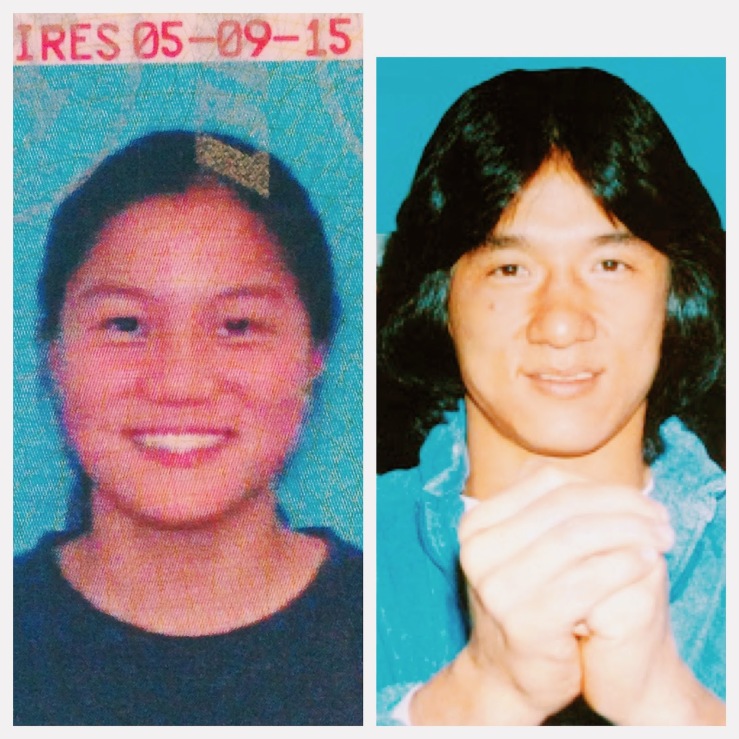
I was normally pretty whatever about my looks but being likened to Jackie Chan twice over two years- an average of once per year – did not sit well with me. Continue reading “After a Terrible Haircut: Tell Yourself, “Hair Grows””
I should have kept David’s card. It would have made a sweet memento from my high school days, when for the most part I considered myself rather mannish and unattractive to guys. Continue reading “My Terrible Jackie-Chan Haircut (The First of Many)”
“Hi Betty.”
I looked down and saw David looking up at me. He had come to my window and was motioning for me to roll the window down. I looked ahead – there were still a few cars ahead of me that did not appear to be leaving the parking lot anytime soon because of the busy street traffic.
I rolled the window down and gave him a surprised look.
“Hey David, what’s up.”
“You leaving school right now?”
I thought it was obvious, but decided to be nice. I nodded, “Yup.”
“Cool, I thought so. Me too.”
“Great.” I looked at the cars ahead of me, willing them to roll off the driveway. One car pulled out and the one behind it was about to as well, but the light ahead turned red. He was leaning on my door now, alternating between gripping it and tapping idly, which would have made it dangerous and a bit rude for me to pull forward. I gave him a questioning look tinged with what I hoped was visible impatience.
“Well,” he said, “I was thinking we could go get a cup of coffee?”
In movies, which informed most of my ideas about romance, this is usually the point when the girl who is also attracted to the guy asks coyly, “Are you asking me out?” But I was not in the movies. I was in high school and in love with many people in the movies (this was the heyday of my infatuation with Edward Norton) and did not drink coffee because I read somewhere that it stunted your growth and made your bones weak (though I’d already hit puberty I was still hoping to grow another inch or two, much to my mother’s bewilderment. At 5’7” she was tall for an Asian woman and during her girlhood back in Taipei, had been teased and called an elephant. “Why not a giraffe?” I’d asked. My mother replied, “Giraffes are thin. I was not.” She seemed to believe, from empirical observations that tall girls stayed single much longer than short girls).
The cars ahead began to pull off the parking lot. I summoned the most regretful look I could muster.
“Ah, I can’t David, sorry. I’m going home to nap before I head to badminton practice.”
In the history of terribly transparent excuses, that one doesn’t quite take first place, but it was transparent enough. David tried again to summon the sad smile he’d given me two weeks before and backed away slowly before turning. He shoved his hands in his pockets, looking left and right though all around us were the gleaming cars of other students.
Before I turned twenty-five, only one person had ever asked me out. This was sophomore year of high school – hardly a recent event. He was a junior named David, a short Vietnamese guy who had come to our badminton club one afternoon with a mutual friend and played a game of mixed doubles with me. I guess because I was friendly and liked to laugh, he thought I’d be a good prom date. Also he was not so good at badminton and I went easy on him. Looking back, I probably moved more gracefully (slowly) than usual to keep the rally going. My partner and I beat him anyway and I went up to the net at the end of the game to shake his hand. I smiled extra big to mean, “Hey, no hard feelings, good match.”
The poem rhymed. In it, he matter-of-factly pointed out that even though I was “several inches taller” he’d still make sure to stand on a book or something for the photos. I think something rhymed with “taller” but I don’t remember what. I was impressed that it rhymed at all, and that he’d taken the time to do it. It’s the kind of thing you look back on and go, “Aww, that guy was so brave,” and then consider the last time someone did something similar at the age you’re at now and think, “Where the hell have all the brave men gone?”
What didn’t help his case was that I don’t lie well under pressure. When I need to come up with a lie fast, the lie ends up being obviously a lie. He had stood off to the side while I read the card and was pretty much expecting an immediate answer. But I wasn’t one to play games or revel in attention I didn’t want, and told him in what I considered a nice manner that the timing just wouldn’t work out. I hadn’t planned to go to prom – what sophomore plans to go to prom?? – and now…my mind drew a blank – again, the pressure. Well, I said lamely, I hadn’t planned to go to prom.
“It’s two weeks away,” he said.
Exactly, I said, definitely not enough time to get a dress and make all the necessary arrangements.
I was afraid he would ask, “Like what?” because he would have, I’m certain, been a gentleman and arranged the limo, tickets and dinner reservations – he seemed to be that kind of guy – and all I’d have to do was find a dress – but he just asked, “Are you sure? I think you’d find a dress pretty easily.”
I shook my head, and couldn’t say anything else. We were only teenagers but old enough to be adult about it.
“Aww man,” he said, “Okay,” and left the room, head bent low.
His friends, watching from another table, shook their heads at me.
“Why you gotta be such a bitch, Betty?”
I shrugged, and tried to look apologetic. I didn’t think I was rude about it, but there is such a thing as Prom karma: Unbeknownst to me, a year later as a junior I would again be asked to prom, but as a backup date for my friend Tom, whose first choice dumped him for a guy she really wanted to go with. Tom, who spoke strictly in a low, monotone, would come up to me after lunch without nary a drugstore carnation never mind a poem.
“Hey Betty. Want to go to prom. I was gonna go with Kristy but she decided to go with someone else.” All one note.
I said yes!
Anyway, as a sophomore being asked out was new and so was being called a bitch. Well tough. I wasn’t interested. David was nice; I could like him as a friend. But for us there would be no dancing.
In a half hour I’ll meet with my workshop professor, the one who had called some of my writing a “trick,” but who, when I met with him a few weeks ago, was also curious to know where I wanted the writing to go.
It changes week by week, but last week I turned in something about high school, attempting to answer the main questions people have for me every time I write about relationships, both mine and others’.
Mostly, “Why were you single for so long?”
Not that weird. It’s a combination of things. Timing. Family background. Pop culture and media. Traveling. Being stuck up and unapproachable. Being too self-deprecating and available. Or spending too much time obsessing with people who are either a.) unavailable or b.) unavailable, though perhaps not in the conventional way.
Anyway. I wrote it not feeling completely inspired but thinking, “Okay, let’s get all this down and lift out the usable parts later,” because Monday, when my workshops are, always roll around faster than I expect. I titled it, “Why I was Single For So Long,” mostly because I couldn’t think of anything better.
The result was not really a result, but the mere first step in a long process. For as long as I’ve been writing, it amazes me how little I know about the writing process – about the energy and investment it takes to not just write something – long, short, in between – but to see it through, in all its permutations until it’s complete. And then you realize, it’s never complete. But it can be comfortable.
I submitted it and some people liked some parts, were confused by others, but in general, they wanted more, which is a good sign. I even made some of them laugh. The professor wrote very few comments on the back of the paper, which in general is a good sign coming from him.
“I’m delighted to see you diving into this material,” he said, “Proceed!”
So now I’ll meet with him and discuss coming attractions. Goal setting, all that stuff I love reading about but never implement in my life.
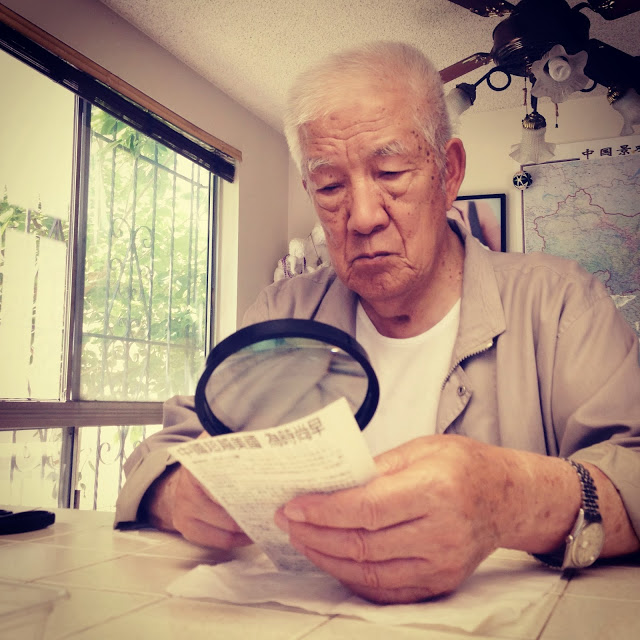 I scrolled all the way down my Instagram today to some thirty-five weeks ago, when I still lived at home. I stopped at this photograph I took of my grandfather, probably on a Monday or Wednesday afternoon, since those were the days I went and had lunch with him. He’s reading a newspaper clipping with a magnifying glass and though I’m taking a photo of him, I was probably reading something too.
 |
| Fifth Avenue Bridge Martin Lewis 1928. Drypoint. |
My coworkers were so different from my classmates. I thought about my workshop from last semester – a group of misfits who oddly enough, when arranged together around rectangular tables in a small classroom, seemed to fit perfectly together. There was the failed actress turned sex columnist; the former (and probably current) meth/crack/heroine addict, the spastic magazine writer with an unidentified eating disorder; the pretty but awkward Brazilian sportswriter who’d slowly gone in a downward spiral until she underwent gastric bypass and discovered that she was actually a genius and joined MENSA (“You know what we do in MENSA?” she said to me over lunch one day, “We compare medications.”)
There was the old woman who sat defensively with her shoulders hunched nearly to her ears and whose hair was so dry I feared it would burst into flames at the slightest friction. I detested her at first because her first essay sucked, and then I sort-of-kind-of reluctantly admired because she took the writing teacher’s advice and made it much better when it was workshopped again. There was the Indian girl who had, back in India, been in an abusive relationship. She had fought with her parents until they agreed to let her come study in the States and was now, according to Facebook at least, in a loving same-sex relationship. And there was the professor, in her late thirties and beautiful in a devil-may-care way and slightly aloof. A winning combination for any professor or woman, for that matter. Everything about her I learned from the sex-columnist and other classmates who adored her and wanted very much to take another workshop with her, though I felt distanced from her, partly because she didn’t seem, most of the time, to want to be in the classroom. She was an adjunct and had another real, full-time job as the editor of an online magazine. I went to visit her once at her office and we had a short conversation (“I’d like you to speak up more in class,” she said. I nodded. “Anything else?” I shook my head. “Okay then.”) before it became clear that she had to get back to work, real work. The kind that paid the bills.
And there were my counterparts – the girls like and unlike me – who had grown up in loving suburban families, who had never done drugs (until they did finally do drugs), who had held a string of odd part-time jobs (strip club waitress, 9/11 archivist, Costco cashier assistant), who had traveled and who wanted to continue traveling but who, at the same time, wanted some sort of internal anchor to keep us centered even when we were in the air. We could write well about a few things, but weren’t sure in the long run if that’s what we could do without running out of words or energy.
Suddenly, with birthday pizza on my lap in the copy room of Company X, I felt like I was in class again – Introduction to Real Life…?– surrounded by the corpses of English majors past that had now been repurposed into living breathing copywriters, all dressed almost exclusively in Madewell and J. Crew (the higher up you are the more full-priced items you can buy!). I got a weird sinking feeling that I and my thrift-store wearing, Brooklyn-living (except I live in the Upper West Side), part-time job-holding, chain-smoking classmates were fooling ourselves in thinking that writing for ourselves could somehow bring us the emotional and material life we wanted. It seemed that these girls, even that damned playwright who seemed to fit in so well despite his side job (though seriously, which job did he consider his “side” job?) must have, at some point, had similar dreams. Until the morning they woke up and turned uncomfortably onto their sides, seeing through the open window, “Oh! Reality.”
I wasn’t depressed, not quite, not yet, but I left the office feeling like a new cog in a giant, though much more fashionable, start-up-ish wheel. It didn’t help either that the walk home that night was bone-chillingly cold. The sounds of the street, usually welcoming after spending an entire day cooped up in my studio, seemed abrasive. I was now one of the hundred thousand people walking home from a tiring day at work. The wind hit my cheeks in sharp, icy slaps. I wasn’t underdressed, but was cold to begin with because I had sat and sat, staring at painfully cheery copy until my innards froze from physical inactivity and my right hand, on the mouse, had turned blue as it usually does when I leave it in that position. The light above my work desk had gone out so my corner had been a monotonous grey except for the blinding glow of the computer screen.
I frowned about these things as I went down into the subway. I frowned as I stood waiting with other people just getting off work, most of them also frowning or bearing no expression at all. In the subway, a man played Spanish guitar and several people frowned a little less as they walked by, deciding after a few steps to return and drop a dollar or two in his open guitar case. On the train, I frowned as I was shoved to the left side doors, then to the right side doors, then towards the middle of the car. I frowned too, when a dirty old homeless black man boarded and began to sing, “I’ve got sunshine on a cloudy day,” informing us that he was in fact, “singing for supper.” I looked away, still frowning. When he left for the next car, I looked at the young men and women and at the not-so-young men and women around me, most of them tired, all of them trying to make a living in various fields. I guessed that most too, had more responsibilities than I, to children, to wives, husbands and parents. To themselves.
I wasn’t being fair. I didn’t have to be, but I ought to try. Especially with former English majors who had read the same books I read, loved the same authors and poets and used, when they could, the same language. Their jobs didn’t define them anymore than an MFA would define me, than the sour smell of the homeless man defined him. They had merely gone a different way and I was passing through, looking.
I stopped frowning, but I didn’t smile either. I was dreading the stairs up to my apartment. I held my keys ready as I came out from underground and walked passed the two bums, one of whom was already fast asleep, himself undoubtedly having gone through a trying day and the other still “working,” though he shivering, stomped his feet and blew onto his hands. His gloves were thin and filled with holes. His sign was crumpled, but I could make out the two words that seem to appear in every homeless man’s message: “Help…God.”
“I get it, God,” I thought, looking up, “I get it.”
In the dark chilly skies above my warm apartment, God shrugged. He hadn’t said anything.
 VERY HIGHBROW