First Impressions II

A friend, also a denizen of SF, likes to say, “To get what you want, you have to tell the universe.”

I didn’t realize that telling E my ambitions in New York (aside from becoming a National Book Award winning and best-selling author) to “date up a storm,” was doing just that, with a few minor tweaks made by the Universe itself.

Apparently what I wanted was a bald white guy who worked in analytics and whose idea of an endearing pet name is “Ho-bag.”

The Universe hears – I know it does – but I’m not sure it listens.

The Universe also reminds me of POI; when they want to, they are capable of doing good, swift work. Otherwise they take their slow ass time providing things they know full well you deserve and you want to strangle them.

——-

Less than a month later, the day before I left for New York, I was at the bachelorette’s wedding in San Clemente, Calfornia, sitting ramrod straight in a very snug chartreuse bridesmaid dress, wondering if I could eat the palm-sized portion of steak in front of me and leave the table with the dress intact.

My phone lit up. It was E.

“Betty!” she texted, “I want to set you up with someone!”

I raised my eyebrows and looked at the empty seat across from me where, just a few minutes earlier, there had sat a hilarious groomsman who, before and during the wedding, had showed plenty of interest in “getting to know me.” Once the bar opened however, he had boozed up and was last seen slipping off behind some palm trees with another bridesmaid, equally boozed up.

A good reminder, I thought, that douchebaggery existed in every city.

I ate a bite of steak and tried to breathe. So far so good. I put the fork down and texted back.

“Hey E! I’m game. But in SF?”

“In New York! Except he’s working in London right now, but it’s temporary. He’ll be back after winter.”

Hm. Via text, we worked out the logistics. He was back in the States for a few weeks – both for work and vacation. He was in SF now but would be in New York for about two weeks after I moved there – we were arriving a day apart – then he’d head back to London.

“He’s really funny,” E wrote, “but he can be kind of offensive.”

“Oh, okay,” I said. This was a strange introduction.

“But I thought ‘It’s perfect’ because you can be kind of offensive too!’”

I snorted, which stretched my dress to max capacity. I texted back, “Wha…” but rolled with it, “Yeah,” I said and added without thinking, “You can tell him I’m racist too.”

E, playing telephone/middleman/matchmaker, wasted no time dispatching a flurry of texts to her friend who was with POI.

I just met her this year but she’s really cool.

In the heavens, God nodded.

She’s a little racist. But who isn’t? 

Right? Right?

Oh and her last name is ‘Ho.’ 

Her friend relayed this vital information to POI, who said, “I have to meet this girl.”

Some people have really high standards.

Photos were exchanged. He had no hair, but did have a nice smile and bright, kind eyes of indeterminate color. E sent him an Instagram I’d taken earlier that day, in full professionally done bridesmaid hair and makeup – basically what I look like…never. But it was established that neither of us were fat trolls; the handoff was made. My number was transferred from E’s phone to her friend’s phone to POI’s phone where a new text box was opened.

My phone blinked again. I had just finished the steak and was wondering when my now-married friends would cut the cake.

“This is POI,” texted POI.

“Hi!” I wrote, though my face bore the expression one wears when one’s dress is too tight and there is still dessert to be had.

“Quick, what are your two least favorite races,” he texted.

I responded in two seconds flat with  ____and ___ (though I’ll leave this to your imagination. Wouldn’t want to lose them as a demographic).

I was (half) joking but if POI took it the wrong way, then, as he likes to say, “So it goes.” Or as I like to say, “Your loss.”

He waited a few beats then wrote, “Great. Are you free next week for dinner?”

My eyebrows rose again. This could be interesting.

The emcee announced the cutting of the cake followed by dancing. I picked up my phone.

I am, I wrote, but didn’t have my agenda with me so I’d get back to him tomorrow. At that moment however, it was my duty as bridesmaid to eat some cake and tear up the dance floor. 
Writing Love Letters in the Modern Age

As I write this, POI, in London for work, is reading a long email I wrote him late last night.

“I’m assuming you’ll read this in the morning, hence the subject line – and indeed the sun should be showing her face in your part of the world soon.”

“You call everything ‘her’,” he texts, “I don’t think the sun is so equipped.” 

I type a single question mark and wait patiently for the wiseacre remark, sure to come. 

“No sungina,” he responds. 

My mother would call this, “Playing piano to a cow.” 

———
Nearly a year ago,  POI and I had our fifth date. We had dinner, then went back to his apartment where I met the rest of his roommates and visited the rooftop. It was the second New York rooftop I’d visited thus far – the first had been a swanky lounge/club called PhD to which POI invited me on our second date.

“Meet some peeps,” he had said, when really he meant nearly twenty of his closest friends in New York City.

“Will they let me in if I only have my bachelor’s?” I joked.

We were texting, but he had slapped his head, groaned. A few months later he would bring it up again and I smiled, knowing I had crafted a really good terrible joke.

We said goodbye a few days later, the fifth date. What is this obsession with numbering the dates, you wonder. Not an obsession – just a statement of what to me, seemed at the time to be crucial facts. Prior to POI I had never gone on more than three dates with anyone.

So that night, to be walking by the giant post office on 8th Ave., a massive reminder of a dying art – seemed a marvel in itself. We strolled alongside the steps and I recall thinking how odd and quiet that street was. I felt too, a light feeling – it’s called “hope,” I think. I thought about his rooftop from where the bright red sign of the New Yorker hotel could be seen.

I could, I said to him, not would – could – write to him when he was in London. But of course I would.

“I haven’t written a letter in…probably twenty years,” he said.

This was the expected answer. I was already doing that thing where I lowered expectations because I was beginning to like someone.

“I’ll write,” I offered, “You email.”

“No no,” he said, “I can pop out a few letters,” (or something to that effect).

A few days later he left. As he was boarding the plane, I sat at my desk – my large white New York desk, still relatively unused – and wrote a few, carefully balanced lines to him on a hideous New York post card I’d bought at a tourist shop. Uncharacteristically, I added a feminine touch and sprayed it with perfume (though looking back this step was unnecessary and most likely exacerbated the myriads of odors – especially that emitted by the crazy crazy homeless man who hangs around the particular letterbox – that were sure to infuse the postcard along its journey). I mailed it that same hour, before his feet even touched British land.

It’s in his possession now, perched precariously at the edge of his dresser along with the rest of my notecards and letters, sent steadily over the four months he lived in London. There are letter-pressed New York greeting cards with a few lines – “I miss you! See you soon!” – and stuck in between, multi-pagers on lined notebook paper, some written in cafes, others in spurts during tedious lectures and seminars- “I am sitting in my Spy Novel class and some girl is droning on and on about feminism. The professor is trying very hard to look engaged….” etc. etc. Even when I write, I like to hear myself talk. But that’s beside the point.

He never wrote me back – not longhand – but there were phone calls, text messages and short, practical emails, mostly logistics regarding my trips to London. Though once, when I had not heard from him via text or email for two days and despaired that his affections were waning, I found in my inbox later that night a sonnet written to near perfect iambic pentameter.

It was one of those things; you’re supposed to read it quietly and go to bed with a wan, wide smile while keeping certain cards close to your chest – but I told him immediately that I was speechless. Which, if you think of it, is an outright lie.

Edward Hopper,  “Hotel Room”   1931 Oil on Canvas 

Despite his never writing back, despite his never responding outright to anything I wrote in my letters (this is fine because I don’t ask questions in my letters. I show and tell), not once did I suspect him of casting my lengthy epistles aside (as some of my best friends have admitted to doing so). This is the modern letter writer’s entitled presumption. Like psychopaths and greasers, we are an uncommon breed (says the blogger too). A handwritten note is not only rare, it’s more thoughtful; to write by hand is to use a different part of the brain, a part closer to the heart. Thus to receive a handwritten letter, when the writer in question could very well be writing other things to other people… that’s equivalent to saying, You’re welcome. I made you feel special. 

But that’s not why I did it. For the most part – and accomplished letter writers adhere to this rule lest we waste precious time and costly, fancy stationery: know your audience. I knew POI to be a reader. And I knew him to be “into me,” as the lingo goes.

———-

When I visited London, I saw that he had propped the greeting cards up on a shelf. I asked where he kept the letters.

“The ten pagers?”

I laughed.

He pulled open his bedside drawer. I saw them there, scattered like old friends at a slumber party.

“What did you think,” I said, “‘Whoa this Betty blathers on and on?'”

“No,” he said. We were not there yet – the stage of being honest. “I mean, you can get really serious sometimes (POI code for ‘sappy’) but some parts of certain letters were pretty funny.”

He sat down at the edge of the bed to look for the excerpts and I left the room – not because I wasn’t interested but because the “replies” I was looking for I found. He had kept my letters.

———-
“Letters are just pieces of paper. Burn them and what stays in your heart will stay; keep them, and what vanishes will vanish.” 

                                                   –Haruki Murakami, Norwegian Wood 

Blog Upkeep

Sometime in the middle of last week, I was automatically charged another ten dollars to renew http://www.veryhighbrow.com as a domain name. 
I nodded to nobody – it was an email – and returned to the task at hand: retagging all my old published posts to organize them in a more accessible way. It’s kind of like what I do best – reorganizing old clothes (stripes, sleeve length, thickness, color) – but in the digital sphere. Mostly with words. I’m not quite done, but the new “system” is more or less in place. 
That drawer I was afraid to open because I thought all my old sweatpants and badminton shirts would come tumbling out? Things are getting folded. The stuff that doesn’t quite belong, I’ve deleted or moved into other, secret compartments.

I Was an Elementary School Bully

In elementary school, I made a girl fall and then kicked her in the stomach. Partly out of spite, and partly because I found myself standing in a warped moment possessing strange schoolgirl power that was so rarely in my hands. I forget why I kicked her – I’ll call her Lucy – most likely for no reason at all except that I disliked her. She had thick short hair, crooked, self-trimmed bangs – a dirty neck. She was fat. Her mass bothered me.

She wanted to be friends with me and my friends though ironically, we were ourselves constantly on the fringe of breaking up. Fractious factions so common to schoolyards filled with little (mostly Korean) bitches.

We were playing some schoolyard game or other. Or perhaps she had said something and I had pushed her. She fell heavily to the asphalt, landing on the corner of an empty foursquare court and I took the opportunity, lunging forward to kick her in the stomach. Not hard enough to send her vomiting, but hard enough so that she felt great discomfort in the soft flesh of her belly. (I have never been kicked in the stomach, so I have difficulty describing the sensation. Perhaps it feels like an external stomachache?) She lay on the ground, clutching her stomach and moaning, trying very hard not to cry. She did anyway, in a quiet, accepting way.

I looked around for angry adults but saw none. But still, she was taking her time rolling around the pavement and I feared a teacher would see this scene and think I had something to do with her odd position on the ground.

“Get up,” I hissed.

She whimpered.

“Get up,” I stomped my feet, threatening to kick her again.

Like a beached seal, she rolled away from me.

“Why did you do that?”

“Do what?” I was prepared to lie through my teeth. No one had seen me kick her, I don’t think. I had moved quickly and was now standing straight up, hands in my pockets.

“You kicked me,” she wailed.

“I didn’t.”

“Yes you did.”

“Get up. Just get up.” I reached down to help her up but she pushed my hand away.

“Suit yourself,” I put my hands back into my pockets. The bell was about to ring. “I didn’t kick you. You fell.”

I walked away that day feeling tough in a shallow way. Was I a bully now? She never told on me – and why would she? She had no bruise to show for it, no proof except for the dried tears around her eyes. Physically she dwarfed me and had an anger management problem, an unfortunate result of being a poor communicator. She frustrated easily and was prone to cry. I recall many times wrinkling my nose in disgust as she sobbed over elementary school equivalents of spilt milk and wondered if she would still act this way if she could see herself in the mirror. Tall for her size and extremely muscular, she had one haircut for the entire time I knew her and dressed in boys’ clothes, which I couldn’t decide if her mother chose for her or were her own taste. And yet even at that young age I recognized something harmless in her – that despite her heft, she was utterly incapable of causing the harm I had caused her. I kicked her out of contempt, a feeling she felt towards no one – not that she was purely good, but that she had no high horse to climb up on while I, at the age of nine or ten, had many such phantom steeds.

We were friends and then we weren’t. These labels depended on which way the winds were blowing from more powerful alpha girls – but even when we were “friends,” I knew we wouldn’t be for long. That was the nature of friendship in elementary school (and sometimes now): ever changing, trend driven, material based. I was allowed to hang out with my friends if I dressed a certain way, used certain words (“bunghole” and “hernia” were class favorites, as in, “Don’t have a hernia, you bunghole.”) and sometimes, although extremely rare, I would find myself at the center of command, capable of making or breaking someone’s social worth because the other girls had suddenly decided my opinion mattered.

Early on, I learned this lesson which takes some people a lifetime to unlearn, provided they have the opportunity: Caring is death. Nonchalance is queen. It wasn’t until middle school, when I consciously separated myself from these poison friendships and became friends with open-faced people who shared my sense of humor, my (feigned) disinterest in boys, my love for BBC America and movie-hopping that I learned a different set of rules which seemed to take me much further in my relationships: Loving people who love you back is much more fulfilling. Reciprocity is queen, along with caring, kindness and generosity.

And I was lucky too that around the same time, the former queen bees of my elementary school were learning the same things, within their respective groups so that by the time high school rolled around we found ourselves sitting next to each other in our honors and AP classes, inches taller, emotionally smarter, ready to rekindle old friendships in a genuine, lasting way. We were, after all, girls who had grown up together – if we couldn’t care about each other, whom could we care about?

But noticeably missing from our reunion was Lucy, the girl I’d kicked in the stomach. Somewhere along the way she had fallen behind, or dropped out intentionally from the path we were traversing, choosing to take another road altogether and probably make new friends. She attended our rival high school which was tucked away in some valley just a few miles away. I thought often of her and the day when I kicked her in the stomach. It was a good story to tell – I was then starting to know the value of being a raconteur – but I always came up blank when people asked with incredulous faces, “Why? Why would you kick her?” There was no moral to my story. I had acted monstrously for a few minutes on a school day afternoon. In the moment, as my leg was swinging, my blind blanked. I felt the rush of some illusory justice – she had annoyed me, assaulted my senses, angered me somehow. A swift kick was her just dessert.

Modern Dating: The Perils of G-Chat

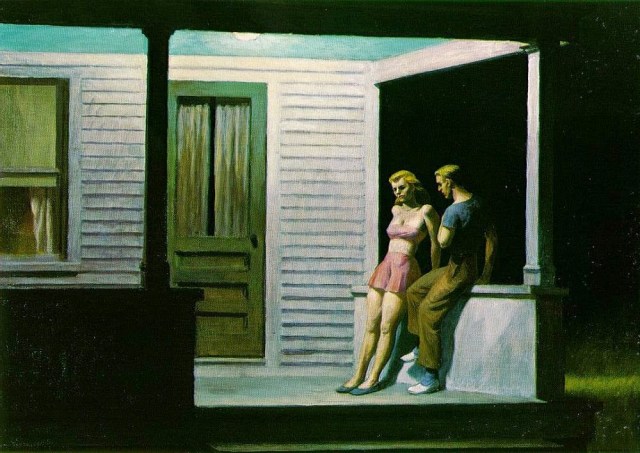
Summer Evening, 1947 by Edward Hopper

POI and I were chatting online.

“I’m thinking about going home the weekend of June 20th,” he wrote, “There’s a baseball game. Are we doing anything that weekend?”

I checked my calendar.

“Nope.”

I was sitting at work, my mind flitting between whatever task was at hand and the myriad of windows I had open from NYTimes.com. Then it occurred to me that POI’s question was a bit strange.

The last time he had gone home to visit his family he had booked his tickets without informing me. Not that he had to, but it had been on the weekend of his birthday, a weekend, I thought, quite suitable for taking me along to meet the family. But when I brought it up casually, carefully, at a dim, dive bar in Brooklyn while celebrating a classmate’s birthday (“You’re right,” POI had said, looking around with raised eyebrows at the characters smoking hand-rolled cigarettes and dressed in purposefully mismatched thrift store rags, “You MFA’ers are a weird bunch.”) it was apparent our thoughts were misaligned.

“I’m not in any rush to meet any parents,” he had said. The implication was that I probably felt the same way. He put a hand up for emphasis. Waved it, like washing a window. Or backing away from it.

I nodded, shrugged. Okay, good to know.

Now a little over two months later, he was going home again.

A lot can happen in two months.

I considered his question, then typed, “This is just you going, right?”

“Well I don’t know,” he wrote, “We’d have to figure that out too.”

I paused. In the world of clear responses, POI’s words had no place. I didn’t have time for limbo. I had things to move around on spreadsheets.

“Do you want me to go with you?”

“Do you want to go.”

My boss asked me to spellcheck something for her. Two seconds later, a sales intern leaned over his computer to inquire if a sell sheet he’d requested was coming along.

“Sure,” I said, and to the intern, “Yeah yeah.” The whole time, eyeing POI’s chat box.

POI is typing… 

“You would probably have to hang out with my parents.”

Oh really? Meeting someone’s parents entails spending time with them? I rolled my eyes, pursed my lips. If the intern saw, he smartly deduced his sell sheets would have to wait.

I took a deep breath. “Do you want me to go?”

Of course I wanted to meet his parents, but… I exhaled as I typed the rest:

“…only if you want me to meet them.”

POI is typing…

Betty gets ready to fume…

It was nearly 6PM. POI was readying to leave for a beer while I still had another hour left at work. It was, as Gchat conversations about serious things tend to go, veering into the valley of miscommunication, where grassy slopes are strewn with the corpses of relationships cut short. Strangled by misinterpreted words sent digitally rather than face to face. I am no good at avoiding this valley. I could probably have typed us both into nooses. POI, thankfully, is not.

“This might be one of those things we are better off figuring out in person,” he said.

I paused. My instinct was to “yell” at him in capital letters, something along the lines of, “YES OR NO! YES. Or. NO,” But it was such a simple call to reason and I felt an odd wave of relief.

I nodded to no one in particular and typed an answer in agreement. It would be much better in person.

What is Good Writing? Brian Doyle on the Heart

So much held in a heart in a lifetime. So much held in a heart in a day, an hour, a moment. We are utterly open with no one in the end – not mother and father, not wife or husband, not lover, not child, not friend. We open windows to each but we live alone in the house of the heart. Perhaps we must. Perhaps we could not bear to be so naked, for fear of a constantly harrowed heart. When young we think there will come one person who will savor and sustain us always; when we are older we know this is the dream of the child, that all hearts finally are bruised and scarred, scored and torn, repaired by time and will, patched by force of character, yet fragile and rickety forevermore, no matter how ferocious the defense and how many bricks you bring to the wall. You can brick up your heart as stout and tight and hard and cold and impregnable as you possibly can and down it comes in an instant, felled by a woman’s second glance, a child’s apple breath, the shatter of glass in the road, the words I have something to tell you, a cat with a broken spine dragging itself into the forest to die, the brush of your mother’s paper ancient hand in the thicket of your hair, the memory of your father’s voice early in the morning echoing from the kitchen where he is making pancakes for his children.” 

Bryan Doyle, “Joyas Volardores,” The American Scholar, Autumn 2004

Grandma Learns Gmail, Writes Back Months Later

When I’d lived in New York for three months I did something I rarely do. I wrote an email in Chinese to my grandmother in Taiwan. This was November 2013. I kept it short, giving a brief overview of my studies, life in New York and POI. I paused a moment before clicking “send,” mostly because things were going well for me, a young woman who (at least on her Instagram) seemed to be having too much fun while dipping her toes into her first romance (here, POI rolls his eyes and shudders violently). By then, my grandmother, a breast cancer survivor, had been widowed four years and was living alone.

My grandfather had passed away the summer before I graduated from Berkeley in 2010. Immediately following the funeral, my mother, anticipating a period of vast loneliness and depression for my grandmother, invited my grandmother to spend winter with us in California. Grandma said yes and traveled happily up and down the California coast and to Las Vegas as well, snapping close to a thousand photos with a shiny pink Canon my mother won at a casino. She celebrated Christmas and New Years with us before heading back to Taipei to start life in anew in her own apartment some twenty minutes away from the house she lived in for twenty years, at my grandfather’s side. 
When she returned, it seemed as though the good times – all good times – had come to an end. She felt an odd lump in her breast. The doctors confirmed it was cancer. A few months later, her best friend passed away from a ten-year battle with the same disease. And closely after that, a few of my grandfather’s friends, with whom she’d grown quite close, passed away as well. 
We worried about her, but she has always been resourceful, resilient. She married an eighty-year old man when she was thirty, after all. They were married for twenty years. Anyone who knows my grandpa will understand that it’s the woman who made it work. 
She ended up having one breast removed and through it all, made new friends both at the hospital and through a Tai Chi class she had taken up just a few weeks before she came to California. When she was recovering, the Tai Chi class began to consume much of her time. She worked up her strength and flexibility so that by the time I saw her next, she was transformed. She cut her hair short and stopped dying it. She adopted a primarily vegetarian diet and as a result, lost the weight she’d gained while being married to my grandfather, who could eat foie gras, butter and sugar by the kilo and not gain an ounce. She stopped wearing makeup but there was more color in her face. Her eyes and skin were brighter. She turned once again into a spritely woman, not young, but with a young spirit. 
She also got a Gmail account. 
I helped her set it up some time ago – I forget which year, which visit – but it was time to upgrade her from the cooling Hotmail. 
I showed her around the easy interface, feeling smugly “techie,” and told her to start telling her friends to email her there. She nodded, always thirsty for cutting edge technology but never quite mastering it. She took pages of notes from my “Gmail lecture” despite my counseling her to just play around with it. This was how she learned, or so she thought, but some people can study and study and not absorb a thing. 
Grandma was smart in other, more important ways. How to appease a hundred-year old man on a hourly basis for twenty years, for one. How to make a huge, disparate family love and rely on you, for another. How to make friends with old and young, Chinese-speaking or not. How to love and love, give and give, and expect very little if nothing in return. The list goes on. I know how to use Gmail but comparatively, my skills pale.  
In the end, I would wander into the kitchen and see her poring over her hotmail account, which she would leave unattended for months at a time. It was a treasure trove of spam. 
“I need to get through all these before I start using my gmail,” she would say. 
I wondered, “By when?”  
When I moved to New York, the promises I’d made to call my grandma fell away – it was hard enough to remember to call my own mother. But I thought about her from time to time, and wondered how she was getting on. I talked more regularly with my cousin Karen, who despite living in the same city, did not see grandma as often as I assumed. 
“She’s pretty busy,” my cousin said, “She’s got like a whole other life outside of us.” 
I’m not sure what compelled me to write to her that day in November – I guess it had been a while. I guess too, that I was continuing a faint tradition of sorts. My grandfather, her husband, had been a steady corresponder – until he was ninety-eight, he wrote letters on a daily basis. Sometimes with a fountain pen, sometimes with a Chinese calligraphy brush. Always in a shaky, but elegant hand. My brother and I wrote to him from time to time, more often when we were children and three weeks later, almost to the date of our last letter to him, there would be a reply in the mail, written on thin, nearly translucent paper. 
The date. 
Dear Howard and/or Betty
A brief message responding to our polite inquiries of how is your health? We accomplished such and such. We are looking forward to our next trip to Taipei… 
Love, Grand Pa. 
Always two words. Grand Pa. 
In any case, I clicked “send,” and my words, the gushing toned down, traveled electronically to my grandmother’s gmail inbox. 
I didn’t hear back from her and did not think anything of it. Had it been anyone else, I would have been irked. Thought them rude. A callous penpal. But it was grandma and I wondered if she was taking the time to digest my email or didn’t know what to say in reply. 
I should have known. 
A few days ago I opened my inbox and saw a message from her. The subject line said simply, “Reply,” in Chinese. 
Zhen (my Chinese name): 
I’m very sorry I’m replying to your message now. Half the year has gone by. 
My inbox has two to three thousand messages. Recently, I have started to go through them one by one, which is how I came across your message. 
I’m very happy you have a boyfriend now. Take the time to understand one another. Your cousin Larry is getting married next year. If you have time, come back for the wedding. 
I will go to America at the end of the year. When the time comes, I will see you. 
Grandma