Focus, Again

I’ve written so much about focus – how I lack it, how much of it others have… it’s not necessarily interchangeable with discipline (which I also lack), but recently I’ve been feeling that odd, old unwinding of the middle, where I feel something essential unraveling though which thankfully will never be untied. That is I think what saves me, a hardy knot in my middle, the result of what, I’m not sure – perhaps a childhood that was infinitely more focused (though my parents would argue otherwise) and more simple or the concentrated reading I try to do for at least ten minutes a day.

So the ropes. The elements, the innards, limbs, yarns, leather belt straps, intellectual spaghetti noodles – they unwind all the time, especially at this time of year when family, friends, engagements, christmas decorations and more baked goods than I can eat start closing in, crowding my physical space (not to mention physical pounds – pants = tight). And that’s to say nothing of the mental space, some of which goes frankly dead (hence the spare ten minutes devoted to reading and the zero minutes devoted to writing) and some of which kind of becomes compressed and anxious, brimming with paradoxically convoluted but simple thoughts such as: “Good God, 2013, what future. Am I prepared?”

George Tooker The Subway, 1950 

Basically I’m not ready to address that question, because I’m writing this with whatever little brainpower I have left after a full day’s shopping with my mom and grandma. Which is not a complaint – not at all. Unarguably, life is good: I am unemployed but busy enough not to feel badly about it, and just as the year is winding down my old peripatetic ways are revving up. Perhaps I don’t deserve any of it, the upcoming trips or the long but comfortably funded unemployment or even the opportunity to apply to grad school, but then again, it’s a trade off.

When I feel loopy because whatever is inside that can unravel is doing so, I blame the exterior. Not my body, per se, but my surroundings. The house that is mine but not mine. The city that I grew up in but is slowly, not becoming strange (it can only be strange in how undyingly familiar it is), but features as a strange character in my daydreams, in which I come back to stay for just a few future holidays as a guest in my own old house. That bank? That grocery store? That high school? We go way back, as the sayings goes. It is unsettling at times to be driving past that lackluster beige and grey building with blue doors day after day when eight years ago I sat within its walls and dreamed about being very far away.

That is life, isn’t it? The eerie dance no one teaches you but when you get to my age (har har, a careworn twenty-six!) you know the steps by heart: Walk two steps, now stand still, now walk. Now stand still again, now run. Now stop. Now fly. Now come back! Come back I say, and start all over again.

End of blather.

Oh. But.

I have never been one to write about current or cultural events, (being the type to get really into the “X-Files” ten years after the series ends), but the recent massacre of children in Connecticut makes me sad and – never mind. I am still not that kind of person.

Peeping Toms

My mother is like a child, though not in a bad way. I marvel at her ability to marvel at the things I take for granted or give little to no thought at all – and push away thoughts of Alzheimer’s to the nether regions of my brain, hoping never to have to retrieve them – and wonder what the switches in her mind look like and who is running them. Happy, mischievous little elves, those switch operators. 

“Look here!” they say, “Look there! Bet you never noticed that before.” 

And obediently my mother will turn and look. Her eyes will grow wide and she will look at me with the kind of earnest surprise that only earnest surprise can generate. Her long index finger will point, and she will ask me something or other, the most obvious question. A restating of the facts themselves, but with a question mark at the end. 

My reaction is always a slackening of the lower jaw and the wrinkling of the top left corner of my nose – a physical embodiment of incredulity

“Mother,” I will inevitably say, “nothing has changed. It has always been like this.   

Last night  she walked into my room and noticed that the louvers on my shuttered windows were open. Let me provide some history. Those windows have been on the south side of my room since the beginning of the house itself. The owners before us outfitted them with shutters that open towards the inside. On a sunny day, the idea was, the girl in the room could open the shutters and enjoy the flowers blooming in the side yard and smell the clean scent of freshly washed laundry sunning on the clotheslines. Such was the function of the side yard: a drying place for clean clothes, a sunning place for pretty white rose bushes or other flowers the lady of the house preferred. 

That elderly couple moved away some twenty years ago and sold their beloved one story house to a young Chinese couple with two young children. The Chinese man was quite fastidious – he was partly by nature and partly by upbringing and training punctual and organized, kept documents in files labeled by date and kept his clothes neatly hung or folded in the closet. He was not obsessive compulsive by any means, but he liked things neat and believed that everything had its place. He was raised in an orderly, tasteful house that blended spare Chinese elegance (his mother) with spots overflowing with shiny English knickknacks (his father). Despite this difference in aesthetic tastes, both parents were punctual and neat. It is odd then, that he married a woman who arrived an hour late to their first blind date and would, for the rest of their married lives, cause him to arrive at least ten minutes late and with high blood pressure to any functions they attended together. This woman was not organized by nature or by training, though to sustain the marriage she tried. She was also by nature a hoarder and this tendency extended to her love of flora. 

When husband and wife moved to their new home formerly occupied by the tasteful elderly couple of Anglo-Saxon descent, the woman immediately set about filling the back and side yards with her hodgepodge of greenery. What had once been a nice, orderly aisle reserved for clean laundry and a few carefully pruned rose bushes was now overrun with pots large and small filled with odd plants of eastern origin, none of which the daughter, whose windows faced this side yard, found aesthetically pleasing. Her mother liked weird spiky plants whose arms looked like crab legs or were wide and flat like ugly green belts. She was loathe to part with any plant and her female relatives took advantage of this, and over the years, added to her mother’s unsightly collection by bringing over their own ugly houseplants that were on the verge of death. 

“Here,” they said to the girl’s mother, “I no longer know what to do with this plant. Perhaps you can nurse it back to health and make it bloom again.” 

Potted Plants,  Paul Cezanne 1890 

It may come as a surprise to some, but a dying ugly plant does not look too much different from a thriving ugly plant. But when one is a plant hoarder, a plant is a plant. The girl’s mother also liked orchids, but these she kept hidden in a green house that sat on the hill, at the back. Instead of complain to her mother, the girl decided at a young age to keep the shutters closed but the louvers open to let in sunlight. She found the light itself pleasing, and did not think about the mess her mother had made of the side yard. At night, it did not matter. Everything was dark, and as the side windows faced the side yard, through which no one ever walked but her mother, the girl did not bother to close the louvers. Ever.

For some twenty years, it can be said, the girl’s mother would come into her bedroom at the end of the night and chat with the girl, telling her stories and doling out the advice only a mother is able to provide. The girl’s bed is positioned directly underneath the shutters, the louvers cast downward at whomever should sit or lie in the bed. They have always been positioned so, and even when the house cleaners come and wipe at the dust and alter the angle of the tilt, the girl will always, always re-position the louvers just so. See, unlike her father, the girl is more than fastidious, she is particular. Especially in regards to the position of the louvers.

They are never closed. The girl believes this takes away from the room’s dimensions. Makes it seem more narrow than it is. So there you have it, the essential point of that history: the louvers are never closed.

Back to last night. I looked up from the book I was reading and stared at her, wondering what in the world she was talking about.

“Your windows are open!” she said again, “You must close them at night!”

“Whatever for?” there was audible alarm in my voice, though my mother failed to notice and instead turned to me with alarm written over her face, as though she couldn’t believe I didn’t know what dangers lurked outside the windows of our small, quiet town.

“It’s not safe! Someone could peek inside and see you!”

“Mother, these windows face the side yard, which is not even connected to the road.”

She waved her hand at me, “You don’t understand. It’s not safe. There could be a bad man out there.”

“No mother, there are only hideous plants.”

She smiled and sat down in her usual spot on the edge of my bed, then proceeded to tell me about the peeping tom that had plagued her and her sister when they were young ladies in their teens.

“Your aunt Joannie and I shared a room and one night I felt someone looking at us, and when I looked to the window, there was a peeping tom! Leering at us right from the window! I screamed and then of course he ran off, but see, there are so many strange people out there.”

I nodded slowly, amused by both the story and my mother’s imitation of her younger self, a personality which emerges constantly and uncannily in her person’s current version. She is, despite her poor memory, someone I would deem ‘ageless.’ And yet in spite of her poor memory something about my south windows prompted a scene of her younger self. We all have those moments, I suppose.

“If I lived in a bad neighborhood in a big city, I’d keep the windows shuttered,” I assured her, “but here…” -I looked up between the louvers and scanned the darkened windows, half expecting to see a pair of bright, leery eyes, but was met with only the faint reflection of my bedside lamp – “I don’t think we need to worry about it.”

“Even so,” my mother said, “even so. You can never be too careful.” But she made no movements to close the louvers.

We chatted some more and she rose to leave, though not before taking one last look outside the windows. She saw nothing, I’m sure – it was a darker night than usual, the moon was off somewhere being bashful – but instead smiled to herself, thinking not of the peeping tom that had frightened her so many years ago but of all her darling odd plants, spiky leaves and waxy arms reaching out or hanging from the old clothesline. They stand in the dark in messy, uneven clusters like poorly conditioned soldiers of a decrepit army. Perhaps they protect me when I sleep.

Baby Steps 2

Now, I’m having lunch with grandpa three days a week and I don’t bring a camera or even a notebook with me. The time is still not right, and there may be a chance it will never be “right.” It takes only a day or two to become accustomed to standing over my grandmother’s stove, stir frying peas and slender green onions from her garden. Slicing navel oranges for dessert. He watches TV as I cook, and when everything is ready (it usually takes fifteen minutes or less to assemble everything), I say, “Let’s eat!” and he shuffles over to take his seat.

Lunch is a quiet affair, the only sound being the TV’s, and my occasional question. “Do you like this? Can you bite this? Do you want more?” It’s alright. Yes. No. Sometimes, I ask him questions about the past and he answers tersely, with a word or two, not angrily or sullenly, just matter-of-factly. Though sometimes he will say dismissively, “You don’t understand.” I don’t. But don’t is different from “will never.” And it’s okay. I let him dismiss me because we are on different planes. There must be much on his mind, both their past and his future, though the latter is slowly taking priority. More than ever he refers to the house as “my father’s house” or “Kwang-tien’s House.” He is wondering about place, his place. About “home” and life and living. 

But I am patient. I lean towards the positive, as, pleasantly apparent sometimes, does he. After lunch on Monday we took a walk in the park, the first time since the previous Wednesday my grandpa has left the house on a weekday. The clouds from the morning rain had parted and it was surprisingly warm outdoors. There was sun. My grandpa agreed easily to the walk and I hid my surprise, pretending that this was his usual routine. Better to fake it till he makes it so. Nearing the park’s cul-de-sac, we spied an old man in a wheelchair, using his toes to shuffle himself forward.

“That’s old man Zhang,” my grandpa said, nodding towards the diminutive figure, “he lives with his daughter. His legs are no good and he can’t hardly see, but his ears are very sharp.”

In a rare demonstration of his social abilities, grandpa nodded towards Old Man Zhang. “Let’s go say hello.”

We crossed the street and Grandpa called to him. The man slowly turned the wheelchair around with the tips of his toes, and I was surprised to see how healthy and pleasant he looked. His eyes, though cloudy with cataracts, glistened and his complexion was unmarred by liver spots. Aside from his obvious handicap, he seemed to be in good health, and in good spirits. He nodded at me and said hello.

“Taking in some sun?” Grandpa asked him.

“Yes, yes,” Zhang said, “I haven’t left the house for days.” It feels very nice out here.”

 “The rain,” grandpa said, “now it’s stopped.”

“”Yes, yes, finally,” Zhang said. “Very nice indeed.” 

The conversation was short as it usually is with two elderly men who do not know each other very well. 

 “Well, we’re just taking a walk,” grandpa said, and Zhang nodded kindly for us to continue on our way.

“They came to your grandma’s funeral,” he told me as soon as we were out of ear shot.

“That’s nice, but I don’t remember seeing anyone in a wheelchair.”

“Not him, don’t be ridiculous,” grandpa said, exasperated, “He can’t go anywhere in that state.”

“What’s wrong with his legs?”

Grandpa looked at me like I was stupid, “He’s old! That’s what happens when you get old. Your legs fail and you can’t walk. A lot of old people are rolling around in wheelchairs.”

I pointed to grandpa’s legs, “But you walk just fine.”

He scoffed, “That’s because I’m not old.”

I laughed. I really was that stupid. “Oh of course you’re not,” I said quickly, “Far from it.”

The sun was still shining and the air was oddly balmy. We had walked one lap around the entire park. Grandpa said he could walk a few more just around the playground.

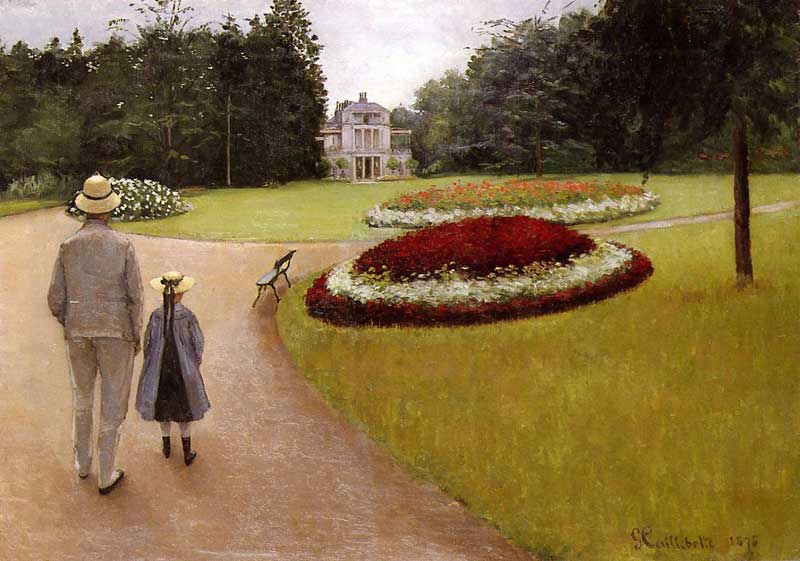
Gustave Caillebotte The Park On the Caillebotte Property at Yerres, 1875 Oil on Canvas

 “Good,” I said. I eyed the changed landscape of the playground that had once been filled with a seesaw, monkey bars and a small jungle gym, but now had only a swing set with four swings. It would do. “I’ll be on the swings.”

“You do that,” he said, and for the next half hour it was just the two of us at the park, doing things we used to do all the time when we were younger. 

Baby Steps

Initially, I sought to spend every other weekday afternoon with my grandfather to make good on a suggestion I’d made the evening my grandmother was hospitalized. I had just had dinner with a friend in town from Switzerland – she was a flight attendant – and, having heard from my mother that she was headed to the hospital, I thought, “Well, I’m heading back from Long Beach, so I’ll stop by grandpa’s house to keep him company.”

My grandfather is a tortured introvert. He can keep to himself forever and he very nearly would if it weren’t for the constant flow of sons and daughters and grandchildren visiting him, even long before grandma fell ill. She was the social one whose voice could always be heard, not necessarily telling stories, but doling out advice on how best to fry a fish, knead the dough for a green onion pancake, pinch the seams of the perfect dumpling – my grandfather would sit in either of two spots: his chair at the table, slightly tilted left so he could watch the tv as well, or a heavy mahogany chair with his back to the sliding glass door that led to the backyard. The latter was his TV chair, though it faced the wall ajacent to the TV rather than the TV itself. Only recently I asked grandpa if his neck had any issues, from spending hours twisted in one direction. He looked at me blankly and shook his head. The neck was fine.

That October evening, my entire family was still ten years younger. I was driving away from a friend I’d made in another country, my head brimming with the plans we made to travel in the near future. She, as a flight attendant, could request destinations a few months in advance and had yet to see Asia, where I planned to be in less than three month’s time. Our lives felt fuller from the conversation alone, conducted over a small cafe table near my grandfather’s house. I had just dropped her off at the hotel when my mother called me.

“It doesn’t look good,” she said, and I shook my head in the dark, silently accusing my mother of jumping as she usually did to the worst conclusions. Grandma being in the hospital was nothing new. She would be out again in a few days’ time.

Still, this time was heavier – not final, just heavier – the result of accumulated fear and anxiety and of course, facts. The fact that grandma had been falling more than usual, had more difficulty breathing than usual. Throughout all this my grandfather sort of faded into the background of our worried brains. He was okay for now, tough as nails, the stoic, the stone. I dialed his number as I drove past the dark freeway on ramp. It was 9PM – on a normal evening grandpa and grandma would be winding down, watching one last Chinese variety show or news broadcast before turning in – but tonight he answered the phone as though he’d been standing by it all evening.

“Hello?”

“Hi Lao Ye,” I said, “It’s Betty.”

“Oh Betty,” he said. It was not unusual for me to detect disappointment in his voice when his wife was at the hospital and someone not at the hospital with her called.

“I’m just passing through,” I said, “Can I stop by?”

“Sure sure.” He hung up in his usual way, before I could say goodbye. It didn’t matter, I would see him soon.

I drove as my grandfather most likely slept that night and the many nights after that: fitfully, building upon the worry my mother had transferred to me over the phone, and wondering how he felt right now. He’d been the one to find her so many times, more than once covered in blood in the middle of the night, her head cracked open, her eyes swollen and cheeks bruised. I thought about the last time I saw grandma without a nasty bruise or scar on her face…I couldn’t remember. As an octogenarian with poor lung function and an inflammatory diet (high in fat, salt and sugar), she healed slowly if at all. She would pass away with the mother of all scabs on her upper lip, but at the moment, the scab was still small.

I parked across the street from the familiar house in which I’d lived until I was six, when we moved to the Park and my parents asked my mother’s parents to move in. My grandpa, a tortured believer in self-reliance who despises handouts to this day refers to the house, at least to me as, “your father’s house.” It is my father’s house, as many things belong to many people, though in name only. I rang the doorbell and almost instantaneously a voice called out, “Ah Jun?”

“Yep, it’s me, Grandpa.”

The garage door rolled up and my grandfather stood in the narrow doorway, one hand on the door frame, the other on the large white garage door control.

“Come in then,” he said.

We sat staring at each other for a while. The TV was off, though it buzzed faintly with cathodes still cooling and as usual there was only the long fluorescent light on over the tiled, built-in dinner table – anywhere else I would describe the light as a harsh, but that particular light over that particular table I have come to associate with my grandparents brightly lit faces, looking at me over the steam of a hundred delicious dishes. But tonight the table was bare except for napkins and reading glasses, and my grandfather’s insulated tea mug. We chatted about what, I forget now, and suddenly, I began to cry.

“What? What?” grandpa asked, looking horrified. Had I stopped by to sob uselessly?

“Grandma,” I choked, then could say nothing more.

He sighed and told me not to cry, “This is just how it is when you get old,” he said, as he’s said a million times before.

I nodded, though inside I disagreed. I did not think that old age had to be this way, filled with falls and hospitalizations and the fear and uncertainty all these things generated. My old age would not – and, looking at my grandfather that evening, I hoped his wouldn’t either.

I stopped crying then, convincing myself that partly, I was just tired from driving and for making those very ambitious plans with my Swiss friend. It was 9:30PM and grandpa did not seem to be tired at all. We began to speak again, though this time about other things, about the past – a favorite subject with old people, no? I started asking questions to pass the time, to get him talking, and that evening, he talked for much longer and with much more energy than I’d ever heard or seen him. We talked about the early days of his marriage, about running away from the communists on foot, with nothing but the clothes on his back, the various friends he’d made and the one or two he miraculously reconnected with decades later in the United States. He told me about the barbarism back then though barbarism is my word. He was thirteen when he witnessed his first decapitation.

“You saw someone murdered?” I said, my eyes wide with horror.

“Not just one!” he said almost indignant, “Dozens! I saw them decapitated right before my eyes.”

He made a motion with his hands, thrusting ten fingers upward, “The blood like this in the air. And the body,” one hand fell limply at the wrist, “just like that.”

“What did you feel? Were you terrified?”

And, so odd to me, he cocked his head to one side and pursed his lips as though he were trying to retrieve the feeling that had accompanied the observation.

“I don’t remember what I felt,” he said, “That’s just how it was in those days. Lives were not of much value.”

By then I had pulled out a small notebook and had filled nearly five pages with spotty notes. I wanted to listen, but knew I would forget – and looking up I saw the clock. My hand was tired from writing, and I still had to drive home. Though grandpa looked as though he could talk forever.

“I have so many stories,” he said, “You don’t even know.”

Vincent Van Gogh Self Portrait with Bandaged Ear 1889

 “I’d like to hear them,” I flipped the pages in my notebook, wondering if this was how biographies are written. “You know, Grandpa, if you don’t mind, I’d like to video tape you next time you tell me stories. I could write them down and share them with the rest of the kids. They’d like that.”

Secretly, I could tell that he too, would like it very much. He was introverted, sure, but at some point (around the decade your mortality rises to look you in the eye) a man wants to share what he knows, wants to be heard. My grandpa was on some strange raconteur’s high that night, and he did not disagree to my idea.

“I have so many stories,” he said again.

I stood up and nodded, “And I’d like to record them.”

We bid each other good night and I wondered if he had gone to bed with his old stories swimming around his head, or if, as I think is the case now, he heard nothing but the overwhelming silence of the empty spot next to him.

———————–

A few weeks later, driving grandpa to the hospital on the same day grandma would later pass away, I asked grandpa if he remembered my suggestion.

“I do,” he said, “but not now. With your grandma in the hospital like this, it is hard for me to say anything. The feeling is not right.”

“Okay,” I said and didn’t bring it up again.

Taking my Grandpa to the Cerritos Library

Grandpa reading.

The Cerritos Library employs a small army of vigilant volunteers who patrols the stacks with straight backs and stern expressions that become sterner if its bearer spies a prohibited Starbucks cup or neon bag of Cheetos. They interrupt the quiet yet unfocused studies of various sleepy, glum-faced students and say, “Sir/Miss, you’re not allowed to have that. Please throw it away outside.” It is no wonder the Library, though having been renovated nearly a decade ago, is still pristine. Continue reading “Taking my Grandpa to the Cerritos Library”