Birth

Less than two months later the woman learned that she was pregnant and a collective sigh emerged from the breath of all those involved, namely, the woman and her husband. He came home from work early the evening she found out and held her hands tightly and looked at her in the same way he’d looked at her when they were still sweethearts in college. It stirred her heart, this look, and made her love her husband more. She felt proud, like she did when she was a little girl and brought home accolades from school, and her parents beamed but were not too lavish with the praise. They knew too much praise for tiny accomplishments would only lead to a lazy child who expected it.

Now however, the woman felt a strange sense of triumph, that she had somehow overcome an impossible obstacle. She knew nothing of medicine or the mysteries of what made this particular pregnancy possible, but she understood that it had felt like an impossibility for the longest time and now, here she was, sitting in her husband’s tender embrace, the beginnings of their child floating warmly in the womb.

It was not an easy pregnancy. She tossed and turned and suffered violent nausea that rocked her entire frame, which seemed to simultaneously swell up and diminish. How her back ached! How her feet hurt! How her stomach churned and churned! Had she not known any better she might have suspected that she was slowly being poisoned to death, but of course she said none of this to her husband, who although still spent much time away from home, was quite attentive when he returned, always making sure to bring her some sweets or noodles. Often she did not feel like eating, but her mother and her mother in law would tsk tsk and made sure she ate half her weight’s worth of herbal broths and such. They brought over entire chickens cooked in ginger broth, the pale, plucked skins of which sickened her to look at but which she ate dutifully, knowing it was for the baby. She put on twenty, then thirty pounds and by the time it was revealed that the baby was in fact, a girl, the woman could hardly recognize herself in the mirror.

A girl! The girl was safely tucked away in her mother’s belly, unable to see the ensuing disappointment on her parent’s faces, but perhaps she felt something – an intangible but audible rhythm that sprang from the valves of her mother’s pulsing heart, reverberated down the maternal spine and through the uterine wall; a miniscule shockwave, barely detectible except to the thin, translucent membranes of a developing fetus. The baby did not yet know the word “disappointment,” but she felt it early on. It was uncomfortable. In response, she kicked and kicked. The woman winced. A girl! This child would not be easy.

—————–

A mother ought to love her child, regardless of its sex, unconditionally. The woman knew this, but when the girl was born and placed into her arms, she was only exhausted. The labor had been brutal, nearing 32 hours. At one point the doctor had feared the baby would stop breathing and they would have to operate.

“It’s as though she doesn’t want to leave,” the nurse said.

The woman moaned through gritted teeth, “No, no,” she gasped, “She wants to kill me first.”

But both mother and daughter survived and the baby emerged shrieking, a loud, siren-like noise that seemed to belong to a much larger animal.

The woman leaned back into her pillow, relieved that the pressure she had felt for the past day and a half was no longer there, still unaware of the pain and discomfort that lay ahead. Beneath the sheets lay a bloody mess, but at least the baby had all ten fingers and toes. At least she was intact. 
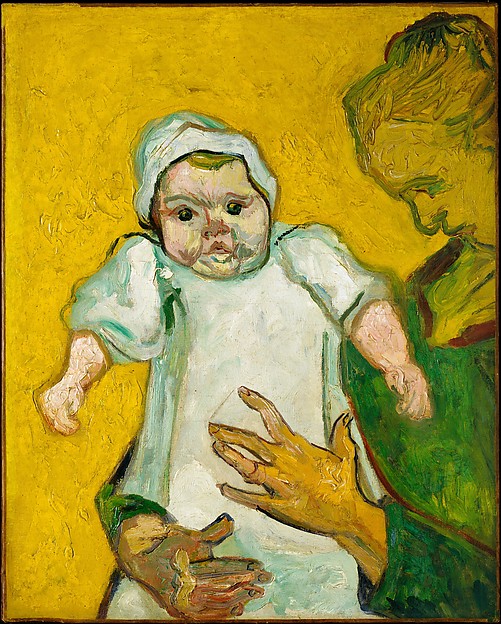
Madame Roulin and her Baby, Vincent van Gogh 1888, Oil on Canvas

Her mother placed her hand on her daughter’s warm forehead, brushing away the matted hair, “She’s a good girl,” the mother said, taking the baby from the woman’s arms, “She looks just like her father.”

The girl’s father was away at the office and would see his daughter a few hours later. He would take the little girl up in his arms and smile a contented smile – true, he had wanted a son, or did he? It wasn’t typical for a man to admit, but he had rather liked the idea of having a daughter – here was a person you could spoil and place upon a pedestal rather than worry if he, a son, could live up to your accomplishments. The man was still a young man at that point but he had foresight – just as he knew he had chosen a suitable and obedient companion in the woman, he knew he would be tremendously successful in his business ventures. It wasn’t a doubt he had ever experienced – he did not have the luxury of doubt. And now he had a daughter upon whom he could shower the spoils of his success. What a princess he held! His princess. His mother in law repeated what she’d said to her daughter and he nodded, looking into what might as well have been a tiny mirror. She did look quite like him.


Conception

It occurred to her some years later that at some point early on in the marriage the lovemaking had turned loveless, and that their only child had been conceived in such a perfunctory manner. It made sense then, did it not, that her relationship with their daughter was strained.

When their plans to have children began to form, she realized she was not the kind of woman who longed to have children. She could easily have lived the rest of her life with just her husband, singing to him alone, though lately she had seen so little of him she began to consider teaching choir at a nearby middle school.

But the woman was dutiful if nothing else. There were aging parents on both sides pestering them for children and at twenty-four her clock, though inaudible to her, was ticking. As husband and wife they knew the importance of working on a schedule and they approached it with the diligence they had both applied to their college entrance exams. The woman recalled this time with mixed feelings: she never felt closer to her husband, never saw more of him than at this moment in their lives. He came home, still exhausted from work, but rather than falling immediately asleep he came to her first.

He wanted a son; she could see it in his eyes. And because it was what he wanted, it became what she wanted. Each night and morning she bit her lip and willed herself and all her necessary organs to give the man a son, to give their parents a strong, healthy grandson, and to give herself – though she didn’t know it then – a companion. She imagined walking up and down the street with their toddler son while her husband worked and the neighbors nodding and smiling, “Now that is a handsome little boy,” they would say, “he will grow up to be tall and strong like his father, and shrewd too.” She would buy him little suits to wear at Chinese New Year and take him to lunch with his grandparents. He would enroll at the best schools, and perhaps take up choir too, but only if his father saw fit.

And slowly, this little boy yet unborn became as concrete as the man sleeping next to her. He was not an abstract thought – she could see his large bright eyes, the thick dark hair, and almost feel, when she clutched her husband’s back, the soft baby flesh that would come from the very same flesh. 

Instead, weeks, months and then a year went by. She gave him nothing.

Her mother intervened, taking her daughter to the best Chinese doctors, acupuncturists and herbalists. The fortuneteller told the woman not to worry, she could conceive. Her husband’s business would flourish. They would have many houses, all over the world. He would invest much into this child.

 The Fortune Teller, Charles Edward Halle, (1846-1919)

“The child, our son,” the woman said, looking at the fortuneteller with imploring eyes.

“I cannot say,” murmured the fortuneteller, “but you have so much to look forward to. It is a good life, by anyone’s measure.”

On her way out of the fortuneteller’s office the woman stopped before the altar where the Bodhisattva Guanyin stood, looking down upon all who needed her. The woman did not like the gaze of this particular sculpture, Guanyin had an air of smug arrogance. What did this porcelain statue know and what could she give? The woman was dissatisfied with the answers she’d received. She had prepared a red envelope of eight thousand to give as an offering but felt that the fortuneteller’s answers were not worth so much. Things were supposed to get better, but her womb was still empty and her husband had less and less to say to her.  She knew her husband’s business would do well – after all, he spent nearly all his breath there so that by the time he returned home he hardly had a word left for her. Whatever common ground they had shared was slowly disappearing so that the only thing they shared was a bed, if barely, considering the late hours he now kept entertaining his buyers. Furtively, the woman slid two fingers in and removed two crisp thousand dollar bills then placed the envelope in a the wooden bowl at Guanyin’s feet, next to waxed apples and fragrant oranges. Guanyin’s expression did not change but behind her the fortuneteller shook her head. Two thousand dollars. Was that the value the woman placed on truth?  

A Marriage Begins

She came from a fairly well-to-do family and was used to certain things. With this man she could see that materially, things could only get better. He had drive – her parents often told her this was more important than coming from a wealthy family, from where the children often lacked ambition and direction. The woman pitied the girls who had failed to find themselves husbands and for the first time she did not focus all her energies on her studies or even choir practice. Her grades slipped slightly but it didn’t matter. She quit trying to give weight and shape to the abstract career thoughts; instead, they took another shape altogether, that of the man she loved and the life they would lead together.

She and her beau spent hours discussing their future, strolling down the palm-lined walkways of their prestigious university on warm summer nights. Other young lovers walked the same paths at the same hours, but when she was with him she felt the path was theirs alone. The street lamps shone solely upon them, like spotlights on a stage that every young woman her age longed to be on. She would turn to look at him under the lamps’ soft glow, not saying a word as he talked animatedly with his hands about the businesses he wanted to start – something about computer parts or panels, she didn’t really understand and instead was mesmerized by the sheen of microscopic sweat forming on his brow and temples. The angles of his face glowed with promise. Such straight teeth! Such bright eyes and strong hands! She felt beautiful in his presence because she felt lucky – she was not picky with men and she did not need to be. He had selected her – of all the roses in the school, he had chosen her.

Boating, Edouard Manet, 1874 Oil on Canvas

They graduated, already knowing they were to marry. He made his intentions clear to her parents and they nodded, seeing the same promise their daughter saw. They gave them their blessing and showered the young couple with a borderline lavish ceremony. It was, the woman thought, one of the happiest days of her life. But that night she lay awake next to her toast-drunk husband and thought, “Why happiest?” She was so young. There was so much ahead of them. Things could only get better.

And for a while they did. His career took off with flying colors – he was a shrewd business man, unafraid of hard work and sacrifice. He made it very clear to his wife that it was for both of them. Within the first year his business doubled then tripled and showed no signs of slowing and the woman smiled contentedly, thinking herself his lucky charm. She let him leave her for long hours because in the beginning it was just him and a handful of his partners, none of who were married so they could stay late at the office without worrying about a wife waiting at home while dinner got cold. She understood these things, and anyway it didn’t matter; if he came home late – which was often – she would simply reheat the dinner she had cooked. She gave him no advice, took no role in his business – she had no head for such things – and sang to him when he returned home exhausted from work. Only once, when he couldn’t sleep for one reason or other did he ask her to quiet down. The other times his sleep was so deep he did not hear.

When did things begin to change?

When does any marriage begin to change? 

When the woman could not get pregnant.

Alto

The woman tried hard not to cry, though it was apparent she’d been holding all she’d wanted to say inside for a long time. I know the feeling – when you’re exhausted and filled with unhealthy thoughts, the very littlest invitation to release can send you sobbing up a storm – but the woman, extremely self-conscious, knew she couldn’t just lose it in the middle of a badminton club. She stifled her tears, steadied her voice, and began to tell a story both my mother and I have heard many times before from the lips of other women, all similar in age, all immigrants from Taiwan.

She had come Stateside some fifteen years ago with her high school aged only daughter. In Taiwan, the girl had done poorly in her freshman and sophomore years and showed neither signs nor interest in improving. School wasn’t her strong suit, she said, and her mother shook her head. She knew the system was unforgiving and except for the diligent few that could study and study, shame inducing. At the end of every term their scores were posted alongside their names in the school courtyard for everyone to see. That was the system. One learned to work within it, with it, and if not, well hopefully you were someone else’s daughter. But it was her daughter having the trouble and the woman didn’t need to see a fortuneteller to know that if they stayed in Taiwan, what lay ahead for her daughter’s academic future was a dismal dead end.

The woman herself had been somewhat of a teacher’s pet. She sang alto in her school choir and marks-wise, consistently ranked in the top five percent of her class. She was industrious and diligent, her parents’ pride and joy. Around school she was recognized as such. She attended an all girl’s high school and though she was friendly enough, had no close friends. The choir was an unlikely breeding ground for competition, but it was one of the few places the girls could exercise talents other than who could sit and study the longest. The woman didn’t realize until years later how much or why she loved to sing, not until she woke up alone in a bed her husband had shared with her only once, in a large empty house halfway around the world. But in high school and then college, singing was just one more thing she felt, and rightfully so, that she did better than others.

She was not a great beauty, but always held her head high and sat with a straight back. The other girls thought her rather uptight, but there were always a handful of such girls at every school. She never laughed loudly or spoke out of turn. Sometimes the wild way certain other girls talked and laughed, throwing their heads back and baring all their teeth, gave her shivers – where they ladies or not? She felt sorry for their mothers. When she had a spare moment from her studies and various activities, she thought about having a “career” in an abstract sense, but never sat long enough to give it shape.

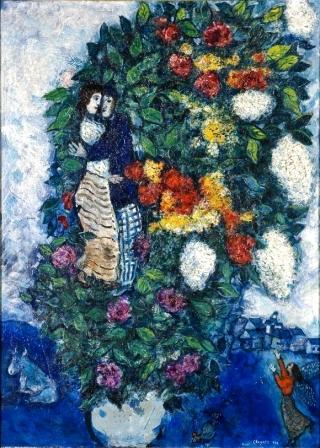
Marc Chagall, Bouquet of Flowers, 1937 Oil on Canvas. Private Collection.

When the time came to prepare for her college entrance exams she doubled down on study time, shut herself away and read until the prescription of her eyes grew more and more severe. To celebrate her inevitable success – admission into Taiwan’s top colleges – her parents awarded her with a new pair of glasses. They were considered a splurge at the time, Italian frames fitted with special thin lenses that masked the severity of her prescription, but their daughter was a rose on the edge of blooming and college was where such blooms were picked.

And picked she was. Reaped, more like it. She was not a particularly romantic woman, but she met a young man who showed a hunger for success and was not afraid to work for it. He wasn’t like so many of the other girls’ boyfriends she heard about in dorm gossip. The man called often and though he had very little money to spend taking her out, often said she was good for him.

“We are partners,” he would say, “I can tell a woman like you will bring me success.”

Partners. Fifteen later it would seem like a cruel pun.

Please Listen

Yesterday my mother came back later than usual from her badminton lesson, looking dejected rather than energized. She plays badminton two or three times a week with two other ladies, both of whom are much older, though in truth their athletic abilities are evenly matched.

“What’s the matter,” I asked, “Didn’t you have a good lesson?”

My mother nodded, her eyes ringed with fatigue, “Oh yes, the lesson was fine. But I didn’t practice much afterward.”

“Why not?”

“One of the new ladies came up to me after our lesson and asked if we could talk.”

“About what?”

“I thought she just wanted to get to know me better,” my mother said, “She started her membership some two, three months ago, but she isn’t the most social person. She doesn’t seem happy. Doesn’t really smile.”

The woman had approached timidly and spoke to my mother in a small, weak voice. My mother leaned in to listen.

“I know this is strange,” the woman said, “But I need someone to talk to. I’m so lonely. I don’t know anyone here, and it’s good for me to get out and exercise, but I’m also ashamed.”

 I’m not surprised that out of all the women in the club my mother was the one the woman felt comfortable coming to. My mother is quite judgmental, but you couldn’t tell by looking at her – she has a warm smile, soft inviting eyes, and a casual yet elegant manner that you can’t help but be drawn to. People see her and think, “Now there is a woman to whom I can pour my heart out to, who will be a friend and confidante.” More than a few times she’s had utter strangers approach her on long flights, tour buses and at conferences for Chinese teachers. They come up to her casually, feel about for mutual interests and when my mother seems receptive, unload their life stories upon her. Perhaps I’m making it seem too one-sided – my mother is a gifted conversationalist and a curious, inquiring woman, but it seems a bit excessive sometimes, the details she comes away with, and as she’s a master storyteller and I her favorite audience, she comes home and repeats the stories to me in such detail that I feel I’ve met them too and know their problems well.

“She told you all that?” I find myself asking, “And you met her when?”

“Just a few hours ago,” my mother will reply, as though it were normal to know so much about a complete stranger.

The Conversation Federico Zandomeneghi, 1895

When I was younger I scratched my head and thought, “What do they expect mother to do? How can she help?” But now, having had my own instances of over-sharing (though I hope not to a complete stranger), I know that they don’t expect her to do anything but listen; for some people, that is the ultimate help. Silence may be golden but talking to the right person can be quite therapeutic; my mother, and I know this from first hand experience, is not just an excellent and encouraging sounding board, but also that rare breed of person whose aura compels you to project your very best self – whatever hope and optimism you may harbor, however little of it is left – upon the conversation before you. That, I think, is the core of a good listener. They function like a diary you can write and write into, and the more you write the more at ease you feel, both within and without. The world is okay if you have a good listener.

This woman did not have a good listener. But she accurately detected one in my mother, and yesterday afternoon she waited on the pine green plastic bleachers, next to my mother’s racket bag, knowing that my mother would stop to wipe her forehead in between her lesson and her double’s game. My mother went to her bag and smiled at the woman, “Hello,” my mother said.

They traded pleasantries and my mother turned towards the court and her waiting friends when the woman asked her to wait a minute. Could they talk? My mother obliged – she hadn’t really worked up a sweat during her lesson, but what can you do when a lonely woman about your age asks you simply to listen? You cannot say, “Oh of course, but how about after I play two sets of 21 points?” Well, perhaps you could, but it isn’t the right thing to do.

Sensing desperation in the woman’s voice, my mother nodded, “Of course.” She placed her racket down on top of her bag, near the still-dry towel and turned to give the woman her full attention.

“What’s the matter?”

Return to Sender

“I’m sending you back to your parents,” my boss said.

It was my last day at The Company.

“Sorry?” I said, “I still live with my parents.”

He chuckled, “I know, but go home and tell them that I say, ‘Your daughter is going back under your care.’ My responsibility for you ends here.”

I laughed, wondering what he meant.

“This whole time, I felt like I was parenting you.”

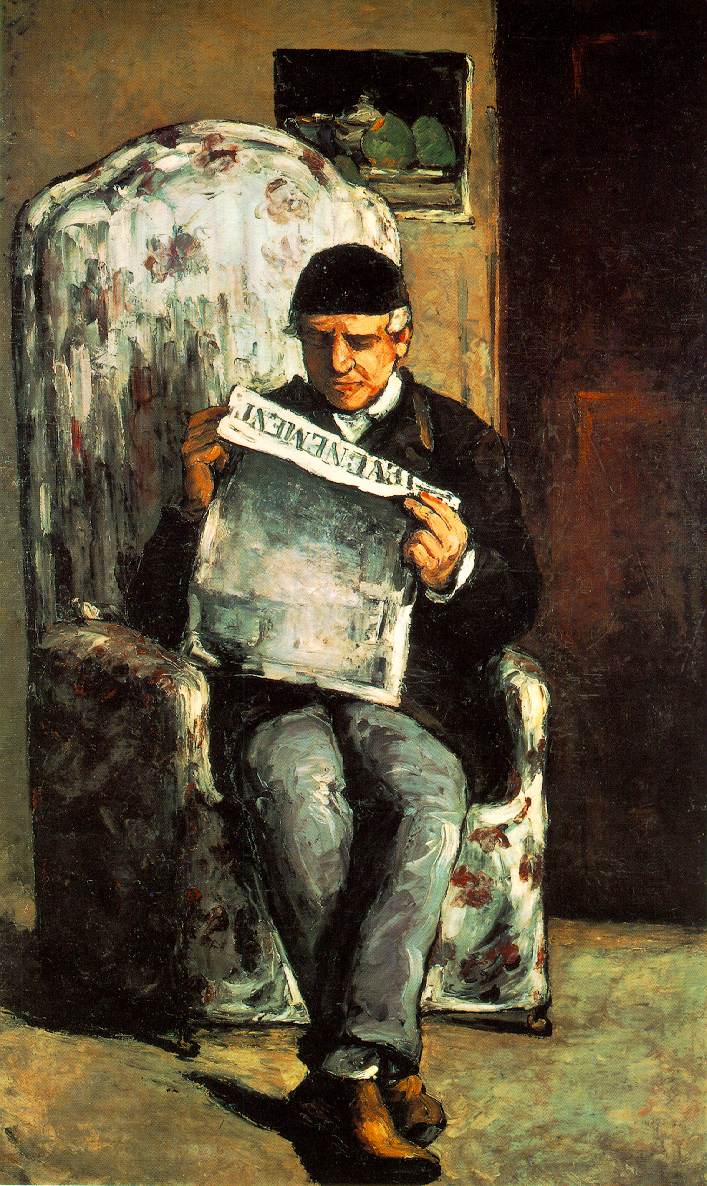
Portrait of the Artist’s Father, Paul Cezanne 1866 Oil on canvas.

 I recalled an awkward moment at one of my boss’s events, where after he’d accepted an award a mob of people swarmed our table to congratulate him. His wife was seated on his left and I to her left. Their daughter had taken the seat on my boss’s right but had gone to the restroom. His wife leaned towards me, asking me one thing or other as was cutting through my filet mignon. A man appeared over my shoulder, patted me on the back and said to my boss, “So is this young lady your daughter?”

I shook my head a little too hard and said five “No’s” in rapid succession so that the pink slice of steak I had so carefully speared quivered and loosened from the tines of my fork. It belly-flopped like a tiny, shitty diver onto my dress.

My boss’s wife laughed and my boss pretended not to see my little mishap. Though to my surprise, he didn’t falter or vehemently correct the man, who also pretended not to see though it was his stupid assumption that ruined my dress.

“Oh no,” my boss said, “She’s my assistant,” then pausing to think about it for a moment, “Well, yeah she could be my daughter.”

I dabbed at the steak stain, (thank god my dress was purple) and smiled in what I hoped was a winning manner at the man, who seemed less interested in me now that he found I wasn’t a blood relation to my boss. My boss’s daughter returned to the table and was immediately accosted by the man and a few elderly women wearing too much makeup.

“Of course she’s your daughter!” they squealed, “Look at the resemblance!”

My boss’s daughter, ever polite and modest, smiled and said thank you. Thank you, thank you.

———

In his office, my boss leaned back in his chair, “I hope you learned a few things from me. And I don’t mean all these tasks I gave you, but just as a person.”

I mentally ran through a few of our key lessons, but my boss did an oral review.

“You forget this and that, don’t plan ahead, pass information around before processing it…”

I nodded, “Yeah, yeah, I know. I’ll try not to do that in my personal life, or in my endeavors to become a writer.”

“So you don’t need a reminder to brush your teeth, right?”

I laughed and shook my head. One night a few months ago after a particularly terrible streak of forgetfulness my boss had sent me what was most likely his angriest text ever: “I feel I have to remind you to update my calendar when you make changes every two or three weeks. This is your job! I hope you don’t need me to remind you to brush your teeth!” 

I read the message at 10PM on Monday night – only Monday! – and wondered how I ought to respond. Should I even wake up the next morning or would he write an email to me that night asking me not to come in anymore?

In the end, acceptance seemed to be the best reaction. I typed, “No, you don’t need to remind me to brush my teeth. And you remind me much more often than that.”

He didn’t write back, not because he was furious at my response, but because there wasn’t anything else to say. What can you do when the person you are angry/disappointed/frustrated with knows exactly why you feel that way and they accept it? You let them bathe in the frustration and hope they remember the shame and the resulting exhaustion. You hope they never let it happen again. 

“Nope,” I said, “I can definitely remember to brush my teeth.”  

My boss grinned, “Good. You learned something. Hopefully you can remember all the other important stuff.”

The Replacement

HR worked fast and stealthily. For weeks they said they had not found anyone until suddenly the resume of “the perfect candidate” appeared in my inbox.

“Please let your boss review,” they said, “We think she is the perfect fit and want to get her in right away before she goes somewhere else.”

I printed the resume (two pages!) and before my boss walked in, devoured her work history and references. If I were gunning for the same job I’d have gulped. She was, as her meticulously curated resume indicated, a professional EA, having worked at least two or three years in each of the positions listed. I was impressed.

“How old is she?”

HR looked at me as though I were stupid. And rude.

“You can’t ask me that.”

Hm.

I’m no mathematician, but I can put two and two together. Her resume indicated that she’d graduated college some twelve years ago with a major she had no intention of applying in the real world. Or perhaps she did – who knows – but most of us are familiar with the fear that strikes so suddenly when we’re on the cusp of stepping into “the real world.” Aspiring filmmakers, psychologists, philosophers, dancers, and yes, writers promptly morph into accountants, tutors, administrators and restaurant hostesses, the ink on their diplomas hardly dry, in industries as far from our hearts as the college campuses we so blithely wandered upon for four years. Time flies, as they say.

I studied the woman’s resume, trying to picture her face, mannerisms and style of dress. From the paper alone I knew she would interview well – how else would she have moved from job to job with virtually no lost time between? I imagined her striding in, briefcase in hand, suit tailored to a T, vibrant red lipstick applied expertly over thin, unsmiling lips. She would shake my hand with a firm if not crushing grip as though silently communicating to me all my failings, “Go and play out your girlish dreams in the cushy meadows of grad school,” this handshake would sneer, “Leave a profession to the professionals.”

She would, as any good EA ought to be, a door closed both to herself and to her boss, an icy cool enigma rather than how I was, a foolish open book who in the beginning shared much more about my boss and his schedule than he felt comfortable.

“Your job is to keep my schedule and act as gatekeeper,” he’d once written to me, “STOP OVER SHARING!!!”

She would certainly not commit a fraction of the faux pas I so freely showered upon the poor man. The coffee! That damned coffee machine! My damned, leaky memory! Her resume still in hand, I ran through the series of unfortunate events during which I felt sorry for myself but really, when I think about it, was really subjecting my boss to the brunt of it all. I made appointments but forgot to record them, leaving poor, soft-spoken foreign gentlemen sitting alone at my boss’s various lunch clubs while he had no idea because they weren’t in his calendar. More than a few times, I’d put down the wrong address, the wrong phone number, and mailed concert tickets to the wrong people (though they didn’t complain). And the most dangerous mistakes of all involved my inviting people outside the company to internal meetings (though in my defense there are too many Asian men with the same damn names) thereby sharing internal agendas, memos and email addresses with people completely uninvolved who would politely write back, “Um, I don’t think you meant me….” or, “I think you have made a mistake I am not on the board of your Company!”)

No. The woman behind this particular resume would make none of these mistakes and if she did, would EXPECT to be fired. She would recognize the gravity of all these situations and in her utter professionalism say very gravely, “It will never happened again.” I tried this. But after the second or third time I remembered an old fable and did not say it again. You see, I could not guarantee it.  But this woman, though faceless, seemed to represent some sort of Executive Assistant Messiah – she would lead my boss to the promised land where all appointments were checked. Secrets kept. The company’s leader and as a direct result its underlings would be run like clockwork. The bullets shot out at me with measured precision: “Step. Aside. Little girl. Step. Aside. This is the big leagues and your boss has decided to play with a better team.”

My boss came in and I handed the resume to him.

“HR found someone they think you’ll like,” I said, “Her resume looks pretty good.”

“Oh?” He took it, gave it a quick scan, and turned it over to read her references. Then flipped it back to the front. His expression remained unchanged. I searched his face for some indication of agreement. Finally he spoke.

“This looks good to you?”

I nodded, “Yeah. I mean, she’s got good work experience.”

He scoffed. What did I know about work experience? Boss had a point – my whole resume, with nothing omitted, was a compendium of odds and ends – a curio cabinet on paper. I’d worked several internships, all more or less writing intensive until I started at the Company which was email intensive. But sandwiched in-between each unpaid but “career-building” internship was a paying job at Rite Aid, Costco, Calvin Klein and, most briefly, a Borders calendar kiosk. Then I started here and was gainfully employed for a whole year, with a salary, benefits, the whole corporate shebang I’d heard about but had never truly experienced.  

So again, my boss was partially wrong: I did know a lot about work history, not because mine was long, but it was undeniably populated. 

At the very least the woman’s experiences were each longer than two years. I pictured myself staying at the Company for another year but shuddered at the image of myself ten pounds heavier and ten years older in the soul. I’ll pass.

“She hasn’t stayed anywhere longer than two years,” my boss said, “This isn’t the best work history.”

I gulped. Had he even seen my resume?

“This is the longest I’ve ever worked anywhere,” I said to him, “and it’s barely over a year.”

He looked at me over the edge of the resume, glasses perched on the bridge of his wide, fortunate nose. There was something fatherly about his look.

“You’re just a kid,” he said, leaning back into his ergonomic chair, “You can still change your ways and get away with it. I’m telling you now to knock it off. All that waffling… You say you want to write, then write. Don’t do a little bit of this and a little bit of that and not really write and then five, ten years from now try to pursue a writing career. You’ll be older with less time and less choice. You’re lucky now! You have a choice!”

I nodded.

He joined his elbows together and made a “Y” with his arms, “You’re at a fork in the road, you know? Pick a path and stick to it.”

It was very profound. I shuddered again. I saw the resume he held in his hand and how really, it was no different from my own resume, which he had held in the same way, with the same fingers and probably wearing that same shirt a little over a year ago, when I was on the brink of walking into his office. The only difference between her resume and mine (aside from superficial formatting) was that hers spanned more time. I had the benefit of youth – and though I was a year older I saw that the benefit was still upon me.

Mr. Obvious

This morning my boss asked me to get a quote for a private jet. I should have known by now, not to go above and beyond on certain things because it invites more questions, for which I’m normally not prepared. But as it is my last week at work I shrugged and thought, “Why not?”

I inquired after the company we normally used for such trips and asked after another one, introduced to us by some friend of my boss’s. This other company was much cheaper by a few thousand dollars. I raised my eyebrows and scoffed, “Well, I guess I know which one Boss will want to go with.”

My Achilles Heel, my boss will tell you, is my tendency to assume.

“You assume things, and then you are wrong. Never think you know anything when you can’t even be bothered to ask the right questions.”

It’s half true. I do ask the questions, I just ask silently, in my own head for a millionth of a second. It is, I think, a natural response when you are handed two vastly different quotes from two companies for what is essentially the same flight, to pause and think “Why? What factors make the prices so different? Is it the type of plane? The personnel involved? The marketing materials one company uses over another?”

I asked these questions, but chose to forgo the actions that ought to follow the asking of said questions: to hunt for answers. And it pains me to acknowledge that yes, after a year, I am still that silly girl that just passes around the information.

My boss is quick. I told him the numbers and he asked, “What kind of planes?”

I gave him a sheepish look, “Very good question,” and went back to my desk to find out. This time, I was more thorough, asking both parties what types of jets they used and why their service was cheaper or more expensive. Both parties returned with mounds of information. I processed it minimally before going back to my boss.

“Well, company B’s quote is cheaper because they use an older prop jet.”

He looked at me with a bemused half-smile, “And what’s a prop jet.”

“Um. I think it has the…” for some reason the scene from Indiana Jones and the Last Crusade in which Indiana Jones flies a small plane into a flock of seagulls came to mind, and instead of using words I awkwardly tried to mime a prop jet. My boss sat and blinked.

“Prop,” he said slowly, prompting me.

“Yes. A prop jet,” I made the motion again, stirring my arms like an old egg beater with a failing engine. After a minute, my arms tired. “No? Am I wrong?” 

“Prop…” he looked at me expectantly.

“Yes…a prop jet…”

“Prop is short for…”

“The wings are propped up by the engines…?”

He was sitting on one of the short red armchairs and when I said this, collapsed back in amused frustration. I stood before him like a shitty comedian. This scene has played out many times in the past year.

“God,” he said, slowing straightening himself as though recovering from a punch, “Propeller! Prop! Propeller! How could you not know this?”

I shrugged.

“And what’s the other kind of engine?” he asked, ever hopeful that he didn’t hire an absolute ding dong.

I laughed mostly out of nervousness.

“I don’t know. Uh. The kind of engine that you find in a….car?”

He stared at me in the same way I stare at people I think are dumb as rocks – namely people who say things like, “Oh Taiwan! That’s in Thailand, right?” – and said, “A jet engine, Betty. A jet engine.”

Ah. Of course.

He went on to patiently explain the difference between the engines, using words like horsepower and thrust, drag and gas velocity, moving his hands through the air in a knowledgeable way. I could see the diagrams wafting crystal clear around his mind’s eye, just not in the air before me. I nodded slowly at his every pause, a check to see if I understood – not really – but still, I didn’t want him to think he was wasting his time. My boss was taking precious minutes out of his day to make clear the distinctions between prop and turbo jets, I wasn’t going to say, “Whoa whoa Boss, hold your horses. I drive a Prius and fly economy.”

So I stood very still and listened.

Finally, at the end of the lesson he smiled as though it were all very simple, “Get it?”

I nodded. Oh sure. Yes. Prop. Propeller. Yes. Of course.

“Okay,” he said, “So what’s the difference?”

“Um. Prop jets… use…propellers to push the air and…”

My boss shook his head, “Man, I thought everyone knew this. You learn this in high school physics.”

I pursed my lips and blinked and threw my arms up in the air, “Ah…I  I didn’t take that class.” Then I laughed because that’s what I do when I’m nervous and want to change the subject. 

He slowly pushed himself out of the armchair, almost dazed that I had been under his employment for so long. How did he let me get away with it? How did he let himself get away with it! A year with an assistant who not only made coffee without coffee, but didn’t even have enough beans to fill her own noggin.

“No you didn’t,” he said, “you definitely did not take that class.” 

Snails

For the past few weekends, I was away. I was on “vacation” on those weekends, short trips to Palm Springs, Las Vegas and San Jose, but there is nothing more relaxing than waking up in your own bed on a warm weekend morning, no alcohol in your bloodstream, no loud music from the night before, no sore soles from high heeled dancing shoes. Self-inflicted torment, I know. On Sunday evenings I would arrive home, exhausted from the drive and the combination of sleeplessness compounded from both the preceding workweek and the resulting weekend. YOLO, my friend Drake likes to say.

YOLO indeed, but there are many ways to YOLO.

This weekend I was at home for the first time in a long time. A delicious, nostalgia inducing state. I was reminded of those lazy summer days of my youth (and in truth there are about to be a lot more with my impending unemployment) where my sole responsibility was to make sure I swam after 4PM, when the sun was not so scorching. And even though this weekend was similar in its simplicity, it is never the same as when you were young. But I tried. I tried.

I ate popcorn and watched a string of Tom Cruise movies (“A Few Good Men” and “Jerry Maguire” – I know he is a crazy Scientologist but man can he deliver some lines!), read magazines from June and July, and went swimming to assuage my growing likeness to a beached whale.

Socially, I spent much needed time with family; lunching with them at a hot, crowded noodle house in Rowland Heights with slow service but enormous dumplings and then cooling off in my cousin’s airy new mansion with green carpeting and onyx vanities. We cooed over their new baby boy. In the afternoon my cousin came over to swim and we paddled and talked while my father dozed in the living room. When we came dripping inside, he gave us fresh cut watermelon. We showered and lounged on my brother’s bed, watching Jerry Maguire propose to Dorothy Boyd.

In the evening, I cut yam leaves from my mother’s garden and blanched them for dinner. It was an eyebrow raising dinner: an odd combination of tomato sauce on yam leaves, with some Parmesan sprinkled on top. My carb-free version of spaghetti. I ate before my mother came home from her line-dance class and when she returned and sat down to eat with my father, I for some reason wanted to stay and talk to them instead of retreat to my room as I normally. I ate a bowl of shaved ice while my father gnawed on leftover pork knuckles. My mother finished the fish she made two days ago.

We were very happy.

After dinner I started to write this, then stopped. I had spend enough time in front of a screen, probably enough for my entire life, though certainly there are several thousand hours ahead. I looked up across the street and saw my neighbor’s car pulling in. I imagined him giving his wife a peck on the cheek as he set his keys down on the kitchen counter. I had been in their house once as a child, and knew the layout. It was the same as ours, except with a second floor. I saw a couple walking their dog after their evening meal, most likely discussing their grown children who lived in other cities. My parents were less than a hundred feet away – we were at the same address and yet I often wondered what they were doing.

I stood up and walked to the living room. My father was asleep in the massage chair. There was a travel show playing, showcasing the gorgeous scenery of some place in Sichuan China. The back door was ajar and my mother’s house slippers at the threshold. It was getting dark and I wondered what my mother could do in the garden.

I called her name and I think she heard me better than I heard her. She was on the hill, crouched in the vegetable patch my father had built for her. The sun was gone and by what light was left I could make out a small plastic bucket in her left hand and the swift plucking motion of her right.

Dunk, dunk.

Whatever she was plucking made a small, satisfying percussion as they hit the inside of the bucket.

“Mom?”

“Hmm?” Her voice was almost singsongy, and though I couldn’t see her face I knew her expression – the slightly wan, but contented look she gets when she’s spent a few satisfying hours in the garden. Hours well spent.

“What are you plucking?”

Dunk, dunk. 

“Snails,” she said, “They come out after dark to eat my precious leaves.”

Dunk, dunk, dunk. 

“Sounds like there are a lot.”

There are. It’s terrible.”

“What do you do with them?”

“I dump them somewhere else.”

“Don’t you think it’s disgusting to touch them?”

Dunk, dunk, dunk.

“I did,” she said, then paused to examine a particularly large one, “I used to use chopsticks. But not anymore. It’s much faster this way.”

I could hardly see my mother then, and left her to her work. Walking back into the house my father stirred.

Where’s your mother?”

Plucking snails in the back,” I said, “They come out at night and snack on yam leaves.”

My father shifted in the massage chair, nodding as though he knew all about snails and yam leaves, “Yam leaves are very good for everyone.” Then he noticed how dark it had become.

Go help your mother,” he said.

I wrinkled my nose, “I don’t want to touch snails or step in the dirt. I’ve already showered.”

“It’s dark,” he said, “You could hold a flashlight for her, couldn’t you? Bring her a light.”

I guess so. I didn’t feel like writing. Not yet. I went to my father’s cabinet, where he kept random things like flashlights and radios and took out the most powerful flashlight he had. The kind that cops use when they are suspicious of someone. The kind that doubles as a weapon. It cast a cold beam, but was sufficiently bright and would illuminate a slimy snail on a clean yam leaf like a helicopter following a car on a high speed chase. Fox News with snails.

Wordlessly, I went back to my mother and clicked it on right where her hand was reaching next. She showed no surprise, as though she’d known all along I would come back with the light.

Point it here,” she said simply. I did as I was told. I held the light for her as she seized the frozen snails. I don’t think she got them all.

“I could never get them all,” she said, “but I did get many of them.”

She told me about a friend of hers who made a funny sort of escargot with the snails she found in her garden.

But I wouldn’t do that,” she said. The little bucket appeared to be about full and I stayed away, purposely not shining the light into the bucket. I think it would have made me squeamish. But my mother took the bucket to a withered avocado tree several feet away from the garden patch and turned the bucket over. She whacked the bucket against a branch. The snails tumbled onto the ground, a confused bunch writhing in the dark.

My mother smiled at me as she came up the cement steps.

“Don’t touch me,” I said.

She laughed. “Of course not. Thanks for your help.”

We stood for a moment and looked down into the garden. A shadowy patch of yam leaves freed from the at least one night’s onslaught of snails.

My father dozed in the light of the living room. My mother was very happy. Poor snails. All they wanted was a twilight snack.