Out of Water

My boss likes to say, “You should know __(insert habit/predilection/taste/leaning/whim)_about me by now!”

And I should. As an assistant, I should know many things about my boss – and I do. I know that he likes decaffeinated coffee in the mornings. I know that he likes to snack on nuts. I know that he is not a morning person. I know that he likes his assistant to pay attention to details and to know things an assistant should know: schedules, names, faces, addresses, phone numbers, important dates and promises made so that they can be kept.

It’s an odd job. Of course so are many other jobs (professional magician, production assistant for adult movies, mortician…) – but it is such an odd job. To think I know so much about one man, his family, his habits and tastes – someone I am neither related to nor in love with – is one whole facet of strange. Stranger still is the fact that I do know so much and yet for the most part feel myself uneasy and in the dark because, the question is: can you ever really know what someone else wants? Or more unsettling: know what they want but doubt your ability to deliver it? I feel uneasy everyday. I walk into work with a bright smile, but underneath it I am hollow, as though removed from my own skin. That’s a decoy walking in. I am standing outside the water. I haven’t jumped in.
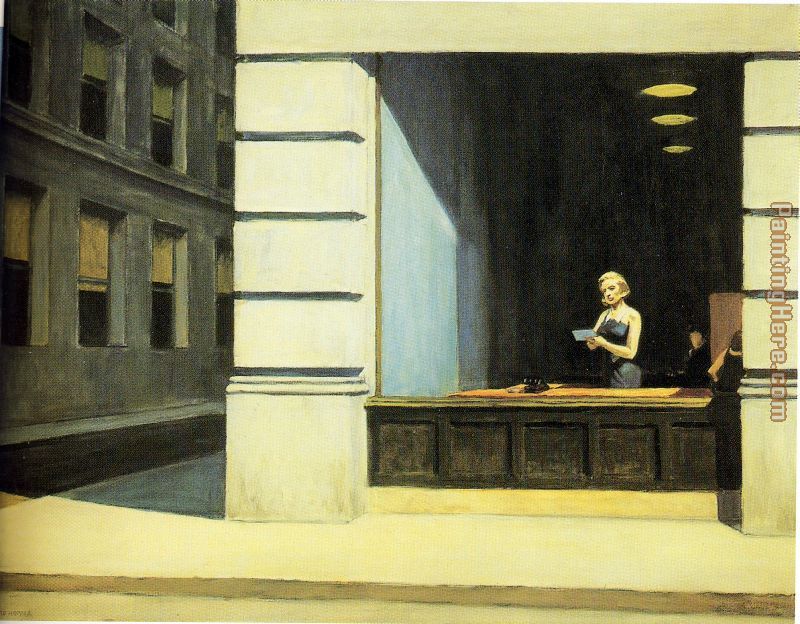
Edward Hopper New York Office

 But my boss is not a shark. He never gnashes his teeth. Never barks or bites; just wears me out with his heavy sighs and questions because I wear him out with mine. 

Lately, I have been spinning a downward spiral at work; an airplane with a clipped wing and a pilot who stunned, goes in and out of consciousness. The plane nose dives and the pilot wakes just in time to pull it back up. Then blacks out. The plane dives again. I can feel my boss’s frustration, even though I know he is too kind to say it full force. He sends me reserved emails instead, with exclamation points (!) to emphasize his exasperation.

“Why did you do this?” He cannot wail in person. It is unbecoming. Unprofessional. So he wails in a muted, manly, electronic way and I hear not the wail but the “ping!” of my phone’s email alert. It is a sound I have come to dread above all others.

In the beginning, I never wrote that I was sorry, because I wasn’t. I often made mistakes, but it was the first month. Then the second month. Then the third. Sometimes, it was a lack of guidance. No one held my hand and that’s fine – I could put two and two together. Boss hands me keys: his car needs gas. No? Then his car needs service. No again? Get something from the trunk. His wife calls. Something to do with: insurance. The company van. Picking up an ice cream birthday cake. Inquiries about my boss’s schedule so she can plan their vacation. But was I sorry to mess up? Sometimes. And if we were in the same room I would apologize profusely and earnestly, but there was something hollow about doing it via text or email. I simply didn’t bother.

But tonight I did, via text. Like a bad boyfriend. He said that he found himself reminding me to do things – simple things that should be rote by now – every three or four weeks. And I knew he didn’t mean it as a jab, but he added, “I hope you don’t need reminding to brush your teeth!”

I had just come in from a swim and stood dripping wet at my desk, feeling the carpet growing soggy beneath my feet. I typed my immediate reaction:

“I don’t. And you remind me more often than that.”

I stopped and wondered about the last two words still unwritten. How much would I mean them? I recalled an early conversation I had with my boss about being willing. “If you’re not smart, then you’ve got to be willing,” he had said. This heartened me at first, then bothered me. It exhausts me now. I am willing, just not willing enough for certain things. And the thing is, the main thing is: I am smart.

Slowly, deliberately, I tapped out the letters, smearing a few droplets of water that distorted the words, but did not make them any less true: “I’m sorry.”

I hit ‘send’, not sure if he would sense that I was serious, but I was.
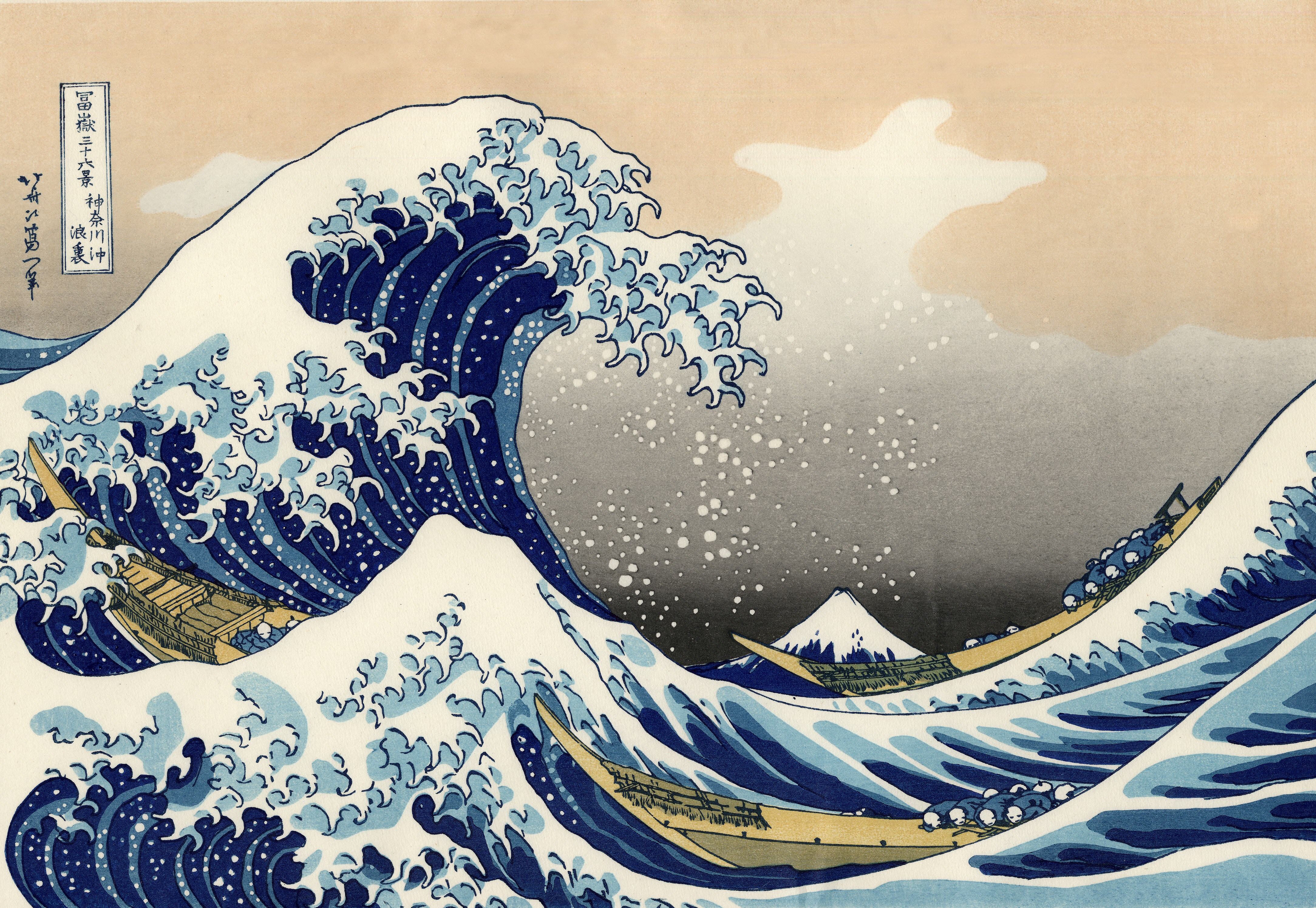
The Wave

The Great Wave off Kanagawa, Hokusai  1830-33
The Great Wave off Kanagawa, Hokusai 1830-33

In the afternoon I swam and did a second load of laundry: the darks. It was a pitifully small load, devoid of my father’s thick navy polos purchased in bulk at Costco and my mother’s nylon badminton shirts. This is laundry when you live alone: just your dirty clothes in a small, limp pile. Small because you’re not the type of person to let the clothes pile up. I used half the detergent I normally use and closed the lid, suddenly unaccustomed to the silence.  Continue reading “The Wave”

Entertainment

A few days ago I cancelled a meeting without telling my boss. I didn’t think I had to. It was one of those things where the other party dictated what they thought should happen because it seemed like the common sense thing to do, and me, without applying common sense, agreed.

I can’t explain the thought process, perhaps because there wasn’t one, but the conversation went something like this:

J: “Hey Betty, can you cancel our Tuesday morning meeting with Boss man, Jeb isn’t in and we don’t have much to update Bossman on since our meeting with him last Friday.”

Me, wondering if it was a good idea, all the while knowing in my gut that it wasn’t, “Okay.”

Click. Click. Meeting cancelled.

On Wednesday morning, Bossman rolls in, nods at me, then goes to his desk.

A few minutes later my phone rings.

It’s Bossman. My voice cracks as I answer. He never calls this early in the morning, preferring to go quietly through his emails.

“Hell- o?”

“Come in.”

I get up and walk into his office, hoping that I haven’t forgotten the coffee again. I see that he has a cup on his desk. It’s not the coffee. He has a disgruntled look on his face, but then again, it is the morning. Early on he told me he wasn’t a morning person.

“Where’s my meeting,” he asks.

“Ah.” I mentally punch myself in the face. Here we go. “I cancelled it,” I say.

“Who told you to cancel it.”

“J did, Jeb’s out because there was a death in his family… and they said that as a team, they didn’t have any new updates to bring to you.”

“So you just cancelled it?”

“Yes…?”

“What is wrong with you? What’s the point of having a set, recurring meeting if you just go and cancel them at their whim? How does that keep them accountable? Oh so they have nothing to show me. Well, why don’t they just stay home? Maybe I shouldn’t even come to work?”

I stand awkwardly and nod along, wondering why he never raises his voice. I study his face. How tired of me is he? I’ve been here eight months…nearing nine now, and in a few days my employee evaluations are due – will he even bother to write it out? I imagine him pulling a huge guilt trip and telling me to fill it out on his behalf. “You tell me how you think you should be evaluated,” I imagine him saying. But back to the cancelled meeting.

“Sorry,” I say, “I wasn’t thinking. I figured…” I don’t know what I figured. I didn’t figure anything because…

“You weren’t thinking,” he says, “You don’t think. You don’t want to think. You just do. You just want to follow instructions, from anyone!”

I say nothing.

“If that’s the case, then you’d be better off working at Burger King. At Burger King, you just gotta follow instructions.”

He made an incongruous gesture with his hands, reaching up to pull some imaginary burgers down from imaginary shelves and placed them roughly on an imaginary conveyor belt. Had anyone been standing outside his office, it would have seemed like a terrible seated rendition of Michael Jackson’s “Thriller,” but he was really demonstrating to me what life would be like at Burger King.

Finally I say, “Do you want me to call J and them upstairs? We can still hold the meeting.”

“Forget it,” he said, “Just don’t cancel my meetings for stupid reasons next time. Don’t let them tell you what to do. You’re here to hold other people accountable, not just to me, but to themselves and their responsibilities.”

“Got it,” I say, then as I walk out, make a mental note to think more.

                                                            ————–

I have good, thoughtful intentions I swear. But brain cells and memory are no longer on my side. Whose side ARE they on?

This morning my boss rolls in again, and I am pretty sure that at least for the rest of the week the calendar is good. All meetings are on. Things have been confirmed and reconfirmed. I am excited like an eager ninth grader in honors bio who read the assigned chapter a couple of times. I almost want Bossman to test me.

He nods good morning as he saunters past my desk and I grin brightly, assured that we’re both off to a good start.

I hear “snap snap snap” and from the corner of my eye I see the lights turn on. Next stop, coffee pot. And once he pours himself a nice hot cup and settles into his chair…

“Betty.”

I snap my head towards him. He is walking towards the desk and motions for me to come in.

Oh goodness what now.

“Yes Boss?”

“You served me hot water again.”

My jaw slackens as though someone has hit me with a sledgehammer. The most obvious thing. ALWAYS, the most obvious thing. Concentrate on one thing and let another thing slip.

I rush to the coffee pot as my morning’s actions rush back toward me. My mental checklist failed again. It makes me sad that I need a mental checklist to make coffee. The fact that I had forgotten AGAIN to put coffee in the coffee pot seems the stuff of comedy and at the end of the day, my boss would tell David that it was his daily entertainment, a small, one woman show called, “What will Betty forget today?”

At this point, there is no point in explaining myself. I grab the coffee pot and laugh. What else is there to do?

I lift the cover and scoop the beans in. How could I have missed that smell this morning? And it’s almost like deja-vu, my standing there, scooping coffee into the the filter and thinking, “Good god I am so bad at this.” The conversation we had yesterday returns to me.

“I don’t even think I can work at Burger King,” I say.

“Nope,” he says without looking at me. He has already sat down in front of his computer and is running through his morning emails. He shakes his head and says drily, “Burger King would not want you.”

Barack and Genevieve

“The sexual warmth is definitely there — but the rest of it has sharp edges, and I’m finding it all unsettling and finding myself wanting to withdraw from it all. I have to admit that I am feeling anger at him for some reason, multi-stranded reasons. His warmth can be deceptive. Tho he speaks sweet words and can be open and trusting, there is also that coolness — and I begin to have an inkling of some things about him that could get to me.”

From the 1984 diaries of Genevieve Cook, one of Barack Obama’s ex-girlfriends 

I don’t know who she is, but I respect and admire her tremendously. And I will buy this book in hardback and read it from cover to cover the day it comes out. If I could, I would buy Genevieve Cook’s diary.

This morning, I read this post in the NY Times, which led me to this article in Vanity Fair, a magazine I stopped subscribing to but will now pick up again. 

I thought about a lot of things: first, that I should be more serious about journaling, not because I am dating anyone on the verge of greatness (though, who knows… perhaps I am) but because, as Genevieve Cook’s diaries indicate, a lover writing of her beloved produces some of the sharpest, most lucid and beautiful prose. The kind that blurs the divide between poetry and prose.  There is no audience – let me correct myself – the audience is the writer herself. 

“How is he so old already, at the age of 22? I have to recognize (despite play of wry and mocking smile on lips) that I find his thereness very threatening. Distance, distance, distance, and wariness.”

Lucid does not mean accurate. Barack’s demeanor to her could have been and probably was completely different from what he showed others, but I doubt any biographer, reporter, or profiler could get as full an account of anyone – especially someone as reserved as the President is portrayed to be – than a lover who writes. Barack was a lover too, and he wrote, but I doubt his pen was as focused on their love as hers was. And even if the focus was tantamount, Genevieve, I think, saw more. She had foresight:

“I’m left wondering if Barack’s reserve, etc. is not just the time in his life, but, after all, emotional scarring that will make it difficult for him to get involved even after he’s sorted his life through with age and experience.

Not only could Genevieve see herself from the outside, but also she could see beyond them and see into two separate futures. I’d like to say this is a woman writer’s prophetic talent, but it has nothing to do with being male or female and everything to do with the nature of ambition and the limits of introspection. Barack loved her but more so he loved a long brewing idea of himself – a portrait he, a consummate artist, was still painting. 


Self Portrait, 1930 Edward Hopper Oil on Canvas 

This limited his view of her. The irony is that this period in our President’s life is seen as one of growth and development, of shape-shifting. He was contemplating the road less-taken (and truly, is there a road less taken?  Only 43 had traveled that road before he did), yet without knowing it, was molding himself into someone strangely predictable despite his perceived mystery, someone whose future partner could be found and fitted in snugly, like the missing piece of a moderately difficult jigsaw puzzle.  

And here is Michelle, succinctly drawn up even before Barack meets her

“Hard to say, as obviously I was not the person that brought infatuation. (That lithe, bubbly, strong black lady is waiting somewhere!)”

 The young serious lover has a special perch, which, if I were asked to place it on the human body, would be roughly, where we as elementary school children pressed our right hands over our hearts during the Pledge of Allegiance. That is essentially where you stand as a hopeful young-but-serious lover: closer to his heart than his head, but not so far away from the latter that you can’t sense something stirring, some thought or ambition that could take him away from you. Sometimes it is a role so distinctly defined that once he assumes it, there is no looking back. The suit is buttoned, the tie tied tight, the papers signed and delivered that life stepped into, like a hot, steaming shower with a heavy glass door. Sometimes another hand turns on the faucet before you can say, “Life.” You are either with him or not.  

If not, you no longer stand on his breastbone. You, outside, can only put your hands on the glass and wonder at the figure shrouded in mist. 

“Barack — still intrigues me, but so much going on beneath the surface, out of reach. Guarded, controlled.”

I have been a young lover, but never a young, serious lover. I have written seriously my
share of studies of real men I have come to know and then not know, my writer’s conscious crouched near my heart, in the hollow of my collarbone, at the base of my throat. I have turned real men into fictions and watched, with a calm acceptance that surprises even me, as the real men walked away or I away from them. 

This has nothing to do with being male or female but with a very different kind of role. Am I more like Barack or am I Genevieve? At what point will I say, I am who I am meant to become and find the missing piece? Perhaps never. 

So for those who are loved by writers, be wary. Don’t be afraid to love her back, but be wary. Know this: a writer will consume you with every sense at her disposal. From the moment you meet, onto paper, blogs, stories both true and not, and into her memory. You are being written.  

Jo Painting 1936, Edward Hopper Oil on Canvas