Monday Night Lament

I realized just now, five minutes ago, that this was my first winter sans winter break. In all fairness, I did have a winter break: a measly two days tacked onto this whirlwind holiday weekend, but four days(!) pales in comparison to the two week or month long breaks I was accustomed to in the past.

It’s strange to think that this time last year, I was moving out of Berkeley. I was eating at my favorite restaurants one last time, packing all my stuff into my dad’s SUV, waving goodbye to roommates and friends, wondering if I’d ever walk the tree-lined streets of Berkeley again. I was so eager to go home and start “real” life, but of course I was still a solid three months away from real life. My parents generously awarded me a two-month trip to Asia for finishing my degree, for which they’d held their breath two years. Underneath it all I was waiting to hear back from the Fulbright commission – if I got it, I’d be off again, living a (government-funded) student’s life abroad under the guise of writing about family history. As long as there was no envelope in the mailbox I was free to travel here and there and delay job hunting.

That was my last hurrah for a while. I spent January catching up with old friends, going to Vegas, baking, reading, lounging around. February and March were spent in Taipei, with short bouts to Hong Kong, Japan and Shanghai. I was happy to be traveling, but at the same time felt something deservedly ominous growing in my heart – that I was somehow having too much fun, and that it was only a matter of time before God said, “I think you’ve had enough.”

I reasoned with myself that I deserved it. But then Karma’s voice came back: “Yeah, but three months? And if you get the Fulbright, you’re never going to find a job. You’re going to tell yourself, ‘What’s the point, if I have to quit in July anyway?'” Karma was right – I was thinking exactly that. But I had gotten past round one – didn’t that entitle me to enjoy some much deserved time off?

Apparently not. The envelope finally came, a slender, pure white “no, thank you,” and had I not been so happy with my situation at home (most of my closest friends had somehow ended up close by), the color and hope I had held onto for the coming year might have drained from my face.

Karma rewards those who actually want the Fulbright (and a slew of other things) for the right reasons. I was, in all honestly, looking to delay “real life” for as long as possible. For all my talk about hating school and the academic life, I was a prime example of what everyone loves about school: I hated writing the essays, yet reviled in the sense of accomplishment they gave when I turned one in. I hated exams, yet loved exam days because they were short and straightforward. Come in, take out pen, write for two hours, turn in. Done. Nothing passes a long school day like a few lengthy exams – you always want the clock to slow down rather than speed up.

But time flies and I am now a 9-5er, or an 8:30 to whenever, as our company goes. I am often too exhausted to think, and it frightens me because I know my job is nowhere near as exhausting as some other jobs. In college people who were only a few years older but who had been working full time for a while whispered to me, “If you’re smart, you’ll stay in school for as long as possible.” I didn’t understand this because I didn’t recognize that school was a haven of sorts – it didn’t matter if you hated what you were studying – your presence there indicated, for most people (unless you were an Asian kid forced into med school or electrical engineering), that you had made the choice. You had somehow found the funds and were there to learn and discover. I didn’t see it that way and instead spent hours in certain classes scowling at over eager students and pompous professors and the false importance both groups assigned to essays and dissertations and exams – who the hell cares who or what influenced Nabokov? Well, I did, sort of, but not nearly enough to think of pursuing a master’s degree never mind a PhD.

Looking back however, it was for me, the ideal lifestyle. I fancied myself a productive person, but school gave me the perfect balance between making progress in my life overall (I was, after all, working towards a degree, however useless it would prove in the job hunt) and doing nothing at all – sometimes, I wonder where the true progress lay: in the hours I spent in class or the quiet mornings and evenings I spent walking through the tree-lined streets? It provided both structure and absolute freedom – I had a community, and yet I was alone. My parents were an eight-hour drive south, my roommates knew not to disturb me if my door was closed, and friends, if I wished to see them, were a text message and then a short stroll away. I could miss class too, and my professors would not care – (the budget cuts cut more than just money).

Call me stupid. No one likes papers and essay tests (With the sole exception of my friend Elena who annotates her books for fun) – but it’s a small price to pay for that balance I so wish I could have now. And looking back, I could have been mistaken for one of the students who cared too much about grades and had doctorate dreams because I was always lingering outside my professor’s office and starting papers early (so I could turn them in early and go home early for Thanksgiving/Winter Break). But I realized that the happiness I felt when I was out of class, browsing through the massive university library at my leisure, laying around on campus near a running stream, underneath a willow, with the campanile in the background was a happiness almost exclusive to my time as a student. And now, at 10:55 PM on the last day of my meager “winter break,” it makes me wistful. Did I squeeze out every last drop?

Groundwork: The First Stone

A month ago Courage sent me this essay. I clicked it open and seeing it’s length, put it off to read some other time. Courage pestered me again and again, “Have you read it yet? I think you will really like it.” And each time I said, “I’ll get to it, I’ll get to it.” Finally one afternoon at work I printed it out and despite a barrage of phone calls and emails and errands, managed to read it there at my desk and once again when I got home in the quiet of my room.

To be sure I don’t relate in the way another famous writer would relate, but this will be, like my beloved Hopper paintings, one of those pieces that I refer to again and again. It so clearly captures those paradoxically personal yet universal convictions.

“…let me make a general observation — the test of a first-rate intelligence is the ability to hold two opposed ideas in the mind at the same time, and still retain the ability to function. One should, for example, be able to see that things are hopeless and yet be determined to make them otherwise. This philosophy fitted on to my early adult life, when I saw the improbable, implausible, often the “impossible,” come true. (Maybe Fitzgerald is talking about assumptions…) Life was something you dominated if you were any good. Life yielded easily to intelligence and effort, or to what proportion could be mustered of both. It seemed a romantic business to be a successful literary man — you were not ever going to be as famous as a movie star, but what note you had was probably longer-lived; you were never going to have the power of a man of strong political or religious convictions but you were certainly more independent. Of course within the practice of your trade you were forever unsatisfied — but I for one, would not have chosen any other.”

With the New Year just around the corner, I want to lay out some groundwork for the coming year. This may be a foolish thing to do – a setting-up for blogging failure, of which I always feel at the edge, despite the increasing number of “drafts” that are populating my post list. Of 116 posts, 99 are “published,” which means 17 posts are languishing offstage. How many of those will ever see the light of cyberspace? It’s hard to say. I have not deleted them because I earnestly envision their completion, but really, are any of these “stories” or “vignettes” or “thoughts” ever completed? I go back to reread some and always end up tweaking them: adding, subtracting, streamlining, fleshing-out. Though of my few readers, who goes back to reread those edits?

Or worse than foolish, it may be too late. I began this blog a little under two years ago (Very Highbrow will turn two on February 17, 2012) and averaged one post per week, a shoddy rate for someone who claims to write often. But I think that’s my problem. I do write often, hence all the damn drafts, but I don’t publish often because I wanted this blog to be different from my older, more blather-filled blogs (of teenaged me). I wanted people to read only “finished” works. And because of this self-applied pressure to “finish” the post before posting and being stuck on certain drafts and then leaving the blog alone for weeks at a time, whatever interest I could hold slowly trickled away.

Perhaps the groundwork I speak of is more about loosening the reins. Not that there will be more blather on this blog, but certainly more room for me to post more often, “finished” posts or just a fleeting thought.

Monday Musing

In high school, our lesbian (? no one ever really knew for sure) English teacher had us write short, freestyle essays over the weekend to turn in on Monday. She called them “Monday Musings,” though a good handful of us thought “The Late Sunday Night Pain in the Ass” would have been a more fitting name. I liked the idea of them (even though I waffled in and out of the Pain in the Ass group), because it was a guaranteed page and a half that I had to write. I did it for the grade, the same reason for which I did most things in high school, but sometimes I’d stand by the printer and realize that what was coming out was something I was quite anxious to turn in.

The questionable lesbian wasn’t the best teacher, but she liked me (the first in a longer-than-it-should-be line of questionable lesbians) and wrote encouraging remarks on my papers with her blue felt-tipped pens. She had the loopy, elegant script of female English teachers and if one were to judge her by her penmanship alone, would never question her femininity. She enjoyed reading our work and wrote at a slant in the margins her thoughts on a particular line or paragraph and at our papers’ end, would suggest how we might further develop our ideas thought. Most student’s musings were half or quarter-assed, but for those who showed promise and who were unwittingly carried away by the writing itself, Ms. M’s slanted lines were some of the earliest encouragement us budding writers would receive. Sometimes she could be harsh if it was too obvious the student had written the Monday Musing during Monday lunch (which was at least an hour) or worse, during Morning Nutrition, which was just ten minutes.

“Please turn in something of better quality or nothing at all,” she’d write.

In her AP English class, I was the student who was always tired in a sad, mysterious way. I was an exhausted senior who had realized a little too early on that perhaps college wasn’t the answer to all of high school’s trivialities. That trivialities (pointless assignments, projects, etc.) continued in college and often, depending on the sort of job you landed, well into one’s career. Sometimes, trivialities followed people to their graves and were, just short of being engraved on one’s tombstone, worked into one’s eulogy. “So and so was a great colleague. Did great work, etc. Etc.”

Alright, perhaps I hadn’t thought so far…but I was dreading the murkiness I saw in front of me. This dread tired my young face and it showed. In the way unhappiness attracts nosy wonderment, I bathed in the Ms. M’s pity and concern whereas other exhausted students (such as my cheerleader friend Grace) only incurred her wrath. When it came time to turn in our senior projects, I had nothing despite that we had the entire year to work on it. The night before our projects were due, I sat in front of my computer and a blank poster board with a glum look on my face, a muted worry churning in my chest. I cared about my grades. But I didn’t really care. I had spent five dollars on that blank poster board, gone through the motions at Staples, stood in line and paid for it and drove it home, wondering how something so thin and light could feel so heavy. The intent, I suppose, was to fill it with lies. Back in September I had proposed to a small committee of over-enthusiastic teachers that I would learn the basics of Japanese. I would keep a weekly log, charting my progress and have knowledgeable adults (my father’s friend Greg Takino) sign off on my reports.

I did none of it. I knew the first five letters of the Japanese “alphabet,” and to whip up a log of all the rest that I hadn’t learned at 10PM sounded downright exhausting.

The poster board was a blinding white, yet I had never seen anything so abysmal. At eleven PM I decided that staring at the poster board for an hour was a good indicator that staring an hour more was useless. I shut my computer off and, if memory serves me right, went to bed or watched a movie or, as I often do in the summers, went swimming. I could have done it, created the project out of thin air, but there were some other things I wanted to do instead. It wasn’t nihilism per se, but in high school, on the edge of college enrollment, it was very very close. Maybe I swam. Maybe I didn’t. But it went quiet in my head and something had been cleared. I heard the faint buzz of the rest of my classmates pounding and pasting and lying away (because really, no one does the senior project) on their own blinding white poster boards, but in my room, there was no such noise. Just the silence of truth about to be delivered.

The next day I seemed strangely alert compared to the rest of my classmates, all of them bleary eyed from having stayed up late to “finish” their projects. A wall of poorly constructed poster boards lined the back of the classroom and sitting in the front of the classroom, I felt almost glad that mine was not there to join their shoddy ranks.

Class ended. I waited until all the other students filed out and approached Ms. M, who sat leaning on her podium. She looked up.

“Betty, I can’t wait to review all these senior projects,” her steely blue eyes stared past me and swept across the back wall. “Remind me again, what was your project on?”

I cleared my throat, “I proposed to learn Japanese. Well, the basics.”

“Oh wonderful! How did that go?”

“I wanted to talk to you about that.”

“Uh-oh.” She put her pen down, and put on her “I’m concerned about you” face, with widened eyes to match. “Are you doing okay? Do you need more time?”

“Ms. M, I don’t have my project.” 

“Okay, do you need more time? All you had to do was ask for an extension.”

“No. I just don’t have it. I didn’t do it.”

“Oh.” She looked crestfallen, as though she would have been the sole beneficiary of my senior project. “Why?”

I twisted my hands. It would have been too easy to cry then. And truly, I did ponder her question. Why? Why didn’t I do it? Why didn’t I feel the urgency or the weight of these final grades? Hadn’t I, at the beginning of the year, planned to finish strong? Hadn’t I promised myself and my parents that senior year was an important gateway to college – and that whatever bad habits I had were to be trampled until dead so I could fly away for college a sleek and disciplined bird? I didn’t know why I did not do the senior project. Or I did. I did not care.  

What I said was almost that. “I don’t know Ms. M. I don’t know. I just didn’t and I didn’t want to lie about it. I’m sorry.”

She stared at me long and hard. I watched her irises contract and widen, doing a quick calculation – what was wrong with this Betty? Was she depressed? Most likely. I had her for ninth grade English and she was a good student then, and still is, despite this senior project snafu and her occasional falling alseep, a good student now. It must be trouble at home. She wrote that one Monday Musing at the beginning of the year about being tired because she was arguing with her parents about her SATs.

It wasn’t that I had a particularly tough year. I went through the college admissions wringer along with the rest of my class, though “escaped” four months early by applying early decision to NYU and was accepted in December. Naturally, I mentally checked out of senior year as soon as I opened the mailbox and saw the big envelope.

“Now I can dick around,” I think, was my exact thought as I opened said envelope.

But Ms. M didn’t need to know that. What she saw wasn’t a student who no longer wanted to invest herself in her studies, but a student who couldn’t invest herself anymore because of unsaid troubles at home.

“Betty,” she said finally, “I’ve been watching you struggle for this whole past semester. I don’t know what is going on, but you can certainly, certainly talk to me any time about it.”

I nodded gravely, though really, there wasn’t much to say. I was staying up late most nights watching movies. My parents had stopped giving me shit about my grades and the SATs a few months back since I turned in my college applications and aside from the occasional warning about wasting their money at an expensive private school and studying something useless like Art or English, had pretty much checked out as well, tucking away their tiger tails.

“I appreciate your honesty.” Ms. M said, “It takes guts to tell the truth like that. I won’t penalize your final grade.”

The senior project was worth ten percent of our grade. had it been counted, it would have given me a B-plus in English, which for a socially awkward, video-game addicted Asian boy would be almost acceptable, but not for me, even in my academically apathetic state. I breathed a quiet sigh of relief and put my hands together in prayer, holding them up to my lips to hide my maniacal grin.

“Thank you so much, Ms. M. I know I don’t deserve this, but I’m really grateful you understand.”

“Remember Betty. You can talk to me anytime. I know this is a strange time for all you seniors.”

“It is,” I said,  already turning towards the door. Perhaps my next Monday Musing would be an ode to honesty.

Dirty Windows

“I assume, therefore I am wrong.” 

When I am a famous writer, that will be a famous quote.

In elementary school Lisa Casey chastised me for assuming something, I have long forgotten what.

“Never assume, Betty.” she said, her voice thick with undeserved authority. “Especially when you haven’t the facts. That’s a bad habit.”

She was precocious for her age, having learned too young from her detective father to distrust and manipulate. Her mother was a judge, and when I met them both, they seemed not as sharp as the detectives and judges I saw on TV, but Lisa was another story. I wish I remembered what it was I had assumed to better flesh out this story, but the point is that I made an assumption, was wrong, and was called out on it by a girl my age who knew most importantly that one must have the facts to make a true, sound judgement. I felt deeply ashamed. What I do remember are my cheeks burning and my self-questioning: why did I assume that? What gave me the right to jump to such conclusions? What a terrible and embarrassing habit!

If my brain were a processor, it would be the latest Intel whatever, albeit a defective one. I’m the queen of snap judgements, (if titles were given for that sort of thing), and what’s more (and worse), I tend to stick by my judgments until slowly proven otherwise. It is a terrible thing to be: judgmental and, for lack of a better word, narrow-minded. I am too lazy to do the research required to flesh out my skeletal judgments and instead, assign labels and story lines from afar. So and so much be such and such because of this and that. For some, “narrow-minded” and “judgmental” are synonymous. For me, they ought not to be. I have no qualms with being judgmental; rather, I’d like to be judgmental in a broad-minded and accurate way.

There is plenty of literature on judgment and more specifically, snap judgement. Most notably, Malcolm Gladwell’s Blink: The Power of Thinking Without Thinking, the title itself which in the wrong hands, can be misinterpreted as encouragement and, more recently, Daniel Kahneman’s Thinking, Fast and Slow which warns that we must recognize both the “power” allotted us by snap judgments as well as the limitations.

Whatever power I find in judgment is almost always without fail, taken away once I come to understand that which I judge. Usually, people. Over and over again I learn that my particular kind of judgment, based upon baseless assumptions, it is not power at all but a weak and brittle shield. It is a filthy glass window I erect between myself and the subject. Once this shield is up, I almost never choose to clean the glass first. They, unexpectedly more broad-minded than I, wipe a bit off their side, allowing me a glimpse into their world. Only then, with their light shining through, do I begrudgingly wipe some grime off my side.

August Renoir, Portrait of Madame Alphonse Daudet, 1876. Or, Me Judging You.

 Perhaps you have already learned. Perhaps you can meet someone and take them at face value – it is not a game to you because you are not judgmental in a bad way. You evaluate, sure, but you do not make a game of it by guessing their inner nature, interests, passions, relationships with their family, the way they treat their boyfriends, girlfriends, wives, husbands, children, employees, etc. etc. etc., but I play this game because that’s what writers do. It’s how fiction is born, how profiles are made – it’s safer, from a reporting standpoint to lay out the facts and let the readers assume what they will about certain people, but where’s the fun in that?

Fun yes. Dangerous, too.

Take the office, for example: ninety-nine percent of the assumptions I made during my first week have already been upended. The fact that my assumptions were proven wrong is not surprising – it is a large part of my life story, this never-ending sentimental education. What’s frightening is the smug certainty, still, with which I made these assumptions, each one so damning and limiting for both myself and others. 

I was so sure that the stony-faced IT guy with a name not unlike Howard David and who always wears a short-sleeved plaid shirt over a t-shirt was awkward and antisocial and lacked a sense of humor, until he came up to fix my computer and made me laugh uncontrollably with his straight-faced sarcasm. And even after many of these encounters, I still assumed unfairly, that he was single and had trouble getting girls, until I asked about his weekend plans and he said simply that he was going hiking with his girlfriend of two years rather than staying in and playing WOW, as I had imagined.

Along the same vein, I was so sure that Cindy, the overweight accountant who had generously supplied me with company gossip in her cloying little girl’s voice, was single. She had to be. She was fat, for one thing, and she dressed horribly in ill-fitting trouser shorts (a stupid sartorial oddity), fishnet stockings and knit-poncho tops in patterns and colors inspired, it seemed, by puddles of vomit in the streets of Downtown LA. She insisted on tying her hair up in a little top knot which from behind made her look like a retired, cross-dressing sumo-wrestler. Worse yet she had a FOB’s penchant for all things pink and Hello Kitty. I failed to notice the engagement ring, so distracting was her ensemble. And really, I thought, who would date her?

“She’s had a live-in boyfriend/fiance for the past two years,” Jane said dryly, which killed me just a little bit. If for some reason her man is tall, handsome, kind and successful, I may shoot myself in the face.

I was so sure that the short and stocky VP of Marketing was a pompous asshole with the world’s worst Napoleon complex until I began gathering evidence of the opposite: that he was just a yes man who struggles to please his boss along with the rest of us and has to, because of his position and his stature, put up a front of extreme confidence. How else would he be credible in his position? I learned that he is somewhat a broken man, his wife having left him some time ago, and that whatever is left of him is being torn across opposite sides of the country, his job tugging him to the west and his daughters to the east. Life is a balancing act, but he juggles too many people in too many states and the obligations they all come with, none of which can be neglected without painful emotional repercussions. I thought he had aged well, until I realized he was ten years younger than what I guessed.

I was so sure that Janet, a girl only a few years older and who had started out as the assistant to the President, would have much in common with me and would, when I suggested we have dinner one night, be as helpful and insightful as our dinner would be fun. I mistook the grime for beautiful stained glass and imagined a possible friendship with a woman who, at work, was pleasant with a sing song voice, all of which I now find to be fraud of the highest order. Instead, she was neither helpful nor insightful, but supremely condescending and as pretentious as our dinner was meatless (very, as we ate at a vegetarian restaurant). She had studied Chinese Art History at Yale and then was halfway through a PhD program at Cornell when she called it quits and via family connections, came to work at the company. When I asked why she quit, she shrugged and in the world’s longest non sequitur, rattled off all the PhD programs she had been accepted to – all the Ivies, essentially, except for Harvard, whose program was just “decent” anyway, and that she ultimately chose Cornell because it seemed like a great fit and blah blah blah… I tuned her out then, concentrating on my vegesoy patty and silently congratulating Harvard for having exercised excellent judgment in the case of denying Janet admission. Whatever others may say, it is indeed a world-class institution.

I was so sure that my Boss, in the easy, relaxed way he interviewed me and his overall calm demeanor, would not be as detail-oriented as he claimed to be. This was among the most dangerous assumptions to make and one that I am still struggling to correct, though in my defense I am certain my boss made the opposite assumptions about me, as I arrived on the scene on time and well groomed with a bright and vivacious energy I reserve expressly for interviews. Though perhaps this is more my acting and projecting an idealized version of myself rather than his assuming anything. 

I was so sure that Peter, the pale guy in marketing with the rather ostentatious fuel-guzzling German sports car and a penchant for tony, waterfront dining establishments was a modern princeling of sorts. In addition to the labor associated with a computer keyboard, his white hands seemed to know only the touch of his steering wheel and the stem of a full wine glass. He lived alone and I, curious about princeling’s dietary habits, once asked him if he cooked.

He thought for a moment, then replied, “I boil.”

I was unsurprised. His response nestled nicely into the formula of my assumptions, and I was hell bent on my faulty math, too focused on single variables rather than the whole equation. Thus I was immensely surprised when I learned that Peter was quite the handyman and rather enjoyed tools and building things.

“I’m all home projects, all the time,” he said, “Over Christmas break, I’m converting half my closet into a workshop. I need the space for my tools.”

“That’s so strange,” I said, “I never thought you’d be the type to do anything like that yourself.”

“Why?”

I mentioned our brief dialogue about his limited culinary repertoire.

“You thought I was a pussy who feared tools because I can’t cook? How are the two even related?”

Not quite that, and they aren’t, but it was futile to explain my though process because my final answer was wrong. I had flattened Peter out along with all the others, stepped on his dimensions and assigned him a role and a personality that fit as poorly as Cindy’s trouser shorts. I had turned the truth into a pale fiction and writer or not, that is never a good thing.

Edouard Manet The Execution of Emperor Maximilian, 1868-69

Chinese Opera

My grandma likes coleslaw. She fries some dumplings for my dinner, twelve more than I ask for, saying she will eat some as well. But she eats only four and then reaches into the fridge for a leftover carton of coleslaw from KFC.

“I like this…salad,” she says, “It’s one thing Americans make right.”

Before dinner I ask my grandpa if he likes dumplings, as this is my grandma’s specialty. In her heyday she could make over 400.

“That wasn’t news, honey,” she says, holding up her hands as though there were a watermelon sized ball of dough between them. “I could make that many easy. And I did so for many years. But then I fell and had to enlist your grandpa to roll out the dumpling skins.” She gives him a look, “That’s when productivity really went downhill.”

He isn’t listening. His hands are folded in his lap and his head is turned toward the television, where Beijing opera singers are warbling on a sparse stage. A man with a long black beard and fierce eyebrows is crying about something. I can’t understand, but my grandpa shakes his head, the old frown playing on his old face.

I try to make him smile and ask him a favorite question, one I know the answer to.

“Do you like dumplings?”

He shakes his head again, but the frown softens.

“Well you sure did marry the wrong person,” I say.

My grandma sits down slowly, using her arms to hold herself against the table. She has weak legs but strong arms, and she winces slightly from the bruises on her hips and shoulders. Weak legs caused her to fall against the windowsill the day before Thanksgiving. She split her forehead open, doused the carpet in blood and now she sports a Frankenstein cut over her forehead and the world’s most vibrant bruise down the right side of her face. Her right eye is swollen, but I can see it clearly when she rolls it. She is a hardy woman. She fell. Blacked out. Woke up a little dizzy half an hour later, her face covered in blood, and then proceeded to the bathroom to wash the blood off.

My grandfather woke to the sound of water running at 1AM and went to find his wife covered in blood.

My grandfather has a strong heart. He panicked, but dialed my uncle, who drove them both to the hospital. In the car, my grandfather wrung his hands in his lap. He wonders if he is lucky to have heard the water running, or lucky that my grandmother awoke at all, and did not bleed to death on the carpet. The whole way to the hospital, he is thinking this.

My grandmother has weak legs, but strong arms. Arms that were once capable of making over 400 dumpling in one morning, but now can probably only do a hundred and fifty or so.

“Seventy years is a long time to be married to the wrong person,” she says, rolling her eyes and nodding at my grandpa. “He’s a strange creature, that one. Strange.” If she spoke English, she would have said, “and a huge pain in my ass.”

Without a word, my grandpa rises slowly too – he has moderately weak legs and, when he was younger, a scholar’s hands. He walks slowly to the hot water dispenser and presses down on the top, filling his insulated tea mug with the hideous painted swans.

“Seventy years,” my grandpa says, in between pumps. I see him eying the mottled skin on his hands and thinking back, perhaps, to when he did not move so slowly and when the sound of running water at 1AM wouldn’t have meant anything. Seventy years. Seventy years. In Chinese he says, “how cruel life is,” but I know he is thinking, as I am thinking, how strange and wonderful.

“Marriage was different then.” My grandma leans back in her chair and puts one leg up, a sign that she’s about to tell me something. “I got married at eighteen and right away I moved in with your grandpa’s family. I had to take care of four generations. Four! I had to please them all and make sure the house ran smoothly. Women back then were different. We made everything by hand. We weren’t afraid of hard work. We had to make our own clothes, trousers, even shoes!

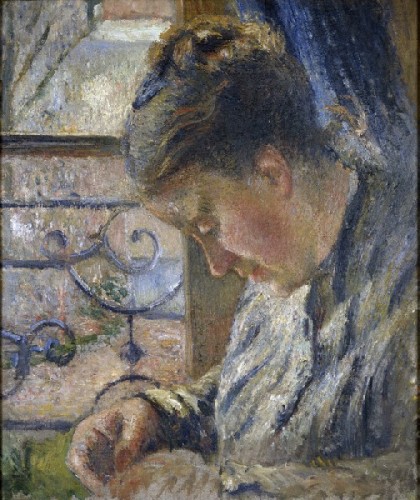
Camille Pissarro, Madame Pissarro Sewing, 1885

My grandpa’s mug is filled and he has seated himself back at the table. He nods along to my grandma’s words.

“Your grandpa was lucky – he married a smart one.”

I burst out laughing, and I can see a shadow of a smile on grandpa’s lips. But he nods.

“What! It’s true!” my grandma purses her lips. “I learned quickly. My mother raised me to be useful because my father died when I was thirteen. Women had work, but not all women did it. There were plenty of girls that just ran wild in the street, girls that didn’t even know how to hold a needle, but my mother wouldn’t let me become one of those girls.”

My grandma shakes her head sadly, as though I have just come in from running wild in the streets.

“If you weren’t married by 23, you were an old maid. No one wanted you then!”

Now it is my turn to give her a look.

“Well of course times are different now,” she says, “Back then you were defined by your marriage. If you look at me, you wouldn’t say I need a man.” She leans in close to me and lowers her voice, “Just between you and me, your strange egg grandpa would not last a week without me.” I turn to look at him, with his hands folded in his lap, his lips pursed. They would be pursed forever if it wasn’t for my grandma goading him to talk now and then. She leans back, content that I know who’s who in this relationship, then shrugs. “But that’s just how it was.”

“Women back then were different,” my grandpa says suddenly. He gives me a look and this time, smiles for real. I know he is thinking about me at family dinners, how my voice is the loudest. How I talk too fast. Say too much. Laugh too loud, and then says exactly what I expect him to say, “They didn’t talk so much, for one thing.”

My grandpa takes his blood pressure with his glasses on, recording the numbers in a little notebook. They seem wildly different from day to day, and I ask him how accurate the readings are. Not very he says, but continues to write down the numbers.

They are examining their medication cases, those long plastic bars that have a compartment for each day of the week.

My grandpa gives me a serious, thoughtful look.

What day is it?

Sunday.

Ah. I forgot to take these this morning.

My grandma roles her eyes. What else is new.

Ah well, he says, then motions for my grandmother’s arm. Let’s take your blood pressure. She lays it out on the table, one strong arm. Seventy years, I think. At least she must have made 400 hundred dumplings at least once a month. 4800 dumplings a year.

336,000 dumplings, just in the course of her marriage, not including when she wasn’t yet married and made dumplings for her own family.  

I write on my phone as the machine groans and squeezes my grandma’s arms.

146 over 56 my grandpa reads, and diligently writes it down next to his numbers. Blood pressure. Heart beats. Life in numbers listed on a clean white, lined square of paper.

Are you still writing your email? My grandpa asks me.

No no, I’m done with that. I’m writing about something else.

He nods. Someone in the family told him I like to write. He turns to my grandmother. Did you take your medicine?

I’m waiting for the water to cool.

On the screen, the actors wail. My grandpa turns back to watching Beijing opera just in time to see the actor with the long black beard disappear behind a curtain and emerge with a gray beard. My grandma asks him whats going on.

The man’s family was executed by the evil Emperor, and he too, is next on the list. He wants to escape, but cannot leave the palace. All the guards have their eyes on him and he has no way out. But he stays up the whole night fretting and his beard turns white from stress. The actor disappears again, and reemerges with a white beard. He laments his beard turning white, but knows it doesn’t matter, because he will die soon anyway. But the next morning, the executioner does not recognize him and he is able to escape with his life. The audience applauds wildly.

I don’t understand the opera, but with my grandpa’s translation, I can understand the relief the man with the white beard must feel. Or perhaps my grandma can better understand. Her face is bruised and battered, but she still has her strong arms, even her weak legs. She can still tell me stories and roll her eyes and call my grandfather a strange creature. 

It’s a nice story, sighs the strange creature with the strong heart. He sounds a little tired, but happy.

Edward Hopper Two Comedians, 1966 Oil on Canvas