Cheap Shot (and likely the first of many)

Something about my afternoon swim – a watery shadow of my former self? – prompted a desire to stroll down my writer’s memory lane. I promptly hauled myself out of the pool and still dripping wet, headed not for my diary cabinet (every writer’s got one) but for the computer in my brother’s room, which I have now re-purposed to no one’s knowledge as my “office.”

As though under a spell, I typed in the address to my very first blog, where I wrote as dharris, a name I crafted in two milliseconds by taking the first letter of ‘Demian’ (a Hesse novel I had bought at the library’s used books section for 25 cents but never read) and the last name of Thomas Harris, author of The Silence of the Lambs, with which, at one point I was obsessed. What was it I was looking for? What every writer looks for when he/she rereads old stuff she won’t toss (or hasn’t bothered to delete off cyberspace): clues from a younger self that explain or at least illuminate the present self.

Going the way of…oh wait. Gone.

According to my “stats,” I started the blog nearly nine years ago on November 3, 2002. Nine years! I wonder what it might have been (surely not pink!) had I stayed there, nursed my slender but steady following and continued to comment, as I did back then, on other peoples’ writing…

It was, in essence, not only the beginning of this blogger, but also the inception of this writer – or more accurately, this blogger who writes. Xanga gave me very first audience which in turn, gave me the high of knowing that people out there actually read my stuff. In that strange (non-pornographic) way we do in cyberspace, I made friends too – people whose faces will forever be a mystery but whose hearts I felt I knew, simply because they were shared on the same blogging platform.

 I constantly lament a feeling of anachronism. A secret admirer of Underwoods and florid handwriting in a time when ink is now digital and cursive is no longer taught in school, I always saw myself struggling against an impossible, unbeatable wave of technology.
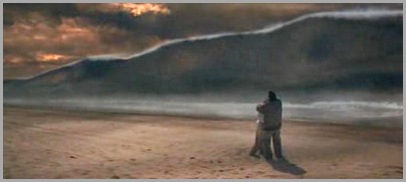
Screen shot from “Deep Impact.” Remember that scene?

My bosses joke about my nonexistent Excel skills and I watch in awe as my coworkers effortlessly create and alter things on Photoshop and make their own web pages and alter the layouts of their own blogs – all technologies that are above me. What happened to letters? What happened to paper? And pen? What happened to islands – what we all were, at least for part of the day, until email, AIM, Gchat, Facebook, twitter, and now goddamn Google+ (a cyberspace wasteland, in my opinion, until everyone moves there and I’m scratching my head in a facebook with no faces) lured and hooked us like drugs with twenty-four hour highs on the premise of being connected all the time because all connections were worth making – after all, behind every screen name is a real, three-dimensional face and behind it, a warm, beating heart. But is that true? Yes and no.

The truth is, I’m like this man – though under less vituperation because really, my decision to blog affects only me. I ought to practice what I preach, I ought to tune in completely – and by tune in, I mean, tune out the technologies I claim give me headaches and be monk-like in my affinity for writing on paper or writing for me and me alone – but that would just be damned ungrateful of me. I don’t philosophize that what’s in my diary cabinet is not writing (it’s not like that proverbial tree in the forest – what’s written is written, regardless of if it’s read widely) but I am also addicted – in a good way, as it keeps me writing – to the connectedness a blog offers. Blogging gave me an audience I otherwise would still be searching for via agents and publishers. Blogging convinced me that one need not write for money (though it would be nice) to earnestly and honestly consider oneself a writer. So to Xanga and Blogger for supporting my development as a writer and to all the other blogging platforms that support my favorite blogs, thank you.

———-

This post turned out to be rather long, considering it began as a re-posting of something I’d written years ago, on my old blog, because I was suffering from writer’s block. Oh well. That’s another thing about blogging – you sit down, meaning to write about one thing and then voila, something else entirely. I’ll post it anyway, for those who really fancy reading right now. But in the future, re-posting really will just be a re-posting of old posts from old blogs – just to remind myself of how far (or not very) I’ve come.

I wrote this four years ago, when I was still in JC hell (that’s Junior College, not the guy who saves people from Hell). I’m re-posting it sans any editing whatsoever (in fact, I think the title links back to the original). Let me know if you think me greatly improved. Don’t let me know if you sense this writer’s reached her peak.

to the university i (might not) go
It’s that time of year again, and no, I speak not of the holidays. Mostly, I’m not ready to speak of them yet. For one thing, the weather’s playing games, not being cold enough and taunting us with weak drizzles when really it should have rained. So blech to the holidays, and blech to the giant white elephant sitting on my brain – UC application…. round two.

Several days ago my brother wandered into my room to find me staring blankly at a screen otherwise blank save for the UC prompts assaulting my tired eyes with its cloyingly upbeat inquistion: tell us about a talent, accomplishment, achievement…blah blah blah. I looked up and gave him a woeful look: my life sucks. It reeks of sisyphean irony i haven’t the heart to appreciate and the only thing I have to look forward to is the act of turning it in. Even that “accomplishment” will be laced with doubt and fury – why the hell am i doing this year after year after year? I was THE girl who HATED college applications. hated them so much I applied to an expensive school on the other side of my known world, EARLY DECISION just so i’d know by december and be done with it. While my classmates ran around like wet chickens (I can’t stand to decapitate them) asking for recommendations and interviewing, I sat back in my chair and waited for my sure thing. A positive reply. It came. I went. I came back.

now i’m in my fourth year of these antics, and i feel like prometheus on the rock. i send in my application, they tear out my liver, only to have it grow back in the form of another semester at SCC. God help me if after spring I must spend another semester at SCC. I try to hang on to whatever levity I have and direct it towards my situation. Yes, i know there are starving kids being circled by vultures in africa. yes there are those people too poor to even consider a college education…..so yeah, I know these people exist and I know, (as you do too,) that this knowledge doesn’t make me feel better.

Thank God for my ability to see into the future. One evening in some distant holiday season, when i have grown hoary and brittle and settled into a staid existence somewhere in Vermont, I will look back on these past four years which have been characterized by their brimming with falsely enthusiastic college essays peppered with feigned passion for whatever (books, literature, writing, travel!!! I want to be a citizen of the world!!!) and say to myself, “Well, that sucked. But it’s snowing now and I’ve got a tree to decorate.” I’ll usher my grandkids, who most likely will be going through the same thing (or perhaps universities and higher education will be done away with by then and everyone will be educated in the same way: by reading The New Yorker and watching BBC Drama productions) and twisting their hair over harvard or yale (as you can see i’ve got big eyes for my posterity), into the living room where a big warm fire (burning on eco friendly fuel, of course) awaits along with their grandfather who at this moment, is a rather murky-faced man of questionable ethnicity (but seeing as it’s vermont he’s most likely white and related to John Irving).

“Were you really rejected to college three years in a row, grandma?” they’ll ask as we hang the neiman marcus special edition angels on the most prominent branches, “That’s an awful lotta times to be rejected.”

 I’ll smile and nod, and before reaching for another ornament, smack the child in the back of his head, “It’s true. But what’s also true is life is full of things you like and things you don’t. If you don’t like coal in your stocking, I suggest you shut up and finish hanging up these ornaments.”

I Agree Entirely. But stop? Never.

“I wonder, too, if this insistence on the improving qualities of our baptismal dips into the waters of literature does not blind us to the real thrill of reading; the recurrent reason why we come back for more, remember, quote, argue, share our experience of books? For me, reading needs to be justified not in terms of some notional moral benefit but – that more dangerous and enticing category – pleasure. I read because I love to read, because, in the company of a book, I am happy, engaged, and inexorable. This may well be bad for me, as selfish pursuits often are: taking me out of contact with my nearest and dearest, making me shirk obligations from washing up to keeping up. “I am reading! Leave me alone!” is the mantra of every true reader.

“Leave me alone. I’m trying to figure it out.”

 “So reading is an uncertain basis for the building of character. I am less ambivalent about writing. My writing, anyway. It has become increasingly clear to me over these last 10 years, in which I have written more regularly than before, that the more I write the worse I become. More self-absorbed, less sensitive to the needs of others, less flexible, more determined to say what I have to say, when I want and how I want, if I could only be left alone to figure it out.”

  – Rick Gekoski, “Writing is Bad For You”

Lucky

This morning, en route to work, I stopped as I usually did, several feet ahead of the Stop sign at the foot of my hill. A white Mercedes came cruising from the left and I paused, waiting anxiously for it to pass as I was already half an hour late for work. Through the windshield, I saw two elderly ladies with perfectly coiffed white hair. They smiled at me as they drove past.

“It must be nice to be retired and have nothing to worry about,” I thought. I stepped on the gas and nearly ran over a young female jogger that had come from my left.

I gasped, but not loudly enough to mask the “thump” of her hands on the hood of my car.

“Whoa! Whoa!” she called out, her expression both hostile and incredulous. She hopped backwards just as I placed the car in Park, and before I could open my door or even register the fact that I had just very narrowly missed handicapping her, she resumed her pace, raising her arms and shaking her head in disgust as she jogged away. I sat there for a while, dumbstruck, shaken, horrified.

Where was my mind? Where were my eyes? What was wrong with me?

Jokes of horrible Asian female drivers aside, I am a horrible driver, period. But also terribly lucky – and I say “terribly” because my luck has lent me a false sense of safety. I’ve always felt, smugly, that God, Karma, Fate, were all on my side and their collective protection allowed me to drive with my eyes closed if I wished.

Like most kids in California, I tested for my license at the age of fifteen. Within a few minutes of leaving the DMV, I ran a red light at a freeway intersection and was promptly failed. Disappointed, I didn’t notice that the woman administering the test had lost all color in her face and had pressed herself into her seat back, as though gearing for an asteroid shower, until I pulled us back into the DMV. When I got home, it made for a funny story, but it didn’t dawn on me until years later, when driving past a horrific accident at a similar intersection, the danger I had put us both in.

Soon after I got my license, I took my best friend Charlene and two of our favorite kids from our badminton club out to dinner in a neighboring town, which meant I would need to take the freeway. Their father trusted me, though mentioned before we headed out to “avoid the freeways if [I] was feeling unsure.” I waved away his concern, “Oh don’t worry, Mr. Shu,” I said breezily, “I’m a good driver.”

Years later, avoiding one of many close calls on the freeway with my brother in the passenger seat, my brother would calmly (with hands gripped tightly on the door handle) say to me, “You’re not a bad driver. But you have terrible judgment.”

And this has been my mistake from the very beginning. I mistake my acknowledgement of the rules – knowing when to brake, turn, speed up, slow down – for being a “good driver,” even though I often push those rules to the limit or, when I feel that no one is looking, disregard them altogether. Being a good driver is not only about knowing the mechanics of driving, but also about harboring the mentality of a good driver, in every sense of the word.

Is there such thing as moral driving? Yes. And for the longest time, I did not exercise it except to let people into my lane or by waving ‘thanks’ for the people who let me into theirs. That night so many years ago, I ushered three young, promise-filled lives into my father’s Landcruiser and attempted to get on the freeway. Except it was dark and the freeway signs had been knocked askew from another careless driver and by the time I read that “North” was actually “South,” I was already halfway on the on ramp. In a moment of panicked impatience, I swerved the car to the neighboring on ramp, misjudging the distance between my front right wheel and a center cement divider, though not soon enough – my right wheel struck, making a horrendous cracking noise, but I was on the right freeway. My heart stopped at the sound and for a minute I drove without breathing, wondering if I had damaged the car in anyway, but nothing seemed amiss and I let my breath go, driving at an easy pace towards the theater.

Two minutes later, Howard, who sat in the passenger seat said, “I think you popped your wheel.”

I gripped the steering wheel, slightly irritated that he would joke like that, “Shut up Howard. No I didn’t.”

“I think you did. I feel like this side of the car is sinking down.”

The four of us sat very still, praying that Howard was wrong, but even as I slowly lifted my foot off the pedal, there was an unmistakeable slant towards the front right. The tire was slowly letting out air, deflating with every rotation it made on the freeway and I did not know what to do.

“Stay calm,” Charlene said calmly from the backseat, the same time Howard began to say, “We’re going to die! We’re gonna dieeee!”

I wanted to slap him, but my hands were clenched to the wheel. I immediately thought of the worst case scenario, hours into the future, when I would have to call Mr. Shu and tell him that I had killed both his sons, and that inexplicably, I had survived unscathed. Suddenly the smell of burning rubber filled the car and in a panic, I sped up, forgetting all my common sense or the knowledge that cars had emergency lights and that freeways had shoulders for situations such as this. I could only think to get us off the freeway.

I’m certain that sparks were flying as the tire burned away like flesh from bone, leaving the rims to scrape against the asphalt. A horrific grating, clanking noise alternated with a ferocious whip-like crack as the tire’s remnants snapped in and around – I didn’t know what was going on with that front right wheel, to be honest, I only hoped that it wouldn’t catch fire or fall completely off. As I do when I drive, I placed trust not in myself, but in other drivers to steer clear of me. Perhaps I was screaming. Perhaps angry drivers honked at me. I heard nothing but the clanking and the snapping and my own thoughts, half begging myself to somehow get us off the freeway and half screaming that speeding up on a flat tire was akin to throwing gasoline on a raging fire. I prayed to the wheel: you can explode into smithereens if that’s how you want to end the night, just wait for us to get out of the car.

I peeled off and into, of all places, a Del Taco whose parking lot was littered with degenerate teen-aged boys on fixed-gear bikes. Their jaws dropped when they saw my car and one of them, balanced expertly on his bike as though in a photograph, said in a half-joking tone, “Uh, I think you’re missing a tire.”

Until then my heart had been racing, and still it pounded, but we were alive. At least the danger was over. I stepped out and went round to the right side – the tire was completely gone except for a tiny scrap of rubber that hung onto a ragged edge of rim, which itself looked as though it had been chewed by round the edges by a beast with diamond teeth. Even with my limited knowledge of cars and their parts, I assumed there was something wrong with the alignment – I looked up at the gleaming del Taco sign and around at the loose, carefree kids on their simple bikes, tires intact. There was no driving the Landcruiser that night.

My father is, when others are in distress, a remarkably calm man. He was at a dinner party that night and when I called to tell him the bad news – that I had mauled his favorite car and placed other people in considerable danger – he simply said, “Are you alright? Is everyone all right?” Yes and yes. I imagined him leaning back into his chair, “Good. Just leave the car there and tell Guh to pick you guys up.”

My brother, equally calm, came riding in like a heroic limo service and drove us to the movie theater where we managed to make it to the showing we’d planned on seeing.

Jack and Howard thought the whole episode hilarious, a story they looked forward to sharing with friends at school and Charlene shrugged, saying, “It could happen to anyone.” Even Mr. Shu had little to say in terms of chastisement.

“Didn’t I say to avoid the freeways,” he joked the next day at the badminton club, then, seeing the horrified look on my face, patted me on the back, “Oh don’t worry, you just need more practice.”

Now nine years later I have run countless red lights (though have only been ticketed for one), hit the side of a house so that the old lady living alone inside came out and said, clutching her heart, “I thought it was Armageddon!”), sped (and only been ticketed once), popped my tire twice on poorly executed right turns (endless thanks to my brother for his prompt and patient road-side assistance), scraped a half dozen parking-lot beams, broken our sprinkler system multiple times by backing out over the lawn (if my father knows, he has been uncharacteristically silent about this), run into my father’s parked car on the driveway, and now, bumped into a jogger in broad daylight on an otherwise none too busy street. My “luck” is still with me, but it’s wearing thin. So thin that I can see the other side, though the view is often marred by steel bars.

A jogger is not a lawn or beam or my father’s car, but a real-live human being with reflexes and emotions. With family and friends and goals, such as training for a marathon, which the jogger might have been doing and from which I might have taken her if I had stepped on the gas a bit sooner or panicked in another way and caused some wires in my brain to cross and recross. I thank her for slapping the hood of my car and for the daggers her eyes sent me. I needed that wake-up call. Driving, I was on the verge of forgetting, is a whole brain exercise. I’m going back to basics – looking both ways, putting my phone away and most importantly putting more trust and responsibility in myself to do the right thing and exercise judgment rather than rely on others to avoid me.

Swimming Pool

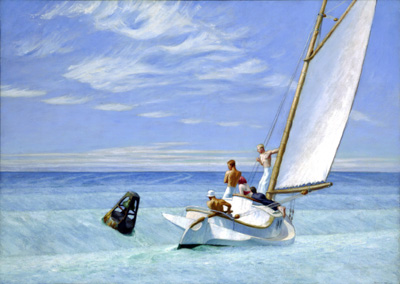
Ground Swell, Edward Hopper 1939. Until I get my skipper, I’m a swimmer .

I went swimming today a little past five thirty in the afternoon, not the optimal time for me, as the pool’s already half-covered by the shadow of our house. I prefer a fully sunlit pool, considering it an ideal form of multi-tasking: swimming and tanning at the same time.
Before, I would have passed on swimming in a half-sun pool. I swam more for the color it brought my skin rather than for any health benefits (and I’m more likely, I realize, to contract skin cancer than build stamina, gain strength and all that other good stuff. Swimming honestly just wipes me out afterward). But recently I’ve started to swim for a half hour or so every other day – it’s nothing so cheesy as “oh the water calls to me” – it’s just a small, backyard pool for crying out loud, not the Caribbean – but I’m learning to appreciate the quiet calm that comes from being alone underwater.

My cousins came over on the fourth of July to swim, though now that we are all older, there is much less swimming and more sitting up to our chests on the steps, talking about this and that. My cousin Daniel, now married and two months away from becoming a father, asked me if I’d ever let myself sink to the bottom like a corpse.

“Of course,” I said, “when you spend as much time alone in a backyard pool as I have, you’ve done the whole “I’m gonna pretend I’m dead,” sort of thing.”

“Yeah but did you do it right?”

“Like did I pretend to be dead in the right way?”

“Yeah. You have to exhale all the air out and just let your body sink to the bottom.”

I tried to recall my past “deaths” and realized that I had held my breath, puffing my cheeks out so that technically, I wasn’t being a very good dead person. My head floated, my toes always just lightly dragged against the pool bottom. No, I hadn’t been accurately portraying death.

Naturally a demonstration ensued and my cousin Daniel and I took turns sinking to the bottom of the pool, a la a man and woman who might have just been shot dead or perhaps strangled and then pushed into some warm, extremely clean and sterile pond. It amused me to see the sides of the pool rise up around me as I slid to the bottom, and despite the thoughts running through my head and the sensation of water enveloping my body, lifting the roots of my hair, I wondered if this heaviness was what made up the initial sensation of dying in water. Without the pain of drowning, of course. I attempted to stay down for as long as possible, until the burning sensation in my lungs, which radiated out through my eyes, reminded me that I was still a long long way from death, and I grappled at the walls of the pool to bring myself up. But I went down a twice more each time looking up to see the sun glinting across the ripples which in turn distorted the sky, the stalks of bamboo that leaned over the glass railing, and my cousin Kathryn’s figure, seated at the edge of the pool, a single leg swaying in the water. If I could, I’d ask Seurat and Hopper to “die” with me and have them collaborate on a painting.

Bathers Georges Seurat 1884

It could, I suppose, all be a grave and beautiful metaphor for something…though at this point, I’m not sure what. When Daniel and I tired of playing dead, we alternated between sitting on the ledge in the water and treading, talking about various people we read in the news who had died by drowning. There was a woman who had gone on vacation with her friends and died suddenly while in the pool. Correctly, she had sunk straight to the bottom. I’m guessing the pool was either not very clean, or of the black-bottomed variety with lots of foliage surrounding it, because her friends, failing to find her, surmised that she had gone home without them and left two days later, when her body was discovered by the people who looked after the pool.

I shuddered to think of all the poor souls who swam in that water with a dead woman. Our pool is much too small and open-faced for something like that to happen. Still, it has its dark areas, also known as the filter. My fondest memories of childhood involve summer afternoons, when school is just about to be let out and homework assignments are petering out. I’d go home, snack, fly through my homework (though in truth, I don’t remember doing much homework in elementary school, when my grades were at their worst of my entire academic career), labor through piano practice, and, when all that hodgepodge was done change like lightning into my flowery bathing suit and jump into the water, sometimes with my brother, who seemed to materialize at fun moments like this. This routine was much more rewarding on the weekends when my cousins would come over and we’d swim until the sun went down, but on weekdays, it was just me and my brother. One afternoon, I remember feeling lighter than usual – the burden of school and piano seemed so far away. Maybe school had already let out. Maybe I was leaving for Taiwan the next day. I don’t know. But the sky had never been bluer, the air never warmer, and the pool water never so perfect in its cool crispness – it’s a delicate balance between too cold and lukewarm bathwater.

Because it is hard to play water games with just two people, we swam laps, each starting from an opposite end and crossing in the middle. On the deep end however, my strokes caused me to turn my head to the right, where the small rectangular opening of the filter was. It was not a very high tech filter back then (not that it’s high-tech now, just less primitive), just a small, plastic flapping door that was designed to catch leaves and bugs, which would end up in a sieve that the pool man removed once a week. The flap opened just as I swam by and I could see something floating beyond it – a small white sack of some sort.

I doggy paddled to the flap and pushed it open. A thin, sliver of a tail came gliding out and then back in. I gasped, let go of the flap and jumped out of the water.

I called to my brother and stood at the small opening atop the filter, wondering if I wanted to see what lay beneath it. My brother came dripping to my side and after studying the lid of the filter, figured out how to open it. He removed it slowly, as though opening a gift from an relative with terrible taste. There it was – the dead rat, bloated to twice or three times its normal size floating atop the basket.

“Gross,” my brother said.

How long it had been there we didn’t know – not more than a week as the pool man came every Friday, but perhaps longer than four or five days, as all its fur was gone. But to where? I blanched, imagining dead rat hair clinging onto my skin and eyebrows and wondered if I ought to burn my suit and shave my head. It’s skin was now milky translucent and in death, had rounded into a fetal position, most likely how it had begun its life, and now exposed to the strong afternoon sun, rocked peacefully to and fro with the calm waves caused by the filter’s flap.

We weren’t brave enough to go back into the water, despite having already spent the better part of an hour swimming, nor did we have the stomach to remove the rat. Later that evening my father reached in with a plastic bag wrapped around his hand and tossed the rat into the garbage. He assured us that we had already swam in the water and were fine, so that by tomorrow, the water would be even cleaner, the contaminate thus removed.

“The filter will do its work,” he said, referring not to the plastic sieve but to the mysterious pipes that lay beneath the pool and were connected to the humming monstrosities in the side yard.  Years later I would see a dialysis machine in the hospital and think about our pool filters.

I don’t remember if I went swimming the next day, or the day after, but for a long time afterward I wouldn’t get into the water until I’d checked the filter and made sure there were only leaves or nothing inside. I wasn’t morbid enough then to think that I had spent an afternoon swimming with death – though small, a dead rat was death nonetheless (though this excludes bees and june bugs, which died in the water by the dozens) – but I was certain that I had no desire to be so close to it, in any incarnation.

July

IMG_0404

My grandfather was interred on a hillside in the outskirts of Taipei city on a muggy July afternoon. As tradition dictated, we turned our backs on his coffin as the gravediggers dropped him into the ground. There is nothing sinister about a man dying from old age, but there is too much mystery about death to take chances, so by turning away, we were protecting our spirits from following his into the grave. Continue reading “July”