Friday Morning Freewrite

I haven’t written on paper in a while. At work, when I take notes at meetings, my coworkers lean over and marvel at my penmanship.
   “Wow,” they say, “It’s like a font….like you typed it, but it’s like cursive.”
    Like a font! I thank them but what I really want to hear is, “Goodness you write like Queen Victoria!” (Once at an exhibit in London, I had seen her handwriting. It was gorgeous.)
    They don’t know how much my handwriting has deteriorated since its heydays – during my first semester at NYU and in my two years at Berkeley, when I wrote furiously in my journal and in letters to friends and family in other cities. Now I type and text. It’s not the same.
     In college, I developed the impractical habit of starting my essays longhand before typing them onto the computer. The other students wondered why I would do something so time-consuming and, in our day and age, anachronistic. And Berkeley, as a community, was actually quite conducive to this. I wandered from bookstore to bookstore, cafe to cafe, and often saw young men and women like myself, sitting cross-legged at wobbly cafe tables with a half-drunk latte and a Moleskine open to a middle page that was either filled with scratchy handwriting (very rarely, with my nose turned absurdly up would I ever see anyone with penmanship as nice as mine) or doodles or lyrics or whatever it was the young artist was working on. I too, have a Moleskin – though the cheaper, three volume paperback kind that is lighter to carry around, not that I ever do. I walked by these people with eyes both critical and congenial, after all, I was looking at like-minded souls who were also potential competitors.  

Ah. Another writer at work. I wonder if what he/she is writing is more profound/interesting/marketable than what I am writing?

     But generally I walked into these cafes with the express purpose to “study” and write essays for school, hardly ever to write for myself and as a result, I’m certain what these other aspiring Joyces and Faulkners were jotting down in their Moleskines was far more interesting than what I was writing on my yellow legal pads, my medium of choice for school essays.
      There is something about writing in cursive that is akin to rolling down a grassy knoll. This is the momentum I relied upon when writing essays for school. On the computer, the words did not pour forth as easily if at all and I often sat for hours in front of a blank screen (intermittently populated by Facebook, the NYTimes, horoscopes, crosswords, etc.) typing and deleting and typing the same opening paragraph in varied syntax. All students know this feeling: the worst kind of constipation. It is knowing that you really do need to pull something out of your ass by a certain time lest the university becomes a bathroom stall you can never leave.
        I forget the paper, there were so many, but for one paper I had an early spark of inspiration and as my computer was not with me, I reached for a legal pad and jotted down the introduction I had in mind. Some fool told me a while ago that once you have your thesis down, it’s all easy as pie from there. Well, I often have my thesis – otherwise how do you even set out to do your research? – but rather than feeling like I’m rolling down a grassy knoll afterward, collecting body paragraphs and whatnot, I usually felt as though I stepped off a cliff. It is difficult to write when your ideas lay shattered at the foot of a cliff.  Anyway, I wrote the thesis down on the yellow legal pad and almost automatically, my hand shifted to start a new paragraph and for a split second it was as though I were watching someone else’s hand at work – someone whose brain was clearer and more organized regarding the subject matter at hand. She took the pen and directed it a dozen or so lines further and voila, paragraph two emerged. This sensation was entirely new to me: how could I have written two paragraphs in such a short time?
       I recall looking up and around at the cafe folk around me, wondering if anyone else had seen the miracle just performed on my yellow legal pad, but of course no one was paying attention. It didn’t matter. I ducked my head down and let the cursive work its magic. In this way I transferred the momentum felt when writing a particularly satisfying diary entry into my schoolwork and from then on, began my school essays thus.

   Now though, more and more I am neglecting the paper. Saving trees, sure, but what about my “craft?” Not the content itself but the writing – the actual act of putting pen to paper and watching the ink…(“bleed” is such a violent, messy word)…flow from the tip of a particularly smooth rolling pen? In my two years at Berkeley, I tried, unsuccessfully, to woo my lovely professor with my handwriting. I didn’t write him love letters, no (though perhaps I ought to have), but I did write him a Christmas card or two, and little missives here… his own writing was abominable, the very reason why I went to his office hours in the first place, because I could not read his writing. And it was in the quiet moments of deciphering what he had written, both of us leaning over my papers (“I think that says…well, I’m just not sure. Ha ha.”) that I fell in love, a minor case of savior complex rearing its head. I felt I could fill in some gap of his – as though messy handwriting was a case of mild cancer and me, with my polished J’s and Y’s and flourished G’s, could waltz in like Florence Nightingale (who also wielded a glorious pen) and save the day.

But mostly, I blog. I’m no calligrapher, and I’m sure if Queen Victoria were to rise from her grave and peer over my shoulder one cold, rainy night as I write in my diary, she’d probably sneer and say, crisply, “My dear, you have a long ways to go before that pen of yours produces something truly beautiful.” We shall see, won’t we?
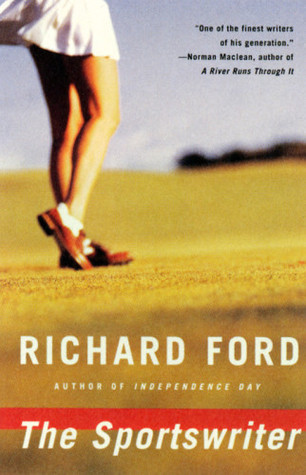
Some People Do It Better: Richard Ford

Finished The Sportswriter . It’s been a while since I’ve read a novel, I felt, that so clearly sums up what I’ve always suspected. I’m not a man, not a sportswriter, have never lost a child nor been divorced and I hope to God I never will – but Bascombe and I – is this the writer’s connection? – definitely see eye to eye on many things. Maybe it has something to do with where you are in life – I’m 25, 15 years younger than Frank Bascombe’s 40, but isn’t it a fact of life that women reach these conclusions much earlier than men do, and even if men get there first, they don’t really know they’ve arrived until someone (usually a woman) points it out to them. This seems to be the case for Bascombe, even though he doesn’t say, or refuses to.

I’ve put the book down on my reread list. I’ll pick it up again when I’m forty to see if I still agree. I have a hunch I will. Someone less careful would write it off as cynicism: “Bascombe thinks like this because he’s divorced, can’t find love, has lost a son, is not passionate about his job…” Regardless, he sees life lived, he wonders, is amazed in an understated way people generally wouldn’t categorize as such. But even if my lips are pursed and my eyes seem unfocused, I’m still awed by the sheer force of life. Where it does and does not take us.

Why I love airports, hotels, traveling:

“It is not bad to sit in some placeless dark and watch commuters step off into splashy car lights, striding toward the promise of bounteous hugs, cool wall-papered rooms, drinks mixed, ice in the bucket, a newspaper, a long undisturbed evening of national news and sleep. I began coming here soon after my divorce to watch people I knew come home from Gotham, watch them be met, hugged, kissed, patted, assisted with luggage, then driven away in cars. And you might believe I was envious, or heartsick, or angling some way to feel wronged. But I fount it one of the most hopeful and worthwhile things, and after a time, when the train had gone and the station was empty again and the taxis had drifted back up to the center of town, I went home to bed almost always in rising spirits. To take pleasure in the consolations of others, even the small ones, is possible. And more than that: it sometimes becomes damned necessary when enough of the chips are down. It takes a depth of character as noble and enduring as willingness to come off the bench to play a great game knowing full well that you’ll never be a regular; or as one who chooses not to hop into bed with your best friend’s beautiful wife.

Why I’m being open about many things, most prominently: the job hunt and members of the opposite sex. 

“…I enjoy this closeness to the trains and the great moment they exude, their implacable hissing noise and purpose. I read somewhere it is psychologically beneficial to stand near things greater and more powerful than you yourself, so as to dwarf yourself (and your piddlyass bothers) by comparison. To do so, the writer said, released the spirit from its everyday moorings, and accounted for why Montanans and Sherpas , who live near daunting mountains, aren’t much at complaining or nettlesome introspection… All alone now beside the humming train cars, I actually do feel my moorings slacken, and I will say it again, perhaps for the last time: there is mystery everywhere, even in a vulgar, urine scented, suburban depot such as this. You have only to let yourself in for it. You can never know what’s coming next. Always there is the chance it will be – miraculous to say – something you want.

Lastly. 

“As I’ve said, life has only one certain closure. It is possible to love someone, and no one else, and still not live that person or even see her. Anything or anyone else who says different is a liar or a sentimentalist or worse. It is possible to be married, to divorce, then to come back together with a whole new set of understandings that you’d never have liked or even understood before in your earlier life, but that to your surprise now seems absolutely perfect. The only truth that can never be a lie, let me tell you, is life itself – the thing that happens.”

Until 40, Mr. Bascombe. (Though I’ll likely read the other two books in the trilogy before then).

Father’s Day

Yesterday afternoon it occurred to me that I am often rude to my father. To anyone who has seen me speak to my father, this is old news. Sometime after my 19th birthday I gained a false confidence that allowed me to bite – not always back, but just bite. It was always there, brewing. My mother always said, “We could never control you. We could never tell you to do anything you didn’t want to do.” And it was true. I have always thought, “What do they know?”  They mostly being my father.

As a child, I would wait at home for my father to bring me books from the library, where he’d stop by on his way home from work and pick out a few picture books for me to read. He reads. I read. He is where I get it from. I got older and started to check out books for myself, rolling down literary hills like the proverbial stone, gathering moss until one day it seemed my tastes would never change. I was stuck in fiction while my father hoped, what with all our magazine subscriptions and shelves filled with reference, history and business books, that I’d transition my tastes to non-fiction. Useful stuff.

“There’s little to be gained from reading fiction,” he would say, “Or at least low-quality fiction.” And perhaps it started then, perhaps it didn’t – but I began to suspect at some point that my father did not and would not understand me. Ever. I admit for many years I read low quality fiction. And while I falsely considered myself a reader from a young age only because someone had pointed out to me in middle school that I always seemed to have a book in hand, it wasn’t until I met other, truer readers – boys and girls whose reading levels seemed years ahead of mine and whose favorite authors wrote single novels about extremely well-developed individuals rather than a series involving a boy named Leroy aka Encyclopedia Brown or soulless novels with gruesome covers that ultimately disappointed in the end (Christopher Pike, anyone?) – that I realized where the really good reading was.

He reads no fiction now, preferring history and finance books on Sunday afternoons, but my father is extremely well-read in classic Chinese literature. Fiction, yes, but vastly different from the emotive, English literature I prefer. Or so I’ve heard. I won’t knock it until I’ve tried it, but this is more than my father is capable of. He sees my novels and glossy fashion magazines and wonders (sometimes correctly, oftentimes not so much) that my brain is all fiction and fashion and frilly.

Misunderstanding breeds contempt, and while my father can never harbor contempt for me, I let my contempt for him grow because I did not – do not- understand how he cannot understand me. It is always a shame when your child is someone you cannot get along with, but my father is blind to this. He likely thinks we have a wonderful relationship, filled with smiles and laughter and understanding – and to a certain extent, in small doses, thirty-minute intervals (or however long it takes to eat dinner), we do. I admire my father for many things: he is calm under pressure, he is knowledgeable, he is organized, a good cook, generous, kind – he is all these things and many more wonderful things. But he is also loud, obnoxious, self-involved, a poor-listener, humorous in a way I find contemptuous rather than truly funny, and alarmingly narrow-minded at times (“No one will read your blog,” he has said, “If you only write about personal things.” Oh father, I beg to differ.)

In college, I began to expand my reading tastes. Thanks to the likes of Jon Krakauer, Russell Baker and Erik Larson, I learned that non-fiction can be just as fascinating as fiction if not more so, as it was real. I ate up biographies, social studies, and eventually opened myself to business books – or at least books that seemed more business like. In the back of my head, I thought perhaps it would give me more to talk about with my dad, but (and this may seem small, but day after day it can become exhausting) he is always more interested in showing what he knows and testing to see if you know it to, in which case, if you don’t, you’re in for an irritating session of “How can you not know this?”

It is not a fun game, especially if one has as much pride as I do.

So my contempt. What is it made of? One part exhaustion – frankly, I am tired of my father. We do better when I am far away. One part empathy: he has none, so I make up for it. Who knows whether it is actual strength or a missing link, a gaping hole in his emotional makeup; I have a hunch however, that it is a enigmatic mixture of the two. No one, and I mean NO ONE, has ever seen him cry. When my grandfather died, he merely smiled and patted my sobbing cousins on the back. “It’s the way of life,” he said. When his mother passed away some forty years ago, he paid his respects and then called my mother, whom his mother extremely disliked. “My mother’s dead,” he said, though perhaps a bit more eloquently, “Let’s get married.”

He is a thinker, but in the most pragmatic way. I am a thinker too, but in the most useless, ineffective way. He sleeps anywhere, without issue. I can no longer sleep. He is a businessman. I like to write personal essays on a blog. All these things caused our personalities to butt heads, but now as I get older, I see that I’m the only one butting.

My father tries now, to accommodate me in every which way. And this is where his vulnerability lies: he does not want his children to be very far away, except that my brother has already flown the coop and may never come back in the way that he came back, just a year ago. And while I’m nowhere near financially ready, my father can probably sense that my feet are itching to go. He does not mean to smother, and honestly I cannot say that he does, but my irritation with him, my narrowed eyes and sullen face and one-word monotone responses that too soon give rise to sharp, ungrateful tones and sarcasm smother our relationship and threaten to unravel an already thin string.

But this Father’s Day, I recognize it is I who needs to change. Not my dad, whom I thought was set in his ways and incapable of change, but me, a kind, happy girl to anyone else but to her own father, who can’t cry or hug or listen or understand, but who loves.

Home 3

I helped my brother pack. My father hunted high and low for a matching set of suitcases as a sort of farewell present for my brother – while many things, my father is not a good communicator of things emotional and this was his way of saying, “Travel well, my son.” I emptied out my brother’s closet, carefully rolling his shirts and pants into neat piles, making sure to leave room for ties, underwear, hats, shoes. His life didn’t fit as neatly as anticipated into two suitcases, but most of it did – we zipped them up and set them upright, marveling that these awkward twins on his bedroom floor could hold so much and still so little. We dragged them out to the car along with a large cardboard box filled with office supplies. I was sure it would be cheaper to buy supplies in China, but my brother insisted he would rather just take them to spare himself the hassle of finding an office supply store in labyrinthine Shanghai. “Good point,” I said. Though really I wondered if any of those items he packed had some sort of sentimental value. Could a stapler, a tape dispenser, a few pens and notepads remind him of home? But perhaps not. For the most part, he wanted to travel light. He left behind quite a few clothes, along with most of his books, golf clubs, and shoes, and I, a closet clotheshorse (no pun intended), admired his relative indifference to leaving these items behind.
“I’ll come back,” he said, “So you better not donate anything.” 
I gave him my solemn promise.
And just like that, he was gone.
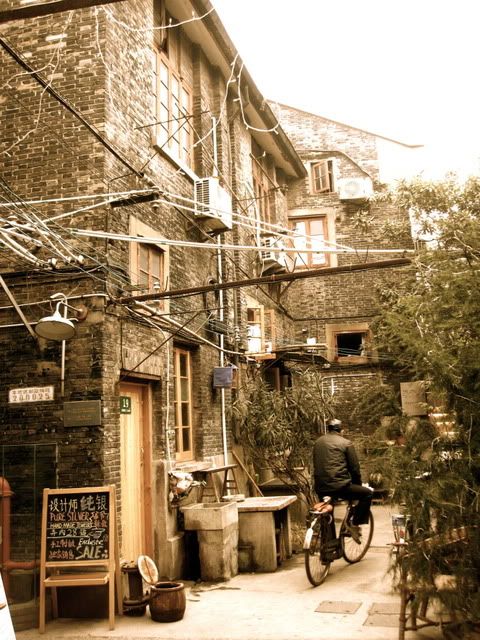
Shortly thereafter I disappeared to Taiwan for two months, and my parents reverted back to the quiet life they’d lived while we were away at school. In Asia, I visited my brother in Shanghai and realized that while he had barely unpacked, he had, in his heart, settled in just as hardily into our family’s condo just as he had done in Podunk. My uncle bought the condo in Shanghai some ten years ago, predicting he’d need a home base for his frequent visits when business was good. Business turned out to be okay, but the condo was frequently visited by family and friends who stopped by for weekend shopping trips or expos – I had stayed there once in the winter and once in the summer, and found the condo’s location to be its only draw. Located on the twelfth floor of a tall building (which in its heyday was THE address to have on that street), we had a wonderful view of the city and a short walk (by Shanghai standards) to the nearest metro. Behind us, a fancy theater was being built, designed in that new architectural style that likens buildings to eggs and nests. We were on a street nicknamed Bar Street, once rival to Hong Kong’s Lan Kwai Fong – at least in terms of noise –but was now a quieter place for expats and locals to gather. No matter how a man may boast of knowing Shanghai, no one can ever truly grasp its center.
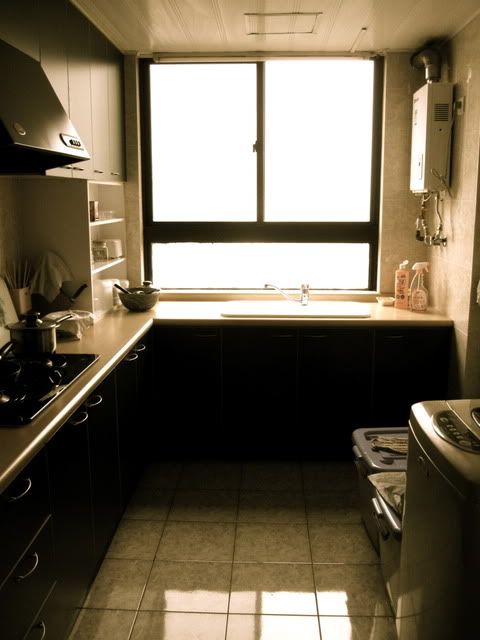
My uncle had furnished the condo cheaply and on the fly, with matching, dark furniture in every room that ate up the sunlight and horribly mismatched drapes and bedspreads, most of which I suspected were gifts from relatives who wanted new drapes and bedspreads in their own homes. The kitchen was sparse, sporting only a few warped pots and pans and a paper cup that held disposable chopsticks. A broken hot water boiler sat collecting dust in one corner and holey, threadbare rags hung from a railing along the wall. There were two bathrooms, but one lacked a shower curtain.
“Yeah, I need to get one,” my brother said. I nodded, examining the dingy pink tiles and the yellow lighting. The fixtures depressed me. The place was cleaned everyday, so cheap is that sort of labor in China, but you can’t wash away bad taste – or age. But my brother, a man of simple tastes, was oblivious to all this.
“I suppose I’ll change it someday,” he said, zero intention behind his words, “but it’s pretty good for now.”
I thought about our home in California, and wondered if my brother still considered it thus. We had hugged and cried at the airport, but it had nothing to do with the actual house he was leaving, just the people inside. But had it been me departing, I would have cried just as heartily for my pink room, my books, my small but adequate closet, my bright, gleaming bathroom. I thought of my brother’s new old living quarters: this is not a home.
And yet.
I watched my brother move around the house in the comfortable way an actor moves around a set after a few weeks of filming – humans, we learn fast, adapt easily, don’t we? He worked at the dining table, which he converted into his workspace. Using water he bought on a weekly basis from the dingy convenient store downstairs, he poured hot tea in the kitchen always standing in the same spot, slightly to the left of the water boiler, and left his dirty dishes in the sink with the confidence of a man with a maid, who also washed his clothes and hung them up on the balcony to dry so that at night, my brother could bring them in if he felt like it. In the mornings, I wasn’t fully awake, but heard the beats – seamless sounds – of him readying for work, and those same beats in descending order (thump, thump of shoes being cast off, the jingle of keys, the creak of the doorknob) of his homecoming in the evenings. As a guest, I could imagine his life in the apartment without me – those same sounds, only perhaps the sound of my voice replaced by the sound of strange Chinese sitcoms complete with laugh track, or perhaps no voice at all but the sound of his fingers upon computer keys, another late with MS Excel. He slept well, ate well (by his standards, anyway) and while he spent most of his time at the office or at bars with friends, the condo was home in every sense that it could be, to a young man living in Shanghai in 2011.
Two months later I was back in the U.S. with my parents, in my room, throwing myself into working life, creating a routine that involved hot yoga, friends, and family. I had moved the coats to my brother’s closet to let my other clothes breathe a bit and wondered what he would say when he came back and discovered my little transgression.          
Very little, it turns out. On Memorial Day weekend my brother materialized at LAX with the express purpose of attending his best friend’s wedding. I picked him up, a huge American smile on my face, not really grasping how much I missed him until he was sitting in the seat beside me. Oh brother, where hath thou been?
“Man I missed it here,” he said. I sped down the 105, the LA skyline whizzing past, knowing that compared to Shanghai’s architectural beasts and beauties, LA seemed like the outline of a village. Soon LA disappeared altogether and we were in the quiet, tree-lined roads of our small town, driving past our middle and high schools like two visitors cruising down the proverbial memory lane.
At home he unpacked while I blathered on about dating, friends, family and hot yoga. A good brother, he nodded and smiled, moving a bit awkwardly around his bed and the lone suitcase, having left its twin in Shanghai, trying to figure out where to put everything. I wondered if he would want me to move my coats for the time being so he could hang his suit up for the wedding. He must have, at some point, noticed my coats in his closet – but he said nothing, nothing at all and instead hung his suit up in the bathroom on the hook behind the door. I found it there the next morning, slightly irritated that he had removed my robe to hang his suit there, then ashamed that this was the only space he could find.
The weekend flew by – the wedding passed, then Memorial Day, then Tuesday, Wednesday and finally, Thursday, the day of his departure. On Tuesday night we had gone out to dinner and he had said, suddenly, “I sort of miss Shanghai.” I realized then where his life was. Or more accurately, I learned how differently we, though siblings with a close emotional core, defined essential terms. He carried home in his heart, his being large enough to grasp it completely while I simply lived at home, it being a space to hold my heart until I moved on into the next. Is this the difference between people who are truly hardy and those who are only reluctantly so? My brother lived happily in Podunk, Pennsylvania and I only half-heartedly in Berkeley, New York, and Taipei. Space was merely space to him, a place a place. He possesses the only center he needs while I search for material, tangible tethers. World traveler, some people call me, but they don’t know the divided nature of my traveling. Abroad, I long to be home; at home, I long to be abroad.
On Thursday morning my brother woke up at six am to hug me goodbye. I was leaving for work, but something about the light, the time, reminded me of the morning he left for Podunk. That summer dawn, he had knocked softly on my door and whispered, “Betty, I’m leaving.” I started crying almost immediately, knowing not how our relationship would change, only that I would miss him terribly.

Now two years later he had left and come back again and again, with each departure feeling more and more final. And he was now leaving again. I hugged him tight, knowing that I would see him at holidays and on my own future visits to Asia, but that by then he would be at the door of or perhaps fully enveloped by his other life, just as my mother and father had been some thirty years ago, when they met and married and left childhood and childhood homes behind. But I do not dread this, this inevitable progression of life – we branch out, move out, move in, move on. My coats would stay in his closet and my brother would stay in Shanghai, for the time being, and then wherever he chooses to settle next. But we, regardless of where we are, remain close. Places, things, tethers – I’m beginning to learn they were always beside the point.

Home

Once, walking by my mother’s room and seeing her settling down for bed, it occurred to me that this had not always been her bed, this room, her room. She lay down on the right side – had she always slept on the right side? – and turned her face towards the lamp, preparing to read herself to sleep.
“When did you start to see this as your home?” I asked, standing in the doorway.
She looked up, the pillowcase hiding half her cheek, “What do you mean? I have never not seen it as my home.”
“No, I mean, when did you…” I faltered, wondering how to phrase the question. I used myself as an example.
“I’m home right now, right? This is my home.”
My mother nodded.
“But you once had a childhood home like this too. When did you feel like your childhood home was no longer your home?”
Edward Hopper, Cape Cod Morning, 1950 

My mother paused for a minute, fingers lightly holding the thin book she had been reading, “I guess when I got married. I lived with your grandparents until then.”

“Was it a strange transition?”
“No, not really.”
“You marry someone and move out, move in, and it’s home? Automatically?”
“It ought to be, but it’s different for everyone. Why?”
I shrugged, not knowing why I was asking except that I had, in that instance, caught a glimpse of my mother as someone younger, without husband and children, living in another house, sleeping in another bed.
  <!– /* Style Definitions */ p.MsoNormal, li.MsoNormal, div.MsoNormal {mso-style-parent:""; margin:0in; margin-bottom:.0001pt; mso-pagination:widow-orphan; font-size:12.0pt; font-family:"Times New Roman"; mso-fareast-font-family:"Times New Roman"; mso-bidi-font-family:"Times New Roman";} @page Section1 {size:8.5in 11.0in; margin:1.0in 1.25in 1.0in 1.25in; mso-header-margin:.5in; mso-footer-margin:.5in; mso-paper-source:0;} div.Section1 {page:Section1;}

–>

Five years ago, my father caved in to the leaky faucets, peeling wallpaper and yellowing fluorescent light covers of our house and announced that he would renovate. Among the things that I pushed for (including a ten-foot kitchen expansion and an entire second story with a game room) was my own bathroom, preferably en suite, and a walk-in closet, every girl’s dream. My father was receptive at first, nodding and taking notes to pass onto a Japanese architect with a fancy pedigree who came back with thousand dollar drawings of my dream house. But on the third or fourth floor plan, my father came to his senses. Among the things that my father actually implemented in the renovation: none of the above. I argued with him for a whole day, though knowing in the back of my head that he was right.
   “Why would I turn it into a two-story house,” he protested, “when you and your brother are about to move out?” 
    He painted a picture of life a few years down the road when the house would be home to just him and my mother, an aging couple with separate but faintly overlapping spheres: my mother’s being the backyard where her orchids and African violets threatened to overtake the lawn, and the dining room, where her Chinese school textbooks and papers had already smothered the smooth wood of our long table. My father’s territories included the living room couch where he often fell asleep in front of Jim Cramer and other Wall Street types and the small round wooden table to the right, where his computer sat and from where he generously doled out more spam than necessary. The kitchen was shared between the two of them, though more and more becoming my father’s territory as he neared retirement and discovered a passion for cooking and entertaining.
In my father’s vision, I saw my brother’s and my bedrooms, shuttered and empty, void of life except for a past life, embalmed in our childhood knickknacks, items that never made it to our new homes, shared with new people. The most recent thing among these relics would be the odd piece of mail that my father would inevitably bring in. Like a lonely mailman on the edge of retirement, he would come down our hallway every so often to set these envelopes upon our dusty desks, wondering when we’d swing by for dinner and pick up the mail. It was a cold, almost cruel image, one that would be realized, soon enough, and vividly so that I did not need to remind my father.
In a sort of compromise, it was decided that my brother and I would move out to a relatively new apartment complex in Irvine while the house was stripped down. My parents would hold down the fort until the renovations crept up to their side of the house, upon which they would then relocate to an Extended Stay on the outskirts of town. My brother and I rented a beige two bedroom in a beige complex behind a beige and purple shopping area. I took the master bedroom, which had an en suite bathroom and a walk-in closet that was sadly, larger than my parents’ at home. We would bring the old furniture from our rooms for our apartment and when the year was up and our house was done, we’d sell it and buy new pieces for our refurbished rooms.
On moving day my brother recruited several of his strongest friends to help us move into the apartment – we worked swiftly and within a few hours our childhood rooms stood empty with compressed patches of carpet lining the ground, where the furniture had been. Here had been my bed. Here had been my desk. Here had been my bookshelf. Only flat circles and rectangles remained from that former life. In the corners, corpses of unfortunate bugs had gathered, my ex roommates. As my brother and his friends drove off to our new apartment, I stayed behind for a while, tying up loose odds and ends, squeezing my belongings into the car. Our apartment was only fifteen minutes away, but it seemed much further than that, now that our rooms were empty. I returned to my room one last time, wondering if I’d miss the flowery wallpaper and matching drapes, adornments chosen by the elderly white couple who had lived there before us.
It was late afternoon as I walked back towards my room. I heard the familiar whirr of our old Kenmore vacuum cleaner, but aside from that, the house was strangely quiet. My mother was teaching Chinese school. I followed the whirr to my room, where I saw my father my father standing in the middle, vacuuming up the dead bugs on the compressed carpet. It clenched my heart, that sight. We were leaving only temporarily, but it was a preliminary stage to something absolutely necessary – my father knew it too. I stopped in the doorway, observing my father move as the afternoon sun danced around him. He did not see me and was framed by the squares of my old window, the view from which he often used to remark upon: “It’s quite nice, isn’t it?” Now he was no longer looking out the window for I was not there to enjoy it with him, not there to receive the old remark. Rather, he moved his arm back and forth with a mute, methodical sadness, stared intently down at the carpet, the fibers of which hinted faintly, only faintly, at his daughter’s footsteps.